
Can You Still Get Long-Term Care Insurance After Age 60?
One of the most common questions we hear from adults approaching retirement is simple and urgent: “Can I still get long-term care insurance after I turn 60?” The short answer is yes. The more complete answer is yes — but timing, health, and structure matter more than ever once you enter your 60s. Long-term care insurance is not automatically unavailable after age 60, and many individuals in their early and mid-60s qualify for meaningful coverage. However, underwriting becomes more selective, pricing increases with age, and available policy designs begin to narrow. The key difference between planning at 52 and planning at 62 is leverage. The difference between 62 and 72 can be insurability itself.

Your 60s are often the decade when retirement transitions from theory to reality. Income streams become fixed. Portfolios shift from accumulation to distribution. Risk tolerance changes. At the same time, health conditions that were once mild or nonexistent begin to surface more frequently. High blood pressure, controlled diabetes, joint replacements, cardiac procedures, and mobility limitations become more common. Insurers evaluate these factors carefully. If you’re unsure how medical history affects eligibility, it may help to review underwriting discussions similar to those outlined in Life Insurance With Pre-Existing Conditions. While life and long-term care underwriting differ in certain respects, both evaluate stability, management, and overall functional independence. The earlier you explore your options, the more carriers are willing to compete for your business.
Request Your Long-Term Care Insurance Review
Learn which long-term care options you still qualify for and compare traditional and hybrid (asset-based) plans side-by-side.
Understanding how insurers determine eligibility is critical after age 60. Long-term care policies are primarily concerned with functional capacity. Carriers want to know whether you are fully independent and whether you require assistance with any Activities of Daily Living (ADLs). These six measures — bathing, dressing, eating, toileting, transferring, and continence — form the backbone of both underwriting and future claims eligibility. If you are managing your daily routines without assistance and have not required home health services, physical therapy due to decline, or cognitive supervision, you may still qualify with competitive carriers. Stability is often more important than perfection. Controlled conditions with predictable medication regimens are frequently insurable. Progressive neurological diagnoses, recent falls, memory impairment, or pending surgeries introduce more complexity.
Why does this matter so much in your 60s? Because this is the decade when the long-term care risk begins to feel real. Parents may have required memory care. Friends may have entered assisted living. You may have already experienced caregiving responsibilities firsthand. Long-term care is not limited to nursing homes. It includes in-home assistance, adult day programs, assisted living communities, memory care units, and skilled nursing facilities. To better understand the care spectrum, it can be helpful to review how in-home care services compare to structured residential settings such as assisted living communities and skilled nursing facilities. Costs vary widely depending on geography and intensity of care, but even moderate part-time home assistance can exceed tens of thousands annually, and full-time care often surpasses six figures per year.
A major misconception that leads many people to delay planning is the belief that Medicare will absorb most long-term care costs. Medicare may cover short-term skilled rehabilitation after hospitalization, but it does not pay for extended custodial care. Bathing assistance, supervision due to dementia, help with dressing, and long-term residential support are not Medicare benefits. If you are unclear on the distinction, reviewing Does Medicare Cover Long-Term Care? can clarify what is and is not included. For a broader side-by-side breakdown, Are Medicare and Long-Term Care Insurance the Same? explains the structural differences between public health coverage and private long-term care protection.
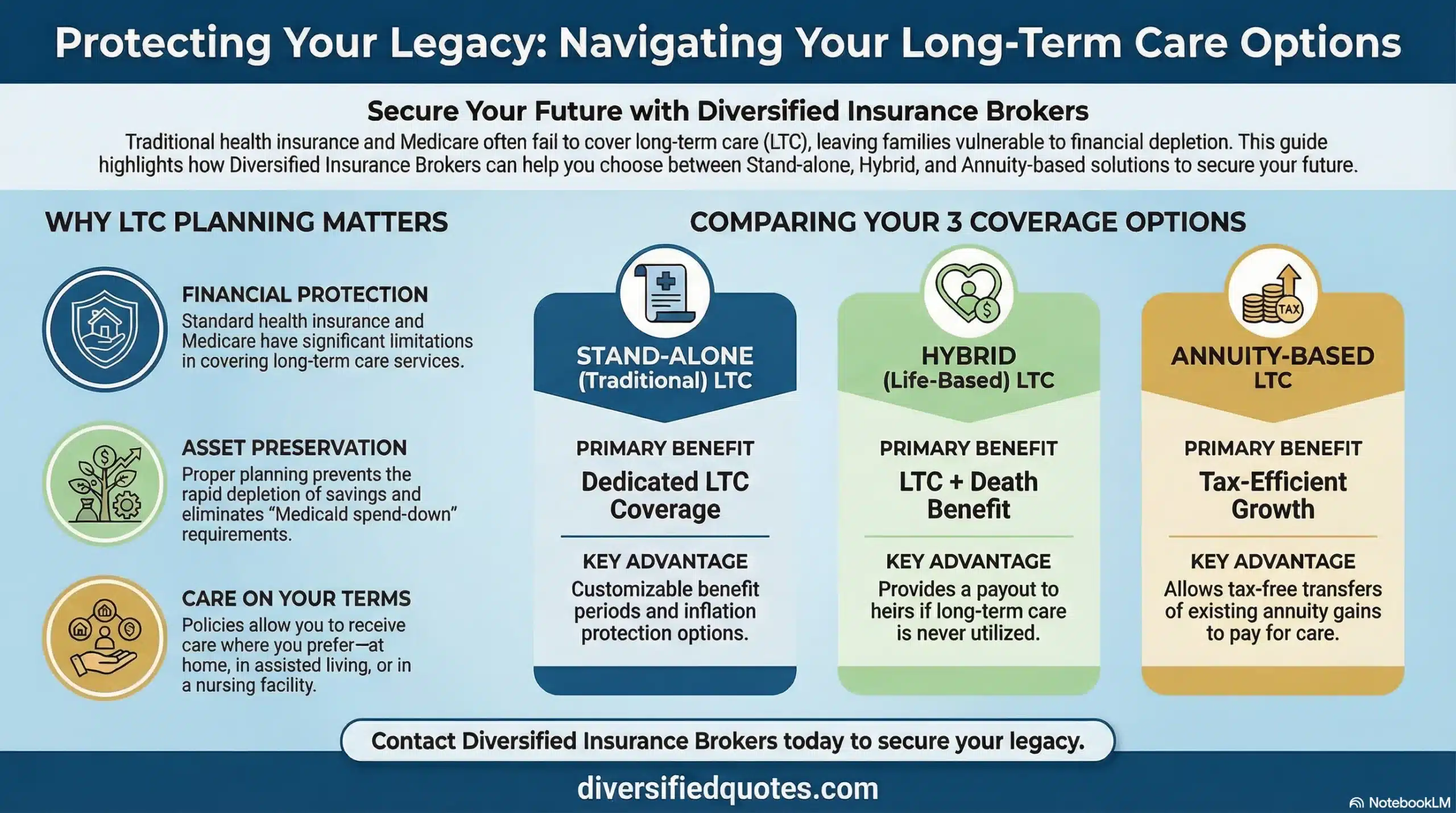
After 60, most applicants will evaluate two primary categories of coverage: traditional long-term care insurance and hybrid or asset-based long-term care solutions. Traditional policies are designed solely to pay for qualifying care services. If you become unable to perform two ADLs or experience cognitive impairment, the policy pays a daily or monthly benefit for home care, assisted living, memory care, or nursing facilities. These policies often provide the highest leverage per premium dollar, especially when purchased earlier in the decade. However, they are “use it or lose it” designs, meaning if care is never needed, no benefit is paid.
Hybrid long-term care solutions, by contrast, combine long-term care benefits with either life insurance or annuity components. If care is needed, the policy provides leveraged long-term care benefits. If care is never needed, a death benefit or retained cash value remains. This structure appeals to many individuals in their 60s who are uncomfortable paying indefinite premiums without a guaranteed return component. For a deeper understanding of annuity-based structures, our page on Non-Qualified Long-Term Care Annuities explains how existing assets can sometimes be repositioned to create tax-advantaged care benefits.
Couples often explore shared benefit structures to maximize flexibility. With Long-Term Care Insurance With Shared Benefits, one spouse can draw from a combined pool of coverage, reducing the risk that one partner exhausts benefits while the other remains unused. These designs can be especially valuable when health histories differ between spouses. In some cases, adding a Return of Premium rider provides additional estate protection, ensuring beneficiaries receive value if coverage is never triggered.
Funding strategies in your 60s are also more diverse than many people realize. Some individuals choose ongoing annual premiums for traditional coverage. Others prefer limited-pay structures — such as 10-pay or single-premium hybrids — to eliminate future payment obligations before retirement income fully stabilizes. Asset repositioning is increasingly common. Under Section 1035 of the Internal Revenue Code, certain life insurance or annuity contracts can sometimes be exchanged into long-term care-focused solutions without immediate tax consequences. Tax efficiency is a meaningful part of the planning conversation, and our overview of the Tax Advantages of Long-Term Care Insurance & Hybrid Policies outlines how benefits and premiums may be treated under current guidelines.
The question then becomes less about “Can I get coverage after 60?” and more about “What structure aligns with my retirement plan?” If you have substantial liquid assets and minimal concern about asset erosion, you may choose partial self-insurance. If your retirement income relies heavily on annuities, pensions, or structured withdrawals, introducing long-term care protection may prevent forced portfolio liquidation during market volatility. If preserving a legacy for children or charitable organizations matters to you, hybrid designs may align well. The right approach integrates long-term care planning with Social Security timing, annuity income strategy, tax positioning, and estate goals.
It is also important to acknowledge that there is a point where options become limited. Most carriers impose maximum issue ages, often somewhere between 69 and 75 depending on product type. Approval rates decline as age increases, not solely because of chronological age but because of accumulated medical history. Falls within the past 12–24 months, hospitalizations, insulin-dependent diabetes with complications, progressive neurological diagnoses, or cognitive impairment can significantly restrict eligibility. This does not mean that everyone in their late 60s or early 70s is uninsurable, but it does mean that carrier selection becomes more nuanced and timing becomes more urgent.
Get Personalized Long-Term Care Recommendations
Compare traditional and hybrid long-term care plans tailored to your age, health, and financial goals.
Diversified Insurance Brokers works with a broad range of top-rated carriers nationwide. Because underwriting guidelines differ significantly between companies, one carrier may decline an application that another would consider acceptable. Our role is to pre-screen health history, medications, and functional status before a formal submission, positioning you with insurers most likely to offer approval. We help evaluate whether traditional coverage, hybrid life/LTC combinations, or annuity-based designs make the most sense based on liquidity, tax considerations, and legacy objectives. If you are beginning this evaluation process, our Long-Term Care Insurance Services page outlines how we approach planning consultations.
For many individuals in their 60s, long-term care insurance remains both available and strategically valuable. The critical factor is not perfection of health but stability and independence. The earlier in your 60s you evaluate options, the greater your flexibility in design and pricing. Waiting until a diagnosis or functional decline occurs may eliminate choices entirely. Planning does not obligate you to purchase coverage — but it does give you clarity about what remains possible.
Long-term care insurance is not about predicting whether you will need care. It is about protecting retirement income, preserving dignity, and maintaining choice if care becomes necessary. If you are in your 60s and wondering whether it is too late, the most prudent step is to review your eligibility while options still exist.
Related Pages
Financial Protection Essentials
Explore annuity interest examples and retirement planning insights to understand how different investment sizes can affect income potential.
Talk With an Advisor Today
Choose how you’d like to connect—call or message us, then book a time that works for you.
Schedule here:
calendly.com/jason-dibcompanies/diversified-quotes
Licensed in all 50 states • Fiduciary, family-owned since 1980
Long-Term Care Insurance After Age 60 – Frequently Asked Questions
Can I still get long-term care insurance after age 60?
Yes. Many people in their 60s are still able to qualify, especially if they are independent with activities of daily living and have stable, well-managed health conditions.
Is it more expensive to buy long-term care insurance in my 60s?
Premiums are generally higher than they would be in your 50s, but meaningful coverage can still be designed. Waiting too long, however, can reduce your options if health issues develop.
What health issues cause problems with approval?
Underwriters may be concerned about mobility limitations, recent falls, memory issues, progressive neurological conditions, or a need for help with daily activities. Well-controlled conditions such as blood pressure or cholesterol are often acceptable.
Can I get coverage if I already need help with daily activities?
If you currently need ongoing assistance with activities of daily living, traditional long-term care coverage is usually not available. That’s why it’s important to apply while you are still largely independent.
What is the difference between traditional and hybrid LTC coverage?
Traditional policies focus solely on paying for care, while hybrid or asset-based solutions combine life insurance or annuity features with long-term care benefits, providing value even if you never use the LTC benefits.
Does Medicare pay for long-term care?
Medicare may cover limited skilled care or rehabilitation, but it does not pay for ongoing custodial care such as help with bathing, dressing, or supervision due to cognitive decline.
How do I know if I’ll qualify medically?
Your eligibility is based on your health history, medications, and ability to perform daily activities independently. An advisor can help you pre-screen your situation before applying.
Is there an age when it’s simply too late to apply?
Carriers typically cap new policies somewhere in the 70s, and approval becomes more difficult as health issues accumulate. It is best to explore options as early in your 60s as possible.
About the Author:
Jason Stolz, CLTC, CRPC and Chief Underwriter at Diversified Insurance Brokers (NPN 20471358), is a senior insurance and retirement professional with more than two decades of real-world experience helping individuals, families, and business owners protect their income, assets, and long-term financial stability. As a long-time partner of the nationally licensed independent agency Diversified Insurance Brokers, Jason provides trusted guidance across multiple specialties—including fixed and indexed annuities, long-term care planning, personal and business disability insurance, life insurance solutions, and short-term health coverage. Diversified Insurance Brokers maintains active contracts with over 100 highly rated insurance carriers, ensuring clients have access to a broad and competitive marketplace.
His practical, education-first approach has earned recognition in publications such as VoyageATL, highlighting his commitment to financial clarity and client-focused planning. Drawing on deep product knowledge and years of hands-on field experience, Jason helps clients evaluate carriers, compare strategies, and build retirement and protection plans that are both secure and cost-efficient. Visitors who want to explore current annuity rates and compare options across multiple insurers can also use this annuity quote and comparison tool.
