
Insurance and Annuities FAQs
Insurance and Annuities FAQs
Navigating insurance and financial planning can feel overwhelming—but it doesn’t have to be. Our FAQ section is designed to answer your most common questions about life insurance, annuities, Medicare, retirement strategies, and more. Whether you’re just starting to explore your options or looking to fine-tune an existing plan, we’re here to help you make confident, informed decisions every step of the way.
Annuity FAQs
-
A true bonus is an upfront percentage added directly to your account value—it’s real money that can be withdrawn under the contract terms. A benefit base bonus, on the other hand, is only used to calculate income benefits like guaranteed lifetime withdrawals. It does not increase your actual cash value or amount available for withdrawal.
👉 Visit our annuity rate page here to compare today’s best bonus annuity offers.
Burial Insurance FAQs
-
Burial insurance, also known as final expense insurance, is a small whole life insurance policy designed to cover end-of-life expenses such as funeral costs, medical bills, or outstanding debts. It offers a simple, affordable way to protect your family from unexpected financial burdens during a difficult time.
👉 Get a burial insurance quote here
Long Term Care Insurance FAQs
-
Long-term care (LTC) insurance helps cover the cost of services that assist with daily activities like bathing, dressing, eating, and mobility. It pays for care provided in the home, an assisted living facility, adult day care, or a nursing home—expenses typically not covered by Medicare or traditional health insurance.
👉 Get a long-term care insurance quote here
Medicare FAQs
-
Medicare is a federal health insurance program for individuals aged 65 and older, and for some younger individuals with disabilities or End-Stage Renal Disease (ESRD). It consists of different parts covering hospital care (Part A), medical services (Part B), prescription drugs (Part D), and optional Medicare Advantage (Part C) plans.
👉 Visit our Medicare page here
Life Insurance FAQs
-
The two primary types are term life and permanent life insurance. Term life provides coverage for a set period (e.g., 10, 20, or 30 years), while permanent life insurance (such as whole or universal life) lasts a lifetime and may accumulate cash value.
👉 Get a quote on our Life Insurance Page
Use our Risk Score Calculator to determine your portfolio’s overall risk level, and the Contact Us Form to help figure out how to reduce your risk.

Additional Resources to Empower Your Retirement Planning
Want to go deeper?
Explore our expert videos on YouTube for clear, unbiased guidance on retirement topics — or use our Lifetime Income Calculator to estimate how long your savings could last and identify potential income gaps.
Use our calculator below to determine your guaranteed lifetime income
Annuity FAQs
What is the difference between a true bonus and a benefit base bonus?
A true bonus is an upfront percentage added directly to your contract’s account value — the real, liquid money in the contract. A $200,000 deposit with a 10% true bonus begins with $220,000 in actual account value, subject to the contract’s surrender schedule and vesting terms. A benefit base bonus increases a separate ledger value used exclusively to calculate guaranteed lifetime income withdrawals. It does not increase the cash value, the amount accessible at surrender, or the death benefit in most contracts. Income base bonuses are genuinely valuable when the goal is maximizing future guaranteed lifetime income — but they do not improve near-term liquidity or accumulation outside the income calculation framework.
The most important question before evaluating any bonus annuity is: where specifically does the bonus apply? Our resources on bonus annuity pros and cons and current bonus annuity rates explain both types and help you compare today’s best offers with full transparency about what the bonus actually does inside the contract.
How are annuities taxed, and what is the difference between qualified and non-qualified?
Qualified annuities are funded with pre-tax dollars — from a 401(k), IRA, 403(b), or other tax-advantaged retirement account. Because contributions were never taxed, every dollar of distribution is taxable as ordinary income when withdrawn. Required minimum distribution rules apply to qualified annuities just as they do to other IRA assets.
Non-qualified annuities are funded with after-tax dollars. The original premium (cost basis) is returned to the owner tax-free over time, but all accumulated growth above the cost basis is taxable as ordinary income when withdrawn, under the LIFO (last in, first out) rule. Interest accumulates tax-deferred inside the contract until withdrawal — which can meaningfully improve after-tax outcomes compared to taxable alternatives where interest is reportable annually. Non-qualified annuities inside Roth IRAs produce tax-free qualified distributions. Transfers between contracts — a 1035 exchange for non-qualified, or a direct trustee-to-trustee rollover for qualified — preserve tax deferral when executed correctly. Our resources on non-qualified annuity taxation and tax-deferred annuity strategies cover the full framework.
What is the difference between a SPIA and an annuity with a GLWB rider?
A Single Premium Immediate Annuity (SPIA) converts a lump sum premium immediately into a guaranteed payment stream. The contract is irrevocably annuitized — the owner surrenders the account value permanently in exchange for fixed payments that begin right away. SPIAs typically produce the highest income per dollar of premium because the carrier commits the full premium to funding lifetime income with no residual obligations for account access or beneficiary payments.
An annuity with a Guaranteed Lifetime Withdrawal Benefit (GLWB) rider is a deferred annuity that allows guaranteed lifetime withdrawals without requiring annuitization. The owner retains contract ownership, the account value continues to earn index credits, and any remaining value passes to beneficiaries at death. GLWB income is typically slightly lower than SPIA income per dollar of premium, because the carrier reserves for ongoing account access and beneficiary features. GLWB riders are best for retirees who want guaranteed income while preserving some access to remaining account value. Our resources on guaranteed lifetime withdrawal benefits explained and annuitization vs. lifetime withdrawals compare both approaches in detail.
Are annuities FDIC insured?
No. Annuities are insurance contracts, not bank deposits, and they are not protected by FDIC insurance. FDIC coverage applies only to bank deposit accounts — checking, savings, CDs — up to $250,000 per depositor per FDIC-member institution. Annuities are regulated at the state level and backed by the claims-paying ability of the issuing insurance company. State guaranty associations provide a secondary layer of protection for qualifying contracts within defined limits — commonly $100,000 to $300,000 per owner per insurer depending on the state — if an insurance company becomes insolvent.
The practical risk management approach for large annuity allocations is to work with carriers that carry strong AM Best financial strength ratings (A or better) and to consider diversifying across multiple highly rated carriers for very large total allocations. Our resources on whether annuities are FDIC insured, whether annuities are insured, and state guaranty association protection explain the regulatory framework in full detail.
Are there fees associated with annuities?
It depends on the annuity type and any optional riders added. Fixed annuities (MYGAs) and many base fixed indexed annuity contracts carry no annual policy fee — the credited rate is net of the insurer’s margin, and no separate charge is deducted from the account value each year. Optional income riders — such as Guaranteed Lifetime Withdrawal Benefit (GLWB) riders — do carry annual fees, typically between 0.50% and 1.50% or more of the benefit base per year, when added to a base contract. Variable annuities typically include mortality and expense (M&E) charges plus fund expense ratios, making them meaningfully more expensive than fixed or indexed products. Enhanced death benefit riders also carry fees in some product designs.
Our resources on whether annuities have fees and whether income riders have fees explain the fee structure across product types and how to evaluate whether a specific rider fee is justified by the guaranteed benefit it provides. Compare low-fee options on our current annuity rates page.
Do annuities provide a death benefit?
Yes — most deferred annuities include a death benefit that passes the remaining account value to named beneficiaries when the owner dies, typically avoiding probate through the direct beneficiary designation. During the accumulation phase, the death benefit is commonly the account value (or a contractually guaranteed minimum if the account value is lower). Some contracts offer enhanced death benefit riders — step-up provisions that lock in account value gains as the death benefit floor, or guaranteed minimum death benefit amounts — at an additional annual cost. After income begins, the death benefit depends on the payout option selected: life-only options typically end at death; period-certain, refund, and joint-life options provide defined amounts to beneficiaries.
Our resources on annuity beneficiary death benefits and whether annuities have beneficiaries explain payout options, spouse continuation rights, and how the 10-year rule affects non-spouse beneficiaries of inherited qualified annuities.
What are surrender charges?
Surrender charges are fees applied to withdrawals above the annual penalty-free allowance or to full contract surrenders during the surrender period — typically 5 to 10 years depending on the product. The charge is expressed as a percentage of the withdrawn amount above the free allowance, and the percentage declines each year toward zero as the surrender period progresses. Most fixed and indexed annuity contracts allow annual penalty-free withdrawals of approximately 7% to 10% of the account value or original premium without triggering surrender charges. A market value adjustment (MVA) may also apply when surrender charges are assessed on some contracts, which can increase or decrease the net amount received depending on interest rate movements since issue.
Our resources on annuity surrender charges and MVA and annuity free withdrawal rules explain how these provisions work and what to evaluate before committing to any surrender period.
How are annuities commissioned — does it come out of my money?
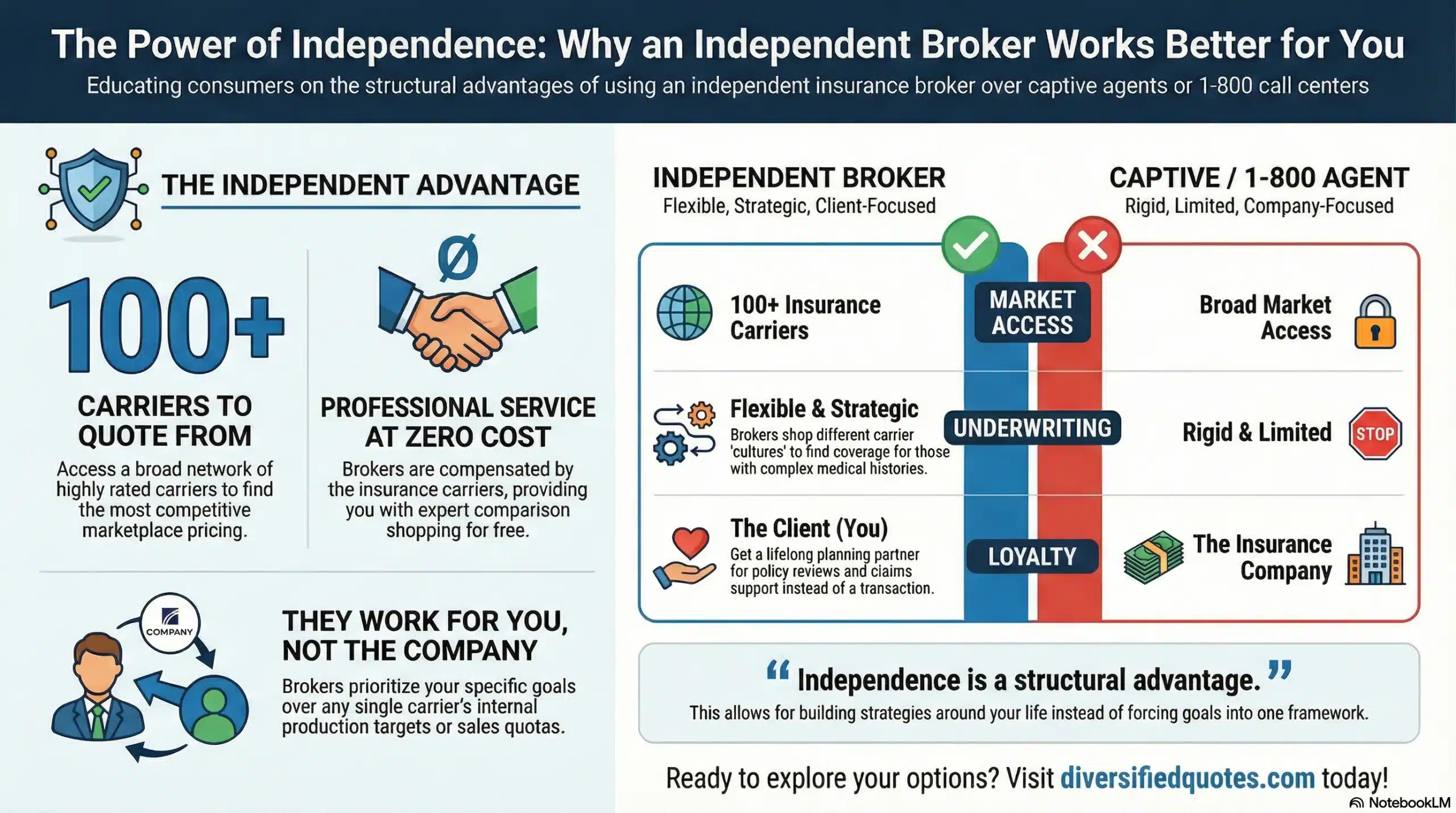
No — annuity commissions are paid by the insurance company to the agent or broker, not deducted from your premium or account value. You receive 100% of your initial premium into the annuity contract. The carrier’s commission cost is built into the product’s economics — the spread between what the carrier earns on the invested premium and what it credits to the contract — rather than appearing as a direct charge against your account. Working with an independent broker who represents multiple carriers does not cost more than working with a single-company agent, because the commission structure is carrier-funded in both cases.
At Diversified Insurance Brokers, we are compensated identically regardless of which carrier we recommend — meaning our recommendation is always based on which contract produces the best outcome for your goals rather than which product generates the highest commission. Compare options with full transparency on our current annuity rates page or through our independent annuity broker service.
Does lifetime income from an annuity ever end?
Guaranteed lifetime income from a properly structured annuity does not end while you are alive — that is precisely what the word “lifetime” in the guarantee means. Under a GLWB income rider, payments continue for as long as you live even if the account value is depleted to zero by ongoing withdrawals and rider fees. Under a Single Premium Immediate Annuity with a life-only payout, payments continue for life regardless of how long you live. With joint-life payout options, income continues as long as either named annuitant is alive. The carrier absorbs the longevity risk — pooling mortality outcomes across thousands of policyholders — so that each individual is protected against outliving their income regardless of how long they live.
The guarantee is backed by the claims-paying ability of the issuing insurance company, which is why carrier financial strength matters in annuity selection. Use our lifetime income calculator to see guaranteed income projections, and review lifetime income annuity options to compare available structures across today’s market.
Why don’t some advisors recommend annuities?
Many financial advisors operate under a fee-based or assets-under-management model, earning a percentage of the financial assets they manage each year. When a client moves funds into an annuity — an insurance product that sits outside the advisor’s managed portfolio — those assets are no longer under the advisor’s management, which means the advisor no longer earns fees on that portion of the client’s money. This creates a structural incentive for some advisors to discourage annuities regardless of whether the product would genuinely serve the client’s retirement income goals. It does not make annuities bad products — it means the recommendation may be shaped by the advisor’s compensation structure rather than by objective analysis of what best serves the client.
At Diversified Insurance Brokers, we are independent and product-neutral. We evaluate annuities alongside other retirement planning options and recommend them only when the income guarantees, tax advantages, and principal protection features genuinely serve the client’s specific goals. Our resource on common annuity myths addresses many of the objections that arise from advisor bias or misinformation, and our 2nd opinion annuity quote review provides an independent evaluation of any annuity offer you have already received.
Burial Insurance FAQs
What is burial insurance?
Burial insurance — also called final expense insurance — is a small whole life insurance policy designed specifically to cover end-of-life expenses such as funeral and burial costs, medical bills, outstanding debts, or any other financial obligations a family faces immediately after a loss. Coverage amounts typically range from $5,000 to $25,000, and premiums are fixed for life once the policy is issued. Because it is whole life insurance, the policy remains in force as long as premiums are paid — there is no expiration date, no term that expires, and no requirement to requalify. Our resource on what burial insurance is and who needs it provides the full explanation, and our burial insurance service page connects you with quotes from top-rated final expense carriers.
How much coverage do I need for burial insurance?
Most people choose burial insurance coverage between $5,000 and $25,000, with the specific amount based on estimated funeral and burial costs in your area, any outstanding debts the policy should address, and the financial cushion you want to provide for your family during the transition period. The national average funeral cost with burial is approximately $8,000 to $12,000, though costs vary significantly by location, service type, and preferences. If you want coverage that addresses both final expenses and a modest amount for surviving family members, coverage in the $15,000 to $25,000 range is common. Our resource on how much burial insurance you need provides the framework for calculating the right amount based on your specific situation.
What is the difference between burial insurance and traditional life insurance?
Burial insurance provides smaller coverage amounts — typically $5,000 to $25,000 — with simplified or guaranteed issue underwriting, designed specifically for end-of-life expense coverage. Traditional life insurance is used for larger financial goals: income replacement for dependents, mortgage payoff, business succession planning, estate planning, or legacy creation, often with face amounts ranging from $100,000 to millions. Traditional term or permanent life insurance requires more detailed underwriting for qualifying coverage at the lowest premiums. Burial insurance is appropriate when the primary goal is covering final expenses affordably and simply without requiring a medical exam or detailed health history, particularly for seniors or those with health conditions that complicate traditional underwriting. Our resource on burial insurance vs. pre-paid funeral also addresses a common alternative comparison.
Do I need a medical exam to qualify for burial insurance?
No — burial insurance is specifically designed to be accessible without a medical exam. Most policies use simplified issue underwriting — a short set of health questions with no labs, no paramedical exam, and no medical records review — and many applicants qualify for immediate level benefit coverage based on their health history. For applicants with more significant health issues, guaranteed issue burial insurance policies accept all applicants within the eligible age range without any health questions, though these policies typically include a two-year graded benefit period during which the full death benefit applies only to accidental death. Our resources on guaranteed issue burial insurance and affordable burial insurance with no medical exam cover both pathways.
What are the different types of burial insurance?
There are three primary benefit structures in burial insurance. Level benefit (immediate full coverage) policies pay the full death benefit from day one — these are issued to applicants who can answer health questions favorably and represent the best value for those who qualify. Graded benefit policies are issued to applicants with moderate health concerns; full benefits typically begin after two years, with a return of premiums plus interest paid if death occurs within the graded period. Guaranteed issue policies accept all applicants within the eligible age range without health questions; all guaranteed issue policies include a two-year graded benefit period. Our resource on best burial insurance explains all three types and profiles which applicants are best suited for each.
Can burial insurance premiums increase over time?
No. Burial insurance is whole life insurance, and whole life premiums are fixed and guaranteed never to increase once the policy is issued. The premium you pay at age 65 is the same premium you pay at age 85, regardless of any changes in your health, inflation, or the carrier’s underwriting experience. Coverage also cannot be cancelled by the carrier as long as premiums are paid, providing guaranteed lifelong protection at a known, stable cost. This premium certainty is one of the most valued features of burial insurance for seniors on fixed incomes who need predictable, manageable monthly costs.
Can I purchase burial insurance for someone else?
Yes — you can purchase burial insurance for a parent, spouse, sibling, or other family member with insurable interest and the insured’s consent. The insured person must be aware of and agree to the policy. The policy owner — the person who pays the premiums and controls the policy — does not need to be the insured. Many adult children purchase burial insurance for aging parents to protect the family from unexpected funeral costs, particularly when the parent’s health might complicate their ability to qualify for coverage on their own. Our resources on burial insurance for seniors and burial insurance for parents address this common planning scenario.
Are burial insurance benefits taxable?
No — the death benefit from a burial insurance policy is generally paid to beneficiaries income-tax-free under the standard life insurance exclusion from gross income under IRC Section 101. The beneficiary can use the money for any purpose — funeral expenses, medical bills, outstanding debts, or simply to provide financial support to the family — with no income tax liability on the amount received. This tax-free treatment applies regardless of the policy size and without distinction between burial insurance and any other form of life insurance death benefit. Our resource on whether the life insurance death benefit is taxable explains the full tax framework including the limited exceptions that can create taxable treatment in specific estate planning scenarios.
How quickly are burial insurance benefits paid out?
Most burial insurance claims are paid within 24 to 72 hours of the insurer receiving the required documentation — typically a completed claim form and a certified copy of the death certificate. This rapid claims processing is a deliberate design feature of final expense insurance, because families often need access to funds quickly to arrange services, pay immediate costs, and address urgent financial obligations in the days following a loss. The direct-to-beneficiary payment mechanism also means funds typically avoid probate delays, arriving directly to the named beneficiary rather than through the estate settlement process.
Can burial insurance be used for anything other than funeral expenses?
Yes — there are no restrictions on how the death benefit is used. The beneficiary receives the funds as an unrestricted cash payment and can apply them to funeral costs, medical bills, outstanding credit card debt, mortgage payments, or any other financial need. The policy is called “burial insurance” because that is the most common intended use, not because the benefit is limited to that purpose. This flexibility is one of the features that distinguishes burial insurance from pre-paid funeral contracts, which lock funds into specific funeral home arrangements. Our resource on burial insurance vs. pre-paid funeral compares these two approaches in detail.
Long-Term Care Insurance FAQs
What is long-term care insurance?
Long-term care (LTC) insurance helps cover the cost of services that assist with activities of daily living (ADLs) — bathing, dressing, eating, toileting, transferring, and maintaining continence — when an illness, injury, or cognitive condition prevents someone from performing these activities independently. LTC insurance pays for care provided at home (home health aides, adult day services), in assisted living facilities, or in nursing homes. These are custodial care expenses, not skilled medical care expenses, and they are specifically excluded from Medicare coverage. The risk of needing long-term care is significant — statistically, about 70% of people over 65 will need some form of long-term care during their lifetime, and care costs have been rising steadily. Our long-term care insurance service page provides quotes and planning resources.
When should I buy long-term care insurance?
The best time to buy long-term care insurance is typically in your early to mid-50s — while premiums are meaningfully lower and you are most likely to qualify for coverage without health-related complications or exclusions. Every year of delay increases the annual premium for the same coverage, and health changes that accumulate over time can make coverage more expensive, restrict the available benefit options, or make qualification impossible. Waiting until your 60s or 70s is still worthwhile if you do not yet have coverage, but the premium and underwriting picture is consistently more favorable for buyers in their 50s. Our resource on best long-term care insurance rates provides current market context for different ages and health profiles.
What does long-term care insurance cover?
LTC insurance covers services that help with activities of daily living and custodial care needs across a range of settings. Home care coverage typically includes home health aides, personal care attendants, homemaker services, and adult day care. Facility care coverage includes assisted living facilities, residential care facilities, memory care facilities, and nursing homes. Most modern LTC policies are comprehensive in their benefit settings — they pay wherever care is provided rather than requiring care to be received in a specific setting. Cognitive impairment (including Alzheimer’s and dementia) is a qualifying trigger independently of physical ADL limitations in most policies. Our resource on long-term care insurance services explains the coverage framework in detail.
Does Medicare cover long-term care?
No. Medicare covers short-term skilled nursing facility care only under specific conditions — following a qualifying hospital stay of at least three days, with coverage declining over a defined benefit period — and it does not cover custodial or long-term care services. Medicare will not pay for a home health aide to assist with bathing and dressing on an ongoing basis, nor for assisted living facility fees, nor for nursing home costs on a long-term basis when the care is primarily custodial rather than skilled. Medicaid does cover long-term care costs but only for individuals who meet strict income and asset eligibility requirements, effectively requiring most of a person’s assets to be depleted before Medicaid coverage begins. Long-term care insurance protects both assets and care choices by providing coverage before Medicaid eligibility would apply.
How much does long-term care cost?
Long-term care costs vary significantly by location, type of care, and level of need. Nationally, nursing home care for a private room averages approximately $9,000 to $12,000 per month. Assisted living facility costs average approximately $4,500 to $6,500 per month. Home health aide care typically runs $25 to $35 per hour, and full-time home care needs can produce monthly costs comparable to assisted living. These costs have been increasing at rates above general inflation, making early planning more important than current figures alone suggest. A couple who both need care simultaneously can face combined costs exceeding $15,000 to $20,000 per month in many markets — a financial exposure that can rapidly deplete retirement assets without insurance protection in place.
What is the difference between traditional LTC insurance and hybrid policies?
Traditional long-term care insurance provides standalone LTC coverage with monthly premiums that may increase over time if the insurer receives state regulatory approval. Benefits are used only if long-term care is needed — if care is never required, no death benefit or cash value is returned. The advantage is that premiums are typically lower than hybrid products for equivalent LTC benefit amounts. Hybrid policies combine long-term care coverage with a life insurance policy or an annuity, providing either a death benefit (if care is not fully used) or a cash value component. Premiums in most hybrid designs are guaranteed not to increase. The two primary hybrid structures are life insurance with LTC rider — providing a death benefit that can be accessed for LTC needs — and annuity-based LTC products that pair LTC benefits with annuity accumulation. Our resource on hybrid long-term care insurance covers both structures.
Can I get long-term care insurance if I have pre-existing conditions?
It depends on the specific condition, its severity, how well it is managed, and the carrier’s underwriting guidelines. Some conditions result in denial across most carriers (advanced cognitive impairment, requiring assistance with ADLs already, severe chronic conditions). Others — including many well-controlled conditions like hypertension, diabetes, and prior surgeries — can be covered at standard or modified terms depending on the carrier. Some conditions result in exclusion riders rather than full denial, providing coverage for all conditions except the specific excluded one. Applying while relatively healthy is the most reliable path to comprehensive coverage at favorable premiums. Our team of independent advisors can pre-screen health profiles against multiple carriers’ underwriting guidelines before any formal application to identify the best available options. Our resource on long-term care insurance after age 80 addresses the options available for older applicants with more complex health profiles.
What is an elimination period in long-term care insurance?
The elimination period is the waiting period between the onset of a qualifying care need and when the insurance company begins paying benefits — functioning similarly to a deductible in terms of the financial responsibility it places on the insured. Common elimination periods are 30, 60, or 90 days, during which the insured (or their family) pays for care out of pocket. Policies with longer elimination periods generally carry lower premiums, while shorter elimination periods cost more but reduce the out-of-pocket exposure before benefits begin. The 90-day elimination period is the most common choice in the current market, representing a reasonable balance between premium and self-insured exposure at the beginning of a care event. Some policies count calendar days toward the elimination period; others count service days when care is actually received — a distinction that can meaningfully affect how quickly the elimination period is satisfied.
Can long-term care insurance premiums increase?
Traditional stand-alone LTC policies can experience premium increases over time if the insurance company receives approval from the state insurance regulator to implement a rate increase. These increases have been a source of frustration for policyholders who purchased coverage years ago under original pricing that was later found to be inadequate. Hybrid LTC policies — those that combine LTC coverage with life insurance or annuity components — typically come with guaranteed, level premiums that cannot increase. This premium stability is one of the primary reasons hybrid products have grown in popularity relative to traditional stand-alone LTC insurance. When evaluating any LTC policy, confirming whether premiums are guaranteed level or subject to potential increases is an essential part of the purchase decision.
Is long-term care insurance worth it?
For most people with meaningful retirement assets to protect and a desire to preserve care choices and family financial stability, yes — long-term care insurance is worth it. The combination of high probability (approximately 70% of people over 65 will need some form of LTC) and high cost (nursing home care averaging $9,000 to $12,000 per month) creates a genuine catastrophic financial risk that retirement savings alone may not be able to absorb, particularly when both members of a couple need care simultaneously. LTC insurance provides both financial protection — preserving retirement assets from depletion by care costs — and care choice protection — allowing insured individuals to access higher-quality care settings and remain in preferred environments rather than being limited by out-of-pocket affordability. Our resource on best long-term care insurance rates provides current market options to evaluate.
What is a benefit period in long-term care insurance?
The benefit period is the maximum length of time the policy will pay covered long-term care benefits — essentially the policy’s total benefit duration. Common benefit periods range from 2 years to lifetime (unlimited) coverage, with 3-year, 4-year, and 5-year options common in the current market. The total policy benefit pool is calculated as: daily benefit amount × number of days in the benefit period. A policy with a $200 daily benefit and a 3-year benefit period provides a total benefit pool of approximately $219,000 ($200 × 365 days × 3 years). Once the benefit pool is exhausted, coverage ends. Choosing the right benefit period involves balancing the premium impact of longer coverage against the probability of needing care beyond the chosen duration. Many advisors recommend at minimum a 3-year benefit period, since the average long-term care event lasts approximately 3 years — though some individuals require care for much longer periods, and a lifetime benefit provides complete protection against extended care needs.
Medicare FAQs
What is Medicare?
Medicare is a federal health insurance program primarily for individuals aged 65 and older, and for some individuals under 65 with qualifying disabilities or End-Stage Renal Disease. It is administered by the Centers for Medicare and Medicaid Services (CMS) and funded through payroll taxes, premiums, and federal general revenues. Medicare is not a single policy — it is a framework of different parts that together cover hospital care, outpatient medical services, prescription drugs, and optionally managed care or supplemental coverage. Understanding how the parts work together — and what they do not cover — is essential for making sound Medicare enrollment decisions. Our Medicare service page and resource on how Medicare works provide the foundational overview.
What are the different types of Medicare?
Part A covers inpatient hospital care, skilled nursing facility care following a qualifying hospital stay, hospice, and limited home health services. Most people receive Part A without a premium if they or their spouse paid Medicare taxes for at least 10 years. Part B covers outpatient medical services — doctor visits, preventive care, outpatient procedures, durable medical equipment, and some home health care — with a standard monthly premium. Part C (Medicare Advantage) combines Parts A and B coverage through private insurance companies approved by Medicare, often including Part D drug coverage and additional benefits like dental, vision, and hearing. Part D is standalone prescription drug coverage added to Original Medicare. Medigap (Medicare Supplement) policies are private insurance that covers some or all of the out-of-pocket costs that Original Medicare leaves — deductibles, copayments, and coinsurance. Our resource on the Medicare Advantage vs. Medicare Supplement comparison helps clarify the two structural paths.
Is Medicare free?
Partially. Part A is premium-free for most beneficiaries who have worked and paid Medicare taxes for at least 10 years (40 quarters). Part B has a standard monthly premium ($174.70 in 2024, subject to annual adjustment) and is higher for individuals with income above certain thresholds under the IRMAA (Income-Related Monthly Adjustment Amount) rules. Part D premiums vary by plan. Medicare Advantage plans may have $0 monthly premiums or low premiums but may include network restrictions and prior authorization requirements. Medigap plans carry their own monthly premiums in addition to Part B. Even “free” Part A includes deductibles and coinsurance that can create substantial out-of-pocket costs without supplemental coverage. Our resource on enrolling in Medicare at 65 covers the full cost picture.
What is the difference between Original Medicare and Medicare Advantage?
Original Medicare (Parts A and B) is the traditional fee-for-service Medicare structure administered directly by the federal government. You can see any doctor or specialist who accepts Medicare assignment, without referrals or network restrictions, and can add Part D drug coverage and a Medigap supplement separately. Medicare Advantage (Part C) is an all-in-one alternative delivered through private insurance companies contracted with Medicare. MA plans typically include Part A, Part B, and Part D coverage in one plan, often with additional benefits (dental, vision, hearing) and sometimes $0 premiums — but with provider networks, referral requirements for specialists, and prior authorization processes for certain services. The right choice depends on your healthcare utilization patterns, preferred providers, travel habits, and tolerance for network limitations. Our resource on Medicare Advantage vs. Medicare Supplement provides the comprehensive comparison framework.
When can I enroll in Medicare?
Your Initial Enrollment Period (IEP) is the 7-month window surrounding your 65th birthday — 3 months before the month you turn 65, the month of your birthday, and 3 months after. Enrolling in Part B during the first 3 months of your IEP (before your birthday month) typically produces the earliest possible coverage start. If you miss your IEP and do not have qualifying employer-based coverage that delays the enrollment requirement, you may face Part B and Part D late enrollment penalties that persist for life, and you may have to wait for General Enrollment Period (January 1 through March 31 annually) with coverage starting July 1. If you are covered by an employer plan at a company with 20 or more employees, you may delay Part B without penalty until the employer coverage ends. Our resource on enrolling in Medicare at 65 covers the full enrollment timeline and the employer size rules that determine when delayed enrollment is safe.
What happens if I don’t enroll in Medicare on time?
Missing your enrollment window without qualifying coverage from an active employer plan can result in permanent late enrollment penalties and delayed coverage. The Part B late penalty is 10% of the standard premium for each 12-month period you were eligible but not enrolled — and this penalty is added to your premium permanently, not just for a defined catch-up period. The Part D late penalty is 1% of the national base premium for each month of delayed enrollment, also added permanently. Both penalties can add up to hundreds of additional dollars per year in premium for the rest of your life. Enrolling on time — or confirming that a qualifying coverage exemption applies before delaying — is essential for avoiding these compounding costs. Schedule a call with a certified Medicare planner before your enrollment window to confirm the right timing for your situation.
Does Medicare cover long-term care?
No. Medicare covers only short-term skilled nursing facility care following a qualifying hospital inpatient stay of at least three days — and even that coverage declines significantly after the first 20 days and ends after 100 days. Medicare does not cover custodial care: the ongoing assistance with activities of daily living (bathing, dressing, eating, mobility) that constitutes most long-term care need. It does not pay for assisted living facility fees, memory care facility fees, or long-term nursing home care when the care is primarily custodial rather than skilled. For ongoing care needs, long-term care insurance — whether traditional or hybrid — is the primary insurance mechanism for protecting assets and care choices against long-term care costs.
Do I need a Medicare Supplement (Medigap) plan?
Medigap plans are not required but are strongly worth considering if you choose Original Medicare as your coverage structure. Without a Medigap plan, Original Medicare leaves you exposed to significant out-of-pocket costs: the Part A hospital deductible ($1,632 per benefit period in 2024), Part B 20% coinsurance with no out-of-pocket maximum, and unlimited potential exposure for extended hospital stays. A Medigap Plan G — the most comprehensive option for new Medicare enrollees — covers most of these costs, leaving only the Part B deductible as an annual out-of-pocket obligation. The monthly premium for Medigap coverage varies by age, location, and carrier but typically provides more predictable total healthcare costs than Original Medicare alone. Our resource on the best independent Medicare broker explains how independent advisors compare Medigap plans across carriers to find the most competitive pricing.
Can I have Medicare and employer health insurance at the same time?
Yes. Coordinating Medicare with an active employer health plan is common and requires understanding which coverage pays first. The coordination rules depend on employer size. If your employer has 20 or more employees, the employer plan pays primary and Medicare pays secondary — meaning you can generally delay Part B enrollment without penalty as long as the employer plan is active. If your employer has fewer than 20 employees, Medicare pays primary and the employer plan pays secondary — meaning you should enroll in Part B when first eligible even if you have the employer plan, to avoid gaps in primary coverage. COBRA and retiree health coverage do not count as active employer coverage for purposes of delaying Medicare enrollment without penalty. Our resource on enrolling in Medicare at 65 covers the employer coordination rules in full detail.
Does Medicare cover dental, vision, and hearing?
Original Medicare (Parts A and B) does not cover routine dental care, routine vision exams or eyeglasses, or routine hearing exams and hearing aids. These are among the most commonly needed services for Medicare-age beneficiaries and among the most significant coverage gaps in the standard Medicare structure. Some Medicare Advantage plans do include dental, vision, and hearing benefits as part of their supplemental benefit offerings — coverage levels and specifics vary significantly by plan and geography. Standalone dental and vision insurance plans are also available for Original Medicare beneficiaries who want this coverage without switching to Medicare Advantage. When evaluating Medicare Advantage plans, the quality and scope of the dental and vision benefit is an important comparison factor alongside the plan’s network, drug formulary, and out-of-pocket limits.
Life Insurance FAQs
What are the main types of life insurance?
Life insurance divides into two primary categories: term and permanent. Term life insurance provides coverage for a defined period — 10, 15, 20, 25, or 30 years — and pays the death benefit only if the insured passes away during the term. It is the most cost-efficient way to secure a large death benefit for a defined risk window and is best suited for time-bounded financial obligations such as mortgage protection, income replacement while children are dependent, or coverage through retirement age. Permanent life insurance is designed to remain in force for the insured’s entire lifetime as long as adequately funded. It includes a cash value component that grows tax-deferred over time. Types of permanent life insurance include whole life (guaranteed growth rate), universal life (flexible premiums and credited based on current interest rates), indexed universal life (index-linked crediting with floor protection), and variable universal life (market-based subaccounts with market risk). Our resource on how life insurance works provides the full framework.
How much life insurance do I need?
The right coverage amount is specific to the household’s financial obligations, income level, existing assets, and planning goals — not a universal multiple of income. The most accurate approach begins with estimating what the household needs if the insured’s income disappeared permanently: the annual living expenses needed times the years of income replacement needed, plus the current mortgage balance, plus any other debts, plus specific goal funding (education, legacy). Subtract existing liquid assets, retirement savings, and employer-provided life insurance to arrive at the coverage gap personal life insurance should fill. Common rule-of-thumb approaches (10 to 15 times annual income) provide a starting point but can produce both over-insurance and under-insurance depending on debt load, savings, and family structure. Our resource on how much life insurance you need provides the full needs calculation framework.
Can a smoker get non-smoker rates for life insurance?
Yes, with some carriers. Most carriers require at least 12 consecutive months of complete tobacco abstinence — no cigarettes, cigars, pipe tobacco, chewing tobacco, or in many cases nicotine replacement products — before considering an applicant for non-smoker rates. Some carriers require 24 months or longer. Blood and urine tests for cotinine (a nicotine metabolite) are typically part of the paramedical exam for fully underwritten policies, so any recent tobacco use will be detected during the underwriting process. For current tobacco users, coverage is available but at tobacco-use rates that are meaningfully higher than non-smoker rates. Our resource on life insurance for smokers and our high-risk life insurance service cover available options.
Do I need a medical exam to get life insurance?
Not always. Accelerated underwriting programs at many carriers use algorithmic analysis of prescription history, MIB records, and driving records to make approval decisions without a paramedical exam for qualifying ages and face amounts — often up to $1 million or more for applicants in favorable health. Simplified issue policies ask health questions but require no exam. No-exam policies are available but typically carry higher premiums per dollar of coverage than fully underwritten alternatives, because the insurer is accepting more uncertainty about the applicant’s health. For applicants in excellent health who qualify for preferred rates, fully underwritten coverage with an exam typically produces the lowest available premium. For applicants with health conditions that could create underwriting complications, an independent broker who can pre-screen across carriers before any formal application is submitted provides the most strategic approach.
What happens if I stop paying my life insurance premiums?
Term policies typically enter a grace period — usually 30 to 31 days — during which a late payment can be made without the policy lapsing. If payment is not received within the grace period, the policy lapses and coverage ends. A lapsed term policy can sometimes be reinstated within a defined window if overdue premiums are paid and insurability is re-demonstrated. Permanent policies with accumulated cash value may have automatic premium loan provisions that use available cash value to pay premiums if a payment is missed, preventing lapse without immediate policyholder action — though excessive loans can erode cash value and cause the policy to lapse if not managed. For policies with significant cash value, surrender options (receiving the net cash surrender value) or reduced paid-up insurance (maintaining a lower death benefit without further premiums) may be available alternatives to simple lapse.
Can I borrow against my life insurance policy?
Yes, but only from permanent life insurance policies that have accumulated cash value. Policy loans allow you to borrow against the cash value without a credit check, without a required repayment schedule, and typically at a contractually defined interest rate. Unlike a personal loan, an unpaid policy loan does not default — it accrues interest and reduces the death benefit by the outstanding loan balance if the insured dies while the loan is outstanding. Excessive policy loans that are not repaid can erode the cash value to the point where the policy cannot sustain itself, potentially causing a lapse with significant tax consequences if the policy lapses with a large outstanding loan and the loan balance exceeds the original cost basis. Our resource on whole life insurance with cash value explains the cash value mechanics and loan provisions in detail.
Are life insurance benefits taxable?
In most cases, life insurance death benefits are received by beneficiaries income-tax-free under IRC Section 101. A $500,000 death benefit paid to a named beneficiary creates no federal income tax liability for the beneficiary, regardless of the policy size or type. Limited exceptions include situations where the death benefit is included in the insured’s taxable estate (when the insured owned the policy at death and the total estate exceeds the applicable federal estate tax exemption), interest earned on death benefit proceeds left on deposit with the insurer, and certain business-owned policies subject to transfer-for-value rules. Our resource on whether the life insurance death benefit is taxable explains the full tax framework and the specific scenarios that create taxable treatment.
Can I have multiple life insurance policies?
Yes — owning multiple life insurance policies is common and often strategically appropriate. A policy laddering approach — holding multiple term policies with different coverage amounts and term lengths — allows coverage to be calibrated to specific time-bounded financial obligations without paying for coverage beyond the period it is needed. For example, a family might hold a 30-year term policy for mortgage and long-term income protection, a 20-year term for additional coverage during child-raising years, and a permanent policy for lifetime needs. Insurers evaluate whether total coverage across all policies is financially justifiable given the applicant’s income and insurable interest — there is no specific legal maximum, but underwriters apply financial guidelines that limit total coverage to a reasonable multiple of earned income. Our resource on the life insurance laddering guide explains this strategy in detail.
What is the difference between group life insurance and individual life insurance?
Group life insurance provided through an employer is typically term coverage in an amount defined by the employer’s plan — often one to two times annual salary — at low or no cost to the employee. The advantages are simplicity and low or no premium. The limitations are significant: coverage amounts are often inadequate relative to actual income replacement needs, the policy is not portable (it ends when employment ends), the death benefit is typically taxable to the employee for coverage amounts above $50,000 when the employer pays the premium, and the owner has no control over the policy terms. Individual life insurance is personally owned, portable, and fully controllable — coverage amount, term length, beneficiary, and riders are all selected by the owner and cannot be changed by an employer. Individual coverage survives job changes, career transitions, and retirement. Our resource on group vs. individual life insurance compares both in detail.
Can I change my life insurance policy after purchasing it?
Yes, though the flexibility depends on the policy type. Permanent life insurance policies — particularly universal life and indexed universal life — offer flexibility to adjust premium payments, coverage amounts (within limits), and sometimes riders over time. Beneficiary designations can be changed at any time on revocable designations by submitting the appropriate form to the insurer. Term policies are less flexible in terms of coverage adjustments but most include a conversion option that allows the policy to be converted to a permanent policy without new medical underwriting during a defined conversion period — one of the most valuable provisions for maintaining coverage if health changes after the term policy was issued. Riders can sometimes be added or removed depending on the carrier and contract. Our resource on converting term to permanent life insurance explains the conversion option and its strategic importance.
Browse All of Our Insurance and Annuity FAQs
About the Author:
Jason Stolz, CLTC, CRPC, DIA, CAA and Chief Underwriter at Diversified Insurance Brokers (NPN 20471358), is a senior insurance and retirement professional with more than 25 years of real-world experience helping individuals, families, and business owners protect their income, assets, and long-term financial stability. As a long-time partner of the nationally licensed independent agency Diversified Insurance Brokers, Jason provides trusted guidance across multiple specialties—including fixed and indexed annuities, long-term care planning, personal and business disability insurance, life insurance solutions, Group Health, Travel Medical and Evacuation Insurance, and short-term health coverage. Diversified Insurance Brokers maintains active contracts with over 100 highly rated insurance carriers, ensuring clients have access to a broad and competitive marketplace.
His practical, education-first approach has earned recognition in publications such as VoyageATL, and contributions from his agency featured in Kiplinger and GoBankingRates— highlighting his commitment to financial clarity and client-focused planning. Drawing on deep product knowledge and years of hands-on field experience, Jason helps clients evaluate carriers, compare strategies, and build retirement and protection plans that are both secure and cost-efficient. Visitors who want to explore current annuity rates and compare options across multiple insurers can also use this annuity quote and comparison tool.
Explore All Insurance & Retirement Services: Return to our Diversified Insurance Brokers home page — covering annuities, life insurance, disability, Medicare, long term care, burial insurance & more from 100+ carriers.
Last Reviewed: June 20, 2026 |
Reviewed by: Jason Stolz, CLTC, CRPC, DIA, CAA
Chief Underwriter, Diversified Insurance Brokers, Inc. | NPN: 20471358 | Diversified Insurance Brokers, Inc. — Licensed in all 50 states
Fact Checked by: Tonia Pettitt, CMIP©
Medicare Specialist, Diversified Insurance Brokers, Inc. | NPN: 14374308 | Diversified Insurance Brokers, Inc. — Licensed in all 50 states
Did you find this content helpful? Leave us a Google review — it helps others find trustworthy guidance too.
Editorial Standards: Diversified Insurance Brokers maintains rigorous editorial standards to ensure accuracy, clarity, and independence in all content. Learn more about our editorial standards and commitment to transparency.
