
Best Independent Long Term Care Insurance Broker
As an Independent Long Term Care Insurance Broker, we compare traditional, hybrid, and partnership-qualified policies across dozens of carriers to find the structure that actually fits your situation.
Best Independent Long Term Care Insurance Broker

Jason Stolz CLTC, CRPC, DIA
Choosing the best independent long term care insurance broker is one of the most consequential steps in retirement planning — and one where most people don’t fully understand what “independent” actually means or why it changes the outcome of the conversation. Long term care planning sits at the intersection of healthcare, retirement income, estate planning, and family dynamics in a way that almost no other insurance decision does. It requires thinking in probabilities about future health events, understanding care settings and how they are actually used, navigating underwriting standards that have become more detailed and carrier-specific over the past decade, and connecting the coverage design to the actual retirement and family protection goals it is meant to serve. An independent broker’s job is to make that complexity navigable without overwhelming the client or steering them toward a predetermined outcome.
At Diversified Insurance Brokers, we are not tied to a single carrier or a single product type. We are not paid differently whether we recommend traditional long term care insurance, a hybrid life/LTC design, or an annuity-based LTC strategy — which means our recommendation reflects what is genuinely best for the individual client’s situation, not what is most convenient for us to sell. That is the practical meaning of independence in long term care planning: the ability to compare all three product lanes honestly, shop underwriting appetite across carriers, design benefits based on actual goals rather than templates, and tell clients what they need to hear rather than what they want to hear. We help clients across the country navigate this decision — starting with education, moving through design, and carrying through the underwriting process with fewer surprises and better outcomes. Our long term care insurance services page provides the broader framework for the full range of options we evaluate.
Compare Long Term Care Options with an Independent Specialist
We’ll help you evaluate traditional LTC, hybrid life + LTC, and annuity-based LTC strategies — then right-size benefits for your situation, health profile, and retirement income plan.
Request Your Long Term Care Review
Questions? Call 800-533-5969
What an Independent Long Term Care Insurance Broker Actually Does
An independent long term care insurance broker serves as an advocate in a marketplace that has changed substantially over the past two decades. The number of carriers offering traditional standalone long term care insurance has contracted significantly — major carriers that were household names in LTC 15 years ago have exited the market, repriced legacy blocks aggressively, or shifted their product strategy entirely toward hybrid designs. Meanwhile, the hybrid life/LTC and annuity-based LTC markets have expanded with new carriers and new product designs. The result is a marketplace that requires genuine cross-product and cross-carrier expertise to navigate effectively.
In that environment, an independent broker’s role is not to present “the best plan” as though there were a single correct answer. The role is to evaluate the client’s goals, health profile, financial situation, and family dynamics — and then map those facts to the product lane and carrier combination that produces the best outcome for that specific household. One client wants maximum long-term care leverage for the premium dollar and is willing to accept that premiums could be subject to rate actions over time. Another wants a single payment from existing assets that creates a defined LTC benefit pool with a death benefit if care is never needed. Another wants nothing to do with ongoing premiums and prefers an annuity-based repositioning strategy. A broker who can only offer one of these paths is not serving the client — they are serving the product.
Our process at Diversified Insurance Brokers typically includes five components that distinguish genuine LTC planning from quote shopping.
Education without overwhelm. We help clients understand what long term care insurance pays for and what it doesn’t, how benefit triggers work in practice, why long term care is categorically different from Medicare and health insurance, and what the actual consequences of not planning look like for the household. Most clients arrive with partial information and significant misconceptions — particularly around Medicare coverage. Understanding that Medicare does not cover long-term care in any meaningful sustained way is foundational, and most people are surprised to learn the extent of the gap. Understanding that Medicare and long-term care insurance are not the same thing clarifies why a separate planning conversation is necessary. The eligibility framework — activities of daily living and cognitive impairment as the primary benefit triggers — is the foundation of how coverage actually works and must be understood before a client can evaluate policy terms meaningfully.
Benefit design that matches real goals. Instead of defaulting to a “standard” daily benefit and a three-year benefit period, we work from the goals backward. Are you protecting a healthy spouse’s retirement income from being consumed by care costs? Are you protecting a legacy or estate plan? Are you primarily concerned about remaining at home as long as possible? Are you trying to reduce the likelihood that adult children will need to become caregivers? Each of these goals produces a different design emphasis — different benefit amounts, different elimination periods, different inflation protection choices, different shared care provisions. Our resource on how much long term care insurance you need provides a structured framework for working through these questions before arriving at specific policy terms.
Carrier shopping based on the applicant’s actual health profile. This is where independence produces the most tangible value. Underwriting standards differ significantly across LTC carriers — a health history that triggers a decline at one carrier may qualify for coverage at another. A condition that results in a rated premium at one carrier may qualify for standard rates elsewhere. For conditions like controlled diabetes, well-managed cardiac history, or certain orthopedic conditions, the difference between carriers’ underwriting decisions can determine whether coverage is available at all and at what cost. We shop underwriting appetite the way we shop price — by understanding which carriers are most favorable for specific health profiles. Our resource on how to qualify for long term care insurance provides the foundation for understanding what carriers evaluate during underwriting.
Clean comparisons across all three product lanes. We present traditional LTC, hybrid life/LTC, and annuity-based LTC strategies on a comparable basis — showing what each provides in care benefits, what the cost structure looks like, what happens if care is never needed, and what the underwriting pathway looks like for the specific client. A practical reference for the most common comparison is our resource on hybrid life vs. traditional long term care insurance, which walks through the value tradeoffs that most clients are trying to evaluate when they first engage with this planning conversation.
Application strategy and underwriting support. Getting approved is not automatic, and the way an application is positioned matters. We help clients avoid preventable issues — inconsistencies in medication lists, missed disclosures, cognitive phone interview anxiety, and application timing relative to recent medical events — that can affect underwriting outcomes. For clients with health complexity, we sometimes do informal inquiries with carriers before formally applying, to identify the most favorable path before any formal underwriting record is created.
Why Independence Matters More in LTC Than in Almost Any Other Insurance Category
The independence of the broker matters in every insurance category, but it matters most in long term care because the product landscape is genuinely diverse across dimensions that have no equivalent in simpler insurance decisions. In term life insurance, comparing across carriers primarily means comparing premiums for equivalent coverage with attention to underwriting classification. In long term care, comparing across carriers means comparing across fundamentally different product structures, benefit philosophies, inflation design choices, elimination period mechanics, and the very different financial structures of traditional versus hybrid versus annuity-based LTC. A broker who is genuinely independent across all three lanes can give an honest answer to “which is right for you” because they have nothing at stake in the answer. A broker who primarily works with one carrier’s hybrid product will tend to recommend that hybrid regardless of whether traditional LTC or an asset-based strategy would serve the client better.
The second reason independence matters in LTC is the long time horizon of the decision. A long term care insurance policy purchased at age 58 may be in force for 30 years before a claim is filed, if a claim is filed at all. The carrier’s financial strength, rate action history, and claims handling reputation over that 30-year period matters in ways that the experience of buying the policy does not reveal. An independent broker who tracks carrier behavior over years — who knows which carriers have taken repeated rate increases, which have maintained stable pricing, which have streamlined their claims process, and which have become more or less financially robust over time — provides information that a first-time buyer cannot easily access through their own research. That perspective is one of the most genuinely valuable things an experienced independent LTC broker brings to the conversation that neither a captive agent nor an online comparison site can replicate.
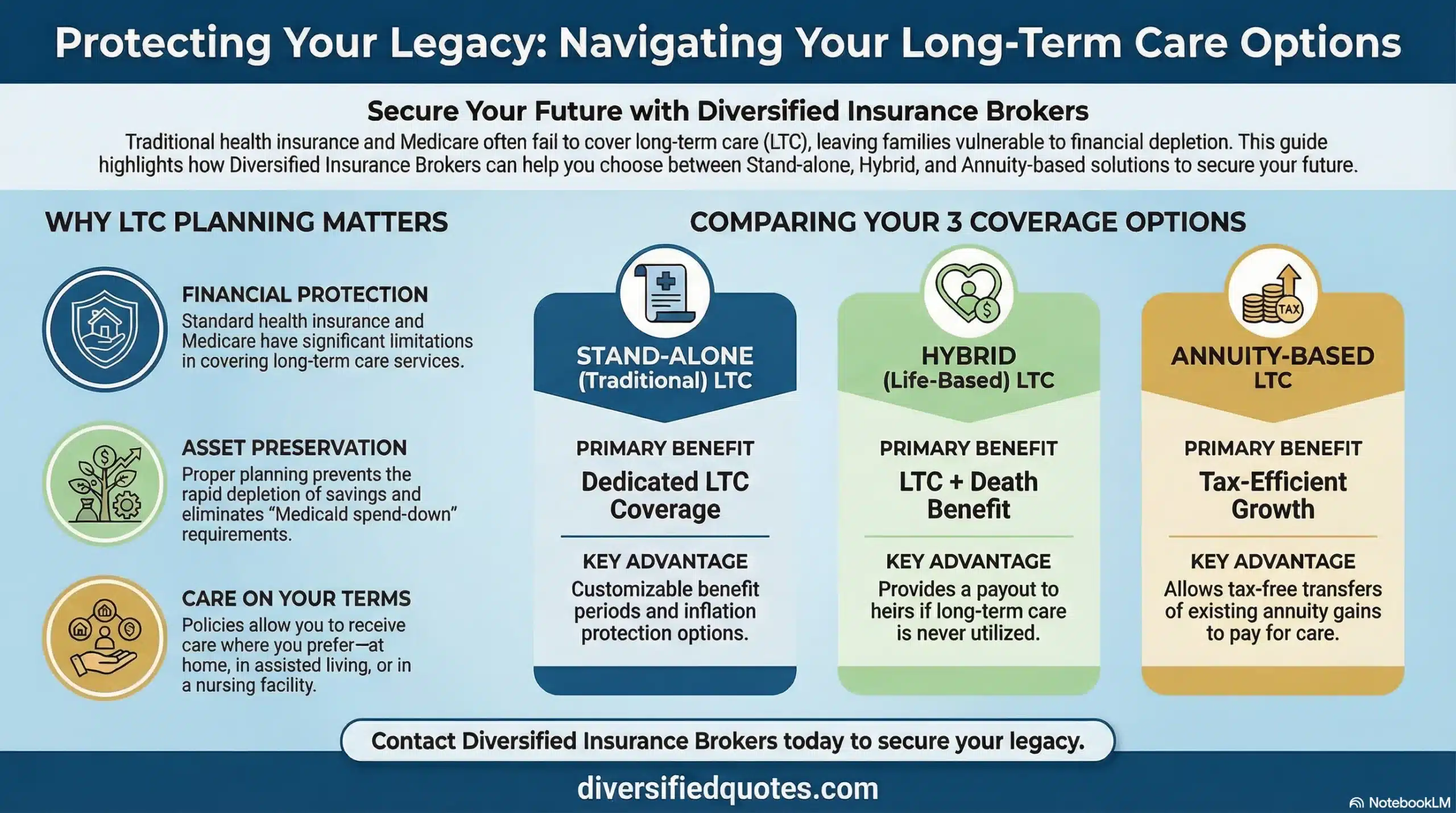
The Three Modern Long Term Care Insurance Lanes Explained
Every client considering long term care planning should understand the three modern approaches clearly — what each does, what each costs, what happens in different scenarios, and which types of clients each tends to serve best. There is no universally “best” lane. The right answer depends on the goals, health profile, financial situation, and preferences of the individual household.
Traditional Standalone Long Term Care Insurance
Traditional long term care insurance is purpose-built coverage for care costs — period. When the insured meets the benefit trigger (inability to perform at least two activities of daily living for a period expected to last at least 90 days, or a qualifying cognitive impairment requiring substantial supervision), the policy pays benefits for covered care in settings including home care, assisted living, memory care units, and skilled nursing facilities, up to the daily or monthly benefit maximum for the benefit period elected.
The primary advantage of traditional LTC is efficiency: for a given premium level, traditional LTC typically delivers more care dollars per premium dollar than hybrid or annuity-based alternatives — assuming a claim is filed. The pure insurance structure means the entire premium is funding care risk rather than life insurance or annuity components. For clients who are primarily focused on maximum care protection for the lowest ongoing premium and are comfortable with the understanding that premiums could be subject to rate actions, traditional LTC is often the most economical choice when a claim actually occurs.
The primary tradeoff is the “use it or lose it” structure: if no qualifying care need develops, the premiums paid do not return to the insured or their family. Some traditional LTC policies offer return-of-premium riders that partially address this concern — our resource on long term care insurance with return of premium explains how these riders are structured and what they cost. The elimination period — the time between benefit trigger and first benefit payment — is a powerful premium control lever in traditional LTC design. Our resource on LTC elimination periods explained covers the mechanics in detail, because the elimination period choice affects both the client’s early out-of-pocket responsibility and the premium materially.
Inflation protection is another critical design variable in traditional LTC that has no direct equivalent in the other lanes. A policy purchased at age 58 with a $200/day benefit that includes 3% compound inflation protection will provide approximately $363/day at age 79 — meaningfully preserving purchasing power against the sustained healthcare cost inflation that typically exceeds general CPI. A level-benefit policy provides the same $200/day at 79 as at 58, which may be substantially less adequate after two decades of care cost increases. The right inflation choice depends on age, budget, and planning timeline, and it represents one of the most consequential and least understood design decisions in traditional LTC planning.
Hybrid Life Insurance with Long Term Care Benefits
Hybrid life/LTC policies combine permanent life insurance with long term care benefits — typically through extension-of-benefits riders that qualify the long term care coverage under IRC Section 7702B, or through acceleration of death benefit provisions under Section 101(g) for chronic illness. The unifying feature of hybrid designs is that the client’s money retains value regardless of whether long term care is needed: if care is needed, the policy provides LTC benefits; if care is not needed, a life insurance death benefit passes to beneficiaries. This “either/or” value structure addresses the psychological barrier that prevents many people from purchasing traditional LTC — the concern that they will pay premiums for decades and receive nothing if they never need care.
Hybrid designs also commonly offer premium payment flexibility that traditional LTC does not. Many hybrid policies can be purchased with a single premium payment — a lump sum that funds the contract without ongoing premium obligations — or with a limited premium payment period of 5 to 10 years rather than premiums for life. This funding structure appeals to clients who want to reposition existing assets into a protection vehicle rather than adding a new ongoing expense. A client who has $100,000 in a low-yield CD or money market account that is simply sitting as a placeholder may find that repositioning it into a single-premium hybrid LTC policy creates a substantially larger LTC benefit pool, a death benefit if LTC is never needed, and superior tax treatment on benefits received. Our resource on single pay long term care insurance explains how single-premium hybrid structures are designed and what they provide.
The tradeoff of hybrid designs is typically that for a given premium dollar, they deliver less pure LTC coverage than traditional LTC insurance — because a portion of the economics is funding the life insurance component rather than pure care risk transfer. For a client whose primary goal is maximum care protection per premium dollar, traditional LTC often wins the comparison. For a client whose primary goal is value preservation and premium certainty, hybrid wins. Our resource on hybrid life insurance with long-term care benefits provides a comprehensive overview of how these policies are structured across major carriers.
Annuity-Based Long Term Care Strategies
Annuity-based LTC strategies are most commonly used when a client has existing non-qualified assets — cash, CDs, or a low-yield annuity — that they want to reposition into a structure that creates defined LTC benefits. The Pension Protection Act of 2006, effective for LTC purposes in 2010, created a specific and powerful tax benefit for this strategy: a properly structured 1035 exchange from a non-qualified annuity with accumulated gains into a qualifying LTC annuity converts those gains — which would otherwise be fully taxable as ordinary income when withdrawn — into LTC benefits that are received income-tax-free. This PPA provision makes annuity-based LTC strategies uniquely compelling for clients with older non-qualified annuities that carry significant built-in gains they would prefer not to pay taxes on.
Annuity-based LTC strategies typically provide a defined benefit multiplier — the LTC benefit pool is a multiple of the deposited premium — and do not require ongoing premium payments after the initial funding. This is appealing for clients who are philosophically opposed to ongoing insurance premiums and prefer a structured, one-time repositioning of assets. The tradeoff is that annuity-based designs typically provide less LTC benefit per premium dollar than traditional LTC insurance — the annuity component means the client’s money is not being fully allocated to pure care risk transfer. Our resource on non-qualified long term care annuity explains how these structures work, and our resource on annuities with long-term care benefits covers the product landscape across carriers offering these designs.
Long Term Care Costs, Coverage Design, and Why the Gap Matters
Understanding what long term care actually costs — and what the gap between those costs and available Medicare coverage looks like — is the foundation of every honest LTC planning conversation. Care costs vary significantly by geography, care setting, level of care, and the duration of need. National median figures from Genworth’s annual Cost of Care Survey provide useful reference points: as of recent data, home health aide costs average over $30 per hour, assisted living community costs average over $5,000 per month, and nursing home private room costs average over $9,000 per month — with substantial variation by state. These numbers are not projections for 20 years from now. They are current costs that will continue to increase.
Medicare’s role in long term care is one of the most misunderstood aspects of retirement healthcare planning. Medicare covers skilled nursing facility care following a qualifying hospital stay of at least three days, but coverage is limited: Medicare pays 100% of covered services only for the first 20 days, adds a daily coinsurance for days 21 through 100, and covers nothing beyond day 100. There is no Medicare benefit for custodial care — the assistance with activities of daily living that constitutes the vast majority of long term care need in the real world. Home care is covered by Medicare only when it is medically necessary skilled care ordered by a physician; routine personal care assistance at home is not a Medicare benefit. Our resource on whether Medicare covers long-term care provides the full breakdown of what Medicare does and does not provide, and our resource on whether Medicare and long term care insurance are the same addresses the common confusion between these two programs.
Medicaid covers long term care — but only after the applicant has spent down financial assets to meet Medicaid’s income and asset eligibility thresholds, which vary by state. For middle-class retirees with home equity, investment accounts, and retirement savings they worked decades to build, Medicaid spend-down represents a forced liquidation of lifetime savings before any program benefit begins. Long term care insurance prevents this outcome by providing a benefit that covers care costs before the asset spend-down threshold is reached — preserving the retirement assets the household needs for the healthy spouse, the estate plan, or the financial legacy they intended to leave. The LTC Partnership program adds another layer: partnership-qualified policies generate dollar-for-dollar asset protection that allows policyholders to protect assets equal to the total benefits paid even if Medicaid is eventually needed. Our resource on partnership-qualified long term care insurance explains this program and how it interacts with Medicaid planning.
Health Underwriting: What Carriers Evaluate and How Timing Affects Options
Long term care insurance is medically underwritten, and the underwriting process is more detailed and carrier-specific than in most other insurance categories. This is because LTC carriers are underwriting a risk that spans decades — the applicant who is healthy today may develop the conditions that generate LTC claims 20 to 30 years from now, and the carrier must assess that long-horizon risk based on current health indicators and actuarial projections about how today’s health conditions typically progress over time.
The conditions that LTC underwriters focus on most carefully are those that affect independence: mobility and balance (fall history, osteoarthritis, neurological conditions), cognitive function (cognitive testing, memory concerns, history of strokes or TIAs), chronic conditions with functional implications (diabetes with complications, significant cardiac history, COPD with oxygen use, Parkinson’s disease), and mental health conditions that affect daily functioning. Carriers are not trying to exclude everyone with a health history — they are trying to identify the risk profile of each applicant based on all available evidence and price or underwrite accordingly. Many manageable conditions qualify with the right carrier match. LTC insurance with preexisting conditions explains how pre-existing health history is handled across different carrier underwriting approaches.
Timing matters in LTC underwriting in two ways. First, applying earlier generally improves both availability and pricing — younger applicants have more carriers available to them, fewer accumulated health conditions affecting their profile, and a longer period over which inflation protection can build meaningful benefit growth. Many clients find that applying in their 50s or early 60s produces substantially different options than waiting until their late 60s or 70s when health history has accumulated. Second, the timing of application relative to recent health events matters — applying shortly after a hospitalization, a new diagnosis, or a recent medication change is generally not advisable. An independent broker helps clients identify the right timing for their application to maximize the probability of favorable underwriting outcomes. Our resource on who qualifies for long term care insurance provides guidance on the health factors that most commonly affect eligibility.
Couples Planning: The Dimension That Changes Everything
Long term care planning for couples is not simply double the individual planning exercise. The presence of a healthy spouse changes both the financial risk profile and the coverage design approach in ways that single-applicant planning does not require. The household’s core financial risk in a couples LTC scenario is often not the nursing home bill itself — it is the effect of that bill on the healthy spouse’s ability to remain financially stable, maintain their home, keep their retirement income plan intact, and continue their intended lifestyle while their spouse receives care that may last years.
The healthy spouse scenario is particularly important because Medicaid’s spousal impoverishment rules, while designed to protect a community spouse, still allow Medicaid to reach assets that the household intended to use for retirement and leave significant financial strain on the spouse still living at home. Long term care insurance prevents this asset erosion by providing benefits that cover care costs before any Medicaid asset spend-down threshold is reached. When coverage is designed to protect the healthy spouse’s financial stability rather than simply to pay care bills, the design choices — benefit amount, inflation protection, benefit period, shared care provisions — are made through a different and more precise lens.
Shared care riders allow couples to structure a pooled benefit approach where unused benefits from one spouse can be accessed by the other if needed. This design creates flexibility: rather than each spouse having a fully independent benefit period that may not be fully used, the couple’s combined benefit pool can be drawn from by whichever spouse needs it most. Our resource on LTC insurance with shared benefits explains how shared care provisions are structured, our resource on LTC insurance with shared spousal benefits covers the spousal-specific design, and our resource on shared care riders in LTC explains how these riders work in practice across different carrier designs. For couples also considering the group health and care coordination dimensions, our resource on long term care insurance for couples provides a comprehensive planning overview.
Integrating Long Term Care Coverage with Retirement Income Planning
Long term care insurance does not exist in isolation from the retirement income plan — it either protects or threatens that plan depending on whether it has been addressed. A retiree who has built a sustainable retirement income strategy built around Social Security, pension or annuity income, and a carefully managed investment portfolio may find that an unplanned multi-year LTC event disrupts every element of that strategy simultaneously: large IRA withdrawals to pay care costs create taxable income spikes, portfolio liquidation under pressure may occur at unfavorable market timing, the healthy spouse’s spending power deteriorates, and the legacy plan is consumed by care expenses rather than passed to intended beneficiaries.
Long term care insurance functions as a structural protection layer that preserves the retirement income plan even when care is needed. It covers care costs with insurance benefits rather than retirement account liquidation — which means the IRA stays intact, the annuity income continues, and the household avoids the forced-withdrawal tax consequences that come from liquidating pre-tax accounts to pay care bills in the same year that income is already elevated. The tax efficiency of LTC benefits — generally received income-tax-free under qualified policy provisions — makes them significantly more economical as a source of care funding than pre-tax IRA withdrawals that are fully taxable as ordinary income. Our resource on whether long term care benefits are taxable covers the tax framework in detail, and our resource on tax benefits of long term care insurance explains both the premium deductibility and benefit exclusion dimensions.
For clients with non-qualified assets — annuities, CDs, or taxable savings — the integration with LTC planning may involve a 1035 exchange repositioning strategy that converts taxable annuity gains into tax-free LTC benefits, simultaneously addressing both the LTC exposure and the deferred tax liability on the existing annuity. This is one of the most tax-efficient LTC funding strategies available for the right client profile. Our resource on what a PPA annuity is covers the mechanics of this strategy in full detail for clients with existing non-qualified annuities that carry significant built-in gains.
For clients building LTC coverage as part of a broader retirement income architecture, the LTC layer interacts with the retirement income floor — the guaranteed income from Social Security, pensions, and annuity income riders — in a specific and important way. When the income floor covers essential monthly expenses, LTC insurance that kicks in for care costs preserves the entire floor rather than forcing withdrawals from the investment portfolio to cover care bills. Our resource on lifetime income planning services provides the broader retirement income architecture framework within which LTC planning fits most effectively.
Common Design Mistakes That Make LTC Insurance Feel Unnecessarily Expensive
Long term care insurance is not inherently expensive — but it can be made to feel that way by design choices that produce unnecessarily high premiums without proportionate additional protection. An independent broker’s role includes helping clients avoid these common mistakes, which consistently appear in proposals from agents who are working from templates rather than from client goals.
Buying maximum benefit amounts without defining what you are protecting. Many first-time LTC shoppers default to a $6,000 or $8,000 monthly benefit because it looks like it “covers” current nursing home costs in their area. But the question is not what nursing home care costs — it is what amount of care cost the household cannot fund from other income and savings. A household with $4,000 per month in Social Security and pension income and $500,000 in liquid savings can fund meaningful care costs from existing resources before insurance benefits become necessary. The insurance is most valuable for the costs that exceed what the household can manage — designing the coverage around that gap produces better value than buying a benefit that partially duplicates resources already available.
Skipping inflation protection without a plan. Inflation protection meaningfully increases premium, and many clients are tempted to eliminate it to reduce cost. But a policy purchased at 58 that will not be used for 20 to 30 years may have a seriously inadequate benefit at claim time without inflation growth. The decision to skip inflation protection should be made intentionally, with a clear-eyed understanding of what the benefit will be worth in 20 years at realistic care cost inflation rates — not simply as a way to reduce premium without understanding the long-term consequence.
Choosing an elimination period that doesn’t match actual financial capacity. The elimination period is measured in days, not dollars — it represents the time period during which the insured pays for care before the policy begins paying benefits. A 90-day elimination period requires the household to fund approximately 3 months of care costs out of pocket — which at current care costs could be $15,000 to $27,000 or more depending on care setting. If the household doesn’t have that available in liquid reserves without disrupting other financial planning, the elimination period needs to be shorter. Our resource on LTC elimination periods explained provides the full framework for calibrating this decision to actual financial reserves.
Applying to the wrong carrier for the health profile. Every LTC carrier has a different underwriting appetite. Applying to a carrier that is known to be strict about a condition you have — without shopping alternatives — can result in a decline that creates an avoidable negative underwriting record. An experienced independent broker knows which carriers are most favorable for specific health histories and directs applications accordingly, often doing informal inquiries before formal applications to identify the path most likely to produce a favorable outcome.
Get an Independent Long Term Care Comparison
We’ll help you compare carriers and structures, then build a plan that fits your budget, health profile, and protects the right risks — without overbuying or underdesigning.
Request Your Long Term Care Review
Questions? Call 800-533-5969
Related Long Term Care Resources
Explore costs, coverage design, shared care strategies, and eligibility considerations.
Compare Policy Types and Planning Angles
Helpful comparisons for hybrids, annuity-based LTC strategies, and the Medicare coverage gap.
Financial Protection Essentials
Specialized coverage options and funding solutions to help manage travel risk, health concerns, and legal financial gaps.
Talk With an Advisor Today
Choose how you’d like to connect—call or message us, then book a time that works for you.
Schedule here:
calendly.com/jason-dibcompanies/diversified-quotes
Licensed in all 50 states • Fiduciary, family-owned since 1980
FAQs: Best Independent Long Term Care Insurance Broker
What does an independent long term care insurance broker do?
An independent long term care insurance broker compares coverage designs and pricing across multiple carriers and all three modern LTC product lanes — traditional standalone LTC insurance, hybrid life/LTC policies, and annuity-based LTC strategies — and helps you structure benefits to match your actual goals, health profile, and budget. The key word is “independent”: unlike a captive agent who works for one company and can only offer that company’s products, an independent broker has no financial stake in recommending one lane or one carrier over another. The recommendation reflects what is genuinely best for the client’s situation.
In practice, a good independent LTC broker provides education on how benefit triggers work and what coverage pays for, designs benefit amounts based on specific household goals rather than default templates, shops underwriting appetite across carriers to identify the most favorable path for the client’s health profile, and supports the client through the underwriting and application process. For a practical framework on how to evaluate whether a broker is genuinely independent and qualified, our resource on why to work with an independent LTC broker provides the full decision framework.
Is it better to use a broker instead of buying long term care insurance directly?
For most people, yes — and particularly in long term care, where the product landscape is more complex and more carrier-specific than in most other insurance categories. Long term care insurance varies widely by carrier, product type, benefit design, and underwriting philosophy. A broker who can access multiple carriers and multiple product lanes gives you a comparison that a single-company direct purchase does not. More importantly, an experienced independent broker knows which carriers are underwriting favorably for specific health profiles — which can mean the difference between coverage being available and not available, or between standard rates and a significantly higher rated premium.
The LTC marketplace also involves genuinely different product structures — traditional LTC, hybrid life/LTC, and annuity-based LTC — that serve different planning goals and have different economics. A direct purchase from a single carrier typically means choosing within that carrier’s product offerings rather than comparing across all three lanes to find the right fit. An independent broker’s comparative process identifies the structure that best serves your goals before committing to any carrier’s product.
What’s the difference between traditional long term care insurance and hybrid long term care?
Traditional long term care insurance is pure care coverage — when you meet the benefit trigger (inability to perform at least two activities of daily living or qualifying cognitive impairment), the policy pays benefits for covered care up to the daily or monthly maximum for the benefit period. If you never need care, the premiums paid do not return. Traditional LTC typically provides the most care dollars per premium dollar of any LTC product structure, making it the most efficient approach for clients whose primary goal is maximum care protection. Premiums may be subject to rate actions over time depending on carrier and policy form.
Hybrid life/LTC policies combine permanent life insurance with LTC benefits — if care is needed, the policy pays LTC benefits; if care is never needed, a life insurance death benefit passes to beneficiaries. This “either/or” value structure appeals to clients who want value preservation regardless of care outcome. Many hybrids can be purchased with a single premium or limited premium payment period, which appeals to clients who prefer not to have lifelong premium obligations. The tradeoff is that hybrids typically deliver less pure LTC coverage per premium dollar than traditional LTC. Our resource on hybrid vs. traditional long term care insurance provides a detailed side-by-side comparison of the value tradeoffs.
When is the best age to apply for long term care insurance?
Earlier is generally better for three compounding reasons. First, health: younger applicants typically have fewer accumulated health conditions that complicate underwriting, giving them access to more carriers and more favorable rate classifications. Second, cost: premiums are lower at younger ages because the actuarial risk is lower and the premium compounds over more years. Third, inflation protection: the earlier inflation protection begins accruing, the more benefit growth occurs before a claim is likely to be filed. A policy purchased at 58 with 3% compound inflation protection has 20 to 25 years to grow the benefit before the most common claim window arrives.
That said, “earlier is better” does not mean older applicants have no options. Many people apply in their 60s and 70s with viable results, particularly if they are flexible about benefit design, elimination periods, or product lane. Some health conditions that develop in the 60s do not necessarily preclude coverage — they may simply change which carrier and which product type produces the best outcome. Our resource on who qualifies for long term care insurance provides guidance on the health factors that affect eligibility across age groups, and our resource on long term care insurance after age 80 addresses options specifically for older applicants.
What health conditions can make long term care insurance harder to qualify for?
LTC underwriters focus primarily on conditions that indicate elevated risk of needing care in the future — conditions affecting independence, mobility, cognitive function, or functional capacity. History of stroke or TIA, Parkinson’s disease or other movement disorders, significant cardiac history with functional limitations, insulin-dependent diabetes with complications, moderate to severe COPD, significant musculoskeletal conditions affecting mobility, and any cognitive concerns or documented memory issues are among the conditions that most commonly affect LTC underwriting outcomes.
Importantly, the fact that one carrier declines or rates an applicant does not mean the market is closed. Underwriting philosophies differ substantially across carriers, and a condition that results in a decline at one carrier may qualify for coverage at another. An independent broker who knows which carriers are underwriting favorably for specific health profiles — and who can do informal inquiries before formal application to avoid creating avoidable negative underwriting records — provides the most effective path through health-challenged underwriting situations. Our resource on LTC insurance with preexisting conditions covers how documented health history is evaluated across different carriers.
How do elimination periods work in long term care insurance?
The elimination period in long term care insurance is the time period — measured in calendar days — between when a qualifying benefit trigger occurs and when the policy begins paying benefits. During the elimination period, the insured pays for care out of pocket. The most common elimination period lengths are 30, 60, 90, and 180 days, with 90 days being the most common choice. A longer elimination period reduces premiums because the carrier is bearing less risk — but it increases the out-of-pocket responsibility before benefits begin.
The critical planning question is whether the household has the financial capacity to fund care during the elimination period without disrupting other financial planning. At current care costs, a 90-day elimination period requires funding approximately 3 months of care costs — which could be $15,000 to $27,000 or more depending on care setting and geography — from personal resources before insurance benefits begin. If that capacity exists comfortably in liquid reserves, a 90-day or longer elimination period is a reasonable premium-control choice. If it does not, a shorter elimination period better matches the policy to actual financial capacity. Our resource on LTC elimination periods explained provides the full framework.
Can couples share long term care benefits?
Many long term care policies offer shared care features that allow one spouse to access unused benefits from the other spouse’s policy pool. Instead of each spouse having a fully independent benefit period that may not be fully used, the couple’s combined benefit pool can be drawn by whichever spouse needs it most. Shared care designs are popular with couples who want flexibility — if one spouse has a longer or more intensive care need than anticipated, the shared pool prevents that spouse from exhausting their individual benefit while the other spouse’s benefit sits unused.
Shared care availability, cost, and mechanics vary across carriers. Some carriers offer a combined pool that either spouse can draw from; others offer riders that allow one spouse to access a defined portion of the other’s unused benefit period. The shared care option typically adds to the premium but may be more economical than buying a longer individual benefit period for each spouse independently. Our resources on LTC insurance with shared benefits, LTC insurance with shared spousal benefits, and shared care riders in LTC explain these designs in detail across carrier variations.
Is long term care insurance worth it if I have significant assets?
The “I have enough money to self-fund” reasoning is among the most common for high-asset households to delay or skip LTC planning — and it conflates the ability to pay with the optimal way to pay. The question is not whether you can fund care costs from portfolio assets. It is whether funding care costs from portfolio assets is the right strategy compared to funding them from tax-free insurance benefits while preserving the portfolio for other purposes.
Large unplanned LTC withdrawals from pre-tax retirement accounts generate ordinary taxable income that can push the household into higher tax brackets, cause more Social Security income to become taxable, and trigger higher Medicare premium surcharges through IRMAA. Funding the same care costs from tax-free LTC insurance benefits avoids all of these consequences. Additionally, high-asset households with estate planning goals may prefer that care costs be covered by insurance rather than by depleting assets intended for heirs, charitable giving, or other legacy objectives. Our resource on self-insured long term care examines the true cost comparison between self-funding and insurance funding for households with the assets to theoretically do either.
Browse How to Buy, Qualify & Coverage Details
About the Author:
Jason Stolz, CLTC, CRPC, DIA, CAA and Chief Underwriter at Diversified Insurance Brokers (NPN 20471358), is a senior insurance and retirement professional with more than 25 years of real-world experience helping individuals, families, and business owners protect their income, assets, and long-term financial stability. As a long-time partner of the nationally licensed independent agency Diversified Insurance Brokers, Jason provides trusted guidance across multiple specialties—including fixed and indexed annuities, long-term care planning, personal and business disability insurance, life insurance solutions, Group Health, Travel Medical and Evacuation Insurance, and short-term health coverage. Diversified Insurance Brokers maintains active contracts with over 100 highly rated insurance carriers, ensuring clients have access to a broad and competitive marketplace.
His practical, education-first approach has earned recognition in publications such as VoyageATL, and contributions from his agency featured in Kiplinger and GoBankingRates— highlighting his commitment to financial clarity and client-focused planning. Drawing on deep product knowledge and years of hands-on field experience, Jason helps clients evaluate carriers, compare strategies, and build retirement and protection plans that are both secure and cost-efficient. Visitors who want to explore current annuity rates and compare options across multiple insurers can also use this annuity quote and comparison tool.
Explore All Long Term Care Insurance Options: Browse our complete Long Term Care Insurance guide — covering hybrid policies, traditional LTC, costs, tax advantages & partnership plans from top carriers.
Last Reviewed: May 17, 2026 |
Reviewed by: Jason Stolz, CLTC, CRPC, DIA, CAA
Chief Underwriter, Diversified Insurance Brokers, Inc. | NPN: 20471358 | Diversified Insurance Brokers, Inc. — Licensed in all 50 states
Fact Checked by: Tonia Pettitt, CMIP©
Medicare Specialist, Diversified Insurance Brokers, Inc. | NPN: 14374308 | Diversified Insurance Brokers, Inc. — Licensed in all 50 states
Did you find this content helpful? Leave us a Google review — it helps others find trustworthy guidance too.
Editorial Standards: Diversified Insurance Brokers maintains rigorous editorial standards to ensure accuracy, clarity, and independence in all content. Learn more about our editorial standards and commitment to transparency.
