
Are Medicare and Long-Term Care Insurance the Same?
As an Independent Medicare Broker, Tonia Pettitt (CMIP©) compares available plans across the major carriers to help you find the right coverage for your health, needs and budget.
As an Independent Long Term Care Insurance Broker, we compare traditional, hybrid, and partnership-qualified policies across dozens of carriers to find the structure that actually fits your situation.
Are Medicare and Long-Term Care Insurance the Same?

Jason Stolz CLTC, CRPC, DIA, CAA
Are Medicare and long-term care insurance the same? Not at all. They’re often mentioned in the same conversation because both relate to aging, healthcare, and retirement planning — but they solve two very different problems. Medicare is built for medical treatment and short-term recovery needs. Long-term care (LTC) insurance is built for ongoing help when someone needs assistance with daily life — especially when that help lasts for months or years. This distinction matters because many families assume Medicare will “cover a nursing home” the way it covers a hospital stay. In reality, Medicare’s nursing facility coverage is limited to skilled care in specific circumstances and for a limited time. Long-term custodial care — help with bathing, dressing, eating, transferring, toileting, or supervision due to cognitive decline — is typically outside Medicare’s design. If you plan correctly, you can layer Medicare and long-term care coverage so each does what it’s best at and your savings are protected from unnecessary spend-down. For the comprehensive resource on how Medicare works — covering Parts A, B, C, and D in full detail — our resource on how Medicare works provides the foundational framework that this page builds on for the LTC comparison. For the resource that covers how LTC insurance fits into the tax picture — an important planning consideration when structuring benefits and premiums — our resource on whether long-term care benefits are taxable covers that dimension in full.
Compare Medicare vs. Long-Term Care Coverage
We’ll show how to layer coverage, reduce financial exposure, and build a plan for future care needs.
Request a Coverage Review Call 800-533-5969Compare Medicare Plans in Your Area
Use the Medicare comparison tool below to review plan options available where you live. Understanding your Medicare coverage is the essential first step before evaluating where long-term care insurance fills the gaps Medicare leaves open.
Medicare vs. Long-Term Care Insurance — Side-by-Side Comparison
The two most important dimensions of this comparison are what triggers coverage and what type of care is covered. Medicare is a medical program triggered by medical necessity. LTC insurance is a personal-care program triggered by functional or cognitive impairment. Each has a specific role, and they do not overlap in the way most families assume.
| Feature | Medicare | Long-Term Care Insurance |
|---|---|---|
| Primary purpose | Medical treatment, acute care, and short-term recovery after a qualifying health event | Ongoing custodial and personal care support when the insured cannot safely perform daily activities independently |
| How benefits are triggered | Medical necessity — a covered service ordered by a physician and deemed medically necessary under Medicare’s rules | Functional impairment — typically need for assistance with 2+ ADLs, or a licensed practitioner-certified cognitive impairment requiring supervision for safety |
| Skilled nursing facility coverage | Limited — up to 100 days after a qualifying 3-night hospital inpatient stay; requires ongoing skilled care need; significant cost-sharing after day 20; nothing after day 100 | Covered for custodial or chronic care needs as defined by the policy — not limited to post-hospitalization or skilled care criteria |
| Assisted living coverage | Generally not covered — Medicare does not pay room and board or custodial care in an assisted living facility; limited skilled services may be available in certain circumstances | Often covered — most LTC policies include assisted living as a qualifying care setting; one of the most commonly used LTC benefits since many people prefer ALF over nursing home |
| Home care coverage | Limited skilled home health services in qualifying situations — e.g., skilled nursing visits, physical or occupational therapy ordered by a physician; not personal care for ADL help | Personal and custodial home care benefits — home health aides for ADL assistance, personal care, homemaker services; the most preferred care setting for most families |
| Memory care / dementia care | Not specifically covered as a care type — Medicare does not fund ongoing custodial supervision for Alzheimer’s or dementia; only medically necessary services in the acute framework | Covered — cognitive impairment is one of the two primary benefit triggers in most LTC policies; memory care facility costs can be covered as a qualifying care setting |
| Duration of coverage | Short-term by design — skilled nursing up to 100 days; home health services are periodic and medically tied; coverage ends when medical necessity criteria are no longer met | Multi-year by design — benefit periods typically 2-5 years or lifetime; designed for the extended nature of chronic care needs, not episodic recovery |
| How it is funded | Federal government program funded through FICA payroll taxes, Medicare premiums, and general federal revenues | Private insurance policy purchased from licensed carriers; individually underwritten based on health profile at time of application |
| Qualification requirements | Age 65+ or qualifying disability; no health underwriting — all qualifying individuals are accepted regardless of pre-existing conditions | Medical underwriting required — must apply while still healthy enough to qualify; typically purchased in 50s-early 60s; conditions like moderate dementia, need for current care, or major chronic illness typically disqualify |
| Asset protection from care costs | Limited — once Medicare’s short-term coverage ends, out-of-pocket costs for custodial care can drain retirement savings rapidly at typical care facility rates of $80,000-$120,000+ per year | This is one of the primary planning goals — LTC insurance benefits activate to pay for care, protecting retirement accounts, home equity, and other assets from the “private pay burn rate” |
How Medicare Works (And Why People Assume It Covers Long-Term Care)
Medicare is a federal health insurance program designed primarily to cover acute medical care. Think of doctor visits, hospital stays, medically necessary procedures, outpatient services, and short-term rehabilitation after a health event. When you are sick, injured, or recovering, Medicare is often the core payer that keeps medical bills from becoming overwhelming. That’s also why the confusion persists. A hospital stay and a rehab stay can look similar on paper: a person is in a medical facility, receiving care, and there are nurses involved. But Medicare’s focus is on medical necessity and skilled treatment. Once a person no longer requires skilled nursing or skilled therapy to improve or maintain function, Medicare coverage typically stops — even if they still need significant help to live safely day to day. At a high level, Medicare is described in “parts,” and each part addresses different costs. Part A is usually associated with inpatient and facility-related coverage. Part B covers outpatient and physician services. Part D focuses on prescription drugs. Medicare Advantage (Part C) is an alternative way to receive Part A and Part B benefits through a private insurance plan, often bundling additional features like dental or vision, but still operating within Medicare’s medical framework. For individuals managing chronic health conditions — where the line between acute medical care and long-term custodial support becomes particularly blurry — our resource on Medicare for people with chronic conditions covers how Medicare handles those intersecting needs.
Medicare’s Skilled Nursing Facility Rules — The 100-Day Structure
Medicare’s skilled nursing facility (SNF) benefit is one of the most frequently misunderstood aspects of the program. Many families believe that Medicare pays for a nursing home stay in full, or for as long as needed. The reality is that Medicare’s SNF coverage is structured around a specific medical need, a qualifying hospitalization, and a time-limited benefit. The table below maps the exact coverage structure that applies when Medicare’s SNF benefit is triggered.
General reference. Medicare coinsurance amounts change annually. For current figures, visit medicare.gov. Requirements for qualifying hospital stay and continued skilled care determination apply throughout the benefit period.
| SNF Benefit Period | What Medicare Pays | Patient Responsibility | Key Conditions That Must Be Met | Planning Note |
|---|---|---|---|---|
| Days 1–20 | Medicare covers 100% of approved SNF costs for the first 20 days after a qualifying hospital stay | $0 per day — full coverage for approved amounts; does not include personal items, private room upgrades, or non-covered services | Qualifying inpatient hospital stay of at least 3 consecutive days (not observation); SNF admission within 30 days of hospital discharge; skilled care need must be certified by physician | The 3-consecutive-inpatient-day rule is a common surprise — observation stays do not count toward the qualifying period, even if the patient was in a hospital bed for multiple nights |
| Days 21–100 | Medicare covers amounts above the daily coinsurance; the coinsurance amount (approximately $200 per day in 2024, updated annually) is the patient’s responsibility | Significant daily coinsurance — approximately $176-$200+ per day depending on the benefit year; this equals $3,500-$4,000 per month in out-of-pocket cost during this window | Continued skilled care must be certified as medically necessary each benefit period; if skilled need ends at any point during days 21-100, Medicare coverage ends immediately — not at day 100 | Medigap policies (Medicare supplement) typically cover the days 21-100 coinsurance — but neither Medigap nor Medicare Advantage extends coverage meaningfully beyond day 100 for custodial needs |
| Days 101+ | Medicare pays nothing — all nursing facility costs become the patient’s full responsibility once the 100-day maximum is reached or skilled care need ends, whichever comes first | Full private-pay rate — typically $250-$400+ per day ($7,500-$12,000+ per month) depending on geographic area, facility, and level of care needed | No Medicare conditions apply because coverage has ended entirely; the only coverage options at this point are personal assets, LTC insurance benefits, or Medicaid if assets have been exhausted to eligibility thresholds | This is the “cliff” where retirement savings become the default payer; the average nursing home stay lasting 2+ years generates $200,000-$400,000 in private-pay costs that Medicare never touches |
| Benefit Period Reset | A new benefit period — with a new 100-day maximum — begins after the patient has not received skilled nursing or inpatient hospital care for 60 consecutive days | New benefit periods reset the coinsurance structure, not the total lifetime maximum; each new benefit period requires a new qualifying hospital stay of 3+ inpatient days | Must have a new qualifying 3-day inpatient hospital stay; 60 days with no skilled care must elapse between the previous benefit period and the new one | Benefit period resets are common after acute re-hospitalization episodes but rarely solve the chronic, ongoing care need that most people with dementia or significant frailty experience |
What Medicare Does Cover in a Facility Setting
Medicare can cover a limited stay in a skilled nursing facility when specific rules are met. This is where many families believe “Medicare covers the nursing home,” but it’s important to understand what that phrase actually means in Medicare language. In general, Medicare’s facility coverage is tied to a qualifying medical event and a medical need. A typical example is a hospitalization for surgery, stroke, severe infection, or injury. After the hospital, a person may need skilled therapy (physical, occupational, or speech therapy) and skilled nursing to recover safely. In this scenario, Medicare may help pay for a short-term skilled nursing facility stay because the goal is recovery and rehabilitation — not long-term custodial support. The key takeaway is that Medicare’s nursing facility coverage is structured around skilled care. It’s designed for recovery periods, not for ongoing help with dressing, bathing, meal support, medication reminders, mobility assistance, or supervision due to memory impairment. One important nuance many families discover too late is the observation status rule. A patient who spends multiple nights in a hospital may still be classified as “outpatient under observation” rather than “inpatient” for Medicare purposes. This matters significantly because only inpatient days count toward the qualifying 3-day hospitalization required before Medicare SNF coverage can begin. Families should always confirm whether a hospital admission is classified as inpatient status.
What Medicare Generally Does Not Cover
Long-term care, as most families experience it, is not primarily medical treatment. It’s ongoing help with the tasks that keep someone functioning safely. That includes hands-on assistance, stand-by assistance, supervision, and cueing — especially when chronic conditions, frailty, or cognitive decline make independent living unsafe. Medicare generally does not pay for custodial care as a standalone need. Custodial care is the non-medical assistance someone needs with routine daily activities. Medicare may cover limited home health services in certain cases, but the presence of a nurse does not automatically mean the care is “skilled” in the Medicare sense. If the care need is ongoing personal support rather than skilled treatment, Medicare is typically not the solution. To understand how insurance companies define these functional limitations, it helps to review activities of daily living (ADLs). ADLs are commonly used in long-term care insurance to determine when benefits can begin. The key ADLs — bathing, dressing, eating, transferring, toileting, and continence — represent the functional baseline that most LTC policies use as the benefit trigger alongside cognitive impairment criteria.
What Long-Term Care Insurance Covers
Long-term care insurance exists to pay for the kind of assistance Medicare usually excludes: extended help when someone cannot safely perform everyday tasks on their own. The trigger is often a need for help with ADLs (commonly two or more), or a qualifying cognitive impairment that requires supervision for safety. Unlike Medicare — which is tied to medical necessity and short-term recovery — long-term care insurance is designed for ongoing support. That support can take place at home, in an assisted living community, in memory care, or in a nursing facility. The goal is to preserve choice, keep care aligned with personal preferences, and protect retirement assets from being drained by multi-year care costs. Depending on the policy, long-term care insurance can help pay for home health aides, in-home custodial care, assisted living, memory care, nursing home care for chronic needs, respite care, and adult day care. The exact covered services depend on the plan design, but the common thread is that it addresses the long-term, personal-care side of aging that Medicare doesn’t meaningfully fund. For the complete overview of how LTC insurance policies are structured, how benefit periods and daily benefit amounts work, and what carriers are looking for in underwriting, our resource on is long-term care insurance worth it covers those mechanics in detail. For individuals in the decision-making stage of whether to purchase, our resource on whether you should buy long-term care insurance covers the cost-benefit analysis that should guide that decision. If you want a starting point for estimating how care costs may look for your age and situation, you can use our long-term care insurance calculator to model coverage and budgeting scenarios.
Medicaid — The Third Layer Most Families Don’t Plan For
Beyond Medicare and private LTC insurance, there is a third system that many families encounter: Medicaid. Medicaid is a joint federal-state program that does pay for long-term custodial care — nursing home care, in particular — but only after a person has spent down assets to the program’s eligibility thresholds. Medicaid is designed as a safety net for individuals who have exhausted their personal resources paying for care. For middle-income and higher-net-worth families, relying on Medicaid means first spending down savings, home equity, and other assets until eligibility is reached. In most states, Medicaid’s asset limits for a single person are very low — often $2,000 or less in countable assets. By the time Medicaid eligibility is reached, most of the wealth accumulated over a working lifetime has already been paid to the care facility. This is the financial exposure that LTC insurance is designed to prevent. The sequence families without LTC insurance commonly experience is: Medicare covers the first days, then runs out; private assets cover years two through exhaustion; Medicaid covers the remaining period of care after asset spend-down. Long-term care insurance interrupts the private asset spend-down phase, protecting savings and providing families with more choices about the setting and quality of care rather than defaulting to Medicaid-accepting facilities. For specific populations who may have a Medicaid-related planning need alongside LTC insurance consideration — including individuals with employer-based coverage options or group LTC access — our resource on group long-term care insurance covers the employer-sponsored LTC option that many working adults overlook.
How Medicare and Long-Term Care Insurance Work Together
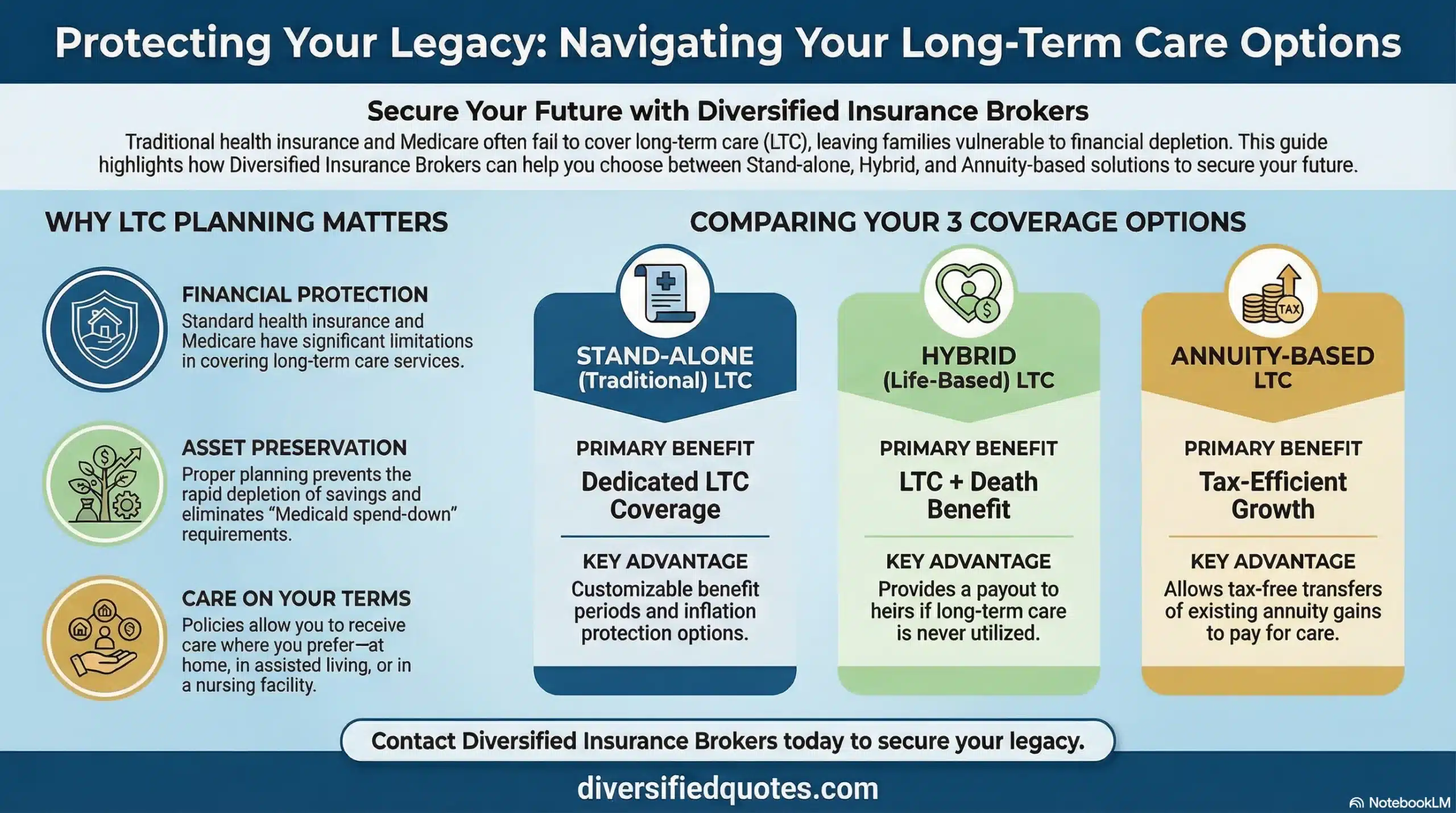
In many well-built retirement plans, Medicare and long-term care coverage are layered — not confused. Medicare covers the medical side: hospital care, physicians, diagnostics, medically necessary treatments, and short-term rehab when the goal is recovery. Long-term care insurance covers the daily-life side: ongoing assistance when the goal is safety, stability, and support. A common sequence looks like this. A health event occurs and Medicare covers the hospital episode. Next, Medicare may cover a period of rehab or skilled services if the rules are met. If recovery reaches a plateau and the person still needs help with daily activities, the situation becomes custodial care. That is where a long-term care policy can step in, so the family is not forced into a private-pay burn rate that can quickly erode savings. Some families also explore alternative ways to fund care risk if traditional long-term care insurance is not a fit. Depending on goals, that can include hybrid life/LTC designs that combine life insurance protection with LTC benefits in a single policy, or annuity-based options that include LTC-style benefit riders. Our resource on life insurance with a long-term care rider covers the hybrid policy structure that is increasingly popular for individuals who want coverage that doesn’t require paying premiums for decades without guaranteed benefit use. For individuals who may have difficulty qualifying for traditional LTC underwriting due to age or health history, our resource on long-term care insurance after age 80 covers the options available for older applicants where traditional underwriting may be restricted.
Who Should Consider Long-Term Care Insurance?
Long-term care insurance is often most useful for people who want to protect assets and preserve options — especially households that could absorb premiums but would feel significant pressure if faced with a multi-year care bill. It can be particularly valuable for families who want the flexibility of home care and assisted living options without the financial and emotional strain of last-minute decisions. Timing matters. Many people explore long-term care coverage in their 50s to mid-60s, when underwriting is often more favorable and policy options may be broader. Waiting until a health event occurs can limit choices or prevent approval. If you’re considering coverage, it’s also helpful to review how to qualify for long-term care insurance so you understand what carriers look for and how to position your application. For individuals with specific health conditions — including diabetes, which can complicate both care planning and LTC underwriting — our resource on long-term care insurance for diabetics covers how that health condition intersects with LTC qualification and coverage planning. For the comprehensive rate and carrier comparison that should accompany any LTC purchasing decision, our resource on best long-term care insurance rates provides the market context needed to evaluate what you’re being offered. Working with a broker experienced specifically in LTC placements is important given the complexity — our resource on best independent long-term care insurance broker covers what to look for in LTC-focused advisory relationships. For the long-term care insurance service overview — covering all the coverage types, product structures, and planning approaches available — our resource on long-term care insurance services provides the full picture.
The Bottom Line
Medicare and long-term care insurance are not the same — and treating them as interchangeable is one of the costliest planning mistakes families make. Medicare is an essential foundation for medical costs, but it is not designed to pay for extended custodial care. Long-term care insurance exists to fund that gap, preserve choices about where care happens, and protect retirement savings from being drained by long-term assistance needs. If you want to know where your current plan leaves exposure — and what it would take to close that gap — an objective review can give you clarity and a realistic action plan.
Get Help Coordinating Medicare & Long-Term Care Coverage
We’ll show how to layer coverage, reduce financial exposure, and build a plan for future care needs.
Request a Coverage Review Call 800-533-5969Related Pages
Related long-term care and Medicare planning resources.
Financial Protection Essentials
Core strategies to protect retirement income, prepare for healthcare costs, and build long-term financial stability.
Talk With an Advisor Today
Choose how you’d like to connect—call or message us, then book a time that works for you.
Schedule here:
calendly.com/jason-dibcompanies/diversified-quotes
Licensed in all 50 states • Fiduciary, family-owned since 1980
FAQs: Medicare vs. Long-Term Care Insurance
Are Medicare and long-term care insurance the same?
No — they are fundamentally different programs that address different care needs. Medicare is a federal health insurance program for people 65 and older (and certain younger individuals with qualifying disabilities) that pays for acute medical care: hospital stays, physician services, medically necessary procedures, and short-term rehabilitation after a qualifying medical event. Long-term care insurance is a private insurance policy that pays for ongoing custodial care — help with activities of daily living (ADLs) like bathing, dressing, eating, and mobility — that continues for months or years when someone can no longer safely care for themselves independently. The most common and costly mistake in retirement planning is assuming that Medicare will function like long-term care coverage. It will not. Once Medicare’s short-term skilled care benefit ends, the family bears the full cost of ongoing care unless LTC insurance, Medicaid eligibility, or personal assets cover it.
Does Medicare pay for assisted living?
Generally no — Medicare does not pay for room, board, or custodial care in an assisted living facility. Assisted living provides ongoing personal and custodial support with ADLs in a community residential setting. This is exactly the type of care Medicare does not fund because it is not medically necessary acute treatment. Some very specific Medicare-covered services — such as a physician visit, a skilled nursing assessment, or a brief course of therapy — might occur within an assisted living community, but those individual services are covered, not the overall assisted living residency. Long-term care insurance can cover assisted living, and many families use LTC benefits to fund this care setting specifically — because it is often the preferred alternative to a nursing home for individuals who need help with daily activities but do not require full nursing home levels of supervision and care.
How long will Medicare cover a nursing home stay?
Medicare may cover skilled nursing facility care for up to 100 days following a qualifying inpatient hospital stay of at least 3 consecutive nights — not observation stay nights. The first 20 days are covered at 100% of approved costs. Days 21 through 100 require a significant daily coinsurance from the patient (approximately $176-$200+ per day depending on the benefit year, updated annually). After day 100, Medicare pays nothing. There is no additional Medicare coverage regardless of how much care is still needed. Coverage can also end before day 100 if a Medicare determination finds that skilled care is no longer medically necessary — at that point, coverage stops regardless of the remaining day count. A Medigap (Medicare supplement) policy can cover the days 21-100 coinsurance, but no standard Medicare or Medigap coverage extends meaningfully beyond day 100 for ongoing custodial nursing home costs.
What does long-term care insurance typically cover?
Long-term care insurance typically covers care received in multiple settings including the home (personal care aides, home health aides, homemaker services), assisted living facilities, memory care communities, nursing facilities for chronic care needs, adult day care programs, and respite care that provides relief for family caregivers. Benefits are focused on help with activities of daily living (ADLs) and supervision for cognitive impairment. Most policies define the benefit trigger as needing assistance with at least two ADLs (bathing, dressing, eating, transferring, toileting, continence) or having a cognitive impairment certified by a licensed health professional. The exact covered services, care settings, and benefit amounts depend on the specific policy design — daily benefit amount, benefit period, inflation protection election, and elimination period are all design variables that affect what the policy ultimately delivers. Using the long-term care insurance calculator can help model what different coverage levels would mean for specific care scenarios.
How do I qualify to trigger LTC insurance benefits?
Most long-term care insurance policies pay benefits when a licensed healthcare practitioner certifies one of two conditions: first, that you are unable to perform at least two activities of daily living (bathing, dressing, eating, transferring, toileting, continence) without substantial assistance from another person for a period expected to last at least 90 days; or second, that you have a qualifying cognitive impairment (such as Alzheimer’s disease or other dementia) that requires substantial supervision to protect your health or safety. The 90-day duration expectation is important — the need for help must not be expected to be short-term or temporary. Once either condition is certified by a physician, the policy’s elimination period (typically 30, 60, or 90 days, similar to a deductible in time) must be satisfied before cash benefits begin flowing from the insurance company.
Does Medicare pay for in-home custodial care?
Medicare can cover short-term skilled home health services in qualifying situations — for example, intermittent skilled nursing visits, physical therapy, or occupational therapy ordered by a physician following a health event. However, Medicare does not cover ongoing custodial home care: the personal assistance with bathing, dressing, meal preparation, medication reminders, and mobility support that many older adults need on a daily basis. This distinction is one of the most practically significant in care planning. Many families assume that because Medicare pays for a skilled nursing visit, it will also cover the home health aide who helps with daily bathing and dressing — but those are different types of care under different coverage frameworks. Long-term care insurance specifically addresses this gap: most LTC policies cover personal care at home, which is consistently rated as the most preferred care setting among families planning for aging.
Do I still need LTC insurance if I have Medicare and a supplement?
Yes — if you want meaningful protection for custodial care costs, Medicare and Medicare supplement (Medigap) coverage together do not cover ongoing custodial care. Medigap fills gaps in Medicare — primarily hospital and physician cost-sharing, including the significant daily coinsurance for days 21-100 in a skilled nursing facility. But Medigap does not extend LTC-type coverage beyond Medicare’s framework. When Medicare’s skilled care benefit ends, Medigap ends with it. Neither program covers assisted living, custodial home care, or multi-year nursing home care for chronic non-medical needs. For families who want to preserve assets, maintain choices about care setting, and avoid the Medicaid spend-down scenario, long-term care insurance — or a hybrid LI/LTC product — is the primary planning tool that addresses those objectives.
What if I can’t medically qualify for traditional LTC insurance?
Applicants who do not qualify for traditional long-term care insurance due to health conditions have several alternative strategies to consider. Hybrid life insurance/long-term care policies combine a death benefit with LTC-style benefit access — some hybrid designs are available with simplified underwriting or guaranteed-issue provisions that make them more accessible when traditional LTC underwriting is unavailable. Annuities with LTC enhancement riders provide additional income or benefit multipliers when a qualifying care need arises, and some of these designs are available with more permissive health requirements than standalone LTC policies. For older applicants who no longer qualify for traditional LTC coverage, short-duration limited-benefit policies or final expense coverage may address specific end-of-life planning needs even when comprehensive LTC coverage cannot be obtained. Consulting an independent broker with access to a range of products across these categories provides the best assessment of which alternatives are genuinely available given a specific health history.
How much does long-term care cost, and how do I plan for it?
Long-term care costs vary significantly by geographic area, care setting, and level of care needed, but the overall magnitude is large enough that most families should plan for it explicitly. Home health aide services in many regions cost $25-$35 per hour for a licensed aide, adding up to $50,000-$70,000+ per year for full-time care. Assisted living facilities typically cost $4,000-$7,000 per month ($48,000-$84,000 per year) in many markets, with memory care commanding a premium. Nursing home care in a semi-private room averages $80,000-$100,000+ per year nationally, with significant regional variation. The average length of a long-term care event requiring paid services is approximately three years, though longer events of five or more years are common for dementia diagnoses. Planning that addresses this risk includes realistic cost estimation for your geographic area, honest assessment of family caregiving capacity, and evaluation of insurance coverage options while health qualifications still permit it. Using the LTC insurance calculator provides a model for how insurance coverage would interact with these costs for your specific situation.
Can Medicare and LTC insurance work together?
Yes — and this is exactly how well-structured retirement plans are designed. Medicare handles the acute and medical phases of a care event: hospital admission, physician management, diagnostic services, and short-term skilled rehabilitation in a skilled nursing facility or at home. When recovery plateaus and ongoing custodial support becomes the need — help with daily activities rather than active medical treatment — the LTC insurance policy activates (after the elimination period) and begins paying benefits for home care, assisted living, or nursing facility costs as defined by the policy. This layered approach means neither program is asked to do what it was not designed for. Medicare handles medical necessity. LTC insurance handles functional limitation. Together, they address both phases of what a serious health event in later life typically involves: a medical phase and a custodial phase. The most important planning action is ensuring both layers are in place before either is needed — because Medicare is automatic at eligibility, while LTC insurance requires active underwriting that becomes more difficult or impossible as health declines.
What is the 3-day hospital rule and why does it matter for LTC planning?
The 3-day hospital rule is one of the most significant and frequently misunderstood Medicare requirements for skilled nursing facility coverage. In order for Medicare to cover a SNF stay, the patient must have had a qualifying inpatient hospital admission of at least three consecutive nights — not observation nights. A patient can be physically present in a hospital bed for multiple days and still not qualify for the SNF benefit if those days were classified as “outpatient under observation” rather than as formal inpatient admissions. Observation status is a billing classification — it does not always reflect how sick the patient was or how long they were in the hospital. Patients and families should always ask the hospital to confirm whether an admission is being classified as inpatient or observation, because the difference determines whether the SNF benefit is accessible at all. Hospitals are required to notify Medicare beneficiaries of their observation status under the NOTICE Act, but many families remain unaware of this distinction until they receive an unexpected billing surprise after a care transition.
What happens to Medicare coverage if I need care in both a hospital and a nursing facility during the same year?
Medicare’s skilled nursing facility benefit is organized around “benefit periods” rather than calendar years. A benefit period begins the day you are admitted as an inpatient to a hospital or SNF and ends when you have not received any inpatient hospital care or skilled nursing facility care for 60 consecutive days. Within a single benefit period, the maximum SNF coverage is 100 days — with full coverage for days 1-20 and significant coinsurance for days 21-100. If you are discharged, go without skilled care for 60+ consecutive days, and then have a new qualifying hospital stay, a new benefit period begins with a fresh 100-day SNF maximum. There is no lifetime limit on the number of benefit periods. This means families dealing with recurrent hospitalizations for a serious chronic condition could theoretically access multiple benefit periods in a single year. However, the 60-day gap requirement is the practical obstacle — for individuals with progressive chronic conditions or dementia, continuous or near-continuous care needs make a true 60-day gap without any skilled service virtually impossible to achieve.
About the Author:
Jason Stolz, CLTC, CRPC, DIA, CAA and Chief Underwriter at Diversified Insurance Brokers (NPN 20471358), is a senior insurance and retirement professional with more than 25 years of real-world experience helping individuals, families, and business owners protect their income, assets, and long-term financial stability. As a long-time partner of the nationally licensed independent agency Diversified Insurance Brokers, Jason provides trusted guidance across multiple specialties—including fixed and indexed annuities, long-term care planning, personal and business disability insurance, life insurance solutions, Group Health, Travel Medical and Evacuation Insurance, and short-term health coverage. Diversified Insurance Brokers maintains active contracts with over 100 highly rated insurance carriers, ensuring clients have access to a broad and competitive marketplace.
His practical, education-first approach has earned recognition in publications such as VoyageATL, and contributions from his agency featured in Kiplinger and GoBankingRates— highlighting his commitment to financial clarity and client-focused planning. Drawing on deep product knowledge and years of hands-on field experience, Jason helps clients evaluate carriers, compare strategies, and build retirement and protection plans that are both secure and cost-efficient. Visitors who want to explore current annuity rates and compare options across multiple insurers can also use this annuity quote and comparison tool.
Explore More Medicare Options: Browse our complete guide to How Does Medicare Work? — covering Medicare Parts A, B, C & D explained — coverage, costs & how it all fits together.
Explore More Long Term Care Insurance Options: Browse our complete guide to Tax, Medicare & Special Situations — covering tax advantages, Medicare vs LTC, seniors, couples, diabetics & age-specific coverage from top carriers.
Last Reviewed: May 31, 2026 |
Reviewed by: Jason Stolz, CLTC, CRPC, DIA, CAA
Chief Underwriter, Diversified Insurance Brokers, Inc. | NPN: 20471358 | Diversified Insurance Brokers, Inc. — Licensed in all 50 states
Fact Checked by: Tonia Pettitt, CMIP©
Medicare Specialist, Diversified Insurance Brokers, Inc. | NPN: 14374308 | Diversified Insurance Brokers, Inc. — Licensed in all 50 states
Did you find this content helpful? Leave us a Google review — it helps others find trustworthy guidance too.
Editorial Standards: Diversified Insurance Brokers maintains rigorous editorial standards to ensure accuracy, clarity, and independence in all content. Learn more about our editorial standards and commitment to transparency.
