
Get a 2nd Opinion on Your Long Term Care Insurance Quote
As an Independent Long Term Care Insurance Broker, we compare traditional, hybrid, and partnership-qualified policies across dozens of carriers to find the structure that actually fits your situation.
Get a 2nd Opinion on Your Long Term Care Insurance Quote

Jason Stolz CLTC, CRPC, DIA, CAA
Getting a second opinion on your long-term care insurance quote is one of the most overlooked — but most important — steps in retirement and healthcare planning. Long-term care insurance is not a standardized product. Two policies that appear similar on the surface can produce dramatically different outcomes depending on how the benefits are structured, how inflation protection is applied, how the elimination period interacts with your available liquidity, and how the benefit period aligns with realistic care duration risk. Because of this complexity, many individuals who accept their first quote are unknowingly leaving gaps in coverage, overpaying for features they do not need, or underestimating how quickly their benefits will be exhausted if care is needed for longer than the policy was designed to support.
At Diversified Insurance Brokers, we specialize in helping individuals and families evaluate long-term care insurance from a planning perspective — not just a pricing perspective. The goal is not simply to find “a policy” but to design a structure that aligns with how care is actually delivered, how costs increase over time, and how your broader financial plan supports or complements that coverage. Our long-term care insurance services include independent carrier comparison, policy design evaluation, and benefit structure review across the full market. Our long-term care playbook and our resource on how to find, evaluate, and apply for long-term care insurance provide the complete framework for moving from initial interest to a properly structured policy.
Review Your Long-Term Care Insurance Quote
Get a second opinion from an independent broker and ensure your coverage is structured correctly — at no cost to you.
Call 800-533-5969
Why a Second Opinion on Long-Term Care Insurance Matters
Long-term care insurance is one of the few areas in financial planning where small structural decisions can lead to massive long-term differences in outcomes. Unlike life insurance, where the benefit is typically a fixed amount triggered by a binary event, LTC insurance is dynamic: it involves daily or monthly benefit limits, benefit periods of defined duration, elimination periods before benefits begin, inflation adjustment mechanisms, and optional riders that affect how the policy performs across a 20-to-30-year timeline. The first quote you receive reflects one broker’s or carrier’s interpretation of how your coverage could be structured — it is not necessarily the optimal design for your specific financial situation, health profile, and care exposure.
A second opinion helps uncover whether your current quote is truly aligned with your long-term care needs or whether there are better alternatives available in the market. Most consumers do not realize that different carriers evaluate risk differently, price policies differently, and structure benefits differently — which means that two quotes for the same person can vary not only in premium but also in how much real protection they provide when care is actually needed. Our resource on the primary reason people buy long-term care insurance covers the planning motivations that should drive the design — and why understanding the “why” produces better structural decisions than starting from a premium number and working backward. Our resource on whether long-term care insurance is worth it and our guide on whether LTC insurance is worth the cost provide the value assessment framework for evaluating this from both a benefit and cost perspective.
The Four Most Common Structural Problems Found in First-Time LTC Quotes
| Structural Problem | What It Looks Like | Real-World Consequence | What the Second Opinion Fixes |
|---|---|---|---|
| Insufficient inflation protection | No inflation rider, or simple interest inflation instead of compound | Benefit amount covers today’s costs but may cover only 40–60% of care costs 15–20 years from now | Appropriate compound inflation rider selected based on age and planning horizon |
| Benefit period too short | 2- or 3-year benefit period selected to reduce premium | Benefits exhausted before care need ends for extended conditions like dementia or Parkinson’s | Benefit period extended or unlimited benefit option evaluated against real duration risk |
| Elimination period misaligned with liquidity | 180-day elimination period with limited available liquid assets | 6 months of care costs must be paid from savings before insurance kicks in — creating financial stress during the most vulnerable period | Elimination period aligned with actual liquid asset availability — 90 days is common for most households |
| Benefit amount below actual state costs | $4,000/month benefit when state nursing home cost is $8,000–$10,000/month | Policy covers half or less of actual care expense — the gap must be funded from retirement accounts | Benefit amount calibrated to actual state-level care costs using current pricing data; our cost of long-term care by state calculator provides the baseline |
How Long-Term Care Insurance Actually Works in Real Life
To understand why second opinions are so valuable, it helps to understand how LTC insurance performs in practice rather than in a sales illustration. These policies are designed to cover extended care needs that are not typically covered by traditional health insurance or Medicare — specifically, assistance with activities of daily living (ADLs) such as bathing, dressing, eating, transferring, and continence, or supervision required due to cognitive impairment. When a claim is triggered, the policy begins paying benefits based on its structure. The key variables — daily or monthly benefit amount, benefit period, elimination period, and inflation adjustment — interact to determine whether the policy actually funds the care need or whether the household is still responsible for a substantial uninsured gap.
The benefit amount must be calibrated to what care actually costs in your state — not a national average, and not what care cost when the policy was sold. Care costs have been increasing steadily, driven by labor shortages, facility expenses, and increased demand from an aging population. A policy that was appropriately sized in 2010 may be seriously undersized today, and a policy sized for today’s costs without compound inflation protection will underperform relative to what care costs 15 to 20 years from now when it is most likely to be needed. Using our cost of long-term care by state calculator provides the current state-level cost baseline that every benefit amount selection should be anchored to. Our resources on how much long-term care insurance you need and our guide on how much long-term care insurance costs translate the state cost data into actionable coverage sizing and premium context.
Traditional vs. Hybrid LTC: Making Sure the Right Type Was Recommended
A second opinion also evaluates whether the type of long-term care insurance in your quote is the most appropriate structure for your situation. Traditional stand-alone LTC insurance and hybrid life/LTC insurance serve different planning purposes and are optimized for different priorities — choosing the wrong type is as consequential as choosing the wrong benefit design within the right type.
Traditional stand-alone LTC insurance provides the most LTC benefit pool per premium dollar — it is purpose-built for care cost protection with ongoing annual or monthly premiums. Hybrid life/LTC insurance combines permanent life insurance with LTC access — if care is never needed, a death benefit is available to heirs, addressing the concern about premiums paid for coverage never used. Single-premium funded designs allow a lump-sum deposit to fund the coverage, eliminating ongoing premium obligations. Our resources on hybrid long-term care, understanding hybrid long-term care insurance, hybrid life insurance with long-term care benefits, and our direct comparison of hybrid life vs. traditional long-term care insurance cover the structural trade-offs in full. Our resource on single-pay long-term care insurance covers the lump-sum funding approach specifically. For couples, shared-care riders and joint policy designs deserve specific evaluation — our resources on long-term care insurance for couples and shared-care riders in LTC cover these spousal planning structures.
Independent Brokers vs. Captive Agents: Why the Source of Your Quote Matters
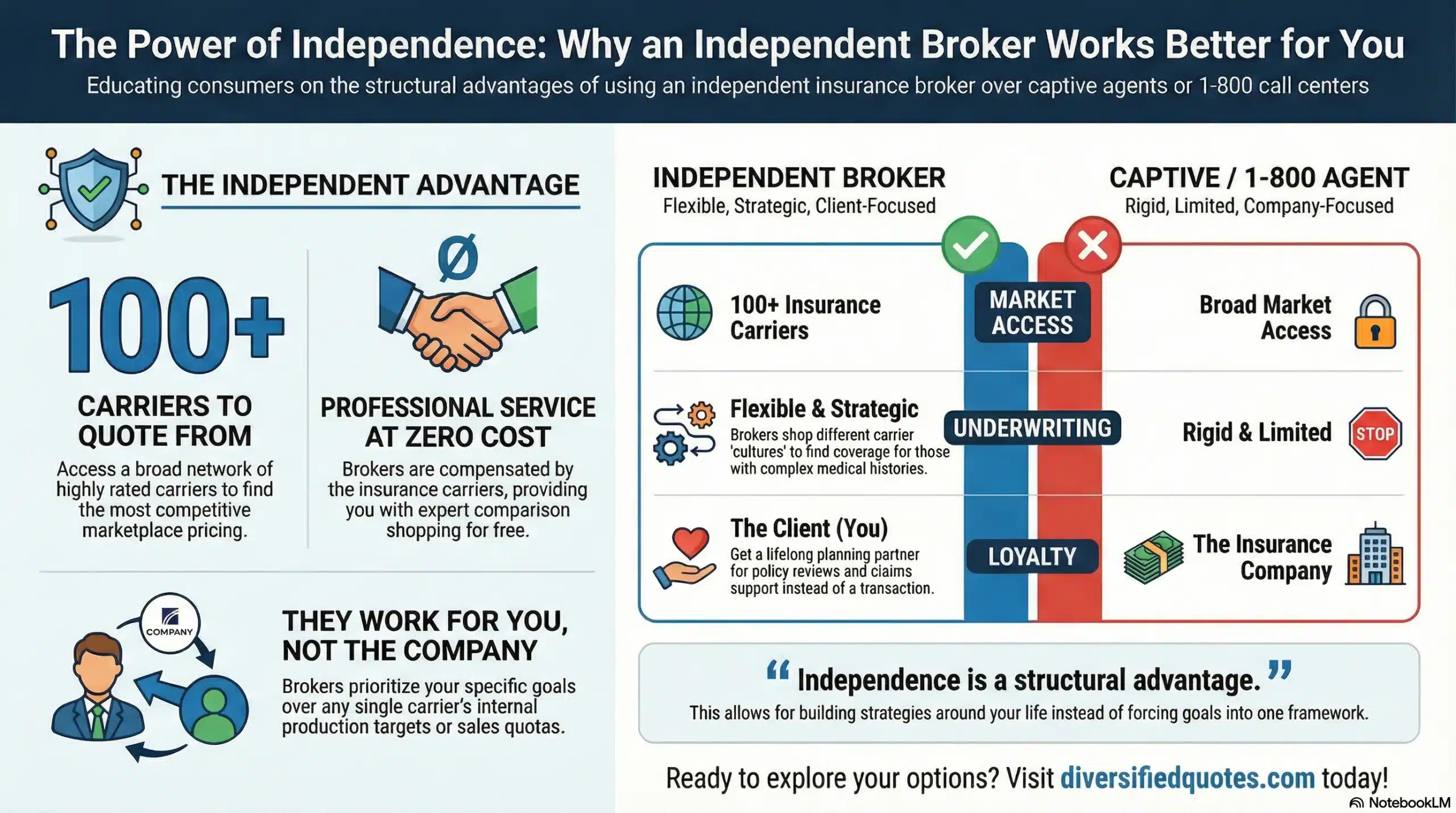
One of the most important factors in getting a meaningful second opinion is who is providing it. A captive agent represents a single carrier — their recommendation is structurally limited to that one company’s products, pricing, and benefit designs regardless of whether that company is the most appropriate match for your specific age, health profile, and coverage goals. An independent long-term care insurance broker can compare multiple carriers objectively and identify which companies are most competitive for your specific situation. Because underwriting, pricing, benefit structures, and available riders vary significantly across carriers, this multi-carrier access consistently produces better outcomes than single-carrier evaluation.
This is particularly important in LTC insurance because carrier participation in the market has changed significantly over the past decade — some carriers that were major LTC providers have exited the market or significantly reduced their product offerings, while other carriers have emerged with competitive designs. The carrier landscape today is genuinely different from even five years ago, which means that an independent broker’s current market knowledge is a meaningful asset in identifying the most competitive available options. Our resource on why to work with an independent long-term care insurance broker covers this structural advantage and what to look for in evaluating an independent LTC broker. Our guide to the best independent long-term care insurance broker provides the selection criteria for identifying who can genuinely serve this specialized market. Our resource on the best long-term care insurance rates provides the current market rate landscape for context in evaluating whether your current quote is competitively priced. Our guide on how to get the best long-term care insurance rates covers the rate optimization strategies including couples discounts and underwriting positioning.
The Underwriting and Health Dimension: Why Acting Before Health Changes Matters
Long-term care insurance uses full medical underwriting — meaning your current health significantly affects both your ability to qualify for coverage and the premium you pay. This creates an important temporal dimension to the second opinion: the right time to correct a poorly structured policy or find better alternatives is while you are still insurable at favorable terms, not after a health event has removed options or significantly increased premiums.
The second opinion process identifies whether better underwriting outcomes are available at alternative carriers for your specific health profile. Different carriers evaluate the same health conditions differently — a condition that produces a decline at one carrier may qualify for standard rates at another with more favorable underwriting for that condition category. Our resources on how to qualify for long-term care insurance, who qualifies for long-term care insurance, and our guide on whether long-term care insurance requires a medical exam cover the underwriting process and how to position a health history for the best available outcome. For applicants with specific health complexity, our resource on long-term care insurance with pre-existing conditions and our guide on LTC insurance for diabetics cover the specific carrier landscape for health-complex applicants. For buyers concerned about their age creating urgency, our resources on whether you can get LTC insurance after age 60, LTC insurance for seniors, and LTC insurance after age 80 address age-related underwriting and coverage options.
How LTC Insurance Fits Into Your Overall Retirement Plan
Long-term care insurance should never be viewed in isolation. It is one component of a broader financial strategy that includes retirement income, asset protection, and estate planning. A well-structured LTC policy complements other assets and income streams rather than replacing them — reducing the probability that a care event forces liquidation of retirement accounts at depressed market prices, disrupts the surviving spouse’s income floor, or eliminates the legacy the household intended to leave.
For individuals who prefer an annuity-based care protection structure, our resources on annuities with long-term care benefits, our guide to the best annuity for lifetime income, and our resource on fixed annuities with long-term care benefits cover the combined income-care structure designs that serve both retirement income generation and care cost protection simultaneously. For the tax planning dimension, our resources on tax advantages of long-term care insurance, tax benefits of LTC insurance, and our guide on whether qualified funds can be used for LTC insurance cover how LTC premium and benefit taxation interacts with your overall income and asset plan. The long-term care insurance calculator allows modeling of benefit amounts, premiums, and projected coverage across different scenarios before committing to a specific design.
Related Pages
LTC policy design resources, hybrid options, underwriting guides, and care planning tools from Diversified Insurance Brokers.
Financial Protection Essentials
Hybrid LTC options, tax advantages, state cost calculators, and retirement protection tools from Diversified Insurance Brokers.
Talk With an Advisor Today
Choose how you’d like to connect—call or message us, then book a time that works for you.
Schedule here:
calendly.com/jason-dibcompanies/diversified-quotes
Licensed in all 50 states • Fiduciary, family-owned since 1980
FAQs: Get a 2nd Opinion on Your Long-Term Care Insurance Quote
Why should I get a second opinion on my long-term care insurance quote?
Long-term care insurance policies can vary significantly in structure, pricing, and long-term performance — even when two quotes look similar on the surface in their premium amounts. The structural differences that matter most — how much the benefit amount will purchase in your specific state 15 to 20 years from now, whether the elimination period is calibrated to your actual liquid assets, whether the benefit period is realistic relative to the care scenarios you face — are often invisible in a first-look premium comparison. A second opinion examines all of these dimensions, not just the premium, and evaluates whether the policy was designed to perform when care is actually needed or whether it was optimized primarily to look affordable on first presentation.
Many individuals who accept their first LTC quote discover through a second opinion that they have insufficient inflation protection that will erode the policy’s purchasing power over time, a benefit period too short for realistic extended care scenarios, an elimination period that does not align with their available liquid assets, or a benefit amount that covers only half or less of what care actually costs in their state. These are structural problems that cannot be corrected after the policy is issued — they must be identified and addressed before the application is complete. Our resource on how to choose the right long-term care insurance policy covers the structural design decisions that a second opinion evaluates.
Can long-term care insurance quotes differ significantly between companies?
Yes — significantly. Different carriers evaluate risk differently, price policies differently, and structure benefits differently. For the same applicant at the same age and health profile, two carriers can produce premiums that differ by 20% to 40% or more, benefit designs that differ materially in how much protection they actually provide, and underwriting decisions that differ — one carrier may decline while another approves at standard rates for the same health history. Without comparing across carriers, it is impossible to know whether you are receiving the most appropriate coverage at a competitive price.
Carrier participation in the LTC market has also changed significantly over the past decade. Some carriers that were major LTC providers have exited or significantly reduced their product offerings. New carriers have entered. The current competitive landscape is genuinely different from what it was even five years ago, which means that a second opinion from an independent broker who tracks current carrier activity is more valuable than a comparison done by someone working with a static product shelf. Our resource on how to get the best long-term care insurance rates covers the rate optimization strategies that an independent carrier comparison enables.
What is the most important feature in a long-term care insurance policy?
There is no single most important feature — the policy’s adequacy depends on all of the key structural elements working together correctly for your specific situation. The benefit amount determines how much the policy pays per month when care is needed; it must be calibrated to actual care costs in your state, not national averages. The benefit period determines how long the policy pays; it must reflect realistic care duration risk including extended scenarios like dementia or Parkinson’s disease that can require multi-year or decade-long care. The elimination period determines how long you must pay for care before the policy begins paying; it must align with your actual liquid asset availability to fund that self-payment period without financial strain. And inflation protection determines whether the benefit amount will keep pace with rising care costs over the 15 to 20 years before care is likely to be needed.
Any one of these elements being wrong can compromise the entire policy’s effectiveness — which is why the second opinion evaluates all four together rather than optimizing any single dimension at the expense of others. Our resource on LTC elimination periods explained covers the elimination period dimension specifically, and our guide on what a long-term care insurance benefit period is covers the duration selection framework. Our resource on LTC with limited-term vs. lifetime benefits addresses the benefit period trade-off between finite and unlimited protection.
Does working with an independent long-term care insurance broker help?
Yes — the difference between an independent broker and a captive agent is structural and significant for LTC insurance. A captive agent or direct carrier representative can only present their carrier’s products. If that carrier’s pricing, underwriting posture, or benefit design is not the best fit for your age, health profile, and coverage goals, the captive agent cannot offer an alternative. An independent broker can compare multiple carriers and benefit designs objectively, identifying which companies are most competitive for your specific situation — not just which products their employer profits from most.
This is especially valuable in LTC insurance because underwriting varies significantly across carriers for the same health conditions. A carrier with conservative underwriting for a specific condition category may decline an applicant that another carrier with favorable experience in that condition would approve at standard rates. An independent broker who knows the underwriting postures of multiple carriers can pre-screen informally before a formal application is submitted, protecting your underwriting record from unnecessary adverse decisions. Our resource on why to work with an independent long-term care insurance broker covers the full advantage framework, and our guide on the best independent long-term care insurance broker provides the selection criteria.
Can I adjust my long-term care policy after purchasing it?
Typically, major structural changes are not available after policy issuance — this is one of the most important reasons to get the design right before the policy is issued rather than correcting it later. The benefit amount, benefit period, elimination period, and inflation protection are generally locked in at issue. Some policies offer future purchase options — provisions that allow you to buy additional coverage at defined future dates without new underwriting — but these provisions have their own specific terms, timing requirements, and cost implications that must be understood when the policy is first purchased. Some carriers also offer automatic benefit increase features that compound coverage upward annually, but these are design features selected at issue, not modifications available after.
If you already own a policy that is not serving your needs — because the benefit amount is too low for current care costs, the benefit period is too short, or the inflation protection is inadequate — the options are limited but not zero. Replacing the policy with a better-designed one requires requalifying medically, which means your current health determines whether replacement is viable. If health has declined since the original purchase, the original policy — even if imperfectly structured — may be preferable to a replacement with better terms that is now unachievable. This is precisely why reviewing the policy design with a second opinion before purchase is so much more valuable than reviewing it years later. Our resource on how to buy long-term care insurance covers the complete purchase process including the decision framework for initial policy design.
What happens if long-term care costs increase over time?
If your policy includes appropriate inflation protection, your benefits grow over time to help keep pace with rising care costs. If the policy has no inflation protection, or simple interest inflation rather than compound, your benefit amount in nominal dollars stays fixed or grows slowly while care costs increase — meaning the policy covers a declining fraction of actual care expenses each year. A policy that covers 80% of nursing home costs in your state at the time of purchase may cover only 50% or 40% of those costs 15 to 20 years later without inflation protection, requiring the household to fund an increasingly large gap from savings.
Compound inflation riders are the most protective for buyers with longer timelines before care is needed — they apply the inflation percentage to the current (growing) benefit amount each year, producing accelerating dollar additions over time. Simple interest riders add the same fixed dollar amount each year and fall significantly behind compound over a 15-to-20-year horizon. Buyers who are already in or near retirement with a shorter expected timeline before care may trade the larger premium of compound inflation for a higher starting benefit at simple or no inflation, depending on their specific financial situation. This trade-off — starting benefit versus inflation rate — is one of the most consequential decisions in LTC policy design and one of the most common areas where first-time quotes miss the mark for the buyer’s actual needs.
Is long-term care insurance still worth it?
For many individuals, long-term care insurance provides valuable protection against one of the largest uninsured financial risks in retirement — extended care costs that can deplete decades of accumulated savings in a few years if no protection is in place. The key is ensuring the policy is structured correctly so it delivers meaningful benefits when needed. A policy that is undersized, lacks inflation protection, or has a benefit period too short for realistic care scenarios may not be worth its premium — but a well-designed policy that covers actual local care costs, includes appropriate inflation protection, and is calibrated to realistic duration risk can provide substantial financial protection that preserves retirement assets, protects spousal income, and maintains estate intentions even through extended care events.
The “worth it” assessment also depends on what alternatives are realistically available. For households with very large liquid asset bases where an extended care event would not materially change their financial situation, self-funding may be rational. For most middle-income and upper-middle-income households where an extended multi-year care event at current state costs would significantly deplete retirement savings, disrupt the surviving spouse’s income, or eliminate planned inheritance, the case for protection is strong. Our resources on whether long-term care insurance is worth it and our guide on whether you should buy long-term care insurance provide the complete analytical framework for this evaluation with realistic cost and protection scenarios on both sides of the decision.
About the Author:
Jason Stolz, CLTC, CRPC, DIA, CAA and Chief Underwriter at Diversified Insurance Brokers (NPN 20471358), is a senior insurance and retirement professional with more than 25 years of real-world experience helping individuals, families, and business owners protect their income, assets, and long-term financial stability. As a long-time partner of the nationally licensed independent agency Diversified Insurance Brokers, Jason provides trusted guidance across multiple specialties—including fixed and indexed annuities, long-term care planning, personal and business disability insurance, life insurance solutions, Group Health, Travel Medical and Evacuation Insurance, and short-term health coverage. Diversified Insurance Brokers maintains active contracts with over 100 highly rated insurance carriers, ensuring clients have access to a broad and competitive marketplace.
His practical, education-first approach has earned recognition in publications such as VoyageATL, and contributions from his agency featured in Kiplinger and GoBankingRates— highlighting his commitment to financial clarity and client-focused planning. Drawing on deep product knowledge and years of hands-on field experience, Jason helps clients evaluate carriers, compare strategies, and build retirement and protection plans that are both secure and cost-efficient. Visitors who want to explore current annuity rates and compare options across multiple insurers can also use this annuity quote and comparison tool.
Get a Second Opinion: Browse our complete 2nd Opinion Quote Review — see how a second opinion from an independent broker could save you money across life, annuity, disability, group health, long term care, and Medicare.
Explore More Long Term Care Insurance Options: Browse our complete guide to How to Buy, Qualify & Coverage Details — covering how to buy, who qualifies, policy types, shared benefits, partnership plans & more from top carriers.
Last Reviewed: June 9, 2026 |
Reviewed by: Jason Stolz, CLTC, CRPC, DIA, CAA
Chief Underwriter, Diversified Insurance Brokers, Inc. | NPN: 20471358 | Diversified Insurance Brokers, Inc. — Licensed in all 50 states
Fact Checked by: Tonia Pettitt, CMIP©
Medicare Specialist, Diversified Insurance Brokers, Inc. | NPN: 14374308 | Diversified Insurance Brokers, Inc. — Licensed in all 50 states
Did you find this content helpful? Leave us a Google review — it helps others find trustworthy guidance too.
Editorial Standards: Diversified Insurance Brokers maintains rigorous editorial standards to ensure accuracy, clarity, and independence in all content. Learn more about our editorial standards and commitment to transparency.
