
Long Term Care Planning Strategies
Long Term Care Planning Strategies

Jason Stolz CLTC, CRPC, DIA, CAA
Planning ahead for long term care is one of the most important financial decisions retirees can make to protect their savings, their independence, and the people they love. Current care costs show assisted living averaging $71,040 annually, semi-private nursing home rooms at $118,500, and private rooms at $129,575 — and care costs have been rising at 3–4% annually. Approximately 70% of adults turning 65 will need some form of long-term care during their lifetime, and roughly 22% will need care for more than five years. The average lifetime care cost for someone with dementia reached $405,262 in 2024. These are not edge-case numbers. They are the planning reality that makes the right long term care planning strategies essential for protecting retirement income, assets, and legacy. At Diversified Insurance Brokers, Jason Stolz, CLTC, CRPC, DIA, CAA, helps families turn a broad concern — what happens if I need care? — into an actual plan built around protecting retirement income and assets so care decisions can be made based on safety and dignity rather than financial pressure.
A sound long-term care plan typically addresses three interconnected questions: how care is most likely to start (often at home, not in a facility), how costs might escalate if needs increase over time through assisted living, memory care, or skilled nursing, and how to protect the household budget and retirement accounts if care lasts longer than the original plan assumed. The point is not to predict the future perfectly — nobody can. The point is to remove the financial surprise from the equation so that whatever happens, the retirement plan survives it. One of the most common and most costly planning errors is assuming Medicare will handle most long-term care costs. Medicare covers certain short-term, medically necessary skilled services in limited situations but is not designed to cover extended custodial long-term care — the kind of ongoing assistance with daily living activities that represents most of what families actually need to fund. Understanding the difference between Medicare and long-term care insurance is the starting point for building a strategy that actually works.
Get a Long Term Care Planning Quote
Compare traditional LTC, hybrid plans, and annuity-based options from top carriers — side by side.
Request a Quote Explore LTC InsuranceWhy Long Term Care Planning Matters
Long-term care planning is fundamentally about maintaining control. When families do not plan, care events force decisions: spending down retirement savings faster than anyone expected, choosing a facility based on availability rather than quality, or asking adult children to step into caregiving roles without the time, training, or financial support to do it sustainably. When a strategy is in place before a care event begins, care decisions can be made based on what is best for the person who needs care rather than what the family can afford on short notice. That shift — from reactive to planned — is what protects both the insured and every person in the family orbit who would otherwise absorb the impact.
Care also tends to arrive in stages rather than as a single dramatic event. A large proportion of care journeys begin at home with modest assistance — meal preparation, bathing help, medication management, transportation — and escalate gradually over months or years as needs progress. For some families, home care remains the entire care journey. For others, it transitions to assisted living, then memory care, then skilled nursing. A strategy built with flexibility across multiple settings is almost always more effective than one designed around a single assumed care path. The long-term care playbook provides the strategic overview that positions all the available tools — insurance, hybrid products, annuity structures, and coordination approaches — within a coherent planning framework before narrowing to specific products. LTC care coordination benefits covers how professional care management at the time of a claim reduces the administrative burden and prevents the documentation errors that delay benefits — a practical dimension of planning that is as important as the coverage design itself.
The Five Core Long Term Care Planning Strategies
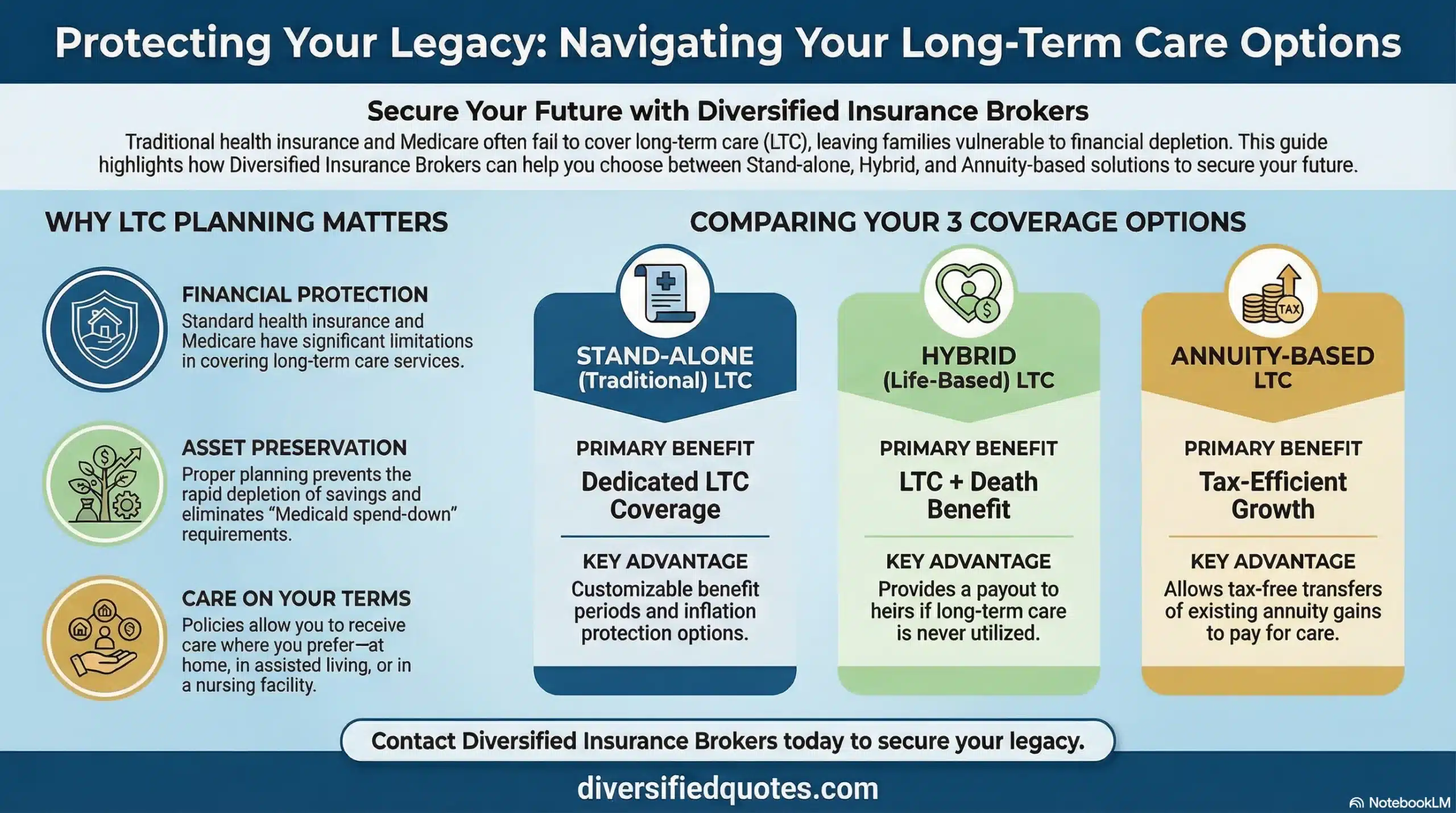
Traditional long term care insurance is a standalone policy designed specifically to fund qualified long-term care services once you meet the policy’s claim triggers — most commonly needing help with at least two Activities of Daily Living or having a qualifying cognitive impairment that requires supervision for safety. The planning advantage of traditional LTC insurance is leverage: you transfer a large, uncertain financial risk to an insurance pool in exchange for access to a structured monthly benefit, a defined benefit pool or benefit period, and the ability to deploy benefits across multiple care settings depending on policy language. Traditional LTC can be the most cost-efficient way to purchase a large amount of potential coverage per premium dollar, particularly when purchased in the 50s or early 60s while health is stronger. Benefit amount, benefit period, elimination period, and inflation protection can be tailored to match the household’s specific financial situation and risk tolerance. How to choose the right long-term care insurance policy covers the design decisions that most affect real-world outcomes, and how to get the best long-term care insurance rates explains how timing, health classification, and carrier selection interact to determine what any specific applicant can realistically expect to pay. For those who want to understand if return-of-premium structures can reduce the “use it or lose it” concern within a traditional LTC framework, long term care insurance with return of premium covers how those designs work and what trade-offs they involve. The tax benefits of long term care insurance are also relevant for households that itemize or have business structures where premium handling affects net cost — tax-favored treatment can meaningfully improve the net cost of coverage in the right situation.
Hybrid life insurance with LTC benefits combines permanent life insurance with long-term care benefits in a single product. If care is needed, the policy can accelerate the death benefit to pay for qualified care expenses or provide structured LTC benefits depending on the contract design. If care is never needed, beneficiaries receive a death benefit rather than the policyholder having paid premiums for coverage that was never triggered. Many families find hybrids compelling because they eliminate the “use it or lose it” concern — the policy delivers value in multiple future scenarios rather than only one. Hybrid premium structures are typically more stable and predictable than traditional LTC designs, which is particularly appealing for retirees concerned about budget strain in later years. For households where legacy planning is a priority, a hybrid design can provide care funding without automatically sacrificing the legacy goal. Hybrid life insurance with long-term care benefits covers the product mechanics in detail, and hybrid life versus traditional long-term care insurance provides the direct comparison that helps households evaluate which structure fits their priorities.
Annuities with long-term care features allow retirees to reposition existing assets — often savings in low-yield accounts — into a contract that can expand the available benefit pool for qualified care expenses when care becomes necessary. In many designs, if care is never needed, the value remains for the account owner or beneficiaries depending on contract structure, which makes this approach particularly attractive for households that are hesitant to commit to an ongoing premium stream but still want leverage and planning structure when care costs arrive. The non-qualified long term care annuity page explains how repositioning strategies work and what trade-offs to evaluate before committing assets to this structure. Annuities with long-term care benefits and fixed annuities with long-term care benefits cover the full range of structures available in this category.
Self-funding or pay-as-you-go means earmarking assets — cash, brokerage accounts, or other accessible reserves — to pay for care out of pocket if it becomes necessary. This strategy can be appropriate for higher-net-worth households that can genuinely absorb large care costs without jeopardizing lifestyle stability, spouse security, or legacy goals. The fundamental limitation is the absence of leverage: a long-duration claim can drain assets faster than most retirees expect, and the timing is rarely convenient. Care events frequently coincide with market volatility, reduced portfolio growth, or other simultaneous retirement expenses. That is why self-funding, when used thoughtfully, is almost always more effective when paired with a partial insurance or annuity layer that limits the “rapid depletion” risk rather than used as the entire strategy with no insurance backstop.
Medicaid planning involves coordinating asset and income positioning to eventually qualify for Medicaid coverage of long-term care costs according to Medicaid eligibility rules. For many households, Medicaid planning is not the preferred primary strategy because it can limit facility choice, involve spend-down requirements, and require strategies that must be implemented years in advance due to look-back rules. However, it is an important planning dimension because Medicaid is the default outcome for families who do not plan earlier. For households with more options, partnership-qualified long-term care insurance provides Medicaid asset protection coordination in a structure that keeps facility choice and care setting flexibility available — combining the protection of insurance leverage with Medicaid eligibility preservation when care eventually exhausts benefits. LTC partnership reciprocity covers how partnership benefit portability works across states for households that may relocate.
Comparison: LTC Planning Strategies at a Glance
Most families do not choose a strategy based on theory alone. They choose based on trade-offs — cost, flexibility, underwriting requirements, and what happens if care is never needed. The table below summarizes the major themes across all five strategies. The real decision is almost always made after matching the strategy to the household’s specific assets, cash flow, health profile, and planning timeline.
| Strategy | Key Advantage | Key Trade-Off | What If Never Used? | Best For |
|---|---|---|---|---|
| Traditional LTC Insurance | Highest leverage per premium dollar; broad multi-setting coverage; tax-favored benefits | Underwriting required; “use it or lose it” if never claimed | Premiums paid with no residual value; coverage simply expires unused | Healthy planners ages 50–65 seeking maximum coverage per dollar |
| Hybrid Life + LTC | Death benefit if no claim; predictable premium; “either way it pays” structure | Higher funding requirement; LTC benefit per dollar less than traditional | Beneficiaries receive death benefit; value retained in household | Retirees wanting dual-purpose coverage and legacy preservation |
| Annuity + LTC Features | Repositions existing low-yield assets; preserves principal; no ongoing premium | Funds committed to contract structure; LTC benefit multiplier varies | Contract value remains for owner or beneficiaries depending on structure | Retirees with existing assets seeking structured care pool without ongoing premiums |
| Self-Funding | Maximum flexibility; no underwriting; no premium commitment | No leverage; long-duration claim can deplete assets rapidly | Assets remain fully available for any use; no insurance cost incurred | Higher-net-worth households who can absorb full care costs without retirement plan disruption |
| Medicaid Planning | Safety net coverage when other strategies are not accessible; no premium requirement | Facility choice limited; look-back rules require early implementation; care setting restrictions | Assets positioned per Medicaid rules; may limit inheritance available to heirs | Limited-asset households; crisis planning; coordination with partnership-qualified LTC |
Who Benefits Most from LTC Planning Strategies?
Long-term care planning provides value across a wide range of household situations, but it is most impactful when care costs would meaningfully disrupt retirement income or require a spouse to drastically change lifestyle in order to manage a care situation that was never planned for. The families who get the most from planning are typically those who act before a crisis forces the decision — because the range of available strategies and the quality of underwriting outcomes both decline as health changes and planning time shrinks.
Retirees in their 50s and early 60s who want access to the widest range of policy designs, the most favorable underwriting classifications, and the most cost-efficient premium structures benefit enormously from acting while options are broadest. Industry data shows that at age 65, comparing three leading insurers for a $165,000 initial benefit pool, annual premiums ranged from $7,137 to $12,250 — a spread of more than $5,000 annually for essentially the same coverage — which underscores both why carrier comparison matters and why earlier planning produces better terms. Couples who want to coordinate benefits so that a prolonged care event for one partner does not permanently impair the other’s financial security benefit from planning that explicitly addresses the household as a unit. Long-term care insurance with shared spousal benefits and long term care insurance with shared benefits cover how benefit pooling strategies protect both partners, and shared care riders in LTC addresses the specific rider mechanism that allows spouses to draw from a combined benefit pool when one partner’s individual benefits are exhausted.
Households with a family history of cognitive decline or other factors that increase concern about longer-duration claims benefit from strategies that specifically address the tail risk. The comparison of limited-term versus lifetime LTC benefits covers how to evaluate whether a lifetime benefit structure is appropriate for a specific household’s risk profile. For families who want to compare the cost structure of their existing or prospective coverage against alternatives in the market, getting a second opinion on your long-term care insurance quote is the most direct path to confirming whether the current plan represents the best available option.
Common Planning Pitfalls and How to Avoid Them
The biggest planning pitfalls almost always originate from mismatched assumptions. People assume care will start in a facility when it typically starts at home. They assume Medicare will pay for extended care when it is not designed for that purpose. They choose benefit amounts without anchoring them to realistic current care costs in the geographic area where they are likely to receive care. They pick a strategy that feels comfortable on the premium basis today but creates significant gaps when care needs do not follow the plan’s assumptions. And they delay acting until a health development narrows their options or eliminates underwriting eligibility for the products that would have best served their planning goals.
The most effective way to avoid those outcomes is to evaluate any proposed strategy across three distinct scenarios: what happens under a short, modest care need that resolves within one to two years; what happens under a prolonged cognitive claim that extends five or more years across multiple settings; and what happens if no care is ever needed and the coverage simply exists as protection that was never triggered. A strategy that holds up well across all three scenarios is almost always the right choice. How to find, evaluate, and apply for long-term care insurance walks through the full analytical process from needs assessment through carrier comparison and application strategy. For applicants whose health history creates underwriting complexity, long-term care insurance with pre-existing conditions addresses how health history affects eligibility and which alternative structures remain available. Guaranteed issue long-term care insurance covers the options available when standard underwriting has been exhausted.
Planning Example: How Strategies Compare for a Real Household
Consider a 62-year-old couple with $750,000 in retirement savings. With a family history of Alzheimer’s disease on one side and a desire to protect each other’s retirement lifestyle, they compare three approaches side by side. A traditional long-term care policy for each spouse provides a defined benefit pool with multi-setting flexibility, a manageable annual premium, and strong inflation protection that grows the benefit over the 15 to 20 years before claims may begin. A hybrid life and LTC policy funded with a single premium creates both a care benefit pool and a death benefit — meaning that if care is never needed, the children inherit rather than premiums having been spent with no residual value. An annuity and LTC structure repositions $200,000 of low-yield savings into a contract that multiplies the available care benefit while preserving the principal base if care is never used.
After evaluating how each plan behaves across three outcome scenarios — a short home-care need of one to two years, a prolonged memory care journey of seven or more years, and no claim ever — the couple identifies which structure aligns best with their two stated priorities: protecting each other’s financial stability if one needs extended care, and preserving meaningful legacy value if neither needs care. The decision is not that one structure is universally superior. It is that the right structure depends on what specific outcome the household is trying to protect against — which is why the planning process must start with the outcome goal rather than the product comparison.
Start Planning for Long Term Care Today
Explore strategies that protect retirement savings, reduce family stress, and keep care choices flexible.
Request Your Quote Explore LTC InsuranceRelated Pages
Additional resources that often pair well with long term care planning conversations.
Financial Protection Essentials
Retirement income and protection tools that often coordinate with long term care planning.
Talk With an Advisor Today
Choose how you’d like to connect—call or message us, then book a time that works for you.
Schedule here:
calendly.com/jason-dibcompanies/diversified-quotes
Licensed in all 50 states • Fiduciary, family-owned since 1980
Frequently Asked Questions: Long Term Care Planning Strategies
What is the best long term care planning strategy?
There is no single best strategy — the right approach depends on the household’s assets, health profile, risk tolerance, cash flow, and planning goals. Traditional LTC insurance provides the most coverage per premium dollar and the broadest multi-setting flexibility, but requires underwriting and the premiums are not recovered if care is never needed. Hybrid life and LTC policies address the “use it or lose it” concern by providing a death benefit if care is never triggered, at the cost of higher funding requirements. Annuity and LTC structures reposition existing assets to create a care funding pool while preserving principal. Self-funding works only for households with substantial liquid assets that can genuinely absorb years of care costs. Most households benefit from comparing all approaches across three scenarios — short care need, prolonged care need, and no claim — before selecting the structure that best addresses their specific priorities.
When is the best time to start long term care planning?
Earlier almost always produces better outcomes. The range of available strategies and the quality of underwriting outcomes both decline as health changes and planning time shrinks. Industry data shows that at age 65, annual premiums for the same $165,000 initial benefit pool ranged from $7,137 to $12,250 across three leading insurers — and premiums are lower at younger ages with better health classifications. Retirees in their 50s and early 60s have access to the widest range of product designs, the most favorable underwriting outcomes, and the most cost-efficient premium structures. Waiting until a health event develops, or until a family member needs care and the urgency becomes clear, consistently produces narrower options, less favorable terms, and sometimes complete ineligibility for the products that would have best served the planning goal.
Does Medicare cover long term care costs?
Medicare does not cover extended custodial long-term care — the ongoing assistance with Activities of Daily Living that represents most of what families actually need to fund. Medicare covers short-term skilled nursing facility care after a qualifying hospital stay under strict conditions: full coverage for days 1 through 20, a daily coinsurance of $204 for days 21 through 100 (as of 2025), and no coverage after day 100. Medicare does not cover home care for ongoing personal assistance, assisted living, or most memory care. Families who assume Medicare will handle long-term care costs are among the most financially unprepared for a care event, because the gap between what Medicare covers and what a multi-year care situation costs can reach hundreds of thousands of dollars.
What are hybrid long term care policies and how do they work?
Hybrid long-term care policies combine permanent life insurance (or sometimes an annuity) with long-term care benefits in a single product. If care is needed and the qualifying trigger is met — typically needing help with two or more Activities of Daily Living or having a qualifying cognitive impairment — the policy provides LTC benefits by accelerating the death benefit or through a dedicated LTC rider. If care is never needed, beneficiaries receive the death benefit rather than premiums having been paid for coverage that was never used. Hybrid policies typically require higher initial funding than comparable traditional LTC coverage, but the “either way it pays” structure eliminates the “use it or lose it” concern that makes traditional LTC premiums psychologically difficult for some households. The specific benefit design — how LTC benefits are triggered, calculated, and paid — varies significantly across products, making detailed contract comparison essential before selecting a hybrid.
How much does long term care insurance typically cost?
Premiums vary significantly based on age at application, health classification, benefit amount, benefit period or pool size, elimination period, and inflation protection provisions. Industry data shows that at age 65 for a $165,000 initial benefit pool, annual premiums ranged from $7,137 to $12,250 across three leading insurers — a spread of more than $5,000 annually for essentially the same coverage, which illustrates why independent carrier comparison produces materially better outcomes than applying to any single company. Premiums are substantially lower at younger ages: the same coverage purchased at 55 costs significantly less than at 65. Inflation protection, which is important for policies purchased decades before care may begin, adds to premium but ensures the benefit amount keeps pace with rising care costs over time. Average monthly premiums in the current market run approximately $165 across all active policyholders, though new policies for comprehensive coverage typically carry higher premiums reflecting the current cost of care environment.
About the Author:
Jason Stolz, CLTC, CRPC, DIA, CAA and Chief Underwriter at Diversified Insurance Brokers (NPN 20471358), is a senior insurance and retirement professional with more than 25 years of real-world experience helping individuals, families, and business owners protect their income, assets, and long-term financial stability. As a long-time partner of the nationally licensed independent agency Diversified Insurance Brokers, Jason provides trusted guidance across multiple specialties—including fixed and indexed annuities, long-term care planning, personal and business disability insurance, life insurance solutions, Group Health, Travel Medical and Evacuation Insurance, and short-term health coverage. Diversified Insurance Brokers maintains active contracts with over 100 highly rated insurance carriers, ensuring clients have access to a broad and competitive marketplace.
His practical, education-first approach has earned recognition in publications such as VoyageATL, and contributions from his agency featured in Kiplinger and GoBankingRates— highlighting his commitment to financial clarity and client-focused planning. Drawing on deep product knowledge and years of hands-on field experience, Jason helps clients evaluate carriers, compare strategies, and build retirement and protection plans that are both secure and cost-efficient. Visitors who want to explore current annuity rates and compare options across multiple insurers can also use this annuity quote and comparison tool.
Explore More Long Term Care Insurance Options: Browse our complete guide to LTC Insurance Costs, Rates & Planning — covering how much it costs, best rates, calculators, planning strategies & is it worth it from top carriers.
Last Reviewed: June 15, 2026 |
Reviewed by: Jason Stolz, CLTC, CRPC, DIA, CAA
Chief Underwriter, Diversified Insurance Brokers, Inc. | NPN: 20471358 | Diversified Insurance Brokers, Inc. — Licensed in all 50 states
Fact Checked by: Tonia Pettitt, CMIP©
Medicare Specialist, Diversified Insurance Brokers, Inc. | NPN: 14374308 | Diversified Insurance Brokers, Inc. — Licensed in all 50 states
Did you find this content helpful? Leave us a Google review — it helps others find trustworthy guidance too.
Editorial Standards: Diversified Insurance Brokers maintains rigorous editorial standards to ensure accuracy, clarity, and independence in all content. Learn more about our editorial standards and commitment to transparency.
