
How to Choose the Right Long Term Care Insurance Policy
As an Independent Long Term Care Insurance Broker, we compare traditional, hybrid, and partnership-qualified policies across dozens of carriers to find the structure that actually fits your situation.
How to Choose the Right Long Term Care Insurance Policy

Jason Stolz CLTC, CRPC, DIA, CAA
Choosing the right long-term care insurance policy is a decision that sits at the intersection of healthcare planning, retirement income strategy, estate preservation, and family dynamics — and getting it wrong carries consequences that compound over decades. Most people approach this decision by comparing monthly premiums, which is the least reliable comparison point available. The premium you pay today on a traditional standalone policy is not guaranteed to remain the same — several major LTC carriers have imposed cumulative premium increases of forty to one hundred percent on in-force policies, requiring state regulatory approval but nevertheless imposing significant financial pressure on policyholders in their retirement years. The right policy choice accounts for carrier financial strength, premium stability history, benefit design that matches actual care preferences, and a structure — traditional, hybrid life/LTC, or annuity-based — that fits the household’s liquidity position, risk tolerance, and retirement income architecture. At Diversified Insurance Brokers, Jason Stolz, CLTC, CRPC, DIA, CAA, works with households across all fifty states to navigate exactly this decision — comparing structures, evaluating carriers, and building a policy design that functions as intended when care is eventually needed.
The starting point is not a policy comparison — it is a set of care preference questions that determine what the policy actually needs to do. Do you want the primary option of receiving care at home, or are you planning primarily for facility-based care? Home care coverage varies significantly between policies and carriers — some policies cover informal care provided by family members; others cover only licensed professional caregivers; others cover home modifications and equipment that extend independent living. If home care is the priority, the home care provisions deserve as much scrutiny as the benefit amount and period. Are you planning specifically against cognitive risk — Alzheimer’s and related dementias now account for a disproportionate share of long-duration care claims, and the care duration distribution for cognitive claims is substantially longer than for physical ADL claims alone? And what is your assumed care duration — are you building a floor against a two-to-three year average claim, or constructing protection against an extended five-to-ten year scenario that, while statistically less likely, represents the most catastrophic financial outcome? The answers to these questions shape every downstream design decision. Our resource on how to find, evaluate, and apply for long-term care insurance covers the three-stage process — structure selection, benefit design, and underwriting positioning — that surrounds the policy choice decision.
Compare LTC Policy Structures Side by Side
Traditional LTC, hybrid life/LTC, and asset-based annuity designs — we compare all three against your health profile, retirement income, and legacy goals with no obligation.
Request Your LTC ComparisonThe Three Policy Structures: What Each One Actually Does
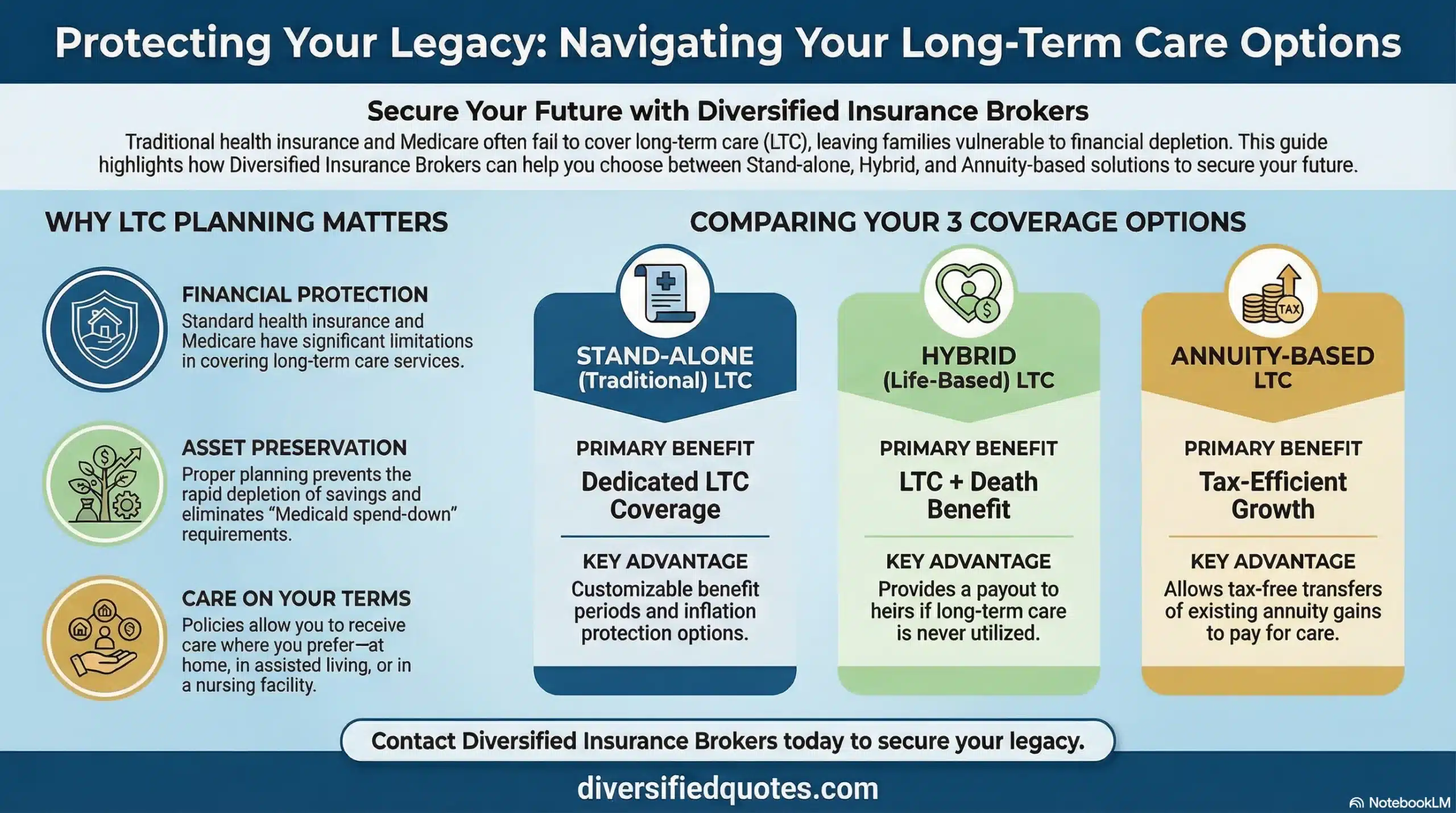
The most consequential policy choice is not benefit amount or inflation rider — it is the structural decision between traditional standalone LTC insurance, hybrid life/LTC insurance, and annuity-based LTC products. Each structure has a distinct financial architecture that produces different outcomes depending on whether care is used, how care is used, what happens if the policyholder dies without needing care, and how the premium interacts with retirement income planning. Understanding these structural differences at the decision stage prevents the common mistake of choosing a structure based on a single feature — the no-risk death benefit of the hybrid, the lower premium of the traditional, or the liquidity of the annuity — without evaluating how the full structure performs against the household’s actual goals.
Traditional standalone LTC insurance is the original product structure — a pure care contract where every premium dollar purchases care coverage and nothing else. Traditional policies typically provide the greatest care benefit per premium dollar among all three structures, particularly for applicants in good health in their fifties who can qualify for preferred health classifications. Monthly premium on traditional policies is lower than hybrid alternatives for the same benefit amount, making them accessible for budget-constrained households where premium affordability is a primary concern. Traditional policies most commonly qualify for state Partnership programs — dollar-for-dollar asset protection against Medicaid spend-down — which hybrid and annuity products typically do not. The significant trade-off is that traditional LTC premiums, while guaranteed renewable, are subject to class-based rate increases that require state regulatory approval. Carriers with conservative pricing philosophies and strong historical rate stability represent meaningfully less risk on this dimension than carriers with histories of aggressive increases. Our resource on whether long-term care insurance is expensive covers how to evaluate the true cost of traditional coverage accounting for both the initial premium and rate increase risk, and our resource on whether LTC insurance is worth the cost frames the comparison against the self-funding alternative.
Hybrid life/LTC insurance combines a permanent life insurance policy with a long-term care benefit rider. The policyholder makes a lump-sum or fixed-period premium deposit — commonly funded with a 1035 exchange from an existing life insurance policy or annuity — and receives three guaranteed outcomes: a defined pool of LTC benefits if care is needed, a death benefit to beneficiaries if care is never needed, and the ability to surrender the policy for a return of premium (typically minus any claims paid) if the situation changes. Hybrid premiums are fixed for life and guaranteed never to increase, which eliminates the rate increase risk that concerns many traditional LTC buyers. The trade-off is that hybrid policies typically cost two to three times more upfront than comparable traditional coverage on a monthly premium basis — because the premium is purchasing both the care coverage and the life insurance component. For households with liquid assets they are willing to reposition — money sitting in low-yield savings, CDs, or non-performing annuities — the hybrid structure is frequently the most efficient use of those assets. Our resources on tax advantages of hybrid LTC policies, Midland National’s income and LTC combination, and American Equity’s income and LTC product cover specific hybrid structures available in the current market.
Annuity-based LTC products reposition a lump-sum asset deposit into a contract that multiplies the deposited amount for qualified long-term care expenses. A healthy 60-year-old depositing $100,000 into a qualified LTC annuity might generate $300,000 to $500,000 or more in available long-term care benefits over the policy’s benefit period, while also maintaining access to the original principal if care is not needed and passing the remaining value to beneficiaries at death. The benefit multiplication factor and product design varies significantly across carriers. Annuity-based LTC structures are particularly appropriate for households with existing non-qualified annuities or CDs they want to reposition — a 1035 exchange from an existing annuity into a qualified LTC annuity can be accomplished without triggering a taxable event on the embedded gain. Our resources on North American’s income and LTC product and Ceres Life’s income product cover specific annuity-based options for applicants evaluating asset repositioning strategies.
Traditional vs. Hybrid LTC: A Structured Comparison
| Factor | Traditional Standalone LTC | Hybrid Life/LTC or Annuity/LTC |
|---|---|---|
| Premium structure | Ongoing monthly or annual; subject to class-based rate increases with state approval | Fixed lump sum or fixed-period payment; guaranteed never to increase |
| Care benefit per dollar | Highest — pure leverage, every premium dollar purchases care coverage | Lower — premium purchases both care coverage and life insurance or annuity component |
| If care is never needed | Premiums paid produce no financial return — use-it-or-lose-it structure | Death benefit or return of premium passes to beneficiaries; premium produces guaranteed value |
| Partnership qualification | Typically qualifies — provides dollar-for-dollar Medicaid asset protection | Typically does not qualify for Partnership programs |
| Liquidity | Premiums paid are not retrievable if policy is lapsed; low upfront commitment per month | Return-of-premium surrender option typically available; large upfront commitment |
| Ideal household profile | Budget-conscious, strong cash flow, comfortable with rate increase risk, wants maximum care leverage and Partnership access | Has repositionable assets, wants guaranteed premium, concerned about use-it-or-lose-it, values death benefit as estate planning tool |
Carrier Selection: The Most Overlooked Policy Decision
After the structure decision, carrier selection is the most important and most frequently shortchanged step in the LTC policy evaluation process. Long-term care insurance promises must be honored twenty, thirty, or more years from the date of purchase — a time horizon that makes carrier financial strength and rate history far more predictive of actual policy value than any feature comparison at the time of issue. Selecting a carrier for a LTC policy requires evaluating five dimensions that standard premium comparisons ignore entirely: AM Best financial strength rating (A or higher is the threshold; anything below A introduces real solvency risk for a policy held for life); the carrier’s state-filed rate increase history (publicly available from state insurance commissioner websites); the carrier’s current in-force block size and claims experience; the carrier’s underwriting appetite for the specific applicant’s health profile; and whether the carrier is actively writing new policies (carriers that have exited the market no longer innovate products but do continue administering in-force blocks, which can affect service quality and future rate pressure).
For traditional LTC, the carriers with the most established track records for financial strength and claims service include Mutual of Omaha, New York Life, Northwestern Mutual, and National Guardian Life. For hybrid life/LTC, the most competitive products come from Nationwide (CareMatters II), Lincoln Financial, OneAmerica (Asset Care), Pacific Life, and MassMutual. For annuity-based LTC, Mutual of Omaha’s LTC annuity, OneAmerica, and several FIA-based LTC products offer competitive structures. None of these carrier relationships is static — product availability, underwriting guidelines, and pricing change, which is why working with an independent specialist who monitors the current market is more reliable than a static carrier ranking. Our resource on the long-term care playbook covers the full carrier evaluation framework, and our resource on finding an independent insurance broker covers what independent access to the carrier market provides that single-carrier recommendations cannot.
Reimbursement vs. Indemnity: A Policy Feature That Determines Claims Experience
One of the most consequential and least-discussed policy design features is whether benefits are paid on a reimbursement basis or an indemnity basis. A reimbursement policy pays up to the monthly benefit maximum for actual qualifying care costs incurred — the policyholder submits receipts and the carrier reimburses documented expenses up to the cap. An indemnity policy pays the full monthly benefit amount whenever the benefit trigger is satisfied, regardless of the actual cost of care received — if the benefit trigger is met and the monthly benefit is $6,000, the policy pays $6,000 regardless of whether actual care costs were $3,000 or $9,000. Indemnity policies provide the most flexibility for home-based care, informal care arrangements, and situations where the policyholder wants to manage care decisions without submitting receipts for every expense. Many hybrid policies are structured as indemnity or cash benefit products. Traditional standalone policies are more commonly reimbursement-based, though indemnity options exist. The distinction matters most for home care: a reimbursement policy that requires professional licensed caregivers may not cover care provided by an adult child or friend, while an indemnity policy pays the full benefit once the trigger is satisfied regardless of who provides the care. Our resource on LTC insurance with lifetime benefits covers how indemnity and reimbursement structures interact with lifetime and extended benefit periods.
Integrating LTC Policy Choice With Retirement Income Architecture
The LTC policy decision cannot be made in isolation from the retirement income plan it protects. The elimination period — the waiting period before benefits begin — must be coordinated with liquid reserves or guaranteed income sources that can cover care costs during that window. A 90-day elimination period on a traditional policy requires the household to fund potentially $15,000 to $30,000 of care costs before benefits begin; that liquidity needs to exist in the retirement income architecture or the elimination period becomes a financial hardship rather than a premium optimization tool. A household with strong guaranteed income from Social Security, pensions, or annuities that exceeds fixed living expenses has more capacity to self-fund the elimination period than a household drawing primarily from volatile investment accounts.
The benefit amount selection should account for existing income sources that would continue during a care event. A person with $5,000 per month in guaranteed retirement income who faces $8,000 per month in care costs needs a policy that covers the $3,000 gap — not necessarily the full $8,000. Sizing the benefit to cover only the gap between guaranteed income and anticipated care costs reduces premium meaningfully while preserving adequate protection. Our resource on lifetime income annuities covers how guaranteed income floors interact with LTC planning, and our resource on annuities as a pension alternative addresses how to construct that guaranteed income floor before LTC coverage is needed. For the Social Security dimension of this coordination — specifically how Social Security claiming timing affects the income available during a care event — our resources on when to start Social Security and how Social Security and annuities work together address the integrated planning approach that produces a more stable retirement income floor before and during a care event.
Talk With an Advisor Today
Choose how you’d like to connect—call or message us, then book a time that works for you.
Schedule here:
calendly.com/jason-dibcompanies/diversified-quotes
Licensed in all 50 states • Fiduciary, family-owned since 1980
Frequently Asked Questions: How to Choose the Right Long-Term Care Insurance Policy
Should I choose a traditional LTC policy or a hybrid life/LTC policy?
The right structure depends on the household’s financial profile, risk tolerance, and retirement income architecture — not a universal preference for one type over the other. Traditional standalone LTC insurance provides the greatest care benefit per premium dollar, typically qualifies for state Partnership programs that protect assets from Medicaid spend-down, and carries the lowest initial monthly premium. The significant risk is that traditional premiums are subject to class-based rate increases that require state regulatory approval but have historically been substantial at some carriers. Hybrid life/LTC insurance provides guaranteed premiums that can never increase, produces value whether care is needed or not (death benefit or return of premium), and eliminates the use-it-or-lose-it concern. The trade-off is that hybrid policies typically cost two to three times more upfront than comparable traditional coverage — because the premium purchases both the care coverage and the life insurance component — and hybrid policies typically do not qualify for Partnership programs. For households with repositionable assets, guaranteed premium certainty, and estate planning objectives, hybrid is frequently the better structural fit. For budget-conscious households in good health who want maximum care leverage and Partnership access and are comfortable evaluating carrier rate stability, traditional may deliver more protection per dollar. Our resource on the long-term care playbook covers both structures with a decision framework for determining which fits specific household profiles.
How do LTC insurance premium increases work and how do I choose a carrier less likely to increase?
Traditional standalone LTC insurance premiums are guaranteed renewable — the carrier cannot cancel the policy for any reason as long as premiums are paid — but they are not guaranteed level. Carriers can request class-based rate increases from state insurance regulators, and several major carriers have imposed cumulative increases of forty to one hundred percent on in-force policies over the past two decades. Rate increases require state approval, cannot target individual policyholders, and must be justified by demonstrated changes in claims experience or actuarial assumptions — but when approved, they apply to all policyholders in the same rate class. Evaluating carrier rate history before purchase is the most reliable available signal of future premium stability. State insurance commissioners publicly list every rate increase filing by carrier — this public record allows comparison of how aggressively or conservatively each carrier has priced and managed its in-force block. Carriers with conservative pricing philosophies, strong AM Best ratings (A or higher), large in-force blocks relative to their capital reserves, and limited rate increase histories represent meaningfully lower premium stability risk than carriers with histories of aggressive increases. Hybrid policies eliminate this risk entirely through fixed guaranteed premiums — which is why rate increase concern is one of the most common reasons households choose the hybrid structure despite its higher upfront cost. Our resource on whether LTC insurance is expensive covers how to evaluate total lifetime cost including rate increase probability.
What is the difference between a reimbursement policy and an indemnity policy?
A reimbursement LTC policy pays up to the monthly benefit maximum for actual documented qualifying care costs — the policyholder submits receipts or invoices and the carrier reimburses covered expenses up to the cap. A month with $4,000 in actual costs receives a $4,000 benefit even if the monthly cap is $6,000. An indemnity policy pays the full monthly benefit amount whenever the benefit trigger is satisfied — if the monthly benefit is $6,000 and the trigger conditions are met, the policy pays $6,000 regardless of whether actual care costs were $3,000 or $9,000 that month. Indemnity policies provide significantly more flexibility for home-based care arrangements, informal care by family members, and situations where the policyholder wants to manage care decisions without tracking and submitting every expense. Many hybrid life/LTC policies are structured as cash indemnity benefits. Traditional standalone policies are more commonly reimbursement-based, though indemnity options exist at some carriers. The distinction matters most if home care is a priority — a reimbursement policy that requires licensed professional caregivers may not cover care provided by family, while an indemnity policy pays the full benefit once triggered regardless of caregiver identity. If family-provided care at home is part of the plan, an indemnity or cash benefit structure is worth the additional premium scrutiny it requires.
What is a 1035 exchange and how can it fund a hybrid LTC policy?
A 1035 exchange is a tax-free transfer mechanism under Internal Revenue Code Section 1035 that allows the owner of an existing life insurance or annuity contract to transfer its accumulated value into a new life insurance, annuity, or — since the Pension Protection Act of 2006 — a qualified long-term care insurance policy or hybrid life/LTC or annuity/LTC contract, without triggering a taxable event on any embedded gain. This makes the 1035 exchange a highly efficient way to fund a hybrid LTC policy: an existing annuity with $150,000 in value and $60,000 in embedded gain that would normally generate a substantial tax bill if surrendered can instead be moved directly into a hybrid LTC policy, allowing the full $150,000 to generate care benefits without any tax being paid on the transfer. The same applies to overfunded life insurance policies, low-performing variable annuities, or CDs where the owner has a strong desire to improve their long-term care coverage position without liquidating and reinvesting through a taxable event. Not every 1035 exchange meets the IRS qualification requirements — the transfer must follow specific rules, and the receiving contract must qualify under the applicable code provisions. Working with an independent advisor who understands both the tax mechanics and the LTC product market is essential for executing this strategy correctly. Our resource on Roth conversion strategies addresses the broader tax-efficient asset repositioning context in which 1035 exchanges often fit as part of a retirement tax planning sequence.
How should couples approach the LTC policy decision together?
Couples face a more complex LTC planning decision than individuals because the financial impact of one spouse needing care falls directly on the other spouse’s retirement security. The primary risk is that extended care costs for one spouse deplete the household’s shared savings, leaving the healthy spouse with inadequate resources for their own remaining years — potentially decades. A well-designed couple strategy addresses both spouses’ individual insurability, the shared financial exposure, and the benefit pool structure that provides adequate coverage for a higher-need claimant. Shared care riders on traditional standalone policies allow the couple to access a combined benefit pool, providing additional coverage runway if one spouse’s individual policy benefits are exhausted. For hybrid products, joint-life options from carriers like Nationwide CareMatters Together and OneAmerica Asset Care cover two insureds under a single policy with shared benefit pool access. Couples who apply together typically receive multi-life discounts — often ten to thirty percent below the sum of two individual policies. The optimal couple strategy also considers health differences: a spouse in better health may qualify for preferred underwriting that locks in lower premiums, while a spouse with health conditions may need to be matched to the carrier whose underwriting guidelines are most favorable for their specific profile. Our resource on survivorship joint whole life insurance covers the life insurance structure that complements LTC coverage for couples whose estate planning objectives include both income protection and legacy transfer.
How does LTC insurance coordinate with my Social Security and retirement income?
LTC insurance is most effectively designed when it is positioned as the gap-filler between guaranteed retirement income and the actual cost of care — rather than as coverage for the total cost of care regardless of other income sources. A household with $5,000 per month in guaranteed Social Security and annuity income facing $8,000 per month in assisted living costs needs $3,000 per month of LTC benefit, not $8,000. Sizing the benefit to cover only the gap between guaranteed income and anticipated care costs reduces premium meaningfully while preserving adequate protection. The guaranteed income floor — Social Security plus any pension or annuity income — also funds the elimination period, allowing the household to weather the 90-day waiting period before LTC benefits begin without drawing from investment accounts under financial stress. A strong guaranteed income floor from Social Security and lifetime income annuities therefore reduces both the benefit amount needed from the LTC policy and the liquidity required to self-fund the elimination period. This is why LTC planning and retirement income planning are most effectively done together rather than sequentially. Our resources on Social Security planning services and delayed retirement credits address the Social Security claiming decisions that build the guaranteed income floor LTC coverage then protects.
What are the tax advantages of LTC insurance and hybrid policies?
Tax-qualified traditional LTC insurance offers two principal tax advantages. First, premiums are partially deductible as a medical expense subject to age-based IRS limits — limits that increase with age and are adjusted annually. The deduction is available to itemizers who exceed the 7.5% AGI floor for medical expenses, and significantly more favorable for self-employed individuals, C-corporations, and S-corporation shareholders above two percent who can deduct premiums as a business expense without the AGI floor constraint. Second, benefits paid by a tax-qualified LTC policy are received income-tax-free, making the after-tax cost of LTC insurance materially more favorable than the gross premium suggests. Hybrid life/LTC policies offer an additional layer of tax efficiency: when funded through a 1035 exchange from an existing annuity or life insurance policy with embedded gain, the full accumulated value transfers into the hybrid policy without triggering income tax on the gain. Benefits paid from the LTC rider of a hybrid policy funded with after-tax dollars are generally received tax-free. For business owners, Section 105 medical expense reimbursement arrangements and C-corporation deduction structures can make traditional LTC premiums fully deductible as a business expense, producing an after-tax cost that is substantially lower than the gross premium. Our resource on tax advantages of LTC and hybrid policies covers the deduction rules and benefit taxation mechanics in detail.
What questions should I ask before choosing a specific LTC policy?
Eight questions to ask before committing to any LTC policy: First, is this carrier rated A or higher by AM Best, and what is its rate increase history in my state? Second, is the premium fixed for life (hybrid) or subject to class-based increases (traditional), and can my retirement budget sustain the worst-case increase scenario? Third, is the benefit paid on a reimbursement basis or an indemnity/cash basis, and does the benefit design cover informal home care by family members? Fourth, what is the elimination period, and do I have sufficient guaranteed income or liquid reserves to cover care costs during that window without financial stress? Fifth, does the policy include inflation protection, and if so, is it compound or simple, and at what annual growth rate? Sixth, does the policy qualify for my state’s Partnership program? Seventh, is the care trigger based on two of six ADLs, cognitive impairment, or both, and does the definition of impairment align with how care need is actually assessed? Eighth, are there care coordination services — nurse case managers who assess care needs and help navigate care options — included in the policy, and how does the carrier’s claims process actually work for policyholders who need to activate benefits? Our resource on finding the best independent insurance broker covers how an independent specialist navigates these questions across multiple carriers simultaneously rather than presenting only the products one carrier offers.
About the Author:
Jason Stolz, CLTC, CRPC, DIA, CAA and Chief Underwriter at Diversified Insurance Brokers (NPN 20471358), is a senior insurance and retirement professional with more than 25 years of real-world experience helping individuals, families, and business owners protect their income, assets, and long-term financial stability. As a long-time partner of the nationally licensed independent agency Diversified Insurance Brokers, Jason provides trusted guidance across multiple specialties—including fixed and indexed annuities, long-term care planning, personal and business disability insurance, life insurance solutions, Group Health, Travel Medical and Evacuation Insurance, and short-term health coverage. Diversified Insurance Brokers maintains active contracts with over 100 highly rated insurance carriers, ensuring clients have access to a broad and competitive marketplace.
His practical, education-first approach has earned recognition in publications such as VoyageATL, and contributions from his agency featured in Kiplinger and GoBankingRates— highlighting his commitment to financial clarity and client-focused planning. Drawing on deep product knowledge and years of hands-on field experience, Jason helps clients evaluate carriers, compare strategies, and build retirement and protection plans that are both secure and cost-efficient. Visitors who want to explore current annuity rates and compare options across multiple insurers can also use this annuity quote and comparison tool.
Explore More Long Term Care Insurance Options: Browse our complete guide to How to Buy, Qualify & Coverage Details — covering how to buy, who qualifies, policy types, shared benefits, partnership plans & more from top carriers.
Last Reviewed: June 11, 2026 |
Reviewed by: Jason Stolz, CLTC, CRPC, DIA, CAA
Chief Underwriter, Diversified Insurance Brokers, Inc. | NPN: 20471358 | Diversified Insurance Brokers, Inc. — Licensed in all 50 states
Fact Checked by: Tonia Pettitt, CMIP©
Medicare Specialist, Diversified Insurance Brokers, Inc. | NPN: 14374308 | Diversified Insurance Brokers, Inc. — Licensed in all 50 states
Did you find this content helpful? Leave us a Google review — it helps others find trustworthy guidance too.
Editorial Standards: Diversified Insurance Brokers maintains rigorous editorial standards to ensure accuracy, clarity, and independence in all content. Learn more about our editorial standards and commitment to transparency.
