
Long Term Care Insurance Calculator
As an Independent Long Term Care Insurance Broker, we compare traditional, hybrid, and partnership-qualified policies across dozens of carriers to find the structure that actually fits your situation.
Long Term Care Insurance Calculator

Jason Stolz CLTC, CRPC, DIA, CAA
Long-term care expenses can disrupt a retirement plan — especially when care starts at home and later shifts into assisted living or skilled nursing. This Long Term Care Insurance Calculator is designed to give you a quick premium estimate based on your age, gender, marital status, benefit amount, benefit duration, and inflation protection. If you’re considering long-term care coverage, the first question is usually “How much will it cost me?” — and the numbers shown are estimates that help you understand how each variable changes the pricing before you request real carrier quotes. Actual rates depend on underwriting class, benefit structure, carrier pricing, health history, and state-specific factors. At Diversified Insurance Brokers, Jason Stolz, CLTC, CRPC, DIA, CAA helps clients nationwide compare coverage designs that match real-world care planning needs — including traditional LTC, hybrid life and LTC designs, shared care structures for couples, and tax-advantaged strategies that leverage existing assets.
Long-term care planning is one of the most important and most often delayed conversations in retirement preparation. The reason it gets delayed is understandable: the subject feels distant and the cost feels uncertain. This calculator addresses the cost uncertainty directly by showing how the major design variables interact to produce a premium range. Before comparing real carrier options, understanding the levers — age, benefit, duration, inflation protection — gives you the planning vocabulary to evaluate real quotes intelligently. Our resource on is long-term care insurance worth it covers the broader value framework — when the math favors coverage versus self-insuring, how the claim statistics affect the planning calculus, and how different household situations change the answer. Our companion resource on how much long-term care insurance costs provides benchmark pricing by age and benefit level that contextualizes the calculator estimates against real carrier pricing ranges.
Want Real Quotes, Not Just Estimates?
Use the quote request form to compare traditional LTC, hybrid options, and annuity-based LTC strategies matched to your age, health profile, and goals.
Request Long Term Care Quotes Call 800-533-5969Use the Long Term Care Insurance Calculator
Step 1: Submit Your Info to Access the Calculator
This keeps estimates behind a simple lead form so we can help you compare real carrier options if you want a full review.
What Affects the Cost of Long-Term Care Insurance?
Long-term care premiums vary based on age, gender, benefit design, duration, and whether you include inflation protection. Two people can select the same monthly benefit but get very different pricing if one is older, has a different health history, or chooses a longer benefit duration. The goal of this calculator is to show how those levers change the estimate so you can quickly identify a comfortable premium range. Understanding these variables is also the foundation for making intelligent coverage decisions — because long-term care insurance is not a one-number purchase. It is a design decision with many interdependent components. Our resource on how to choose the right long-term care insurance policy covers the full decision framework — from benefit amount sizing to elimination period selection — that turns calculator estimates into an actual coverage plan.
Age is the biggest pricing driver. The younger you apply, the lower your premiums tend to be for the same coverage — especially before the mid-60s. Waiting can also reduce eligibility and limit carrier options if new health conditions arise. Our resource on can you still get long-term care insurance after age 60 covers the specific underwriting dynamics that shift as applicants move into their mid-60s and beyond — including which policy types remain available and how health history affects the pricing and eligibility picture in later age brackets. Gender also matters. Women often pay more because claim likelihood and claim duration tend to be higher. For couples, coordinated plan designs can sometimes improve affordability for both spouses compared to two separate individual policies.
Benefit amount and benefit duration change the math quickly. Higher monthly benefits and longer durations increase the premium because the potential claim size is larger. Many households choose a benefit that covers a meaningful portion of costs rather than trying to cover 100% of every scenario. For coverage that never runs out regardless of how long care is needed, our resource on long-term care insurance with lifetime benefits covers how unlimited benefit period designs work and when they make financial sense relative to policies with defined benefit durations. Inflation protection is a trade-off — adding 3% inflation increases cost, but it can help reduce the risk of being underinsured later. Our resource on is long-term care insurance expensive provides additional context on how today’s premium compares to the financial exposure of an uninsured care event, which is the most practical frame for evaluating whether the cost is actually “expensive” relative to the risk it addresses.
LTC Insurance Cost Drivers — How Each Variable Affects Premium Estimates
The table below maps each major cost variable to its low-cost and higher-cost profile, and explains the planning implication of each trade-off. This reference is designed to help you use the calculator more effectively by showing why specific input combinations produce the estimates they do.
| Cost Variable | Lower-Cost Profile | Higher-Cost Profile | Planning Implication |
|---|---|---|---|
| Age at application | Ages 50–57 — premiums lowest, broadest carrier options, strongest underwriting eligibility | Ages 65–79 — significantly higher premiums, more limited carrier options, higher health scrutiny | Every year of delay increases premiums — applying at 55 vs. 65 can represent 50–100% or more premium difference for the same benefit |
| Gender | Male — lower base pricing at most carriers due to shorter average claim duration | Female — higher base pricing due to statistically longer care events and higher lifetime claim costs | For couples, applying together under coordinated designs often produces better combined pricing than two individual applications at female rates |
| Marital status | Married — couples discounts available at most carriers when both partners apply; shared care pool options available | Single — no couples discount; full individual pricing; no shared benefit pool available | Married couples who apply together often see the most significant premium improvement relative to individual applications |
| Monthly benefit amount | $2,000–$3,000/month — modest benefit that covers a portion of care costs; highest household financial participation | $5,000–$7,000+/month — higher benefit approaching or exceeding full coverage of local care costs; much larger premium | Covering the “gap” between household income and care cost is often more affordable than insuring 100% — right-sizing the benefit is the most impactful planning decision |
| Benefit duration | 2–3 years — covers the most statistically common care event length; lower premium; most common choice | 6–9 years or lifetime — provides protection against long care events (dementia, ALS, Parkinson’s); substantially higher premium | Average care events cluster around 2–3 years; longer durations protect against the tail risk of extended care — particularly relevant for cognitive decline planning |
| Inflation protection | No inflation protection — lowest premium; benefits remain flat at issued amount; works best when care is expected soon or when affordability is the priority | 3% compound inflation — benefits grow each year; highest premium but most protection against future cost increases | Younger applicants (50s) benefit most from inflation protection since care may be 20–30 years away; older applicants may optimize for premium affordability instead |
| Health history | Excellent health — preferred rate class; highest carrier eligibility; lowest actual underwritten premium | Significant health conditions — rated premium or decline; reduced carrier options; may require hybrid or guaranteed issue alternatives | Health history is not captured in this calculator but materially affects actual pricing and eligibility — applying before health changes occur is the strongest financial protection argument for earlier action |
| Policy type | Traditional LTC — most affordable premium for equivalent benefit; “use it or lose it” structure; no return of premium if unused | Hybrid life + LTC — higher premium or lump sum; death benefit if LTC is not used; no “wasted premium” concern | The right policy type depends on assets available, household concerns about unused premiums, and how the LTC benefit fits into the overall estate plan — not just premium level |
How We Help You Find the Right Coverage
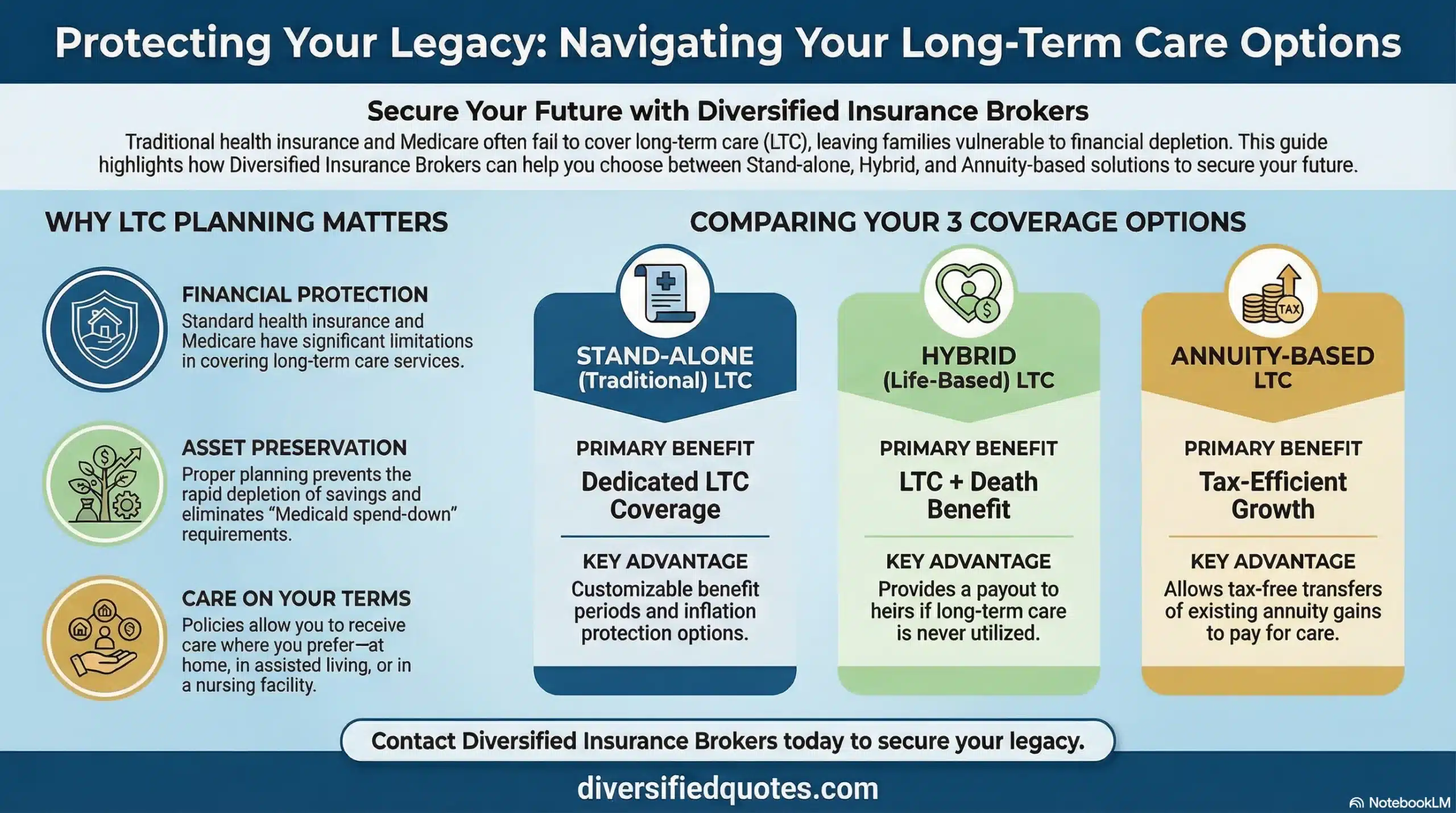
At Diversified Insurance Brokers, we help you compare coverage designs that match the real-world way care tends to unfold. That can include traditional LTC, hybrid life + LTC designs including policies that can be used overseas, shared care structures for couples, and tax-advantaged strategies that leverage existing assets. For clients who want to understand how the federal tax treatment works before selecting a coverage structure, our resource on tax advantages of long-term care insurance and hybrid policies covers the Section 7702B qualified LTC deductibility rules, how hybrid life and LTC policies are taxed at claim, and how using qualified retirement funds can interact with LTC premium payments. For clients who want to understand the key differences between policy types before requesting quotes, our resource on hybrid life vs. traditional long-term care insurance maps the most important structural differences and the planning situations where each type typically outperforms the other.
We are family-owned, licensed in all 50 states, and independent — so the goal is to help you compare strategy choices, not push a single company or a one-size-fits-all plan. You can explore the full range of options through our long-term care insurance services hub, which covers the full product landscape from traditional LTC through hybrid and annuity-based LTC strategies. If tax efficiency is a priority alongside coverage planning, our resource on tax-free long-term care insurance covers how benefits are received and under what circumstances LTC claim proceeds are treated as tax-free income — an important consideration when sizing the benefit and choosing the policy structure. For clients whose health history makes standard underwriting uncertain, our resource on long-term care insurance for diabetics covers how one of the most common health conditions that affects underwriting is evaluated across different carriers and policy types. For a comprehensive look at how pricing compares across age and benefit levels, our resource on best long-term care insurance rates provides the broader rate comparison context that transforms calculator estimates into a real carrier evaluation.
Get Personalized LTC Quotes
Compare traditional LTC, hybrid options, and annuity-based LTC strategies — matched to your age, health profile, and goals. This calculator is a strong first step; real quotes give you the full picture.
Request Long Term Care Quotes Call 800-533-5969Related Long-Term Care Pages
Policy structure guides, spousal planning resources, asset-funded LTC strategies, and coverage eligibility resources.
Financial Protection Essentials
Adjacent retirement and income protection resources for households coordinating LTC planning with broader financial planning.
Talk With an Advisor Today
Choose how you’d like to connect—call or message us, then book a time that works for you.
Schedule here:
calendly.com/jason-dibcompanies/diversified-quotes
Licensed in all 50 states • Fiduciary, family-owned since 1980
Long-Term Care Insurance Calculator — Frequently Asked Questions
This calculator estimates an approximate monthly premium based on your age, gender, marital status, monthly benefit amount, benefit duration, and whether you include 3% inflation protection. The numbers are directional — they are designed to help you understand how each variable affects cost so you can identify a comfortable premium range before requesting real carrier quotes. Two people can select the same monthly benefit and get very different estimates depending on age, gender, and benefit structure, which is exactly what this tool is built to show.
No. These are estimates only. Real quotes depend on underwriting class, health history, carrier pricing, benefit structure, and state-specific factors that this calculator cannot capture. The estimate gives you a useful starting point for understanding the cost range and how design choices affect premiums, but actual rates will vary — sometimes meaningfully — once underwriting and carrier-specific pricing are applied. Use the quote request form to compare real carrier options and see what your specific profile would actually look like across multiple plans.
Age is typically the single largest pricing driver in long-term care insurance. The younger you are when you apply, the lower your premiums tend to be for the same coverage — especially before the mid-60s. This is because insurers price based on the expected number of years premiums will be collected before a claim, and because younger applicants generally have better health profiles and more carrier options available to them. Waiting to apply does not just mean paying higher premiums later — it can also reduce eligibility if new health conditions arise in the meantime, which is why earlier planning almost always produces better outcomes.
Pricing differs by gender because claim likelihood and average claim duration differ between men and women. Women statistically have longer care events and higher lifetime claim costs, which is reflected in how carriers price coverage. This does not mean women should avoid coverage — it means the plan should be sized and structured intentionally so it remains affordable over time. For couples, coordinated plan designs can sometimes improve affordability for both spouses compared to purchasing two separate individual policies.
Inflation protection causes your benefits to grow over time, which helps reduce the risk of being underinsured when care is actually needed — often many years in the future. Adding 3% inflation increases the premium estimate because the potential future benefit is significantly larger than what you start with. Whether inflation protection is the right choice depends on how many years you expect before care is likely needed and how you are balancing affordability against future coverage adequacy. For younger applicants with a longer runway to a potential claim, inflation protection is often a higher priority. For applicants focused on near-term affordability, there are designs that structure inflation differently.
This calculator applies an estimated couples discount for married applicants to reflect how some carrier pricing models work when underwriting and plan designs are coordinated for two people. Many carriers offer discounted rates for married or partnered applicants, particularly when both individuals apply together. The exact discount varies by carrier and is one of the reasons that couples who apply together often see meaningfully better pricing than if each person applied separately. This is reflected in the estimate as a general directional difference — actual couples pricing will depend on the specific carrier and plan design.
No. Health history and current medications are not captured by this calculator, but they can materially change both pricing and eligibility with real carriers. Some health conditions result in a rated premium — meaning a higher price than the standard estimate — while others may lead to postponement or decline depending on the carrier and the specific condition. This tool is designed to provide directional guidance on how benefit design choices affect cost before underwriting is applied. Once you request real quotes, health history becomes part of the evaluation and the actual pricing will reflect your specific profile.
A common planning approach is to size the monthly benefit to cover a meaningful portion of expected care costs in your area rather than trying to insure every dollar. Many households choose a benefit that reduces worst-case financial exposure — for example, covering the most expensive phase of care or protecting the healthy spouse’s income — rather than attempting 100% coverage of every scenario. Duration works similarly: longer benefit periods increase the premium, but they provide more protection if care extends longer than expected. Balancing benefit amount and duration against what the household can comfortably sustain as a premium is usually the most practical starting point, and a full quote review can help map out the tradeoffs across different design combinations.
Yes. The age dropdown supports ages 50 through 79 with complete estimates across that range. This age range reflects the most common window when people evaluate long-term care coverage — early enough to qualify for better pricing and broader underwriting options, but close enough to retirement that the planning conversation is timely. If you are outside this range or have specific health considerations, the quote request form is the better starting point for a personalized review.
Use the quote request form on this page to compare real carrier options across traditional LTC, hybrid life and LTC designs, and annuity-based LTC strategies. At Diversified Insurance Brokers, we are independent and licensed in all 50 states, which means we compare options across multiple carriers rather than recommending a single company or plan type. Once you submit your information, we map out coverage designs that match your age, health profile, budget, and goals — so you can see real numbers and make a decision with full context rather than estimates alone.
About the Author:
Jason Stolz, CLTC, CRPC, DIA, CAA and Chief Underwriter at Diversified Insurance Brokers (NPN 20471358), is a senior insurance and retirement professional with more than 25 years of real-world experience helping individuals, families, and business owners protect their income, assets, and long-term financial stability. As a long-time partner of the nationally licensed independent agency Diversified Insurance Brokers, Jason provides trusted guidance across multiple specialties—including fixed and indexed annuities, long-term care planning, personal and business disability insurance, life insurance solutions, Group Health, Travel Medical and Evacuation Insurance, and short-term health coverage. Diversified Insurance Brokers maintains active contracts with over 100 highly rated insurance carriers, ensuring clients have access to a broad and competitive marketplace.
His practical, education-first approach has earned recognition in publications such as VoyageATL, and contributions from his agency featured in Kiplinger and GoBankingRates— highlighting his commitment to financial clarity and client-focused planning. Drawing on deep product knowledge and years of hands-on field experience, Jason helps clients evaluate carriers, compare strategies, and build retirement and protection plans that are both secure and cost-efficient. Visitors who want to explore current annuity rates and compare options across multiple insurers can also use this annuity quote and comparison tool.
Explore More Long Term Care Insurance Options: Browse our complete guide to LTC Insurance Costs, Rates & Planning — covering how much it costs, best rates, calculators, planning strategies & is it worth it from top carriers.
Last Reviewed: June 15, 2026 |
Reviewed by: Jason Stolz, CLTC, CRPC, DIA, CAA
Chief Underwriter, Diversified Insurance Brokers, Inc. | NPN: 20471358 | Diversified Insurance Brokers, Inc. — Licensed in all 50 states
Fact Checked by: Tonia Pettitt, CMIP©
Medicare Specialist, Diversified Insurance Brokers, Inc. | NPN: 14374308 | Diversified Insurance Brokers, Inc. — Licensed in all 50 states
Did you find this content helpful? Leave us a Google review — it helps others find trustworthy guidance too.
Editorial Standards: Diversified Insurance Brokers maintains rigorous editorial standards to ensure accuracy, clarity, and independence in all content. Learn more about our editorial standards and commitment to transparency.
