
Get a 2nd Opinion on Your Life Insurance Quote
As an Independent Life Insurance Broker, we compare rates across 100+ carriers and prescreen every application before submission.
Get a 2nd Opinion on Your Life Insurance Quote

Jason Stolz CLTC, CRPC, DIA, CAA
Getting a life insurance quote is easy. Getting the right life insurance quote is something entirely different. Most people assume that once they receive a premium estimate — whether online, through a captive agent, or from a quick application — the pricing and structure they see is accurate, competitive, and appropriate for their situation. In reality, life insurance pricing and underwriting vary dramatically depending on the carrier, how the application is presented, and how your health and lifestyle profile is interpreted by that specific company’s underwriting team. The quote you received may be reasonable. It may also be 20% to 40% higher than what the right carrier would offer for the same coverage, or structured in a way that creates problems later — limited conversion options, misaligned term length, riders that don’t fit your planning goals, or an underwriting class that doesn’t reflect what the market would actually assign.
At Diversified Insurance Brokers, we routinely review life insurance quotes and active policies where the original offer was overpriced, submitted to the wrong carrier for the applicant’s profile, or structured in ways that don’t serve the household’s long-term financial goals. We are an independent, fiduciary insurance agency licensed in all 50 states with access to more than 100 top-rated carriers — which means we compare the full market rather than a single company’s product shelf. A second opinion costs nothing, takes very little time, and can produce outcomes ranging from meaningful premium savings to improved coverage structure to access to carriers that are materially more favorable for your specific health or lifestyle profile. Our resource on why to work with an independent life insurance broker explains the structural advantage that independent market access provides throughout the life insurance shopping and underwriting process.
Request a Professional Second Opinion
We’ll review your current life insurance quote and compare it across top-rated carriers to ensure you’re getting the best possible outcome.
Request a ReviewCall 800-533-5969
See Real-Time Rates Side by Side
Compare coverage amounts and term lengths across 100+ top-rated carriers. Use as a baseline before your second opinion review.
Already have a quote? Call 800-533-5969 or submit your quote for a full review →
Why Life Insurance Quotes Vary So Much — And Why It Matters
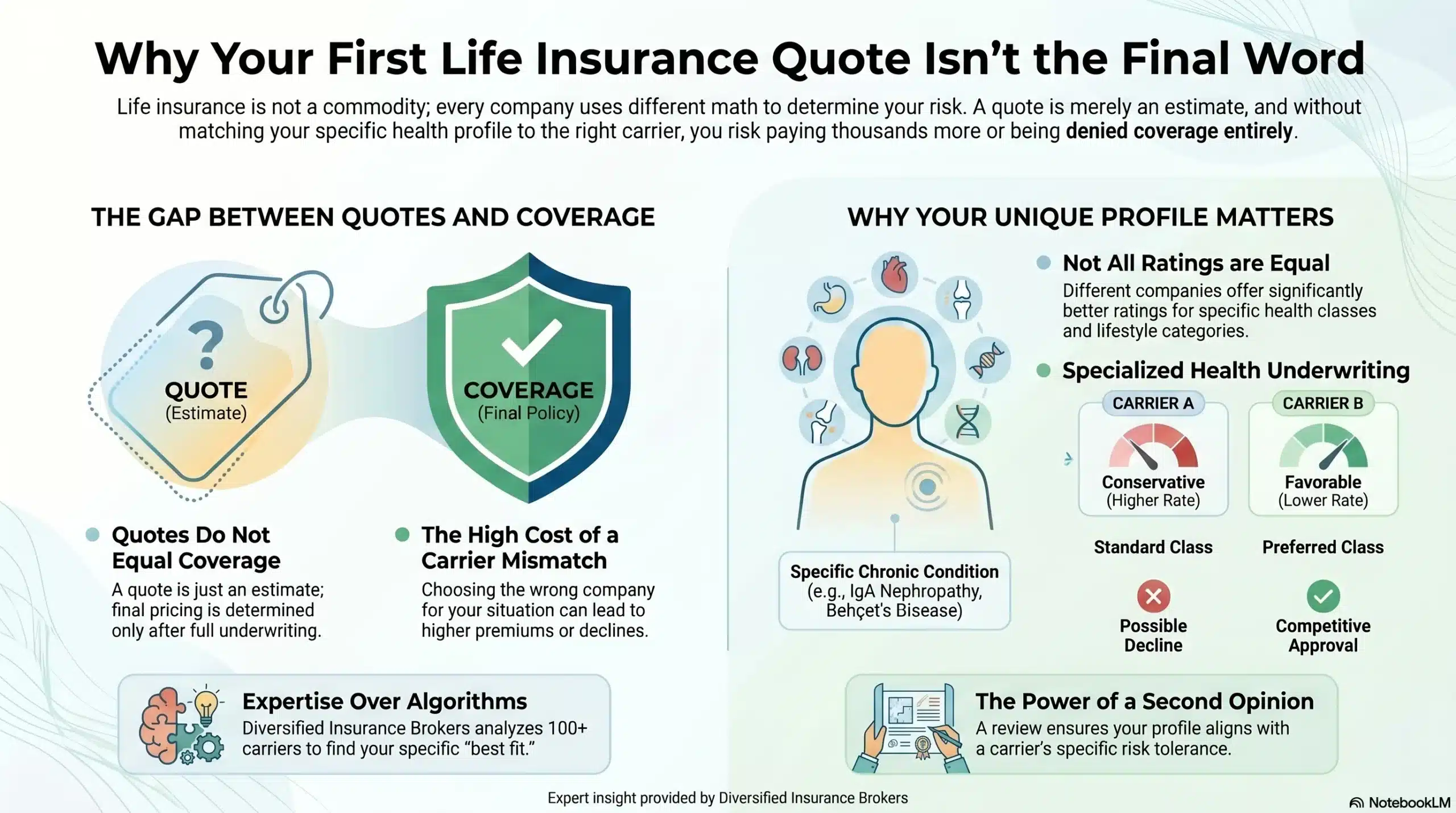
Life insurance is not a commodity where all providers offer the same product at different prices for the same outcome. It is a deeply carrier-specific product where the same applicant profile can produce meaningfully different premiums, underwriting classes, and structural terms across different companies — all legitimately, because each carrier has its own actuarial model, risk tolerance, and underwriting philosophy for the hundreds of variables that go into an individual life insurance decision.
Carrier-to-carrier variation is largest and most consequential in three areas. The first is health-based underwriting. Different carriers evaluate identical health histories differently — a well-controlled hypertension history that produces Standard Plus at one carrier may produce Standard at another and Preferred at a third. A cancer diagnosis in remission for eight years that triggers a decline at one carrier may produce a Table 2 offer at another and a Standard offer at a specialized carrier with favorable actuarial experience in that condition category. The second is avocation and lifestyle underwriting. Mountaineers, pilots, scuba divers, and other applicants with elevated-risk activities see the widest carrier-to-carrier variation because each carrier’s specific guidelines for these risks differ substantially. The third is build underwriting. Each carrier uses its own height/weight charts with different thresholds for each rate class, and an applicant who is just outside the Preferred range at one carrier may be comfortably within it at another.
Our resources on life insurance table ratings explained, what a flat extra is in life insurance, and how to pre-screen a life insurance application explain the specific mechanics that drive these carrier-to-carrier differences — and why pre-screening before formal application produces better outcomes than applying blindly and accepting whatever comes back.
The Four Most Common Reasons a Life Insurance Quote Is Wrong for You
| Problem Type | What It Looks Like | What a Second Opinion Does |
|---|---|---|
| Carrier mismatch | Applied to a carrier with conservative underwriting posture for your specific health history, build, or avocation | Identifies carriers with favorable postures for your specific profile; submits to the right company first |
| Incomplete or poorly framed underwriting information | Application left gaps or framed health history in ways that triggered conservative assumptions | Reviews the file for completeness and case presentation; fills gaps that underwriters would otherwise fill with worst-case assumptions |
| Product mismatch | Term length, face amount, or product type don’t align with the household’s actual financial obligations and planning horizon | Evaluates term length, laddering opportunities, and product type against the specific planning goals |
| Missing future flexibility | Policy lacks conversion rights, appropriate rider options, or structural features needed for long-term planning | Reviews conversion provisions, rider availability, and structural features against future planning needs |
How the MIB Record Makes Getting It Right the First Time More Valuable
One of the most significant but least-discussed consequences of applying to the wrong carrier is what happens to your underwriting record. The Medical Information Bureau (MIB) is a shared database used by most major life insurance underwriters. When you submit a formal application and a decision is rendered — including adverse decisions like table ratings, declines, and exclusion riders — that activity is typically reported to the MIB. When a subsequent carrier orders an MIB report as part of your next application, they can see prior adverse decisions. This can make each subsequent application progressively harder as carriers see a trail of unfavorable outcomes and apply more conservative assumptions.
This is why the sequence of carrier selection and application submission matters as much as the quality of the application itself. Applying to five carriers without pre-screening — and receiving three adverse outcomes before finding a favorable carrier — is a significantly worse starting position than pre-screening across those same five carriers, identifying the two most favorable, and submitting only to those. The second approach produces better premium outcomes, better underwriting class outcomes, and a cleaner MIB record for any future coverage needs. Our resource on what MIB is in insurance explains how the system works and how it affects sequential applications. Our guide on how to pre-screen a life insurance application covers the process that protects the underwriting record while identifying the most favorable carrier options.
When a Second Opinion Is Most Valuable
A second opinion is valuable in any life insurance situation, but certain specific scenarios produce the most meaningful improvements in outcomes. Recent declinations are the clearest case: a decline from one carrier does not mean the applicant is uninsurable. Different carriers have different underwriting thresholds for the same conditions, and applicants who were declined at one company often qualify — sometimes at standard or near-standard rates — at carriers with more favorable actuarial experience in the relevant condition category. Our resource on what to do if nobody will insure you for life insurance and our guide to the best life insurance for pre-existing conditions cover the carrier landscape for applicants who have faced previous adverse outcomes.
Higher-than-expected table ratings are another strong trigger for a second opinion. If an applicant received a Table 4 or higher at the original carrier, the question is not whether to accept that rating — it is whether a different carrier with more favorable underwriting posture for that specific condition combination would rate the same profile at Table 2 or Standard. The premium difference between Table 4 and Standard on a $1,000,000 policy can represent $20,000 to $50,000 in total premium over a 20-year term — a comparison that takes very little time to make through a pre-screening process but that has a significant financial impact if the better outcome is available. Our resources on life insurance table ratings explained and the best high-risk life insurance companies provide the underwriting landscape context for applicants evaluating alternative carriers after a table-rated offer.
Quotes that came from a single captive agent or a direct-to-consumer platform represent a third strong trigger for a second opinion. Captive agents represent one company — their comparison is limited to that company’s product options at that company’s pricing. Direct-to-consumer platforms provide real-time quotes based on assumed health classes that may not survive full underwriting. Neither approach provides the full-market comparison that an independent broker can provide by pre-screening across 100+ carriers. Our resource on best life insurance rates and our guide on how to get the best life insurance rates provide the market context for understanding what full-market comparison can produce.
Changing life circumstances — a new marriage, a new child, a significant income increase, a new mortgage, or a health improvement — make a policy review equally valuable for existing coverage holders. The policy that was right three years ago may be under-sized, over-sized, or structurally misaligned with where life is now. Our resources on reviewing your life insurance policy and our annual beneficiary review checklist provide the maintenance framework for keeping coverage aligned with evolving circumstances.
What We Evaluate in a Second Opinion Review
A proper second opinion review goes beyond comparing the headline premium to a competing carrier’s quote. It evaluates the full context of the quote: whether the underwriting class reflected in the premium actually matches what the applicant’s health profile would produce through full underwriting; whether better carriers exist for the specific combination of health history, lifestyle, and avocation factors present; whether the policy structure — term length, face amount, conversion provisions, rider selection — aligns with the household’s actual financial goals and planning horizon; and whether the MIB record has any prior adverse entries that require strategic management in the carrier selection and submission approach.
For applicants with health history, we specifically evaluate which carriers have the most favorable actuarial experience with the relevant conditions — not just which carrier offers the lowest generic online rate for a healthy 35-year-old. Our resource on life insurance with pre-existing conditions and our guide on how to get life insurance with health issues cover the carrier-selection framework for health-complex applications. For applicants with avocational risk factors — mountaineering, scuba diving, aviation, motorsports — our high-risk life insurance services cover the specialized underwriting approach these cases require. For tobacco users or those transitioning off nicotine, our resource on life insurance for smokers covers the carrier landscape and timing strategy.
For the structural side of the review — policy type, term length, laddering, conversion rights — our resources on the life insurance laddering guide, converting term to permanent life insurance, and how much life insurance you need provide the structural framework for evaluating whether the existing policy design is appropriate or could be improved. For applicants whose health or financial situation has changed since the original application, our resource on how much life insurance costs provides current market pricing context across different health classes and ages.
For Applicants Who Were Declined or Are Concerned About Future Insurability
A decline from one carrier is not a permanent verdict on insurability — it is that specific carrier’s assessment of your specific profile at that specific time. Different carriers have different thresholds, and conditions that trigger declines at conservative carriers frequently produce approvals at carriers with more favorable actuarial experience in those condition categories. The challenge after a decline is that the MIB record now includes the adverse decision, which means subsequent applications are more complex — not impossible, but requiring more strategic carrier targeting.
For applicants who have been declined or who are concerned about insurability, several specific pathways remain available. Simplified issue life insurance uses a streamlined health questionnaire without full medical underwriting and can provide meaningful coverage for applicants who cannot qualify for fully underwritten products. Guaranteed issue products provide coverage with no health questions at all, though typically at lower face amounts and higher per-thousand premiums. Our resources on guaranteed issue life insurance under age 50, no-exam life insurance, and our guide on what to do if nobody will insure you cover these alternative pathways in full. And for applicants with specific complex health histories who want to understand their options across the full market, our best life insurance for pre-existing conditions resource covers the carrier landscape for the most commonly evaluated health histories.
Related Pages
Underwriting strategy guides, high-risk life insurance resources, and coverage planning tools from Diversified Insurance Brokers.
Compare Term Life Insurance Lengths
Explore different term periods to find coverage that best matches your timeline and budget.
Financial Protection Essentials
Underwriting resources, disability insurance, long-term care, and retirement income tools from Diversified Insurance Brokers.
Compare Term Life Insurance Lengths
Explore different term periods to find coverage that best matches your timeline and budget.
Talk With an Advisor Today
Choose how you’d like to connect—call or message us, then book a time that works for you.
Schedule here:
calendly.com/jason-dibcompanies/diversified-quotes
Licensed in all 50 states • Fiduciary, family-owned since 1980
FAQs: Get a 2nd Opinion on Your Life Insurance Quote
Is it worth getting a second opinion on a life insurance quote?
Yes — and for most applicants who have not already compared across the full carrier market through an independent broker, a second opinion produces meaningful improvements in at least one important dimension of the policy. For some applicants it produces lower premiums for the same coverage. For others it produces a better underwriting class — Preferred instead of Standard, or Standard instead of Table 2 — that reflects the actual risk profile more accurately than the first carrier’s assessment. For applicants with health history, it often identifies carriers that are genuinely more favorable for specific conditions rather than applying a generic conservative posture to any health complexity.
Even when the second opinion confirms that the original quote was already competitive, that confirmation has real value: it converts a decision made under uncertainty into a decision made with confidence. The process costs nothing and takes very little time. The potential upside — hundreds to thousands of dollars in annual premium savings over a 20 or 30-year policy term, or access to better coverage structure — is substantial enough that the decision to get a second opinion is almost always worth making. Our resource on best life insurance rates provides the market context for understanding what the current competitive landscape looks like across different ages and health classes.
How often are life insurance quotes inaccurate?
Initial online quotes and early agent quotes are frequently not the final premium — they are estimates based on assumed health classifications (typically Preferred or Standard) that may or may not survive full medical underwriting. For applicants with any meaningful health history, the gap between the initial estimate and the final underwritten premium can be significant. Some applicants receive better-than-estimated rates when underwriting confirms a health profile that qualifies for a better class than initially assumed. Others receive worse-than-estimated rates when health factors or lab results produce a lower class assignment than the initial estimate assumed.
Beyond the accuracy of any single carrier’s quote, the more important question is whether the quote represents the best available market outcome for the specific profile — regardless of whether it matches the initial estimate. A quote that perfectly matched the initial estimate but was obtained from a carrier with a conservative posture for the applicant’s health profile may still be 20% to 30% higher than what a more favorably positioned carrier would offer for the same coverage at the same health class. Our resource on how to get the best life insurance rates covers the strategies that produce the most competitive final outcomes across the full underwriting process.
Can I get a better rate after already applying?
Yes — in many cases. If the original application was submitted to a carrier that is not well-suited for the applicant’s specific profile, applying to a more favorably positioned carrier can produce better underwriting class outcomes and lower premiums — even for the same health history and the same coverage amount. The carrier selection decision is often more impactful on the final premium than any other single variable in the underwriting process, and selecting the wrong carrier first does not preclude selecting a better carrier subsequently.
The important nuance is the MIB record: an adverse outcome from the first application — a table rating, a decline, an exclusion rider — is reported to the MIB database and visible to subsequent carriers. This does not make a better outcome impossible, but it does make strategic carrier targeting more important for the second application than it would have been for the first. Our resource on what MIB is in insurance explains this record-keeping system and its implications for sequential applications.
What information is needed for a second opinion review?
The most useful starting point for a second opinion review is the existing quote or policy document showing the coverage amount, term length, premium, and underwriting class. Beyond that, the same information that goes into any life insurance application is relevant: age, height and weight, health history including all diagnoses, medications, and treatments, tobacco and nicotine use history, family history for the major conditions carriers evaluate, driving record, occupation, and any avocational activities (sports, hobbies, travel). If a full application was submitted and an offer was received, having the offer letter or a summary of the underwriting decision helps identify specifically where carrier selection or case presentation may have produced a suboptimal outcome.
You do not need to have a formal quote in hand to start. Many second opinion conversations begin with a profile discussion — describing the health history and coverage goals — from which we can pre-screen across carriers to identify the most favorable options before any formal application is submitted. This pre-screening approach protects the MIB record while identifying the best available market result for the specific profile. Our resource on how to pre-screen a life insurance application explains the process in detail.
Will getting a second opinion affect my current application?
No — reviewing your options through an independent broker does not negatively impact an existing application that is still in process. An independent broker consultation does not create a formal application record, does not access your MIB file, and does not trigger any communication with the carrier you originally applied to. It is an advisory and comparison process that happens entirely outside the formal application system until you decide to formally submit a new application to an identified alternative carrier.
If a formal application is in process and an offer has been extended but not yet accepted, you typically have a defined window to accept or decline. Reviewing alternatives during that window is entirely appropriate and does not forfeit the existing offer — you can evaluate both options and select the most favorable one. If an offer has been accepted and a policy is in force, a second opinion review evaluates whether replacement with a better-suited policy makes financial sense given the current policy’s structure, premium, and remaining convertibility or flexibility provisions.
Is there a cost to get a second opinion on life insurance?
No — independent life insurance brokers provide comparison reviews and guidance as part of their standard service. Brokers are compensated by the insurance carrier when a policy is placed, not by the consumer — which means the review, the comparison across carriers, the pre-screening process, and the underwriting strategy guidance are all provided at no direct cost to you regardless of whether you ultimately purchase a policy through the broker. There is no fee for the second opinion, no obligation to purchase, and no charge for the time invested in the review and comparison process.
This is one of the important structural differences between independent brokers and fee-based financial advisors for life insurance: the broker’s value is realized through better market access and better underwriting outcomes rather than through explicit advisory fees. The incentive alignment is also reasonable: the broker earns compensation only when coverage is placed, which means the broker’s interest is in finding coverage that is genuinely suitable and that the applicant is motivated to purchase. Our resource on why to work with an independent life insurance broker covers this compensation structure and the related independence advantages in more depth.
What if I was declined for life insurance?
A decline from one carrier is not a final verdict on insurability — it is that specific carrier’s underwriting decision based on its specific guidelines applied to your specific profile at that specific time. Different carriers have different underwriting thresholds, different actuarial experience with specific conditions, and different risk tolerances. Conditions that trigger declines at conservative carriers frequently produce approvals — sometimes at standard or near-standard rates — at carriers with more favorable postures for those condition categories. The key is identifying which carriers those are before submitting a formal application, rather than experiencing additional adverse MIB entries from poorly targeted subsequent applications.
If fully underwritten options are not available through any carrier, simplified issue life insurance (which uses a condensed health questionnaire without full medical underwriting) and guaranteed issue life insurance (which uses no health questions at all) provide coverage pathways regardless of health history. Our resources on guaranteed issue life insurance under age 50, no-exam life insurance, and our guide on what to do if nobody will insure you cover these alternative pathways. Our resource on the best life insurance for pre-existing conditions covers the carrier landscape for the most common health conditions associated with declinations.
How do I know if my existing policy needs to be replaced or just reviewed?
Policy replacement — purchasing a new policy to replace an existing one — is appropriate when the existing policy’s premium, coverage structure, or underwriting class no longer reflects the best available market option for the policyholder’s current age, health, and financial situation. It is not appropriate when the existing policy’s early-year cost basis, existing health protections (the policy cannot be cancelled or repriced based on future health changes), or accumulated conversion rights would be lost in the replacement without being exceeded by the improvement in the new policy. The decision requires a specific comparison, not a general preference for “newer” coverage.
A review without replacement is appropriate when the primary questions are about beneficiary designations, coverage amount adequacy, term length alignment with current financial obligations, or rider provisions — areas that may be addressable through policy modifications without starting over. Our resources on reviewing your life insurance policy, the annual beneficiary review checklist, and beneficiary designation mistakes cover the maintenance framework for keeping existing coverage optimally aligned without unnecessary replacement. Our group vs. individual life insurance resource provides context for applicants evaluating whether to supplement or replace employer-provided group coverage with individual portable protection.
About the Author:
Jason Stolz, CLTC, CRPC, DIA, CAA and Chief Underwriter at Diversified Insurance Brokers (NPN 20471358), is a senior insurance and retirement professional with more than 25 years of real-world experience helping individuals, families, and business owners protect their income, assets, and long-term financial stability. As a long-time partner of the nationally licensed independent agency Diversified Insurance Brokers, Jason provides trusted guidance across multiple specialties—including fixed and indexed annuities, long-term care planning, personal and business disability insurance, life insurance solutions, Group Health, Travel Medical and Evacuation Insurance, and short-term health coverage. Diversified Insurance Brokers maintains active contracts with over 100 highly rated insurance carriers, ensuring clients have access to a broad and competitive marketplace.
His practical, education-first approach has earned recognition in publications such as VoyageATL, and contributions from his agency featured in Kiplinger and GoBankingRates— highlighting his commitment to financial clarity and client-focused planning. Drawing on deep product knowledge and years of hands-on field experience, Jason helps clients evaluate carriers, compare strategies, and build retirement and protection plans that are both secure and cost-efficient. Visitors who want to explore current annuity rates and compare options across multiple insurers can also use this annuity quote and comparison tool.
Get a Second Opinion: Browse our complete 2nd Opinion Quote Review — see how a second opinion from an independent broker could save you money across life, annuity, disability, group health, long term care, and Medicare.
Explore More Life Insurance Options: Browse our complete guide to Life Insurance Ownership & Policy Management — covering reviewing, selling & understanding your existing policy, riders, taxes & claims from 100+ carriers.
Last Reviewed: June 9, 2026 |
Reviewed by: Jason Stolz, CLTC, CRPC, DIA, CAA
Chief Underwriter, Diversified Insurance Brokers, Inc. | NPN: 20471358 | Diversified Insurance Brokers, Inc. — Licensed in all 50 states
Fact Checked by: Tonia Pettitt, CMIP©
Medicare Specialist, Diversified Insurance Brokers, Inc. | NPN: 14374308 | Diversified Insurance Brokers, Inc. — Licensed in all 50 states
Did you find this content helpful? Leave us a Google review — it helps others find trustworthy guidance too.
Editorial Standards: Diversified Insurance Brokers maintains rigorous editorial standards to ensure accuracy, clarity, and independence in all content. Learn more about our editorial standards and commitment to transparency.
