
Guaranteed Issue Life Insurance Under Age 50
As an Independent Life Insurance Broker, we compare rates across 100+ carriers and prescreen every application before submission.
Guaranteed Issue Life Insurance Under Age 50

Jason Stolz CLTC, CRPC, DIA, CAA
Guaranteed issue life insurance under age 50 occupies a specific and often misunderstood corner of the life insurance market. For most healthy adults under 50, the words “guaranteed issue” never come up — because traditional underwriting produces approvals quickly and at competitive rates without requiring the certainty-first structure that guaranteed issue provides. The people who search for guaranteed issue life insurance under age 50 are almost always searching for a reason: a prior decline that closed the traditional door, a health history complex enough that the underwriting outcome feels unpredictable, a recent diagnosis that hasn’t yet stabilized, or a situation where the certainty of approval matters more than the premium efficiency that comes from medical underwriting. Understanding what guaranteed issue coverage actually provides — and what it does not — is the foundation for deciding whether it is the right path or whether another no-exam option would serve the same goal at better terms.
Guaranteed Issue Life Insurance — No Health Questions
Coverage you cannot be turned down for. This is non-graded, guaranteed issue life insurance — meaning the full death benefit is in force from day one, with no two-year waiting period. Available as both term and whole life. The only requirement to qualify is that you are actively working at least 20 hours per week at the time you apply.
✔ Guaranteed acceptance — no medical exam, no health questions
✔ Non-graded — full coverage immediately, not phased in
✔ Your choice of term or whole life (or BOTH!)
✔ One simple qualification — working 20+ hours per week when you apply
At Diversified Insurance Brokers, Jason Stolz, CLTC, CRPC, DIA, CAA works with 100+ carriers across the guaranteed issue, simplified issue, and fully underwritten life insurance markets — which means the comparison is always the starting point rather than an assumption about which product type a client needs. Guaranteed issue life insurance under age 50 is genuinely available from specific carriers in most states, but it is less common and more restricted than the senior-market GI products that most people encounter in advertising. The right answer for any individual client under 50 depends on their specific health history, their coverage goal, what alternatives remain available despite a prior decline or complex health profile, and whether the graded benefit structure of a GI policy is consistent with what they actually need. Our resource on life insurance with a prior decline covers the full strategy for navigating coverage after a prior underwriting decision, and our resource on high-risk life insurance covers the broader market for applicants whose health profile makes traditional underwriting uncertain.
See Real-Term Rates Side by Side
Life Insurance Quoter
Confirm What’s Available in Your State — No Obligation
We check GI availability under 50 for your state, explain face amount limits and graded periods, and compare alternatives only when they produce genuinely better value.
Request a Guaranteed Issue Quote Call 800-533-5969No-Exam Life Insurance Options Compared — GI vs. Simplified Issue vs. Accelerated Underwriting
The phrase “no-exam life insurance” covers at least three meaningfully different product structures, and the differences between them determine the face amounts available, the premium cost, whether a graded benefit applies, and whether approval is truly certain before the application is submitted. Understanding these distinctions before choosing a product type is the most important decision a person under 50 searching for guaranteed issue coverage can make.
| Feature | Guaranteed Issue (GI) | Simplified Issue | Accelerated / No-Exam Underwritten |
|---|---|---|---|
| Health questions asked | None — no health questions of any kind; acceptance is age-based and administrative only | Yes — a short list of health questions; “yes” answers to specific questions can trigger decline | Yes — full application questions plus electronic review of prescription history, MIB, and driving records; no physical exam required |
| Medical exam required | Never | No — no blood draw, no urine sample, no physical | No physical exam — but electronic data sources replace the exam for underwriting purposes |
| Approval certainty | Certain — within eligible age band and state; no medical outcome can prevent approval | Conditional — depends on health question answers and electronic database review; decline is possible | Not guaranteed — full underwriting decision based on health questions and electronic data; decline possible |
| Typical face amounts under age 50 | $5,000–$25,000 most common; some carriers reach $40,000–$50,000 depending on state and program | $10,000–$500,000+ depending on product type; more face amount available than GI | Up to $1,000,000+ at some carriers for qualifying profiles; the broadest face amount range |
| Graded death benefit | Almost always — typically 2-year graded period where non-accidental death pays return of premiums plus interest; accidental death usually covered at full amount from day one | Sometimes — depends on product and how health questions are answered; level benefit products exist for applicants who qualify | Typically no graded period — standard level benefit from policy effective date |
| Premium cost per $1,000 of coverage | Highest — no medical screening means the carrier prices for a broader risk pool; significantly more expensive per dollar than underwritten options | Moderate — less expensive than GI for qualifying applicants; more expensive than fully underwritten for the same profile | Lowest — standard or near-standard rates for qualifying profiles; the most cost-efficient option when available |
| Best suited for under-50 buyer who | Has been declined elsewhere, has a health profile that makes any underwriting outcome uncertain, or needs the absolute certainty of approval as a prerequisite to any coverage decision | Has a manageable health history that would likely produce favorable answers to a short health questionnaire; wants more coverage than GI allows at a lower premium | Has a health profile that would produce a favorable electronic underwriting outcome; wants the most coverage for the lowest premium without a physical exam |
The table makes the core planning principle concrete: guaranteed issue life insurance under age 50 is the right answer when approval certainty is the non-negotiable requirement — when every other no-exam option carries the risk of another decline that the applicant cannot afford to generate. It is not the right answer when simplified issue or accelerated underwriting options remain available, because those alternatives provide larger face amounts, lower premiums per dollar, and often immediate level benefits without a graded period. The right comparison is always between the options genuinely available to the specific applicant in the specific state — not between GI and the theoretical best-case alternative that their health profile might not actually support. Our resource on what will disqualify me from life insurance covers the underwriting spectrum from absolute bars to carrier-specific guidelines, helping applicants understand which alternatives remain viable before defaulting to guaranteed issue.
What Guaranteed Issue Life Insurance Under Age 50 Actually Is
Guaranteed issue life insurance is a coverage structure where acceptance is based on age eligibility and administrative requirements rather than any evaluation of the applicant’s health history. In a true guaranteed issue program, the carrier does not ask health questions, does not order medical records, does not review the MIB, and does not use prescription database results to make the coverage decision. If the applicant is within the eligible age band, lives in a state where the program is available, and meets basic requirements such as a valid identity and a premium payment method, approval is automatic and unconditional within the program’s parameters.
Most guaranteed issue life insurance under age 50 is structured as permanent whole life coverage — policies designed to remain in force for the insured’s lifetime as long as premiums are paid rather than expiring at a defined term date. This permanent structure is a meaningful advantage for applicants whose health history makes the future availability of life insurance uncertain: a policy placed today under a GI whole life program cannot be declined, cancelled, or rated upward based on future health changes as long as premiums remain current. The coverage stays in place regardless of what health changes occur after issue. Many GI whole life policies also accumulate cash value over time — a growing reserve that the policy owner can access through loans or surrender — though the cash value in smaller GI policies typically grows modestly and is not the primary reason for purchasing the coverage. Our resource on life insurance with no medical questions asked covers the full no-exam landscape including how guaranteed issue sits within the broader range of products that use different approaches to skip the traditional exam process.
Why Under-50 GI Is Harder to Find Than Senior-Market GI
The senior-market GI programs that most people encounter in advertising are designed for final expense planning in the 50–85 age band — the segment where demand is highest, the coverage amounts needed are modest, and the premium economics for the carrier work because the pool of applicants using GI at older ages is large enough to support the product structure. Under age 50, the market dynamics are different: most applicants in that age band are still eligible for traditional underwriting, so the total population seeking guaranteed issue is smaller. Fewer carriers build programs specifically for the under-50 GI market because the economics require a different product design, and state regulatory approvals for GI products add additional development costs that carriers weigh against expected market size.
The practical effect for applicants searching for guaranteed issue life insurance under age 50 is that availability varies significantly by state, the eligible age band for any given program may start at 40 or 45 rather than including applicants in their 20s and 30s, and the maximum face amount available is often lower than what senior-market GI programs allow. Applicants in their 20s and early 30s seeking true guaranteed issue coverage face a particularly narrow market — in many states, the programs that exist for this age group are limited to employer and association group structures with their own eligibility requirements rather than individually purchased guaranteed issue policies. This is a genuine market limitation that requires honest acknowledgment rather than a promise that guaranteed issue is broadly available at any age below 50. Our resource on life insurance with a prior decline covers the alternative strategies that can produce coverage when GI availability is limited at a specific age — including simplified issue options that may remain available despite a prior decline under different carrier guidelines.
Who Under-50 GI Is Actually Designed to Help
The clearest use cases for guaranteed issue life insurance under age 50 share a common thread: every other coverage path has either failed or carries unacceptable uncertainty. An applicant in their mid-40s who has received a prior decline, has a complex prescription history that makes simplified issue screens uncertain, and needs the absolute certainty of an approval to put any coverage in place — this is the GI candidate. An applicant who was recently diagnosed with a serious health condition that has not yet stabilized to the point where any underwritten product would produce a reliable result — also a GI candidate. A parent under 50 who is providing for a child with special needs and wants to establish a guaranteed, irrevocable permanent policy as part of a long-term protection plan — this situation has specific GI products designed for it, which our resource on guaranteed issue life insurance for special needs adults covers in detail.
What GI is not the right tool for: applicants under 50 who are declined from one carrier due to a carrier-selection error rather than a genuine health barrier. Many life insurance declines happen because the application went to the wrong carrier — a company with conservative guidelines for the specific condition at issue — when another carrier with different guidelines would have approved the same application. For these applicants, the right response is not guaranteed issue but a strategic reapplication with carrier prescreening rather than defaulting to a product that costs more per dollar and provides less coverage than what the market would actually allow. Our resource on how to prescreen a life insurance application covers how to identify whether the prior decline was a carrier mismatch before committing to the guaranteed issue path.
The Graded Death Benefit — The Single Most Important Detail
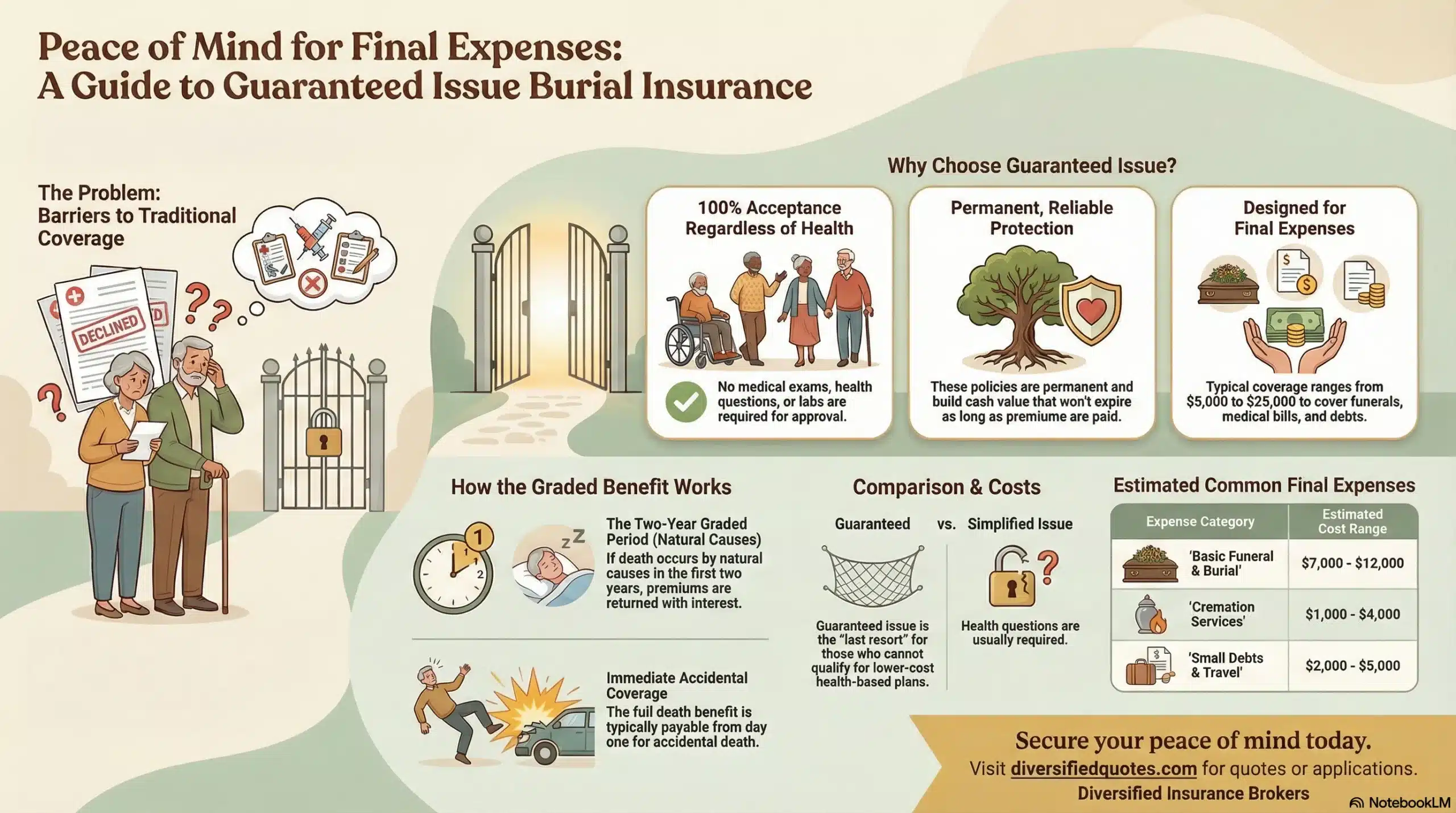
The graded death benefit is the most consequential feature of guaranteed issue life insurance, and it is the detail most commonly misunderstood by applicants who have heard only the “guaranteed approval” part of the product description. Because the carrier accepts applicants without any health screening, the actuarial risk of providing an immediate full death benefit from the first day of coverage is prohibitive — an applicant who is terminally ill could theoretically purchase a GI policy, pay one premium, and generate a death claim far exceeding any premium collected. The graded benefit structure manages this risk by limiting the death benefit payable for non-accidental death during an initial period — typically two years, though some carriers use a different period — to a return of premiums paid with interest rather than the full face amount.
After the graded period expires — typically after the second policy anniversary — the full face amount becomes payable for all covered causes of death, accidental and non-accidental alike, as long as premiums remain current. Most GI designs treat accidental death differently during the graded period: death from a covered accident typically triggers the full face amount even during the graded period because the carrier’s concern is adverse selection by terminally ill applicants rather than random accidental death. The practical implication for any GI under-50 buyer is straightforward: if immediate full death benefit coverage is the priority — not just coverage certainty — then a simplified issue product with immediate level benefits should be evaluated alongside GI even if the simplified issue product carries some decline risk. The certainty of GI approval may be less valuable than the immediate full benefit that some simplified issue products provide if the applicant’s health situation makes a simplified issue approval likely. Our resource on final expense life insurance covers both the GI and simplified issue products that provide smaller permanent death benefits, including how their graded versus level benefit structures compare.
GI vs. Simplified Issue — The Comparison That Often Saves Money
The most common mistake in the no-exam life insurance market is assuming that a prior decline from one carrier means simplified issue products at other carriers are also unavailable. This assumption is wrong often enough that it should be tested before the GI path is chosen. Simplified issue products evaluate the applicant’s health through a short list of health questions rather than a full medical exam — and the specific questions asked, and the specific conditions that trigger declines, vary dramatically across carriers. A condition that generated a simplified issue decline at carrier A may be an acceptable risk at carrier B with different guidelines for the same condition, especially if the carrier B product targets a different segment of the simplified issue market or uses different database lookups.
When simplified issue remains genuinely available to an applicant under 50, the advantages over GI are typically significant: lower premium per dollar of coverage, larger face amounts, and — for products with immediate level benefits — no graded period that limits early-year coverage. The tradeoff is that a simplified issue application carries decline risk that GI does not, and a simplified issue decline adds to the MIB record in a way that a GI application does not, since GI applications typically do not generate the same type of reportable adverse action. The strategic implication is that simplified issue should be evaluated first through a prescreening approach — informally assessing likely carrier response without generating a formal record — and only when simplified issue is genuinely unlikely to produce an approval should the GI path be chosen as the primary strategy rather than an alternative. For applicants with autoimmune conditions or other health histories that create underwriting uncertainty, this informal evaluation step is particularly important before committing to the GI premium structure.
Choosing the Right Face Amount When Coverage Needs Are Evolving
The face amount decision for guaranteed issue life insurance under age 50 is different from the face amount decision for a standard term or permanent policy, because the constraints of the GI market — lower maximum face amounts, higher premium per dollar — mean the starting point is the coverage that is available and affordable rather than the coverage that a comprehensive needs analysis would specify as optimal. Understanding that distinction allows the face amount to serve the right purpose: immediate meaningful protection within the constraints of the current coverage environment, with a plan to build toward more comprehensive coverage as health improves, alternative products become available, or financial capacity grows.
The most useful framework for the GI under-50 face amount decision is to identify the specific, immediate financial exposures that the coverage is meant to address and size the face amount to cover those priorities rather than attempting to address every insurance need within a single GI policy. If the primary concern is final expenses and immediate costs for a surviving family, a modest face amount in the $10,000–$25,000 range may adequately serve that goal. If the concern is also providing a brief runway of household expense coverage, a somewhat larger face amount adds this protection. For applicants with mortgage obligations, our resource on how to protect your mortgage with life insurance covers the coverage amounts that specifically address this need, and our resource on how much life insurance do I need covers the comprehensive needs analysis framework for when the full picture of financial exposure needs to be mapped against available coverage solutions.
Using GI as a Bridge to Larger Coverage Later
One of the most strategically coherent uses of guaranteed issue life insurance under age 50 is as a permanent foundation that protects the family during a period when larger underwritten coverage is temporarily unavailable — with a concurrent plan to add that larger coverage through simplified issue or fully underwritten products as health stabilizes, documentation accumulates, or the triggering event recedes into history. This bridge strategy treats the GI policy not as the final destination of the coverage plan but as the guaranteed element that prevents the family from being entirely unprotected during the transition period.
The concrete advantage of this approach is that the GI policy, once placed, cannot be declined or cancelled by the carrier due to future health changes. Its continued existence does not depend on the applicant’s health remaining stable — it depends only on premium payments continuing. This permanence means that as health improves and underwritten options become available, the GI policy can serve as the permanent base layer while term coverage, simplified issue supplemental policies, or eventually a fully underwritten product covers the larger protection need. Our resource on convert term to permanent life insurance covers the conversion option that allows term policies purchased later — after health improves — to be converted to permanent coverage without new underwriting, making the bridge strategy particularly valuable: the GI permanent foundation plus a convertible term layer addresses both the immediate certainty requirement and the longer-term coverage need. Our resource on group vs. individual life insurance covers the employer-based coverage option that may be available as an additional interim layer if the applicant has access to an employer group plan that does not require medical underwriting for participation.
Special Needs Planning and Guaranteed Issue Coverage
Parents of children with special needs who are under 50 represent a specific and important GI under-50 use case. A parent who carries the primary financial responsibility for a child with a disability or chronic condition has an insurance need that differs from standard income replacement planning: the coverage must remain in force long enough to fund a special needs trust, support an ABLE account, or provide a financial bridge for caregiving after the parent is gone, potentially across decades of future need. Guaranteed issue coverage for the parent — providing a permanent, irrevocable death benefit regardless of the parent’s future health changes — aligns directly with this long-duration planning requirement in a way that term coverage does not. Our resource on life insurance for a special needs child covers the planning framework for this situation, and our resource on guaranteed issue life insurance for special needs adults covers the specific GI products designed for special needs planning scenarios — including coverage on the special needs individual directly when their health history or cognitive profile makes traditional underwriting unavailable.
Confirm What’s Available in Your State
We check GI under-50 availability for your specific state, face amount, and age — and compare simplified issue options when they produce genuinely better value.
Request a Guaranteed Issue QuoteRelated Pages
Explore additional no-exam options and how underwriting differs when health history is involved.
Financial Protection Essentials
Employer health planning, high-risk life insurance guidance, retirement transitions, and long-term care comparison tools.
Talk With an Advisor Today
Choose how you’d like to connect—call or message us, then book a time that works for you.
Schedule here:
calendly.com/jason-dibcompanies/diversified-quotes
Licensed in all 50 states • Fiduciary, family-owned since 1980
FAQs: Guaranteed Issue Life Insurance Under Age 50
Is guaranteed issue life insurance actually available under age 50?
Yes — but with important limitations that most people do not encounter in standard GI advertising. The senior-market GI programs marketed heavily for final expense planning are designed for the 50–85 age band, which is where the market is largest. Under 50, genuine guaranteed issue products exist at specific carriers for specific states and age bands, but they are less common, the eligible age minimums may be 40 or 45 rather than younger, and the face amounts available are often more restricted than senior-market products. Applicants in their 20s and early 30s seeking true guaranteed issue individual policies face a particularly narrow market, with most accessible options in that age range involving employer or association group structures rather than individually purchased GI products. The availability check for any specific applicant depends on their state, their age, and the current product offerings of the carriers we work with in that state — which is why confirming what is actually available in your specific situation is the essential first step before choosing the GI path.
What ages are typically eligible for GI under 50?
The eligible age range for guaranteed issue life insurance programs under age 50 varies by carrier and state. Some programs begin as low as age 40 or 45; others begin at 50. True GI programs that cover applicants in their 20s and 30s through individual policies are rare in most states — the economics of GI pricing are harder to support at younger ages where the total population seeking guaranteed issue is smaller and the alternative underwriting options are broader. For applicants under 40 who need a certainty-first coverage solution, the most viable paths typically involve employer or association group coverage structures, simplified issue products with more flexible health question screens, or specialized programs like those designed for special needs planning. Our resource on guaranteed issue life insurance for special needs adults covers the specific programs designed for younger applicants whose health or cognitive profiles make traditional underwriting unavailable.
How much coverage can I get through GI under age 50?
Guaranteed issue face amounts for under-50 programs are generally modest — most commonly in the $5,000–$25,000 range, with some carriers offering programs up to $40,000–$50,000 depending on state and product design. These amounts are designed to address final expense needs, cover immediate family financial obligations, or serve as a foundation layer within a broader coverage strategy rather than to replace the full income protection that larger fully underwritten policies provide. The face amount limitation is a fundamental structural feature of GI products, not a carrier-specific restriction that can be easily overcome — and it is one of the primary reasons why the comparison between GI and available alternatives is so important. When simplified issue or accelerated underwriting options can provide $100,000 or $500,000 of coverage at a lower premium per dollar, the GI face amount ceiling becomes a meaningful consideration in whether GI is genuinely the best available tool or simply the most certain one. Our resource on how much life insurance do I need covers the needs analysis framework for sizing the total coverage requirement against all available product options.
Is there a waiting period before the full death benefit is paid?
Yes — almost all guaranteed issue life insurance policies include a graded death benefit for the first two policy years (some carriers use a different period). During this graded period, if the insured dies from a non-accidental cause, the policy pays a limited amount rather than the full face amount — most commonly, the total premiums paid plus a stated interest rate (often 10% per year on premiums paid). After the graded period expires, the full face amount is payable for all covered causes of death, accidental and non-accidental, as long as premiums remain current. Accidental death is typically treated differently — most GI designs pay the full face amount from the first day of coverage for death caused by a covered accident, because the carrier’s concern is adverse selection by terminally ill applicants rather than protection against random accidental death. The graded benefit is the most important detail to understand clearly before purchasing any GI policy, because it directly affects what the policy pays in the most likely early-claim scenario. Exact terms, definitions, and graded period lengths vary by carrier and state — always review the contract language before completing the application.
How do GI premiums compare to other life insurance options?
Guaranteed issue premiums are typically the highest per dollar of coverage among all life insurance product types — significantly higher than simplified issue for the same face amount, and dramatically higher than fully underwritten term or permanent coverage for qualifying profiles. The reason is actuarial: when the carrier accepts applicants without any health screening, the risk pool includes the full spectrum of health histories — including applicants with serious or terminal conditions who would be declined under any underwriting standard. The carrier must price for that entire pool, which produces premiums that exceed what any underwritten product charges for a profile that passes medical screening. This premium differential is the direct cost of guaranteed acceptance — not an arbitrary markup, but the actuarial reality of insuring without selection. Whether that cost produces acceptable value depends entirely on the alternatives available. If simplified issue remains available and can provide more coverage at lower cost, the GI premium premium may not be justified. If GI genuinely represents the only path to any coverage, the comparison shifts from “GI versus a cheaper alternative” to “GI versus no coverage” — which for families who need protection is often straightforwardly resolved in GI’s favor.
Is guaranteed issue term life available under age 50, or only whole life?
True guaranteed issue term life insurance is rare — the standard GI product structure is whole life (permanent coverage with cash value accumulation) rather than term coverage. The reason is structural: a term policy has a defined expiration date after which no benefit is payable; a whole life policy has a guaranteed death benefit as long as premiums are paid, regardless of how long the insured lives. For a carrier offering GI without health screening, the whole life structure is more predictable to price because the benefit is certain at some point — the actuarial question is when, not whether. A guaranteed issue term policy that accepts all health profiles and then expires at age 65 or 70 creates a different pricing challenge because a significant portion of GI applicants with serious health conditions may outlive the term, producing no death claim while having paid premiums — or may die within the term, concentrating claims in the early years. Most carriers address this by offering GI as whole life only. If term coverage is the priority, simplified issue term products — which ask a limited set of health questions — may be available for profiles that pass those screens. Our resource on life insurance with a prior decline covers the options for applicants who want term coverage but have a prior decline on record.
Does guaranteed issue whole life build cash value?
Yes — guaranteed issue whole life policies typically accumulate cash value over time, following a schedule that is defined in the policy contract at issue and does not change based on future market conditions or the insurer’s investment performance. The cash value grows slowly in the early years of the policy — particularly during any graded benefit period — and builds more meaningfully over longer holding periods. Policy owners can access accumulated cash value through policy loans (which do not require the insurer’s approval but reduce the death benefit by the outstanding loan amount) or through policy surrender (which terminates the coverage in exchange for the net cash surrender value). For the smaller face amounts typical of GI under-50 products, the cash value accumulation is modest in absolute dollar terms — the primary value of the GI whole life policy is the permanent death benefit, not the cash accumulation feature. Applicants who want cash value accumulation as a meaningful component of their policy strategy typically need larger face amounts available only through underwritten permanent products, which our resource on convert term to permanent life insurance covers from the perspective of transitioning from temporary to permanent coverage as health and coverage situations evolve.
What alternatives exist if I’m under 50 and can’t find GI in my state?
When guaranteed issue coverage is unavailable or inadequate for a specific applicant’s needs in a specific state, several alternatives deserve systematic evaluation before concluding that no coverage is available. Simplified issue products — which skip the medical exam but ask a short list of health questions — are available in many states from multiple carriers with varying health question standards, and the specific questions asked vary enough that a condition that triggers a decline at one carrier may be acceptable at another. Employer group life insurance, if available through the applicant’s employer, typically does not require medical underwriting for participation up to a defined benefit amount and can provide meaningful coverage without any health screening. Association group programs through professional, alumni, or membership organizations sometimes offer group life coverage with limited medical underwriting. And for applicants whose prior declines resulted from carrier mismatches rather than absolute health barriers, strategic reapplication through a prescreening process may produce a simplified issue or fully underwritten approval that GI was not needed for in the first place. Our resource on life insurance with a prior decline covers the full framework for identifying which alternatives remain viable after a prior decline before committing to the guaranteed issue path and its associated premium and coverage limitations.
How quickly can coverage start after applying for GI under 50?
Guaranteed issue applications are typically among the fastest to process in the life insurance market because the absence of medical underwriting eliminates the most time-consuming steps in the traditional application workflow: no exam scheduling, no medical records requests, no attending physician statements, and no lab result review. Most GI applications require only basic enrollment information — age, name, address, coverage amount, beneficiary designation, and payment method — and can be completed in a single session. Policy issuance typically follows within days of application completion and initial premium payment. Coverage becomes effective — meaning the graded benefit period or level benefit period begins — once the policy is issued and the first premium is received. The graded period clock starts on the policy effective date; the sooner the application is completed and the first premium paid, the sooner the graded period begins accumulating toward the full-benefit activation date. For applicants who need coverage in place as quickly as possible due to an urgent protection need, the GI application-to-issue timeline is typically shorter than any underwritten product — though the graded benefit limitation during the initial period means “coverage in force” and “full death benefit available” are different milestones with a two-year gap between them for non-accidental death.
About the Author:
Jason Stolz, CLTC, CRPC, DIA, CAA and Chief Underwriter at Diversified Insurance Brokers (NPN 20471358), is a senior insurance and retirement professional with more than 25 years of real-world experience helping individuals, families, and business owners protect their income, assets, and long-term financial stability. As a long-time partner of the nationally licensed independent agency Diversified Insurance Brokers, Jason provides trusted guidance across multiple specialties—including fixed and indexed annuities, long-term care planning, personal and business disability insurance, life insurance solutions, Group Health, Travel Medical and Evacuation Insurance, and short-term health coverage. Diversified Insurance Brokers maintains active contracts with over 100 highly rated insurance carriers, ensuring clients have access to a broad and competitive marketplace.
His practical, education-first approach has earned recognition in publications such as VoyageATL, and contributions from his agency featured in Kiplinger and GoBankingRates— highlighting his commitment to financial clarity and client-focused planning. Drawing on deep product knowledge and years of hands-on field experience, Jason helps clients evaluate carriers, compare strategies, and build retirement and protection plans that are both secure and cost-efficient. Visitors who want to explore current annuity rates and compare options across multiple insurers can also use this annuity quote and comparison tool.
Explore More Life Insurance Options: Browse our complete guide to Guaranteed Issue, No Exam & High-Risk Education — covering guaranteed issue policies, no-exam coverage, and table ratings from 100+ carriers.
Last Reviewed: July 13, 2026 |
Reviewed by: Jason Stolz, CLTC, CRPC, DIA, CAA
Chief Underwriter, Diversified Insurance Brokers, Inc. | NPN: 20471358 | Diversified Insurance Brokers, Inc. — Licensed in all 50 states
Fact Checked by: Tonia Pettitt, CMIP©
Medicare Specialist, Diversified Insurance Brokers, Inc. | NPN: 14374308 | Diversified Insurance Brokers, Inc. — Licensed in all 50 states
Did you find this content helpful? Leave us a Google review — it helps others find trustworthy guidance too.
Editorial Standards: Diversified Insurance Brokers maintains rigorous editorial standards to ensure accuracy, clarity, and independence in all content. Learn more about our editorial standards and commitment to transparency.
