
Burial Insurance Quotes
Burial Insurance Quotes

Jason Stolz CLTC, CRPC, DIA, CAA
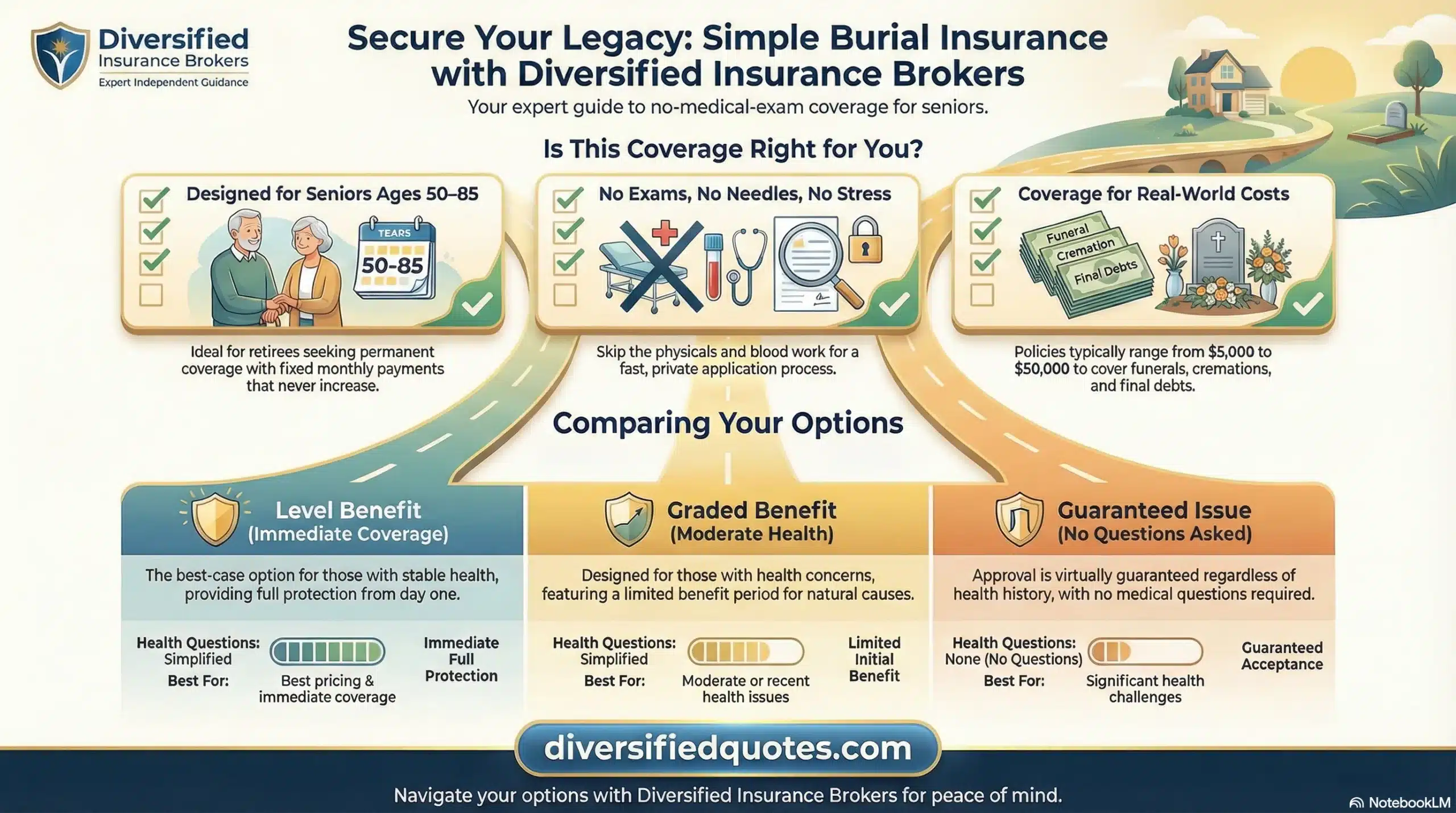
Burial insurance quotes give you the fastest honest answer to one of the most common retirement planning questions families delay too long: what will it actually cost to make sure final expenses don’t become a burden someone else has to carry? Burial insurance — also called final expense life insurance — is a small permanent whole life policy specifically designed to cover funeral costs, cremation expenses, cemetery charges, final medical bills, and any other end-of-life expenses. The face amount is typically between $5,000 and $25,000, the premiums are locked at the rate you qualify for on the day you’re issued and never increase, the coverage never expires as long as premiums are paid, and in most cases no medical exam is required. These three features — fixed premiums, permanent coverage, and no-exam application — make burial insurance the most practical final expense planning tool available for seniors on fixed incomes who want to handle this obligation now rather than leave it to their family at the worst possible time.
The most important thing to understand before running burial insurance quotes is that the lowest number you see is not automatically the best option for your situation. Burial insurance policies are structured in three distinct benefit tiers — level benefit, graded benefit, and guaranteed issue — and each tier has different underwriting requirements, different cost levels, and critically different rules about when the full death benefit is actually payable. A level benefit policy that approves you on day one and pays the full face amount from the first premium is not the same product as a guaranteed issue policy that charges a higher premium, requires no health questions, but pays only a return of premiums plus 10% interest — not the face amount — if death from natural causes occurs in the first two years. Understanding which tier you qualify for before shopping quotes prevents two common and costly mistakes: accepting a graded or guaranteed issue policy when a level benefit policy was actually available for the same health history, or choosing a policy without understanding that the full death benefit won’t be payable for the first two years. This page covers both — what the tiers are, how to determine which one fits your health profile, and how to get quotes that reflect your actual best option rather than the easiest sale. Our resource on how to get the best burial insurance rates covers the optimization framework in detail.
Rates can vary by 30% or more between carriers offering nearly identical coverage for the same applicant — which means comparison shopping is not a nicety, it is the primary cost-control mechanism available in this market. Two carriers quoting a $10,000 policy for the same 70-year-old non-tobacco female can produce premiums that differ by $15-$25 per month, and over a 20-year holding period that difference totals $3,600-$6,000 in cumulative premiums paid for the same benefit. The Compulife quoter embedded below compares rates across multiple carriers simultaneously so you can see the spread instantly — enter your age, state, coverage amount, and tobacco status to get real comparisons. Our broader resource on final expense life insurance covers the full product category, and our resource on burial insurance services overview covers how we help match applicants to the right carrier and benefit tier for their specific health profile.
Compare Burial Insurance Quotes From Multiple Carriers
Enter your age, state, coverage amount, and tobacco status — get side-by-side rates instantly.
Quotes are estimates subject to underwriting. Final pricing depends on age, state, tobacco status, and health history. Coverage and benefit tier available depend on carrier underwriting approval.
What Burial Insurance Covers and Why Families Buy It
Burial insurance is a permanent whole life policy in a small face amount — typically $5,000 to $25,000 — designed specifically to fund the costs families face when a loved one dies. The National Funeral Directors Association reported a median cost of approximately $7,800 for a funeral with viewing and burial as of its most recent industry data, and that figure does not include cemetery costs, a burial plot, headstone, obituary, flowers, or any post-service reception. Total actual costs frequently reach $10,000 to $20,000 when all end-of-life expenses are counted. A cremation service costs less than a traditional burial but has still risen significantly in recent years — many families planning for cremation are targeting $8,000 to $12,000 to cover the service, memorial, and related costs. Our resource on how much does a funeral cost covers current cost ranges in detail and helps determine an appropriate coverage target before shopping quotes.
The death benefit from a burial insurance policy is paid as a tax-free lump sum directly to the named beneficiary — it is not paid directly to the funeral home or tied to any specific vendor. This is an important distinction from prepaid funeral plans, which lock money in with a specific funeral home. The beneficiary of a burial insurance policy receives cash and can use it for any purpose: paying the funeral home, covering an outstanding medical bill, clearing a small credit card balance, or handling any other need that arises at the time of death. This flexibility is one of the reasons burial insurance is generally preferred over prepaid funeral plans for families who want their loved ones to have control over how and where final arrangements are made without being contractually bound to a specific provider.
The Three Benefit Tiers — How Underwriting Shapes Your Policy and Your Quote
The single most consequential variable in a burial insurance quote — more than the carrier, the face amount, or even the premium — is the benefit tier the policy is structured in. The three tiers differ fundamentally in what health questions they ask, when the full death benefit is payable, and how much the policy costs. Most applicants can qualify for the best tier available to them only if they are matched to a carrier whose underwriting guidelines fit their specific health history. This is why carrier selection and benefit tier matching are the most important services an independent broker provides in the burial insurance market.
| Feature | Level Benefit (Simplified Issue) | Graded / Modified Benefit | Guaranteed Issue (No Health Questions) |
|---|---|---|---|
| Health Questions Required? | Yes — simplified health questionnaire (no exam) | Yes — health questions; some conditions disqualify from level but allow graded | No — approval is guaranteed regardless of health history |
| Medical Exam Required? | No | No | No |
| When Full Death Benefit Pays | Day one — full face amount payable immediately from first premium for any cause of death | After waiting period — typically years 1-2 pay a percentage of face amount (e.g., 25-50% in year 1; 50-75% in year 2); full face amount from year 3 forward. Accidental death often pays full benefit immediately. | After 2-year waiting period — natural cause death in years 1-2 pays return of all premiums paid plus typically 10% interest, NOT the face amount. Accidental death usually pays full face amount immediately from day one. |
| Premium Level vs. Other Tiers | Lowest cost among the three tiers — most favorable for those who qualify | Higher than level; lower than guaranteed issue in most cases | Highest cost per dollar of coverage — the least efficient option but available to everyone |
| Who Typically Qualifies | Applicants with controlled chronic conditions, no recent major medical events, stable health history | Applicants with more complex health histories — certain recent diagnoses, recent hospitalizations, or multiple conditions that disqualify from level tier at some carriers | Anyone ages 50-85 (typical issue range); used when health history disqualifies from level and graded, or when any approval is needed quickly regardless of health profile |
| Coverage Amounts Typically Available | $2,000–$50,000 depending on carrier and state | $2,000–$25,000 depending on carrier | Typically $5,000–$25,000; some carriers limited to $10,000-$15,000 maximum |
| Best Strategic Use | Best value whenever you qualify — always pursue level benefit first before accepting a graded or GI offer | Appropriate bridge when level is not available but the waiting period is acceptable given the applicant’s age and health situation | Last resort when health history prevents any other approval; also useful for very rapid coverage placement when health questions create uncertainty about other tiers |
Benefit tier definitions, waiting period structures, and graded benefit schedules vary by carrier and policy. Not all carriers offer all three tiers. Some carriers use different names for these tiers (e.g., “Preferred,” “Standard,” “Modified,” “Guaranteed Acceptance”). The waiting period and graded benefit schedule details above are generalizations — always verify the specific provisions of any policy you are considering against the actual contract language before purchase. Accidental death benefit during the graded and guaranteed issue waiting period is common but not universal — confirm with the specific carrier. Rates and eligibility based on age, state, tobacco status, and health history.
Understanding the Two-Year Waiting Period — What It Means for Your Family
The two-year waiting period in guaranteed issue burial insurance — and the graded benefit schedule in graded tier policies — is the most misunderstood provision in the burial insurance market, and misunderstanding it has caused real financial harm to families who believed they had full coverage before they actually did. The provision is straightforward once it is explained clearly: during the waiting period (two years for guaranteed issue; the graded schedule period for graded policies), death from natural causes does not trigger the full face amount payout. Instead, guaranteed issue policies typically pay the total of all premiums paid into the policy plus a defined interest amount — commonly 10%. For example, if a policyholder paid $85/month for 18 months before dying of natural causes, the beneficiary would receive approximately $1,530 in premiums plus 10% — not the $15,000 face amount the family believed was in place. The family would then face the full funeral cost with only a fraction of the expected coverage available.
This is why the benefit tier discussion is so important before any quote is accepted. The appropriate question before signing any burial insurance application is: “Am I in a level benefit policy, a graded benefit policy, or a guaranteed issue policy — and do I understand exactly what my beneficiary receives if I die in the next two years?” An honest independent broker answers that question specifically and in writing before the application is submitted. Our resource on guaranteed issue burial insurance covers the waiting period mechanics in detail and explains when guaranteed issue is the right choice vs. when additional carrier comparison might identify a level benefit option that wasn’t initially apparent. Our resource on burial insurance with no medical exam covers the important distinction between “no exam” (which still involves health questions in simplified issue policies) and “no health questions” (which is guaranteed issue with the waiting period).
How Much Coverage Do You Actually Need?
Coverage sizing is a practical decision grounded in the actual costs families face, not an abstract coverage maximization exercise. Most applicants targeting traditional burial with viewing, casket, hearse, and graveside service should plan for $10,000 as a conservative minimum in most U.S. markets — with $12,000 to $15,000 providing meaningful additional cushion for cemetery costs, flowers, an obituary, and a small reception. Applicants planning for cremation can often target a lower coverage amount, but cremation costs have risen alongside funeral costs more broadly — $8,000 to $12,000 remains a realistic target in most areas depending on the specific service level desired.
Beyond the funeral or cremation service itself, final expenses often include outstanding medical bills from the final illness or hospitalization, prescription medication balances, small credit card or utility balances, and logistical costs such as family travel expenses for out-of-town relatives arriving for services. When these adjacent costs are included in the target coverage, $15,000 to $20,000 represents a comprehensive final expense provision for most households rather than an oversized coverage amount. The Compulife quoter above lets you compare $10,000, $15,000, and $20,000 side by side in seconds to see how the premium difference affects affordability before settling on a face amount. Our resource on burial insurance calculator covers the coverage sizing framework in detail, and our resource on how much does a funeral cost provides the cost research context for determining an appropriate target in your specific geographic area and service preference.
What Determines Your Burial Insurance Quote — The Five Variables
Five variables determine the premium quoted for any burial insurance policy, and understanding each helps you evaluate whether a quote is competitive and whether there are cost-reduction opportunities you have not yet explored. Age is the most powerful variable: burial insurance premiums increase with age, and the increase is not linear — premiums accelerate in the 70s and 80s as mortality risk increases. A 65-year-old and a 75-year-old shopping for the same $10,000 policy at the same carrier with the same health profile may see very different monthly premiums, which is why applying sooner rather than later is financially advantageous in this product category. Applying sooner locks in a permanently lower rate before age-related premium increases and before any new health diagnoses shift the applicant from a level benefit tier to a graded or guaranteed issue tier.
Tobacco status is the second major variable — tobacco users typically pay meaningfully more than non-tobacco users for equivalent coverage because smokers carry higher mortality risk in the actuarial tables carriers use for pricing. State of residence is the third variable, affecting both which carriers are available and what pricing regulations apply. Approximately 85% of final expense carriers do not operate in New York due to the state’s regulatory environment — applicants in New York should expect a more limited carrier menu and potentially higher premiums for equivalent coverage than residents of other states. Montana’s unisex rating law requires insurers to charge the same premium for men and women — because mortality tables show men with higher mortality risk, the practical effect is that women in Montana pay approximately 30% more than women in comparable situations in other states. Coverage amount is the fourth variable — premiums scale roughly proportionally with face amount, though not always perfectly linearly across carriers. Health history is the fifth variable, affecting both the premium level and the benefit tier available, with stability of managed conditions often more important than the diagnosis itself in level benefit underwriting decisions.
Why Carrier Comparison Matters — Rate Variation of 30% or More
The carrier market for burial insurance includes dozens of active companies, each with different pricing models, underwriting guidelines, and risk appetites for specific health conditions and demographic profiles. Research consistently documents rate variation of 30% or more between carriers offering nearly identical coverage for the same applicant profile — meaning the cheapest and most expensive quotes in a multi-carrier comparison for a specific 70-year-old female in Georgia with diabetes and hypertension can differ by $20-$30 per month or more for the same $15,000 face amount in the same tier. Over a 15-year holding period, that $20-$30/month difference represents $3,600-$5,400 in cumulative premium paid for the same death benefit.
Carrier variation in underwriting guidelines matters as much as carrier variation in pricing. One carrier may decline level benefit coverage for an applicant who had a stroke three years ago; another may approve level benefit for the same applicant because their stroke was more than two years ago and their current neurological status is stable. One carrier may decline level benefit for an applicant on insulin; another may approve level benefit for well-controlled insulin-dependent diabetes with no recent hospitalizations. These guidelines are not publicly standardized — they are proprietary to each carrier and change periodically. An independent broker who works regularly with the burial insurance market knows which carriers are more favorable for specific conditions and can match the applicant to the right carrier before the application is submitted, rather than discovering a mismatch through an adverse decision. Our health-condition specific guides below cover underwriting patterns for common conditions in this market.
Getting Burial Insurance Quotes With Health Conditions
A health diagnosis does not automatically disqualify a burial insurance applicant from level benefit coverage. The underwriting distinction that matters most in final expense insurance is not whether you have a condition but whether the condition is stable and controlled. Most carriers define stability in terms of time since last hospitalization related to the condition, current medication regimen, and absence of recent major complications. An applicant with well-controlled type 2 diabetes, no hospitalizations in the past year, and stable blood sugar on oral medications is a fundamentally different underwriting profile than an applicant with recent diabetic complications requiring hospitalization — even if both applicants disclose “diabetes” on the health questionnaire. Getting the right level benefit match for a health-complex applicant is a carrier-matching exercise, not a simple quote comparison.
Burial Insurance With Health Conditions
Each condition is underwritten differently. Select yours for condition-specific carrier guidance.
How to Apply and What to Expect
Most burial insurance applications are designed for simplicity and speed. The typical application process begins with confirming the coverage amount you want and running quotes from multiple carriers using the Compulife tool above or our dedicated burial insurance calculator. Once quotes are compared, the next step is confirming which benefit tier is available for your specific health history — this is the carrier-matching step that an independent broker handles by reviewing your medication list and health history against current carrier guidelines before submission. The application itself is usually completed electronically, requires no physical exam, and asks either a simplified health questionnaire (level and graded benefit policies) or no health questions at all (guaranteed issue). Most level benefit approvals come back the same day or within a few business days; guaranteed issue policies are often issued even faster since no underwriting review is required. Our resource on burial insurance with no medical exam covers the application experience in detail, and our resource on no-exam life insurance covers the broader no-exam underwriting landscape for context. Our resource on affordable burial insurance for low-income seniors covers the specific strategies for right-sizing coverage to fit a fixed-income budget without leaving the family underinsured.
Common Burial Insurance Mistakes That Cost Money or Coverage
The most common mistake in burial insurance is accepting a graded benefit or guaranteed issue policy without first exhausting level benefit options across the carrier market. Many applicants — including those who have been declined or rated at one carrier — assume that the decision reflects the entire market when it actually reflects only one carrier’s specific guidelines. A carrier decline for a level benefit policy does not mean no carrier will approve level benefits for the same applicant. It means that specific carrier’s guidelines did not match that applicant’s health profile. An independent broker with relationships across 20 or more final expense carriers can often identify a level benefit match where a single-carrier search produced a graded or GI result. Accepting a graded or guaranteed issue policy with a two-year waiting period when a level benefit option was actually available across the market means the family gets less benefit for more premium during the most vulnerable coverage period — the waiting period years — and that mistake cannot be undone after the policy is issued.
The second most common mistake is waiting. Burial insurance is age-priced and the premiums increase every year — sometimes at every birthday, sometimes at defined age brackets depending on the carrier. A 68-year-old who waits until 70 to apply for a $15,000 policy will pay a permanently higher premium for the same coverage for as long as they hold the policy. Additionally, new health diagnoses that emerge during the waiting period can shift the tier available — a level benefit applicant who waits and develops a qualifying condition during that delay may find only graded or guaranteed issue available at the time of application. Locking in coverage and rate while current health status supports the best available tier is consistently the most cost-effective timing strategy in final expense insurance. The third most common mistake is underinsuring — buying $5,000 or $7,500 in coverage and discovering at the time of death that funeral costs in the local market have risen well above the face amount, leaving the family to cover the shortfall from other resources.
Talk With an Advisor Today
Choose how you’d like to connect—call or message us, then book a time that works for you.
Schedule here:
calendly.com/jason-dibcompanies/diversified-quotes
Licensed in all 50 states • Fiduciary, family-owned since 1980
FAQs: Burial Insurance Quotes
What is burial insurance and what does it cover?
Burial insurance (also called final expense life insurance) is a small permanent whole life policy designed to cover funeral costs, cremation expenses, cemetery charges, final medical bills, and other end-of-life costs. Coverage typically ranges from $5,000 to $25,000. The death benefit is paid as a tax-free lump sum directly to the beneficiary — not to the funeral home — so your family can use the money for any need at the time of death. Premiums are locked at the rate established at issue and never increase; coverage never expires as long as premiums are paid. No medical exam is required for most plans.
What are the three types of burial insurance benefit tiers?
Burial insurance is structured in three benefit tiers. Level benefit (simplified issue) requires health questions but no exam — it provides full day-one coverage and is the best value for those who qualify. Graded benefit requires health questions and provides partial coverage in the first two years (typically a percentage of the face amount or return of premium plus interest), with full coverage from year three forward — used when health history disqualifies from level but is not severe enough for guaranteed issue. Guaranteed issue requires no health questions and guarantees approval, but always includes a two-year waiting period during which natural cause death pays only a return of premiums plus typically 10% interest, not the face amount — used when health history prevents other approvals. Level benefit is almost always the best value whenever it is available.
What happens during the two-year waiting period on a guaranteed issue policy?
During the two-year waiting period on a guaranteed issue burial insurance policy, death from natural causes pays back all premiums paid into the policy plus a defined interest amount — typically 10% — not the face amount. For example, if the insured paid $85/month for 18 months and then died of natural causes, the beneficiary would receive approximately $1,530 in premiums returned plus 10% interest, not the $15,000 face amount shown on the policy. Accidental death is typically covered at the full face amount from day one, even during the waiting period. After the two-year waiting period expires, the full face amount is payable for any cause of death. This is why confirming which tier you are purchasing — and whether a level benefit alternative was available — is critical before any application is signed.
How much burial insurance coverage should I buy?
Coverage should be sized to your actual expected final expenses in your geographic area. For traditional burial with viewing, casket, hearse, and graveside service, $10,000 is a conservative minimum in most U.S. markets — with $12,000 to $15,000 providing cushion for cemetery costs, flowers, obituary, and a small reception. Those planning for cremation can often target $8,000 to $12,000 depending on service level. Adding a buffer for potential outstanding medical bills, small debts, and family travel costs makes $15,000 to $20,000 a comprehensive final expense provision for most households. The Compulife quoter on this page lets you compare $10,000, $15,000, and $20,000 premiums simultaneously to see the cost difference before deciding on a face amount.
Do I need a medical exam to get burial insurance?
No medical exam is required for any tier of burial insurance. Level benefit (simplified issue) policies ask a health questionnaire — typically 10-15 yes/no health questions covering recent diagnoses, hospitalizations, and current medications — but involve no blood draw, no physical measurements, and no physician visit. Guaranteed issue policies require neither a medical exam nor any health questions — they approve all applicants within the eligible age range regardless of health history, with the two-year waiting period as the trade-off. The distinction that matters is not exam vs. no exam, but health questions vs. no health questions — because the two-year waiting period applies exclusively to guaranteed issue (no health questions) policies, not to simplified issue policies that approved the applicant based on health questionnaire responses.
Can I qualify for burial insurance if I have diabetes, heart disease, or other conditions?
Many applicants with chronic conditions qualify for level benefit burial insurance — what matters more than the diagnosis itself is the stability and control of the condition. Well-controlled diabetes on oral medications with no recent hospitalizations typically qualifies for level benefit at several carriers. Heart attack history may qualify for level benefit if it occurred more than two years ago and the applicant is currently stable on medications with no recurrent events. Each carrier has different guidelines for each condition, which is why carrier matching is so important — a declination for level benefit at one carrier does not mean all carriers will decline. An independent broker familiar with the final expense market can often identify a level benefit match for applicants who were told they needed graded or guaranteed issue by a single-carrier comparison.
Will my premiums ever increase after I buy burial insurance?
No — burial insurance is permanent whole life insurance, and premiums are locked at the rate established on the day the policy is issued. They never increase for any reason: not for age, not for health changes, not for inflation, not because the insurance company’s costs have risen. The premium you pay in month one is the premium you pay in month one hundred and month one thousand. The policy also does not expire at a fixed age — it remains in force as long as premiums are paid, regardless of how long the insured lives. This combination of locked premiums and lifetime coverage is what makes burial insurance specifically suited for final expense planning on a fixed income, where budget predictability is as important as the coverage itself.
Can I buy burial insurance for a parent or other family member?
Yes — with the insured’s knowledge and consent, an adult child or other family member can purchase and pay for a burial insurance policy on a parent, naming themselves or another person as beneficiary. The insured (your parent) must be aware of and consent to the application, and must participate in any health questions for simplified issue policies. The policy owner and premium payer can be a different person than the insured. Many families set up policies this way specifically to ensure that final expense coverage is in place before health changes might reduce the tier available or before aging out of the eligible issue age range. Our resource on burial insurance for mom and dad covers the process for purchasing on behalf of a parent in detail.
How fast can I get covered after accepting a burial insurance quote?
Many simplified issue (level benefit) applications receive a decision on the same day — sometimes within minutes of electronic submission. Policies can be placed the same day or within a few business days in most cases. Guaranteed issue policies can be issued even faster because no underwriting review is required — the application is essentially administrative rather than evaluative. Once the policy is issued and the first premium is received, coverage begins: for level benefit policies this means full day-one coverage; for guaranteed issue policies this starts the two-year waiting period clock. The electronic application and e-signature process that most carriers use today has made the timeline from quote comparison to active coverage much shorter than it was in previous generations of final expense insurance.
Why do burial insurance rates vary so much between carriers?
Each burial insurance carrier develops its own premium pricing based on its specific actuarial model, target market, investment portfolio, and competitive positioning — and because these factors differ across companies, the resulting rates for identical applicant profiles can vary by 30% or more. Beyond pure pricing differences, carrier guidelines for specific health conditions also differ significantly: what one carrier approves at level benefit, another may only approve at graded, and a third may decline entirely. These underwriting guideline differences are not public — they are proprietary to each carrier and updated periodically. This is why multi-carrier comparison using the Compulife tool above is the most important first step in any burial insurance shopping process — it surfaces the rate spread across the market and helps identify where your health profile is most favorably matched to carrier guidelines.
About the Author:
Jason Stolz, CLTC, CRPC, DIA, CAA and Chief Underwriter at Diversified Insurance Brokers (NPN 20471358), is a senior insurance and retirement professional with more than 25 years of real-world experience helping individuals, families, and business owners protect their income, assets, and long-term financial stability. As a long-time partner of the nationally licensed independent agency Diversified Insurance Brokers, Jason provides trusted guidance across multiple specialties—including fixed and indexed annuities, long-term care planning, personal and business disability insurance, life insurance solutions, Group Health, Travel Medical and Evacuation Insurance, and short-term health coverage. Diversified Insurance Brokers maintains active contracts with over 100 highly rated insurance carriers, ensuring clients have access to a broad and competitive marketplace.
His practical, education-first approach has earned recognition in publications such as VoyageATL, and contributions from his agency featured in Kiplinger and GoBankingRates— highlighting his commitment to financial clarity and client-focused planning. Drawing on deep product knowledge and years of hands-on field experience, Jason helps clients evaluate carriers, compare strategies, and build retirement and protection plans that are both secure and cost-efficient. Visitors who want to explore current annuity rates and compare options across multiple insurers can also use this annuity quote and comparison tool.
Explore More Burial Insurance Options: Browse our complete guide to Best Burial Insurance — covering top burial insurance options, rates, calculators & how to find the best coverage from top carriers.
Last Reviewed: June 3, 2026 |
Reviewed by: Jason Stolz, CLTC, CRPC, DIA, CAA
Chief Underwriter, Diversified Insurance Brokers, Inc. | NPN: 20471358 | Diversified Insurance Brokers, Inc. — Licensed in all 50 states
Fact Checked by: Tonia Pettitt, CMIP©
Medicare Specialist, Diversified Insurance Brokers, Inc. | NPN: 14374308 | Diversified Insurance Brokers, Inc. — Licensed in all 50 states
Did you find this content helpful? Leave us a Google review — it helps others find trustworthy guidance too.
Editorial Standards: Diversified Insurance Brokers maintains rigorous editorial standards to ensure accuracy, clarity, and independence in all content. Learn more about our editorial standards and commitment to transparency.
