
Burial Insurance for People with Heart Conditions
Burial Insurance for People with Heart Conditions

Jason Stolz CLTC, CRPC, DIA, CAA
Burial insurance for people with heart conditions is more accessible than most applicants expect — but the outcome depends heavily on which cardiac condition is involved, how long ago the most significant event occurred, and whether the condition has been consistently managed since. The final expense and burial insurance market was designed to accommodate the health histories that fully-underwritten traditional life insurance cannot readily absorb, and cardiac history is one of the most common profiles the market serves. Heart conditions span a wide spectrum: a stable AFib diagnosis managed with anticoagulants looks very different from congestive heart failure with a recent hospitalization, and a stent placement three years ago is underwritten entirely differently than a stent placed last month. Understanding where a specific cardiac profile falls on that spectrum — and which policy structure it points toward — is the practical starting point for every heart condition burial insurance conversation. Our resource on burial insurance services covers the full product landscape, and our resource on life insurance for heart disease covers the traditional fully-underwritten market for cardiac applicants who need coverage beyond the final expense face amount range.
The central organizing principle in cardiac burial insurance underwriting is time. Cardiac underwriting in the simplified-issue final expense market is largely built around a two-year threshold — most carriers require more than two years since a major cardiac event such as a heart attack, bypass surgery, stent placement, or angioplasty before they will consider level-benefit (day-one) coverage under simplified-issue guidelines. Within that two-year window, coverage is still available, but it typically shifts to graded-benefit simplified issue or guaranteed issue products. For some higher-severity conditions — active congestive heart failure with recent hospitalizations, a very recently placed implantable cardioverter-defibrillator, or untreated active angina — the realistic pathway may be guaranteed issue regardless of timing, because those conditions carry near-term risk factors that most simplified-issue carriers treat as automatic graded or decline triggers. The good news is that even in those cases, guaranteed issue burial insurance provides meaningful, permanent coverage without any health questions or medical evaluation. Our resource on burial insurance after a heart attack covers the specific post-heart-attack timing and carrier landscape in detail.
Final expense costs in the current market underscore why permanent coverage matters regardless of which policy structure is available. The 2026 median cost of a funeral with burial is approximately $8,300 according to industry data — before cemetery charges, which are almost always billed separately and commonly add $3,000 to $5,000 for the plot, professional grave opening and closing, and the required burial vault or grave liner. Cremation with a memorial service runs approximately $6,280 as a median, with costs varying widely by region and service level. Final medical bills, family travel and lodging costs, outstanding small debts, and estate administrative expenses arrive in the same week the family is least prepared to manage them. A burial insurance policy — whether level benefit, graded, or guaranteed issue — creates a dedicated, probate-bypassing benefit that pays the named beneficiary directly and promptly, addressing exactly these costs without requiring the family to liquidate savings or use credit under pressure. Our resource on burial insurance vs. pre-paid funeral covers the structural comparison between insurance and direct funeral pre-payment that some families evaluate alongside coverage.
Compare Burial Insurance Rates for Heart Conditions
No medical exam — simplified issue and guaranteed issue options. See real rates for your age and state.
Not sure which policy type fits your cardiac history?
We match your specific heart condition, event timeline, and co-conditions to the carriers most likely to approve at the best available rate — before any application is submitted.
Burial Insurance by Cardiac Condition — Underwriting Reference Guide
The table below maps the most common cardiac conditions to their typical burial insurance underwriting outcome, key timing thresholds, and the factors that most directly affect the result. Carrier guidelines vary — treat this as a planning framework rather than a guarantee of any specific carrier’s decision.
| Cardiac Condition | Typical Policy Type Available | Key Timing Threshold | Most Important Underwriting Factors |
|---|---|---|---|
| Heart Attack (Myocardial Infarction) | Level benefit simplified issue at 2+ years; graded simplified issue 12–24 months post-event; GI for very recent events | 2 years from event is the dominant threshold for level benefit consideration at most carriers | Time since event; any subsequent hospitalizations or new cardiac events; current ejection fraction if CHF developed; co-condition profile (diabetes, kidney disease, smoking) |
| Coronary Stents or Angioplasty | Level benefit possible at 2+ years with stable history; graded 12–24 months; GI for very recent procedures | 2 years from most recent stent or angioplasty procedure; exact month and year matters | Number of stents; whether any stent restenosis or repeat procedures occurred; current symptom status; medications and compliance |
| Bypass Surgery (CABG) | Level benefit simplified issue at 2+ years post-surgery with stable recovery; graded within 2 years; GI for very recent surgery | 2 years from surgery date for most carriers to consider level benefit; full recovery and no recurrent events required | Post-surgical recovery quality; no recurrent cardiac events since surgery; current functional status; cardiac rehab completion; ejection fraction if available |
| Atrial Fibrillation (AFib) | Simplified issue — often level benefit when AFib is stable and controlled; graded when paired with CHF or recent hospitalizations; GI rarely required for AFib alone | No universal timing threshold — stability and control are the primary criteria rather than time since diagnosis | Controlled vs. uncontrolled; anticoagulant compliance; presence or absence of concurrent CHF; recent ER visits or hospitalizations for cardiac symptoms; ablation history |
| Congestive Heart Failure (CHF) | GI is the most common pathway; graded simplified issue possible at carriers with more lenient CHF guidelines when no recent hospitalizations; level benefit uncommon | Recent hospitalizations (within 12–24 months) for CHF exacerbations typically close off simplified issue; stable CHF with no recent admissions opens more options | Current ejection fraction; hospitalization frequency; diuretic use and fluid management; functional status and mobility; co-conditions (CKD, diabetes, COPD) |
| Pacemaker or ICD Placement | GI for recent placement (within 12–24 months); simplified issue possible at 2+ years from placement with stable performance and no related hospitalizations | 2 years from placement is the general guideline; ICD (defibrillator) history is evaluated more conservatively than pacemaker alone | Pacemaker vs. ICD distinction; how long device has been in place; whether device has fired or required reprogramming; underlying rhythm condition being treated |
| Cardiomyopathy | Depends on type and severity — dilated cardiomyopathy with active CHF symptoms typically points to GI; hypertrophic or other forms with stable, well-managed history may qualify for simplified issue at favorable carriers | No universal threshold — carrier-specific and condition-type specific; stability and absence of recent exacerbations are primary | Type of cardiomyopathy; current ejection fraction; any ICD placement; CHF presence; recent hospitalizations; functional status and daily activity capacity |
| Valve Replacement or Repair | Level benefit possible at 2+ years post-procedure with stable recovery; graded within 2 years; GI for recent procedures or those with concurrent CHF | 2 years from most recent valve procedure; mechanical valve patients remain on anticoagulants permanently — warfarin/anticoagulant use is a standard post-procedure condition, not itself a disqualifier | Recovery status; presence of post-procedure CHF; functional status; whether anticoagulation is stable and managed; any repeat procedures or related hospitalizations |
| Coronary Artery Disease (CAD) — Diagnosed, No Major Events | Simplified issue — often level benefit when CAD is diagnosed and treated but no major cardiac events have occurred | No acute event history means the 2-year threshold often does not apply; stability from diagnosis date is the primary criterion | Medication compliance (statins, antiplatelets); no active angina symptoms; blood pressure control; absence of nitroglycerin current use; diabetes and tobacco co-condition status |
Underwriting criteria, benefit structures, and policy availability vary by carrier and state. This table reflects general market patterns based on current industry research; it is not a guarantee of any specific carrier’s underwriting decision. The exact month and year of cardiac events, the full co-condition picture, and specific carrier guidelines all affect individual outcomes. Multi-carrier comparison through an independent specialist consistently produces better outcomes than single-carrier application for cardiac health profiles.
The Two-Year Rule — Why Timing Is the Most Controllable Factor
Most simplified-issue final expense carriers draw their level-benefit approval line at two years since the most recent major cardiac event. This threshold is not arbitrary — it reflects actuarial data showing that the risk of a recurrent cardiac event is highest in the period immediately following an initial event and declines over the subsequent years as treatment takes effect, the heart stabilizes, and follow-up care becomes established. For applicants whose last major cardiac event (heart attack, bypass, stent, angioplasty, or valve procedure) falls within the two-year window, the appropriate strategy is to establish graded or guaranteed issue coverage now — beginning the graded period clock immediately — and to revisit simplified-issue level-benefit options as the two-year mark is crossed. Waiting accomplishes nothing except delaying the start of the graded period and leaving the family unprotected in the interim. A graded policy established at month 18 post-event will have its graded period end at month 42, meaning full coverage is in force well before a family would realistically need it. A family that waits until month 24 to establish coverage achieves nothing except losing those 6 months of graded period accumulation. Our resource on burial insurance after a heart attack covers the post-cardiac-event planning timeline and carrier-specific timing guidelines in detail.
The Level / Graded / Guaranteed Issue Decision Framework for Cardiac Applicants
Every cardiac burial insurance application resolves into one of three policy structures, and the appropriate choice is determined by the specific cardiac profile, not by a preference for simpler underwriting. Level benefit simplified-issue coverage — which pays the full face amount from the policy effective date for all covered causes of death — is the optimal outcome for cardiac applicants who fall outside the high-risk window: stable coronary artery disease without acute events, controlled AFib without concurrent CHF, and post-procedure histories that clear the two-year threshold with stable recovery. For these applicants, defaulting to graded or guaranteed issue is a financial mistake that costs more per dollar of coverage than necessary.
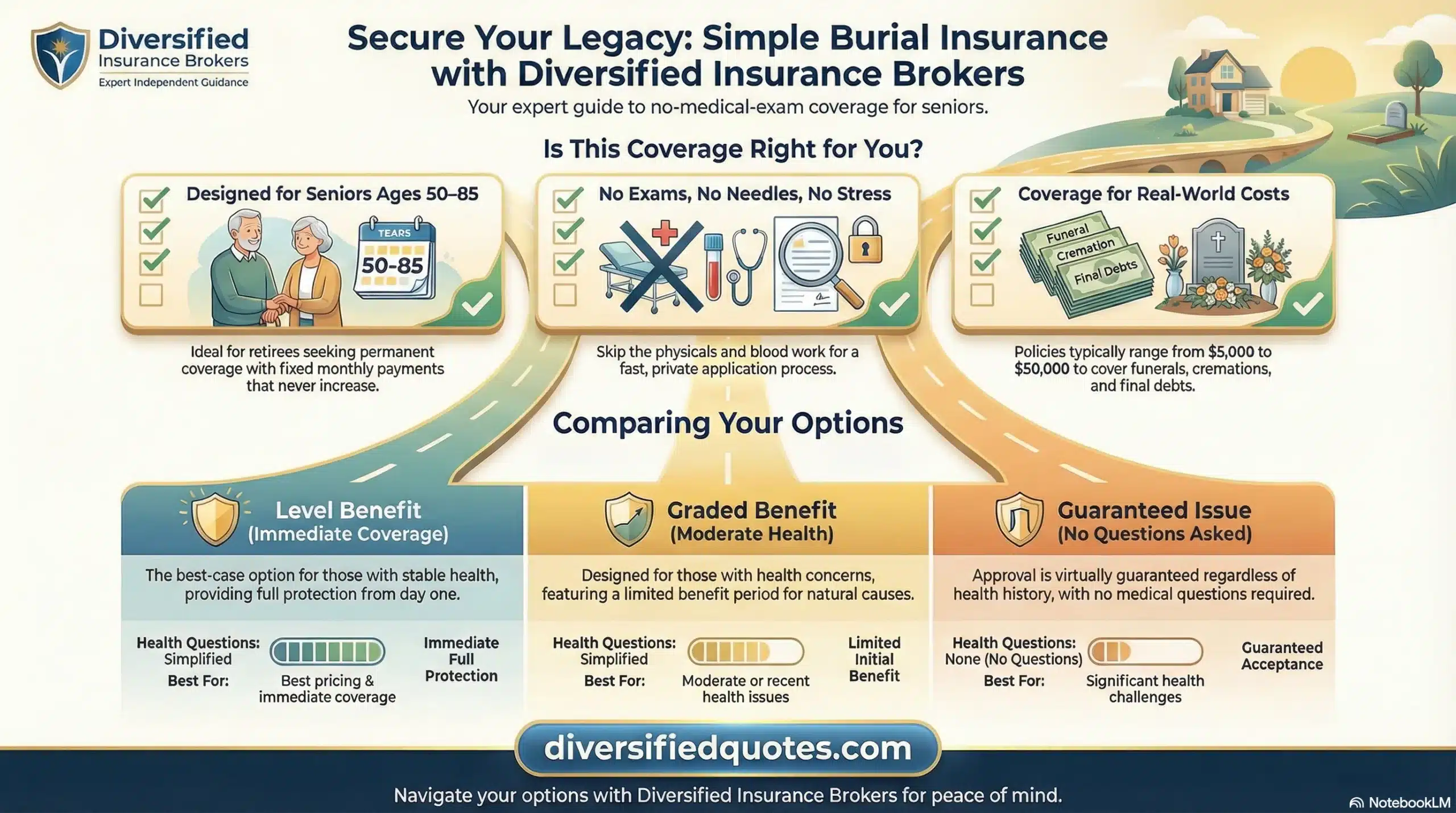
Graded benefit simplified-issue coverage is the appropriate middle-ground for applicants who have more complex cardiac history but can still answer “no” to the highest-severity knockout questions — typically the ones about CHF, recent hospitalizations for cardiac symptoms, or events within very recent windows. Graded policies at most carriers pay 30% of the face amount in year one, 70% in year two, and 100% from year three onward, or alternatively pay return of premiums plus interest for natural-cause death in years one and two. Accidental death is typically covered at the full face amount from day one regardless of graded period status. Graded coverage is not a fallback — for applicants whose cardiac history places them in this tier, it is precisely the right product and it provides meaningful, growing protection from the day it is issued. Guaranteed issue is the appropriate pathway for the highest-severity profiles: CHF with recent hospitalizations, very recent major procedures, active angina with frequent nitroglycerin use, or any cardiac profile that cannot clear the simplified-issue health questionnaire. GI requires no health questions, provides automatic approval within the age eligibility range, and follows the same graded structure for natural causes with full accidental death coverage from day one. Our resource on is guaranteed issue life insurance expensive covers the cost comparison between GI and simplified-issue in detail.
Congestive Heart Failure — The Most Complex Cardiac Underwriting Category
Congestive heart failure represents the most challenging cardiac condition in the burial insurance market and warrants its own discussion. CHF is a chronic condition in which the heart muscle cannot pump blood efficiently enough to meet the body’s demands, typically resulting in fluid accumulation, fatigue, and progressive functional limitation. Its presence as a burial insurance underwriting factor is significant because CHF is often the endpoint condition that follows years of other cardiac history — a heart attack that reduces ejection fraction, AFib that stresses the cardiac muscle over time, or prolonged uncontrolled hypertension — and because its exacerbations frequently result in hospitalizations that appear prominently in the application picture. Most simplified-issue final expense carriers have CHF listed prominently in their health questionnaire, and active CHF with recent hospitalizations is commonly a graded or guaranteed-issue trigger at the majority of carriers. However, “CHF” as a diagnosis does not automatically mean the same outcome at every carrier — a CHF patient who has been stable for two or more years with no recent fluid retention episodes or hospitalizations, who is compliant with diuretics and other medications, and who has no concurrent kidney disease or diabetes may find that some carriers will consider a graded simplified-issue product. Multi-carrier comparison is particularly valuable for CHF profiles because carrier-specific guidelines vary more for this condition than for most others in the cardiac category.
How Co-Conditions Compound Cardiac Underwriting
Cardiac history rarely travels alone in the final expense market, and the co-condition picture often determines the underwriting outcome as much as the cardiac diagnosis itself. Diabetes paired with cardiac history is one of the most common co-condition combinations in this market, and it compounds underwriting risk in both directions — uncontrolled diabetes independently increases cardiovascular risk, and cardiac history makes diabetic complications more likely. For applicants managing both conditions, controlled medication compliance and absence of recent hospitalizations for either condition are the factors that keep simplified-issue options on the table. Our resource on burial insurance for people with diabetes covers the diabetes underwriting specifics for applicants managing both conditions.
Tobacco use is a significant cost amplifier for cardiac burial insurance applicants — tobacco users typically pay 30–50% more than non-tobacco applicants at the same policy type, and tobacco history in a cardiac applicant signals continued cardiovascular risk that some carriers treat more conservatively than tobacco history alone. Significant overweight or obesity paired with cardiac history can trigger build-table evaluations at some carriers that affect eligibility tiers. Kidney disease alongside cardiac history compounds the cardiovascular risk picture significantly, as CKD and cardiac disease frequently co-occur and mutually amplify mortality risk. Our resource on burial insurance for people with kidney disease covers the CKD underwriting dynamics for applicants managing both conditions, and our resource on burial insurance for people with high blood pressure covers hypertension as the cardiac co-condition most commonly paired with the conditions in the table above. Stroke history alongside cardiac history is also common and introduces additional underwriting factors — our resource on burial insurance for stroke survivors covers that specific combination.
Blood Thinners, Anticoagulants, and Cardiac Medications
A common concern for cardiac burial insurance applicants is whether anticoagulant therapy — warfarin, eliquis, xarelto, and similar medications — will affect approval. The short answer is: anticoagulants themselves are not typically a disqualifier, but the reason for taking them matters. Blood thinners are standard post-procedure care for many cardiac conditions — AFib, mechanical valve replacement, prior clot history, recent stent or bypass — and most simplified-issue carriers recognize them as expected medications for the conditions they accompany. What carriers evaluate is the underlying condition the anticoagulant is treating and whether that condition is stable. Similarly, statins, beta-blockers, ACE inhibitors, and other common cardiac medications are expected in an applicant with cardiac history and their presence alone does not move an application toward a graded or GI tier. Active nitroglycerin use is treated more variably — some carriers are concerned with frequent sublingual nitroglycerin use because it signals active angina symptoms, while others evaluate it in context of frequency and indication. The prescription history database check that most simplified-issue carriers run at application will reflect the full current medication picture regardless of what is stated on the application, so accuracy matters.
Choosing the Right Benefit Amount with Cardiac History
The benefit amount for burial insurance with cardiac history should reflect actual final expense costs rather than maximizing coverage or selecting an arbitrary round number. Based on 2026 NFDA data, a funeral with burial averages approximately $8,300 before cemetery charges, which commonly add $3,000 to $5,000 for the plot, grave opening and closing, and burial vault or liner. Cremation with a memorial service averages approximately $6,280 before additional service and merchandise costs. Adding final medical bills, family travel and lodging, small outstanding debts, and estate administrative costs, most families find that a benefit between $10,000 and $20,000 addresses their realistic final expense needs with a reasonable buffer. Our resources on burial insurance calculator, final expense insurance calculator, and monthly cost of a $10,000 burial insurance policy provide the pricing reference points to model specific amounts before selecting a carrier. For cardiac applicants whose pathway is guaranteed issue — where premiums per dollar of coverage are higher — focusing the benefit amount on actual final expense needs rather than inflating to a larger number keeps the monthly premium sustainable permanently. Our resource on low cost burial insurance and affordable burial insurance for low-income seniors cover premium management strategies for applicants where budget is the primary constraint.
Family Members Arranging Coverage for a Relative With Heart Disease
Adult children and other family members frequently research burial insurance for parents or relatives with cardiac history who have not yet established coverage. This arrangement is entirely standard in the final expense market — an adult child can serve as the policy owner and premium payer while the parent is the insured, with the parent’s informed consent and accurate health question responses required. For parents whose cardiac history would point toward graded or guaranteed issue coverage, establishing that coverage now starts the graded period clock immediately. For parents who are within the two-year window from a major cardiac event and would benefit from simplified-issue coverage after the window clears, establishing GI coverage now provides protection during the window and the possibility of adding or replacing with improved coverage later. Our resources on burial insurance for parents over 70 and best burial insurance for parents over 70 cover the parent-specific planning considerations, and our resource on best-rated burial insurance companies covers the carrier landscape for high-risk cardiac profiles in the final expense market.
Talk With an Advisor Today
Choose how you’d like to connect—call or message us, then book a time that works for you.
Schedule here:
calendly.com/jason-dibcompanies/diversified-quotes
Licensed in all 50 states • Fiduciary, family-owned since 1980
FAQs: Burial Insurance for People With Heart Conditions
Can I get burial insurance after a heart attack?
Yes. Most simplified-issue final expense carriers consider level-benefit coverage for heart attack survivors who are more than two years past the event with a stable recovery and no recurrent cardiac events. Within the two-year window, graded-benefit simplified issue or guaranteed issue burial insurance is typically available, providing coverage that begins building toward full benefit immediately. The exact month and year of the heart attack matters, because the two-year threshold is measured precisely. Establishing graded or GI coverage now starts the clock rather than delaying protection while waiting for the window to clear.
Can I get burial insurance with stents or bypass surgery?
Yes. The same two-year timing rule that applies to heart attacks applies to stents, angioplasty, and bypass surgery. Two or more years from the most recent procedure, with stable recovery and no recurrent events, typically qualifies for level-benefit simplified-issue coverage at most carriers. More recent procedures point toward graded simplified issue or guaranteed issue. Having had multiple stents or a repeat procedure affects which carriers will consider level benefit, but coverage remains available across the product range regardless of procedure history.
Is burial insurance available if I have atrial fibrillation?
Yes — AFib alone, when stable and controlled, often qualifies for simplified-issue level-benefit coverage at many carriers. Unlike conditions with a strict two-year event threshold, AFib is primarily evaluated on stability, control, and the absence of concurrent CHF or recent hospitalizations. Controlled AFib with consistent anticoagulant management and no recent cardiac-related ER visits or hospitalizations has one of the more favorable underwriting profiles in the cardiac category. If AFib is paired with CHF or has resulted in recent hospitalizations, the pathway shifts toward graded or GI coverage.
Can someone with congestive heart failure get burial insurance?
Yes — CHF does not block all burial insurance pathways. Guaranteed issue burial insurance is available to CHF patients regardless of disease severity or recent hospitalization history, requiring no health questions. Some carriers with more lenient CHF guidelines may also consider graded simplified-issue coverage for CHF patients who have been stable for 2+ years with no recent hospitalizations. CHF is the most challenging cardiac condition in the burial insurance market for simplified-issue qualification, but the GI pathway ensures coverage is always accessible. Establishing that coverage now begins the graded period immediately, providing accidental death protection from day one and transitioning to full coverage after year two.
Do I need a medical exam for burial insurance with heart disease?
No. Burial insurance does not require a medical exam, blood work, cardiac stress test, echocardiogram, or physician records in any of its forms. Simplified-issue policies use a short health questionnaire (typically 5-15 questions) and an electronic prescription history database check. Guaranteed issue policies require no health questions at all — only basic demographic information. The absence of medical examination is one of the defining advantages of the final expense product category for people managing serious cardiac conditions.
Will being on blood thinners or cardiac medications affect my application?
Anticoagulants (eliquis, xarelto, warfarin) and standard cardiac medications (statins, beta-blockers, ACE inhibitors) are expected and do not themselves disqualify an application. Carriers evaluate the underlying condition the medication is treating, not the medication in isolation. Active nitroglycerin use is evaluated more variably — frequent use for active angina can be a concern at some carriers because it signals ongoing symptoms, while stable, infrequent use for precautionary purposes is treated more neutrally. The prescription database check will reflect the full medication profile regardless of what is stated on the application, so accuracy is important.
What is the difference between level benefit and graded benefit burial insurance?
Level benefit burial insurance pays the full face amount for all covered causes of death from the policy effective date — there is no waiting period for natural causes. Graded benefit burial insurance limits the natural-cause payout during the first two to three years, then transitions to full coverage. Most graded policies either pay return of premiums plus 10% interest for natural-cause death in years one and two, or follow a 30/70/100% structure over three years. Accidental death is typically covered at the full face amount from day one under either structure. For cardiac applicants, understanding which structure a specific policy uses before applying ensures there are no surprises about how the policy performs in the early years.
Can I get declined for burial insurance because of my heart condition?
Under simplified issue, yes — some cardiac profiles will be declined at specific carriers, particularly very recent major events or complex multi-condition profiles that exceed a carrier’s health question thresholds. However, a decline from one simplified-issue carrier does not mean all coverage is unavailable — it typically means that specific carrier’s underwriting guidelines do not fit the profile. Guaranteed issue burial insurance cannot decline age-eligible applicants regardless of cardiac history. For any cardiac profile where simplified issue produces a decline, guaranteed issue provides a reliable alternative pathway. Applying strategically — with an independent agent who knows which carriers accept which cardiac profiles — avoids unnecessary declines from the start.
About the Author:
Jason Stolz, CLTC, CRPC, DIA, CAA and Chief Underwriter at Diversified Insurance Brokers (NPN 20471358), is a senior insurance and retirement professional with more than 25 years of real-world experience helping individuals, families, and business owners protect their income, assets, and long-term financial stability. As a long-time partner of the nationally licensed independent agency Diversified Insurance Brokers, Jason provides trusted guidance across multiple specialties—including fixed and indexed annuities, long-term care planning, personal and business disability insurance, life insurance solutions, Group Health, Travel Medical and Evacuation Insurance, and short-term health coverage. Diversified Insurance Brokers maintains active contracts with over 100 highly rated insurance carriers, ensuring clients have access to a broad and competitive marketplace.
His practical, education-first approach has earned recognition in publications such as VoyageATL, and contributions from his agency featured in Kiplinger and GoBankingRates— highlighting his commitment to financial clarity and client-focused planning. Drawing on deep product knowledge and years of hands-on field experience, Jason helps clients evaluate carriers, compare strategies, and build retirement and protection plans that are both secure and cost-efficient. Visitors who want to explore current annuity rates and compare options across multiple insurers can also use this annuity quote and comparison tool.
Explore More Burial Insurance Options: Browse our complete guide to Burial Insurance for High Risk Conditions — covering burial insurance for diabetes, heart conditions, cancer, stroke & more from top carriers.
Last Reviewed: June 4, 2026 |
Reviewed by: Jason Stolz, CLTC, CRPC, DIA, CAA
Chief Underwriter, Diversified Insurance Brokers, Inc. | NPN: 20471358 | Diversified Insurance Brokers, Inc. — Licensed in all 50 states
Fact Checked by: Tonia Pettitt, CMIP©
Medicare Specialist, Diversified Insurance Brokers, Inc. | NPN: 14374308 | Diversified Insurance Brokers, Inc. — Licensed in all 50 states
Did you find this content helpful? Leave us a Google review — it helps others find trustworthy guidance too.
Editorial Standards: Diversified Insurance Brokers maintains rigorous editorial standards to ensure accuracy, clarity, and independence in all content. Learn more about our editorial standards and commitment to transparency.
