
Burial Insurance for Seniors Over 70
Burial Insurance for Seniors Over 70

Jason Stolz CLTC, CRPC, DIA, CAA
Burial insurance for seniors over 70 is not a last-resort product for people who couldn’t get anything else — it is the primary final expense planning tool for the entire 70s age decade, and most seniors in this age range are well within the market’s most active acceptance window. The final expense and burial insurance product category was designed specifically for applicants at ages like these: permanent whole life coverage without a medical exam, simplified underwriting focused on the conditions most commonly present at 70 and above, and benefit amounts sized to actual final expense costs rather than large income-replacement objectives. A senior in their early 70s with controlled blood pressure, managed cholesterol, and stable type 2 diabetes is the kind of health profile that many final expense carriers actively price for, not one they reluctantly accommodate. Level benefit coverage — which pays the full death benefit from the policy effective date for all covered causes of death — is broadly available throughout the 70s for applicants whose health history fits the carrier’s simplified-issue guidelines. The practical question is not “can a 70-something get burial insurance” but “which carrier’s underwriting is most favorable for this specific profile, and what benefit amount creates the right balance of coverage and sustainable premium.” Our resource on burial insurance services and our resource on burial insurance for seniors provide the full market context, and our resource on burial insurance for seniors over 60 covers the adjacent decade where premiums are lower and the option set is broader.
What makes the 70s different from the 60s is primarily cost and, to a lesser degree, the distribution of available policy structures. Premiums at age 70 are meaningfully higher than at age 60 for identical coverage and health profile — each year of age increases the premium because the carrier has fewer expected years to collect before the policy pays out. A senior who purchases a $15,000 burial policy at age 70 locks in a lower lifetime monthly premium than the same senior would face at age 73 or 76. Waiting has a calculable cost in this market, and for seniors who are already in their 70s, understanding that cost is part of making a sound decision about when to act. What makes the 70s different from the 80s is substantially broader access to level-benefit simplified-issue coverage, more carrier competition, and the full availability of guaranteed issue for applicants whose health makes simplified-issue uncertain — the age-85 guaranteed-issue cutoff that creates urgency in the 80s is still comfortably far away for most of the 70s decade. A senior at age 72 has substantially more carrier options, better rate competition, and a wider range of health profiles that qualify for level benefit than the same senior would at age 82. Acting in the 70s rather than deferring preserves those advantages.
The financial planning case for burial insurance at 70 and above is rooted in a specific practical problem: when a senior passes away, the family faces immediate financial obligations — funeral home deposit, service costs, burial or cremation arrangements, final medical bills, small outstanding debts — on a very short timeline, typically within days of death. These costs must be paid promptly from whatever funds are immediately accessible. Savings accounts are accessible but may be titled in ways that complicate immediate access through estate or probate processes, may be held jointly with a surviving spouse who is also under financial stress, or may simply be funds the family had designated for other purposes. A burial insurance policy pays directly to a named beneficiary — bypassing estate and probate in most cases — creating a dedicated, accessible source of funds specifically for the final expense purpose. The benefit doesn’t have to be large to be valuable. A $12,000 policy that pays in 48 hours is worth substantially more to a family that needs it that week than a $100,000 brokerage account that takes six weeks to transfer and was earmarked for retirement income. Our resource on burial insurance vs. pre-paid funeral covers the structural comparison between insurance and funeral pre-payment that many families evaluate alongside the insurance option.
Compare Burial Insurance Rates for Seniors Over 70
Simplified issue — no medical exam. Compare level, graded, and guaranteed issue options from multiple carriers.
Want the most competitive rate for your specific profile?
We compare carriers whose underwriting is most favorable for your age, health history, and benefit amount — and we identify whether level, graded, or guaranteed issue is the right starting point before any application is submitted.
Request a Quote for Seniors Over 70Three Policy Structures Available to Seniors Over 70
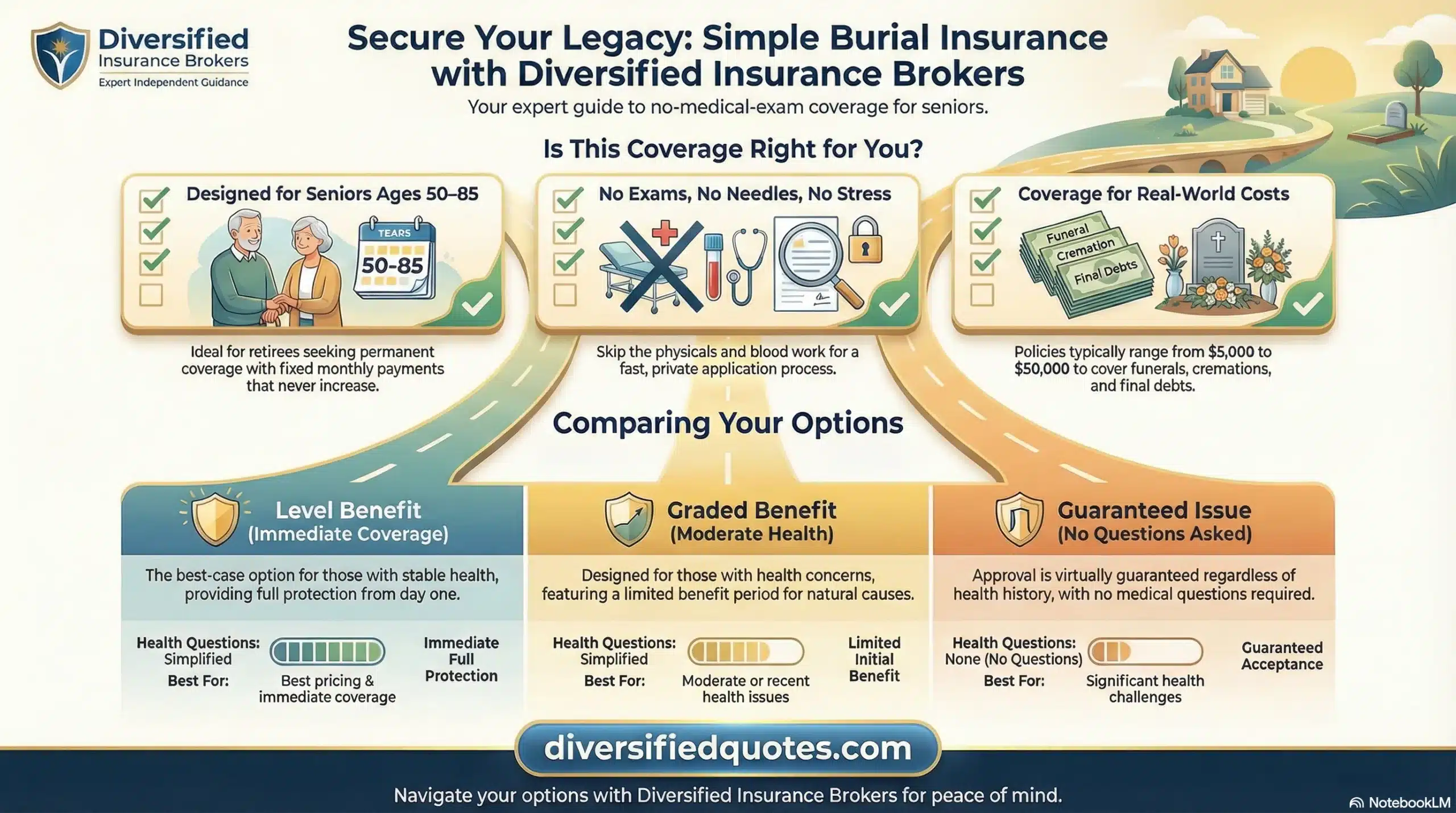
Every burial insurance applicant in their 70s will encounter three fundamental policy structures, and which one is appropriate depends on the specific health profile — not age alone. Understanding what each structure does, who typically qualifies, and what the cost and benefit trade-offs are is the foundation for making an informed decision rather than defaulting to whatever structure the first carrier offers.
| Dimension | Level Benefit (Day-One) | Graded Benefit | Guaranteed Issue |
|---|---|---|---|
| Underwriting | Simplified issue — short health questionnaire (5–15 questions), no medical exam; carrier adds electronic prescription database check and MIB review | Simplified issue — same application process as level benefit; carrier approves but assigns graded structure based on the specific health answers provided | No health questions, no exam — approval is automatic within the eligible age range (typically up to age 85); carrier prices in maximum uncertainty |
| Day-One Death Benefit | Full face amount from day one — both natural causes and accidental death covered at 100% from the policy effective date; no waiting period | Partial for natural causes in years 1–2 — typically return of premiums paid plus 10% interest; OR 30–40% of face amount in year 1, 70% in year 2, 100% year 3+; accidental death usually 100% from day one | Graded for natural causes — always — 2-year waiting period standard; premiums plus interest returned for natural-cause death in years 1–2; full benefit from year 3; accidental death typically 100% from day one |
| Coverage Amounts | $5,000–$50,000 depending on carrier; the broadest face amount range is available through level-benefit simplified issue; $10,000–$25,000 most common selection in the 70s | $5,000–$30,000+ depending on carrier; similar range to level benefit at most carriers | $5,000–$25,000 typically; GI maximums are generally lower than simplified issue at most carriers; designed specifically for final expense amounts |
| Premium Cost | Lowest per dollar of coverage — the most cost-effective structure when health qualifies; carrier can price precisely because it has complete health information | Moderate — higher than level benefit for identical face amount; lower than guaranteed issue because health questions allow some risk selection | Highest per dollar of coverage — significantly more expensive than either simplified-issue structure; carrier prices in the worst-case health pool because anyone can apply |
| Who Typically Qualifies in Their 70s | Seniors with controlled chronic conditions (blood pressure, cholesterol, stable diabetes), no recent hospitalizations for major events, functional independence, no oxygen therapy, no recent cancer diagnosis; the most common qualification tier in the early-to-mid 70s for otherwise-healthy seniors | Seniors with more complex or recent health history — recent cardiac events, shorter post-stroke timelines, moderately complex diabetes with managed complications, recent procedures; still qualifying simplified issue but at graded structure due to elevated profile | Seniors who cannot qualify for simplified issue — very recent serious events (within months), active cancer treatment, home oxygen use, severe functional limitations, or prior formal declines that make simplified-issue approval unlikely |
| Strategic Role | Primary target — always evaluate level benefit first; the most value for any health profile that qualifies; sets the benchmark for premium efficiency | Strategic bridge — provides coverage when level benefit is not available; better value than GI while building toward full coverage as graded period ends | Last resort — appropriate when simplified issue is genuinely unavailable; reserve for situations where other options have been properly evaluated first |
Policy structures, coverage limits, graded period mechanics, and premium rates vary significantly by carrier and state. This table reflects general market patterns for educational purposes. Verify all terms, benefit definitions, and premium amounts in the actual policy documents before any purchase decision. An independent final expense specialist compares options across multiple carriers whose underwriting fits the specific health profile, rather than defaulting to the first available structure.
What Determines Whether a 70-Year-Old Gets Level Benefit
The boundary between level benefit and graded benefit in the 70s final expense market is not primarily an age boundary — it is a health history boundary. Most final expense carriers have underwriting guidelines that explicitly accommodate the most common chronic conditions of the 70s age bracket, because designing a product for this demographic while excluding blood pressure medication and statin therapy would eliminate most of the market. The conditions that typically still qualify for level benefit in the 70s include well-controlled hypertension, managed cholesterol, type 2 diabetes with stable A1C and no significant complications, non-insulin-dependent diabetes with consistent follow-up, COPD that is mild and managed without home oxygen, stable cardiovascular history with consistent cardiology follow-up and no recent events or procedures, and most cancers that are more than a defined number of years into clean remission. What pushes applications toward graded benefit or guaranteed issue in the 70s is recent event history — a heart attack within the past 12 to 24 months, a stroke within the past 12 months, a hospitalization for cardiac or respiratory reasons within the past 90 days, new oxygen therapy, or recently-diagnosed cancer that is still under active treatment. The specific thresholds vary by carrier, which is the reason multi-carrier comparison produces better outcomes than single-carrier application. Our resource on life insurance with pre-existing conditions covers the general framework for how carriers evaluate common health conditions, and our condition-specific resources on burial insurance for people with heart conditions, burial insurance for stroke survivors, burial insurance for cancer survivors, and burial insurance for people with high blood pressure cover the most common 70s health profiles in detail.
Premium Reality for Seniors Over 70 — What to Actually Budget
Burial insurance premiums in the 70s are higher than at younger ages, but they are structured to remain manageable because coverage amounts are smaller than traditional life insurance. As a general market reference, final expense insurance at age 70 typically costs in the range of $30–$100 per month for $10,000 of coverage depending on gender, tobacco status, health profile, and whether the plan is level benefit or guaranteed issue. A 72-year-old woman, for example, might see quotes ranging from approximately $78 to $105 per month for the same $10,000 policy depending on the carrier, reflecting the meaningful 15–25% premium variation that commonly exists across carriers for identical coverage amounts and similar health profiles. This variation is why comparing multiple carriers is worth the time — the lowest competitive rate for a specific age, gender, and health profile can be materially lower than the first rate encountered. Premiums for tobacco users are typically 30–50% higher than for non-tobacco users at the same age and benefit amount. Guaranteed issue is the most expensive structure per dollar of coverage at any age, and at age 70, the premium gap between a level-benefit simplified-issue policy and a guaranteed-issue policy for the same face amount is significant enough to make exploring simplified-issue options first a consistently worthwhile step. Our resource on monthly cost of a $10,000 burial insurance policy provides real pricing reference points across age ranges and genders, and our resource on is guaranteed issue life insurance expensive covers the full cost structure comparison between GI and simplified-issue options.
Why Carrier Comparison Makes a Material Difference in the 70s
The burial insurance market at ages 70 and above is not uniform — every carrier builds its own underwriting guidelines, pricing tables, maximum issue ages, health question criteria, and rate class structures. A health profile that qualifies for level benefit at one carrier’s standard rate may attract a graded benefit structure at another carrier and a guaranteed-issue route at a third. A profile with a specific combination of conditions — say, blood pressure, cholesterol, and a resolved cardiac procedure from several years ago — may be priced very favorably at a carrier whose underwriting guidelines are designed for that exact combination and expensively at a carrier whose guidelines are more conservative on cardiac history. Premium differences of 15–25% for the same coverage at the same age are documented and common across the carrier landscape. Working with an independent final expense specialist rather than going directly to any single carrier is the mechanism through which those differences become visible. An independent broker comparing 20 or more final expense carriers can identify which carriers are currently most favorable for the specific age, health profile, and benefit amount rather than presenting only the products one company offers. This is the practical reason that comparison shopping produces better outcomes — not because any single carrier is uniformly bad, but because no single carrier is uniformly the best fit for every applicant profile.
Health Conditions Most Common in the 70s and How They Typically Affect Approval
Seniors over 70 rarely present with a single isolated health factor — the typical application profile in this decade includes two or three managed chronic conditions alongside age as a pricing factor. The combination matters more than any individual element. Blood pressure managed with medication and consistent follow-up, without recent hospitalizations or stroke history, is typically a neutral or minor factor at most final expense carriers — it is so common at this age that the underwriting tables are built around it. Blood pressure combined with recent cardiovascular complications creates a more complex picture. Stable type 2 diabetes on oral medication with well-controlled A1C is accepted at level benefit rates by many carriers; insulin-dependent diabetes with complications narrows the carrier field. Tobacco use — current or recent — adds a defined percentage to premiums regardless of other health factors. Build factors (height-to-weight ratio) affect some carriers more than others; when weight is a concern, carrier selection matters because some final expense companies have more flexible build charts than others. Our resource on burial insurance for overweight people covers the specific underwriting dynamics for applicants where build is a factor, and our resource on burial insurance for smokers covers tobacco classification in the final expense market specifically. Our resource on burial insurance for people with kidney disease covers the renal conditions that commonly accompany cardiovascular and diabetic profiles in the 70s age bracket.
The Premium Clock — Why Buying in the 70s Beats Waiting for the 80s
Every year a senior waits to purchase burial insurance has two financial consequences: the monthly premium for the same coverage amount increases, and the range of health conditions that qualify for level benefit may narrow if new health events occur in the interim. At age 70, a senior who is eligible for level benefit at a competitive rate locks in that rate permanently — premiums for existing burial insurance policies do not increase after issue regardless of age, health changes, or additional diagnoses. The same senior who waits until age 75 to apply pays a meaningfully higher monthly premium for the same policy, and the same senior who waits until age 79 or 80 pays higher still. If a health event occurs in the years between 70 and 75 — a cardiac event, a new cancer diagnosis, a stroke — the level-benefit option that was available at 70 may be replaced by a graded-benefit or guaranteed-issue option that costs more per dollar of coverage and delivers full benefits on a delayed timeline. The benefit of early action is straightforward: lower premiums locked in permanently, the broadest health qualification window, and the most carrier options available before any future health changes narrow the competitive landscape. Our resource on how to find an old life insurance policy is useful for seniors who may have coverage they have lost track of before evaluating new options, and our resource on best burial insurance for parents over 70 covers the adult-child-driven purchase scenario that frequently arises when a parent in their 70s has not yet addressed final expense planning independently.
Choosing the Right Benefit Amount for Seniors Over 70
The right burial insurance benefit amount for a senior in their 70s is determined by actual final expense costs — not by the maximum available face amount, not by a round number that sounds substantial, and not by what a carrier is willing to offer. A standard burial service with viewing, casket, vault, and cemetery costs averages $8,500 to $13,000 in the current market depending on geography and service selections. Cremation with a memorial service typically runs between $2,000 and $5,000 for direct cremation plus ceremony costs. Most families use burial insurance to cover the funeral and burial service, any final medical or hospice bills that arrive after death, small outstanding debts, and the administrative and travel costs that accompany loss. For most seniors in their 70s, a benefit between $10,000 and $25,000 addresses these needs without pushing monthly premiums to uncomfortable levels. Seniors who also want a modest legacy component — a small amount left over for the family above what the final expenses consume — typically target $20,000–$30,000 when that goal is affordable within their monthly budget. Seniors on fixed income where premium sustainability is the primary concern should prioritize a benefit amount they can maintain long-term over a larger benefit they may struggle to keep in force. Our resources on burial insurance calculator and final expense insurance calculator model specific benefit amounts at current rates before any carrier selection, and our resource on affordable burial insurance for low-income seniors covers premium management strategies for seniors where monthly budget is a primary constraint.
Talk With an Advisor Today
Choose how you’d like to connect—call or message us, then book a time that works for you.
Schedule here:
calendly.com/jason-dibcompanies/diversified-quotes
Licensed in all 50 states • Fiduciary, family-owned since 1980
FAQs: Burial Insurance for Seniors Over 70
Can you get burial insurance after age 70?
Yes — the 70s are actually one of the most active age decades in the final expense and burial insurance market. Most carriers actively accept new applicants throughout this age range, and all three policy structures — level benefit, graded benefit, and guaranteed issue — are broadly available. Many seniors in their 70s qualify for level-benefit day-one coverage when their health history is stable and their controlled conditions fit the carrier’s simplified-issue guidelines. Premiums are higher than at younger ages, but coverage is both accessible and permanent once issued.
Do seniors over 70 need a medical exam for burial insurance?
No — burial insurance is simplified issue in almost all cases, meaning no medical exam, no blood work, and no physician records submission. Carriers use a short health questionnaire, a prescription history database check, and a Medical Information Bureau check to evaluate the application. Guaranteed issue policies go further — no health questions at all, with automatic approval for age-eligible applicants. Neither simplified issue nor guaranteed issue requires a physical examination at any age.
How much burial insurance do seniors over 70 typically need?
The appropriate amount is determined by actual final expense costs — a standard burial service with viewing, casket, and vault averages $8,500 to $13,000 in the current market, depending on location and service selections. Most seniors in their 70s select between $10,000 and $25,000 to cover the funeral and burial service, any final medical bills, small debts, and family travel costs. Seniors who want a modest legacy component above the final expense coverage may target $20,000–$30,000. The right amount is one the senior can comfortably maintain in monthly premiums for the long term, not the maximum available face amount.
What health conditions affect burial insurance approval in the 70s?
Controlled chronic conditions — managed blood pressure, stable cholesterol, type 2 diabetes with controlled A1C, mild COPD without oxygen therapy — typically qualify for level-benefit simplified-issue coverage at carriers whose guidelines accommodate these common 70s profiles. What generally pushes applications toward graded benefit or guaranteed issue is recent event history: a heart attack or stroke within the past 12–24 months, a recent hospitalization for cardiac or respiratory reasons, home oxygen therapy, active cancer treatment, or significant functional limitations. Carrier guidelines vary, which is why the same health profile can produce level benefit at one carrier and a graded structure at another — comparison across carriers identifies which is most favorable for the specific profile.
How much does burial insurance cost for a senior over 70?
As a general market reference, final expense insurance at age 70 typically runs in the range of $30–$100 per month for $10,000 of coverage depending on gender, tobacco status, health profile, and policy structure. A 72-year-old woman might see quotes ranging from approximately $78 to $105 per month for the same $10,000 policy across different carriers — a 15–25% spread that is common and makes comparison shopping worthwhile. Premiums increase with each birthday, tobacco users pay 30–50% more than non-tobacco users, and guaranteed issue is significantly more expensive per dollar of coverage than level-benefit simplified issue. Locking in coverage earlier in the decade permanently sets a lower premium than any future year would offer.
Will premiums increase after the policy is issued?
No. Burial insurance is permanent whole life coverage with level premiums that are fixed at the time of policy issue and never increase due to age, health changes, or additional diagnoses after the policy is in force. This is one of the most important financial features for seniors on fixed income — the monthly cost is completely predictable for the life of the policy, and the coverage never expires or decreases as long as premiums are paid. The premium set at issue at age 70 is the same premium the policyholder pays at age 80 or age 90.
Do burial insurance benefits go through probate?
In most cases, burial insurance proceeds are paid directly to the named beneficiary and bypass the estate and probate process. This is one of the key practical advantages of burial insurance over using savings or bank accounts for final expense funding — the beneficiary can receive the funds within days of submitting the claim, without waiting for estate settlement, asset title transfers, or probate court timelines. This speed of access is particularly valuable because funeral homes, cremation services, and burial costs require payment within days of death, not weeks or months.
What if I already have some life insurance — do I still need burial insurance?
It depends on what the existing coverage is designated for and how accessible it is at the time of death. If an existing life insurance policy is earmarked for income replacement for a surviving spouse, mortgage payoff, or other obligations, using it for final expenses depletes funds that serve a separate purpose. A dedicated burial insurance policy creates a separate pool of funds specifically for final expenses — accessible quickly to the beneficiary who is managing the funeral arrangement — without drawing on coverage that serves other goals. If existing coverage is an older group policy from an employer that will be terminating, or a small policy that is no longer appropriately sized for current funeral costs, a new burial policy may replace rather than supplement. Our resource on how to find an old life insurance policy helps seniors confirm what they actually have before evaluating whether new coverage is needed.
About the Author:
Jason Stolz, CLTC, CRPC, DIA, CAA and Chief Underwriter at Diversified Insurance Brokers (NPN 20471358), is a senior insurance and retirement professional with more than 25 years of real-world experience helping individuals, families, and business owners protect their income, assets, and long-term financial stability. As a long-time partner of the nationally licensed independent agency Diversified Insurance Brokers, Jason provides trusted guidance across multiple specialties—including fixed and indexed annuities, long-term care planning, personal and business disability insurance, life insurance solutions, Group Health, Travel Medical and Evacuation Insurance, and short-term health coverage. Diversified Insurance Brokers maintains active contracts with over 100 highly rated insurance carriers, ensuring clients have access to a broad and competitive marketplace.
His practical, education-first approach has earned recognition in publications such as VoyageATL, and contributions from his agency featured in Kiplinger and GoBankingRates— highlighting his commitment to financial clarity and client-focused planning. Drawing on deep product knowledge and years of hands-on field experience, Jason helps clients evaluate carriers, compare strategies, and build retirement and protection plans that are both secure and cost-efficient. Visitors who want to explore current annuity rates and compare options across multiple insurers can also use this annuity quote and comparison tool.
Explore More Burial Insurance Options: Browse our complete guide to Burial Insurance for Seniors — covering burial insurance for seniors over 50, 60, 70, 80 & parents from top carriers from top carriers.
Last Reviewed: June 4, 2026 |
Reviewed by: Jason Stolz, CLTC, CRPC, DIA, CAA
Chief Underwriter, Diversified Insurance Brokers, Inc. | NPN: 20471358 | Diversified Insurance Brokers, Inc. — Licensed in all 50 states
Fact Checked by: Tonia Pettitt, CMIP©
Medicare Specialist, Diversified Insurance Brokers, Inc. | NPN: 14374308 | Diversified Insurance Brokers, Inc. — Licensed in all 50 states
Did you find this content helpful? Leave us a Google review — it helps others find trustworthy guidance too.
Editorial Standards: Diversified Insurance Brokers maintains rigorous editorial standards to ensure accuracy, clarity, and independence in all content. Learn more about our editorial standards and commitment to transparency.
