
Burial Insurance for Seniors
Burial Insurance for Seniors

Jason Stolz CLTC, CRPC, DIA, CAA
Burial insurance for seniors solves a specific and time-sensitive financial problem: ensuring that funeral expenses, final medical bills, and end-of-life costs are covered by a dedicated, guaranteed pool of funds rather than falling unexpectedly on a spouse, adult children, or other family members who may not have the liquidity to absorb thousands of dollars in immediate costs while simultaneously managing grief. Burial insurance for seniors — also called final expense insurance or funeral insurance — is typically a small permanent life insurance policy in the $5,000 to $40,000 range, designed to stay in force for the insured’s entire lifetime as long as premiums are paid and to pay a guaranteed lump-sum benefit to the named beneficiary when death occurs. It is the simplest and most accessible form of life insurance available for older adults, including many who have health conditions that make traditional fully-underwritten life insurance difficult or impossible to obtain.
At Diversified Insurance Brokers, we compare burial insurance options across multiple carriers that specialize in final expense coverage for seniors. Our focus is on matching the right policy structure — level benefit, graded benefit, or guaranteed issue — to the applicant’s health profile, selecting the benefit amount that genuinely covers realistic final expenses in the applicant’s area, and ensuring the premium is sustainable over the long term rather than optimized only for today’s budget. This page provides everything seniors and their families need to understand burial insurance: how it works, what it costs, who qualifies for what type, how health conditions affect options, and how burial insurance fits into a complete retirement financial plan.
Compare Burial Insurance for Seniors
Use the calculator below to see real rates from multiple carriers and compare coverage amounts in minutes.
What Burial Insurance for Seniors Actually Covers
Burial insurance is designed to cover the costs that arise immediately when someone passes away — before an estate is settled, before any inheritance reaches family members, and often before family members can access the deceased’s bank accounts due to probate and financial institution hold processes. The benefit is paid directly to the named beneficiary as a lump sum, typically within a week to a few weeks of claim submission and documentation, providing immediate liquidity exactly when families need it most.
Funeral and burial costs represent the primary use case. A traditional funeral with burial in most American markets now runs from $8,000 to $15,000 or more when all components are included: funeral home services (embalming, body preparation, visitation, and coordination), the casket or urn, burial plot or columbarium niche, opening and closing fees for the grave, headstone or marker, and printed materials and flowers for the service. Cremation is generally less expensive than burial — basic cremation services with a simple memorial can run $2,000 to $5,000 — but direct cremation without any memorial service is often the lowest-cost option while a cremation followed by a full memorial service with urn and interment can approach the cost of a traditional burial.
Beyond the funeral home and burial components, families frequently encounter additional costs: final medical bills and hospital copays not fully covered by Medicare, hospice services and equipment, travel expenses for out-of-town family members attending the service, immediate household expenses during the period before the estate is settled, and small outstanding debts. A burial insurance benefit that covers only the funeral director’s invoice may fall short of the family’s actual total need at the time of loss. Choosing a benefit amount that reflects the full realistic cost picture — not just the funeral home estimate — produces more adequate protection.
The True Cost of a Funeral in the United States
Understanding actual funeral costs before selecting a burial insurance benefit amount is one of the most practically useful steps a senior can take. Many people significantly underestimate what a funeral costs, and a policy that was adequate when purchased in a lower-cost year may be insufficient by the time it is actually needed due to funeral cost inflation that has consistently outpaced general consumer price inflation.
The National Funeral Directors Association (NFDA) tracks funeral costs annually. The median cost of a funeral with viewing and burial has consistently run above $8,000, and that figure does not include cemetery costs — the burial plot, opening and closing fees, and grave marker — which typically add another $2,000 to $5,000 or more. Metropolitan areas, particularly along the coasts and in major cities, commonly see total funeral and burial costs ranging from $15,000 to $25,000 or higher when all components are totaled. Cremation has grown in prevalence and currently accounts for a majority of dispositions in the United States, but the cost range for cremation services is wide — from a few hundred dollars for direct cremation to $8,000 or more for a cremation with a full memorial service and permanent interment.
Seniors who choose a burial insurance benefit of $10,000 or less may find that inflation, geographic variation, or family preferences for a meaningful memorial service exceed the policy’s capacity by the time a claim is filed. A policy designed with a $20,000 to $25,000 benefit provides a more realistic cushion in most markets, with the additional proceeds above direct funeral costs available for final medical bills, travel, or other immediate family expenses. The Compulife calculator above allows rapid comparison of premium costs at different benefit amounts, making it straightforward to evaluate whether the additional premium for a higher benefit amount is within budget.
How Burial Insurance Underwriting Works for Seniors
Burial insurance underwriting is designed to be more accessible than traditional life insurance, but it still involves a risk assessment process that determines the type of policy available and the premium charged. Understanding how carriers evaluate senior applicants helps families choose the right carrier and the right policy type rather than accepting the first available option without comparison.
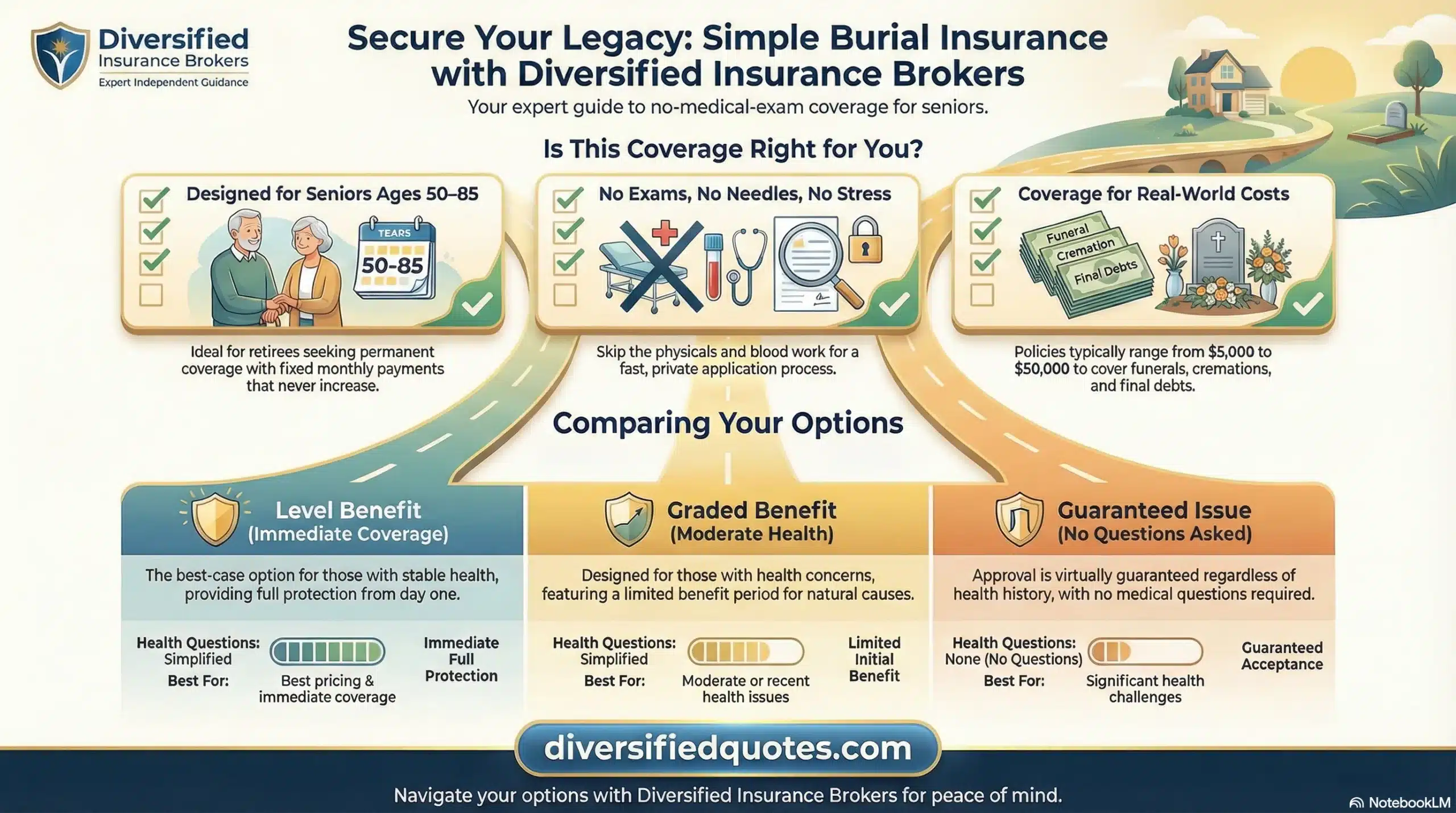
Most burial insurance for seniors falls into one of three underwriting categories, each appropriate for a different health profile:
Level benefit (simplified issue) policies are available to seniors who can answer health questions favorably — meaning they do not have the conditions that disqualify for immediate coverage. These policies provide full death benefit from day one of the policy, which means no waiting period for natural-cause death. Level benefit policies are the most favorable structure because they provide maximum value immediately: the full face amount is available from the first day of coverage. Carriers verify answers through prescription history database checks and in some cases through the MIB (Medical Information Bureau), but do not require a physical exam or medical records. Common conditions that may be acceptable for level benefit approval include treated and controlled hypertension, controlled type 2 diabetes (with A1C within carrier guidelines), high cholesterol, treated depression or anxiety, former tobacco use with a defined quit period, and most orthopedic conditions. Conditions that typically disqualify for level benefit but may still qualify for graded include recent hospitalizations, active cancer treatment, oxygen use, insulin-dependent diabetes with complications, and advanced kidney or heart conditions.
Graded or modified benefit policies provide a waiting period — typically two to three years — during which the full death benefit is not payable for natural-cause death. If the insured passes from natural causes during the graded period, the policy pays a limited benefit: most commonly, a return of premiums paid plus a defined interest rate (often 10%). After the graded period ends, the full face amount is payable for all causes of death. Accidental death is typically covered at the full face amount even during the graded period. Graded benefit policies are appropriate when health history makes level benefit approval unlikely — multiple chronic conditions, recent significant medical events, or a medication profile that suggests elevated health risk. They are better than no coverage and provide full coverage protection after the waiting period is satisfied.
Guaranteed issue policies accept all applicants within the age range (typically 45 to 85, though limits vary by carrier) without health questions, without prescription checks, and without medical records. The tradeoff is that premiums are substantially higher per dollar of coverage than either level or graded benefit policies, and all guaranteed issue policies include a graded benefit period — usually two years — during which natural-cause death pays only a return of premiums plus interest. Guaranteed issue is the option of last resort when no other policy type is available due to health history, but it is genuinely valuable in that specific context because it provides at least some guaranteed coverage with a defined waiting period rather than leaving the family entirely without protection.
Common Health Conditions and How Burial Insurance Carriers Evaluate Them
One of the most important aspects of helping seniors choose burial insurance is understanding how specific health conditions affect carrier eligibility and policy type. The same condition can result in different outcomes at different carriers because each insurer uses proprietary underwriting guidelines with different knockout rules, look-back periods, and condition-specific assessments.
High blood pressure (hypertension) is among the most common conditions in senior applicants, and most burial insurance carriers accept treated and controlled hypertension for level benefit coverage. Uncontrolled hypertension, or hypertension combined with a recent stroke or heart attack, is more likely to result in graded or guaranteed issue outcomes. The key factors are blood pressure control (values within generally accepted ranges), medication compliance, and whether there are significant complications or additional cardiovascular diagnoses.
Diabetes is acceptable for level benefit policies at many carriers when type 2 diabetes is well-controlled (A1C within acceptable ranges), managed with oral medications or insulin without significant complications, and not combined with severe co-morbidities. Type 1 diabetes and type 2 diabetes with significant complications — kidney disease, peripheral neuropathy with significant impact, or prior diabetic coma — are more likely to result in graded or guaranteed issue outcomes. The carrier-specific A1C thresholds and complication exclusion rules vary, which is why a broker comparison across carriers is valuable for diabetic applicants.
Heart conditions cover a wide range. Treated stable coronary artery disease without recent events (no heart attack in the past 12 to 24 months, depending on carrier) may qualify for level benefit at some carriers. A recent heart attack, active congestive heart failure, or use of certain heart medications associated with unstable conditions typically results in graded benefit or guaranteed issue. Atrial fibrillation (AFib) managed with medication without significant complications is often acceptable for level benefit policies at many final expense carriers.
Cancer history depends heavily on type, stage, treatment completion, and time since last treatment. Some cancer histories — skin cancers (excluding melanoma), localized prostate cancer with successful treatment, and certain other localized cancers with defined disease-free periods — may qualify for level benefit policies. More recent or more serious cancer histories are more likely to result in graded or guaranteed issue outcomes. Active cancer treatment is typically a disqualifier for level benefit and graded policies, making guaranteed issue the primary option during active treatment.
COPD, emphysema, and respiratory conditions related to smoking history are common in senior applicants. Mild to moderate COPD without oxygen use may qualify for level benefit at some carriers. Severe COPD, use of supplemental oxygen at home, or a recent hospitalization for respiratory causes typically results in graded or guaranteed issue outcomes. Current tobacco use affects the premium rate for any policy type and may affect availability at certain carriers.
How Much Burial Insurance Do Seniors Need?
The right burial insurance benefit amount for a senior is the amount that genuinely covers realistic final expenses without creating a premium commitment that becomes unsustainable on a fixed retirement income. Both extremes — too little coverage that leaves family members with unmet financial burden, and too much coverage at too high a premium that creates ongoing budget strain — are planning failures. The goal is an accurate match between the policy’s benefit amount and the family’s actual needs.
A practical benefit sizing approach starts with getting real local cost information. Contact one or two local funeral homes for current pricing on the type of service anticipated — traditional burial versus cremation with memorial service — to establish a baseline. Add estimated cemetery costs if burial is planned. Add a reserve for final medical bills, hospice costs, and immediate household expenses during the estate settlement period. For most seniors in mid-range-cost markets, a total of $15,000 to $25,000 covers these categories with a modest cushion. Higher-cost markets or preferences for more elaborate services suggest higher benefit levels; very modest service preferences may be adequately covered by lower amounts.
Some families choose benefit amounts that also incorporate a small legacy component — an additional $5,000 to $10,000 beyond strict final expense coverage that allows the passing of a modest amount to children, grandchildren, or a charitable cause without requiring the drawing down of other estate assets. This legacy function of burial insurance is modest compared to traditional life insurance, but for seniors whose other financial assets are modest or primarily earmarked for a surviving spouse’s support, even a small legacy amount can have meaningful symbolic and practical value. The cost of increasing the benefit from $15,000 to $20,000 or $25,000 is often relatively modest compared to the complete premium, making slight oversizing often economically sensible.
Burial Insurance vs. Pre-Need Funeral Contracts
Seniors exploring how to pre-plan their final expenses often encounter both burial insurance and pre-need funeral contracts (also called preneed funeral trusts or prepaid funeral plans). These are meaningfully different products that serve different purposes, and understanding the distinction prevents families from choosing one when the other — or a combination — would better serve their goals.
A pre-need funeral contract is an agreement with a specific funeral home to provide specific services at today’s prices or at a guaranteed price for future delivery. You pay the funeral home — either in a lump sum or over time — for a defined set of services such as a specific casket, specific embalming services, a specific viewing package, and transportation. The money is typically held in trust and the funeral home is obligated to provide the agreed services when needed. The advantages are specific price lock-in (if the contract guarantees price regardless of future cost increases) and direct coordination with a preferred funeral home. The limitations are portability risks (if you move to a different area or the funeral home closes or is sold, the contract may be difficult to transfer), inflexibility (the contract is for specific services at one location), and the fact that pre-need contracts typically cover only the funeral home’s fees — not cemetery costs, final medical bills, travel, or other surrounding expenses.
Burial insurance, by contrast, pays a cash benefit to the beneficiary who can use it for any purpose — not just for a specific funeral home’s services. This flexibility is valuable because family circumstances and preferences at the time of death may differ from what seemed appropriate years earlier when the policy was purchased. The cash benefit can be applied toward any funeral home, any set of services, or any other final expenses the family faces. For seniors who prefer maximum flexibility and want to ensure funds are available for the full range of end-of-life costs — not just the funeral director’s bill — burial insurance typically serves the objective better than a pre-need contract. For seniors who have specific funeral preferences, want to lock in current pricing, and trust the funeral home’s long-term stability, a pre-need contract for the funeral home services combined with burial insurance for surrounding costs may provide the most complete solution.
The Financial Impact on Families Without Burial Insurance
Most families who have not planned for funeral costs discover the financial reality of that gap at the worst possible time — during the acute emotional period immediately following a loss. Funeral homes typically require payment or a payment arrangement before releasing the body for burial or cremation. When families do not have liquid funds readily available, the options are using credit cards (which may not have adequate limits), drawing on savings that may be dedicated to other purposes, taking out personal loans, borrowing from family members, or relying on GoFundMe campaigns that may or may not reach the necessary amount in the available time.
Beyond the immediate financial stress, the absence of burial planning can also create family conflict — disagreements about service type and cost when financial resources are limited and emotions are heightened are common in families without a clear pre-arranged plan. When one family member has more financial capacity than others, decisions about who pays what and how much can create lasting resentment. A burial insurance policy with a clearly named beneficiary and an understood purpose — “this is for my funeral expenses” — removes the financial ambiguity from a situation that is already emotionally complex.
The practical act of discussing burial insurance with family members and sharing the policy information — carrier name, policy number, beneficiary designation, and where the policy document is kept — ensures that the family can access the benefit promptly when needed rather than discovering it later in the estate process. Many life insurance benefits go unclaimed or are significantly delayed simply because beneficiaries are unaware a policy exists. Communicating about the policy while alive is the final step that makes the coverage actually functional rather than merely theoretical.
How Burial Insurance Fits Into a Complete Retirement Financial Plan
Burial insurance is most effectively understood not as a standalone purchase but as one component of a complete retirement financial protection strategy. Seniors often have multiple financial planning priorities — maintaining adequate retirement income, covering healthcare costs above Medicare, protecting a surviving spouse’s financial stability, and managing the legacy implications of how assets are ultimately distributed. Burial insurance addresses the narrowly defined but immediately pressing concern of final expense costs, leaving other financial resources available for these broader priorities.
When a senior has adequate retirement income and liquid savings, the case for burial insurance is primarily about convenience and family protection — ensuring that final expenses do not create a claim on a spouse’s income or a liquidity problem for children who may not have immediate access to estate assets. The relatively modest annual premium for burial insurance coverage is a cost-efficient way to provide that protection without diverting retirement assets from their primary purposes.
When a senior’s retirement resources are more modest, burial insurance takes on additional importance because the alternative — self-funding final expenses from savings — may not be reliably feasible. A savings account earmarked for funeral costs requires the discipline to maintain it undepleted, the investment of time and attention that many seniors prefer to avoid, and the risk that the funds are needed for another purpose before the funeral occasion arises. Burial insurance solves the dedication and certainty problems: the policy is contractually earmarked, cannot be “borrowed” for other purposes, and guarantees the benefit regardless of what happens to other financial resources. For comprehensive guidance on protecting retirement funds, our resource on how to protect your funds in retirement covers complementary strategies alongside burial insurance.
Get Burial Insurance Rates for Seniors
Compare carriers, benefit amounts, and coverage types with no obligation. We help you find the right fit for your health profile and budget.
Request a Burial Insurance Comparison
Questions? Call 800-533-5969
Financial Protection Essentials
Specialized underwriting guidance, legal funding access, and Social Security coordination to strengthen long-term financial security.
Related Pages
Explore more burial and life insurance planning resources.
Talk With an Advisor Today
Choose how you’d like to connect—call or message us, then book a time that works for you.
Schedule here:
calendly.com/jason-dibcompanies/diversified-quotes
Licensed in all 50 states • Fiduciary, family-owned since 1980
FAQs: Burial Insurance for Seniors
Burial insurance for seniors — also called final expense insurance or funeral insurance — is a small permanent life insurance policy specifically designed to cover funeral costs, final medical bills, and other end-of-life expenses that arise when a person passes away. Coverage amounts are typically between $5,000 and $40,000, and the policy is designed to remain in force for the insured’s entire lifetime as long as premiums are paid. The death benefit is paid as a lump sum directly to the named beneficiary, who can use it for funeral expenses, cremation or burial, outstanding medical bills, travel costs for family members, or any other final expenses the family faces.
Unlike term life insurance, which expires after a defined period, burial insurance does not have an expiration date — there is no risk that the policy “runs out” before it is needed. Unlike traditional fully-underwritten life insurance, burial insurance typically uses a simplified application process without a medical exam, making it accessible to many seniors with common health conditions who might not qualify for traditional coverage. The policy is designed to be simple, permanent, and easy for beneficiaries to claim when the time comes.
Most seniors choose burial insurance coverage between $10,000 and $25,000, which reflects realistic final expense costs in most American markets. A traditional funeral with burial — including funeral home services, casket, burial plot, opening and closing fees, and grave marker — typically runs $10,000 to $20,000 or more depending on geographic location and service preferences. Metropolitan areas with higher costs may see total burial costs exceeding $20,000, while rural and lower-cost markets may allow adequate coverage at $10,000 to $15,000.
Seniors who select coverage amounts at the lower end of this range are typically planning for simpler services or are primarily concerned about ensuring their immediate family is not financially burdened rather than leaving a significant cash buffer. Those who select higher coverage amounts often want the additional cushion to cover final medical bills, hospice costs, family travel, and immediate household expenses during the estate settlement period — costs that the funeral home’s invoice alone does not capture. Before finalizing a coverage amount, getting a real estimate from a local funeral home for the type of service you anticipate is the most reliable way to size the policy appropriately rather than relying on general guidelines.
Yes — burial insurance is specifically designed to be accessible for seniors with common health conditions. Most final expense carriers offer three levels of coverage depending on health profile: level benefit policies (full coverage from day one, for applicants who meet health requirements), graded benefit policies (waiting period for natural-cause death, for applicants with more complex health histories), and guaranteed issue policies (no health questions, universal acceptance within age limits, with a waiting period and higher premiums). The combination of these three tiers means virtually every senior within the eligible age range can access some form of burial insurance coverage.
Conditions commonly accepted for level benefit approval include treated and controlled hypertension, controlled type 2 diabetes, high cholesterol, treated depression, former tobacco use with a defined quit period, and most stable orthopedic conditions. More complex health profiles — multiple chronic conditions, recent hospitalizations, oxygen use, active cancer treatment — are more likely to qualify for graded or guaranteed issue policies. The practical implication is that if one carrier declines level benefit coverage, another carrier may approve it, and if no carrier approves level benefit, graded or guaranteed issue options remain available. Working with an independent broker who knows how different carriers evaluate specific health conditions produces the best outcome rather than applying randomly to a single company.
A graded benefit period is a waiting period — typically two to three years — at the start of a burial insurance policy during which the full death benefit is not payable for natural-cause death. If the insured passes from natural causes (illness, disease, or health-related event) during this period, the policy typically pays a defined limited benefit rather than the full face amount. The most common graded benefit structure pays a return of all premiums paid plus a percentage of interest — often 10% — rather than the face amount during the graded period. After the graded period expires, the full face amount becomes payable for all causes of death including natural causes.
Accidental death is typically covered at the full face amount from day one even during the graded period — so an accidental death in the first year of a graded policy pays the complete death benefit. Graded benefit policies exist specifically to provide coverage for applicants whose health profile makes level benefit approval difficult, and they represent a genuine protective option rather than just a marketing compromise. A graded policy that pays premiums plus interest during a two-year waiting period and then pays the full face amount for all causes thereafter is meaningfully better than having no coverage at all, particularly because the insured will eventually outlive the waiting period and gain access to full coverage.
Yes — burial insurance, final expense insurance, and funeral insurance are terms used interchangeably in the industry to describe the same category of product: small permanent life insurance policies designed to cover end-of-life costs. Different carriers and agents may prefer different terminology, but the underlying product structure is the same regardless of what it is called. Some carriers may use “final expense whole life insurance” to emphasize the permanent whole life chassis; others may use “burial insurance” to emphasize the intended use case; still others may use “simplified issue life insurance” to emphasize the underwriting approach. When comparing options, the important factors are the policy structure (permanent whole life versus other forms), the underwriting category (level benefit, graded, or guaranteed issue), the benefit amount, the premium, and the carrier’s financial stability — not the specific marketing term used.
One distinction worth noting is between burial insurance as a life insurance product (what this page describes) and a “burial insurance” product sometimes offered directly by funeral homes, which is actually a prepaid funeral contract. These are fundamentally different products — one is life insurance that pays cash to a beneficiary who can use it for any purpose, and the other is a prepaid service contract with a specific funeral home for specific services. If you are comparing options from an insurance carrier and options from a funeral home, you are comparing meaningfully different products, and the distinction matters for flexibility, portability, and how the benefit is ultimately used.
For most seniors who have not made other arrangements for final expense costs, burial insurance provides genuine financial value — both in the direct benefit it delivers and in the peace of mind it creates for both the insured and their family. The core value proposition is that a relatively modest monthly premium creates a guaranteed benefit that would take many years to accumulate in savings, ensuring that final expense costs are covered with certainty regardless of when death occurs rather than depending on the hope that sufficient savings will be available at the right time.
The “worth it” calculation is most favorable when: the insured has no other life insurance in force, the family would struggle to absorb $10,000 to $20,000 in immediate costs without financial stress, the insured is in good enough health to qualify for level benefit coverage (maximizing the benefit per premium dollar), and the monthly premium fits comfortably within the budget. It is less compelling when substantial liquid savings are already specifically earmarked for final expenses, when a surviving spouse has adequate income to absorb funeral costs without disruption, or when the premium represents a genuine hardship relative to retirement income. For the large majority of seniors who fall between these extremes — who have some savings but not specifically designated final expense funds, and whose families would face real stress absorbing unplanned costs — burial insurance is one of the most practical and cost-efficient financial protection tools available at this life stage.
Browse Burial Insurance for Seniors & Parents
About the Author:
Jason Stolz, CLTC, CRPC, DIA, CAA and Chief Underwriter at Diversified Insurance Brokers (NPN 20471358), is a senior insurance and retirement professional with more than 25 years of real-world experience helping individuals, families, and business owners protect their income, assets, and long-term financial stability. As a long-time partner of the nationally licensed independent agency Diversified Insurance Brokers, Jason provides trusted guidance across multiple specialties—including fixed and indexed annuities, long-term care planning, personal and business disability insurance, life insurance solutions, Group Health, Travel Medical and Evacuation Insurance, and short-term health coverage. Diversified Insurance Brokers maintains active contracts with over 100 highly rated insurance carriers, ensuring clients have access to a broad and competitive marketplace.
His practical, education-first approach has earned recognition in publications such as VoyageATL, and contributions from his agency featured in Kiplinger and GoBankingRates— highlighting his commitment to financial clarity and client-focused planning. Drawing on deep product knowledge and years of hands-on field experience, Jason helps clients evaluate carriers, compare strategies, and build retirement and protection plans that are both secure and cost-efficient. Visitors who want to explore current annuity rates and compare options across multiple insurers can also use this annuity quote and comparison tool.
Explore All Burial Insurance Options: Browse our complete Burial Insurance guide — covering seniors, high risk conditions, no medical exam options & final expense planning.
Last Reviewed: May 16, 2026 |
Reviewed by: Jason Stolz, CLTC, CRPC, DIA, CAA
Chief Underwriter, Diversified Insurance Brokers, Inc. | NPN: 20471358 | Diversified Insurance Brokers, Inc. — Licensed in all 50 states
Fact Checked by: Tonia Pettitt, CMIP©
Medicare Specialist, Diversified Insurance Brokers, Inc. | NPN: 14374308 | Diversified Insurance Brokers, Inc. — Licensed in all 50 states
Did you find this content helpful? Leave us a Google review — it helps others find trustworthy guidance too.
Editorial Standards: Diversified Insurance Brokers maintains rigorous editorial standards to ensure accuracy, clarity, and independence in all content. Learn more about our editorial standards and commitment to transparency.
