
Gerber Life College Savings Life
Gerber Life College Savings Life

Jason Stolz CLTC, CRPC, DIA, CAA

The Gerber Life College Plan is a guaranteed endowment life insurance policy — a product that combines adult life insurance coverage with a contractually guaranteed savings payout at the end of a defined term. Understanding what kind of financial instrument this is matters before evaluating whether it fits a family’s college savings or financial planning objectives, because it is frequently misunderstood as a college savings account when it is structurally something different. An endowment policy is an insurance contract that pays a defined lump sum either at the end of the term — called the maturity date — or at the insured’s death, whichever occurs first. The insured is the adult purchaser, not the child — unlike juvenile whole life policies where the child is the insured. The adult controls the contract, pays the premiums, and receives the guaranteed payout at maturity. The payout can be used for any purpose at all: college tuition, a down payment on a home, a business startup, debt payoff, retirement supplement, or any other financial need the family has at the time the policy matures. Adults between ages 18 and 75 are eligible to apply, making the product accessible to parents, grandparents, and guardians across a wide age range. Underwriting involves a simplified health questionnaire rather than a full medical exam, which streamlines the application and approval process relative to fully underwritten life insurance products. At Diversified Insurance Brokers, Jason Stolz, CLTC, CRPC, DIA, CAA presents the Gerber Life College Plan honestly — including both the features that make it appropriate for specific families and the limitations that make other vehicles the better choice for families whose primary goal is maximizing the growth of college savings over a defined timeline. The right recommendation depends on which problem the family is actually trying to solve: guaranteed certainty of a defined payout, or maximum growth potential toward an education funding goal.
The Core Mechanism — Guaranteed Payout, Fixed Premiums, Life Insurance Protection
The Gerber Life College Plan selects a maturity value — between $10,000 and $150,000 — and a term length between 10 and 20 years. Fixed monthly premiums are paid for the full term, and at maturity the full guaranteed payout is delivered regardless of how interest rates, stock markets, or any other external factor performed during the accumulation period. The payout is contractually guaranteed by Gerber Life Insurance Company as long as premiums are paid as scheduled. This guaranteed payout is the product’s defining advantage for families who value certainty over growth potential: they know from day one exactly how much money will be available at exactly what date, with no market risk, no sequence of returns risk, and no dependence on investment performance. The dual function — guaranteed savings accumulation plus life insurance protection during the funding period — is what distinguishes this product from pure savings vehicles: if the insured adult dies before the policy matures, the full maturity value is paid immediately to the named beneficiary, ensuring the original financial goal remains funded even if the income stream that would have continued funding it is interrupted. Gerber Children’s Whole Life — the related juvenile policy — differs structurally in that the child is the insured and ownership of the policy transfers to the child at adulthood, while the College Plan insures the adult and delivers the payout to the adult or their beneficiary at the specified maturity date. Gerber Life accident protection is a complementary coverage that some families add alongside the College Plan to address the specific financial risk of accidental injury or death during the accumulation period.
Apply Now for the Gerber Life College Plan
Secure a guaranteed payout for college or other major life goals — while protecting your family with built-in life insurance coverage.
Gerber Life College Plan vs. 529 Plan — An Honest Side-by-Side
| Planning Dimension | Gerber Life College Plan | 529 College Savings Plan |
|---|---|---|
| Payout guarantee | Maturity value is contractually guaranteed — the exact payout amount is known at the time of application and does not depend on market performance, interest rates, or any investment outcome; the guarantee holds as long as scheduled premiums are paid | No guaranteed payout — account value depends on investment performance of the selected options; accounts can decline in value during market downturns, including in the years immediately before funds are needed for tuition |
| Growth potential | Conservative — the effective return is the difference between total premiums paid and the guaranteed maturity value, which is modest and typically below what market-based investments have historically produced over comparable periods; the guarantee is purchased at the cost of growth potential | Higher growth potential — invested in market-based options that can grow substantially over long accumulation periods; historically stronger long-term returns than guaranteed instruments, though with corresponding market risk and no floor on account value |
| Tax treatment | The death benefit is generally income-tax-free to beneficiaries; the maturity payout’s tax treatment depends on policy structure and gain relative to premiums paid — the earnings component of the maturity value may be subject to income tax; premiums are not tax-deductible; consult a tax professional for specific treatment | Tax-free growth and tax-free withdrawals for qualified education expenses — a substantial tax advantage for families committed to using the funds for education; many states also offer state income tax deductions for 529 contributions; non-qualified withdrawals trigger income tax and a 10% penalty on earnings |
| Use of proceeds | Fully flexible — the maturity payout can be used for college tuition, a home purchase, a business, debt payoff, retirement supplementation, or any other purpose with no restrictions, no penalties for non-education use, and no reporting requirements | Tax-advantaged treatment applies only to qualified education expenses; non-qualified withdrawals are subject to income tax plus a 10% penalty on earnings; recent legislative changes have expanded qualified uses modestly, but flexibility remains more limited than the Gerber College Plan |
| Financial aid impact | Endowment life insurance policies are generally not counted as assets in federal financial aid (FAFSA) calculations — the policy value does not reduce a student’s financial aid eligibility the way a parent’s investment account or 529 balance might | 529 plans owned by a parent are counted as parental assets in FAFSA calculations, reducing financial aid eligibility by up to approximately 5.64% of the account value annually; accounts owned by grandparents or others can have different and sometimes more favorable treatment depending on the aid methodology used |
| Life insurance component | Built-in adult life insurance coverage during the accumulation period — if the insured adult dies before the policy matures, the full maturity value is paid immediately to the beneficiary, ensuring the savings goal is funded regardless of whether all premiums have been paid | No life insurance component — a 529 plan contains only the invested balance at the time of the account owner’s death; the account can be transferred to a successor owner but there is no insurance-based guarantee that the education funding goal will be met if the funding adult dies |
The comparison table presents the two vehicles’ most consequential differences without overstating the advantages of either. The Gerber Life College Plan is not the superior college savings vehicle for every family — for families who can tolerate market risk, have a long accumulation horizon, and want to maximize the growth of their college savings while benefiting from the 529’s tax advantages, a 529 plan will almost certainly outperform the Gerber College Plan’s conservative guaranteed return over the same period. The College Plan is the more appropriate choice for families who prioritize certainty over growth, who need the flexibility to use the funds for purposes other than education without penalty, who are concerned about financial aid impact, or who specifically value the life insurance protection that ensures the savings goal is met if the funding adult dies before the policy matures. Indexed universal life insurance for college funding represents a third alternative that combines market-linked growth potential with principal protection floors — a structure that may appeal to families who want more upside than the Gerber College Plan provides while still having some downside protection that a pure 529 investment account lacks.
Who the Gerber Life College Plan Is Best Suited For
The family profiles for whom the Gerber Life College Plan represents a genuinely appropriate choice are specific and worth defining carefully — because the product is sold broadly to families who may not fall into those profiles and who would be better served by alternative vehicles. The College Plan is most appropriate for families whose primary concern is certainty of outcome rather than maximization of growth: parents or grandparents who experienced significant portfolio losses during a market downturn at a critical time — such as when a child was approaching college age — and who do not want to repeat that experience with a market-dependent savings vehicle. It is appropriate for families who genuinely do not know whether the funds will be used for college specifically and who value the flexibility to apply the payout to a home purchase, a business, or other life goals without any tax penalty or restriction. It serves families who want the life insurance component — the assurance that the savings goal remains funded if the adult who is making the monthly payments dies before the policy matures — and who find the combination of protection and guaranteed savings in a single product operationally simpler than maintaining a separate term life policy and a separate savings vehicle. It is well-suited for grandparents who want to fund a grandchild’s future without creating a 529 account that affects the family’s financial aid calculations and that requires the complexity of account ownership, beneficiary designation, and rollover management that 529 plans involve. Whole life insurance with cash value growth is a related concept that shares the guaranteed accumulation dimension of the College Plan but within a permanent life insurance structure rather than a defined-term endowment — relevant context for families who are evaluating both the College Plan and permanent life insurance as part of a broader financial planning conversation. Permanent life insurance structures more broadly — the full landscape of whole life, universal life, and indexed universal life — provide the framework within which the College Plan’s endowment structure can be understood relative to other instruments that combine insurance protection with cash accumulation.
The Cash Value, Policy Loans, and Flexibility Before Maturity
The Gerber Life College Plan builds cash value as premiums are paid throughout the accumulation period — a standard feature of endowment and whole life products that distinguishes them from pure term life policies, which carry no accumulated value. The cash value grows steadily over the policy’s term and provides the policyholder with a liquidity option through policy loans if funds are needed before the maturity date. A policy loan allows the owner to borrow against the accumulated cash value without surrendering the policy, with no mandatory repayment schedule — the outstanding loan balance accrues interest and is simply deducted from the maturity payout if not repaid before the policy matures. This pre-maturity liquidity option is specifically valuable for families who face unexpected financial needs during the accumulation period — a medical expense, a job transition, a family emergency — and who do not want to surrender the policy or disrupt the accumulation schedule if a shorter-term cash need can be addressed through a loan rather than a full surrender. However, borrowing against a College Plan policy is a planning decision that should be made carefully: outstanding loan balances directly reduce the maturity payout that the policy was purchased to deliver, and repeated or large loans can meaningfully reduce the final amount available for the educational or other financial goal the policy was structured to fund. Converting term life insurance to permanent coverage is a related concept that some families pursuing the College Plan also consider in the context of their broader life insurance architecture — evaluating whether existing term coverage should be converted to permanent protection that builds cash value alongside the College Plan’s accumulation. Group life insurance versus individual coverage is a comparison that families with employer-provided group life often need to make when evaluating how the College Plan’s built-in adult life insurance interacts with existing coverage — confirming that the combined coverage level is appropriate for the household’s survivor income needs during the policy term.
Integrating the College Plan With the Broader Family Financial Structure
The Gerber Life College Plan is most valuable when it is part of a thoughtfully constructed family financial plan rather than a standalone purchase made in isolation from the rest of the household’s savings, insurance, and income planning. Families who purchase the College Plan without reviewing their existing life insurance coverage may be paying for protection that duplicates what they already have, or they may be underinsured because the College Plan’s coverage amount is sized to the savings objective rather than the household’s full income replacement need. The appropriate life insurance coverage level for a family during the years when dependent children are present is typically far larger than a $10,000 to $150,000 College Plan face amount — and the College Plan should be understood as serving the specific savings and goal-funding function, with separate term or permanent coverage addressing the full income replacement protection need. How to buy life insurance thoughtfully — evaluating the full coverage need before selecting products — is the planning discipline that ensures the College Plan serves its specific savings function without being mistaken for a comprehensive life insurance solution. The full life insurance product landscape at Diversified Insurance Brokers includes term, whole life, indexed universal life, and specialized products that together can construct a complete protection and accumulation architecture — within which the College Plan occupies a specific savings and goal-funding role. How much life insurance a family needs for income replacement, mortgage protection, and dependent support establishes the coverage target that separate term or permanent coverage should meet, independent of the College Plan’s accumulation objective. Current life insurance rates for term and permanent coverage allow the family to assess the cost of the full protection architecture alongside the College Plan premium commitment — ensuring the total insurance budget allocation is appropriate for the household’s combined coverage and savings objectives. Whether life insurance remains necessary in retirement is relevant context for families purchasing the College Plan in their 50s or 60s — where the term aligns with college funding needs but the question of what happens to life insurance coverage after the College Plan matures also deserves consideration. Annuities for conservative investors are a complementary savings and income planning vehicle that families evaluating the College Plan may also consider — particularly for retirement income security alongside the college savings objective, since many families are simultaneously planning for both. The best annuity for guaranteed retirement income serves the retirement income planning dimension that the College Plan does not address — ensuring the parent or grandparent who funds the College Plan has their own retirement income secured through a separate guaranteed income structure. Annuity planning in the 40s and 50s is specifically relevant for families who are simultaneously funding a College Plan during the child-raising years and building a retirement income foundation — the two planning objectives that compete for budget in those decades are the accumulation phase of both the family’s retirement and the child’s future funding. How annuities compare to 401k plans for retirement income is a planning dimension that families managing the tradeoff between College Plan premiums, retirement account contributions, and annuity premium allocation need to work through with a complete picture of all competing savings and income objectives. How annuity income is taxed in retirement alongside the College Plan’s maturity payout tax treatment establishes the multi-source income tax picture for families who will have both annuity income and College Plan maturity proceeds in the same planning horizon. Fixed indexed annuities for retirement provide the principal-protected growth and income potential that some College Plan purchasers also want for their own retirement assets — a parallel accumulation objective served by a different instrument designed specifically for the retirement income use case. Disability insurance planning is specifically relevant for the adult insured under a College Plan — if that adult becomes disabled and can no longer pay the College Plan premiums, the policy may lapse before reaching maturity, eliminating the guaranteed savings goal the policy was purchased to fund; a disability income policy that protects the premium-paying ability of the insured adult is a complementary coverage that directly supports the College Plan’s long-term sustainability. Social Security planning guidance intersects with the College Plan for families in their 50s and 60s who are simultaneously approaching their Social Security claiming decision and managing a College Plan accumulation — the household income level and tax structure in the years around both the Social Security claim and the College Plan maturity have combined planning implications. Maximizing Social Security benefits through optimal claiming strategy interacts with the College Plan maturity payout’s tax treatment in the year the policy matures — since the maturity payout’s taxable gain is recognized as ordinary income in the maturity year, the Social Security claiming strategy that minimizes combined income in high-income years may need to account for College Plan maturity timing. IRMAA planning strategies are relevant for older purchasers approaching Medicare eligibility who may find that the College Plan’s maturity payout pushes modified adjusted gross income above IRMAA thresholds in the maturity year, creating an unexpected Medicare premium surcharge that the overall planning should anticipate.
Start Building Guaranteed College Funds Today
Choose your payout amount, lock in fixed premiums, and secure life insurance protection all in one predictable plan.
Talk With an Advisor Today
Choose how you’d like to connect—call or message us, then book a time that works for you.
Schedule here:
calendly.com/jason-dibcompanies/diversified-quotes
Licensed in all 50 states • Fiduciary, family-owned since 1980
FAQs: Gerber Life College Savings Plan
Is the Gerber Life College Plan actually a college savings account?
No — the Gerber Life College Plan is a guaranteed endowment life insurance policy, not a college savings account in the traditional sense. It does not function like a 529 plan, a Coverdell Education Savings Account, or a brokerage account dedicated to education savings. It is an insurance contract that pays a defined lump sum — the maturity value you select at the time of application — either when the policy term ends or when the insured adult dies, whichever occurs first. The maturity value is contractually guaranteed as long as scheduled premiums are paid, regardless of market performance, interest rates, or any external factor. The insured is the adult purchaser, not the child, and the payout at maturity can be used for any purpose — not only college tuition.
This distinction matters because the product’s marketing name suggests a dedicated college savings function that is more accurately described as a guaranteed endowment accumulation with flexible use of proceeds and built-in life insurance protection. Families who understand what it is — an insurance-based guaranteed savings vehicle — can make a more informed decision about whether it serves their planning objectives better than a 529 plan, an indexed universal life policy, or other alternatives. Families who purchase it believing it functions like a 529 plan with the same tax treatment and growth characteristics may be disappointed by the comparison. The product is not better or worse than a 529 plan in absolute terms — it serves a different planning profile and the right choice depends entirely on which features matter most to the specific family’s situation.
What happens if I die before the College Plan policy matures?
If the insured adult dies before the policy reaches its maturity date, the full maturity value — the same guaranteed payout the policy would have delivered at the end of the term — is paid immediately to the named beneficiary. This payment occurs regardless of how many premiums have been paid at the time of death and regardless of how many years remain in the policy term. A parent who purchases a 20-year policy with a $50,000 maturity value and dies in year three has still ensured that their beneficiary receives the full $50,000 — a coverage amount that represents the contribution of many future premiums the parent will no longer be able to make.
This immediate full payout at death is the College Plan’s most compelling planning feature compared to pure savings vehicles like 529 plans: if the funding adult dies mid-term in a 529 plan, the account contains only whatever balance has accumulated from premiums paid to that point — typically far less than the intended final balance if many years remain. The College Plan’s life insurance component guarantees the savings goal is met regardless of when the insured adult dies during the policy term. For families with a specific education funding goal — a defined dollar amount intended to be available when a child reaches college age — this guaranteed outcome regardless of mortality is the planning certainty that makes the product specifically valuable for families who want to know the goal will be funded no matter what.
Does the Gerber Life College Plan affect financial aid eligibility?
Endowment life insurance policies, including the Gerber Life College Plan, are generally not counted as assets in federal financial aid calculations under the FAFSA methodology. The cash value and accumulated savings within a life insurance policy typically do not appear as a reportable asset in the same way that a 529 plan balance or an investment account balance does. This means that families who hold College Plan value are generally not reducing their child’s federal financial aid eligibility by holding that value in the policy — a meaningful distinction from a 529 plan owned by a parent, which is counted as a parental asset and can reduce financial aid eligibility.
However, financial aid rules are complex, subject to change, and vary by institution — some private colleges use their own institutional methodology (Profile) that may treat assets differently from FAFSA. The financial aid treatment of any asset, including a life insurance policy’s cash value, should be confirmed with a qualified financial aid advisor or the specific institutions the student plans to apply to rather than assumed based on general guidance. The general principle that life insurance cash value is excluded from federal financial aid calculations has been consistent, but confirming current treatment before making purchasing decisions based on the financial aid advantage is the prudent approach.
What if my child doesn’t go to college — can I use the payout for something else?
Yes — the maturity payout from the Gerber Life College Plan can be used for any purpose without restriction, penalty, or tax consequence specific to the use. Unlike a 529 plan, which applies income tax plus a 10% penalty on earnings for non-qualified withdrawals, the College Plan’s maturity payout carries no restriction on how the funds are used. Whether the child pursues a four-year college education, a vocational or trade program, entrepreneurship, military service, or any other path, the maturity payout is available for whatever purpose the family determines is most useful at that time.
This flexibility is one of the most frequently cited reasons families choose the College Plan over a 529 plan — the commitment to education spending in a 529 creates a potential penalty exposure for families whose child ultimately does not attend a qualified educational institution or does not incur sufficient qualified education expenses to use the full balance. Legislative changes have expanded the definition of qualified 529 uses, including modest ability to roll over funds to a Roth IRA under certain conditions, but the fundamental flexibility advantage of the College Plan’s unrestricted payout remains meaningful for families who are uncertain whether their child will pursue a traditional four-year college path. The College Plan’s payout can fund a business, a home down payment, a gap year, trade school, or any combination of needs the family identifies as most valuable when the policy matures.
Is the growth rate in the Gerber Life College Plan competitive?
The effective return in the Gerber Life College Plan is conservative — it is the mathematical difference between the total premiums paid over the policy term and the guaranteed maturity value, and it is typically modest compared to what market-based investments have historically produced over comparable periods. The product is designed to guarantee an outcome, not to maximize return, and the guarantee is purchased at the cost of growth potential. Families who evaluate the College Plan expecting competitive investment returns relative to a 529 plan invested in equity mutual funds will generally find the comparison unfavorable to the Gerber product over longer accumulation periods in favorable market environments.
The relevant framing is not the return of the College Plan versus the return of other vehicles in isolation but the total value delivered by the combined features — guaranteed payout, no market risk, life insurance protection during the accumulation period, and full flexibility of use at maturity — relative to the cost of the premiums paid. For families who specifically need the certainty of a defined outcome rather than the probability of a higher outcome, and who assign meaningful value to the life insurance protection during the funding period, the conservative return is a known and accepted cost of the product’s defining features. For families whose primary objective is maximizing the growth of their education savings over a long horizon and who can tolerate market risk, alternative vehicles will typically produce more dollars for the same premium commitment over the same period.
Who actually applies for this — parents, grandparents, or someone else?
Adults between ages 18 and 75 can apply for the Gerber Life College Plan, which means parents, grandparents, and other adult guardians or family members who want to fund a child’s future are all eligible. The insured is the adult applicant — the policy covers the applicant’s life during the accumulation period, and if that adult dies before maturity, the full payout goes to the named beneficiary immediately. The child is typically named as the beneficiary or the intended recipient of the proceeds, but the adult retains ownership and control of the contract throughout the accumulation period.
Grandparent purchasers are a specific use case the College Plan serves particularly well. A grandparent who wants to fund a grandchild’s future without the complexity of 529 plan ownership, beneficiary management, and financial aid implications can purchase a College Plan in their own name, name the grandchild or the grandchild’s parent as beneficiary, and make fixed monthly payments for a defined term without any account management, investment selection, or plan coordination required. The guaranteed payout arrives at the specified maturity date regardless of what the grandparent’s health or financial situation looks like at that point — as long as premiums have been paid — and if the grandparent dies before the policy matures, the full amount is paid immediately to the beneficiary. Underwriting requires a simplified health questionnaire rather than a full medical exam, making the application accessible across a wide health spectrum within the eligible age range.
About the Author:
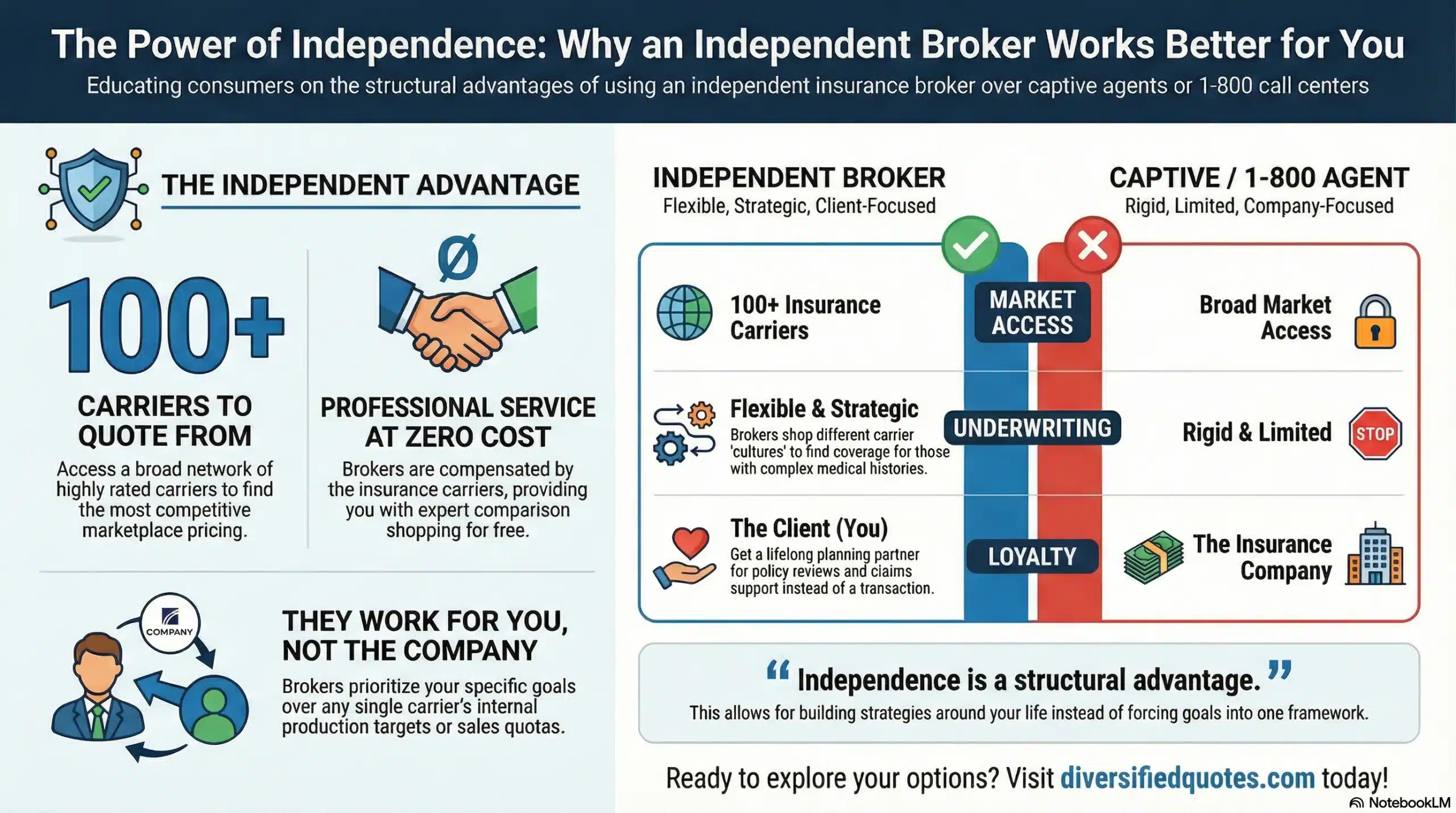
Jason Stolz, CLTC, CRPC, DIA, CAA and Chief Underwriter at Diversified Insurance Brokers (NPN 20471358), is a senior insurance and retirement professional with more than 25 years of real-world experience helping individuals, families, and business owners protect their income, assets, and long-term financial stability. As a long-time partner of the nationally licensed independent agency Diversified Insurance Brokers, Jason provides trusted guidance across multiple specialties—including fixed and indexed annuities, long-term care planning, personal and business disability insurance, life insurance solutions, Group Health, Travel Medical and Evacuation Insurance, and short-term health coverage. Diversified Insurance Brokers maintains active contracts with over 100 highly rated insurance carriers, ensuring clients have access to a broad and competitive marketplace.
His practical, education-first approach has earned recognition in publications such as VoyageATL, and contributions from his agency featured in Kiplinger and GoBankingRates— highlighting his commitment to financial clarity and client-focused planning. Drawing on deep product knowledge and years of hands-on field experience, Jason helps clients evaluate carriers, compare strategies, and build retirement and protection plans that are both secure and cost-efficient. Visitors who want to explore current annuity rates and compare options across multiple insurers can also use this annuity quote and comparison tool.
Explore More Burial Insurance Options: Browse our complete guide to Burial Insurance for Seniors — covering burial insurance for seniors over 50, 60, 70, 80 & parents from top carriers from top carriers.
Last Reviewed: June 9, 2026 |
Reviewed by: Jason Stolz, CLTC, CRPC, DIA, CAA
Chief Underwriter, Diversified Insurance Brokers, Inc. | NPN: 20471358 | Diversified Insurance Brokers, Inc. — Licensed in all 50 states
Fact Checked by: Tonia Pettitt, CMIP©
Medicare Specialist, Diversified Insurance Brokers, Inc. | NPN: 14374308 | Diversified Insurance Brokers, Inc. — Licensed in all 50 states
Did you find this content helpful? Leave us a Google review — it helps others find trustworthy guidance too.
Editorial Standards: Diversified Insurance Brokers maintains rigorous editorial standards to ensure accuracy, clarity, and independence in all content. Learn more about our editorial standards and commitment to transparency.
