
How to Buy Life Insurance
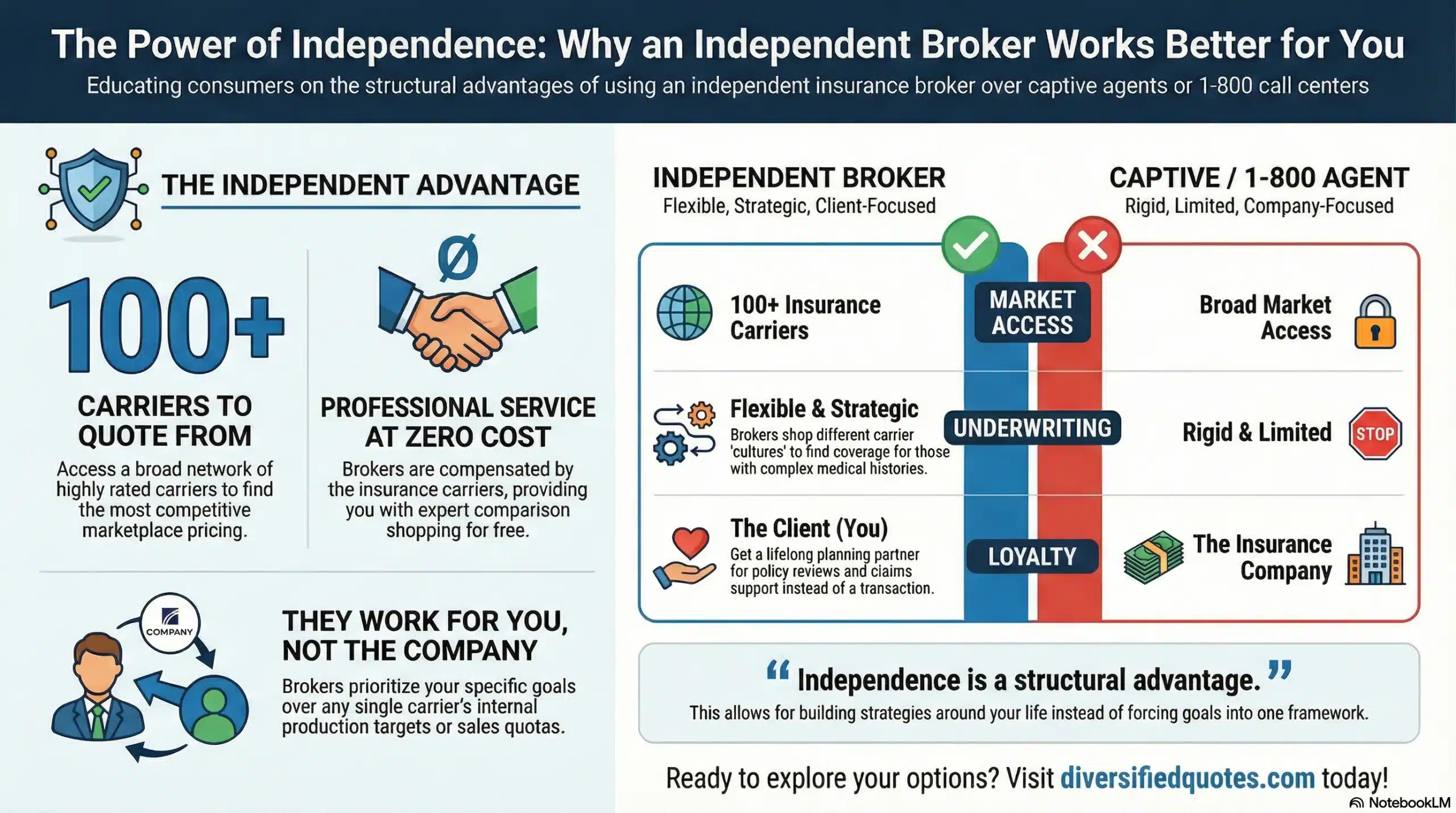
As an Independent Life Insurance Broker, we compare rates across 100+ carriers and prescreen every application before submission.
How to Buy Life Insurance

Jason Stolz CLTC, CRPC, DIA, CAA
Buying life insurance is one of the most financially important decisions most families will make — and one of the most frequently delayed, misunderstood, or handled through the first agent who presents a quote. The process of getting life insurance right requires more than accepting a price on a policy type. It requires understanding how much coverage your household actually needs, what type of policy structure matches the duration and nature of the risk you are protecting against, how underwriting will evaluate your specific health and financial profile, and why the carrier and broker you work with materially affects both the outcome and the cost. At Diversified Insurance Brokers, Jason Stolz, CLTC, CRPC, DIA, CAA, with more than twenty-five years of experience in the independent life insurance market, helps individuals and families across all fifty states move through this process with the clarity and competitive options that a single-carrier agent cannot provide. This guide covers every meaningful step in the life insurance purchase process — from calculating how much you need, to selecting the right product type, to navigating the application and underwriting process, to understanding what happens after the policy is issued.
The single most common mistake in buying life insurance is starting with price. Price is the last variable to evaluate, not the first. Coverage amount, policy structure, carrier underwriting standards, and benefit design all determine what a premium buys — and comparing a $40 monthly term premium without knowing whether the underlying death benefit, term length, conversion privilege, and carrier financial strength are appropriate for your situation is not comparison shopping. It is cost shopping. The two are not the same. Our resources on how to get life insurance and how to choose the right life insurance policy complement this guide for readers who want deeper coverage of specific decision points.
See Real-Term Rates Side by Side
Life Insurance Quoter
Step One: How Much Life Insurance Do You Actually Need?
The most widely cited rules of thumb — “buy ten times your income” or “buy enough to cover your salary for ten years” — produce a starting estimate, not a final answer. A more precise needs calculation uses the DIME method: Debt, Income, Mortgage, and Education. Debt represents all outstanding non-mortgage liabilities — credit card balances, auto loans, student loans, personal loans, and any other obligations your survivors would inherit or manage. Income represents the years of salary replacement your dependents need, multiplied by your current annual income — typically five to twenty years depending on the ages of your children and the financial independence of your spouse. Mortgage represents the outstanding balance on your home loan, which is typically the largest single obligation most families carry. Education represents estimated future education costs for each dependent child — tuition, room, board, and related expenses through graduation.
Adding these four components produces a total coverage target that accounts for the full scope of your financial obligations, rather than just approximating income replacement. Once you have the DIME total, subtract existing life insurance coverage and liquid assets your survivors could deploy, and the remainder is your actual coverage gap — the amount you need to purchase. The DIME result typically exceeds what simple income multiples suggest, because it captures specific obligations rather than averaging across household types. Our life insurance calculator and the detailed resource on how much life insurance you need walk through this calculation with examples calibrated to different family and income profiles.
Step Two: Term vs. Permanent — Choosing the Right Policy Structure
The choice between term life insurance and permanent life insurance is not a preference question — it is a structural question about the nature of the risk you are protecting against. Term life insurance covers a defined period — ten, twenty, or thirty years — and pays a death benefit only if the insured dies within that period. When the term expires, the coverage ends unless renewed, converted, or replaced. Premiums are level for the selected term and are meaningfully lower than permanent coverage for equivalent death benefits, making term the most cost-efficient solution for time-limited risks: the mortgage that will be paid off in twenty-three years, the income replacement need that ends when children reach financial independence, the business partnership protection that runs with a specific loan or obligation.
Permanent life insurance — including whole life, guaranteed universal life, and indexed universal life — provides a death benefit that never expires as long as premiums are paid, along with a cash value component that accumulates over the policy’s life. Permanent coverage is appropriate when the need for protection does not have a defined end date: estate liquidity requirements, final expense coverage for buyers who want certainty regardless of when they die, key person coverage for business owners, or retirement income supplementation strategies that use the cash value component as a tax-advantaged accumulation vehicle. The decision between term and permanent is not binary for many buyers — a combination of term coverage for the large near-term obligations and permanent coverage for the indefinite needs is frequently the most intelligent structure. Our resources on what term life insurance is and permanent life insurance structures provide the foundational explanation for each category, and the life insurance laddering guide covers how to use multiple policies strategically to reduce premiums over time as obligations decline.
Term Length: Matching the Policy to the Obligation
If term life insurance is the right structure, the next decision is term length — and the most important principle is matching the policy’s coverage period to the specific obligation it is protecting. A thirty-year term policy on a buyer who is forty-five years old provides coverage to age seventy-five — well past the point when most income replacement and mortgage obligations end, which may mean paying for coverage the family will not ultimately need. A twenty-year term on a thirty-five-year-old new parent with a recently purchased home and two young children covers the entire period of maximum financial dependency and mortgage risk at the lowest available premium for the coverage period required. Our individual term length resources — including 10-year term, 20-year term, and 30-year term — cover the specific scenarios where each length is most appropriate.
An important feature to evaluate in any term policy is the conversion privilege — the contractual right to convert some or all of the term coverage to a permanent policy at the end of the term, or at specified points during it, without submitting new evidence of insurability. This privilege has significant value for buyers who may be uninsurable or rated at the end of the term due to health changes that occurred after the original policy was issued. A term policy with a strong conversion privilege provides optionality that a non-convertible term policy does not, and this optionality has genuine financial value even for buyers who do not expect to exercise it. Our resource on converting term to permanent life insurance explains how this right works in practice and when exercising it makes sense. Buyers who reach the end of their term and still need coverage can also review what happens at the end of a term policy for their available options at that transition point.
Life Insurance Product Comparison
| Product | Coverage Duration | Cash Value | Best Use Case | Relative Premium |
|---|---|---|---|---|
| Term Life | Fixed term (5–40 years) | None | Income replacement, mortgage protection, time-limited obligations | Lowest |
| Whole Life | Lifetime (permanent) | Guaranteed, grows at fixed rate | Final expenses, estate planning, guaranteed cash accumulation | Highest |
| Guaranteed Universal Life | To specified age (often 90–121) | Minimal to none | Permanent death benefit at lower cost, estate liquidity | Moderate |
| Indexed Universal Life | Lifetime (flexible premium) | Index-linked growth with floor protection | Supplemental retirement income, tax-advantaged accumulation | Moderate–High |
| No-Exam Term | Fixed term (varies by carrier) | None | Buyers who want speed, minor health concerns, lower face amounts | Slightly higher than fully underwritten |
Step Three: The Underwriting Process — What to Expect
Underwriting is the process by which a life insurance carrier evaluates the risk of insuring a specific applicant and determines both the eligibility for coverage and the premium rate that applies. Understanding what underwriters evaluate, how long the process takes, and how to prepare for it reduces delays, prevents surprises, and maximizes the likelihood of receiving the most favorable available rate classification for your specific health and lifestyle profile. Jason Stolz, CLTC, CRPC, DIA, CAA, has placed policies across more than one hundred carriers and understands which carriers underwrite specific health conditions most favorably — knowledge that can be the difference between a preferred-plus rating and a standard rating for the same applicant profile.
The underwriting process begins with the completed application, which collects personal information, complete medical history, current medications, lifestyle factors including tobacco use and hazardous activities, and financial justification for the face amount requested. For policies above certain face amount thresholds — typically $500,000 to $1 million depending on the carrier and the applicant’s age — a paramedical examination is required. The exam is conducted at the applicant’s home or workplace by a licensed examiner and typically includes a blood draw, urinalysis, blood pressure reading, height and weight measurement, and an electrocardiogram for older applicants or larger face amounts. The carrier’s underwriting team reviews the application, exam results, prescription database check, Medical Information Bureau report, and attending physician statements if warranted by the medical history. Total underwriting time ranges from a few days for fully automated no-exam decisions to four to six weeks for fully underwritten policies requiring medical records. Our resources on what the life insurance exam involves and how to prescreen a life insurance application help buyers prepare effectively and identify potential underwriting concerns before formally submitting.
Health Classifications and Rate Classes
Life insurance carriers use health classifications — commonly Preferred Plus, Preferred, Standard Plus, Standard, and Table Ratings from Table 1 through Table 8 or higher — to assign premium rates based on assessed risk. Each classification tier carries a different premium multiplier, meaning that the difference between a Preferred Plus rate and a Standard rate on the same policy can represent thirty to fifty percent higher annual premium for identical coverage. Health classifications are determined by a combination of factors including build (height and weight), blood pressure, cholesterol levels, family history of cardiovascular disease or cancer, personal history of serious illness, current medications, tobacco use, aviation or extreme sport participation, and driving record.
Because carriers apply their rating criteria differently, the same applicant can receive materially different rate classifications at different carriers for identical health profiles. An applicant with controlled Type 2 diabetes managed by oral medication may receive a Standard rating at one carrier and a Table 2 rating at another — a difference that translates to hundreds or thousands of dollars in annual premium. An independent broker who knows which carriers underwrite specific conditions most favorably — and who can simultaneously pre-screen an applicant across multiple carriers before formal application — produces better outcomes than applying to a single carrier and accepting whatever rating results. Our resource on life insurance table ratings explained and life insurance flat extras covers the classification system in detail. For applicants with health concerns, our resources on life insurance with pre-existing conditions, how to get life insurance with health issues, and best life insurance for pre-existing conditions address specific scenarios and carrier selection strategies.
No-Exam Life Insurance: When Speed and Simplicity Outweigh Cost
A growing segment of the market offers term life insurance with no medical examination requirement, using automated underwriting that makes a coverage decision within minutes based on application data, prescription database information, and motor vehicle records. No-exam life insurance is genuinely useful in specific circumstances: buyers who want coverage in place quickly without scheduling an exam appointment, applicants with minor health concerns who would qualify at standard or better but prefer simplified issuance, younger buyers at lower face amounts where the price premium for no-exam coverage is modest, and buyers who have experienced past exam-related anxiety or logistical difficulty. The trade-off is straightforward: no-exam policies typically carry slightly higher premiums than fully underwritten equivalents for the same face amount, because the carrier absorbs more risk without the detailed medical data that a full exam provides. For buyers in excellent health seeking large face amounts, full underwriting almost always produces a better outcome. For buyers prioritizing speed and simplicity over the lowest possible premium, no-exam is a legitimate and effective pathway. Our resources on no-exam life insurance and how to buy instant decision life insurance cover both the products available and the scenarios where each makes sense.
Buying Life Insurance at Different Life Stages
The right life insurance strategy changes meaningfully across life stages, and the cost of delay at any transition point is permanent — every year of delay locks in a higher rate for the life of the policy. New parents represent one of the most financially vulnerable households — they have taken on the largest obligations of their lives (mortgage, dependent children) while simultaneously having the least accumulated wealth to absorb the loss of an income earner. Coverage purchased immediately after a new child’s arrival is priced at the buyer’s youngest available age and is structured around the longest observable dependency horizon. Our resources on life insurance for new parents and life insurance for parents with young children address the specific coverage structure and sizing decisions for this stage.
Buyers in their fifties enter a different phase of the life insurance calculation. Mortgage balances have declined, children may be approaching or achieving financial independence, and the primary insurance need shifts from income replacement to estate preservation, retirement income supplementation, and final expense coverage. Our resource on life insurance over 50 covers the specific product and coverage options available and the most common strategic errors buyers make at this stage — including the costly mistake of allowing a term policy to lapse without converting or replacing it. Single adults and unmarried individuals without dependents face a different calculation still, with coverage needs driven primarily by debt obligations and any financial support they provide to parents, siblings, or other non-spouse dependents. Our resource on life insurance for singles with no kids addresses when coverage makes sense and in what structure for this demographic. For buyers who experienced a major life transition, our resource on life insurance after divorce covers the coverage review and restructuring decisions that follow dissolution of marriage.
The Cost of Waiting: Why Timing Matters More Than People Expect
Life insurance premiums increase with age — predictably, permanently, and more steeply than most buyers realize. The premium for a twenty-year, $500,000 term policy on a healthy non-smoking male increases meaningfully every year of delay, and that increase is locked in for the full twenty-year premium period. A buyer who delays purchasing coverage from age thirty to age thirty-five does not pay five percent more — they pay the compounded cost of five additional years of premium aging for every year of the twenty-year policy. Beyond the pure premium arithmetic, the risk of health events that affect insurability increases with age. A health change that occurs before coverage is purchased permanently closes certain carrier options, restricts certain face amounts, and can elevate the premium rate for the life of the policy. The insurable risk that exists today may not exist at the same terms in three years. Our resource on the hidden costs of waiting to buy life insurance quantifies this dynamic with specific premium comparison examples across age brackets, and the resource on whether you are too young for life insurance addresses the other end of the age spectrum for buyers who think they have unlimited time before the decision is urgent.
Life Insurance for Business Owners and Special Situations
Business owners face a distinct set of life insurance needs that extend beyond personal income replacement and family protection. Buy-sell agreement funding — ensuring that a surviving business partner can purchase the deceased partner’s interest at a predetermined price without forced sale or family interference — requires life insurance that is precisely sized to the business valuation and owned in a structure that aligns with the buy-sell agreement’s legal terms. Key person insurance protects the business itself against the financial disruption of losing an executive, technician, or revenue producer whose loss would materially impair operations. Our resources on buy-sell life insurance, key person life insurance for executives, and life insurance for business owners cover each of these applications in detail.
High-income earners, individuals with complex health profiles, and applicants in elevated-risk occupations require specialized carrier placement strategies that a generalist or captive agent is unlikely to execute effectively. Our resource on life insurance for high-income earners covers the face amounts, product structures, and underwriting approaches most relevant to this profile. For applicants who have been declined or rated by one carrier and want to understand whether better options exist, our guide to what to do if you are denied life insurance and the second opinion on life insurance quote service frequently identify superior alternatives that the initial carrier did not offer.
After the Policy Is Issued: What Comes Next
Purchasing a life insurance policy is not a one-time transaction — it is the start of an ongoing coverage relationship that should be reviewed at every major life change. Marriage, divorce, the birth of a child, a home purchase, a business acquisition, a significant income change, or a health event that affects the original coverage assumptions all create trigger points for a formal policy review. The question at each review is not simply whether the policy is still in force — it is whether the coverage amount, product structure, and carrier choice remain appropriate given the current financial picture. Our resource on five signs it is time to review your life insurance policy and the policy review service provide both the framework and the practical mechanism for this ongoing assessment.
The most common post-purchase oversights include failing to update beneficiary designations after major life changes, allowing employer-sponsored group coverage to substitute for individual coverage without recognizing its portability limitations, and neglecting to evaluate whether a term policy that is approaching expiration should be converted, renewed at higher rates, or replaced with a new policy while health still permits. Our resource on common mistakes people make when buying life insurance covers these failure modes in detail, and the resource on why an independent broker matters explains how the ongoing broker relationship differs from the transactional approach of a single-carrier agent in ways that affect long-term outcomes. For buyers who want the most direct path to understanding current market pricing across carriers before beginning the formal process, our best life insurance rates resource, the life insurance quotes tool, and the detailed breakdown of how much life insurance costs by age, health class, and product type provide competitive market context.
Compare Term Life Insurance Lengths
Explore different term periods to find coverage that best matches your timeline and budget.
Talk With an Advisor Today
Choose how you’d like to connect—call or message us, then book a time that works for you.
Schedule here:
calendly.com/jason-dibcompanies/diversified-quotes
Licensed in all 50 states • Fiduciary, family-owned since 1980
Frequently Asked Questions: How to Buy Life Insurance
How much life insurance do I need?
The most precise starting point is the DIME method — an acronym for Debt, Income, Mortgage, and Education. Add up all outstanding non-mortgage debts, multiply your annual income by the number of years your family would need income replacement, add the remaining mortgage balance, and estimate future education costs for each dependent child. The sum of these four components gives you a total coverage target. Subtract any existing life insurance and liquid savings your survivors could access, and the remainder is your true coverage gap. The DIME result typically exceeds the commonly cited ten-times-income rule because it captures specific obligations rather than approximating from income averages. A buyer who earns $80,000 per year, has a $300,000 mortgage balance, $25,000 in non-mortgage debt, and two young children requiring $100,000 each in future education funding might calculate a coverage need of $1.5 million or more — well above the $800,000 that a simple ten-times-income estimate would produce. For a step-by-step walkthrough, see our resource on how much life insurance you need.
What is the difference between term life and whole life insurance?
Term life insurance provides a death benefit for a defined coverage period — ten, twenty, or thirty years are the most common — and expires at the end of that period with no value remaining if the insured has not died. Premiums are level and significantly lower than permanent coverage for the same face amount. Term is the most cost-efficient solution for time-limited risks: the mortgage that will be paid off, the income replacement need that ends when children reach financial independence, or business obligations with a defined duration. Whole life insurance provides permanent coverage that never expires as long as premiums are paid, along with a guaranteed cash value component that grows at a contractually defined rate over time. Premiums are significantly higher than term for the same face amount because the policy is designed to last a lifetime and accumulate value. Whole life is appropriate when the coverage need is indefinite — estate liquidity, final expense certainty, or cash value accumulation as part of a broader financial strategy. Many buyers benefit from a combination: term for the large near-term obligations and permanent coverage for the needs that do not have a defined end date. For more detail on each structure, see our resources on term life insurance and how whole life insurance works.
How long does the life insurance application process take?
The timeline depends on the policy type and underwriting pathway selected. No-exam policies with automated underwriting can deliver a coverage decision within minutes to a few days, making them the fastest pathway to coverage in force. Fully underwritten policies that include a paramedical examination and review of medical records typically take four to six weeks from application submission to policy delivery, though straightforward applications with clean health histories at moderate face amounts can sometimes be resolved in two to three weeks. Delays most commonly result from incomplete application information, slow responses from attending physicians when medical records are requested, additional follow-up questions from the underwriting team, or face amounts that require supplemental financial documentation. Preparing before submitting — knowing your medical history accurately, having your physician contact information available, and working with a broker who can anticipate likely underwriting questions — meaningfully reduces the timeline. For a detailed overview of each stage, see our resource on what the life insurance exam involves.
What health conditions can affect my life insurance rates?
Life insurance underwriters evaluate a broad range of health factors to assign a rate classification. The most significant include cardiovascular history (heart attack, stroke, arrhythmia, coronary artery disease), cancer history and current status, diabetes and blood sugar control, blood pressure and cholesterol readings, kidney and liver function, build and body mass index, current medications and their indications, family history of cardiovascular disease and cancer, and tobacco use or cessation history. Mental health history — particularly hospitalization or treatment for serious depression, anxiety disorders, or substance use disorders — is evaluated differently across carriers and can affect eligibility and pricing. Importantly, carriers differ significantly in how they underwrite the same condition. A buyer with controlled Type 2 diabetes managed by oral medication may receive a preferred standard rate at one carrier and a rated table classification at another for identical profiles. This carrier variation is one of the most important reasons why working with an independent broker who can identify the most favorable carrier for your specific health profile produces materially better outcomes than applying to a single carrier. For condition-specific guidance, see our resources on life insurance with pre-existing conditions and how to get life insurance with health issues.
Is the death benefit from life insurance taxable?
Life insurance death benefits are generally received income-tax-free by named beneficiaries under Section 101(a) of the Internal Revenue Code. This is one of the most significant tax advantages of life insurance — a $1 million death benefit paid to a surviving spouse or child carries no federal income tax liability on receipt, regardless of how large the benefit is. However, there are circumstances where taxation can arise. If the death benefit is paid out in installments rather than a lump sum, the interest portion of each installment payment is taxable as ordinary income. If the policy was transferred for value — sold or assigned for valuable consideration — a portion of the death benefit may become taxable under the transfer for value rules. For estates above the federal exemption threshold ($15 million per individual beginning in 2026 under the One Big Beautiful Bill Act), death benefits included in the gross estate may generate estate tax liability — which is why ILIT ownership structures are used for large estate planning policies. Cash value accumulation within a policy grows tax-deferred, and policy loans against cash value are generally not taxable events. For a complete breakdown, see our resource on whether the life insurance death benefit is taxable.
What is a life insurance conversion privilege and why does it matter?
A conversion privilege is a contractual right embedded in term life insurance policies that allows the policyholder to convert some or all of the term coverage to a permanent policy — without providing new evidence of insurability — within a defined conversion window. This right is valuable because it preserves future insurability regardless of what health changes occur during the term period. A buyer who purchases a twenty-year term policy at age thirty-five and develops a serious health condition at age forty-eight is otherwise uninsurable for new coverage — but if their term policy includes a conversion privilege, they can convert to a permanent policy at age forty-eight using their original health classification without any new medical underwriting. The permanent policy premium is based on current age, not the original issue age, but the right to obtain coverage exists regardless of health status. Not all term policies include conversion privileges, and not all conversion privileges are equally strong — some restrict conversion to specific permanent products, some have narrow conversion windows, and some exclude certain riders from the converted policy. Evaluating the conversion privilege before purchasing a term policy is as important as evaluating the premium, particularly for buyers under fifty who may not yet know what their long-term health picture will look like. See our resource on converting term to permanent life insurance for the mechanics and timing considerations.
Why should I use an independent broker instead of buying directly from a carrier?
An independent broker represents multiple carriers and can run a simultaneous competitive comparison across the full market, presenting multiple options side by side with different underwriting standards, premium structures, and product designs. A captive agent or direct-to-carrier online platform presents one carrier’s products at one set of prices, with no competitive context. The difference is most consequential in three scenarios. First, when the applicant has a health history that different carriers underwrite differently — an independent broker identifies which carrier is most favorable for the specific condition, potentially producing a significantly better rate class than the carrier chosen by default. Second, when the optimal product structure involves a combination of carriers — term from one carrier for maximum income replacement value and permanent coverage from another for estate planning — which a single carrier cannot accommodate. Third, when the applicant has been declined or rated and needs to identify which carriers in the broader market will accept the risk on better terms. Independent brokers are also compensated by carriers in the same way captive agents are — there is no additional cost to the buyer for accessing broader market coverage through an independent brokerage. For more on how this process works, see our resource on why to work with an independent life insurance broker.
When should I review or update my existing life insurance coverage?
Life insurance coverage should be reviewed at every significant life change that affects either the need for coverage or the financial ability to maintain it. The most common review triggers include marriage or divorce, the birth or adoption of a child, purchase of a home or business, a significant income increase or decrease, a business partnership change, receipt of an inheritance or other major asset, a health change that may affect insurability, and the approach of a term policy’s expiration date. Outside of specific trigger events, a formal policy review every three to five years ensures that coverage amounts remain appropriate as obligations change — particularly as mortgages pay down, children age toward financial independence, and retirement assets accumulate. The review process should evaluate whether the current coverage amount and structure still match the need, whether better pricing is available at current market rates (which may have changed since original purchase), whether the carrier’s financial strength rating remains strong, and whether any riders or benefits should be added or modified. Our life insurance policy review service and the resource on five signs it is time to review your policy provide the framework for this assessment.
About the Author:
Jason Stolz, CLTC, CRPC, DIA, CAA and Chief Underwriter at Diversified Insurance Brokers (NPN 20471358), is a senior insurance and retirement professional with more than 25 years of real-world experience helping individuals, families, and business owners protect their income, assets, and long-term financial stability. As a long-time partner of the nationally licensed independent agency Diversified Insurance Brokers, Jason provides trusted guidance across multiple specialties—including fixed and indexed annuities, long-term care planning, personal and business disability insurance, life insurance solutions, Group Health, Travel Medical and Evacuation Insurance, and short-term health coverage. Diversified Insurance Brokers maintains active contracts with over 100 highly rated insurance carriers, ensuring clients have access to a broad and competitive marketplace.
His practical, education-first approach has earned recognition in publications such as VoyageATL, and contributions from his agency featured in Kiplinger and GoBankingRates— highlighting his commitment to financial clarity and client-focused planning. Drawing on deep product knowledge and years of hands-on field experience, Jason helps clients evaluate carriers, compare strategies, and build retirement and protection plans that are both secure and cost-efficient. Visitors who want to explore current annuity rates and compare options across multiple insurers can also use this annuity quote and comparison tool.
Explore More Life Insurance Options: Browse our complete guide to Life Insurance Buying & Cost Education — covering how to buy, costs, calculators, rates & buying guides from 100+ carriers.
Last Reviewed: June 11, 2026 |
Reviewed by: Jason Stolz, CLTC, CRPC, DIA, CAA
Chief Underwriter, Diversified Insurance Brokers, Inc. | NPN: 20471358 | Diversified Insurance Brokers, Inc. — Licensed in all 50 states
Fact Checked by: Tonia Pettitt, CMIP©
Medicare Specialist, Diversified Insurance Brokers, Inc. | NPN: 14374308 | Diversified Insurance Brokers, Inc. — Licensed in all 50 states
Did you find this content helpful? Leave us a Google review — it helps others find trustworthy guidance too.
Editorial Standards: Diversified Insurance Brokers maintains rigorous editorial standards to ensure accuracy, clarity, and independence in all content. Learn more about our editorial standards and commitment to transparency.
