
Life Insurance Table Ratings Explained
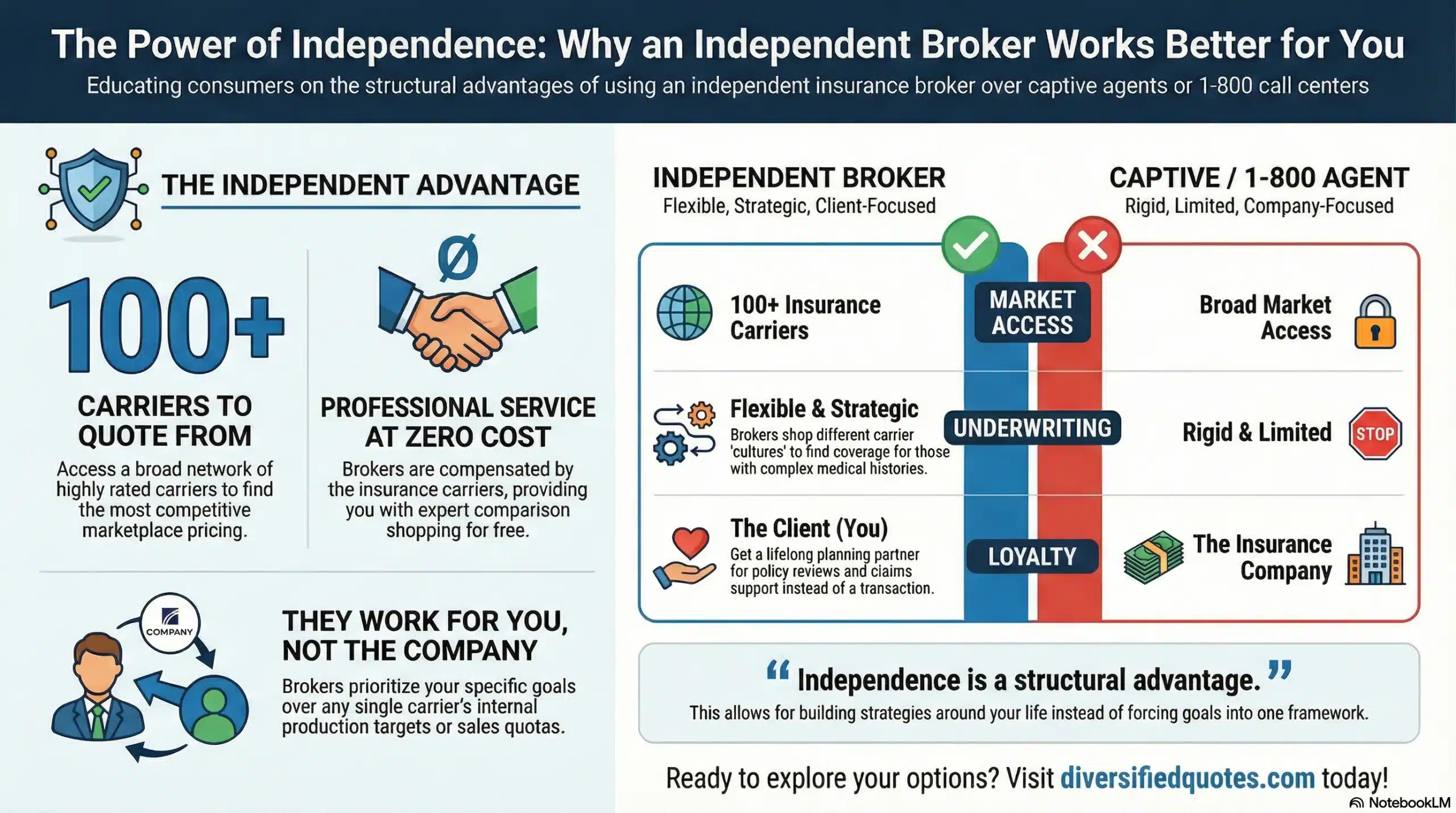
As an Independent Life Insurance Broker, we compare rates across 100+ carriers and prescreen every application before submission.
Life Insurance Table Ratings Explained

Jason Stolz, CLTC, CRPC, DIA, CAA
A life insurance table rating means you have been approved for coverage — but at a premium above Standard because the underwriter assessed your risk profile as elevated relative to the general population. That distinction matters more than it sounds. Many applicants who receive a table rating initially react as though they were rejected. They were not. A table rating is an approval decision. The carrier is telling you: we will insure you, and here is the specific premium surcharge that reflects the additional risk we are accepting. That is categorically different from a decline, and for applicants with significant health history, a Table 4 approval from the right carrier often provides more protection value than the search for a better offer would suggest — particularly when the alternative is going uninsured while pursuing a theoretical improvement that may never materialize.
Understanding what determines the table number, how the cost increase scales across levels, when and how a rating can improve over time, and how carrier selection changes the practical outcome for the same risk profile is the information that transforms a confusing underwriting letter into a navigable planning decision. At Diversified Insurance Brokers, we are an independent, fiduciary insurance agency licensed in all 50 states with access to more than 100 carriers. Our high-risk life insurance services are specifically designed for applicants whose health history, lifestyle, or build places them in the substandard underwriting category — because this is where independent, multi-carrier access produces the largest financial advantage relative to applying directly to a single company. Our resource on the best high-risk life insurance companies provides current carrier context for which insurers are most favorable across different elevated-risk profiles.
Compare Life Insurance Options Across 100+ Carriers
If you’ve received a table rating — or expect one — we can pre-screen your profile across carriers before a formal application creates a record, then identify where you’ll receive the most favorable offer.
Request a QuoteCall 800-533-5969
What Determines a Table Rating
Underwriters assign table ratings when the combination of health factors, build, lifestyle, and medical history in an application presents a mortality risk above what Standard classification assumes — but not so severe that coverage is declined entirely. The table level reflects the underwriter’s assessment of how much additional mortality risk exists, expressed as a premium surcharge above Standard. The specific factors that trigger table ratings are not secret, but the way they interact is complex and carrier-dependent.
Medical conditions are the most common source of table ratings in the standard life insurance population. Diabetes (particularly Type 2 diagnosed at later age with good A1C control), treated hypertension (particularly when well-controlled with one or two medications), sleep apnea (particularly when CPAP-compliant with normal follow-up studies), elevated cholesterol, elevated liver enzymes, autoimmune conditions, substance abuse history, and cardiac history with documented stability are all conditions that frequently produce Standard Plus through Table 4 outcomes rather than declines — depending on the severity, duration, control quality, and specialist involvement documented in the medical record. Our condition-specific resources — including life insurance for diabetes, life insurance for heart disease, life insurance for sleep apnea, life insurance for atrial fibrillation, and life insurance for autoimmune disease — cover the specific carrier postures for each condition category.
Build (height/weight ratio) is evaluated against each carrier’s build chart, which defines the maximum weight at each height that qualifies for each rate class. Applicants who exceed the preferred build thresholds by a moderate amount typically receive Standard or Standard Plus; those significantly above chart thresholds receive table ratings that increase with the degree of excess. Carriers’ build charts differ, and a weight that produces Table 2 at one insurer may be Standard Plus at another. Our resource on life insurance for overweight people and our guide to life insurance for overweight applicants cover the carrier build chart comparison specifically.
Lifestyle and history factors — including alcohol use patterns documented in medical records, drug use history, adverse driving record including DUI convictions, and hazardous occupation or aviation activity — can also produce table ratings or flat extras. Some of these factors are time-sensitive: a DUI that is three years old may produce a different rating than the same event at six years. Our resource on life insurance for alcohol use and our guide to life insurance for drug abuse cover the stability timeline and documentation considerations for each of these history categories.
How Life Insurance Table Ratings Affect Premiums
Most life insurance companies structure table ratings in incremental levels that increase pricing relative to Standard rates. While exact calculations vary by carrier, product, age, and state, the common framework increases approximately 25% per table level. The table below illustrates how most insurers apply substandard ratings — and adds the most important practical context: what each level translates to in terms of monthly cost relative to a Standard benchmark, and where those costs become significant enough to justify exploring carrier alternatives or structural solutions.
| Table Level | Letter Equivalent | Typical Premium Increase Above Standard* | If Standard = $100/mo | Planning Note |
|---|---|---|---|---|
| Table 1 | Table A | +25% | $125/month | Often near-Standard; well-controlled mild conditions; modest build excess |
| Table 2 | Table B | +50% | $150/month | Most manageable chronic conditions with good control; carrier shopping often productive |
| Table 3 | Table C | +75% | $175/month | More complex health history; multiple conditions; strong carrier selection impact |
| Table 4 | Table D | +100% | $200/month | Double Standard; evaluate term length, face amount, and flat extra alternative |
| Table 5 | Table E | +125% | $225/month | Significant risk elevation; niche carrier expertise increasingly important |
| Table 6 | Table F | +150% | $250/month | Consider whether face amount reduction or term restructuring improves affordability |
| Table 7 | Table G | +175% | $275/month | High surcharge; evaluate simplified issue alternatives for smaller coverage needs |
| Table 8 | Table H | +200% | $300/month | Triple Standard; most severe substandard classification before decline; explore all structures |
*Illustrative example only. Actual rating scales and premium calculations vary by insurance company, product design, underwriting class, age, gender, and state. A Table 2 at one carrier may cost less than a Table 1 at another because Standard base pricing differs across companies.
Life Insurance Calculator
Compare real-time rates from 100+ top-rated carriers. No pressure. No obligation.
Need help interpreting your results? Call 800-533-5969 or request a personalized quote →
The most practically important insight from this scale is that carrier selection matters more than table level alone. Because each carrier sets its own Standard base rate, and because different carriers evaluate the same health profile differently and may assign different table levels, a Table 3 at a competitively priced carrier can produce a lower monthly premium than a Table 1 at an expensive carrier with a favorable risk posture for your condition. This cross-carrier comparison effect is the primary reason why working with an independent broker who can shop across the full market — rather than applying to a single carrier and accepting its table assignment — produces better financial outcomes for table-rated applicants. Our resource on the best independent life insurance broker explains why independent brokerage access changes outcomes in complex underwriting situations.
Table Ratings vs. Flat Extras: An Important Distinction
Table ratings and flat extras are both substandard premium adjustments, but they work differently and matter in different scenarios. A table rating is a percentage surcharge on the Standard premium — it applies for the life of the policy and scales with the policy’s base cost. A flat extra is a dollar-per-thousand-of-coverage charge added for a defined period — typically two to five years — that reflects an elevated risk the carrier considers temporary. Once the flat extra period ends, the charge is removed and the premium drops to whatever the base rate would have been without the extra.
For applicants with a recent medical event — a heart attack resolved 18 months ago with documented full cardiac rehabilitation and clean stress testing, for example — the carrier may consider the early years post-event as the highest-risk period, tapering off as stable time accumulates. In that scenario, a flat extra that expires in year three is a better financial outcome than a permanent table rating, even if the immediate monthly premium is similar. The flat extra disappears; the table rating stays. Understanding whether your specific risk profile is the type that carriers treat as permanent (chronic, progressive conditions) or time-limited (resolved events, documented recovery) determines which pricing structure is more likely and more advantageous.
When and How Table Ratings Can Improve
Table ratings assigned at policy issue are not always permanent. Many carriers allow formal reconsideration — a post-issue request for the underwriter to re-evaluate the rating based on updated medical information, improved health metrics, or additional time since the event that originally triggered the rating. The conditions that most commonly support successful reconsideration include: improved A1C or blood pressure readings over 12 to 24 months of documented monitoring; weight reduction documented through multiple physician visits over an extended period; extended post-event stability for cardiac or other organ system conditions; improved lab results for conditions like elevated liver enzymes or kidney function; and additional sober time for applicants whose rating was related to alcohol or substance history.
Timing is critical. Applying three months after a medical event often produces a materially worse rating than applying 12 to 18 months later when stability is documented. Many underwriters use benchmark windows — 6-month, 12-month, and 24-month stability periods — at which point they are willing to reconsider the risk more favorably. Strategic timing of the application date relative to these windows, combined with the documentation that makes stability visible to the underwriter, frequently produces better initial ratings rather than requiring post-issue reconsideration. Our resource on how to pre-screen a life insurance application covers the timing strategy and documentation preparation that prevents unnecessarily poor initial ratings. Our resource on how to get life insurance with health issues provides the complete strategic framework for applicants with complex medical histories.
The MIB Risk: Why Application Strategy Matters
One of the most consequential and least-discussed aspects of life insurance shopping with health history is how formal applications create records in the Medical Information Bureau (MIB) database — a shared information repository used by most major life insurance underwriters. When you submit a formal application and a decision is rendered, that activity is typically reported. When a subsequent carrier orders an MIB report as part of your new application, they can see prior application activity, including adverse decisions.
For an applicant who applies to four or five carriers simultaneously without pre-screening, each carrier that returns a table rating or decline creates an MIB record that all subsequent carriers see. This can compound the problem: subsequent carriers may apply more conservative underwriting postures when they see that multiple prior applications produced adverse outcomes — leading to worse ratings or declines on applications that might have been evaluated more favorably if submitted first without an adverse history trail. Our resource on what MIB is in insurance explains how the system works and why strategic pre-screening before formal application submission protects your underwriting options.
The practical alternative is pre-screening — an informal process where a broker presents your health profile to underwriting departments at target carriers without a formal application, receives informal guidance on how that carrier would likely rate the case, and identifies which one or two carriers are most likely to produce the best outcome before any formal application is submitted. This prevents the MIB trail problem and produces better carrier selection. Our resource on how to pre-screen a life insurance application explains the pre-screening process in detail.
Coverage Structures That Work Well for Table-Rated Applicants
Policy structure decisions can meaningfully reduce the financial impact of a table rating — not by changing the rating itself, but by selecting the coverage design that minimizes long-term premium cost while maintaining the protection that matters most. Several structural strategies are particularly relevant for table-rated applicants.
Shorter initial term with conversion rights is often the most financially efficient structure for applicants who expect their health to improve over time. A 10 or 15-year convertible term provides protection at the rated premium while preserving the contractual right to convert to permanent coverage during the conversion window — without new medical underwriting. If health improves during the term period and a better rating becomes achievable, the applicant can apply for new coverage at the improved rating. If health does not improve, the conversion right provides a permanent coverage pathway without requalification. Our guide on the best term life insurance policy explains how to structure term coverage effectively when navigating substandard ratings, and our resource on converting term to permanent life insurance covers the conversion mechanics and timing.
Face amount right-sizing addresses affordability at higher table levels. A Table 6 or Table 7 rating can make the originally desired face amount unaffordable at the rated premium. Rather than purchasing no coverage because the desired amount is too expensive, selecting a lower face amount at the current rating — and planning to supplement with additional coverage if health improves — provides immediate protection within budget constraints. Some coverage now at an affordable premium is almost always preferable to no coverage while waiting for a better rating that may not materialize on the desired timeline.
For applicants who cannot achieve favorable fully underwritten outcomes, simplified issue and guaranteed issue alternatives provide coverage pathways that do not involve medical underwriting. Our resources on guaranteed issue life insurance under age 50 and our guide for applicants who cannot get life insurance cover these non-traditional pathways. And for applicants who have already received a table rating offer and want to confirm it represents the best available market result, our second opinion life insurance quote review evaluates whether a different carrier and submission strategy would produce meaningfully better terms.
Related Life Insurance Pages
High-risk underwriting guides, condition-specific resources, and coverage strategy tools from Diversified Insurance Brokers.
Financial Protection Essentials
Retirement income strategy, business planning, beneficiary considerations, and long-term care flexibility resources.
Compare Term Life Insurance Lengths
Explore different term periods to find coverage that best matches your timeline and budget.
Talk With an Advisor Today
Choose how you’d like to connect—call or message us, then book a time that works for you.
Schedule here:
calendly.com/jason-dibcompanies/diversified-quotes
Licensed in all 50 states • Fiduciary, family-owned since 1980
FAQs: Life Insurance Table Ratings
What is a life insurance table rating?
A life insurance table rating is an underwriting classification used when an applicant’s risk profile is elevated above what Standard pricing assumes — but not so elevated that coverage is declined entirely. It is an approval with a premium surcharge, not a rejection. The table level indicates the amount of the surcharge above Standard pricing, typically structured in increments of approximately 25% per table level (though exact calculations vary by carrier, product, age, and state). The higher the table, the greater the premium — a Table 4 rating adds approximately 100% to Standard pricing, meaning the rated premium is roughly double what a Standard-class applicant pays for identical coverage.
Table ratings most commonly arise from elevated but manageable medical history — controlled chronic conditions, build outside preferred parameters, lab results above standard thresholds, lifestyle factors, or combinations of multiple moderate risk factors that collectively present elevated mortality risk. The important framing is that a table rating represents access to coverage the applicant otherwise might not have received. Many conditions that would have produced declines in the pre-substandard era now result in approvals at table ratings because carriers have developed more granular risk assessment capabilities. Our resource on high-risk life insurance provides the broader context for how substandard underwriting functions as a coverage pathway rather than a barrier.
How many table ratings are there?
Most carriers use eight table levels, commonly designated either numerically (Table 1 through Table 8) or alphabetically (Table A through Table H). Both systems represent the same underlying structure — each level is one increment above the previous, with an approximately 25% premium increase per step in the most common carrier frameworks. Some carriers use different internal designations or different step sizes, but the general structure of 8 substandard classifications below Standard is industry standard for fully underwritten individual life insurance.
Above Table 8 (or Table H), most carriers would decline rather than offer coverage, though specialized high-risk carriers occasionally offer coverage at ratings beyond standard substandard scales for specific conditions or demographics. The most common table ratings in practice fall between Table 1 and Table 4 — these represent the largest population of substandard approvals and the scenarios where multi-carrier shopping produces the most meaningful premium differences. Tables 5 through 8 are used for significantly elevated risk profiles and typically require specialized carrier expertise and case positioning to achieve approval at all, let alone at competitive premiums.
Can a table rating improve later?
Often yes — and this possibility is worth planning around rather than simply accepting the initial rating as permanent. Many carriers offer a post-issue reconsideration process where, after the policy has been in force for a defined period, the contract owner can request a new underwriting review based on updated medical information. If the reconsideration review reveals improved health metrics, greater stability, or additional time since the event that originally triggered the rating, the carrier may reduce the table level — lowering the premium to reflect the improved risk assessment.
The conditions most likely to support successful reconsideration include: significantly improved A1C for diabetic history; improved blood pressure readings with documented medication compliance over 12 to 24 months; weight reduction of a meaningful amount documented through multiple physician visits; extended post-event stability for cardiac, renal, or other organ system conditions; and additional sober time for applicants with alcohol or substance history. Timing matters: reconsideration after 12 months of documented stability is more commonly successful than requests made at 3 to 6 months when the record is still too recent. Proactively planning to request reconsideration at appropriate intervals, rather than simply paying the rated premium indefinitely, is part of the strategic management of a substandard life insurance position. Our resource on getting a second opinion on your life insurance quote also evaluates whether a reapplication to a different carrier might produce a better outcome than reconsideration at the current carrier.
What’s the difference between a table rating and a flat extra?
Both are substandard premium adjustments, but they work fundamentally differently and matter in different planning scenarios. A table rating is a percentage surcharge on the Standard premium — it applies for the life of the policy and increases in proportion to the policy’s base cost. A flat extra is a dollar-per-thousand-of-coverage charge that is typically applied for a defined period — commonly two to five years — reflecting elevated risk the carrier considers temporary rather than permanent. When the flat extra period ends, the charge is removed and the premium drops to the base rate.
The practical difference: a table rating is permanent and continues at elevated cost for as long as the policy is in force. A flat extra disappears after the specified period — making it a better financial outcome for applicants whose risk elevation is genuinely time-limited. For example, an applicant who has recently resolved a health event that the carrier considers appropriately time-limited may receive Standard rates plus a flat extra for three years, rather than a permanent table rating. After those three years, the premium drops. Identifying whether your specific risk factor is the type that carriers treat as permanent versus time-limited determines which pricing structure to expect and pursue. Our resource on what a flat extra is in life insurance covers the mechanics and planning implications in full.
Do all companies use the same table rating scale and pricing?
No — and this variation is the primary reason why multi-carrier shopping produces meaningfully different outcomes for table-rated applicants. While the table label system (A–H or 1–8) is common across most major carriers, three dimensions vary significantly: the underwriting thresholds that determine which table is assigned for a given health profile, the Standard base premium from which the surcharge is calculated, and the specific surcharge percentage applied per table step (most carriers use approximately 25%, but some vary).
Because each carrier sets its own Standard base rate, a Table 2 at a competitively priced carrier with favorable underwriting posture for your condition may produce a lower monthly premium than a Table 1 at an expensive carrier with a less favorable posture. Additionally, different carriers evaluate identical health profiles differently — what produces a Table 3 at one insurer may produce Table 1 at another, or may not trigger a table rating at all. The variation in carrier underwriting posture across specific conditions is significant: some carriers have formal niche programs for conditions like diabetes, sleep apnea, or well-managed cardiovascular history that other carriers evaluate with much more conservative assumptions. Our resource on the best high-risk life insurance companies provides carrier-specific context for which insurers are most favorable across different elevated-risk profiles.
Does a table rating always mean I’m stuck with expensive coverage?
Not necessarily, and the strategic options for managing the cost impact of a table rating are more extensive than most applicants realize. First, as discussed, carrier selection itself can reduce the premium at the same or better effective table level — and multi-carrier pre-screening identifies which carriers are most favorable for your specific profile before a formal application is submitted. Second, coverage structure can be adjusted: a shorter initial term with conversion rights provides immediate protection at the rated premium while preserving the path to permanent coverage without requalification; a reduced face amount provides affordable protection now that can be supplemented as health improves or finances change. Third, timing reconsideration proactively — at 12, 18, or 24 months of documented stability — can produce table reductions that meaningfully lower the premium without requiring a new policy purchase.
For applicants at very high table levels where the premium exceeds what is financially manageable, simplified issue life insurance or no-exam policies represent an alternative that does not involve medical underwriting at all — though typically at lower face amounts and higher per-thousand premiums than fully underwritten policies. Our resources on guaranteed issue life insurance under age 50 and our guide on what to do if nobody will insure you cover these pathways.
What’s the smartest first step if I think I’ll be table rated?
Pre-screen before you formally apply — this is consistently the highest-value first step for any applicant who anticipates substandard underwriting. Pre-screening means presenting your health profile to underwriting departments informally (through a broker who has those relationships) to get informal feedback on how different carriers would likely rate the case, before any formal application is submitted. This prevents the MIB database trail problem where multiple formal applications with adverse outcomes follow you into subsequent carrier evaluations and potentially produce more conservative results than your actual risk profile deserves.
After pre-screening reveals which one or two carriers are most likely to produce the best outcome, a formal application is submitted strategically — with documentation organized to address the underwriter’s likely questions before they arise, at a timing that reflects appropriate stability benchmarks for your specific conditions. Our resource on how to pre-screen a life insurance application explains the process in detail, and our resource on what MIB is in insurance explains why protecting your underwriting record matters before formal applications are made. If you have already received a table rating offer and want to know if it represents the best available outcome, our second opinion life insurance quote review evaluates whether a different carrier and case presentation would produce better terms.
What health conditions most commonly lead to table ratings?
The most common conditions that produce table ratings in standard life insurance underwriting are also the most prevalent chronic conditions in the American adult population — which is precisely why understanding how each is evaluated is important for the large majority of applicants who have some health history. Type 2 diabetes is one of the most frequently table-rated conditions, with outcomes ranging from Standard Plus (for well-controlled, late-onset diabetes with excellent A1C and no complications) to Table 4 or higher (for poorly controlled diabetes with significant comorbidities). Treated hypertension, when well-controlled on one or two medications with normal readings at physician visits, frequently achieves Standard or mild table ratings at favorable carriers.
Sleep apnea — when CPAP-compliant with documented normal follow-up sleep studies — is often rated more favorably than applicants expect, sometimes at Standard at carriers with specialized sleep apnea underwriting. Overweight or obese build ratings depend on each carrier’s build charts, which differ meaningfully. Atrial fibrillation, cardiomyopathy, cancer history, autoimmune conditions, and kidney disease each have their own carrier-specific underwriting postures. Our condition-specific resources — including life insurance for diabetes, life insurance for sleep apnea, life insurance for atrial fibrillation, life insurance for cancer survivors, and life insurance for heart disease — provide the specific carrier posture details for each condition category.
About the Author:
Jason Stolz, CLTC, CRPC, DIA, CAA and Chief Underwriter at Diversified Insurance Brokers (NPN 20471358), is a senior insurance and retirement professional with more than 25 years of real-world experience helping individuals, families, and business owners protect their income, assets, and long-term financial stability. As a long-time partner of the nationally licensed independent agency Diversified Insurance Brokers, Jason provides trusted guidance across multiple specialties—including fixed and indexed annuities, long-term care planning, personal and business disability insurance, life insurance solutions, Group Health, Travel Medical and Evacuation Insurance, and short-term health coverage. Diversified Insurance Brokers maintains active contracts with over 100 highly rated insurance carriers, ensuring clients have access to a broad and competitive marketplace.
His practical, education-first approach has earned recognition in publications such as VoyageATL, and contributions from his agency featured in Kiplinger and GoBankingRates— highlighting his commitment to financial clarity and client-focused planning. Drawing on deep product knowledge and years of hands-on field experience, Jason helps clients evaluate carriers, compare strategies, and build retirement and protection plans that are both secure and cost-efficient. Visitors who want to explore current annuity rates and compare options across multiple insurers can also use this annuity quote and comparison tool.
Explore More Life Insurance Options: Browse our complete guide to Guaranteed Issue, No Exam & High-Risk Education — covering guaranteed issue policies, no-exam coverage, and table ratings from 100+ carriers.
Last Reviewed: September 14, 2026 |
Reviewed by: Jason Stolz, CLTC, CRPC, DIA, CAA
Chief Underwriter, Diversified Insurance Brokers, Inc. | NPN: 20471358 | Diversified Insurance Brokers, Inc. — Licensed in all 50 states
Fact Checked by: Tonia Pettitt, CMIP©
Medicare Specialist, Diversified Insurance Brokers, Inc. | NPN: 14374308 | Diversified Insurance Brokers, Inc. — Licensed in all 50 states
Did you find this content helpful? Leave us a Google review — it helps others find trustworthy guidance too.
Editorial Standards: Diversified Insurance Brokers maintains rigorous editorial standards to ensure accuracy, clarity, and independence in all content. Learn more about our editorial standards and commitment to transparency.
