
26-Year Term Life Insurance
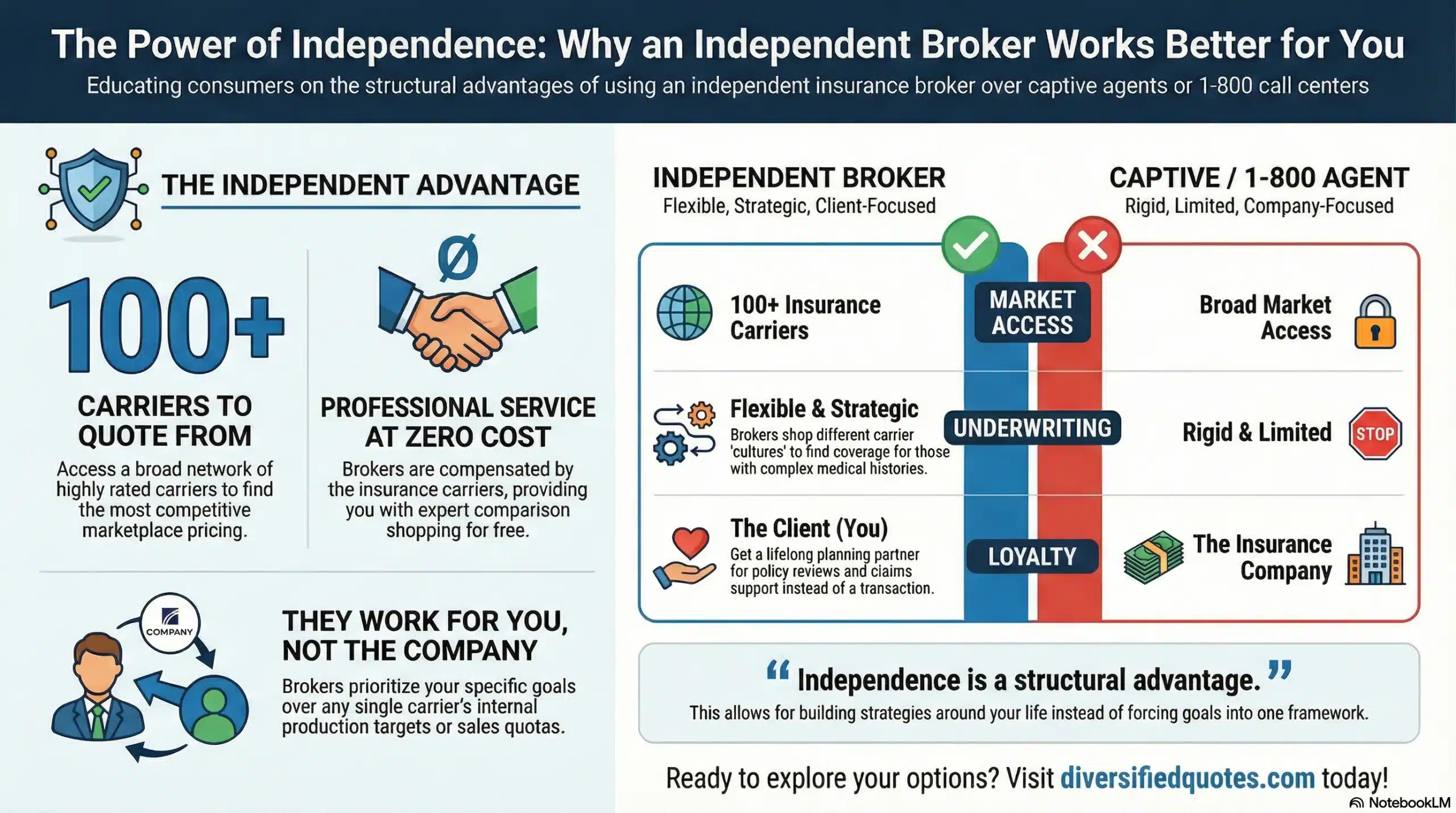
As an Independent Life Insurance Broker, we compare rates across 100+ carriers and prescreen every application before submission.
26-Year Term Life Insurance

Jason Stolz CLTC, CRPC
26-Year Term Life Insurance is a precision-style term length for people who want protection to end on a specific timeline — often aligned with a mortgage payoff date, a child’s graduation window, or a planned retirement age. While many carriers primarily market standard durations like 20, 25, and 30 years, a 26-year protection goal can still be achieved in the real world by selecting the closest available level-term product or by structuring coverage so your protection timeline fits your obligations as closely as possible without creating gaps.
At Diversified Insurance Brokers, our advisors help you compare a 26-year horizon against 25-year term life insurance and 30-year term life insurance, so you can lock in strong value while matching your financial timeline as closely as possible — without guessing, and without relying on “one-size-fits-all” assumptions. For a foundational overview of how life insurance works across all policy types before comparing specific term lengths, our life insurance services page explains how different structures serve different planning functions.
Get a Term Life Insurance Quote
Compare 26-year term life insurance goals with 25- and 30-year options to find the best fit for your timeline.
What Is 26-Year Term Life Insurance?
“26-year term life insurance” generally refers to level-term coverage designed to keep a fixed premium and fixed death benefit in place for 26 years. If the insured passes away during the protection window, the policy pays the death benefit to named beneficiaries — in most cases income-tax free. If the insured outlives the term, coverage ends unless the policy offers renewal at higher attained-age rates or includes a conversion option allowing transition into permanent coverage. In practice, the phrase “26-year term” is usually less about a single widely marketed product and more about a planning goal: coverage that stays level for 26 years because that’s when the household’s biggest financial obligations end. The most important part of the conversation is not just the number of years — it’s what those years represent and whether the coverage duration aligns with the real financial risk window.
Why People Choose a 26-Year Term Life Insurance Timeline
Most people don’t pick a term length at random. A 26-year term life insurance goal typically comes from a real deadline already visible in the household’s financial plan — something that will still matter even if everything else goes well. The most common drivers are mortgage payoff protection (coverage lasting through remaining mortgage years so the house stays secure if income is lost), family dependency protection through college and beyond, income replacement until retirement savings and Social Security can realistically carry the plan, and business or partnership obligations aligned with loan schedules or key-person exposure timelines.
There’s also a “risk decline” reason that gets overlooked. Many households expect risk to decline gradually, not suddenly — debt usually declines, savings and retirement accounts usually grow, income often rises in established careers. A 26-year term goal is often the sweet spot where a household expects debt to be low, savings to be high, and the plan to be resilient. There’s also the underwriting protection rationale: choosing a term that ends early and then needing to reapply later means higher rates due to age and potentially different underwriting outcomes if health changes. For families thinking about how life insurance coverage interacts with mortgage protection specifically, our resource on how to protect your mortgage with life insurance explains how to align term length with payoff schedules.
26-Year Term vs. 25-Year Term Life Insurance
When the goal is a 26-year protection window, many people naturally compare the nearest standard option: 25-year term life insurance. In real planning, that extra year can matter more than it sounds. If your mortgage payoff is 26 years away, a 25-year term may end while you still have a meaningful remaining balance. If your youngest child is still in school in year 26, that final year still represents high-impact financial exposure. If your retirement plan relies on continued income contributions through year 26, that final year is part of the plan’s stability. From a pricing perspective, a 25-year term is often easier to shop and may price better because it is a more common product with broader carrier availability — but “cheaper” is only better if it still covers the full need. Choosing a term that ends early can force you into one of the least favorable outcomes: buying new coverage later at an older age, possibly with changed health, and with fewer favorable options.
26-Year Term vs. 30-Year Term Life Insurance
30-year term life insurance is widely available and often the most practical “long” term for younger buyers. If you’re considering a 26-year goal, the question becomes whether the additional four years of guaranteed coverage is worth the premium difference. Sometimes yes — those extra years provide cushion when a mortgage payoff timeline might not stay exactly on schedule, when children’s dependency could extend longer than planned, or when “plan drift” over time makes a buffer valuable. If the price jump from a 26-year structure to a 30-year policy is modest, some families prefer the simplicity of 30 years with built-in buffer. Other times, when the plan is highly defined — mortgage payoff is fixed, retirement age is clear, income replacement needs are well-modeled — keeping the term closer to the 26-year target can be more efficient. A third angle is laddering, which can create a better fit than choosing the longest term available when coverage needs naturally decline as debts pay down and savings accumulate.
How to Build a 26-Year Term Life Insurance Plan
Because a true 26-year level-term product is not always available from every carrier, we typically solve a 26-year timeline through practical, planning-first structures. The most reliable approach is choosing a term length that does not end before the need ends — often a 30-year policy if a true 26-year level-term is not available or not priced efficiently. This prioritizes certainty and eliminates gap risk. For households that value stability above all else, one policy with one premium and one expiration date well beyond the deadline is the simplest solution.
A second approach uses a primary term policy plus a small bridge layer — a 25-year primary policy with a small additional layer designed to cover the extra year of the risk window. This works when the goal is precise but the extra years of a full 30-year policy feel unnecessary. The key is implementing the bridge upfront rather than planning to “figure it out later,” so the entire timeline is secured at today’s age and underwriting outcome rather than at a future age when health may have changed. For an explanation of how policy laddering and layering works as a strategy across different coverage timelines, our resource on the life insurance laddering guide explains the approach in detail and when it produces better outcomes than a single large policy.
A third approach is true laddering — stacking multiple policies so coverage is highest when obligations are highest and steps down later. Many households don’t need the same coverage amount for all 26 years. Early on, the mortgage is larger, savings is smaller, and children are more dependent. Later, debts may be lower and retirement accounts may be stronger. Laddering creates a smoother match between coverage and real risk, reducing the feeling of “overbuying” because part of the coverage expires earlier as it becomes less necessary. The goal is not complexity — it is matching coverage to real obligations so the household plan stays intact under stress without paying for protection beyond the period when that protection is genuinely needed.
Rates and Underwriting for a 26-Year Term Life Goal
Whether you purchase a longer term to cover a 26-year timeline or build it using structured layers, pricing is driven by the same underwriting fundamentals across all term lengths. The insurer is pricing the risk of insuring you over a long period, and the primary factors that influence rate class typically include age at application, health history, medications and prescriptions, build, tobacco and nicotine use, family medical history, driving record, the coverage amount requested, and the underwriting path selected. Even though term length can influence premium, underwriting class often matters more — two people applying for the same term length can see very different pricing based on rate class outcomes. That is why the focus should not be only on term length but on carrier fit and underwriting fit simultaneously.
If you want a clearer picture of what carriers evaluate and how the traditional exam process works versus accelerated underwriting, our resource on what a life insurance exam is explains what to expect and why certain applications still benefit from full underwriting even when accelerated options are available. For applicants with medical history that could affect pricing, our resource on life insurance with pre-existing conditions explains how carrier guidelines vary and why shopping underwriting across multiple carriers can materially change both approval odds and price for the same applicant.
Life Insurance Quoter
See Real-Term Rates Side by Side
No-Exam vs. Fully Underwritten Term Life for a 26-Year Timeline
Many carriers now offer accelerated underwriting that can approve term life insurance without a paramedical exam for eligible ages and face amounts. No-exam term life insurance can be ideal when speed and convenience matter and the applicant’s history is straightforward — these programs use application disclosures, prescription checks, and digital data sources to make a decision quickly and often produce competitive pricing. Fully underwritten term life insurance can be the better route when you’re looking for the strongest possible rate class, applying for a larger face amount, or when you believe your exam and lab profile will improve the underwriting picture. For longer timelines, even a small difference in rate class can have a meaningful impact on total premium dollars over the full 26-year period. Our resource on no-exam life insurance explains how accelerated underwriting programs work and when they produce favorable outcomes versus when traditional underwriting may be the better path.
Convertibility and Renewability for a 26-Year Term Plan
Two contract features matter more than many people realize over a long protection window. Conversion — the ability to exchange term coverage for permanent coverage with the same insurer without a new medical exam, during a defined window — is valuable if health changes or if coverage needs evolve later. Even if you believe term insurance is all you’ll ever need, conversion preserves options. Renewability refers to what happens after the level term ends — some policies allow annual renewal at higher attained-age premiums as a short-term bridge. Renewal can be available but is rarely the plan because premiums rise sharply with age. Smart planning focuses on selecting the right duration upfront, or using conversion strategically if permanent coverage becomes necessary later. For a full explanation of how the conversion process works and what to look for when evaluating conversion provisions across carriers, our resource on converting term to permanent life insurance provides the relevant detail. For households that want to understand what permanent coverage looks like before evaluating conversion options, our resource on guaranteed universal life insurance covers one of the most common conversion destination products.
How Much Coverage Do You Need for a 26-Year Term Life Plan?
The right coverage amount is the amount that protects the household plan for the next 26 years — not just an amount that sounds large. Most families start with income replacement and debt payoff, then layer in longer-term objectives like education funding and household stability. From there, subtract resources that would realistically be available: savings, existing life insurance, and any survivor income expected to remain in place. A practical approach builds the number from identified obligations rather than defaulting to a generic income multiplier. If income replacement is $8,000 per month for 15 years, that can be translated into a present-value lump sum. If the mortgage balance is $400,000, that is a defined layer. If college funding for two children is a goal, that adds another layer. Final expenses ensure the benefit is not consumed before serving its primary purpose.
The key principle is sustainability. Term insurance only works if it stays in force for the full term — the best policy is the one that can be kept consistently for 26 years, which is why premium comfort matters as much as face amount. For a structured framework on calculating the right coverage amount before applying, our resource on how much life insurance you need walks through the layered calculation approach that accounts for real household obligations rather than generic multiples. For parents specifically focused on child dependency and education funding timelines, our resource on life insurance for parents with young children covers the coverage amount decisions that matter most during the highest-obligation years.
Common Mistakes to Avoid With a 26-Year Term Life Goal
The first common mistake is choosing too short a term because it looks cheaper today. If obligations last 26 years, a 25-year term that ends early creates a coverage gap right when you least want to be forced into a new application — older, potentially with changed health, and facing higher premiums for the same coverage. The second is overbuying years that aren’t needed just to keep things simple — sometimes a 30-year policy is the right answer because pricing is close and the household values cushion, but other times paying for four extra years meaningfully increases total premium cost over the life of the policy.
The third mistake is relying on renewals as a plan. Even when renewability exists, renewal premiums rise sharply based on attained age and are designed as a short-term bridge, not a long-term solution. A strong term plan is designed so you’re not forced into expensive renewals because the term ended prematurely. The fourth mistake is ignoring conversion options — conversion can preserve flexibility if health changes later, and evaluating which carriers offer the strongest conversion windows and the broadest permanent product options for conversion is part of a complete carrier comparison. Finally, many people underestimate how much carrier selection matters when there is medical history. Our resource on life insurance with pre-existing conditions explains how carrier guidelines vary and why shopping underwriting can materially change both approval odds and pricing for the same applicant profile.
Financial Protection Essentials
Term life planning resources, coverage amount calculators, laddering strategies, and underwriting guidance for longer timelines.
Related Pages
Compare Term Life Insurance Lengths
Explore different term periods to find coverage that best matches your timeline and budget.
Talk With an Advisor Today
Choose how you’d like to connect—call or message us, then book a time that works for you.
Schedule here:
calendly.com/jason-dibcompanies/diversified-quotes
Licensed in all 50 states • Fiduciary, family-owned since 1980
FAQs: 26-Year Term Life Insurance
A true 26-year level-term product exists at some carriers but is not widely marketed — most carriers focus on standard durations like 20, 25, and 30 years. When a precise 26-year timeline is important, the practical approach is comparing nearby available term lengths and evaluating whether a 25-year, 27-year, or 30-year policy best serves the specific obligation timeline, factoring in gap risk, premium cost, and carrier availability in your state. Occasionally a carrier does offer flexible or custom term lengths, but availability varies by state and carrier. We compare across 75+ carriers to identify what is actually available for your age, health profile, and coverage amount before recommending a structure. Evaluating carrier quality alongside term availability is part of the comparison — our resource on whether Mutual of Omaha is a good insurance company illustrates how carrier-specific evaluation factors into term decisions beyond just the available lengths.
The best alternative depends on what matters most for the household — coverage certainty, premium efficiency, or flexibility. If coverage certainty is the priority, selecting a 30-year term that extends beyond the 26-year deadline eliminates gap risk and provides built-in cushion in case the plan drifts from its original timeline. If premium efficiency is the priority, evaluating a 25-year term alongside a small bridge layer or a laddered structure can produce coverage precisely aligned to the 26-year window without paying for four additional years beyond the need. If flexibility is the priority, a policy with strong conversion provisions allows a 25-year term to convert to permanent coverage within a defined window if circumstances change after the term was purchased. Some families also coordinate life insurance timeline decisions alongside longer-range planning goals — our resource on wealth transfer strategies explains how permanent coverage can complement term in a complete financial plan.
The premium difference between a 25-year, 26-year, and 30-year term is typically modest relative to the death benefit — often a matter of dollars or tens of dollars per month rather than a fundamentally different budget commitment. Underwriting class typically has a larger impact on total premium than the difference between nearby term lengths: a Preferred Plus applicant at 30 years will often pay less than a Standard applicant at 25 years for the same face amount, because the rate class difference is larger than the term length difference. That’s why the focus should be on getting the best possible underwriting class for the profile alongside choosing the right term length — not just on minimizing the term length to reduce premium. Our resource on whether life insurance is expensive provides realistic premium benchmarks across ages and underwriting classes so you can evaluate the term extension cost in context before making the decision.
Many term policies include a conversion privilege allowing you to exchange some or all of the term coverage for permanent coverage with the same insurer — without new medical underwriting — provided conversion occurs within the policy’s defined conversion window. Conversion is particularly valuable if health changes during the term period and new underwriting would result in a higher premium or possible decline. Even if you expect to only need term coverage, having the option to convert later preserves planning flexibility if your needs evolve — a long-term dependent develops, estate planning goals emerge, a business relationship creates a new insurance need, or retirement income objectives benefit from a cash-value component. The specifics of conversion provisions — how long the window lasts, which permanent products are eligible, whether the full face amount or only a portion can be converted — vary considerably across carriers. Evaluating conversion provisions upfront is part of a complete carrier comparison. Our resource on converting term to permanent life insurance explains how to evaluate these provisions when comparing term policies. For context on one of the most common conversion destination products, our resource on guaranteed universal life insurance covers how that product works as a permanent coverage option.
Whether a medical exam is required depends on the carrier, the face amount, the underwriting program, and your age and health profile. Many carriers offer accelerated or fully no-exam underwriting for qualifying applicants — using prescription database checks, motor vehicle records, and electronic health data in place of a traditional paramedical examination. For many healthy applicants at standard face amounts, no-exam underwriting produces competitive pricing and faster approval. For larger face amounts, for applicants who believe their current health metrics are favorable, or for situations where a specific health condition might benefit from direct documentation through a physician’s exam, traditional full underwriting may produce better results. For applicants with specific health history concerns, our resources on life insurance for high A1C diabetics and our broader resource on life insurance with pre-existing conditions explain how specific conditions interact with underwriting and which carriers may be most favorable for particular profiles.
When the level premium period of a term policy ends, the policyholder typically has several options: allowing coverage to expire if financial obligations have concluded and the policy has served its purpose; renewing coverage annually at rates that reflect the insured’s attained age — typically significantly higher than the original level premium and designed as a short-term bridge rather than a sustainable long-term solution; or converting to permanent coverage if the policy includes a conversion provision with remaining window time. The most important planning discipline is beginning to evaluate post-term options well before the term expires — ideally within the final 18 to 24 months of the level period — to preserve all available options and make decisions without urgency. Waiting until the term has already expired creates the worst possible conditions for post-term planning. For broader context on planning retirement finances around the period when term coverage ends, our resource on what to do with your money after retirement provides useful framing for the post-coverage planning conversation.
The right coverage amount is the amount that meaningfully protects the household plan for the next 26 years without dramatically overshooting it in ways that create unnecessary premium cost. Most households build the coverage amount from identified obligation layers rather than defaulting to a generic income multiplier: income replacement for the years dependents or a surviving spouse would need it, outstanding mortgage and debt balances that would create financial hardship if income is lost, education funding for children at projected costs, childcare and household services that would need to be replaced, and final expenses to ensure the benefit is not consumed before it can serve its primary purpose. From that total, subtract existing financial resources that would be available — savings, other life insurance policies, investment assets — to identify the true coverage gap. Our resource on how much life insurance you need provides a structured layered calculation approach. For families with complex long-range obligations — including special needs dependents who may require extended protection beyond the typical dependency window — our resource on choosing a special needs trustee explains how trust-based coverage structures can accommodate obligations that extend beyond a standard term period.
Yes — and for households whose coverage needs naturally decline over the 26-year period as debts pay down and savings accumulate, laddering often produces a better cost-to-coverage alignment than a single flat policy for the full term. The concept is straightforward: instead of one large policy at a fixed amount for 26 years, you structure two or more overlapping policies with different face amounts and different term lengths. A larger layer covers the high-obligation early years when debt is highest and savings is lowest, while a smaller core layer extends to the full 26-year timeline. As the shorter layer expires, total coverage steps down to reflect the reduced obligation level — matching the natural financial trajectory of the household rather than maintaining a fixed large benefit well into the period when the household is financially stronger. For business owners aligning coverage to defined financial milestones, this approach can also be combined with business-specific protection structures — our resource on key person life insurance for executives covers how key-person and personal coverage layers can be coordinated in a comprehensive plan. Our life insurance laddering guide explains the full strategy in detail.
About the Author:
Jason Stolz, CLTC, CRPC, DIA, CAA and Chief Underwriter at Diversified Insurance Brokers (NPN 20471358), is a senior insurance and retirement professional with more than 25 years of real-world experience helping individuals, families, and business owners protect their income, assets, and long-term financial stability. As a long-time partner of the nationally licensed independent agency Diversified Insurance Brokers, Jason provides trusted guidance across multiple specialties—including fixed and indexed annuities, long-term care planning, personal and business disability insurance, life insurance solutions, Group Health, Travel Medical and Evacuation Insurance, and short-term health coverage. Diversified Insurance Brokers maintains active contracts with over 100 highly rated insurance carriers, ensuring clients have access to a broad and competitive marketplace.
His practical, education-first approach has earned recognition in publications such as VoyageATL, and contributions from his agency featured in Kiplinger and GoBankingRates— highlighting his commitment to financial clarity and client-focused planning. Drawing on deep product knowledge and years of hands-on field experience, Jason helps clients evaluate carriers, compare strategies, and build retirement and protection plans that are both secure and cost-efficient. Visitors who want to explore current annuity rates and compare options across multiple insurers can also use this annuity quote and comparison tool.
Explore More Life Insurance Options: Browse our complete guide to How Life Insurance Works — covering term life, whole life, final expense, annuity alternatives & more from 100+ carriers.
Last Reviewed: May 12, 2026 |
Reviewed by: Jason Stolz, CLTC, CRPC, DIA, CAA
Chief Underwriter, Diversified Insurance Brokers, Inc. | NPN: 20471358 | Diversified Insurance Brokers, Inc. — Licensed in all 50 states
Fact Checked by: Tonia Pettitt, CMIP©
Medicare Specialist, Diversified Insurance Brokers, Inc. | NPN: 14374308 | Diversified Insurance Brokers, Inc. — Licensed in all 50 states
Did you find this content helpful? Leave us a Google review — it helps others find trustworthy guidance too.
Editorial Standards: Diversified Insurance Brokers maintains rigorous editorial standards to ensure accuracy, clarity, and independence in all content. Learn more about our editorial standards and commitment to transparency.
