
Get a 2nd Opinion on Your Annuity Quote
As an Independent Annuity Broker, we compare rates across 100+ carriers and 1,000 different annuities— not just one company’s product offerings — to find the best fit for your goals.
Get a 2nd Opinion on Your Annuity Quote

Jason Stolz CLTC, CRPC, DIA, CAA
Getting a second opinion on your annuity quote is one of the most financially consequential steps you can take before committing retirement dollars to a long-term contract. Annuities are not simple, commodity-priced products where one quote from one company gives you a reliable picture of what the market offers. They are complex, carrier-specific contracts where pricing, income payout rates, crediting strategies, surrender terms, and fee structures vary significantly — sometimes dramatically — from one company to the next.
Many people receive an annuity quote and assume it represents a fair market rate, or that the advisor presenting it has surveyed the full landscape of available options. In most cases, neither assumption is accurate. A single quote from a single carrier reflects one company’s interpretation of your needs and one agent’s product access. Without a proper second opinion on your annuity quote, you have no baseline for comparison — and no way to know whether what you have been shown is competitive, optimized, or simply what was most convenient to present.
At Diversified Insurance Brokers, a second opinion on your annuity quote is not a casual review of marketing materials. We stress-test your options, x-ray the contract mechanics, and compare real projected outcomes across multiple top-rated carriers. That means breaking down exactly how income is calculated, how any bonuses actually function within the contract, what the true cost of riders is, and whether the annuity you have been shown is genuinely aligned with what you are trying to accomplish in retirement.
Get a Second Opinion on Your Annuity Quote
We compare your current quote against top-rated carriers to ensure you are getting the best structure, income potential, and contract terms available.
Why a Second Opinion on Your Annuity Quote Matters
The annuity market is vast and competitive. Dozens of top-rated carriers actively compete for retirement assets, and each brings a different approach to crediting interest, structuring income, managing surrender periods, and pricing riders. Two annuities that look nearly identical on a summary page can produce meaningfully different real-world results over a ten or twenty-year period — differences that only become visible when you compare contract mechanics side by side rather than relying on headline numbers.
A second opinion on your annuity quote matters because the first quote you receive is almost never presented with full context. Income projections may reflect best-case crediting assumptions rather than realistic averages. Bonus figures may be presented without disclosure of the vesting schedules, holding periods, or income-only restrictions that govern them. Rider costs may be buried in contract language rather than clearly disclosed upfront. Getting a second opinion on your annuity quote brings all of these elements into the open, allowing you to make a decision based on reality rather than marketing.
This is particularly important because annuities are long-term commitments. Surrender periods of seven to ten years are common, and the decisions you make at the point of purchase — which carrier, which crediting strategy, which riders — lock in the framework for how your contract will perform for years. A second opinion on your annuity quote costs nothing and takes very little time. The alternative — discovering years later that a better option was available — is a far more expensive outcome. For anyone considering how annuities fit into a broader retirement strategy, our resource on using a fixed indexed annuity for growth and income provides essential context.
How Annuity Quotes Differ Between Carriers
The degree to which annuity quotes can differ between carriers surprises most people who have not shopped the market before. On the income side, two fixed indexed annuities with identical premium amounts and identical income activation timelines can produce guaranteed lifetime withdrawal amounts that differ by 20%, 30%, or more — depending on the carrier’s payout factors, the income base crediting rate, and the specific rider design. Over a 20-year retirement, that difference compounds into a substantial gap in total income received.
On the accumulation side, fixed annuities differ in the rates they guarantee across multi-year terms. A five-year MYGA from one carrier might offer 5.10% while another offers 5.85% for identical terms and similar financial strength ratings. For a $300,000 deposit, that rate difference generates tens of thousands of dollars in additional growth over the contract term — growth that compounds if the contract is renewed or exchanged into a new annuity at maturity.
Fixed indexed annuities vary in crediting strategies, participation rates, cap rates, and spread fees — all of which determine how much of the underlying index performance actually gets credited to your account. Understanding how these mechanics interact is not something most consumers can evaluate from a single quote presentation. It requires side-by-side comparison across multiple carriers, which is exactly what a second opinion on your annuity quote delivers. Our guide on what makes fixed indexed annuities different from fixed products is a helpful foundation for anyone working through this comparison.
The Truth About Annuity Bonuses — What a Second Opinion Reveals
Premium bonuses are one of the most commonly misunderstood elements of annuity marketing, and a second opinion on your annuity quote frequently reveals that a bonus-driven recommendation is not as advantageous as it initially appears.
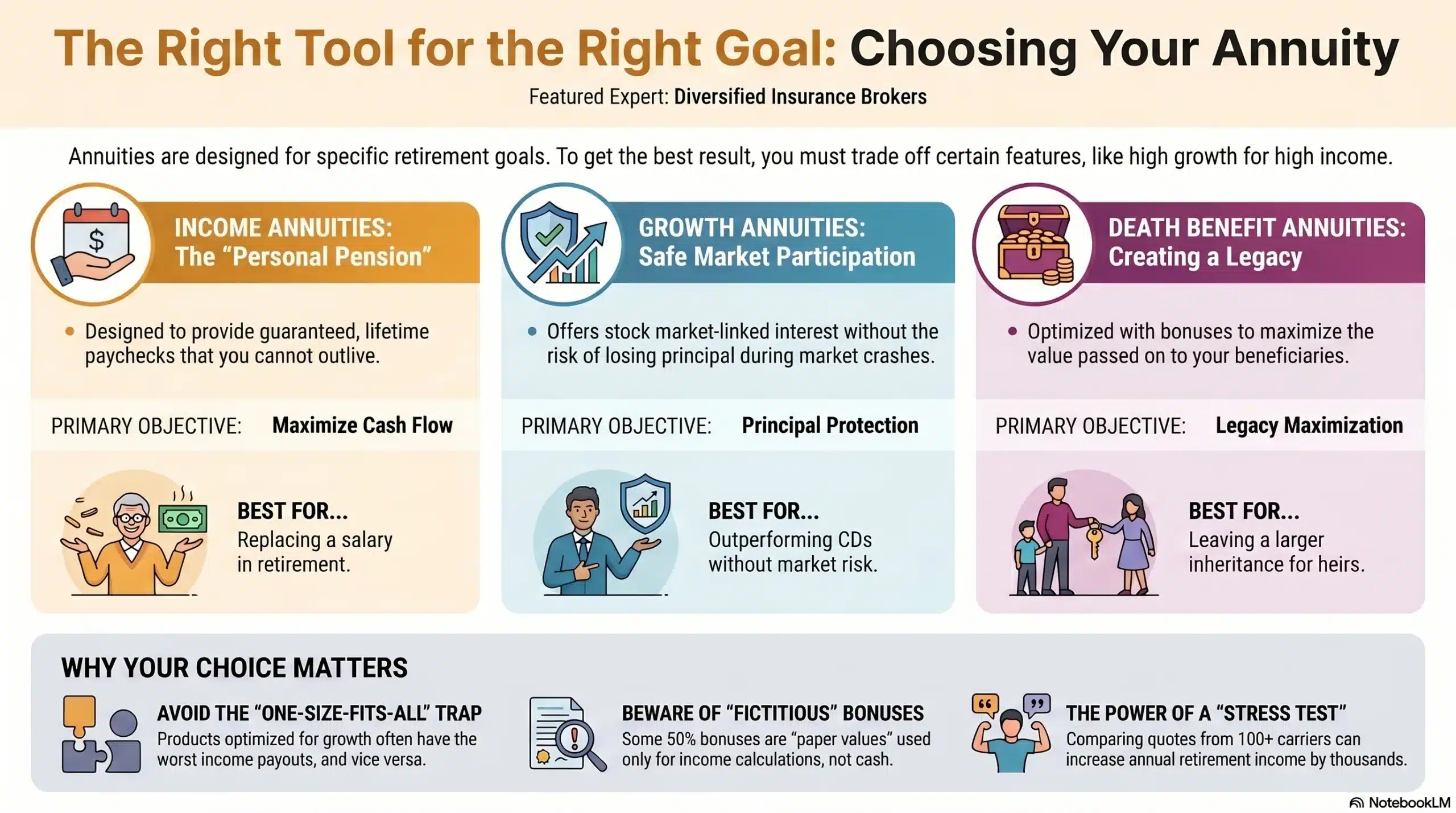
There are two distinct types of annuity bonuses, and confusing them is a significant source of buyer disappointment. Premium bonuses — where the carrier adds a percentage of your deposit to the contract value — are real dollar additions to your accumulation value, though they typically come with vesting schedules that determine when the full bonus becomes accessible. Income bonuses, by contrast, are credits applied only to the income base used to calculate future withdrawals. They are not real money that can be accessed, surrendered, or passed to heirs. An annuity marketed as having a “20% bonus” that applies only to the income base is not putting 20% more real money into your account.
Bonus annuities also tend to carry trade-offs that reduce their net advantage: longer surrender periods, lower cap rates or participation rates in indexed strategies, or higher annual rider costs. In many cases, a non-bonus product from a different carrier produces superior total income or accumulation over the life of the contract, even without the headline bonus number. Getting a second opinion on your annuity quote specifically evaluates whether a bonus is driving genuine value — or simply driving a sale. For more on this topic, our resource on how annuity bonuses actually work breaks down both types in full detail.
SPIA Payout Structures — Monthly vs. Annual and What It Means for Your Premium
Single Premium Immediate Annuities — SPIAs — are among the most straightforward annuity products available, but even they contain structural choices that most buyers are never shown. One of the most important is the payout frequency: monthly versus annual income payments.
What most people do not realize is that choosing monthly income payments actually requires less premium than choosing annual payments for the same income target. This is because the insurance company is paying out smaller amounts more frequently with monthly distributions, which reduces the actuarial cost of the income guarantee. Annual payments, where the full year’s income is disbursed in a single lump sum, require a larger premium to generate the same total annual payout — because the carrier must hold and guarantee a larger distribution event.
For buyers working with a specific premium amount and trying to maximize income, monthly payouts will typically generate a higher effective yield on the deposited premium. For buyers who need a specific annual income target and are willing to commit a larger premium, annual payments may suit cash flow preferences. Neither structure is universally superior — the right choice depends on your income needs, budgeting preferences, and the premium amount you are working with. A second opinion on your annuity quote ensures you have seen both structures modeled clearly before making a final decision. Understanding how lifetime income annuity tradeoffs work in practice is essential context for any SPIA buyer.
Income Products vs. Accumulation Products — Getting the Match Right
One of the most common issues uncovered by a second opinion on an annuity quote is product mismatch — a situation where the annuity being recommended is not the right tool for the buyer’s stated objective. Not all annuities are built to do the same job, and trying to make one product serve a purpose it was not designed for produces suboptimal results.
Pure income annuities — including SPIAs, deferred income annuities, and fixed indexed annuities with standalone income riders — are engineered to maximize guaranteed lifetime income. They trade accumulation flexibility and liquidity for the highest possible contractual income commitment. Accumulation-focused products — including MYGAs and growth-oriented fixed indexed annuities without income riders — are engineered to grow principal efficiently with principal protection and tax deferral. Hybrid products attempt to serve both goals simultaneously, often with some compromise on each.
A buyer whose primary goal is maximum guaranteed income is rarely best served by a hybrid product that also emphasizes growth features. A buyer whose primary goal is tax-deferred accumulation with access to principal is poorly served by a long-surrender income annuity. Getting a second opinion on your annuity quote ensures that the product recommended is genuinely the right tool for the job you need done — not simply the most available or most aggressively marketed option in the presenting agent’s portfolio. For a clear framework on how different annuity types serve different goals, our resource on why more retirees are choosing MYGAs for accumulation provides helpful context on product selection logic.
Second Opinion Comparison — Original Quote vs. Optimized Alternative
The table below illustrates a typical outcome when a second opinion on an annuity quote is conducted on a $250,000 fixed indexed annuity with a lifetime income rider, comparing the original quote presented to an optimized alternative identified through carrier comparison.
| Feature | Original Quote | Second Opinion Result |
|---|---|---|
| Guaranteed Annual Income at Age 65 | $24,000/year | $31,500/year |
| Annual Rider Cost | 1.20% per year | 0.85% per year |
| Liquidity During Surrender Period | 10% free withdrawal annually | 10% free withdrawal plus enhanced nursing home waiver |
| Surrender Period | 10 years | 8 years |
| Income Bonus Type | Income base only (not real money) | No bonus, higher payout factor |
| Carrier AM Best Rating | A- | A+ |
The $7,500 per year income difference in this example — $31,500 versus $24,000 — represents $75,000 in additional guaranteed income over just ten years of retirement. Over a 20-year retirement, the gap exceeds $150,000 in total income received. A second opinion on your annuity quote is the only way to uncover differences of this magnitude before a contract is signed.
The Annuity Tools
Before requesting your second opinion, use the tools below to see current top rates across the market and model how much guaranteed lifetime income your premium can generate.
Ensure You Are Receiving the Absolute Top Rates
Current Fixed Annuity Rates
Compare today’s best fixed annuity rates from top carriers.
Current Bonus Annuity Rates
See which annuities offer the highest upfront bonus today.
Request an Annuity Quote
Submit our annuity request form to get personalized rate options.
Lifetime Income Calculator
Use our calculator to see how much guaranteed income your annuity can provide.
What a Second Opinion on Your Annuity Quote Actually Reviews
A proper second opinion on your annuity quote is not a casual glance at a competing product’s brochure. At Diversified Insurance Brokers, the review process covers the full contract — not just the income projection on page one of the illustration.
We evaluate the income rider mechanics in detail: what rate the income base grows at during the deferral period, how the payout factor is applied when income begins, whether the payout factor changes based on when income starts, and what happens to the income base and death benefit during the payout phase. These details determine the actual long-term value of the income promise — and they are frequently glossed over in an initial presentation.
We review the accumulation crediting strategy with equal rigor: whether the indexed strategy uses annual point-to-point, monthly averaging, or other crediting methods; what the current cap rates or participation rates are; whether the carrier has a strong historical record of maintaining competitive crediting rates at renewal; and how the contract performs against alternatives in moderate and conservative market scenarios. Our analysis of how interest rate environments affect annuity performance informs every second opinion we conduct.
We also examine the carrier’s financial strength rating, complaint history, and track record of renewal rate fairness — because an annuity is only as reliable as the company standing behind it for the next ten to thirty years of your retirement.
When You Are Most Likely to Need a Second Opinion on Your Annuity Quote
There are specific situations where getting a second opinion on your annuity quote is particularly important. If you received your quote from a captive agent who represents only one carrier — rather than an independent broker with access to the full market — a second opinion is essential. Captive agents can only recommend what their company offers, regardless of whether it is the most competitive option available.
If the annuity you have been shown features a large premium or income bonus as the centerpiece of the pitch, a second opinion is equally important. As discussed above, bonus annuities frequently carry trade-offs that reduce net performance. A second opinion evaluates the full contract rather than the headline number, revealing whether the bonus is driving genuine value or obscuring a less competitive underlying structure. For anyone who has already explored when a bonus annuity genuinely makes sense, that context is directly relevant to evaluating any bonus-driven recommendation.
If you have an existing annuity that has been in force for several years and is approaching the end of its surrender period, a second opinion is highly valuable at that transition point. The renewal rate offered by your current carrier may not be competitive with what you could achieve by moving to a new contract through a tax-free 1035 exchange — and an independent second opinion is the only objective way to evaluate that comparison.
The Role of an Independent Annuity Broker in the Second Opinion Process
The independence of the broker conducting your second opinion determines the objectivity of the analysis. A second opinion from another captive agent at a different single-carrier company is not a true second opinion — it is simply a second sales pitch from a different corner of the same limited marketplace. A genuine second opinion requires access to dozens of carriers simultaneously and the analytical capacity to compare them without bias toward any particular product or commission structure.
At Diversified Insurance Brokers, we are independent. We represent no single carrier and have no incentive to steer any client toward any particular product. Our income comes from placing the right annuity for each client — which means our interest is perfectly aligned with yours. When we conduct a second opinion on your annuity quote, we are evaluating your existing quote against the full competitive landscape, identifying the best available alternative if one exists, and giving you an honest assessment of whether your current quote should be accepted, improved, or replaced entirely.
For clients who want to understand the broader value of working with an independent broker across all financial products — not just annuities — our resource on how independent insurance brokers get paid explains the compensation structure and why it aligns broker incentives with client outcomes.
How a Second Opinion on Your Annuity Quote Fits Into Broader Retirement Planning
A second opinion on your annuity quote does not exist in isolation from the rest of your retirement plan. The annuity you choose interacts with your Social Security claiming strategy, your required minimum distribution timeline, your Medicare cost structure, and your legacy goals. A product that looks optimal when evaluated in isolation may create complications when viewed in the context of your full financial picture.
For example, placing a large non-qualified annuity into a contract with high annual income rider costs may accelerate taxable distributions in a way that affects Medicare IRMAA thresholds. Choosing a deferred income annuity with a fixed start date may conflict with a Social Security bridge strategy that requires income flexibility. Selecting an annuity without a long-term care rider may leave a gap in the financial plan that a hybrid product could have addressed simultaneously. These are the kinds of interactions that a comprehensive second opinion on your annuity quote brings to the surface. For those exploring how annuities interact with long-term care planning, our guide on fixed annuities that include long-term care benefits is a valuable companion resource.
At Diversified Insurance Brokers, we evaluate annuity recommendations within the context of the full retirement plan — not as isolated products. That comprehensive perspective is what allows us to identify not just whether a competing annuity offers better income, but whether the annuity type itself is the right solution for the goal being addressed. Our broader resources on annuity strategies for early retirees reflect this planning-first approach.
Final Thoughts on Getting a Second Opinion on Your Annuity Quote
An annuity is a commitment that will shape your retirement income for years or decades. It deserves the same due diligence you would apply to any major financial decision — and more, given the complexity of the contract structures involved. A second opinion on your annuity quote is the mechanism that ensures that diligence is actually applied before you sign.
The process costs nothing, obligates you to nothing, and takes very little time. What it can produce — a more competitive income payout, a stronger carrier, a shorter surrender period, a lower rider cost, or simply the confidence that your original quote was fair — is worth considerably more than the time invested. If you have been presented with an annuity quote and have not yet gotten a second opinion, that is the most important next step you can take before committing your retirement savings.
Related Pages
Talk With an Advisor Today
Choose how you’d like to connect—call or message us, then book a time that works for you.
Schedule here:
calendly.com/jason-dibcompanies/diversified-quotes
Licensed in all 50 states • Fiduciary, family-owned since 1980
Get a Second Opinion on Your Annuity Quote FAQs
A second opinion on your annuity quote involves a structured comparison of your existing quote against the full competitive landscape of available alternatives across multiple top-rated carriers. At Diversified Insurance Brokers, this process covers income rider mechanics, accumulation crediting strategies, bonus structures, rider costs, surrender period length, liquidity provisions, and carrier financial strength ratings — all evaluated side by side. The goal is not to automatically replace your current quote, but to determine whether it is genuinely competitive or whether a better option exists. Many clients discover that their original quote was underperforming by a meaningful margin; others gain the confidence that they were shown something fair. Either outcome is valuable.
The variation between annuity quotes from different carriers can be substantial. On the income side, two fixed indexed annuities with identical premium amounts and identical income start dates can produce guaranteed lifetime income amounts that differ by 20% to 30% or more, depending on each carrier’s payout factors and income base crediting rate. On the accumulation side, MYGA rates for identical terms from carriers with similar financial strength ratings can differ by 0.50% to 1.00% or more — a difference that generates tens of thousands of additional dollars in growth on a substantial deposit. These are not marginal differences. A second opinion on your annuity quote is the only reliable way to determine where your quote falls within the competitive range.
It depends entirely on the type of bonus. Premium bonuses — where the carrier credits a percentage of your deposit to the contract’s accumulation value — are real money additions, though they typically vest over a period of years and may carry other trade-offs. Income bonuses, by contrast, are credits applied only to the income base used to calculate future guaranteed withdrawals. An income bonus is not accessible as cash, cannot be surrendered, and does not pass to heirs as a death benefit. It exists solely to increase the calculation basis for future income payments. Many annuity presentations feature income bonuses prominently without making this distinction clear. A second opinion on your annuity quote ensures you understand exactly what type of bonus is being offered and what it actually means for your real money. Our full breakdown of how annuity bonuses actually work covers both types in detail.
Monthly SPIA payouts actually require less premium than annual payouts for the same income target. Because monthly distributions send out smaller amounts more frequently, the actuarial cost to the insurance company is lower — which means less premium is required to fund the same annual income on a monthly basis. Annual payouts, where the full year’s income is delivered in a single lump sum, require a larger premium commitment because the carrier must hold and guarantee a larger single distribution. For buyers working with a fixed premium amount, monthly payouts typically generate a higher effective yield on the deposited funds. For buyers with a specific annual income target who prefer a single yearly distribution, annual payouts may suit their cash flow needs — but the premium requirement will be higher. A second opinion ensures you see both structures modeled before committing.
You should get a second opinion on your annuity quote any time before signing a contract — but there are specific situations where it is especially important. If you received your quote from a captive agent representing only one carrier, a second opinion is essential because you have only seen one corner of the market. If the recommendation centers on a large premium or income bonus, a second opinion is critical for understanding the trade-offs embedded in that bonus structure. If you are approaching the end of an existing annuity’s surrender period and evaluating whether to renew or exchange into a new contract, a second opinion determines whether your current carrier’s renewal rate is competitive. In every case, the process costs nothing and takes very little time.
Yes, and this is one of the most valuable applications of the second opinion process. If your existing annuity is still within its surrender period, a second opinion determines whether the contract is performing as expected, whether any provisions or riders are being fully utilized, and whether any adjustments in income strategy or withdrawal approach could improve your outcome. If your annuity is approaching the end of its surrender period, a second opinion evaluates whether the renewal rate offered by your current carrier is competitive — or whether a 1035 tax-free exchange into a new contract at a different carrier would produce materially better results. The 1035 exchange allows you to move from one annuity to another without triggering a taxable event, making this transition strategy particularly powerful for non-qualified annuities with accumulated gains. Understanding how your annuity account value is tracked and calculated is important context before requesting this review.
Pure income annuities — including SPIAs, deferred income annuities, and fixed indexed annuities with standalone income riders designed for maximum payout — are engineered with a single objective: producing the highest possible guaranteed income for the premium committed. Every aspect of the contract structure is optimized for that goal. Hybrid products that attempt to deliver both income and accumulation or liquidity features must balance competing objectives, and that balance typically means some compromise on income efficiency. For a buyer whose primary goal is maximizing guaranteed lifetime income, a product designed purely for income will almost always outperform a hybrid on that single dimension. A second opinion on your annuity quote identifies whether the product you have been shown is genuinely the best available option for your stated objective.
Not at all. A second opinion on your annuity quote is an analytical service, not a sales transaction. Many clients who request a second opinion from Diversified Insurance Brokers discover that their original quote was genuinely competitive, and proceed with their original recommendation with greater confidence. Others identify meaningful improvements and choose to act on the alternative identified through the second opinion process. In either case, the client makes the final decision with complete information. There is no pressure, no obligation, and no fee. Our compensation comes only if and when a client chooses to place an annuity — never from the review process itself.
A comprehensive second opinion evaluates your annuity quote in the context of your full retirement picture — not as an isolated product. The annuity you choose affects your Social Security claiming strategy, your required minimum distribution obligations, your Medicare cost structure, and your estate plan. A product that looks optimal when evaluated alone may create tax complications, IRMAA exposure, or planning conflicts when placed within your broader financial situation. At Diversified Insurance Brokers, we evaluate annuity recommendations holistically, identifying not just whether a competing product offers better income, but whether the annuity type and structure is the right solution for the specific goal being addressed. Our resources on using a fixed indexed annuity for growth and income together illustrate how this planning-first approach works in practice.
Diversified Insurance Brokers is an independent brokerage with access to dozens of top-rated annuity carriers across every product category — fixed, fixed indexed, MYGA, SPIA, deferred income, and hybrid long-term care products. We represent no single carrier, which means our analysis of your quote is genuinely objective. We evaluate every relevant contract dimension — income mechanics, crediting strategies, bonus structures, rider costs, surrender terms, and carrier financial strength — and we communicate our findings clearly so you can make a fully informed decision. Whether your original quote turns out to be excellent or significantly improvable, you will know exactly why and exactly what your options are. That transparency is the foundation of every second opinion we conduct. For more background on how we approach client relationships, our resource on how independent insurance brokers are compensated explains our alignment with your interests.
About the Author:
Jason Stolz, CLTC, CRPC, DIA, CAA and Chief Underwriter at Diversified Insurance Brokers (NPN 20471358), is a senior insurance and retirement professional with more than 25 years of real-world experience helping individuals, families, and business owners protect their income, assets, and long-term financial stability. As a long-time partner of the nationally licensed independent agency Diversified Insurance Brokers, Jason provides trusted guidance across multiple specialties—including fixed and indexed annuities, long-term care planning, personal and business disability insurance, life insurance solutions, Group Health, Travel Medical and Evacuation Insurance, and short-term health coverage. Diversified Insurance Brokers maintains active contracts with over 100 highly rated insurance carriers, ensuring clients have access to a broad and competitive marketplace.
His practical, education-first approach has earned recognition in publications such as VoyageATL, and contributions from his agency featured in Kiplinger and GoBankingRates— highlighting his commitment to financial clarity and client-focused planning. Drawing on deep product knowledge and years of hands-on field experience, Jason helps clients evaluate carriers, compare strategies, and build retirement and protection plans that are both secure and cost-efficient. Visitors who want to explore current annuity rates and compare options across multiple insurers can also use this annuity quote and comparison tool.
Get a Second Opinion: Browse our complete 2nd Opinion Quote Review — see how a second opinion from an independent broker could save you money across life, annuity, disability, group health, long term care, and Medicare.
Explore More Annuity Options: Browse our complete guide to Annuity Strategies & Retirement Income — covering tax strategies, retirement income planning, lifetime income & annuity comparisons from 100+ carriers.
Last Reviewed: June 9, 2026 |
Reviewed by: Jason Stolz, CLTC, CRPC, DIA, CAA
Chief Underwriter, Diversified Insurance Brokers, Inc. | NPN: 20471358 | Diversified Insurance Brokers, Inc. — Licensed in all 50 states
Fact Checked by: Tonia Pettitt, CMIP©
Medicare Specialist, Diversified Insurance Brokers, Inc. | NPN: 14374308 | Diversified Insurance Brokers, Inc. — Licensed in all 50 states
Did you find this content helpful? Leave us a Google review — it helps others find trustworthy guidance too.
Editorial Standards: Diversified Insurance Brokers maintains rigorous editorial standards to ensure accuracy, clarity, and independence in all content. Learn more about our editorial standards and commitment to transparency.
