
Deferred Annuity Calculator
Deferred Annuity Calculator

Jason Stolz CLTC, CRPC, DIA, CAA
A deferred annuity calculator is the most direct way to understand how the growth period before income begins affects the retirement paycheck an annuity ultimately produces — and why the deferral period is often the most consequential variable in the entire income planning equation. The word “deferred” in deferred annuity refers to the structure’s defining characteristic: unlike an immediate annuity that converts premium into income within a few months of purchase, a deferred annuity operates in two distinct phases separated by time. The accumulation phase comes first, during which the annuity’s account value grows through interest crediting while earnings compound on a tax-deferred basis. The distribution phase follows, during which the accumulated value supports income payments — either through annuitization, a guaranteed lifetime withdrawal benefit rider, or a structured payout from the account value. The deferred annuity calculator models the accumulation phase’s output, showing how premium, growth rate assumptions, and time horizons interact to produce the account value that will ultimately fund retirement income.
For retirement planning purposes, the deferred annuity calculator answers the question that drives the most consequential planning decisions: “If I put this amount into a deferred annuity now and let it grow for this many years, what account value will I have available to fund income when I need it?” Different answers — driven by different initial premiums, different growth rate assumptions, and different deferral periods — produce dramatically different income outcomes. Understanding these relationships in concrete numbers is the foundation for making an informed decision about how much to allocate to a deferred annuity strategy and when to activate income. At Diversified Insurance Brokers, Jason Stolz, CLTC, CRPC, DIA, CAA helps clients use the calculator’s projections as a starting framework, then refines those projections using current annuity rates across 100+ insurance companies to produce the real-world income comparisons that support confident decisions. Our resource on how to use an annuity in retirement covers the distribution phase mechanics, and our resource on what is a deferred income annuity covers the specific structure that maximizes future income by committing premium to a fixed future income start date.
Ensure you are receiving the absolute top rates
Current Fixed Annuity Rates
Compare today’s best fixed annuity rates from top carriers.
View Current RatesCurrent Bonus Annuity Rates
See which annuities offer the highest upfront bonus today.
View Bonus RatesRequest an Annuity Quote
Submit our annuity request form to get personalized rate options.
Quote Request FormDeferred Annuity Growth Calculator
Estimate how much your annuity could produce in retirement based on your age, deposit amount, and expected deferral period.
Deferred Annuity Types Compared — What the Calculator Is Actually Modeling
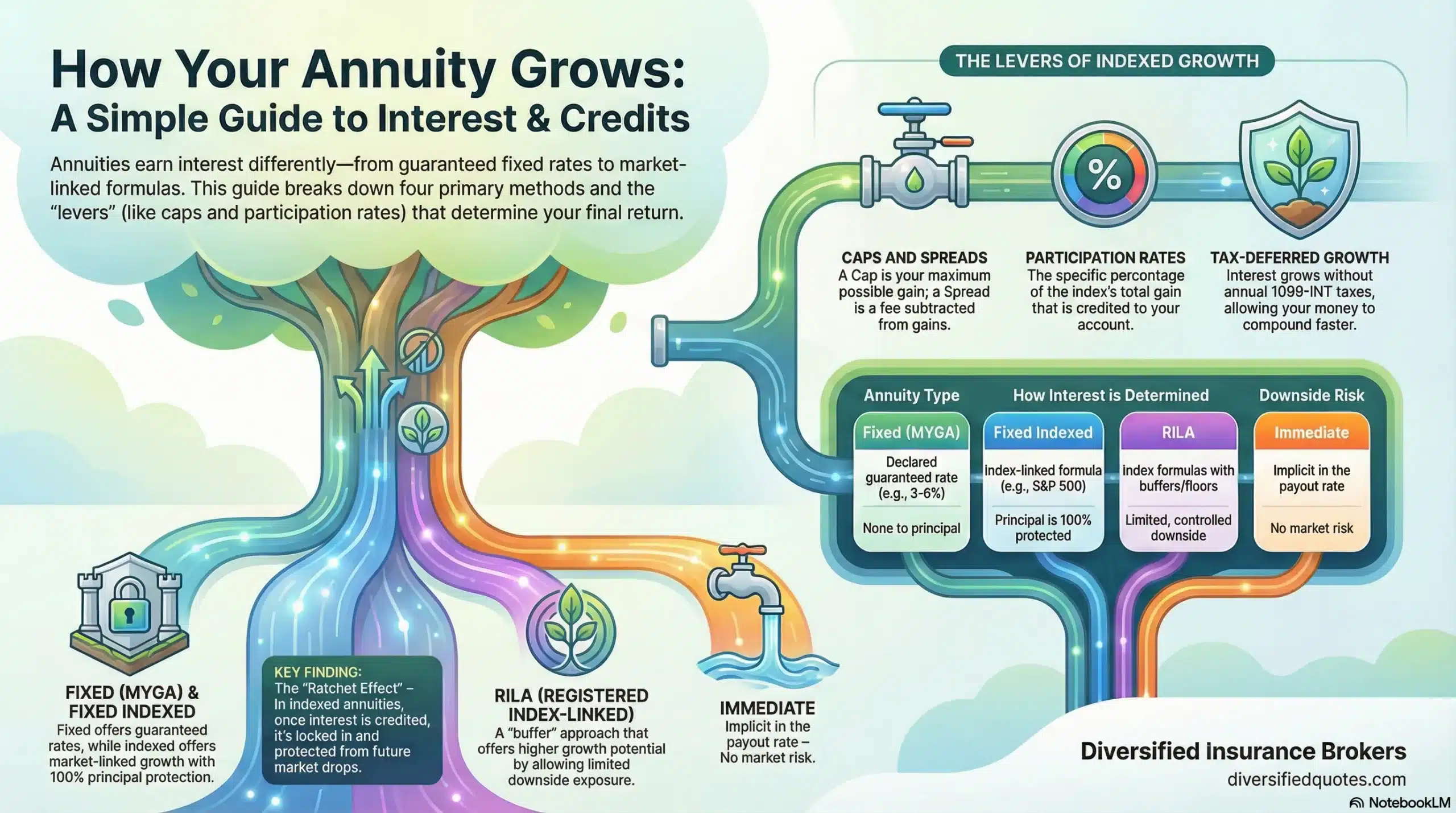
When you use a deferred annuity calculator, the growth rate assumption you enter corresponds to the type of deferred annuity you are evaluating — and different annuity types grow through fundamentally different mechanisms. Understanding which type matches the calculator inputs you are using ensures that the projections are meaningful rather than hypothetical. The three primary structures — fixed, fixed indexed, and variable — all qualify as deferred annuities but produce growth through entirely different processes, with different risk and reward profiles that determine what growth rate is realistic to model.
| Feature | Fixed Annuity (MYGA) | Fixed Indexed Annuity (FIA) | Variable Annuity |
|---|---|---|---|
| Growth mechanism | Declared fixed interest rate guaranteed for the contract term — precise and predictable | Interest linked to index performance (S&P 500, etc.) subject to caps, participation rates, or spreads — no direct market investment | Account value invested in subaccounts (similar to mutual funds) — returns reflect actual subaccount performance |
| Principal protection | Full — principal and credited interest cannot be reduced by market performance | Full — index losses cannot reduce account value below the floor (typically zero interest floors) | None on account value — subaccount losses reduce account value directly |
| Calculator growth rate input | Use the actual declared rate — precise modeling because the rate is guaranteed | Use a conservative historical average (typically 4–6%) — actual crediting varies by index performance and product terms | Use assumed market return minus fees — results are projections only, not guarantees |
| Tax treatment during accumulation | Interest defers tax-free — taxed as ordinary income when withdrawn | Credited interest defers tax-free — income rider distributions have specific tax treatment | Subaccount gains defer tax-free — taxed as ordinary income when withdrawn; no capital gains rate advantage |
| Surrender charges | Typically declining over 3–10 year surrender period; free withdrawal provisions (commonly 10%/year) allow partial access | Typically declining over 7–10 year surrender period; free withdrawal provisions apply; income riders have separate rules | Typically declining over 5–8 years; additional charges include mortality and expense fees and fund management fees |
| Best for deferred annuity calculator modeling | Most precise modeling — enter the actual guaranteed rate for exact projections | Conservative to moderate growth scenarios — run multiple rate scenarios for a range of outcomes | Higher growth scenarios with corresponding risk — calculator projections are illustrations only |
The table reveals the most important principle for deferred annuity calculator use: the accuracy of the projection depends entirely on whether the growth rate input matches the type of annuity being modeled. When modeling a MYGA, using the actual declared guaranteed rate produces a precise projection of what the account value will be at the end of the guarantee period. When modeling a fixed indexed annuity, a conservative historical crediting average produces a reasonable central estimate — but actual FIA crediting will be higher or lower depending on index performance and the specific product’s terms. Our resource on best MYGA annuity rates covers the current rate environment for fixed annuities, providing the most reliable inputs for precise deferred annuity calculator modeling. Our resource on highest bonus FIA rates covers the bonus-enhanced FIA structures where an upfront credit increases the initial compounding base — which materially changes what the deferred annuity calculator projects at any given growth rate.
The Accumulation Phase — How Deferred Annuities Grow
The accumulation phase of a deferred annuity is the period between initial premium payment and the first income distribution — the time during which the contract’s account value grows through interest crediting or investment performance while the owner defers both income and taxation. This phase can last anywhere from a few years to several decades depending on the owner’s age at purchase, their planned retirement timeline, and whether they are building a specific future income amount or simply maximizing the account value available at retirement. Understanding how the accumulation phase works — and what drives its output — is the prerequisite for using the deferred annuity calculator effectively.
During accumulation, the annuity’s account value grows through one of the three mechanisms described in the table above. All three types share the tax deferral characteristic that makes deferred annuities particularly efficient for long accumulation horizons. The practical impact of tax deferral compounding grows with the length of the accumulation period — which is why the deferred annuity calculator’s most revealing comparison is always between different deferral periods for the same premium and growth rate assumption. Our resource on are annuities worth it covers the full value framework for evaluating whether a deferred annuity’s accumulation advantages justify its surrender period and fee structure relative to alternative approaches. Our resource on guaranteed income from annuities covers how the accumulation phase’s output translates into the income phase’s paycheck — completing the picture the deferred annuity calculator’s projections begin.
The Tax Deferral Advantage — Why It Changes the Calculator’s Math
Tax deferral is not simply a convenience of deferred annuity ownership — it is a structural growth mechanism that compounds the calculator’s projected account values meaningfully over long accumulation horizons. In a taxable investment account, interest and dividends are subject to income tax in the year they are earned, regardless of whether the owner withdraws them. This taxation reduces the amount available for reinvestment — and over many years, the cumulative effect of this annual tax drag produces a materially smaller account value than the same investment growing in a tax-deferred environment.
In a deferred annuity, credited interest remains inside the contract without annual taxation. The full credited amount compounds in subsequent periods without reduction for current-year tax obligations. The tax obligation is deferred until distributions occur, at which point the owner pays ordinary income tax on the earnings portion of distributions at their applicable rate in the year of withdrawal. For retirees who expect to be in a lower tax bracket in retirement than during their peak earning years, this deferral produces a genuine tax arbitrage advantage: income that would have been taxed at higher rates during accumulation is instead recognized at lower rates during distribution. Our resource on annuity with inflation protection covers how tax-deferred growth interacts with inflation-adjusted income options — relevant for deferred annuity owners who want to ensure their future income retains purchasing power. Our resource on pension alternative covers how the deferred annuity’s accumulation-then-income structure parallels the way traditional pension plans build and distribute retirement income.
How the Deferral Period Length Affects Future Income
The most powerful lever in the deferred annuity calculator — the one that produces the most dramatic differences in projected outcomes — is the length of the deferral period. More time means more compounding periods, which means more growth. For deferred annuities with income riders, more deferral also typically means higher payout factors applied to a larger benefit base, compounding the income advantage in two simultaneous ways: a higher account value and a higher payout percentage applied to that value.
The concrete implication is that beginning a deferred annuity strategy earlier in pre-retirement planning produces substantially better income outcomes than waiting, even when the total premium invested is identical. An annuity funded at age 55 and deferred 15 years to age 70 grows for 15 compounding periods before income begins. The same premium funded at age 65 and deferred 5 years to age 70 grows for only 5 compounding periods. With identical growth rates, the earlier purchase produces a significantly larger account value at age 70 — and therefore significantly larger income when activated. Our resources on guaranteed income at age 65 and guaranteed income at age 70 provide income projection context for the most common retirement income activation ages — showing what different account values produce in monthly income at each age and making the deferral period’s compounding benefit concrete in real income dollars rather than abstract percentages.
For retirees managing the transition from accumulation to distribution, the deferral period decision also interacts with sequence of returns risk — the vulnerability that market-linked account withdrawals create when large market declines occur early in the distribution phase. A deferred annuity growing through the accumulation phase in fixed or fixed indexed structures is unaffected by market timing at retirement, because its growth is contractually protected from market losses rather than market-exposed. This protection means that the account value the deferred annuity calculator projects will actually be there at the planned income date — not reduced by a market correction in the final years before retirement.
Fixed Annuities (MYGAs) — The Most Precisely Calculable Deferral Path
Multi-year guaranteed annuities (MYGAs) — the most common form of fixed deferred annuity — provide the most reliable deferred annuity calculator inputs because their growth rate is contractually guaranteed for the entire term rather than dependent on future market performance. When you purchase a MYGA at a declared rate for a specific term, the account value at the end of that term can be calculated with mathematical precision — no assumptions, no scenarios, no ranges. The calculator’s projection for a MYGA is a specific number rather than an estimate, which makes MYGAs uniquely useful for retirement income planning that requires a known future account value.
This calculability makes MYGAs ideal for “bridge” retirement planning — the period between a current age and a planned retirement or income activation date. A pre-retiree at age 60 who plans to activate annuity income at 67 can purchase a 7-year MYGA and calculate precisely what account value will be available at age 67 to fund income — allowing detailed retirement planning with much higher precision than market-linked alternatives provide. Comparing multiple MYGA terms — a 3-year, 5-year, and 7-year at their respective current declared rates — in the deferred annuity calculator reveals which term and rate combination produces the largest account value at the planned income date, accounting for the fact that shorter terms allow the owner to lock in potentially different rates at renewal. Our resource on best MYGA annuity rates covers the current competitive rate landscape across different MYGA terms, providing the actual inputs needed to replace the calculator’s assumed rate with market-accurate numbers.
Fixed Indexed Annuities — Growth With Protection for the Deferral Period
Fixed indexed annuities — the most popular deferred annuity structure for pre-retirees and early retirees — provide the deferred annuity calculator’s most important modeling challenge: the growth rate assumption must be reasonable but cannot be precise, because FIA crediting depends on future index performance filtered through the product’s cap, participation rate, or spread parameters. A conservative historical average of credited interest across different index environments provides the most intellectually honest calculator input — acknowledging that the FIA might credit more in strong index years and nothing in flat or negative index years.
The structural advantage of the FIA in the deferred annuity calculator context is that the floor protection — most commonly a zero percent minimum crediting floor — prevents the account value from declining in years of negative index performance. This asymmetric outcome profile (capped upside, floored downside) produces a growth trajectory that is less volatile than direct market exposure while typically exceeding what a guaranteed fixed rate provides over multi-year periods with positive index performance. For deferred annuity calculator modeling, the FIA is best evaluated by running multiple growth rate scenarios rather than a single assumed rate. Our resource on deferred annuity with lifetime payout covers how the FIA’s income rider mechanics interact with the accumulation phase to determine future lifetime income amounts — specifically the benefit base’s roll-up rate, which grows separately from the account value and often produces a larger income base than the account value itself.
Surrender Charges and Liquidity During the Accumulation Period
Every deferred annuity operates under a surrender schedule during the accumulation phase — a defined period during which withdrawals beyond the free withdrawal allowance are subject to surrender charges that reduce the distributed amount below the account value. Surrender charges typically decline annually over the surrender period until they reach zero. Understanding the surrender schedule is important when using the deferred annuity calculator because the planning value of the projected account value at a future date is diminished if the surrender period has not yet expired at that date — accessing the full projected value requires waiting until surrender charges have declined to zero.
Free withdrawal provisions provide partial liquidity during the surrender period. Understanding exactly how annuity free withdrawal rules work is essential for anyone using the deferred annuity calculator to plan how a portion of the projected account value might be accessed before the end of the accumulation phase. Most deferred annuities allow up to 10% of the account value annually without surrender charges — but these withdrawals reduce the compounding base, lowering the projected future account value the calculator models. For planning purposes, the strongest accumulation outcomes come from allowing the full premium to compound throughout the accumulation period without partial withdrawals — which is why adequately funded liquid reserves outside the annuity are the prerequisite for an effective deferred annuity accumulation strategy. Our resource on the immediate annuity calculator covers the distribution-phase calculation for when the deferred annuity’s accumulated value is ultimately converted to income, completing the two-phase planning picture.
The Accumulation-to-Income Transition — Using the Calculator to Plan the Handoff
The deferred annuity calculator’s ultimate value is not simply in projecting how large the account value will be at a future date — it is in providing the starting point for distribution-phase planning that follows. The projected account value at the end of the accumulation period becomes the premium for whatever income structure is activated: annuitization for lifetime income, systematic withdrawals from the account value, or activation of a guaranteed lifetime withdrawal benefit rider whose income is calculated based on the benefit base. Our resource on guaranteed income from annuities covers all three income activation structures in detail — explaining what each produces in monthly income from a given account value and how to choose between them based on the retiree’s income objectives.
For deferred annuities with income riders — the FIA-plus-rider structure that is the most common income-focused deferred annuity product — the benefit base that determines future income grows during the deferral period through a contractually defined roll-up rate that is separate from the account value’s index-linked crediting. The benefit base roll-up is often higher than the account value’s average crediting rate, meaning the future income amount may be based on a higher number than the account value the deferred annuity calculator projects. Our resource on annuity payout calculator covers the income calculation for different account values and income activation ages — providing the distribution-phase tool that completes what the accumulation-phase deferred annuity calculator starts. Our resource on how much does an annuity pay covers the income amounts different account values produce across product types and ages, making the future paycheck concrete from the projected account value.
Coordinating the Deferred Annuity with Other Retirement Accounts
Most retirement planners using a deferred annuity calculator are evaluating the annuity as one component of a broader retirement income strategy — not as a standalone solution. The deferred annuity’s role in a coordinated plan is typically defined by what problem it is solving: providing tax-deferred accumulation with downside protection, creating a guaranteed income floor when activated, or creating a bridge to a specific future income activation date. The calculator’s projections should be read in the context of what portion of total retirement assets will fund the annuity and what role the remaining assets will play in the overall income and legacy plan.
When a deferred annuity is funded through a qualified retirement account rollover — IRA, 401(k), TSP, or 403(b) — the transfer mechanics matter as much as the growth projections. Our resource on how to transfer an IRA to an annuity covers the direct rollover process for IRA-funded deferred annuities, and our resource on how to transfer a 401(k) to an annuity covers the qualified plan rollover mechanics — both showing how the projected account value from the deferred annuity calculator translates to a real-world funded contract with the right tax treatment. Our resource on how to transfer a Roth IRA to an annuity covers the Roth-specific transfer mechanics, where the tax treatment during distribution differs significantly from traditional pre-tax funding. Our resource on institutional investing strategies covers how sophisticated retirement planners integrate guaranteed income products with diversified investment portfolios to create balanced retirement income that the deferred annuity calculator’s accumulation projections are designed to support.
What a Deferred Annuity Calculator Can and Cannot Tell You
The deferred annuity calculator is a planning orientation tool — it reveals how different combinations of premium, growth rate, and deferral period interact to produce different account values and income possibilities. What it provides is a framework for understanding the order-of-magnitude relationships between inputs and outcomes: how much does adding five years to the deferral period change the projected value? How much does a 1% increase in the assumed growth rate change the 15-year projection? These are the planning questions that the calculator answers most reliably.
What the deferred annuity calculator cannot provide is a binding illustration of actual future values for specific products — because actual account values at any future date depend on specific contract terms, the specific crediting method, actual index performance for FIAs, actual investment returns for variable annuities, and any withdrawals made during the accumulation period. A common misunderstanding — one of the most important common annuity myths — is treating a calculator projection as a guaranteed result rather than a scenario estimate built on assumed inputs. For products with variable outcomes (FIAs and variable annuities), the calculator’s single-rate projection should always be supplemented with multiple scenarios — conservative, moderate, and optimistic — to reflect the realistic range of outcomes. Our resource on what questions to ask when researching annuities covers the specific product-level questions that convert a calculator estimate into an informed product evaluation. Our resource on why capital preservation is the new goal for retirees covers the philosophical framework that makes deferred annuities’ principal protection features particularly relevant for pre-retirees who cannot afford to recover from market losses late in their accumulation phase. And our resource on annuity beneficiary death benefits covers what happens to the projected account value when the owner dies during the accumulation phase — an important planning consideration that the calculator’s growth projection does not address but that significantly affects the complete evaluation of any deferred annuity contract.
Compare Deferred Annuity Options With Real Carrier Rates
Once you’ve used the calculator to understand the planning relationships, compare actual current rates across 100+ carriers to translate those projections into real-world income quotes.
Request a Personalized Quote View Current Annuity RatesRelated Pages
Additional annuity planning resources for understanding deferred annuity growth, income, and product options.
Financial Protection Essentials
Additional resources covering retirement income, long-term care planning, and annuity research guidance.
Talk With an Advisor Today
Choose how you’d like to connect—call or message us, then book a time that works for you.
Schedule here:
calendly.com/jason-dibcompanies/diversified-quotes
Licensed in all 50 states • Fiduciary, family-owned since 1980
FAQs: Deferred Annuity Calculator
What is a deferred annuity calculator?
A deferred annuity calculator estimates how much an annuity contract may grow during the accumulation phase — the period between initial premium payment and the first income distribution. By entering the deposit amount, an assumed annual growth rate, and the number of years before income begins, the calculator projects the future account value that will be available to fund retirement income. For fixed annuities (MYGAs), where the growth rate is contractually guaranteed, the calculator produces a precise projection. For fixed indexed annuities and variable annuities, where crediting depends on future index performance or subaccount returns, the calculator produces an estimate based on the assumed rate — and running multiple scenarios with different growth rate assumptions provides a more complete planning picture than a single number. The calculator is a planning orientation tool that reveals how premium, growth rate, and time horizon interact; it does not produce binding illustrations for specific products, which require carrier-specific calculations using actual current rates and product terms.
How does a deferred annuity differ from an immediate annuity?
A deferred annuity separates the investment phase from the income phase — premium is paid now, the account value grows during an accumulation period of months to decades, and income begins at a chosen future date that the owner controls. An immediate annuity converts premium into income quickly, typically within 30 days to 12 months of purchase, with no separate accumulation phase. The two structures address different planning needs: a deferred annuity is most appropriate when the owner has time before income is needed and wants the account value to grow before income begins; an immediate annuity is most appropriate when income is needed now. Our resource on the immediate annuity calculator covers the immediate income calculation mechanics for comparison with the deferred annuity calculator’s accumulation-phase projections. Many retirement plans incorporate both: a deferred annuity to accumulate and build income potential over time, and an immediate annuity structure to convert accumulated assets into current income at the appropriate future date.
How long can a deferred annuity grow before income starts?
A deferred annuity can accumulate for many years — the specific duration depends on the contract’s surrender schedule, any required minimum distribution rules for qualified accounts, and the owner’s planned retirement timeline. Fixed annuities (MYGAs) are typically structured for defined terms of 3, 5, 7, or 10 years, after which the owner can renew, convert to income, or transfer to another product. Fixed indexed annuities often have 7- to 10-year surrender periods but can be structured with income riders that allow income activation at any time after the initial period regardless of the annuity’s maturity date. For qualified annuities (funded with IRA or 401(k) rollovers), required minimum distribution rules beginning at age 73 limit how long accumulation can continue without some distributions. The deferred annuity calculator’s most powerful demonstration is showing how the same premium grows to materially different values over 5, 10, 15, and 20 years — revealing the compounding power that makes beginning a deferred annuity strategy earlier in pre-retirement planning so impactful on eventual income capacity.
Are deferred annuity earnings tax-deferred?
Yes — tax deferral is one of the primary structural advantages of deferred annuities for accumulation planning. Interest credited inside a deferred annuity compounds without annual taxation, meaning the full credited amount is available for reinvestment in subsequent periods rather than having a portion extracted for current-year income tax payments. This tax deferral compounding advantage accumulates meaningfully over long time horizons: compared with a taxable account earning the same nominal interest rate, the deferred annuity typically produces a larger gross account value after 10 or more years because annual tax drag has not reduced the compounding base throughout the accumulation period. The tax obligation is deferred, not eliminated — earnings are taxed as ordinary income when withdrawn or converted to income payments. For non-qualified (after-tax funded) deferred annuities, each distribution has a taxable earnings component and a tax-free return-of-principal component based on the exclusion ratio or LIFO rules depending on the distribution type. For qualified annuities (funded through IRA or 401(k) rollovers), all distributions are taxed as ordinary income because the underlying contributions were pre-tax.
Can I convert a deferred annuity into lifetime income?
Yes — deferred annuities are specifically designed to be converted into income at the owner’s chosen retirement date, and the conversion mechanics depend on the product type. For any deferred annuity, the accumulated account value can be annuitized — converted into guaranteed lifetime income payments calculated based on the account value, the annuitant’s age at income start, and the carrier’s annuitization rates at that time. For deferred annuities with guaranteed lifetime withdrawal benefit (GLWB) riders, income is activated by the owner’s election and calculated based on the benefit base (which may be higher than the account value), the annuitant’s age, and the rider’s payout percentage — without requiring full annuitization or surrender of the account value. Our resource on deferred annuity with lifetime payout covers these conversion mechanics in detail, including how the benefit base’s roll-up during deferral interacts with the payout percentage to determine the lifetime income amount.
What factors influence deferred annuity growth?
The primary factors that determine how much a deferred annuity grows during the accumulation phase are: the initial premium amount (the compounding base), the credited interest rate (the speed of growth), the length of the accumulation period (the number of compounding periods), the type of annuity (fixed, fixed indexed, or variable), any withdrawals made during accumulation (which reduce the compounding base), and any premium bonuses added at the beginning of the contract for bonus annuity products. For fixed annuities, the declared guaranteed rate determines precisely how fast the account value grows. For fixed indexed annuities, the credited interest in each period depends on index performance filtered through the cap, participation rate, or spread — producing growth that varies year to year. For variable annuities, subaccount performance and ongoing fees determine the account value trajectory. The deferred annuity calculator reveals the sensitivity of the projected future value to each of these inputs, allowing side-by-side scenario comparisons that make the planning tradeoffs concrete.
Are deferred annuities protected from market losses?
Fixed deferred annuities (MYGAs) and fixed indexed annuities (FIAs) provide full principal protection from market losses — the account value cannot decline due to market performance regardless of how poorly the index or broader markets perform. This protection is one of the most important structural features for pre-retirees who cannot afford to recover from large market losses late in the accumulation phase, because a severe market decline within a few years of retirement can permanently impair the account value available to fund income. Fixed indexed annuities use a zero-floor crediting structure in most periods — when the index to which the annuity is linked performs negatively, zero interest is credited for that period rather than a negative amount, preserving the prior periods’ gains. Variable annuities, by contrast, are directly exposed to subaccount investment performance and can decline with poor market returns — providing higher potential growth in exchange for the market risk that fixed and indexed products eliminate. Our resource on why capital preservation is the new goal for retirees covers how this protection feature fits into the broader pre-retirement risk management framework.
Who typically uses deferred annuities?
Deferred annuities are most commonly used by individuals in their 50s and 60s who are planning for retirement income they will need 5 to 20 years in the future — long enough to benefit meaningfully from tax-deferred compounding and the income-building effect of a multi-year deferral period, but with a specific retirement income date that the accumulation plan can target. Pre-retirees who have maximized contributions to their 401(k) and IRA accounts and want additional tax-deferred accumulation capacity often use non-qualified deferred annuities (funded with after-tax dollars) for this purpose. Retirees who have not yet activated all their income sources — who are managing Social Security timing or who have a pension with a deferred start date — sometimes use deferred annuities to efficiently accumulate or protect a portion of assets they do not yet need for income. And individuals in their 40s who want to lock in current interest rates or income rider terms while building a long-dated income foundation also commonly use deferred annuities. Our resource on what questions to ask when researching annuities covers the evaluation process for anyone in the early stages of deferred annuity planning.
About the Author:
Jason Stolz, CLTC, CRPC, DIA, CAA and Chief Underwriter at Diversified Insurance Brokers (NPN 20471358), is a senior insurance and retirement professional with more than 25 years of real-world experience helping individuals, families, and business owners protect their income, assets, and long-term financial stability. As a long-time partner of the nationally licensed independent agency Diversified Insurance Brokers, Jason provides trusted guidance across multiple specialties—including fixed and indexed annuities, long-term care planning, personal and business disability insurance, life insurance solutions, Group Health, Travel Medical and Evacuation Insurance, and short-term health coverage. Diversified Insurance Brokers maintains active contracts with over 100 highly rated insurance carriers, ensuring clients have access to a broad and competitive marketplace.
His practical, education-first approach has earned recognition in publications such as VoyageATL, and contributions from his agency featured in Kiplinger and GoBankingRates— highlighting his commitment to financial clarity and client-focused planning. Drawing on deep product knowledge and years of hands-on field experience, Jason helps clients evaluate carriers, compare strategies, and build retirement and protection plans that are both secure and cost-efficient. Visitors who want to explore current annuity rates and compare options across multiple insurers can also use this annuity quote and comparison tool.
Explore More Annuity Options: Browse our complete guide to How Much Does an Annuity Pay? — covering annuity payout calculators, income amounts & interest rates by investment size from 100+ carriers.
Last Reviewed: May 26, 2026 |
Reviewed by: Jason Stolz, CLTC, CRPC, DIA, CAA
Chief Underwriter, Diversified Insurance Brokers, Inc. | NPN: 20471358 | Diversified Insurance Brokers, Inc. — Licensed in all 50 states
Fact Checked by: Tonia Pettitt, CMIP©
Medicare Specialist, Diversified Insurance Brokers, Inc. | NPN: 14374308 | Diversified Insurance Brokers, Inc. — Licensed in all 50 states
Did you find this content helpful? Leave us a Google review — it helps others find trustworthy guidance too.
Editorial Standards: Diversified Insurance Brokers maintains rigorous editorial standards to ensure accuracy, clarity, and independence in all content. Learn more about our editorial standards and commitment to transparency.
