
Best 6 Year Annuity Rate
As an Independent Annuity Broker, we compare rates across 100+ carriers and 1,000 different annuities— not just one company’s product offerings — to find the best fit for your goals.
Best 6 Year Annuity Rate

Jason Stolz CLTC, CRPC, DIA, CAA
The best 6-year annuity rate can sit in a structurally unusual position that no other MYGA term occupies: lower than the shorter 5-year rate and lower than the longer 7-year rate, placing it in a rate valley rather than partway up a rising curve. Check the three terms against one another before committing, because when that pattern holds it changes the entire logic of the decision. The 6-year commitment becomes the one point on the term spectrum where neither shortening nor lengthening improves the declared rate — a condition that reflects the specific shape of the investment-grade bond yield curve and the fact that carriers structure portfolio duration around five-year and seven-year sweet spots more efficiently than six-year ones. The practical implication for buyers is direct: where the valley exists, there is no rate optimization argument for choosing a 6-year MYGA over a 5-year or 7-year alternative. The 6-year is the correct choice exclusively when the buyer’s actual planning horizon is genuinely 72 months, not when the buyer is optimizing rate per year of commitment. Buyers who are flexible between five and six years should compare the two directly and normally take the shorter term for superior rate capture. Buyers who can commit to seven years should evaluate the 7-year MYGA for better long-term rate lock. The 6-year earns its place only for buyers whose specific planning timeline lands precisely on the 72-month horizon. For the full rate spectrum across all terms, our highest guaranteed annuity rates resource provides the complete context.
Within its specific planning niche, the 6-year MYGA serves buyers who need more than 60 months of guaranteed accumulation and have a genuine reason to stay shorter than seven years. Common profiles include pre-retirees planning to retire in exactly six years who want guaranteed accumulation through that specific date before transitioning to income strategies, buyers implementing a 2-4-6 or 3-6-9 ladder where the 6-year creates a specific maturity window, and retirees building a Medicare coordination timeline where a 6-year MYGA matures precisely when a supplemental coverage decision needs to be revisited. The 6-year carrier table also typically provides an unusually strong A-rated field for a medium-term MYGA, with multiple investment-grade carriers appearing within a reasonable rate range of the tier leader. That makes the 6-year attractive specifically for buyers who require A-rated financial strength at a medium-term commitment, and it distinguishes this tier from the 3-year term where investment-grade carriers are frequently absent from the competitive band altogether. For the complete picture of how 6-year fixed annuity rates compare to indexed annuity alternatives at similar surrender periods, our resources on who is best suited for an indexed annuity and the downside of a fixed indexed annuity provide the foundational comparison framework.
The 6-year table frequently includes at least one product carrying a substantial minimum premium, reflecting a design aimed specifically at larger-deposit buyers seeking recognized A-rated financial strength at this term. Where such a product appears, its minimum is a hard gate rather than a guideline — buyers below the threshold cannot access it regardless of interest, and buyers above it gain an investment-grade option at a rate normally within a fraction of a point of the tier leader. Confirm the premium band for any product before building a plan around it. The broader carrier due diligence context — including how buyers evaluate carriers beyond the annuity rate table — is illustrated by our resources on Country Financial, Cincinnati Life, Security Benefit, and American Family.
Ensure you are receiving the absolute top rates
Current Fixed Annuity Rates
Compare today’s best fixed annuity rates from top carriers.
View Current RatesCurrent Bonus Annuity Rates
See which annuities offer the highest upfront bonus today.
View Bonus RatesRequest an Annuity Quote
Submit our annuity request form to get personalized rate options.
Quote Request FormLifetime Income Calculator
Use our calculator to see how much guaranteed income your annuity can provide.
What Is a 6-Year Fixed Annuity — And Why 72 Months Is a Specific Planning Commitment
A 6-year fixed annuity (MYGA) declares a guaranteed interest rate at issuance and applies it to the full accumulation value for exactly 72 months. The declared rate is contractually locked — the carrier cannot reduce it during the term regardless of market conditions. Principal is fully protected from any market loss. Interest compounds tax-deferred inside the contract without generating an annual 1099 for non-qualified money. At the end of month 72, a maturity window opens — typically 30 days — during which the buyer can withdraw the full accumulated value penalty-free, renew into a new contract at then-current rates, or convert to a different structure. The maturity value is knowable to the dollar on the day you sign: compound your deposit at the declared rate across six years and that is precisely what the contract pays, with zero market exposure throughout. The 6-year commitment establishes the contract as a medium-term planning vehicle: 72 months is long enough that the buyer’s financial situation, rate environment, and income needs will have changed meaningfully by maturity, requiring active planning for what comes after. This medium-term planning horizon makes the 6-year MYGA most appropriate for buyers who have thought carefully about their 72-month trajectory — not as a default term selection but as a deliberate alignment of the contract’s maturity with a specific future decision point.
💰 Best 6-Year Annuity Rates (as of October 2026)
The table below shows the top five 6-year MYGA options with their carriers, AM Best ratings, products, declared rates, and penalty-free withdrawal provisions. Two things are worth reading carefully rather than sorting on rate alone. First, the tier leader typically carries no penalty-free access at all, so the top row and the right row for your situation are frequently different. Second, the withdrawal provisions differ in structure as well as in percentage — some allowances begin only in year two, leaving the first twelve months with nothing, and some permit interest-only access in year one, which caps the accessible amount at what the contract has actually credited rather than a share of the full accumulation value. Read the withdrawal column alongside the rate and note which contract years each allowance covers. Confirm live quotes for your specific state, age, and deposit amount before purchasing.
| Company | AM Best | Product | Rate | Penalty-Free Withdrawal |
|---|---|---|---|---|
| American Gulf | B++ | Anchor MYGA | 6.00% | None |
| Atlantic Coast Life | B | Safe Harbor | 5.90% | None |
| Oceanview Life | A | Harbourview MYGA | 5.90% | 10% / None yr 1 |
| Sagicor | A | Milestone Max MYGA | 5.90% | 10% / None yr 1 |
| Oxford Life | A | Multi-Select MYGA | 6.35% | 10% / None yr 1: Int. only |
Compare Annuity Income by Investment Amount
See estimated income examples for different annuity investment amounts to understand how payouts can scale.
The Rate Valley — When the 6-Year Sits Below Both the 5-Year and the 7-Year
In a normal MYGA rate environment, longer commitment means more yield. Beyond five years that pattern frequently breaks down, and the six-year term is where it breaks down most often — a peak at five years, a valley at six, and a partial recovery at seven. The cause traces back to how insurance carriers build and price their general account bond portfolios at different durations. Five-year investment-grade bonds often offer the optimal yield-to-risk combination, generating the investment income that produces the 5-year MYGA’s rate peak. At six-year durations, investment-grade bond availability and yield levels frequently do not support the same portfolio efficiency, which shows up as a lower credited rate. At seven years, carriers can access longer-duration instruments at more attractive yields, allowing the rate to recover modestly above the six-year level.
For buyers, the consequence is worth calculating rather than assuming. Compare the six-year rate against the five-year directly: if the shorter term pays more, a buyer choosing six years accepts an additional year of surrender commitment in exchange for less annual guaranteed interest — a negative outcome on both axes at once, and one of the few places in fixed annuities where that combination occurs. Multiply the rate difference by your premium to see what the extra year actually costs rather than earns. This is precisely why the 6-year buyer must be making a planning decision rather than a rate decision: the 72-month commitment has to reflect a genuine 72-month planning horizon, because nothing about the yield supports it otherwise. Verify the current relationship on the 5-year MYGA page before deciding, since the shape of the curve moves as carriers reprice.
Built-In Liquidity at the 6-Year Term — Reading the Withdrawal Column Carefully
Penalty-free access is scarce at the 6-year term, and where it exists the provisions are not equivalent. Most carriers in this tier list no allowance at all, meaning any withdrawal across the full 72 months triggers surrender charges. Where an allowance does appear, three patterns recur. A double-digit annual percentage beginning in year two is the most generous common structure, giving access in years two through six but nothing in the first twelve months. An interest-only allowance in year one lets the buyer withdraw the interest credited that year without touching principal — meaningfully better than zero, but capped at what the contract has actually earned rather than a share of the full accumulation value. And a lower single-digit percentage, where offered, roughly halves the accessible amount compared with the double-digit provisions.
Translate whichever provision applies into dollars against your own deposit before comparing carriers, because the same stated percentage produces very different access at different premium levels, and a percentage of a growing accumulation value rises each year as interest compounds. Then price the liquidity: subtract the rate of the product offering the allowance from the tier leader’s rate, multiply by your premium, and multiply by six. That figure is the full cost of the access across the term, and it is the number to weigh against how likely you actually are to use it. For buyers at this term who need annual access to their conservative allocation — retired income supplementers, buyers accommodating required distributions, or anyone who wants downside liquidity across the 72 months — a product with a built-in allowance is worth a real rate concession. For buyers who will genuinely hold to maturity untouched, that concession is money left on the table. Our resource on annuity surrender charges explained covers the mechanics of what happens when withdrawals exceed the penalty-free allowance for all carriers in this tier.
The A-Rated Option for Larger Premium Buyers
The 6-year table frequently includes a product from a large, nationally recognized insurer carrying an A rating from AM Best — the kind of carrier whose name buyers recognize without looking it up, with a long operational history behind the guarantee. Products of this type at this term are often designed specifically for larger-premium buyers, carrying a substantial minimum deposit and an upper premium ceiling as well. The minimum is a hard gate: buyers below it cannot access the product regardless of interest, and the threshold is high enough to exclude a meaningful share of retail buyers. For those above it — someone repositioning a large IRA rollover, a substantial CD maturity, or a comparable conservative allocation — the trade is investment-grade financial strength and national recognition at a declared rate normally within a fraction of a point of the tier leader.
Products in this category commonly carry no penalty-free withdrawal provision, which means the buyer commits fully to the 72-month term with no access pathway short of surrender charges. That combination — a high minimum premium and zero liquidity — narrows the appropriate buyer considerably. It fits someone with a large conservative allocation who can genuinely hold untouched for six years and who values carrier recognition and balance-sheet strength enough to accept a modest rate concession for them. It does not fit anyone who might need the money. Confirm the exact premium band and the surrender schedule for any specific product before building a plan around it, since both vary by carrier and can change between rate updates. Our resource on whether American National is a good insurance company provides a full carrier profile as an example of the due diligence worth doing at this premium level.
The FIA Alternative — Why Buyers Considering 6-Year MYGAs Often Evaluate Indexed Annuities
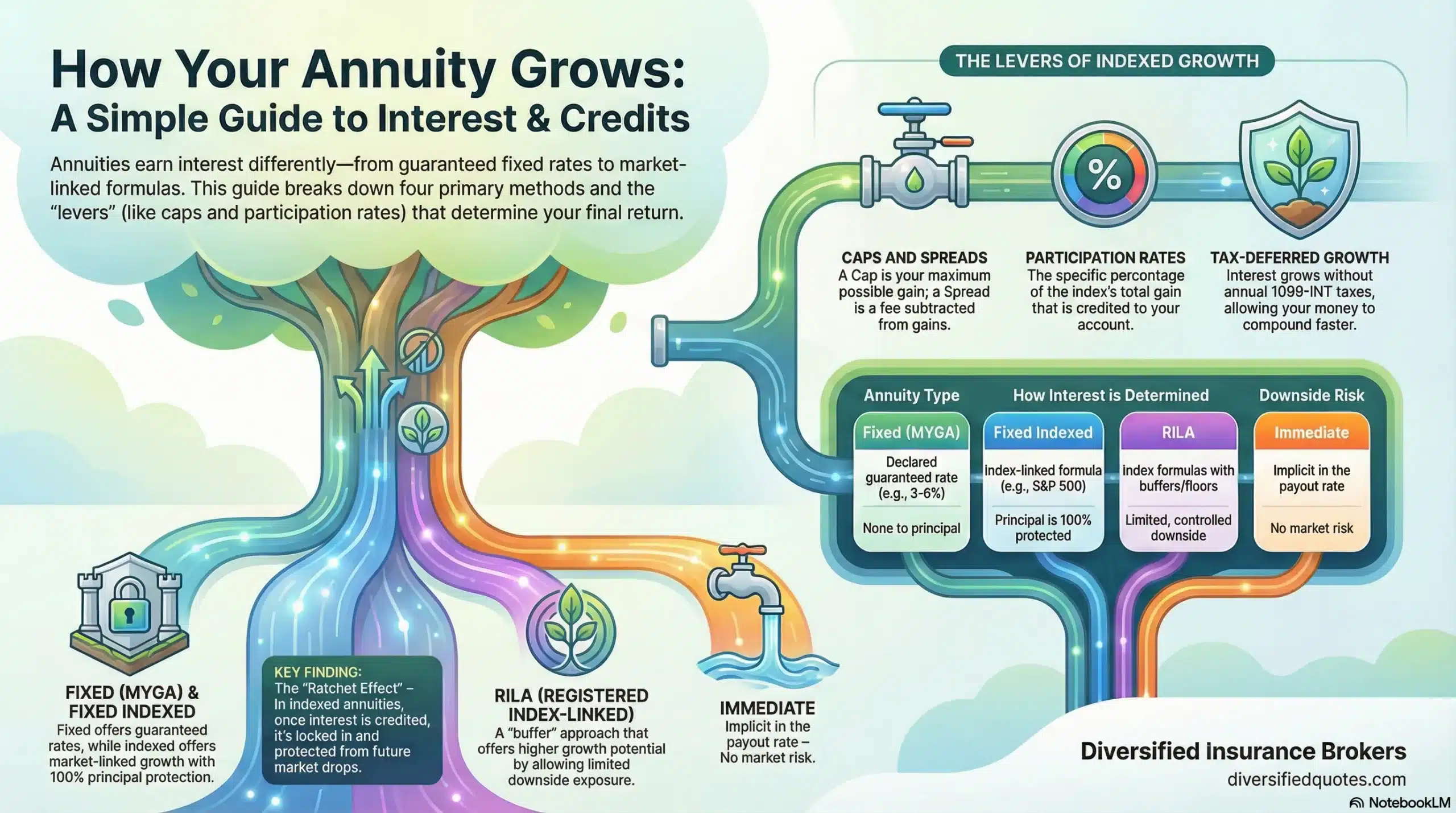
At the 6-year commitment level, the MYGA versus fixed indexed annuity comparison becomes more substantive than at shorter terms. Both a 6-year MYGA and a 6-year FIA involve the same surrender period, but they deliver return potential very differently. The MYGA credits its declared rate in every year of the term regardless of index performance. An FIA credits interest based on an external index’s performance subject to annual caps, spreads, or participation rates — potentially crediting more than the MYGA in strong index years and zero in flat or negative ones. The practical test is straightforward: take the guaranteed 6-year MYGA rate from the table as your benchmark and ask whether the indexed alternative is likely to average more than that across six years net of its caps and participation limits. That question deserves an answer built on the specific product’s actual crediting history rather than its illustration. The key considerations are addressed in our dedicated resources: what happens to an indexed annuity when markets decline clarifies how the zero-loss floor works in practice, whether you lose principal in an indexed annuity addresses the most common misconception about FIA principal protection, and whether fixed indexed annuity rates change covers how caps and participation rates move over a contract’s life. For buyers exploring premium enhancement structures at similar commitment horizons, our resource on bonus annuities over 20% covers those designs. The full landscape of indexed and bonus alternatives is available on our current annuity rates comparison page.
72-Month Tax Deferral — Six Full Years of Compounding Advantage
Six years of tax-deferred compounding in a fixed annuity produces a chain that substantially separates the MYGA’s effective after-tax yield from any taxable instrument at the same stated rate. For non-qualified money, every dollar of interest credited inside the 6-year MYGA accumulates without an annual 1099, stays fully invested in the contract, and earns the declared rate on its full pre-tax value the following year. A CD holder, by contrast, pays income tax on each year’s interest and compounds every subsequent year on a base already reduced by those payments. The gap widens with each passing year rather than staying constant.
To size it on your own numbers, multiply your deposit by the declared rate to get one year of credited interest, multiply that by your marginal tax rate to find what a CD holder would owe annually, and total it across the six years. That sum is what stays inside the contract compounding rather than leaving as tax payments — and it accrues before you even account for the rate difference between the two instruments, which normally favors the MYGA as well. Both effects run in the same direction, which is why the comparison should always be made after tax rather than on headline rates. Our resources on fixed annuities vs. CDs, tax-deferred annuity strategies, and non-qualified annuities provide the complete after-tax mechanics across different bracket scenarios.
Who Specifically Should Choose a 6-Year MYGA
The 6-year MYGA buyer has a specific 72-month planning horizon that genuinely cannot be served as well by a five-year or seven-year contract in their particular scenario. Common profiles include pre-retirees in their late fifties or early sixties who want guaranteed accumulation through their Medicare eligibility date; buyers implementing a 2-4-6 or 3-6 fixed annuity ladder where the 6-year creates the longest maturity window; larger-premium buyers who require a nationally recognized A-rated carrier specifically at this term and can meet the higher minimum deposit those products carry; and retirees who need one of the tier’s few products offering a built-in withdrawal allowance as part of a conservative allocation requiring systematic annual access. For buyers who have an existing annuity contract that may no longer be optimal, our no-cost insurance policy review service provides a professional assessment of whether repositioning via 1035 exchange into a current-rate 6-year MYGA makes financial sense. For buyers who eventually plan to convert the accumulated value into guaranteed lifetime income, our resource on best fixed indexed annuities with lifetime income riders covers the income structures most commonly evaluated at 6-year maturity. And for the Medicare planning coordination that makes a 72-month commitment particularly meaningful for buyers approaching 65, our resource on best Medicare rates covers the supplement coverage landscape many retirees coordinate with their annuity planning at this life stage.
Understanding MVA and Surrender Mechanics at 6 Years
Most carriers at the 6-year term carry MVA provisions, meaning any withdrawal above the penalty-free allowance during the 72-month term triggers both surrender charges and an interest-rate-based adjustment to the amount received. Understanding what a market value adjustment is before committing to any 6-year MYGA is essential, and confirming whether a specific product includes one is a required pre-purchase step rather than a safe assumption either way. The MVA adjusts the surrender value based on interest rate movements since contract issuance: if rates have risen since your contract was issued, the MVA reduces the surrender value on an early exit; if rates have declined, it increases the value.
The interaction with the withdrawal column is what matters practically. For the products in this tier carrying no penalty-free allowance, any mid-term withdrawal whatsoever triggers both surrender charges and the MVA, which makes early exit particularly costly and effectively converts the contract into a genuine hold-to-maturity commitment. For products carrying an allowance, withdrawals taken within that limit avoid both charges entirely — but only within the limit, and only in the contract years the allowance actually covers. A buyer whose provision begins in year two has no protected access in year one, and a first-year withdrawal there sits fully exposed to charges and adjustment alike. Buyers who hold to maturity and take funds during the penalty-free maturity window are unaffected by the MVA regardless of which direction rates moved. Our resource on the interaction between surrender charges and MVA provisions covers the complete mechanics for medium-term MYGA contracts.
Related Pages — Continue Exploring Annuity Strategies and Rate Comparisons
Request a Personalized 6-Year Annuity Quote
Receive customized comparisons across every carrier in the tier — including the larger-premium A-rated options and the products carrying built-in withdrawal provisions — with full MVA and surrender details for each.
Talk With an Advisor Today
Choose how you’d like to connect—call or message us, then book a time that works for you.
Schedule here:
calendly.com/jason-dibcompanies/diversified-quotes
Licensed in all 50 states • Fiduciary, family-owned since 1980
FAQs: Best 6-Year Annuity Rate
What is the best 6-year annuity rate right now?
The rate table above shows the current leader together with each product’s carrier, AM Best rating, declared rate, and penalty-free withdrawal provision. Two patterns are worth noting before you sort on rate. The tier leader typically carries no penalty-free access at all, so the top row and the right row for your situation are frequently different. And the products further down the table are often the A-rated ones, which means buyers who want investment-grade financial strength give up a fraction of a point rather than a large concession at this term. It is also worth checking the six-year rate against both the five-year and the seven-year, because the six-year frequently sits below both — a rate valley rather than a step up the curve. Select six years only when your planning horizon is genuinely 72 months. Working with an independent annuity broker gets you the full carrier field in one comparison rather than a single company’s offer.
Why can the 6-year rate be lower than both the 5-year and 7-year?
Because the MYGA curve frequently dips at six years, creating a valley between a five-year peak and a partial seven-year recovery. The cause is how carriers invest. Five-year investment-grade bond maturities often offer the optimal yield-to-risk combination for insurance general account portfolios, which produces peak declared rates at the five-year term. At six-year durations that portfolio efficiency breaks down, showing up as a lower credited rate. At seven years, carriers can access different longer-duration instruments at better yields, recovering part of the difference. The practical takeaway is that where the valley exists, there is no rate advantage to choosing six years over five — the buyer accepts an additional year of surrender commitment for less annual interest, which is one of the few places in fixed annuities where both axes move against you at once. Multiply the rate gap by your premium to see what that extra year costs rather than earns. Verify the current relationship across the three terms before deciding, since the shape of the curve moves as carriers reprice, and read our guide on whether annuities are worth it for the broader evaluation framework.
Which 6-year carrier offers penalty-free access during the term?
Read the withdrawal column in the table above, because access is scarce at this term and the provisions are not equivalent where they exist. Most carriers in this tier list no allowance at all, meaning any withdrawal across the full 72 months triggers surrender charges and potentially a market value adjustment. Where an allowance does appear, the common structure is a double-digit annual percentage beginning in year two, which gives access in years two through six but nothing in the first twelve months. Some products add interest-only access in year one — better than zero, but capped at what the contract has actually credited rather than a share of the full accumulation value. Translate whichever provision applies into dollars against your own deposit, and note that a percentage of a growing accumulation value rises each year as interest compounds. Buyers who need any liquidity during the term should shortlist only the products whose allowance covers the contract years in which they expect to withdraw, then use rate as the tiebreaker. For buyers whose need for access is really a need for reliable income, our resource on using an annuity for monthly retirement income covers the structures purpose-built for that job.
What is the minimum premium for American National’s 6-year product?
American National’s Palladium MYG MAX carries a minimum premium of $250,000 and a maximum of $3,000,000, which makes it specifically designed for larger-premium buyers — IRA rollovers, CD maturities, or other significant repositioning amounts — who want a nationally recognized A-rated carrier at the six-year term. The minimum is a hard gate rather than a guideline: buyers depositing less than that cannot access the product regardless of interest. Buyers below the threshold who still want investment-grade financial strength at this term have other A-rated options in the table at far lower minimums, and those alternatives sometimes carry built-in withdrawal provisions that the larger-premium product does not. Confirm the premium band and the surrender schedule for any specific product before building a plan around it, since both vary by carrier and can change between rate updates. For buyers weighing how a large conservative allocation fits alongside the rest of a portfolio, our resource on annuities for conservative investors provides that framework.
Are 6-year fixed annuities safe?
Yes. Fixed annuities protect principal from market loss, lock the declared rate for the full 72-month term, and are backed by state insurance regulatory oversight including statutory reserve requirements. The 6-year table typically includes multiple A-rated carriers alongside carriers in the B-range, and every one of them is a licensed insurer meeting the same regulatory standards regardless of rating. State guaranty associations provide protection within applicable limits, and because those limits are set state by state rather than nationally, verify the figure that applies where you live. That figure is what makes premium size part of the safety analysis: a deposit sitting entirely inside your state’s limit is protected regardless of where the carrier falls on the rating scale, while a deposit substantially above it leaves the excess resting on the carrier’s own balance sheet — which is where the A-rated options in the table earn their keep. Our resource on common annuity myths addresses several of the misconceptions that distort this question in both directions.
Should I choose a 6-year MYGA or a fixed indexed annuity at 6 years?
Both carry the same surrender period — the difference is how interest is credited. The MYGA credits its declared rate in every year regardless of index performance, which means you know exactly what the contract will be worth at maturity on the day you sign. The FIA credits interest based on index performance subject to annual caps, spreads, or participation rates, potentially more than the MYGA in strong years and zero in flat or negative ones. The practical test is to take the guaranteed rate from the table as your benchmark and ask whether the indexed alternative is likely to average more than that across six years net of its limiting factors — a question worth answering with the specific product’s actual crediting history rather than its illustration, and one that depends heavily on how to choose annuity indexes. If your primary goal is knowing precisely what your accumulated value will be on a specific future date, the MYGA is the correct choice. If you can accept annual variability for the possibility of higher cumulative credits, the FIA may be appropriate. The FIA’s zero-loss floor prevents principal loss but does not guarantee any minimum annual interest crediting.
What happens at maturity after 6 years?
At month 72, a penalty-free maturity window opens — typically 30 days — during which the buyer can: (1) Withdraw the full accumulated value completely penalty-free; (2) Renew into a new 6-year MYGA at then-current declared rates; (3) Roll into a different term MYGA; or (4) Convert to a different annuity structure via 1035 exchange. For qualified money, rollovers continue tax-free carrier-to-carrier. For non-qualified money, a 1035 exchange preserves tax-deferred status. If you withdraw rather than roll, the credited interest becomes taxable at that point, and our resource on how annuities are taxed covers the treatment. If no action is taken during the maturity window, most contracts auto-renew at the carrier’s then-current 6-year declared rate, which may be materially different from the rate originally locked and may not be competitive — calendar the maturity date when the contract is issued and treat it as a decision point rather than a formality.
Can I use IRA or 401(k) money for a 6-year MYGA?
Yes. The carriers in the 6-year table accept qualified retirement funding — IRA, 401(k), 403(b), 457, TSP, SIMPLE IRA, SEP IRA — through direct rollover or trustee-to-trustee transfer without triggering a taxable event. The Retirement Transfer Guides provide step-by-step mechanics for each account type, and buyers moving federal retirement money should review our resource on best annuities for TSP rollover. For qualified account 6-year MYGAs, confirm RMD accommodation before funding — this matters most for the products carrying no penalty-free allowance, where an RMD waiver provision may be the only access pathway for required distributions during the term. Buyers who expect required distributions across the 72 months should give serious weight to the products carrying a built-in withdrawal allowance, and should check which contract years that allowance covers, since a provision beginning in year two leaves the first twelve months exposed. Our guide to qualified annuity taxation covers how those distributions are treated.
About the Author:
Jason Stolz, CLTC, CRPC, DIA, CAA and Chief Underwriter at Diversified Insurance Brokers (NPN 20471358), is a senior insurance and retirement professional with more than 25 years of real-world experience helping individuals, families, and business owners protect their income, assets, and long-term financial stability. As a long-time partner of the nationally licensed independent agency Diversified Insurance Brokers, Jason provides trusted guidance across multiple specialties—including fixed and indexed annuities, long-term care planning, personal and business disability insurance, life insurance solutions, Group Health, Travel Medical and Evacuation Insurance, and short-term health coverage. Diversified Insurance Brokers maintains active contracts with over 100 highly rated insurance carriers, ensuring clients have access to a broad and competitive marketplace.
His practical, education-first approach has earned recognition in publications such as VoyageATL, and contributions from his agency featured in Kiplinger and GoBankingRates— highlighting his commitment to financial clarity and client-focused planning. Drawing on deep product knowledge and years of hands-on field experience, Jason helps clients evaluate carriers, compare strategies, and build retirement and protection plans that are both secure and cost-efficient. Visitors who want to explore current annuity rates and compare options across multiple insurers can also use this annuity quote and comparison tool.
Explore More Annuity Options: Browse our complete guide to Current Annuity Rates — covering current fixed, bonus, MYGA & income annuity rates by term from top carriers from 100+ carriers.
Last Reviewed: October 1, 2026 |
Reviewed by: Jason Stolz, CLTC, CRPC, DIA, CAA
Chief Underwriter, Diversified Insurance Brokers, Inc. | NPN: 20471358 | Diversified Insurance Brokers, Inc. — Licensed in all 50 states
Fact Checked by: Tonia Pettitt, CMIP©
Medicare Specialist, Diversified Insurance Brokers, Inc. | NPN: 14374308 | Diversified Insurance Brokers, Inc. — Licensed in all 50 states
Did you find this content helpful? Leave us a Google review — it helps others find trustworthy guidance too.
Editorial Standards: Diversified Insurance Brokers maintains rigorous editorial standards to ensure accuracy, clarity, and independence in all content. Learn more about our editorial standards and commitment to transparency.
