
Is Talcott Financial Group a Good Insurance Company?
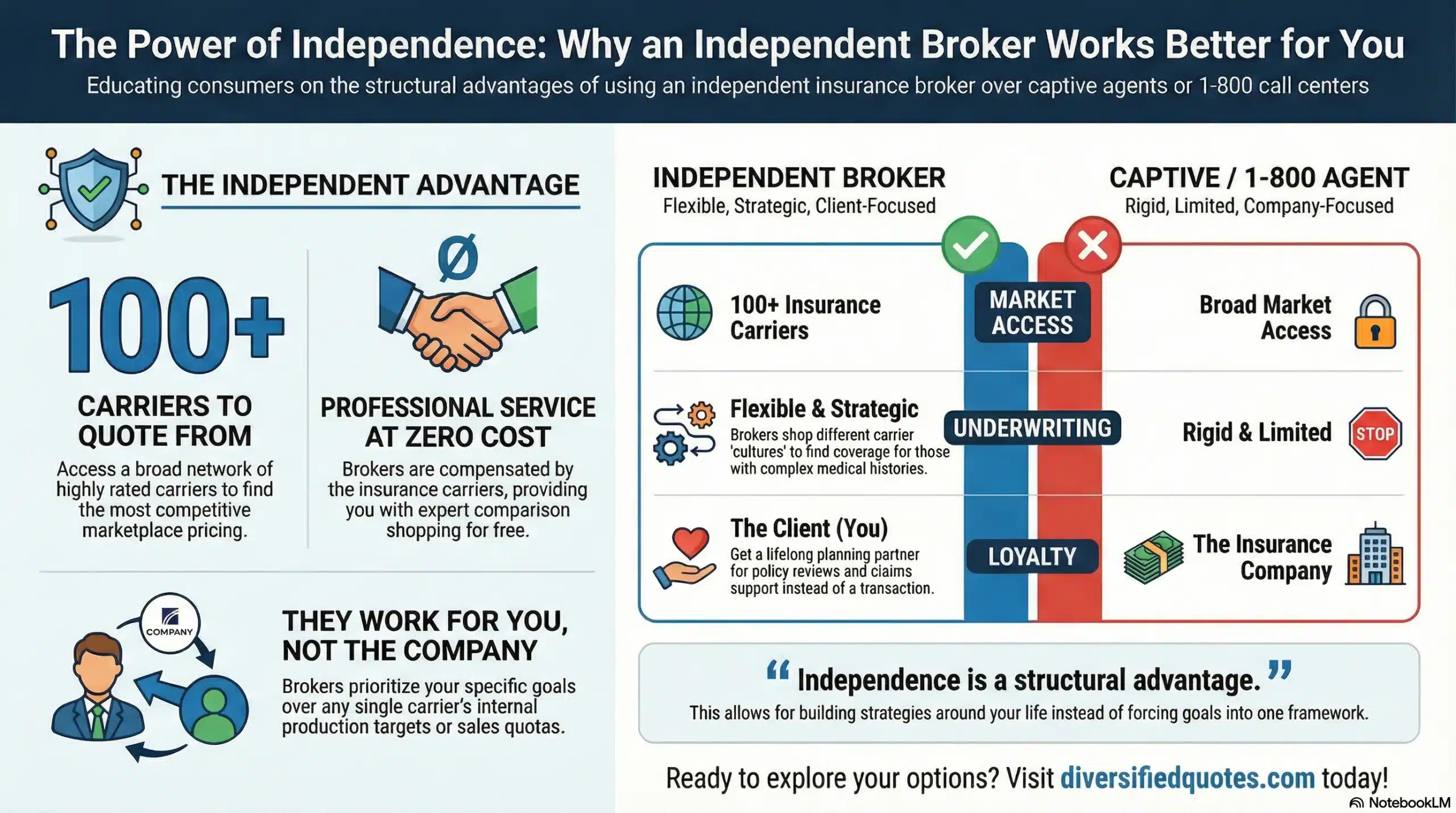
View the table near the end of the page to see why working with an independent insurance broker provides you the best possible rates.
Is Talcott Financial Group a Good Insurance Company?

Jason Stolz CLTC, CRPC, DIB, CAA
Talcott Financial Group is one of the most unusual stories in the US life insurance and annuity market — a company most individual consumers have never heard of that manages $127 billion in assets and more than one million individual contracts, built almost entirely by acquiring and reinsuring the liability blocks of other major carriers. If you have an annuity originally issued by The Hartford, you likely have a Talcott contract today. If you have a variable annuity that went through an Allianz Life or Guardian Insurance reinsurance transaction, Talcott may be the company standing behind it. For most of its post-Hartford history, Talcott operated in the background — a specialist in insurance liability management and risk transfer, not a consumer-facing brand. That changed in January 2026 when Talcott officially re-entered the retail annuity market with three new products: the EverStead MYGA, EverGuard Assurance 10, and EverGuard Aspire. The company holds AM Best A- (Excellent), Fitch A- (stable), and S&P BBB+ with a positive outlook revised in December 2025 — the positive outlook indicating S&P sees potential for an upgrade if operating performance continues. At Diversified Insurance Brokers, Jason Stolz, CLTC, CRPC, DIA, CAA, evaluates Talcott Financial Group across its new retail products alongside the full competitive market to give you an honest assessment of where these brand-new products fit against established alternatives.
Ensure you are receiving the absolute top rates
Current Fixed Annuity Rates
Compare today’s best fixed annuity rates from top carriers.
Current Bonus Annuity Rates
See which annuities offer the highest upfront bonus today.
Request an Annuity Quote
Submit our annuity request form to get personalized rate options.
Lifetime Income Calculator
Use our calculator to see how much guaranteed income your annuity can provide.
See Real-Term Rates Side by Side
Life Insurance Quoter
Company Snapshot
| Category | Details |
|---|---|
| Origin / HQ | Rooted in The Hartford’s life and annuity division; spun off as independent in 2018; acquired by Sixth Street (global investment firm) in 2021; HQ Hartford, CT; additional offices New York, Bermuda, Cayman Islands |
| Financial Strength Ratings | AM Best A- (Excellent), stable; Fitch A- (stable); S&P BBB+ (positive outlook — potential upgrade signal); Moody’s Baa1 (positive); all affirmed through 2024–2025 |
| Scale | $127 billion in AUM (September 2025); approximately 1 million+ individual contracts; major reinsurance blocks from Allianz Life and Guardian Insurance |
| Primary Business Model | Insurance liability consolidator and risk transfer specialist — acquires and manages large blocks of life and annuity contracts from other carriers; now also re-entering retail annuity market |
| New Retail Products (Jan 2026) | EverStead MYGA (fixed rate, defined term); EverGuard Assurance 10 (FIA, accumulation-focused, 10-year); EverGuard Aspire (FIA, income-focused, guaranteed deferral credits) |
| Recent Development | February 2026: 101 WARN Act layoffs at Hartford office — permanent closure of certain operations and IT functions; company cited strategic restructuring |
The Hartford Legacy: What It Means If You Have an Old Hartford Annuity
For decades, The Hartford Financial Services Group was one of the most recognizable names in life insurance and annuities. Thousands of American households built retirement savings through Hartford-branded variable annuity contracts. When The Hartford exited the life and annuity business in 2012 and eventually spun off that portfolio, it became what is now Talcott Financial Group. If you hold a Hartford-issued annuity and have been receiving statements from Talcott Resolution, your contract is being serviced by Talcott — the contractual terms, guarantees, and death benefits are unchanged, and the AM Best A- financial strength rating applies to those obligations. Talcott has specifically maintained continuity of service for legacy Hartford policyholders as the central mission of its post-independence years. For clients with Hartford variable annuities now managed by Talcott who are evaluating whether to keep their contracts or execute a 1035 exchange into a different product, our resource on annuity surrender charges and MVA covers the surrender cost analysis that must precede any exchange decision. Our resource on how an annuity works after death covers the beneficiary and death benefit provisions that are frequently the most important feature of Hartford-era variable annuity contracts to preserve — particularly the enhanced death benefit riders that were common in that product generation.
Sixth Street Ownership and the Reinsurance Business Model
Talcott’s acquisition by Sixth Street in 2021 gave the company access to a global investment management platform and the capital base to pursue large-scale reinsurance transactions. Sixth Street is not a traditional insurance parent — it is a global investment firm managing hundreds of billions across credit, growth equity, and real assets, with a strategic focus on insurance liability acquisition as a capital deployment vehicle. The Allianz Life transaction (reinsuring over $20 billion in fixed indexed annuity liabilities in 2021) and the Guardian Insurance transaction ($7.4 billion in variable annuity liabilities in late 2022) are the clearest examples of Talcott’s institutional-scale business model — acquiring large, long-duration liability blocks and managing them against Sixth Street’s investment platform. This model is common among PE-backed and investment-firm-backed insurance entities, and AM Best explicitly reflects the Sixth Street backing in Talcott’s balance sheet assessment. The balance sheet is categorized as “very strong” by AM Best — a positive signal that goes beyond the A- FSR headline. For clients comparing how investment-firm-backed insurance companies manage long-duration liabilities, our resources on Is GiLiCo a Good Insurance Company and alternative investments the wealthy use cover adjacent institutional investment contexts. Our resource on what a deferred income annuity is covers a product category that institutional liability managers — including Talcott — often manage within their acquired blocks.
The January 2026 Retail Re-Entry: EverStead, EverGuard Assurance, EverGuard Aspire
The three new products launched in January 2026 represent Talcott’s return to the consumer annuity market after years of operating exclusively in the institutional and reinsurance channel. The EverStead MYGA provides a fixed rate of compound interest for a selected term — a straightforward guaranteed accumulation product matching the standard MYGA structure. Our full product review of the Talcott EverStead MYGA covers the rate terms, available durations, and how it positions in the competitive MYGA market. The EverGuard Assurance 10 is a ten-year FIA focused on accumulation — principal protection with indexed upside participation, consistent with the accumulation FIA design used by many carriers. Our full product review of the Talcott EverGuard Assurance 10 covers the crediting structure, index options, and how the ten-year surrender period positions the product. The EverGuard Aspire is the income-focused FIA — featuring guaranteed deferral credits that grow the income base independently of market performance, giving clients a predictable income base accumulation path regardless of index performance during the deferral period. Our full product review of the Talcott EverGuard Aspire covers the income rider mechanics, deferral credit structure, and how the guaranteed income base compares against competing income FIA designs from established carriers. Talcott has built a technology-enabled, streamlined sales and underwriting process alongside the products — a deliberate design choice intended to reduce friction for both agents and policyholders. For clients transferring existing retirement accounts into one of these products, our resources on how to transfer a SEP IRA to an annuity, how to transfer a SIMPLE IRA to an annuity, how to transfer a Keogh to an annuity, and how to transfer a TSP to an annuity cover the mechanics for the qualified plan types most commonly evaluated alongside new annuity purchases.
Honest Assessment: New Products, Limited Track Record
The three EverStead and EverGuard products launched in January 2026 are genuinely new — they have not yet accumulated the multi-year rate history, agent experience, and claim servicing track record that established carriers bring. Being a new retail product from an institutionally experienced company is not the same as being an established retail carrier. Talcott’s depth in managing $127 billion of legacy annuity liabilities provides actuarial and operational experience that most genuinely new entrants lack — this is not a startup launching its first product. But the specific consumer-facing retail product experience — how rates hold over multiple terms, how the technology-enabled claims process performs in practice, how the income rider mechanics are administered over years of deferral — is unknown because it cannot yet be known. The S&P positive outlook is a forward-looking signal that the rating agency expects improvement, not a current upgrade. The February 2026 WARN Act layoffs — 101 employees across operations and IT functions in Hartford — represent a meaningful restructuring event that occurred one month after the retail product launch. Talcott described it as a permanent closure of certain functions, which is consistent with the technology-enabled, streamlined process model the retail products were built on. It does not indicate financial distress, and the AM Best and Fitch A- ratings were not placed under negative review as a result. But it is the kind of operational transition event worth knowing about when evaluating a brand-new product line. For clients whose primary concern is income reliability over a multi-decade retirement horizon, the combination of Talcott’s institutional depth, A- ratings, and Sixth Street backing makes the EverGuard Aspire worth including in an income FIA comparison — but it belongs alongside established income FIA products rather than as the sole option. For clients evaluating disability income protection alongside retirement planning, our resources on disability insurance for radiologists and disability insurance for speech pathologists cover occupational DI planning adjacent to annuity decisions. For seniors managing Medicare planning alongside new annuity purchases, our resources on best Medicare rates, Medicare Advantage versus Medicare Supplement, the Medicare calculator, and Medicare enrollment mistakes to avoid cover the healthcare coverage decisions running alongside this planning stage. For retirement income projections, our resources on how long a pension lasts in retirement, how long a Keogh lasts, how retirement accounts are taxed, and how a Roth IRA works cover the planning context most relevant to a buyer evaluating Talcott products. For employer group health planning that often runs alongside individual annuity decisions in the same client household, our resources on group health for 150 employees, group health for 500 employees, and group health for 30 employees cover the employer benefit planning context. For Social Security planning alongside annuity income design, our resources on Social Security spousal benefits after divorce, the government pension offset explained, and Social Security for the self-employed cover the claiming decisions most relevant to this planning intersection. For long-term care alongside income annuity planning, our resource on long-term care insurance for seniors covers the protection planning that runs parallel to guaranteed income decisions. For burial and final expense alongside retirement savings, our resources on the best-rated burial insurance companies and burial insurance for seniors over 50 cover this adjacent planning need.
Talk With an Advisor Today
Choose how you’d like to connect—call or message us, then book a time that works for you.
Schedule here:
calendly.com/jason-dibcompanies/diversified-quotes
Licensed in all 50 states • Fiduciary, family-owned since 1980
Frequently Asked Questions: Is Talcott Financial Group a Good Insurance Company?
What is Talcott Financial Group and how did it originate?
Talcott Financial Group is the evolved form of The Hartford’s life and annuity division. For decades, The Hartford was one of the best-known life insurance and annuity brands in the US. When The Hartford exited the life and annuity business in 2012, that portfolio was eventually spun off as an independent entity — operating under the Talcott Resolution name from 2018 onward. In 2021, Talcott was acquired by Sixth Street, a major global investment firm that provides the capital base for Talcott’s growth as a liability consolidation and risk transfer platform. Today, Talcott Financial Group manages approximately $127 billion in assets and over one million individual contracts — including the legacy Hartford annuity block, the Allianz Life FIA reinsurance ($20+ billion), and the Guardian Insurance variable annuity block ($7.4 billion). If you hold a Hartford-issued annuity and have been receiving statements from Talcott, your contract is now serviced by Talcott — contractual terms, guarantees, and death benefits are unchanged. In January 2026, Talcott re-entered the retail annuity market with three new consumer-facing products under the EverStead and EverGuard brand names.
What are Talcott’s financial strength ratings?
Talcott Resolution Life Insurance Company and Talcott Resolution Life and Annuity Insurance Company hold AM Best A- (Excellent) and Fitch A- (stable), both affirmed through 2024–2025. S&P holds BBB+ — one notch below A- — with a positive outlook revised in December 2025, which signals S&P sees potential for an upgrade if operating performance continues. Moody’s rates the issuer at Baa1 with a positive outlook. AM Best categorizes Talcott’s balance sheet strength as “very strong” — a positive distinction from the A- FSR itself, indicating that the capitalization level exceeds what the FSR headline alone conveys. The three-entity structure (Talcott Resolution Life, Talcott Resolution Life and Annuity, and Bermuda-based Talcott Life Re) all carry the same A- from AM Best and Fitch. For existing Hartford policyholders or new product purchasers, the A- ratings with stable outlooks from two agencies and positive outlooks from two others represent a solid — and potentially improving — financial strength profile. Our resource on what an AM Best rating means covers how to interpret the full rating picture including the outlook designation.
What are the three new retail annuity products Talcott launched in 2026?
In January 2026, Talcott Financial Group launched three fixed annuity products under the EverStead and EverGuard brand names. The EverStead MYGA is a multi-year guaranteed annuity providing a fixed rate of compound interest for a defined term — a straightforward accumulation product with principal protection and no market exposure. The EverGuard Assurance 10 is a ten-year FIA focused on accumulation — it protects the premium from market losses while offering growth potential linked to a market index, with a zero floor ensuring principal cannot decline from index performance. The EverGuard Aspire is an income-focused FIA featuring guaranteed deferral credits that grow the income base independently of market performance — the income base grows on a predetermined schedule regardless of what the market index does, which provides more certainty for lifetime income planning than purely market-linked income base designs. All three products are supported by a technology-enabled, streamlined sales and underwriting process that Talcott built specifically for the retail channel. These products launched in January 2026 and have limited real-world track record by their nature as new offerings — they warrant comparison against established alternatives before placement. Our full product reviews of each are linked above.
I have an old Hartford annuity — what does Talcott’s involvement mean for me?
If you hold an annuity originally issued by The Hartford Life Insurance Company or Hartford Life and Annuity Insurance Company, your contract is now serviced by Talcott Financial Group. The transition occurred as part of the legal separation and rebrand. Your contractual terms — guaranteed rates, death benefit riders, income rider provisions, surrender schedule, and all other policy terms — were carried forward unchanged. Talcott is obligated to honor those terms and the AM Best A- financial strength rating applies to those obligations. Your statements, service contacts, and payment information now come from Talcott rather than Hartford. For legacy policyholders evaluating whether to maintain their current contract or execute a 1035 exchange into a new product, the analysis should center on what riders, guarantees, and features your current contract contains — particularly if you have an enhanced death benefit or guaranteed minimum withdrawal benefit from the Hartford era, as those provisions may have significant value that would be forfeited in an exchange. Our resources on annuity surrender charges and MVA and how an annuity works after death cover the two dimensions most commonly evaluated when legacy policyholders consider exchanges.
What were the February 2026 layoffs and should they concern policyholders?
In February 2026, Talcott Resolution Life filed a WARN Act notice announcing the layoff of 101 employees at its Hartford office, citing the permanent closure of certain operations and information technology functions. The layoffs were scheduled for late April 2026. Talcott described the restructuring as consistent with its strategic direction — specifically the technology-enabled, streamlined operations model that underpins its new retail product line. Eliminating certain legacy operations and IT functions is consistent with a carrier migrating away from older administrative infrastructure toward a technology-driven service model. The AM Best A- and Fitch A- ratings were not placed on negative review following this announcement. The timing — one month after the retail product launch — is notable but aligns with the broader operational transformation Talcott has described publicly. For existing policyholders and new product purchasers, the key questions are: does Talcott have the operational capacity to service your contract reliably, and are the financial strength ratings intact? The former is a service quality question that will develop more clarity over the coming years as the new platform matures; the latter is confirmed by the rating agencies’ continued stable outlooks. This is a development to monitor rather than a reason for immediate concern, and the honest answer is that early operational transitions at newly repositioned carriers warrant ongoing attention.
About the Author:
Jason Stolz, CLTC, CRPC, DIA, CAA and Chief Underwriter at Diversified Insurance Brokers (NPN 20471358), is a senior insurance and retirement professional with more than 25 years of real-world experience helping individuals, families, and business owners protect their income, assets, and long-term financial stability. As a long-time partner of the nationally licensed independent agency Diversified Insurance Brokers, Jason provides trusted guidance across multiple specialties—including fixed and indexed annuities, long-term care planning, personal and business disability insurance, life insurance solutions, Group Health, Travel Medical and Evacuation Insurance, and short-term health coverage. Diversified Insurance Brokers maintains active contracts with over 100 highly rated insurance carriers, ensuring clients have access to a broad and competitive marketplace.
His practical, education-first approach has earned recognition in publications such as VoyageATL, and contributions from his agency featured in Kiplinger and GoBankingRates— highlighting his commitment to financial clarity and client-focused planning. Drawing on deep product knowledge and years of hands-on field experience, Jason helps clients evaluate carriers, compare strategies, and build retirement and protection plans that are both secure and cost-efficient. Visitors who want to explore current annuity rates and compare options across multiple insurers can also use this annuity quote and comparison tool.
Review More Carrier Reviews: Browse our complete Annuity Company Reviews — covering Allianz, Athene, Jackson National, North American, and more annuity carriers.
Last Reviewed: June 12, 2026 |
Reviewed by: Jason Stolz, CLTC, CRPC, DIA, CAA
Chief Underwriter, Diversified Insurance Brokers, Inc. | NPN: 20471358 | Diversified Insurance Brokers, Inc. — Licensed in all 50 states
Fact Checked by: Tonia Pettitt, CMIP©
Medicare Specialist, Diversified Insurance Brokers, Inc. | NPN: 14374308 | Diversified Insurance Brokers, Inc. — Licensed in all 50 states
Did you find this content helpful? Leave us a Google review — it helps others find trustworthy guidance too.
Editorial Standards: Diversified Insurance Brokers maintains rigorous editorial standards to ensure accuracy, clarity, and independence in all content. Learn more about our editorial standards and commitment to transparency.
