
How Does a Fixed Annuity Work
As an Independent Annuity Broker, we compare rates across 100+ carriers and 1,000 different annuities— not just one company’s product offerings — to find the best fit for your goals.
How Does a Fixed Annuity Work

Jason Stolz CLTC, CRPC, DIA, CAA
How Does a Fixed Annuity Work — Guaranteed Rates, Tax-Deferred Compounding, and the Role a Fixed Annuity Plays in a Complete Retirement Income Plan
A fixed annuity is an insurance contract in which you deposit a premium — a lump sum from savings, a maturing CD, or a rollover from a qualified retirement account — and the insurance company guarantees a defined interest rate for a specified term. The rate cannot decline during the guarantee period regardless of what happens to interest rates, stock markets, or bond prices. Your principal is protected from market-caused losses, and the interest compounds tax-deferred — you do not pay income tax on the credited interest each year until you withdraw funds. The combination of a contractual interest rate, principal protection, and tax-deferred compounding is what distinguishes a fixed annuity from every other conservative accumulation vehicle and what makes it a useful tool for the portion of a retirement portfolio assigned to stability, predictability, and guaranteed growth. At Diversified Insurance Brokers, Jason Stolz, CLTC, CRPC, DIA, CAA compares fixed annuity rates across more than 100 carriers — evaluating the guarantee rate, the term length, the free withdrawal provision, the renewal process, the carrier’s financial strength, and the contract’s flexibility for repositioning at maturity — before recommending any specific product to a retirement planning client. Sequence-of-returns risk — the specific retirement danger that a market decline in the early distribution years permanently impairs portfolio sustainability — is the retirement planning problem most directly addressed by allocating a portion of retirement assets to a fixed annuity: the guaranteed accumulation portion of the portfolio is entirely immune from the market-caused account value declines that drive sequence risk in the equity-invested portion. How tax deferral creates compounding advantage over multi-year accumulation periods — and why the absence of annual taxation on fixed annuity interest produces meaningfully better net accumulation than a CD or taxable bond with an equivalent pre-tax yield — establishes the mathematical reason tax deferral is not merely a convenience but a genuine return enhancement that improves the fixed annuity’s effective yield relative to its stated rate.
MYGA vs. Traditional Fixed Annuity — What the Term Structure Means for the Rate and the Flexibility
The multi-year guaranteed annuity is the most precisely structured form of fixed annuity: a defined rate is guaranteed for a defined term — typically two to ten years — with a defined surrender schedule that governs early access beyond the annual free withdrawal provision. The rate is contractually locked for the full term and does not fluctuate with market conditions after purchase. A five-year MYGA issued at 5.25% guarantees 5.25% every year for five years regardless of whether market rates rise, fall, or remain unchanged during the contract period. This rate certainty is the primary reason MYGAs are frequently compared to bank CDs — both lock in a rate for a term — but the MYGA typically offers a higher rate than a comparable-term CD because it operates on a tax-deferred basis and because the insurance carrier’s general account investment efficiency produces a higher credited return than the bank deposit model. A traditional single-year declared rate fixed annuity operates differently: the carrier declares an initial rate for the first year and then declares a renewal rate each subsequent year, giving the policyholder annual visibility into the rate but also annual renewal-rate uncertainty. For buyers who want the maximum rate certainty for a defined accumulation period, the MYGA’s multi-year lock is typically preferred. For buyers whose priority is annual flexibility — including the option to reassess annually whether the renewal rate is competitive or whether a 1035 exchange to a more attractive product is warranted — the traditional single-year structure preserves that evaluation point each year. Laddering annuities — the strategy of spreading premium across multiple fixed annuities with staggered maturity dates to create periodic liquidity, capture different rate environments, and maintain flexibility across the accumulation and distribution timeline — is the portfolio construction approach that maximizes the flexibility dimension of fixed annuity investing while maintaining the rate certainty and tax deferral benefits of each individual contract in the ladder.
Ensure you are receiving the absolute top rates
Current Fixed Annuity Rates
Compare today’s best fixed annuity rates from top carriers.
Current Bonus Annuity Rates
See which annuities offer the highest upfront bonus today.
Request an Annuity Quote
Submit our annuity request form to get personalized rate options.
Lifetime Income Calculator
Use our calculator to see how much guaranteed income your annuity can provide.
Fixed Annuity Compared to Other Conservative Vehicles — What Each Does and Doesn’t Provide
| Vehicle | Rate and Principal Protection | Tax Treatment | Income Conversion |
|---|---|---|---|
| Bank CD | Guaranteed rate for the term; FDIC-insured principal protection up to applicable limits; no market risk on principal or rate during the guarantee period | Annual interest is taxable as ordinary income in the year credited regardless of whether it is withdrawn; no tax deferral benefit — interest appears on 1099 annually | No lifetime income conversion option; at maturity, proceeds are received as cash or reinvested in a new CD; no annuitization or income rider available |
| Fixed annuity (MYGA) | Guaranteed rate for the full term; principal protected from market loss by carrier general account and state regulation; backed by state guarantee association up to applicable limits rather than FDIC | Interest accumulates tax-deferred — no annual 1099, no current income tax on credited interest until withdrawn; allows the full compounding balance to grow without annual tax drag; particularly advantageous for buyers in higher marginal brackets | At maturity, can be converted to a systematic income stream through annuitization, repositioned into an income-focused annuity via 1035 exchange, or renewed at the new declared rate; lifetime income options are available through conversion or exchange |
| Individual bond | Guaranteed coupon and par value at maturity if held to term; market value fluctuates during the holding period — selling before maturity can produce a gain or loss; default risk on corporate bonds; no guarantee of par value if issuer defaults | Coupon income is taxable annually; capital gains or losses recognized when sold; no deferral mechanism unless held inside an IRA; interest from Treasury securities may be state-tax-exempt but remains federally taxable | No lifetime income conversion option unless the bond proceeds are later repositioned into an income annuity; periodic coupon payments can serve as a form of income but stop at maturity with no longevity protection |
| Fixed indexed annuity (FIA) | Principal protected by 0% floor — no market-caused account value decline; interest credited is linked to an index subject to caps, participation rates, or spreads; growth potential higher than a fixed annuity in strong market years; growth may be lower or zero in flat or declining markets | Same tax-deferred treatment as a fixed annuity; no annual 1099 on credited interest; same qualified and non-qualified tax treatment at distribution; same 1035 exchange flexibility for repositioning | Most FIAs include optional GLWB income riders that convert accumulated value into a guaranteed lifetime withdrawal benefit; the income rider design is more sophisticated than fixed annuity annuitization and can produce higher income with more flexibility |
The comparison table establishes where the fixed annuity’s distinctive value lies: it delivers the CD’s rate certainty and principal protection while adding the tax deferral that CDs lack and the lifetime income conversion option that no bank product offers. The trade-off versus the FIA is that the fixed annuity’s return is fully defined at purchase — it cannot exceed the stated rate regardless of market performance — while the FIA’s index-linked crediting can produce higher returns in good market years. For buyers whose primary objective is maximum rate certainty rather than any market-linked upside, the fixed annuity’s total predictability is the defining advantage. How annuities are taxed — the complete qualified and non-qualified tax mechanics, the interaction with IRMAA thresholds and Social Security taxability, and how the distribution timing affects the annual tax calculation — is the tax framework that determines the net after-tax yield the fixed annuity produces relative to its stated rate and relative to taxable alternatives. IRMAA planning strategies — how fixed annuity income adds to Modified Adjusted Gross Income and potentially triggers Medicare premium surcharges — establish the Medicare cost dimension that affects the net value of fixed annuity distributions for high-income retirees whose IRMAA status is sensitive to the timing and amount of their annual taxable income.
End-of-Term Options — 1035 Exchange, Renewal, Income Conversion, and Repositioning to a GLWB
When a fixed annuity’s guarantee period ends, the policyholder enters a renewal window during which the carrier declares a new rate for the next term. This renewal window is the most flexible point in the contract’s life — surrender charges have expired, the full account value is accessible, and the policyholder has four primary choices: renew at the new declared rate, withdraw all or a portion of the account value, convert to lifetime income through annuitization, or execute a 1035 exchange into a new contract with more competitive terms. How 1035 exchanges work — the tax-free transfer mechanism that allows the full accumulated value of a maturing fixed annuity to be repositioned into a new contract without triggering income tax on the gain — is the end-of-term tool that allows buyers to follow the best available rates across carriers without the tax friction that a full surrender and reinvestment would produce. A buyer who accumulated a fixed annuity for five years and now wants either a higher current rate from a different carrier or a transition from accumulation to a guaranteed income design (through an FIA income rider) can make either move entirely tax-free through the 1035 exchange. The 1035 exchange is the mechanism that makes the fixed annuity ladder strategy particularly efficient: at each contract’s maturity, the accumulated value rolls forward into the next rate environment or into the income structure that is most appropriate for the buyer’s current retirement timeline, without any tax event disrupting the compounding. How the guaranteed lifetime withdrawal benefit works — the income rider available in FIA products that a maturing fixed annuity could be repositioned into — establishes the income design destination for fixed annuity buyers who transition from accumulation focus to income focus as retirement approaches. Fixed indexed annuities with income riders cover the complete product design for buyers making this transition — how the benefit base, roll-up rate, and payout percentage produce a defined guaranteed annual income from the amount transferred from the maturing fixed annuity. Guaranteed income at age 65 and guaranteed income at age 70 provide the age-specific income design analysis for buyers who have accumulated in a fixed annuity and are now evaluating how to convert the balance into income at these common activation ages. The best annuity for lifetime income — evaluated across immediate annuity, deferred income annuity, and FIA with GLWB designs — provides the complete product comparison for buyers whose fixed annuity maturity coincides with their readiness to activate guaranteed income. Guaranteed income from annuities — how a fixed annuity balance converted to income produces a defined monthly payment alongside Social Security and other retirement income sources — establishes the complete income architecture context for the end-of-term income conversion decision. How annuities serve as a pension alternative for buyers who lack a defined benefit pension and whose fixed annuity balance is the primary capital available to create a pension-like income stream establishes the benefit framing that makes the income conversion option most compelling for fixed annuity holders approaching retirement without employer-provided guaranteed income. Maximizing Social Security benefits — and how the fixed annuity’s accumulation period can serve as a financial bridge during the years between retirement and the optimal Social Security claiming age — establishes the income coordination that makes fixed annuity accumulation strategically valuable beyond its guaranteed rate: the fixed annuity funds the income bridge, Social Security claims at 70 for the higher permanent benefit. How annuity death benefits work for beneficiaries — including what remaining account value is available to surviving spouses and other beneficiaries if the annuity owner dies during the accumulation period or after income activation — establishes the legacy dimension of the fixed annuity that buyers should confirm before purchase and keep current through periodic beneficiary designation review. How annuity income is calculated — the complete formula from premium through benefit base and payout percentage — provides the quantitative framework for projecting how much income a fixed annuity balance produces when eventually converted, allowing buyers to make the accumulation versus income transition decision with actual income projections rather than general estimates.
Compare Fixed Annuity Rates and Build Your Retirement Income Plan
We compare guaranteed rates, terms, surrender schedules, carrier financial strength, and renewal policies across 100+ carriers — plus we model how the accumulated balance converts to income at your target retirement age.
Request My Personalized Comparison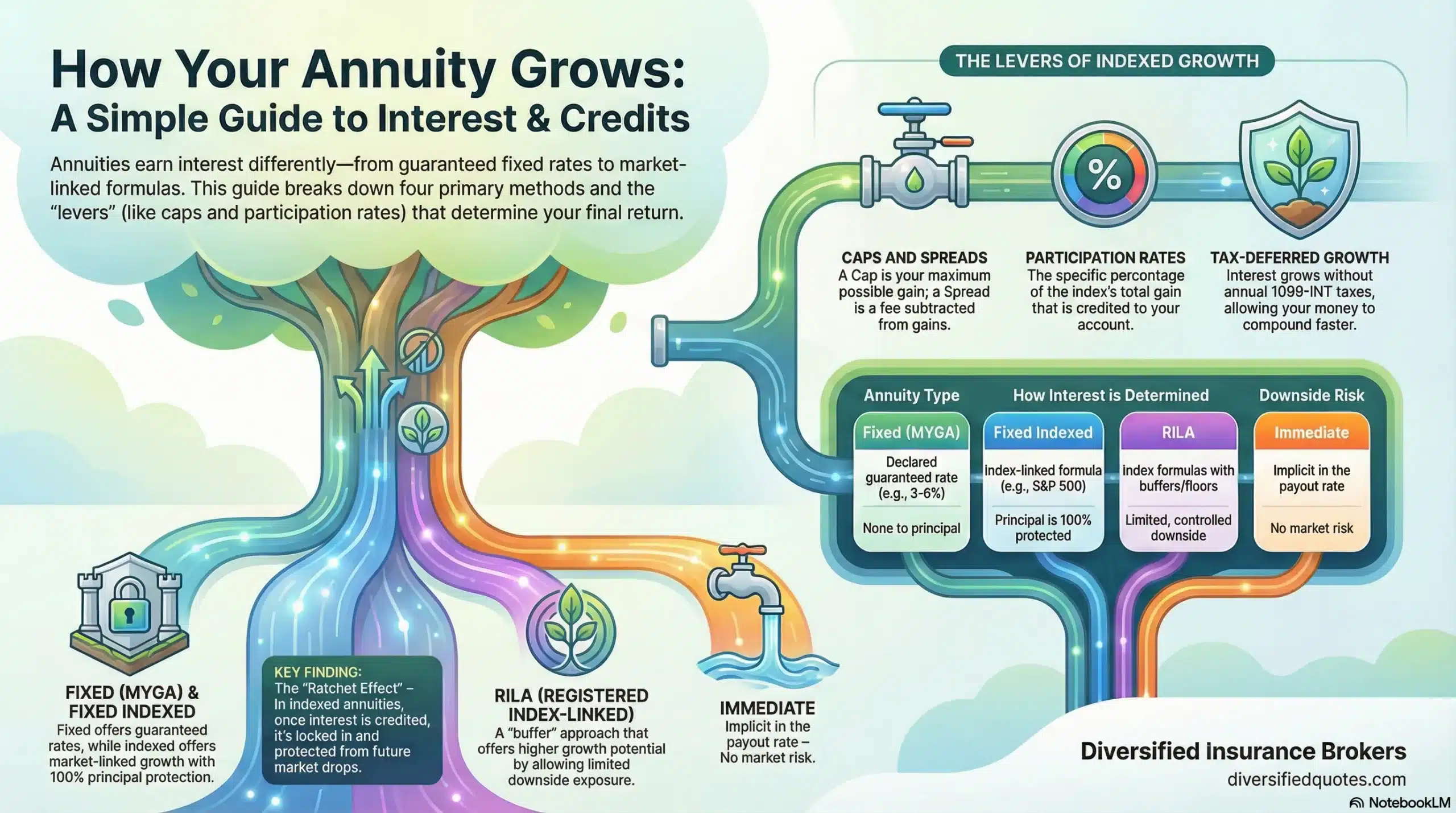
Talk With an Advisor Today
Choose how you’d like to connect—call or message us, then book a time that works for you.
Schedule here:
calendly.com/jason-dibcompanies/diversified-quotes
Licensed in all 50 states • Fiduciary, family-owned since 1980
About the Author:
Jason Stolz, CLTC, CRPC, DIA, CAA and Chief Underwriter at Diversified Insurance Brokers (NPN 20471358), is a senior insurance and retirement professional with more than 25 years of real-world experience helping individuals, families, and business owners protect their income, assets, and long-term financial stability. As a long-time partner of the nationally licensed independent agency Diversified Insurance Brokers, Jason provides trusted guidance across multiple specialties—including fixed and indexed annuities, long-term care planning, personal and business disability insurance, life insurance solutions, Group Health, Travel Medical and Evacuation Insurance, and short-term health coverage. Diversified Insurance Brokers maintains active contracts with over 100 highly rated insurance carriers, ensuring clients have access to a broad and competitive marketplace.
His practical, education-first approach has earned recognition in publications such as VoyageATL, and contributions from his agency featured in Kiplinger and GoBankingRates— highlighting his commitment to financial clarity and client-focused planning. Drawing on deep product knowledge and years of hands-on field experience, Jason helps clients evaluate carriers, compare strategies, and build retirement and protection plans that are both secure and cost-efficient. Visitors who want to explore current annuity rates and compare options across multiple insurers can also use this annuity quote and comparison tool.
Explore More Lifetime Income Options: Browse our complete guide to How Retirement Accounts & Annuities Work — covering how IRAs, 401ks, annuities, pensions, GLWBs & fixed indexed annuities work from 100+ carriers.
Explore More Annuity Options: Browse our complete guide to What Is a Fixed Annuity? — covering fixed annuities, MYGAs, laddering strategies & conservative growth options from 100+ carriers.
Last Reviewed: June 11, 2026 |
Reviewed by: Jason Stolz, CLTC, CRPC, DIA, CAA
Chief Underwriter, Diversified Insurance Brokers, Inc. | NPN: 20471358 | Diversified Insurance Brokers, Inc. — Licensed in all 50 states
Fact Checked by: Tonia Pettitt, CMIP©
Medicare Specialist, Diversified Insurance Brokers, Inc. | NPN: 14374308 | Diversified Insurance Brokers, Inc. — Licensed in all 50 states
Did you find this content helpful? Leave us a Google review — it helps others find trustworthy guidance too.
Editorial Standards: Diversified Insurance Brokers maintains rigorous editorial standards to ensure accuracy, clarity, and independence in all content. Learn more about our editorial standards and commitment to transparency.
