
How to Protect Your Funds in Retirement
How to Protect Your Funds in Retirement

Jason Stolz CLTC, CRPC, DIA, CAA
Knowing how to protect your funds in retirement is not the same as knowing how to grow them — and treating the two goals identically is one of the most common and most costly retirement planning mistakes. During the accumulation years, time is the investor’s ally: market downturns can be endured because contributions continue and portfolios have years or decades to recover before distributions begin. In retirement, that cushion disappears. Withdrawals start, contributions stop, and a significant market decline early in the distribution phase can permanently impair a portfolio’s ability to sustain income for 25 to 35 years. Protecting your funds in retirement means building a structure that produces reliable income, shields principal from catastrophic loss, manages tax exposure efficiently, and keeps the household financially stable regardless of what markets, interest rates, or inflation do in any given year.
The question of how to protect your funds in retirement is not answered by a single product or a single strategy — it is answered by a coordinated architecture that assigns each portion of a retirement asset base a specific job, matched to the right tool. Some money should produce guaranteed income that continues for life regardless of market performance. Some money should preserve purchasing power against inflation. Some money should remain accessible for unplanned expenses and opportunities. Some money can remain invested for growth and legacy. The art of protecting funds in retirement is not eliminating all risk — it is eliminating the risks that could derail essential income and household stability while managing growth-oriented risks in positions where they cannot cause catastrophic harm. At Diversified Insurance Brokers, we help retirees and pre-retirees build this kind of coordinated protection architecture using over 100 carriers and 1,000+ products. Our lifetime income planning services overview covers the complete income architecture process, and our resource on the income gap in retirement planning covers why protecting funds in retirement requires addressing both income adequacy and principal stability simultaneously.
Ensure you are receiving the absolute top rates
Current Fixed Annuity Rates
Compare today’s best fixed annuity rates from top carriers.
View Current RatesCurrent Bonus Annuity Rates
See which annuities offer the highest upfront bonus today.
View Bonus RatesRequest an Annuity Quote
Submit our annuity request form to get personalized rate options.
Quote Request FormLifetime Income Calculator
Estimate how much guaranteed income your savings could generate — the first step in building a retirement fund protection strategy.
Why Retirement Changes the Rules of Protecting Your Funds
The transition from accumulation to distribution is the most consequential financial shift most people ever make, and it fundamentally changes what “risk management” means. During the working years, risk management in an investment portfolio is primarily about volatility tolerance — the ability to endure temporary market declines without panicking or liquidating positions at a loss. The underlying logic is sound: if the portfolio has 20 or 30 years before distributions begin, even a severe bear market is a temporary setback rather than a permanent impairment, because new contributions continue adding to the portfolio during the recovery.
In retirement, this logic inverts. New contributions have stopped. Distributions are not optional — they are how the household pays its bills. A bear market that begins in the first years of retirement, combined with consistent withdrawals to fund living expenses, creates a compound harm: the portfolio loses value from market declines, additional principal is removed through withdrawals, and the remaining assets are smaller than they would have been without the withdrawals when the market eventually recovers. The portfolio never fully rebounds to where it would have been without the double damage of declining prices and outgoing distributions. This is the core reason why protecting funds in retirement is a different challenge than investing for retirement — and why strategies designed for the accumulation phase can be dangerously misapplied to the distribution phase.
The Five Core Threats to Funds in Retirement
Protecting funds in retirement requires understanding the specific threats that most commonly erode retirement savings. Each threat operates differently and responds to different protective tools, which is why a single protective strategy rarely addresses all of them adequately.
| Threat | How It Damages Retirement Funds | Most Dangerous For | Primary Protective Tool |
|---|---|---|---|
| Sequence of Returns Risk | Early losses + withdrawals permanently reduce portfolio longevity even when long-run returns are adequate | First 5–10 years of retirement — the “fragile decade” | Guaranteed income floor; principal-protected income bucket |
| Longevity Risk | Outliving the portfolio — running out of money before running out of life | Healthy individuals and couples with family longevity history | Guaranteed lifetime income annuity; GLWB rider |
| Inflation Risk | Purchasing power erosion; fixed income covers fewer real expenses each year | Long retirement horizons; heavy reliance on fixed income | Inflation-adjusted income; FIA growth; growth portfolio layer |
| Tax Erosion | RMDs, Social Security taxation, bracket creep, and tax drag reduce net spendable income | Large traditional IRA balances; multiple taxable income sources | Tax deferral; Roth conversions; non-qualified annuity exclusion ratio |
| Healthcare and Long-Term Care Costs | Large, unpredictable expenses that can rapidly deplete savings not specifically allocated for care | Retirees without long-term care coverage or healthcare reserves | LTC insurance; hybrid LTC/annuity; healthcare reserve allocation |
Each threat in the table operates on a different timeline and at a different intensity, which is why the most resilient retirement plans address multiple threats simultaneously rather than relying on a single tool that addresses only one. The comprehensive approach to protecting funds in retirement starts by identifying which threats are most relevant to a specific household’s age, health, asset base, and income structure, then matching the right protective tools to each threat in priority order.
Sequence of Returns Risk: The Retirement-Specific Danger That Most Plans Ignore
Sequence of returns risk is the most retirement-specific financial threat on the list and the one most commonly underestimated in pre-retirement planning. The concept is simple: the order in which investment returns occur matters enormously when withdrawals are being made, even if the long-run average return is the same. Two retirement portfolios with identical long-run average returns can produce dramatically different outcomes if one experiences strong early returns and one experiences weak early returns — specifically because the one with weak early returns depletes more principal through the combination of market losses and concurrent withdrawals, leaving less capital to benefit from the eventual recovery.
Protecting funds in retirement against sequence of returns risk requires creating a protected income floor that covers essential living expenses without requiring withdrawals from the growth-oriented portfolio during periods of market weakness. When Social Security income and guaranteed annuity income together cover essential household expenses — mortgage or rent, utilities, food, healthcare premiums — the growth portfolio does not need to produce income in a down year. The retiree can allow the portfolio to recover without forced liquidation. This protection is not about eliminating market exposure entirely — it is about ensuring that market exposure only exists in portions of the portfolio that can afford to wait for recovery. Our resource on sequence of returns risk covers the mathematical mechanics of how timing of losses interacts with withdrawals to produce retirement portfolio impairment.
Building an Income Floor to Protect Funds in Retirement
The income floor concept is the foundational architecture for protecting funds in retirement. An income floor is a level of guaranteed monthly or annual income — from Social Security, pensions, and contractually guaranteed annuity income — sufficient to cover the household’s essential, non-discretionary living expenses. When an income floor covers these baseline expenses, every additional dollar of portfolio income and withdrawal addresses discretionary spending and legacy goals rather than survival needs. This separation of essential income from growth-portfolio income is the most powerful protection architecture available to retirees.
The practical planning question is: what amount of guaranteed income is needed to cover essential expenses, and how much of that is already provided by Social Security and any pension income? The gap between total essential expenses and guaranteed income from Social Security plus pension represents the income floor deficit that an annuity solution should fill. For many retirees, this deficit is significant — Social Security replaces only a portion of pre-retirement income, and employer pensions are increasingly rare. Filling the income floor deficit with a guaranteed lifetime income annuity is the most direct path to genuine retirement fund protection, because it converts accumulated savings into a contractual income stream that continues regardless of market performance or longevity.
When the income floor is fully funded — when every essential monthly expense is covered by guaranteed income from multiple contract-backed sources — the household’s relationship with its investment portfolio changes completely. The portfolio no longer bears the burden of essential income production. It becomes a vehicle for discretionary spending enhancement, inflation fighting, legacy accumulation, and opportunistic growth. This separation reduces investment anxiety, improves decision quality during market volatility, and produces the psychological resilience that keeps retirees from panic-selling at market bottoms. Our resource on pension alternative strategies covers how annuity income can replicate the income floor that defined benefit pension plans provided for previous generations of retirees.
Fixed Annuities and MYGAs as a Principal Protection Layer
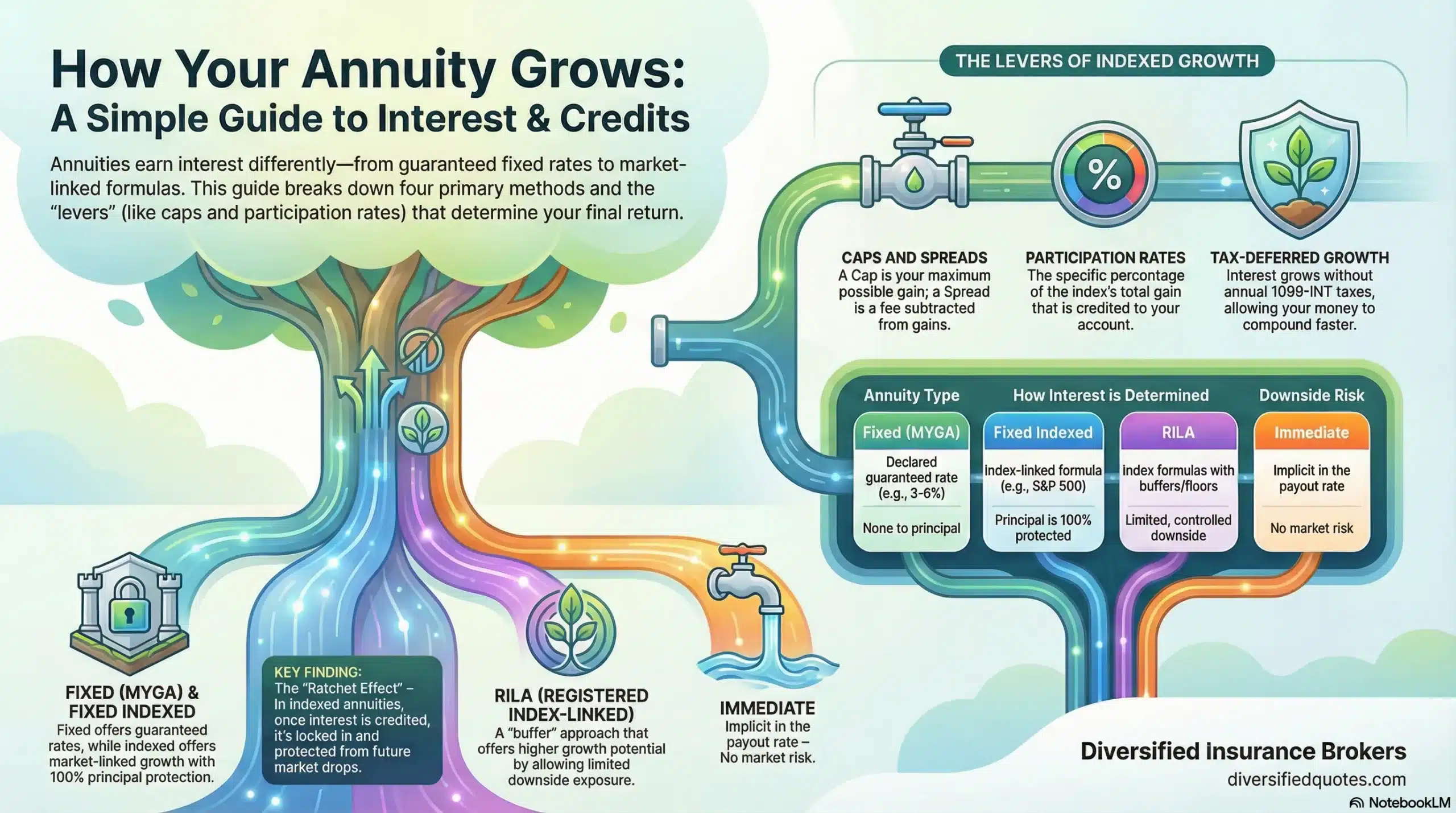
For the portion of retirement savings that needs to be completely protected from market loss while still earning a competitive return, multi-year guaranteed annuities (MYGAs) and traditional fixed annuities are the most direct tools. These products guarantee both the principal and a declared interest rate for a defined term — providing a level of certainty that no market-linked investment can offer. The account value cannot decline due to market performance. The credited rate is contractually fixed for the full term. The result is a predictable, secure accumulation vehicle that functions as a true protection layer for retirement funds.
The comparison to bank CDs is natural — both products provide principal protection and a declared rate for a defined term — but MYGAs and fixed annuities typically offer competitive advantages in two dimensions. First, the interest rate offered on MYGAs from highly rated carriers is frequently more competitive than comparable-term CD rates, particularly at longer terms. Second, the interest inside a non-qualified (after-tax) annuity accumulates on a tax-deferred basis — meaning no annual income tax on credited interest during the accumulation period, unlike a CD where interest is taxable each year regardless of whether it is withdrawn. The compounding benefit of tax deferral over a multi-year period is meaningful, particularly for retirees in moderate to higher income tax brackets. Our resource on fixed annuities versus CDs covers this comparison directly, and our resource on how tax deferral creates generational compounding quantifies the accumulation advantage of tax deferral over time.
For retirement fund protection planning, MYGAs serve a specific role: they are the safe, guaranteed accumulation layer for funds that cannot afford market risk but need to earn more than a savings account. They preserve capital during the period before those funds are needed, and they provide a defined maturity date when the funds become accessible for repositioning into income strategies, additional growth vehicles, or direct use. Our resource on understanding multi-year guaranteed annuities covers the MYGA product structure in detail, and current rates are available through our highest guaranteed annuity rates resource.
Fixed Indexed Annuities: Principal Protection With Upside Participation
Fixed indexed annuities (FIAs) provide a different expression of the principal protection principle — one that adds market-linked growth potential alongside the downside protection. Where a MYGA or traditional fixed annuity credits a declared guaranteed rate regardless of market conditions, a fixed indexed annuity credits interest based on the performance of an external market index (such as the S&P 500) while contractually protecting the account value from losses due to negative index performance. If the index gains, the annuity credits a portion of that gain. If the index loses, the annuity credits zero for that term — the account value does not decrease due to market performance.
This asymmetry — participation in index upside, elimination of index downside — is the defining characteristic of the FIA structure and the reason it plays a central role in retirement fund protection for many retirees. The trade-off is that the portion of index gains credited to the FIA is limited by crediting parameters (caps, participation rates, or spreads), so the FIA does not capture the full index return in strong years. The protection against losses is funded by this upside limitation. For retirees whose primary concern is not losing principal while still growing more than guaranteed-rate products allow, the FIA structure offers a middle path between the full market exposure of a brokerage account and the complete certainty of a fixed annuity. Our resource on how a fixed indexed annuity works covers the crediting mechanics in detail, and our resource on common annuity myths covers the misunderstandings that sometimes prevent retirees from evaluating FIAs accurately.
Guaranteed Lifetime Income: The Most Powerful Protection Against Longevity Risk
Guaranteeing that retirement funds produce income for life — regardless of how long the retiree lives — is the most powerful and most complete form of retirement fund protection available. Guaranteed lifetime income from an annuity converts a defined premium into a contractually obligated payment stream that the insurance carrier must continue paying for as long as the annuitant lives, even if the annuitant lives far beyond actuarial life expectancy and has effectively received far more in payments than the original premium could have supported from portfolio withdrawals alone.
The mechanism that makes guaranteed lifetime income possible is insurance risk pooling — the carrier’s obligation to any individual annuitant is manageable because it is offset across a large pool of policyholders with diverse longevity outcomes. For the individual retiree, this means that longevity risk — the risk of living so long that the portfolio runs dry — is completely transferred to the carrier in exchange for a premium. The retiree cannot outlive the income. The household’s essential expenses remain funded regardless of whether the retiree lives 15 years in retirement or 35 years.
Two primary structures deliver guaranteed lifetime income in retirement fund protection planning. The first is a single premium immediate annuity (SPIA) or a deferred income annuity (DIA), where a premium converts directly into a guaranteed payment stream beginning at a specific date. The second is a fixed indexed annuity or fixed annuity with a guaranteed lifetime withdrawal benefit (GLWB) income rider, which provides guaranteed lifetime income through a contractually defined annual withdrawal while allowing the account value to continue participating in growth. Our resource on what a GLWB is covers the income rider structure, and our resource on how much income an annuity pays covers the income calculation mechanics that determine how much guaranteed income a given premium produces.
Tax Deferral as a Retirement Fund Protection Mechanism
Tax erosion is one of the most underappreciated threats to retirement funds precisely because it operates invisibly — unlike a market crash that appears dramatically on a brokerage statement, taxes quietly reduce the net value of every dollar distributed from a traditional IRA, 401(k), or other pre-tax retirement account. Required minimum distributions beginning at age 73 force retirees to take taxable distributions from pre-tax accounts regardless of whether those distributions are needed for income, potentially pushing the retiree into a higher marginal tax bracket and increasing the taxable portion of Social Security benefits simultaneously.
Protecting retirement funds from excessive tax erosion involves several coordinated strategies. Tax deferral within non-qualified annuity contracts delays the recognition of earnings until distribution, allowing compound growth to continue without annual tax drag during the accumulation phase. The accumulation advantage of this deferral — the difference in ending balance between a taxable account and a tax-deferred annuity earning the same rate over the same period — grows substantially over time, particularly for retirees in moderate to higher tax brackets. Our resource on non-qualified annuities covers how after-tax funded annuities create deferral and income advantages, and our resource on non-qualified long-term care annuities covers a specific hybrid structure where annuity funds are directed toward long-term care expenses with favorable tax treatment.
Roth conversion strategies can also reduce the lifetime tax burden on retirement funds by converting pre-tax IRA balances to Roth status during lower-income years, reducing future RMD obligations and creating a pool of tax-free withdrawable funds for later-retirement income needs. The optimal conversion strategy depends on the retiree’s current income level, the expected tax rate trajectory, the size of pre-tax account balances, and the projected RMD amounts at age 73 and beyond. Our resource on Roth conversions covers the mechanics and planning considerations for this strategy.
The Bucket Strategy for Layered Retirement Fund Protection
One of the most widely used frameworks for organizing retirement fund protection is the bucket strategy — dividing the total retirement asset base into three distinct allocations, each with a different time horizon, risk profile, and purpose. The three buckets work together to ensure that near-term income needs are funded without market exposure, medium-term income needs are funded with low-risk protected growth, and long-term needs are served by growth-oriented assets that have time to recover from market volatility.
The first bucket is the income bucket — funds allocated to cover near-term essential living expenses over the next 3 to 5 years. This bucket is held in cash, short-term fixed instruments, or very short-term annuity contracts, and its primary attribute is guaranteed availability without market risk. The purpose is to ensure that market downturns do not force the household to liquidate growth assets at unfavorable prices — the income bucket funds the household while the other buckets recover.
The second bucket is the protection and moderate growth bucket — funds invested in principal-protected vehicles (fixed annuities, MYGAs, fixed indexed annuities) for a 5 to 15-year horizon. This bucket grows steadily with some market-linked upside potential while maintaining the principal protection that prevents catastrophic loss. As the income bucket is depleted over time, the protection bucket replenishes it — maturing annuity contracts or systematic withdrawals from principal-protected vehicles flow into the income bucket on a scheduled basis.
The third bucket is the growth bucket — the portion of retirement assets invested in growth-oriented vehicles (equity funds, indexed growth products) for a 15-year-plus horizon. This bucket aims to fight inflation, build legacy value, and provide long-term portfolio growth. Because the income and protection buckets fund near and medium-term income needs, the growth bucket can be managed with a long-term perspective without being liquidated to fund current expenses during market downturns. Our resource on protecting your nest egg covers the bucket strategy and its implementation in retirement asset management.
Laddering Annuities to Protect Funds in Retirement Over Multiple Horizons
Laddering annuities — dividing a total annuity allocation across multiple contracts with staggered maturity dates — provides a way to protect funds in retirement across different time horizons simultaneously while maintaining periodic access to capital for repositioning as interest rates, income needs, and circumstances change. Rather than locking the entire allocation into a single long-term contract at one point in time, a ladder creates a portfolio of annuity positions that mature at regular intervals, each providing a decision window to reinvest, redirect toward income, or access without surrender charges.
In the context of protecting funds in retirement, an annuity ladder accomplishes several goals simultaneously: it provides guaranteed principal protection across all rungs at all times; it produces guaranteed competitive interest earnings across the full allocation without market risk; it creates regular access windows that prevent the “all my money is locked up” anxiety that sometimes causes retirees to avoid appropriate annuity allocations; and it reduces interest rate timing risk by spreading entry into the market across multiple time periods rather than concentrating a single large commitment at one rate environment. Our resource on laddering annuities covers the strategy in comprehensive detail, including worked examples of how a ladder is constructed, maintained, and eventually transitioned toward income as each rung matures.
Protecting Retirement Funds From Inflation Over a 25-Year Horizon
Inflation protection is one of the most underweighted components of retirement fund protection for retirees who focus primarily on principal safety. A retirement that begins with a comfortable monthly income can feel significantly less comfortable 20 years later if that income has not grown with inflation — even modest inflation of 3% per year reduces purchasing power by approximately 45% over 20 years, meaning the household can purchase less than half as much with the same nominal dollar amount at the end of that period as at the beginning.
Several strategies can address inflation as part of a comprehensive approach to protecting funds in retirement. Fixed indexed annuities with inflation-linked income riders provide a contractual mechanism for income to increase with a cost-of-living index or a fixed annual percentage, reducing the real purchasing power erosion that affects level-payment income annuities. Maintaining a portion of the retirement portfolio in growth-oriented assets provides the potential for real (inflation-adjusted) returns that outpace price increases over long horizons. Coordinating Social Security benefits — which carry an annual COLA adjustment — with guaranteed annuity income creates a base income structure where at least one major component adjusts upward with inflation each year.
The practical approach to inflation protection in retirement fund planning is to model the household’s income needs at multiple future points — 5 years, 10 years, 15 years, and 20 years into retirement — and confirm that the income architecture provides adequate real purchasing power at each horizon, not just at the retirement date. This forward-looking analysis often reveals that a retirement plan that looks income-sufficient at the point of transition is meaningfully income-insufficient 15 or 20 years later unless inflation-adjustment mechanisms are explicitly built into the design.
Long-Term Care: The Single Largest Unplanned Threat to Retirement Funds
Long-term care costs represent the largest single unplanned financial threat to retirement funds for most retirees, because they can be both catastrophic in scale and completely unpredictable in timing. The cost of residential nursing home care, assisted living, or professional in-home care can range from several thousand dollars per month to well over ten thousand dollars per month for premium care in higher-cost markets — and these costs can persist for years or even a decade in cases of progressive cognitive decline or serious physical impairment.
For retirees without specific long-term care coverage, these costs are funded from the same retirement savings that were intended to produce income for life. A multi-year long-term care event drawing $5,000 to $10,000 per month can deplete a retirement portfolio in a fraction of the time the portfolio was designed to last, leaving the surviving spouse or estate with dramatically reduced resources. Protecting retirement funds from long-term care costs requires explicitly addressing this risk with designated coverage, whether through traditional long-term care insurance, a hybrid life/LTC policy, or a hybrid annuity/LTC structure that dedicates a portion of the annuity value to long-term care benefits with favorable tax treatment. Our resource on long-term care insurance services covers the coverage options available, and our resource on non-qualified long-term care annuities covers the hybrid annuity structure that addresses both income needs and long-term care funding simultaneously.
Behavioral Protection: Why a Structured Plan Prevents the Costliest Retirement Mistakes
The most underappreciated element of protecting funds in retirement is behavioral: the protection that a well-structured, documented retirement plan provides against the emotional decision-making errors that destroy more retirement wealth than any market event. Fear during market downturns frequently leads retirees to liquidate investment positions at exactly the wrong time — selling after losses are locked in and before recoveries occur, turning temporary paper losses into permanent realized losses. Conversely, complacency during long bull markets can lead to over-concentration in equities well past the point where market risk is appropriate for the retirement timeline.
A structured retirement fund protection plan — one where each dollar has an assigned role, each income source is contractually defined, and each asset allocation decision follows a documented framework rather than a daily market reaction — provides behavioral protection by replacing emotional decision points with scheduled, rule-based actions. When a retiree knows that essential expenses are covered by guaranteed income regardless of what the market does today, the incentive to panic-sell growth assets during a temporary downturn disappears. When the protection layer is funded and the income floor is secure, the growth portfolio can be managed with the patience and discipline that long-term compounding requires. Our resource on the income gap covers how the absence of guaranteed income coverage creates the anxiety that drives costly behavioral mistakes, and our resource on whether annuities are worth it covers the complete value proposition of guaranteed income protection in behavioral and financial terms.
A Practical Framework for Protecting Funds in Retirement
Translating the principles of protecting funds in retirement into a practical implementation plan requires a sequence of decisions that build from the most fundamental needs outward to discretionary and legacy goals. The following framework provides that sequence for retirees who want to construct a comprehensive retirement fund protection architecture.
The first decision is establishing the income floor target: what monthly income is needed to cover all essential, non-discretionary household expenses — housing, utilities, food, healthcare premiums, transportation, and debt service? The second decision is calculating the income floor gap: how much of that target is already covered by Social Security and any pension income? The gap between the essential expense target and the current guaranteed income establishes the minimum guaranteed annuity income needed to complete the income floor. The third decision is selecting the annuity structure that best fills that gap — whether a SPIA for simplicity and maximum income, an FIA with GLWB for principal preservation alongside income, or a deferred income annuity that begins income payments at a specific future date.
The fourth decision is allocating the protection bucket — the portion of savings that needs guaranteed principal protection and competitive returns while remaining in accumulation for the medium term. This is where MYGAs, fixed annuities, and fixed indexed annuities serve their role in protecting funds in retirement. The fifth decision is determining the growth bucket allocation — how much can remain in growth-oriented assets given that the income floor and protection bucket are funded, and what is the appropriate risk level for that growth portion given the retirement timeline. The sixth decision addresses specific risks: long-term care coverage, inflation adjustment mechanisms, tax reduction strategies, and estate planning documentation. Our resource on stocks versus bonds versus annuities provides the comparative framework for allocating across the protection, income, and growth dimensions, and our resource on annuities 101 covers the foundational annuity education that supports the income floor and protection bucket decisions.
Build Your Retirement Fund Protection Plan
We’ll help you identify your income floor gap, select the right protection tools, and compare guaranteed income options from 100+ carriers — built around your specific timeline and needs.
Request a Personalized Protection StrategyRelated Retirement Fund Protection Pages
Explore the strategies, products, and educational resources that make retirement fund protection comprehensive and actionable.
Financial Protection Essentials
Complete your retirement fund protection plan with these essential resources on income, taxes, and long-term care.
Talk With an Advisor Today to lear how to protect your funds in retirement.
Choose how you’d like to connect—call or message us, then book a time that works for you.
Schedule here:
calendly.com/jason-dibcompanies/diversified-quotes
Licensed in all 50 states • Fiduciary, family-owned since 1980
Frequently Asked Questions: How to Protect Your Funds in Retirement
Why is protecting funds in retirement different from investing during working years?
During accumulation years, market downturns are tolerable because contributions continue and portfolios have time to recover before distributions begin. In retirement, contributions have stopped and withdrawals are ongoing. A significant market decline early in retirement, combined with concurrent withdrawals to fund living expenses, permanently reduces the portfolio’s ability to sustain income — even if markets recover to prior levels, the dollars withdrawn during the downturn never participate in the recovery. This is called sequence of returns risk, and it is the retirement-specific danger that makes protecting funds in retirement a fundamentally different challenge from managing a portfolio during the working years.
What is the most important first step in protecting retirement funds?
The most important first step is establishing a guaranteed income floor — a level of contractually guaranteed monthly income sufficient to cover essential, non-discretionary household expenses. Essential expenses that are covered by guaranteed income (Social Security plus annuity income) do not require portfolio withdrawals during market downturns, eliminating the forced liquidation at depressed prices that most permanently damages retirement portfolios. The income floor gap — the difference between essential monthly expenses and current Social Security income — establishes how much guaranteed annuity income is needed to complete the protective architecture.
Are annuities safe for protecting retirement funds?
Fixed and fixed indexed annuities provide principal protection from market loss — account values cannot decline due to market performance. The guarantees in an annuity are backed by the issuing insurance carrier’s claims-paying ability and state regulatory oversight, including state guaranty association protections within applicable limits. Purchasing from carriers with strong financial strength ratings (A- from AM Best or higher) is the standard practice for significant retirement fund allocations. Annuities are not FDIC insured (that protection applies to bank deposits), but they carry their own distinct protection structure that makes them appropriate for retirement fund protection planning.
How much of my retirement savings should be in protected income-generating vehicles?
The appropriate allocation depends on your specific income floor gap — the amount needed beyond Social Security to cover essential monthly expenses. Many retirees aim to cover essential expenses entirely with guaranteed income (Social Security plus annuity income), then allow the remaining portfolio to pursue growth and discretionary income objectives. The specific dollar amount required to fill the income floor gap varies significantly by household. As a framework, funds covering essential expenses should be in guaranteed income vehicles, funds needed in the next 3 to 5 years should be in principal-protected liquid vehicles, funds needed in the 5 to 15-year window should be in protected moderate-growth vehicles, and funds for 15+ year horizons can bear more growth-oriented risk.
How do annuities address inflation as a threat to retirement funds?
Several annuity features address inflation protection in retirement. Some income riders include a fixed annual cost-of-living increase (such as 2% or 3% annual step-up) that builds purchasing power protection into the income stream contractually. Fixed indexed annuities participate in market-index performance during the accumulation phase, providing potential growth that can outpace inflation over the medium term. Maintaining a growth-oriented portfolio alongside guaranteed income instruments provides the long-term return potential that fights inflation on the investment side. And Social Security’s annual COLA adjustment ensures that at least one major income component increases with the consumer price index each year. A complete inflation protection strategy typically combines several of these mechanisms rather than relying on any single approach.
Can annuities help protect retirement funds from excess taxation?
Yes, in several ways. Non-qualified (after-tax) annuities grow tax-deferred, meaning earnings are not taxed annually — the compounding advantage of this deferral over time is substantial. When non-qualified annuities are annuitized, the exclusion ratio allows a portion of each payment to be treated as a tax-free return of principal, reducing the taxable income recognized from each payment during the basis recovery period. For IRA annuities, structured distribution patterns can help manage taxable income each year to reduce bracket pressure. Coordinating annuity income with Social Security timing, Roth conversions, and RMD planning can produce a retirement tax strategy that meaningfully reduces lifetime tax burden compared to an uncoordinated approach.
Should I ladder annuities or buy one contract for retirement fund protection?
Both approaches have merit, and the right choice depends on the household’s income timeline, access needs, and desire for rate flexibility. A single large annuity contract maximizes simplicity but concentrates rate timing risk and access risk at a single point. Laddering annuities — dividing the total allocation across multiple contracts with staggered maturity dates — distributes rate timing risk, provides rolling access windows at maturity, reduces the concentration of a single large decision, and allows for carrier diversification across the allocation. Many retirees use a hybrid approach: a guaranteed lifetime income annuity or two for the income floor, combined with a laddered MYGA structure for the principal protection bucket.
About the Author:
Jason Stolz, CLTC, CRPC, DIA, CAA and Chief Underwriter at Diversified Insurance Brokers (NPN 20471358), is a senior insurance and retirement professional with more than 25 years of real-world experience helping individuals, families, and business owners protect their income, assets, and long-term financial stability. As a long-time partner of the nationally licensed independent agency Diversified Insurance Brokers, Jason provides trusted guidance across multiple specialties—including fixed and indexed annuities, long-term care planning, personal and business disability insurance, life insurance solutions, Group Health, Travel Medical and Evacuation Insurance, and short-term health coverage. Diversified Insurance Brokers maintains active contracts with over 100 highly rated insurance carriers, ensuring clients have access to a broad and competitive marketplace.
His practical, education-first approach has earned recognition in publications such as VoyageATL, and contributions from his agency featured in Kiplinger and GoBankingRates— highlighting his commitment to financial clarity and client-focused planning. Drawing on deep product knowledge and years of hands-on field experience, Jason helps clients evaluate carriers, compare strategies, and build retirement and protection plans that are both secure and cost-efficient. Visitors who want to explore current annuity rates and compare options across multiple insurers can also use this annuity quote and comparison tool.
Explore More Annuity Options: Browse our complete guide to Annuities 101 — covering annuity education, planning guides, pros & cons, how to choose & buy from 100+ carriers.
Explore More: Browse our complete Lifetime Income Planning guide — covering retirement income strategies, account transfers & annuity income solutions from 100+ carriers.
Last Reviewed: May 24, 2026 |
Reviewed by: Jason Stolz, CLTC, CRPC, DIA, CAA
Chief Underwriter, Diversified Insurance Brokers, Inc. | NPN: 20471358 | Diversified Insurance Brokers, Inc. — Licensed in all 50 states
Fact Checked by: Tonia Pettitt, CMIP©
Medicare Specialist, Diversified Insurance Brokers, Inc. | NPN: 14374308 | Diversified Insurance Brokers, Inc. — Licensed in all 50 states
Did you find this content helpful? Leave us a Google review — it helps others find trustworthy guidance too.
Editorial Standards: Diversified Insurance Brokers maintains rigorous editorial standards to ensure accuracy, clarity, and independence in all content. Learn more about our editorial standards and commitment to transparency.
