
Non Qualified Long Term Care Annuity
As an Independent Long Term Care Insurance Broker, we compare traditional, hybrid, and partnership-qualified policies across dozens of carriers to find the structure that actually fits your situation.
As an Independent Annuity Broker, we compare rates across 100+ carriers and 1,000 different annuities— not just one company’s product offerings — to find the best fit for your goals.
Non Qualified Long Term Care Annuity

Jason Stolz CLTC, CRPC, DIA, CAA
Non-qualified long-term care annuities are a powerful way to reposition after-tax savings into a strategy that can help pay for future care costs without creating new taxes at the moment a care event occurs. Many retirees already own an older non-qualified annuity that was purchased years ago for tax-deferred growth but is no longer serving a clear purpose in the retirement income plan — the accumulation phase has ended, no income is being drawn, and the embedded gain represents a future tax liability rather than a current planning asset. This is precisely where a long-term care annuity strategy can produce a meaningful improvement in the retirement plan’s overall efficiency: by converting a dormant, gain-laden asset into a structure that delivers qualified long-term care benefits with more favorable tax treatment than a standard taxable withdrawal would produce. The average cost of nursing home care in the United States now exceeds $100,000 annually for a private room, and home care costs for individuals requiring significant assistance routinely reach $50,000 to $80,000 per year — costs that can rapidly exhaust retirement savings and disrupt a spouse’s financial security when no care funding plan is in place.
Thanks to the Pension Protection Act, certain annuity designs can allow annuity earnings — and in many cases the full benefit stream — to be used tax-free when the dollars are applied to qualified long-term care benefits. At Diversified Insurance Brokers, we help clients evaluate existing annuities, consider a compliant repositioning strategy, and align the outcome with what matters most: protecting retirement income, reducing family burden, and keeping more money available for a spouse or heirs. The planning conversation is less about selling a new product and more about determining whether a repositioning of assets already in the retirement plan can produce better long-term outcomes than the current structure provides. Long-term care planning strategies provides the broader framework for how LTC funding decisions integrate with retirement income, estate planning, and tax strategy. Whether long-term care insurance is worth it addresses the core planning question that precedes any product selection decision.
Request LTC Annuity Options (PPA Tax-Free Benefits)
We’ll review your existing annuity or after-tax assets and show how non-qualified LTC annuity designs can create tax-efficient care protection.
Request Your LTC Annuity Quote
Want the basics first? Review non-qualified annuities and how they are commonly used in retirement planning.
Ensure you are receiving the absolute top rates
Current Fixed Annuity Rates
Compare today’s best fixed annuity rates from top carriers.
Current Bonus Annuity Rates
See which annuities offer the highest upfront bonus today.
Request an Annuity Quote
Submit our annuity request form to get personalized rate options.
Lifetime Income Calculator
Use our calculator to see how much guaranteed income your annuity can provide.
What Is a Non-Qualified Long-Term Care Annuity?
A non-qualified annuity is funded with after-tax dollars — money that has already been subject to income tax, held outside of a 401(k), IRA, or other qualified retirement account. Historically, the primary advantage of a non-qualified deferred annuity was tax-deferred growth: interest, dividends, and capital appreciation within the annuity contract accumulated without current-year taxation, allowing the full credited amount to compound rather than the after-tax net. The challenge arises at distribution: when withdrawals are taken from a non-qualified annuity, gain is generally taxed as ordinary income on a last-in, first-out basis, meaning earnings come out before cost basis and are fully taxable until the gain component is exhausted.
A non-qualified LTC annuity strategy addresses this challenge by pairing an annuity structure with long-term care benefits in a design that can convert what would otherwise have been taxable annuity gain into tax-free long-term care benefits when distributions are used for qualifying care expenses. The Pension Protection Act created the regulatory framework that makes this favorable tax treatment available for certain product designs, and the planning value it produces for retirees who have accumulated substantial gain inside older non-qualified annuities is significant — potentially eliminating the tax liability on years of deferred growth when that growth is deployed toward the care need it was always intended to fund. How annuities are taxed covers the baseline tax mechanics of non-qualified annuity withdrawals that the LTC annuity strategy is designed to improve upon. Tax-deferred annuity strategies covers the broader range of planning applications for non-qualified annuity assets in retirement. Inherited non-qualified annuity covers the tax treatment considerations that affect beneficiaries who receive non-qualified annuity assets at the owner’s death — a dimension of the LTC annuity strategy that affects legacy planning alongside care funding.
The Pension Protection Act: Why the Tax Treatment Can Change
The Pension Protection Act created a specific tax advantage for annuity products that are designed to pay qualified long-term care benefits: annuity dollars used for qualified long-term care services may be treated as tax-free distributions rather than ordinary income withdrawals under the rules governing long-term care insurance benefits. This provision addresses one of the most frustrating intersections in retirement tax planning — the moment when a retiree who has carefully deferred annuity gain for decades faces a large, unexpected care need and discovers that accessing the annuity to pay for care also triggers a substantial ordinary income tax liability at precisely the moment the family is under the greatest financial and emotional stress.
In practical terms, the PPA provision means that rather than pulling taxable gain out of a non-qualified annuity and paying federal and state income taxes on the distribution before the net proceeds can be applied to care costs, a properly designed LTC annuity can direct benefit payments to qualifying care services on a tax-advantaged basis. The value of this treatment compounds in states with high income tax rates, where the combined federal and state marginal rate on ordinary income can reach 40% or more — meaning a $100,000 care cost funded from taxable annuity withdrawals could require $165,000 or more in gross annuity distributions to net the necessary after-tax funds. Because the tax treatment is design-specific and depends on how the contract pays benefits and how it aligns with qualified long-term care definitions and benefit triggers, the evaluation of which products achieve PPA-favorable treatment requires specific product-level review rather than general planning principles. Tax advantages of long-term care insurance covers the full range of federal and state tax provisions applicable to LTC planning, including the PPA provision and traditional LTC insurance deductibility rules.
How Non-Qualified LTC Annuities Work in Real Life
Unlike a traditional long-term care insurance policy that requires ongoing annual premiums paid from current income or retirement cash flow, a non-qualified LTC annuity approach typically begins with money already in the retirement plan — particularly an existing deferred annuity that is no longer actively serving an income or accumulation purpose and is “sitting there” with embedded gain and no defined role in the current plan. The repositioning strategy involves moving that existing annuity asset into a newer contract structure specifically designed for long-term care benefit delivery, typically through a Section 1035 exchange that preserves tax treatment during the transfer rather than triggering a taxable distribution.
Once the repositioning is complete, the new contract delivers long-term care benefits when the policyholder meets the contract’s benefit eligibility definition — typically the inability to perform two or more activities of daily living or a cognitive impairment requiring substantial supervision, the same benefit triggers used in traditional LTC insurance. Benefits can typically be applied to qualified care services including home health care, assisted living facility costs, adult day care, and nursing home care. The contract retains a defined value throughout the coverage period, and if care is never needed or the full benefit pool is never exhausted, the remaining contract value typically passes to named beneficiaries — addressing the “use-it-or-lose-it” concern that makes many retirees reluctant to commit to traditional LTC insurance premiums. Annuity with long-term care benefits covers the product structure in detail. Fixed annuity with long-term care benefits covers the specific category of fixed-crediting LTC annuity products that form the foundation of most non-qualified repositioning strategies. Annuity with nursing home care rider covers the rider-based approach where LTC benefits are added to an existing annuity structure rather than requiring a full product replacement.
Who Should Consider a Non-Qualified LTC Annuity Strategy?
The non-qualified LTC annuity strategy is most compelling for retirees and pre-retirees who have an existing non-qualified annuity that is no longer actively fulfilling a purpose in the retirement income plan, who want long-term care protection but prefer to fund it through asset repositioning rather than ongoing premium commitments, and who are motivated by the tax efficiency improvement the PPA treatment provides relative to standard taxable withdrawals. The combination of these three characteristics — idle asset, preference for single-premium funding, and meaningful embedded gain — identifies the candidate whose situation is most structurally aligned with what this planning approach is designed to accomplish.
It is also a meaningful option for retirees with health history that makes traditional LTC insurance approval challenging or unavailable, since many LTC annuity products use simplified underwriting rather than the comprehensive medical underwriting process that traditional standalone LTC carriers apply. Couples planning together represent another strong candidate category: when one spouse’s care need can rapidly erode the joint retirement asset base and compromise the surviving spouse’s financial security, the LTC annuity’s defined benefit pool creates a financial boundary around the care funding that prevents a single health event from draining the entire plan. Long-term care insurance for seniors covers the full range of LTC planning options by age and health profile. Long-term care insurance with shared spousal benefits covers the shared benefit pool structures that address the couples’ planning scenario specifically. Long-term care insurance with pre-existing conditions covers the underwriting landscape for candidates who cannot qualify for traditional LTC insurance and for whom simplified-underwriting LTC annuity products may be the most accessible path to care protection. Guaranteed issue long-term care insurance covers the most accessible end of the underwriting spectrum for candidates with significant health history.
Using a 1035 Exchange to Reposition an Existing Annuity
For retirees who already own a deferred non-qualified annuity with embedded gain, the Section 1035 exchange is the standard mechanism for repositioning to a new LTC-designed contract without triggering a taxable event on the accumulated gain. The IRS recognizes 1035 exchanges as tax-deferred transfers between annuity contracts when properly structured — the existing contract’s value transfers directly to the new carrier without passing through the owner as a taxable distribution, preserving the accumulated tax deferral while allowing the asset to move into a more appropriate product structure for the current planning objective.
The practical outcome of a successful 1035 exchange is that the retiree avoids the ordinary income tax that would otherwise apply to the gain component on a full surrender — which in some cases can represent decades of deferred earnings that would be subject to taxation at the owner’s marginal rate in the year of surrender. Beyond the tax benefit, the exchange also allows the owner to escape surrender charges that have expired on the old contract while entering a new LTC-designed product at favorable rates, combining tax efficiency with improved product functionality in a single transaction. The exchange evaluation should include a careful review of any remaining surrender schedule on the existing contract, the current contract’s feature set relative to the new product’s benefit structure, and whether the basis and gain allocations in the existing contract are correctly documented for the exchange. Annuity surrender charges explained covers how surrender schedules affect the exchange analysis and what penalties may apply if the existing contract is not yet surrender-charge-free. Annuity free withdrawal rules covers the annual penalty-free access provisions that may allow partial repositioning while the surrender schedule is still active. Annuity beneficiary and death benefit rules covers how beneficiary designations and death benefit provisions should be reviewed and updated as part of the exchange process to ensure the new contract aligns with legacy planning goals.
Traditional LTC Insurance vs. Non-Qualified LTC Annuity
Both traditional long-term care insurance and the non-qualified LTC annuity approach can be appropriate planning solutions, and neither is universally superior — the better choice depends on the individual’s health profile, cash-flow preferences, the presence or absence of an existing non-qualified annuity with embedded gain, and whether the priority is maximizing the care benefit pool or repositioning an existing asset into a more purposeful structure. Understanding the structural differences helps frame which approach is likely to produce a more efficient outcome for a specific situation rather than approaching the decision as a generic product comparison.
| Feature | Traditional LTC Insurance | Non-Qualified LTC Annuity Strategy |
|---|---|---|
| Funding structure | Ongoing annual or monthly premiums paid from current income or retirement cash flow | Single repositioning of an existing after-tax asset — often a 1035 exchange from an older non-qualified annuity |
| Tax treatment | Premiums may be partially deductible for qualifying taxpayers; benefits generally tax-free for qualified care | Designed for PPA-favorable tax treatment: LTC benefit payments may be tax-free even when funded from taxable annuity gain |
| If care is never needed | Premiums paid produce no residual asset value; feels “use-it-or-lose-it” for many policyholders | Remaining contract value typically available to named beneficiaries; asset not forfeited if care is not used |
| Underwriting | Full medical underwriting; significant health conditions may result in declination or rating | Simplified underwriting at many carriers; more accessible for applicants with health history concerns |
| Benefit leverage | Highest benefit pool for premium paid; designed to maximize pure LTC coverage per dollar of ongoing premium | Benefit leverage determined by contract multiplier above deposited premium; generally lower than traditional LTC per premium dollar |
| Premium stability | Subject to carrier rate increases; historically significant rate increases have occurred across the industry | Single premium — no ongoing payment obligation and no exposure to future premium increases |
| Best fit | Maximizing pure LTC benefit for healthy applicants comfortable with ongoing premium obligations | Balancing LTC protection with tax efficiency and asset repositioning for retirees with existing non-qualified annuity assets |
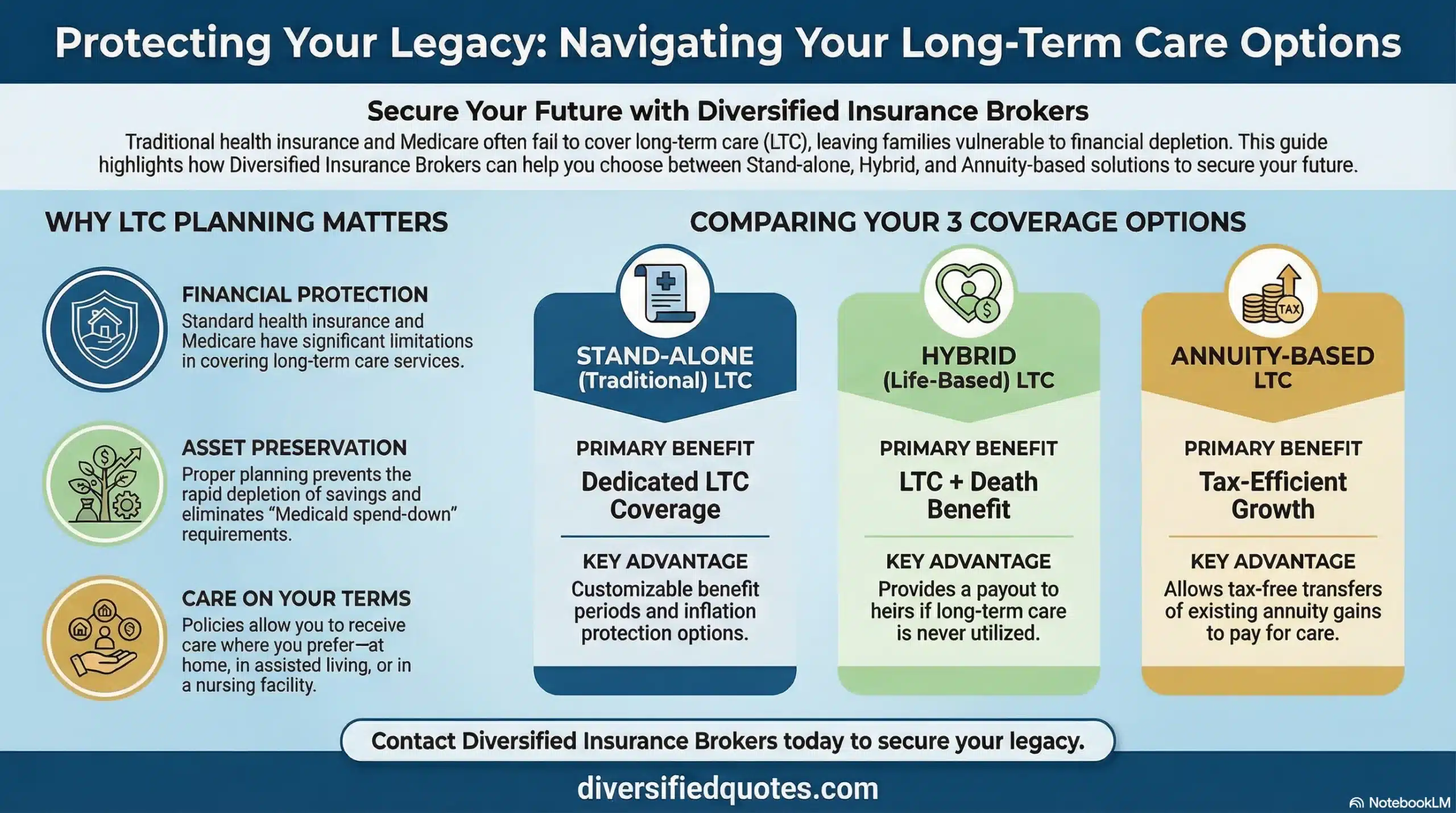
The hybrid landscape also includes life insurance-based LTC products that combine a death benefit with long-term care benefits — a separate structure from the annuity-based approach but worth understanding for complete comparison. Hybrid life versus traditional LTC insurance covers the life insurance-based hybrid in detail. Hybrid long-term care and hybrid life insurance with long-term care benefits cover the full hybrid category across both life and annuity-based structures. Single-pay long-term care insurance covers the single-premium traditional LTC option for candidates who prefer the insurance company’s benefit leverage but want to fund with a single asset rather than ongoing premiums.
Coordinating LTC Annuity Planning With Retirement Income
Long-term care planning produces the most durable outcomes when it is coordinated with the complete retirement income structure rather than evaluated in isolation as a standalone coverage decision. The objective is not simply having coverage — it is ensuring that a care event does not force disruptive choices across the rest of the retirement plan, including selling appreciated assets at inopportune times, accelerating income recognition from qualified retirement accounts, increasing combined income into IRMAA thresholds that elevate Medicare premiums, or reducing the surviving spouse’s standard of living below a comfortable and sustainable level.
Some families pair a long-term care annuity approach with predictable accumulation strategies elsewhere in the conservative allocation — a fixed annuity ladder, for example, can provide staged liquidity at defined intervals while the LTC annuity handles the care funding contingency. Others evaluate the LTC annuity alongside tax planning tools — qualified charitable distributions from IRAs can reduce taxable required minimum distribution income in ways that complement the tax deferral strategy on the non-qualified annuity side, creating a more efficient overall tax picture for the retirement household. The cost of long-term care also varies substantially by geography, making regional cost awareness an important input in benefit sizing decisions — the cost of long-term care by state calculator provides the regional benchmarking that grounds benefit amount decisions in realistic care cost projections rather than national averages. Are Medicare and long-term care insurance the same? covers the critical distinction between Medicare’s limited skilled nursing benefit and the long-term custodial care coverage that the LTC annuity strategy is designed to fund — a distinction that affects how the LTC annuity integrates with the Medicare plan structure. Does Medicare cover nursing home care? addresses the Medicare coverage limitations that make private LTC funding plans essential for retirees who want to protect their assets and their families from extended nursing home cost exposure.
Compare LTC-Qualified Annuity Designs
We’ll evaluate your existing annuity and show which long-term care annuity options fit your goals.
Related Pages to Explore
Keep going with these guides comparing non-qualified annuity mechanics, single-pay LTC, and hybrid LTC structures.
Financial Protection Essentials
Retirement income and planning tools that coordinate with long-term care and annuity decisions.
Talk With an Advisor Today
Choose how you’d like to connect—call or message us, then book a time that works for you.
Schedule here:
calendly.com/jason-dibcompanies/diversified-quotes
Licensed in all 50 states • Fiduciary, family-owned since 1980
Frequently Asked Questions: Non-Qualified Long-Term Care Annuity
What makes an LTC annuity “non-qualified” and why does that matter?
Non-qualified refers to the funding source — the annuity is purchased with after-tax dollars rather than pre-tax money from a 401(k), IRA, or other qualified retirement account. This distinction matters for long-term care planning because the tax challenge with non-qualified annuities is that withdrawals are subject to ordinary income tax on the gain component, which can create a significant tax event at exactly the moment a care need requires large distributions. The non-qualified LTC annuity strategy is designed specifically to address this problem — using the Pension Protection Act’s favorable treatment to convert what would have been taxable annuity gain into tax-advantaged long-term care benefits, improving the net efficiency of care funding compared to standard taxable withdrawals from the same asset.
Can I use an existing annuity to fund an LTC annuity without paying taxes on the transfer?
Yes — a Section 1035 exchange is the standard mechanism for moving from an existing non-qualified annuity to a new LTC-designed annuity contract without triggering ordinary income tax on the accumulated gain during the transfer. The IRS recognizes 1035 exchanges as tax-deferred transfers between annuity contracts when properly structured — the value transfers directly from the old carrier to the new carrier without passing through the owner as a taxable distribution. The exchange preserves the accumulated tax deferral while allowing the asset to move into a product designed for long-term care benefit delivery. The analysis should include a careful review of any remaining surrender charges on the existing contract, the existing contract’s basis and gain allocation, and whether the product change produces a net benefit improvement that justifies any surrender charge that may apply during the remaining surrender period.
What happens to the money in an LTC annuity if I never need long-term care?
One of the structural advantages of the LTC annuity approach compared to traditional standalone LTC insurance is that the asset is not forfeited if care is never needed. Most LTC annuity contracts retain a defined residual value that passes to named beneficiaries at the owner’s death, subject to the contract’s death benefit provisions. This residual value — which may be the full original premium, the accumulated contract value, or a defined death benefit depending on the product — addresses the “use-it-or-lose-it” concern that makes some retirees reluctant to commit premium to traditional LTC insurance. The death benefit mechanics, including how beneficiaries access the value and how ordinary income tax applies to the gain component inherited by non-spousal beneficiaries, should be reviewed as part of the product evaluation and integrated with the broader estate planning structure.
Is health underwriting required for a non-qualified LTC annuity?
Many non-qualified LTC annuity products use simplified underwriting rather than the comprehensive medical underwriting process that traditional standalone LTC carriers apply. This makes the LTC annuity strategy more accessible for applicants with health history that would result in a declination or significant rating under traditional LTC insurance underwriting standards. The specific underwriting requirements vary by carrier and product design — some products ask only a small number of health questions while others use a more detailed application process — and the underwriting flexibility is one of the reasons the LTC annuity is often presented as an alternative for candidates who have been declined for traditional coverage or who have conditions that make traditional approval uncertain.
How does the Pension Protection Act affect the taxation of LTC annuity benefits?
The Pension Protection Act created a provision allowing certain annuity products designed to pay qualified long-term care benefits to treat those benefit payments as tax-free distributions rather than ordinary income withdrawals — even when the benefits are funded from what would otherwise be taxable annuity gain. In practical terms, this means that an annuity owner who has accumulated substantial gain inside an older non-qualified annuity may be able to reposition that asset into a PPA-compliant LTC annuity design and receive care benefits without paying income tax on the gain component as it is disbursed for qualifying care expenses. The tax treatment is design-specific and depends on how the contract pays benefits and how those payments align with qualified long-term care benefit definitions under the tax code, which is why product-level evaluation is necessary rather than assuming all LTC annuity products achieve the same PPA-favorable treatment.
About the Author:
Jason Stolz, CLTC, CRPC, DIA, CAA and Chief Underwriter at Diversified Insurance Brokers (NPN 20471358), is a senior insurance and retirement professional with more than 25 years of real-world experience helping individuals, families, and business owners protect their income, assets, and long-term financial stability. As a long-time partner of the nationally licensed independent agency Diversified Insurance Brokers, Jason provides trusted guidance across multiple specialties—including fixed and indexed annuities, long-term care planning, personal and business disability insurance, life insurance solutions, Group Health, Travel Medical and Evacuation Insurance, and short-term health coverage. Diversified Insurance Brokers maintains active contracts with over 100 highly rated insurance carriers, ensuring clients have access to a broad and competitive marketplace.
His practical, education-first approach has earned recognition in publications such as VoyageATL, and contributions from his agency featured in Kiplinger and GoBankingRates— highlighting his commitment to financial clarity and client-focused planning. Drawing on deep product knowledge and years of hands-on field experience, Jason helps clients evaluate carriers, compare strategies, and build retirement and protection plans that are both secure and cost-efficient. Visitors who want to explore current annuity rates and compare options across multiple insurers can also use this annuity quote and comparison tool.
Explore More Long Term Care Insurance Options: Browse our complete guide to Hybrid & Annuity LTC Policies — covering hybrid life insurance, annuities with LTC benefits & linked benefit policies from top carriers.
Explore More Annuity Options: Browse our complete guide to Annuity Beneficiary & Death Benefits — covering inherited annuities, death benefits, divorce, RMDs & taxation from 100+ carriers.
Last Reviewed: June 15, 2026 |
Reviewed by: Jason Stolz, CLTC, CRPC, DIA, CAA
Chief Underwriter, Diversified Insurance Brokers, Inc. | NPN: 20471358 | Diversified Insurance Brokers, Inc. — Licensed in all 50 states
Fact Checked by: Tonia Pettitt, CMIP©
Medicare Specialist, Diversified Insurance Brokers, Inc. | NPN: 14374308 | Diversified Insurance Brokers, Inc. — Licensed in all 50 states
Did you find this content helpful? Leave us a Google review — it helps others find trustworthy guidance too.
Editorial Standards: Diversified Insurance Brokers maintains rigorous editorial standards to ensure accuracy, clarity, and independence in all content. Learn more about our editorial standards and commitment to transparency.
