
Hybrid Life vs. Traditional Long-Term Care Insurance
As an Independent Long Term Care Insurance Broker, we compare traditional, hybrid, and partnership-qualified policies across dozens of carriers to find the structure that actually fits your situation.
Hybrid Life vs. Traditional Long-Term Care Insurance

Jason Stolz CLTC, CRPC, DIA, CAA
The decision between hybrid life/LTC insurance and traditional long-term care insurance is one of the most consequential planning choices many families make in their 50s and 60s — and also one of the most frequently misunderstood. Both strategies are designed to create a dedicated funding source for long-term care costs, but they do it through fundamentally different structures with different premium mechanics, benefit leverage, and what happens to the money if care is never needed. Getting this comparison right requires looking beyond surface-level marketing language to understand what each approach actually delivers across realistic care scenarios, how premiums work over time, and which structure fits the specific planning goals of the individual or couple involved. The long-term care insurance services hub covers the full LTC planning landscape. This page goes deep on the head-to-head comparison that drives most planning conversations.
Nearly 70% of people turning 65 are expected to need some form of long-term care during their lifetime. The average duration of care need is approximately three years, though a meaningful minority will require care for five or more years at costs that can run $6,000-$10,000 or more per month depending on care setting and geography. Against that financial exposure, both hybrid and traditional LTC strategies offer protection — but they make different trade-offs in how they build that protection, what it costs to maintain, and what value remains if care is never needed. Understanding those trade-offs clearly is the starting point for a sound planning decision. At Diversified Insurance Brokers, we model both approaches side-by-side using real carrier pricing so decisions are grounded in actual numbers rather than product preference.
Compare Hybrid Life vs. Traditional LTC — Side by Side
See real premium ranges, benefit structures, elimination periods, and inflation options tailored to your age and health.
Request My LTC ComparisonHybrid Life/LTC vs. Traditional LTC Insurance — Full Comparison
| Feature | Hybrid Life/LTC Insurance | Traditional LTC Insurance |
|---|---|---|
| Premium structure | Single premium (typically $75,000-$250,000 lump sum) or limited-pay (5, 10, or 15 years); premiums are guaranteed never to increase | Ongoing annual premiums (typically $5,000-$10,000/year for quality coverage); historically subject to rate increases, though current actuarial pricing is more stable |
| What happens if care is never needed | Death benefit paid to beneficiaries — typically equal to or greater than the premium paid; some designs include return-of-premium provisions for full liquidity | No residual benefit; premiums paid over the years do not return to the policyholder or beneficiaries — the “use it or lose it” structure |
| LTC benefit leverage | Typically 2-3x the base death benefit in LTC coverage; a $100,000 single premium may generate $200,000-$300,000 in LTC benefit pool depending on carrier, design, and age | Strongest leverage when care is actually used; $10,000/year in premiums over 20 years can generate $500,000+ in LTC benefit pool with compound inflation — more total benefit per premium dollar when care occurs |
| Inflation protection | Typically limited rider options; some carriers offer built-in automatic benefit increases; inflation features may be bundled rather than fully customizable | Full menu of inflation options — 3% simple, 3% compound, 5% compound, CPI-linked — with compound inflation especially valuable for younger buyers who may not need care for 20-30 years |
| Premium stability | Guaranteed — carriers cannot increase premiums after issue; this is the primary financial certainty advantage of hybrid designs | Carriers can petition state regulators for rate increases; historically this has occurred, though modern pricing is more conservative; new applicants face the actuarially adjusted rates, not the historical mispriced rates |
| Underwriting | Often more flexible for applicants with some health history; some hybrid designs approve applicants who might not qualify for traditional LTC underwriting | More stringent underwriting; mobility, cognitive, and chronic condition history all evaluated carefully; carriers may decline or substantially rate applicants with certain health histories |
| Customization | Generally less flexible; benefit period, elimination period, and inflation options may have fewer choices depending on the specific carrier and product | Highly customizable — benefit period (2 years to unlimited), elimination period (0-180 days), monthly benefit amount, inflation options, and riders can all be independently adjusted |
| Spousal / couples planning | Joint-life hybrid options available (Nationwide CareMatters Together, OneAmerica Asset-Care); shared LTC benefit pools available on some designs | Robust shared benefit rider options; couples can structure a single pooled benefit that either spouse can draw from, dramatically extending potential coverage across two lives |
| Tax treatment of benefits | Benefits generally received income-tax-free up to the IRS per-diem limit ($430/day in 2026) or actual qualified LTC costs; death benefit received income-tax-free by beneficiaries | Benefits generally received income-tax-free; tax-qualified policies offer potential deductibility of premiums subject to age-based limits and itemized deduction thresholds; Partnership-qualified policies offer additional Medicaid asset protection |
| Who it fits best | Individuals and couples with $75,000+ in repositionable conservative assets who dislike “use it or lose it,” want premium certainty, and have legacy or estate planning goals alongside care protection | Individuals and couples focused primarily on maximizing care protection per premium dollar; those comfortable with the pure insurance model; those who want deep inflation protection and full benefit customization |
The Core Difference — Insurance vs. Asset Repositioning
The fundamental distinction between hybrid and traditional LTC comes down to what the premium dollars are doing inside the policy. Traditional long-term care insurance is pure insurance — premiums are pooled with other policyholders’ premiums, the carrier accepts the risk, and benefits pay when care is needed. If care is never needed, the premiums are not returned. This structure allows carriers to offer the most benefit leverage per dollar when care occurs: a modest ongoing annual premium maintained over two decades, with a compound inflation rider, can generate a benefit pool that dwarfs the total premiums paid — but only if care actually happens. The tradeoff is the uncertainty of ongoing premiums and the possibility that decades of premium payments produce no benefit.
Hybrid life/LTC insurance operates differently. The single premium or limited-pay premium is not pooled in the same way — it is repositioned into a permanent life insurance contract that carries both a death benefit and long-term care acceleration provisions. The carrier is not primarily taking on a longevity insurance risk the way traditional LTC carriers do; it is issuing a permanent life policy with LTC features attached. This structure explains why hybrid premiums are guaranteed — the funding schedule is locked in from the start, and the economics of the policy don’t depend on the same risk pool dynamics. The tradeoff is that the LTC leverage — the ratio of LTC benefit to premium paid — is typically lower than what a well-designed traditional policy produces when care is actually used. A $100,000 single premium hybrid typically generates $200,000-$300,000 in LTC benefits. The same $100,000 spread across annual traditional LTC premiums over many years, with compound inflation protection, could generate a much larger benefit pool by the time care is needed.
Why Hybrid LTC Has Grown Significantly in Popularity
The growth of hybrid strategies over the past decade reflects real buyer concerns that the traditional LTC market’s historical behavior created. When traditional LTC carriers significantly mispriced policies in the 1990s and early 2000s — underestimating how long people would live and how expensive care would become — the result was substantial premium increases for existing policyholders. Those increases, while affecting policies issued under flawed historical assumptions rather than today’s more conservative pricing, created lasting buyer hesitation about committing to an ongoing premium that could increase. Hybrid’s guaranteed premium structure directly addresses that concern. Affordable hybrid long-term care policies covers how these products are structured and what asset repositioning looks like in practice. The return-of-premium feature — available in many hybrid designs — adds an additional comfort layer: if the policyholder changes their mind or needs the capital, the premium can be recovered. This liquidity provision is absent from traditional LTC insurance entirely.
The legacy benefit is another powerful driver. For families with estate planning goals or income replacement concerns alongside care protection needs, the fact that beneficiaries receive a death benefit if care is never used changes the emotional calculus of the purchase significantly. Traditional LTC insurance is not designed to deliver estate value — it exists purely to fund care costs. Hybrid coverage serves two masters: care protection and legacy planning simultaneously.
Why Traditional LTC Insurance Remains Compelling
Despite the hybrid market’s growth, traditional long-term care insurance retains meaningful advantages for buyers focused primarily on maximizing care protection. The leverage argument is straightforward: when care actually occurs and lasts multiple years, a traditional policy with compound inflation protection generates significantly more benefit per premium dollar than most hybrid designs can match. For a 55-year-old buyer purchasing a traditional policy with 3% compound inflation, the monthly benefit at age 75 when care begins will be approximately 80% higher in nominal terms than the benefit at purchase — a factor that hybrid designs rarely replicate at comparable cost. The full details of how to structure traditional coverage for maximum protection are at how to buy long-term care insurance and how to choose the right long-term care insurance policy.
Customization is the second major traditional LTC advantage. Traditional policies allow independent adjustment of monthly benefit amount, benefit period, elimination period, and inflation protection — creating an almost unlimited design space. Families planning specifically for home care scenarios can weight benefits toward home and community-based care while keeping facility coverage strong. Couples can structure shared spousal benefit structures that allow unused benefits from one spouse to extend protection to the other — a design feature that can dramatically increase total available coverage across two lives. The full couples planning framework is at long-term care insurance for couples. State Partnership-qualified LTC policies add an additional Medicaid asset protection layer unavailable through most hybrid designs.
The Net Cost Reality — What the Math Actually Shows
A rigorous comparison of hybrid and traditional LTC often reaches a less dramatic conclusion than marketing materials suggest. When the opportunity cost of the large hybrid single premium is factored in — what that capital could have earned invested conservatively over the same period — the net cost difference between hybrid and traditional frequently narrows to a modest margin. Hybrid’s marketing advantage (the death benefit “making premiums not lost”) only holds if the opportunity cost of the repositioned capital is ignored. A family repositioning $100,000 into a hybrid policy is forgoing the growth that $100,000 could generate over 20 years. Traditional LTC’s annual premiums, funded from investment returns on the capital not committed to the hybrid, may produce a similar net cost while delivering significantly more LTC leverage. This does not make hybrid the wrong choice — it means the choice should be evaluated on planning fit, not just on the “use it or lose it” emotional argument. For some buyers, the certainty and legacy benefit are worth accepting lower LTC leverage. For others, maximizing care protection is the clear priority. The should you buy long-term care insurance page and long-term care planning strategies guide cover the decision framework in depth.
Elimination Periods, Benefit Triggers, and How Benefits Begin
Both hybrid and traditional LTC policies require that care meet benefit triggers before payments begin — typically the inability to perform two or more Activities of Daily Living (ADLs), or substantial cognitive impairment meeting clinical standards. Once triggered, benefits begin after the elimination period is satisfied. Traditional LTC policies offer the widest elimination period selection — 0, 30, 60, 90, or 180 days — with longer elimination periods reducing premiums by self-insuring the initial care period. The full mechanics are at LTC elimination periods explained. Hybrid policies typically use a 0-day or 90-day elimination period depending on the product design; some hybrid structures pay benefits on a reimbursement basis while others pay cash indemnity regardless of actual expenses — a meaningful practical difference in how benefits can be deployed for informal care provided by family members. The care setting question — home versus facility, and how each approach covers the range — is covered at long-term care vs. assisted living insurance coverage differences.
Tax Treatment and How Each Structure Is Taxed
Tax treatment differs between hybrid and traditional LTC designs in meaningful ways. Traditional tax-qualified LTC policies allow premium deductibility as a medical expense for individuals who itemize, subject to age-based IRS limits (for 2026: $480 for ages 41-50, $1,280 for 51-60, $3,400 for 61-70, $4,250 for age 71+, approximate). Benefits from qualified traditional policies are generally income-tax-free. Tax advantages of long-term care insurance and tax benefits of long-term care insurance cover this in full detail. For hybrid policies, LTC benefit payments are generally income-tax-free up to the IRS per-diem limit ($430/day in 2026) or actual qualified LTC expenses if higher. Death benefits from the life insurance component are generally received income-tax-free by beneficiaries. The are long-term care benefits taxable page covers both traditional and hybrid tax treatment. Premium deductibility is generally not available for hybrid life/LTC premiums in the same way it applies to traditional tax-qualified LTC insurance. Partnership-qualified benefits — available through traditional policies meeting state requirements — offer an additional Medicaid asset protection layer that hybrid designs typically cannot replicate.
Health Underwriting — When Hybrid Opens Doors That Traditional Cannot
Traditional LTC insurance underwriting is more stringent than most buyers expect. Carriers evaluate mobility history, cognitive screening results, chronic condition status, medication lists, and functional independence carefully — and some applicants with moderate health conditions are declined or rated to the point of unaffordability. Hybrid designs often accept applicants with health histories that traditional LTC underwriters would decline, because the hybrid carrier is underwriting a life insurance contract rather than a pure long-term care risk pool. For buyers who have been declined for traditional LTC or who have health conditions that make approval uncertain, hybrid LTC coverage frequently represents the only viable path to meaningful protection. Who qualifies for long-term care insurance covers the qualification framework across both approaches, and how to qualify for long-term care insurance covers the application and underwriting process. For buyers where traditional LTC is genuinely unavailable, guaranteed issue long-term care insurance covers the options available without full medical underwriting. For buyers approaching the age where traditional LTC underwriting becomes significantly more difficult, long-term care insurance after age 80 covers what remains available at later ages.
Single-Pay and Limited-Pay Hybrid Funding Structures
Most hybrid LTC policies are funded with a single premium, though 10-year and 15-year limited-pay schedules are available from most major carriers. Single-pay long-term care insurance covers how single-premium designs work and who they are most appropriate for. The single-pay structure is particularly useful for repositioning idle capital — money sitting in CDs, savings accounts, or conservative investment positions that is not being deployed aggressively — into a multi-purpose vehicle that creates both LTC protection and a legacy benefit. It is also relevant for families considering annuity-based LTC approaches: non-qualified long-term care annuities cover how deferred annuities with LTC riders work as an alternative funding vehicle that combines income generation with care benefit access.
What Medicare Does and Does Not Cover
One of the most common misconceptions in LTC planning is that Medicare will cover extended care needs. Does Medicare cover long-term care and does Medicare cover nursing home care both address this directly: Medicare provides limited skilled nursing facility coverage following a qualifying hospital stay — typically up to 100 days, with significant daily co-pays after day 20 — and does not cover custodial care, which is what most long-term care actually involves. Understanding this gap is essential context for evaluating how much protection a hybrid or traditional LTC policy actually needs to provide. Families who assume Medicare will cover most care costs consistently underestimate the financial exposure they are leaving unaddressed, which is why LTC planning — in whichever form fits best — addresses a real and significant retirement financial risk. For buyers where budget constraints limit traditional or hybrid options, short-term care insurance alternatives and affordable long-term care insurance strategies for retirees cover lower-cost entry points into care protection.
Build Your Long-Term Care Protection Plan
We model hybrid and traditional LTC options side-by-side using real carrier pricing and your retirement timeline, care goals, and premium range.
Start My LTC Planning Review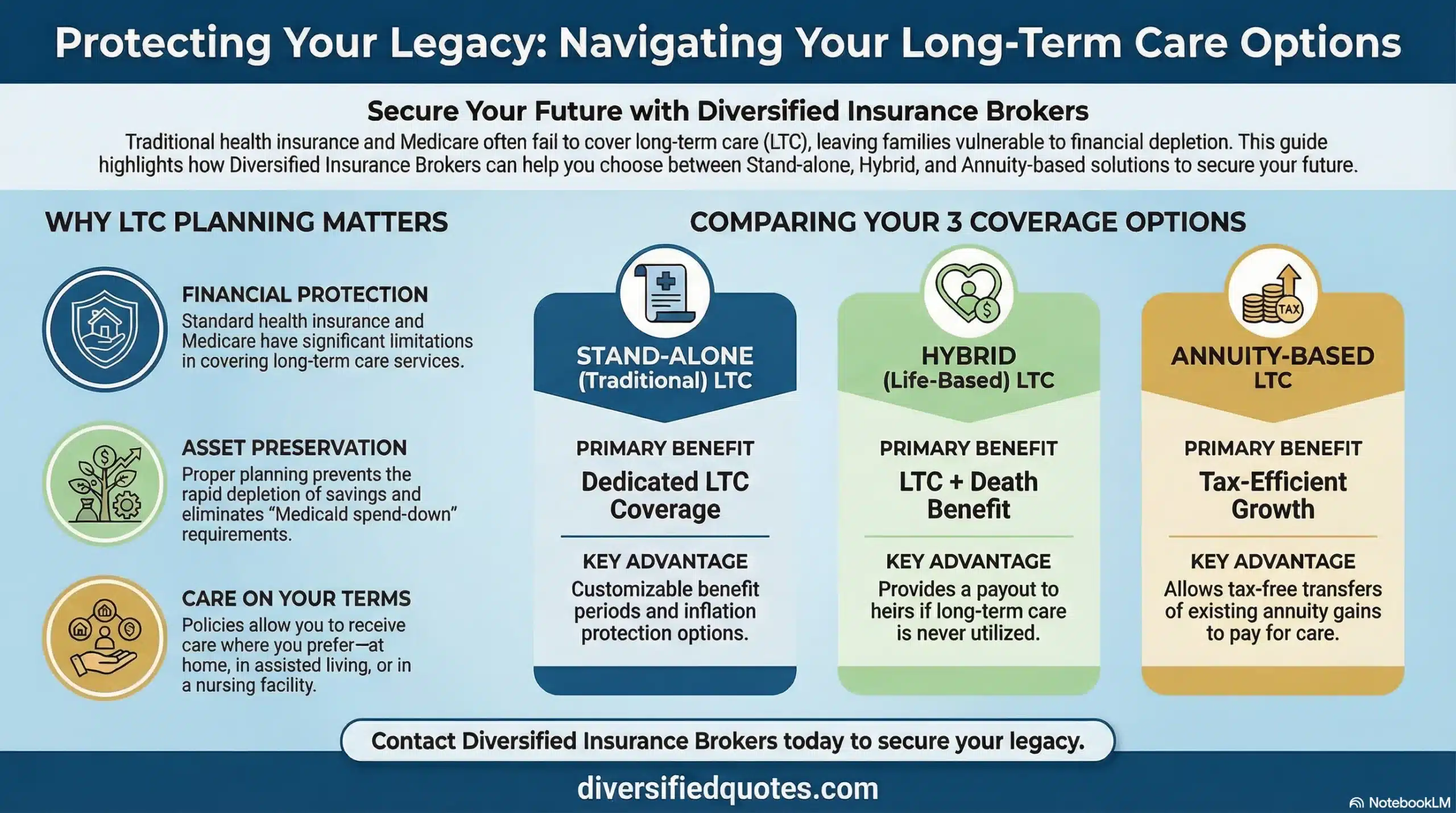
Talk With an Advisor Today
Choose how you’d like to connect—call or message us, then book a time that works for you.
Schedule here:
calendly.com/jason-dibcompanies/diversified-quotes
Licensed in all 50 states • Fiduciary, family-owned since 1980
FAQs: Hybrid Life vs. Traditional Long-Term Care Insurance
Is hybrid life/LTC insurance the same as “asset-based long-term care”?
Yes — “hybrid,” “asset-based,” and “linked-benefit” are terms used interchangeably for the same structure: a permanent life insurance policy that includes long-term care benefit access, either through an acceleration of the death benefit or through a stand-alone LTC rider. The unifying concept is that the premium creates value in three ways — LTC benefits while living, a death benefit if care is never needed, and in many designs a return-of-premium option that preserves capital access. This distinguishes hybrid designs from traditional LTC insurance, which is a pure insurance product that delivers no benefit if care is never needed.
Which option usually provides more long-term care benefits for the premium?
Traditional long-term care insurance typically provides more LTC benefit per premium dollar when care is actually used — especially when compound inflation protection is selected and care occurs 15-25 years after purchase. A well-structured traditional policy can generate a benefit pool many times the total premiums paid when care occurs. Hybrid designs typically provide 2-3x the single premium in LTC benefits, which is more modest leverage — but the death benefit ensures no premium dollars are “lost” if care is never needed. The right answer depends on which outcome matters more: maximum care leverage when care occurs, or certainty of value regardless of whether care occurs.
Can premiums increase on a hybrid LTC policy?
No — guaranteed premiums are one of the defining features of hybrid designs. Whether funded with a single premium or a limited-pay schedule, the funding commitment is locked in at issue and cannot be changed by the carrier. This is the primary financial certainty advantage of hybrid coverage. Traditional LTC insurance premiums can be increased if the carrier petitions the state insurance regulator and demonstrates actuarial justification — this happened at industry-wide scale in the 2010s for policies issued in the 1990s and early 2000s under flawed pricing assumptions. Modern traditional LTC policies are priced more conservatively, but the legal ability to increase remains. For buyers who prioritize premium certainty above all else, hybrid’s guaranteed structure is a meaningful and real advantage.
Is it possible to blend both hybrid and traditional LTC coverage?
Yes — and for many couples this blended approach is intentional and strategically sound. One spouse may be better suited for hybrid coverage (perhaps due to health history that makes traditional LTC harder to place, or because of estate planning goals), while the other qualifies easily for traditional LTC and benefits from the higher leverage it provides when care occurs. The combination spreads risk across funding styles and benefit structures. Some individual buyers also use a smaller hybrid policy as a guaranteed floor with a traditional policy providing the higher-leverage care protection above that floor — creating layered protection rather than relying entirely on one approach.
Does Medicare cover the long-term care costs that these policies address?
No — Medicare does not cover custodial care, which is what the vast majority of long-term care involves: assistance with bathing, dressing, eating, toileting, transferring, and continence. Medicare covers limited skilled nursing facility stays following qualifying hospitalizations — up to 100 days, with significant daily co-pays after day 20 — and does not cover ongoing care in a memory care facility, assisted living, or home-based custodial care. This gap is the reason LTC planning exists as a distinct financial planning need. Relying on Medicare for long-term care financing is one of the most common and costly planning oversights in retirement income planning.
About the Author:
Jason Stolz, CLTC, CRPC, DIA, CAA and Chief Underwriter at Diversified Insurance Brokers (NPN 20471358), is a senior insurance and retirement professional with more than 25 years of real-world experience helping individuals, families, and business owners protect their income, assets, and long-term financial stability. As a long-time partner of the nationally licensed independent agency Diversified Insurance Brokers, Jason provides trusted guidance across multiple specialties—including fixed and indexed annuities, long-term care planning, personal and business disability insurance, life insurance solutions, Group Health, Travel Medical and Evacuation Insurance, and short-term health coverage. Diversified Insurance Brokers maintains active contracts with over 100 highly rated insurance carriers, ensuring clients have access to a broad and competitive marketplace.
His practical, education-first approach has earned recognition in publications such as VoyageATL, and contributions from his agency featured in Kiplinger and GoBankingRates— highlighting his commitment to financial clarity and client-focused planning. Drawing on deep product knowledge and years of hands-on field experience, Jason helps clients evaluate carriers, compare strategies, and build retirement and protection plans that are both secure and cost-efficient. Visitors who want to explore current annuity rates and compare options across multiple insurers can also use this annuity quote and comparison tool.
Explore More Long Term Care Insurance Options: Browse our complete guide to Hybrid & Annuity LTC Policies — covering hybrid life insurance, annuities with LTC benefits & linked benefit policies from top carriers.
Last Reviewed: June 6, 2026 |
Reviewed by: Jason Stolz, CLTC, CRPC, DIA, CAA
Chief Underwriter, Diversified Insurance Brokers, Inc. | NPN: 20471358 | Diversified Insurance Brokers, Inc. — Licensed in all 50 states
Fact Checked by: Tonia Pettitt, CMIP©
Medicare Specialist, Diversified Insurance Brokers, Inc. | NPN: 14374308 | Diversified Insurance Brokers, Inc. — Licensed in all 50 states
Did you find this content helpful? Leave us a Google review — it helps others find trustworthy guidance too.
Editorial Standards: Diversified Insurance Brokers maintains rigorous editorial standards to ensure accuracy, clarity, and independence in all content. Learn more about our editorial standards and commitment to transparency.
