
Long Term Care Insurance for Couples
As an Independent Long Term Care Insurance Broker, we compare traditional, hybrid, and partnership-qualified policies across dozens of carriers to find the structure that actually fits your situation.
Long Term Care Insurance for Couples

Jason Stolz CLTC, CRPC, DIA, CAA
For married couples and long-term partners, planning ahead for extended care is one of the most important two-person financial decisions you can make in retirement. Long term care insurance for couples is not just about covering the cost of care — it is about protecting the household’s income, preserving retirement savings for the healthy spouse, and preventing a care event from turning into a financial crisis that forces rushed choices at the worst possible moment. The stakes are significant: current care costs show assisted living averaging $71,040 annually, semi-private nursing home rooms running $118,500, and private rooms reaching $129,575. An estimated 70% of adults turning 65 will need some form of long-term care during their lifetime, and approximately 22% will need care for more than five years. The average lifetime care cost for someone with dementia reached $405,262 in 2024. At Diversified Insurance Brokers, Jason Stolz, CLTC, CRPC, DIA, CAA, helps families compare long term care insurance designs built specifically for couples — including shared benefit pools, spousal discounts, and flexible coverage structures that can adapt as care needs change across both partners over time.
One reason couples benefit from planning earlier is straightforward: long-term care risk is rarely even between partners. One spouse may need help for a short period after a surgery or a recoverable health event, while the other could require years of cognitive supervision later in life as a progressive neurological condition develops. A coordinated plan reduces the odds that one person’s care expenses will jeopardize the other person’s standard of living, housing stability, or retirement income. Many couples want the same core outcome: a plan that can support care at home first, then assisted living or facility care if needed, without draining assets that were built to support both partners throughout retirement or creating pressure that turns adult children into default care coordinators and financial managers. Current care costs by state provide the regional context that makes these projections concrete rather than abstract, and the long-term care playbook positions all the available coverage tools within a strategic framework before narrowing to specific product comparisons.
Compare Long Term Care Insurance for Couples
We’ll help you evaluate shared benefits, spousal discounts, inflation options, and hybrid designs — matched to both partners’ goals.
Why Couples Need Long Term Care Coverage
Couples often approach long-term care as a single-person problem — “If one of us needs care, the other will handle it.” But the financial and practical reality is almost always a household problem. The financial impact of a care event does not only come from the care bill itself. It includes reduced household income if the healthy spouse steps back from work to provide care, higher ongoing living expenses including home modifications, specialized transportation, and professional supervision, and the emotional and logistical cost of managing care decisions under sustained pressure without a professional care plan already in place. When one partner needs care, the other partner frequently becomes the default coordinator — managing providers, schedules, prescriptions, insurance paperwork, and family communication simultaneously. If the care need extends for months or years, couples face hard trade-offs: paying for professional help versus relying on family, modifying the home versus moving to a care facility, or drawing down retirement accounts faster than planned to fill the gap between care costs and available coverage.
A well-designed couple’s LTC plan provides cash flow or reimbursement support that can make those decisions far less disruptive by ensuring professional care resources are funded without requiring the healthy spouse to become the primary provider. Another point that is consistently underestimated: long-term care risk is not primarily about nursing homes. Many couples strongly prefer to receive care at home as long as it is safely possible. That preference is entirely realistic early in most care journeys, but home care becomes expensive quickly when supervision or hands-on assistance is needed for many hours per day — and the cost escalates further when the spouse providing informal care must reduce their own work or health management activities to absorb the caregiving role. Planning for home care first, with the ability to transition to facility care when appropriate, is the actual care path that most couples want — and the reason coordinated coverage designed specifically for couples consistently produces better outcomes than two independently designed individual policies.
The Caregiver Spouse Risk Most Couples Miss
Even financially stable households can be significantly vulnerable when one spouse becomes the primary caregiver. Caregiving reduces the healthy spouse’s ability to manage their own health, maintain social relationships, continue income-producing work, and make clear-headed financial decisions while simultaneously managing the emotional weight of a partner’s declining health. Research consistently shows that spouse caregivers face elevated risks of burnout, physical injury from caregiving activities, social isolation, and health decline that can create a second care need in the household at the same time the first is ongoing.
This is why couple-focused planning has a fundamentally different goal than individual planning. The central question is not only “Can we pay for care?” It is “Can we pay for care while preserving the independence, financial stability, and quality of life of the spouse who is not receiving care?” That framing changes the coverage design priorities — it argues for benefit amounts and structures that specifically protect the healthy spouse’s lifestyle rather than simply maximizing the total benefit available to the insured. Shared benefit riders and coordinated policy design can accomplish exactly that goal by creating flexibility if one spouse needs significantly more support than the other while keeping the household’s overall retirement plan intact. Long-term care insurance with shared spousal benefits covers how household benefit pooling works in detail and why coordinated household planning consistently outperforms two separately designed policies for couples with asymmetric care risk.
Couples also tend to make decisions together about where care should happen and what level of professional involvement versus informal family involvement is acceptable. Some couples want a plan that strongly favors home care for as long as safely possible, with facility care as a last resort. Others want the option to transition to assisted living earlier so the healthy spouse is not carrying an unsustainable caregiving burden. The best LTC design for a couple often reflects these preferences explicitly in the benefit structure — which care settings are covered, what the benefit triggers are, and how the elimination period is structured — rather than assuming both partners share identical preferences about how and where care will be delivered.
How Long Term Care Insurance for Couples Typically Works
Most couples do not purchase a single policy that covers two people. Instead, couples typically apply for two coordinated policies — one for each spouse — with couple-friendly pricing provisions and optional riders that connect the two policies to create household-level flexibility. This is where the major planning advantage of couples planning appears: coordinated coverage can be meaningfully more cost-efficient and substantially more flexible than two separate policies designed in complete isolation from each other.
Depending on the carrier and the specific policy design, couple-friendly structures may include a spousal discount for applying simultaneously that lowers the per-person premium, shared benefit pool riders that allow one spouse to access a portion of the other spouse’s benefit period if their own benefits are exhausted, and waiver of premium provisions that can help keep one spouse’s coverage in place if the other spouse enters claim and the household’s available cash flow becomes more constrained. Shared care riders in LTC covers the specific rider mechanism that creates this household benefit pooling and how it interacts with each individual policy’s benefit period in practice. Long-term care insurance with shared benefits covers the broader shared benefit design category including how different carriers structure these features and what eligibility requirements apply at claim.
Key Features and How They Compare for Couples
Every couple’s situation is different, but the same core design decisions show up consistently when comparing LTC coverage options. The goal is not to maximize every feature simultaneously — the goal is to select the combination of features that produces the best real-world outcome when care is needed, at a premium level that is sustainable for the household throughout retirement.
| Feature | What It Does | Why It Matters for Couples | Trade-Off to Consider |
|---|---|---|---|
| Shared benefit / shared care rider | Allows one spouse to draw from the other’s unused benefit period if their own is exhausted | Addresses the uneven care risk between spouses; prevents one partner’s long claim from exhausting coverage while the other has unused benefits | Adds rider cost; requires both spouses to maintain coverage for pooling to remain available |
| Spousal discount | Premium reduction for both spouses applying simultaneously through the same carrier | Makes coordinated coverage more affordable; available even when shared riders are not selected | Discount varies significantly by carrier and state; requires both spouses to be insurable |
| Inflation protection | Grows the monthly benefit over time to keep pace with rising care costs; typically 3% or 5% compound annual | Critical for couples who may not need care for 15+ years — a benefit adequate today can be insufficient in 2040 without growth | Adds meaningfully to premium; the right growth rate depends on age and how early coverage is purchased |
| Elimination period | Waiting period before benefits begin; measured in days of care (30, 60, 90, 180) | Longer elimination period reduces premium; couples self-fund the early phase from savings or income | Requires adequate liquid assets to bridge the elimination period without disrupting household finances |
| Benefit period / pool size | Defines how long or how much the policy can pay; can be defined in years or as a pooled dollar amount | Longer benefit periods or larger pools protect against extended claims; 22% of care recipients need care for 5+ years | Longer periods cost more; lifetime benefit designs provide the strongest backstop at the highest premium |
| Hybrid LTC structure | Combines life insurance or annuity with LTC benefits; death benefit if care never needed | Addresses “use it or lose it” concern; retains value for household or heirs if neither spouse claims | Higher upfront funding requirement; LTC benefit per dollar often less than standalone traditional LTC |
Planning for the Care Settings Couples Actually Use
Couples planning is most effective when the coverage design reflects how care is actually likely to unfold rather than assuming a facility placement is the only outcome worth planning for. Most care journeys begin with small, targeted supports: help with bathing or dressing, meal preparation, medication management, transportation coordination, and supervision during activities that carry fall or safety risk. Over months or years, those needs frequently escalate — particularly when cognitive impairment enters the picture and the level of supervision required increases substantially above what family caregivers can realistically provide without professional support.
Long-term care insurance triggers are most commonly tied to loss of independence with Activities of Daily Living — bathing, dressing, eating, toileting, transferring, and continence — or to cognitive impairment that requires substantial supervision for safety. Understanding exactly how these triggers work in the specific policy being considered matters because the language in the contract determines when benefits begin. LTC care coordination benefits covers how a professional care coordinator helps families navigate the claim trigger documentation and care plan development so benefits begin as efficiently as possible when care starts.
One reason couples specifically benefit from shared benefit designs is that the care path can differ dramatically between the two partners over a long retirement. One spouse may need brief, focused home care after a medical event and recover to full independence. The other may experience a gradual cognitive decline that requires escalating care intensity over five or more years across multiple settings. A shared structure bends with that reality rather than locking both partners into identical benefit periods that may fit one care scenario and be either excessive or insufficient for the other. The comparison of limited-term versus lifetime LTC benefits covers how to evaluate whether a lifetime benefit structure is appropriate for the household’s specific long-duration risk profile.
Why Medicare Does Not Solve the Long-Term Care Problem for Couples
Many couples assume Medicare will cover extended care needs in the way it covers acute medical treatment. In reality, Medicare’s long-term care coverage is tightly limited and focused on short-term skilled care needs rather than the extended custodial care that represents most of what families actually need to fund. Medicare covers short-term skilled nursing facility care after a qualifying hospital stay — full coverage for days 1 through 20, a daily coinsurance of $204 per day for days 21 through 100 as of 2025, and no coverage after day 100. Medicare does not cover ongoing home care for personal assistance with activities of daily living, assisted living, or most memory care. Does Medicare cover long-term care? explains this distinction in plain language and is often the clarifying moment for couples who assumed Medicare would fill the extended care gap. Does Medicare cover nursing home care? addresses the specific nursing home coverage question that generates the most confusion in retirement planning conversations.
Understanding this gap is especially important for couples because a care event that occurs shortly after retirement can be particularly disruptive — the household is still adjusting to a new income structure built around retirement assets rather than employment income, and a major unplanned care expense arriving before the retirement income plan has fully stabilized can force portfolio withdrawals at the worst possible time. Couples who build LTC coverage as one coordinated layer of retirement protection — alongside guaranteed income sources, conservative allocations, and a realistic care cost projection — are the ones who can manage a care event without permanently impairing the surviving spouse’s financial trajectory.
The Real Cost of Care for Couples and Why Duration Is the Critical Variable
The most important cost variable in long-term care planning is rarely the monthly care rate. It is the duration. A moderate care cost sustained for a short period is manageable for most households with adequate savings. The same monthly cost extended for three, five, or seven years reshapes the entire retirement trajectory — especially when it affects the healthy spouse’s ability to work, manage the household, and maintain their own standard of living simultaneously. When only one spouse needs care, the household frequently carries two sets of ongoing expenses: the regular household living costs plus the care costs. This is the “two-household budget” dynamic that makes long-duration couple planning uniquely challenging.
| Type of Care | Why It Matters Specifically for Couples |
|---|---|
| Home care (part-time to extended hours) | Most common first stage of care; costs rise quickly as supervision needs increase, especially with cognitive impairment. Home health aide averaging $77,792 annually at full-time equivalent hours. The household continues paying regular living expenses simultaneously. |
| Assisted living / memory care | Assisted living averages $71,040 annually. Reduces caregiver burden on the healthy spouse but household may still carry home expenses simultaneously if the spouse remains in the primary residence. Transition from home care to assisted living is often gradual. |
| Skilled nursing / facility-based care | Private room averages $129,575 annually. Creates the full two-household budget effect: regular living expenses plus facility care bills running simultaneously. A 5-year facility stay can represent $650,000+ in total costs at current rates. |
The question of whether to insure versus self-fund part of this risk depends on the household’s total liquid assets, income stability, and how strongly the couple wants to protect the healthy spouse’s retirement lifestyle. Self-insured long-term care frames this decision in practical terms for households evaluating the trade-off between insurance leverage and asset flexibility. Many couples choose to cover the “budget-breaking” layer — the portion of care costs that would force major investment liquidation or require the healthy spouse to compromise their lifestyle — with insurance, while accepting some level of self-funding for shorter or less severe care situations. Whether long-term care insurance is worth it provides the analytical framework for evaluating that trade-off against the household’s specific financial picture. Long-term care planning strategies covers the full range of approaches — traditional insurance, hybrid, annuity-based, and self-funding — and how they interact for households at different asset and income levels.
When Couples Consider Hybrid LTC Instead of Traditional Coverage
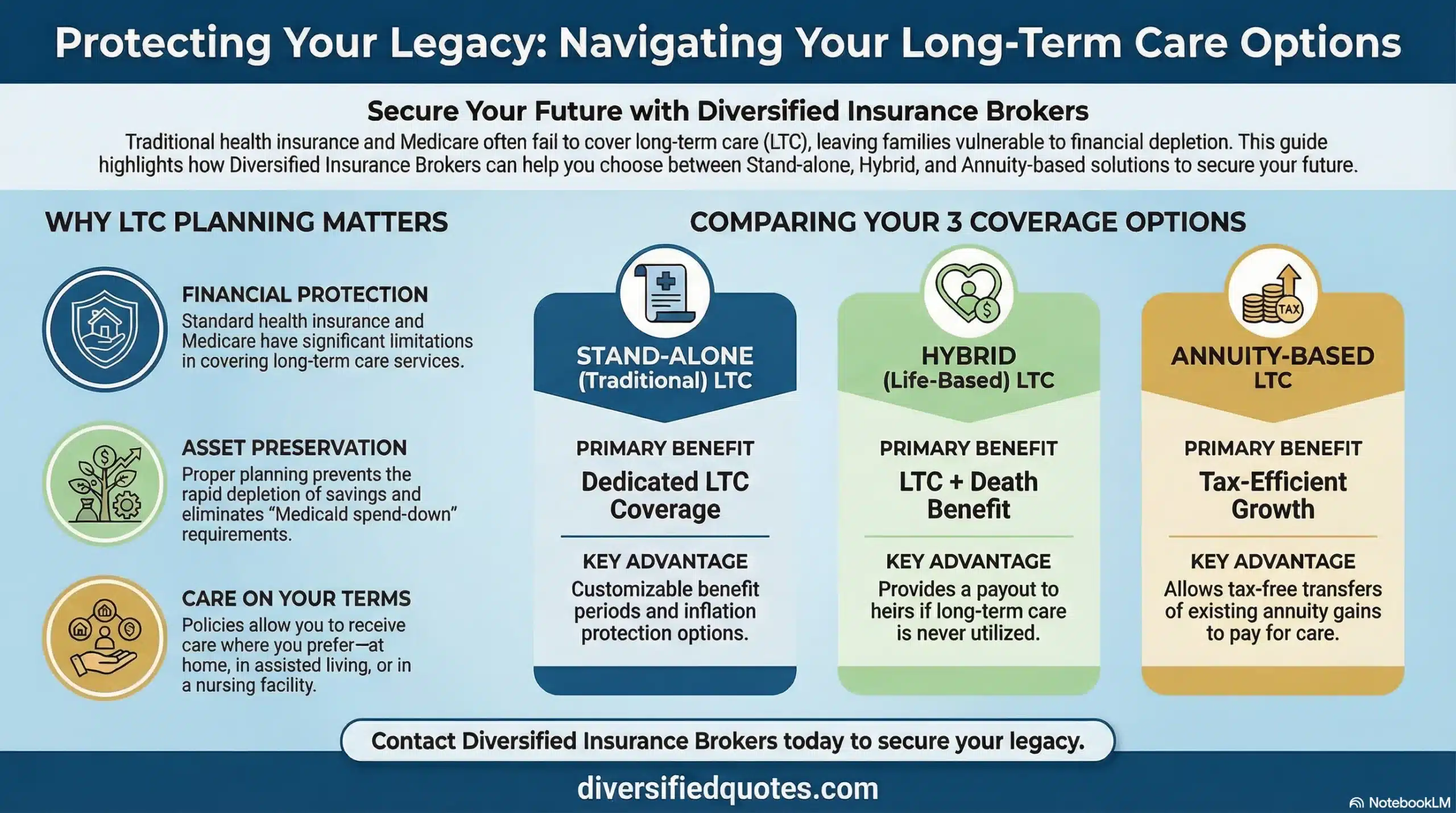
Hybrid long-term care strategies are common in couple planning because they can address a specific psychological barrier: “What if we pay premiums for decades and never use the coverage?” With standalone traditional LTC insurance, premiums are paid over years and if benefits are never triggered, the premiums are spent with no residual value returned to the household. With hybrid life and LTC or annuity and LTC designs, there is typically retained value in the form of a death benefit or remaining contract value if long-term care is never needed — creating the “either way it pays” structure that many couples find more psychologically sustainable than an open-ended premium commitment.
Hybrids are not automatically better than traditional LTC coverage. They are different tools with different trade-offs. Hybrid designs typically require larger upfront funding or a different ongoing premium structure compared to traditional LTC, the LTC benefit per dollar of premium is often less than a comparable standalone traditional policy, and the specific design details — how benefits are triggered, how they are calculated, how long meaningful benefits can continue — vary significantly across products. Understanding hybrid long-term care insurance explains the product mechanics in practical terms. Hybrid life insurance with long-term care benefits covers the life-chassis hybrid specifically, and the tax advantages of LTC and hybrid policies addresses the tax-planning dimension that can affect how hybrid designs are structured for different household situations. For couples who want to reposition existing low-yield assets rather than pay an ongoing premium, annuities with long-term care benefits and fixed annuities with long-term care benefits cover how asset repositioning into insurance-linked structures creates a care funding pool without the ongoing premium structure.
How Couples Design Coverage That Works in the Real World
The best couple-focused LTC plan almost always begins with a few practical questions before any product comparison is made. Where do both partners want care to happen — at home as the strong preference, in a facility if home care becomes inadequate, or wherever is safest at the time? How much of the care cost does the household want insurance to cover — the entire expected cost, or just the layer that would break the budget and force major financial disruption? How much combined premium is comfortable for the household on a sustained basis throughout a retirement that may span 20 to 30 years?
Once those preferences are clear, benefit design follows from the answers. Many couples do not need the policy to pay 100% of every possible care cost across every possible setting. They want coverage to address the break-the-budget portion — the layer that would force major investment liquidation at an inopportune market moment, require the healthy spouse to reduce their standard of living substantially, or create a financial emergency that adult children must manage alongside their own households. A well-designed couple’s LTC plan covers that layer reliably while leaving room in the household budget to sustain the premium commitment throughout the years before care is needed. For households evaluating whether current health profiles qualify for preferred pricing, who qualifies for long-term care insurance covers the underwriting standards that determine eligibility and pricing classification. For couples where one or both partners are approaching the upper end of the traditional underwriting window, whether you can still get LTC insurance after age 60 and long-term care insurance after age 80 address what remains available as the planning timeline shortens. For employers and business owners evaluating group coverage for their households, group long-term care covers how employer-sponsored LTC programs compare to individually owned policies for couple planning specifically.
Protect Your Future Together
Compare couple-friendly LTC policies and hybrid options to help safeguard retirement savings and reduce caregiver pressure.
Related Long-Term Care Resources
Keep comparing benefit styles and couple-focused strategies.
Long-Term Care Insurance with Shared Spousal Benefits
Shared Care Riders in LTC
Long-Term Care Insurance with Return of Premium
Partnership-Qualified Long-Term Care Insurance
Tax Advantages of LTC and Hybrid Policies
Does Medicare Cover Long-Term Care?
Limited-Term vs Lifetime LTC Benefits
LTC Care Coordination Benefits
Understanding Hybrid Long-Term Care Insurance
Long-Term Care Insurance Hub
Financial Protection Essentials
Retirement income and protection tools that often coordinate with couple-focused LTC planning.
Talk With an Advisor Today
Choose how you’d like to connect—call or message us, then book a time that works for you.
Schedule here:
calendly.com/jason-dibcompanies/diversified-quotes
Licensed in all 50 states • Fiduciary, family-owned since 1980
Frequently Asked Questions: Long Term Care Insurance for Couples
Do both spouses need to apply for LTC insurance at the same time?
Both spouses do not need to apply simultaneously, but applying together produces meaningful advantages. Most carriers offer spousal discounts when both partners apply through the same carrier at the same time, which lowers the per-person premium even if shared benefit riders are not selected. Shared care riders — which allow one spouse to draw from the other’s unused benefit period — require both spouses to maintain active coverage, so coordinated simultaneous application is the only way to access those features from the start. Applying together also ensures the coverage design for each spouse can be deliberately coordinated around shared household goals rather than designed independently and then assembled after the fact, which consistently produces better overall protection at more efficient combined cost.
What is a shared care rider and why does it matter for couples?
A shared care rider connects the two spouses’ policies so that if one spouse exhausts their own benefit period, they can access a portion of the other spouse’s unused benefits. This matters because long-term care risk is almost never evenly distributed between partners — one spouse may need care briefly or not at all, while the other may need extended care for years. Without a shared rider, those unused benefits on one policy cannot help when the other policy runs out. With a shared rider, the household’s total benefit pool can be deployed more efficiently against whichever care need is largest. The rider adds cost, but for couples with asymmetric care risk — particularly where cognitive decline on one side of the family is a concern — it can be one of the most valuable design features in the plan.
What happens to the healthy spouse’s LTC coverage if the other spouse starts receiving care?
The healthy spouse’s policy generally continues independently — they remain covered under their own policy regardless of whether the other spouse is actively receiving benefits. Some policy designs include a waiver of premium provision that can keep both policies active if the household’s premium-paying capacity becomes strained during a care event, though the specific terms vary by carrier and product design. This continuation is one of the core planning advantages of coordinated couple coverage: each spouse has their own independent coverage that protects them individually, while the shared benefit features create household-level flexibility when one policy’s benefits are insufficient for an extended claim. Confirming the specific premium waiver and continuation provisions in any policy being considered is an important pre-purchase step for couples.
Is a hybrid LTC policy better than traditional LTC for couples?
Neither is universally better — they are different tools with different trade-offs that suit different households. Traditional LTC insurance typically provides the most LTC benefit per premium dollar and the broadest multi-setting coverage flexibility, but the premiums are not recovered if care is never needed. Hybrid life and LTC policies address the “use it or lose it” concern by providing a death benefit to beneficiaries if neither spouse claims — creating the “either way it pays” structure that many couples find more psychologically sustainable. However, hybrids typically require larger upfront funding, and the LTC benefit per dollar of premium is often less than a comparable standalone traditional policy. The right choice for a specific couple depends on their current assets, cash flow preferences, how strongly legacy preservation matters, and whether the premium structure or the benefit-per-dollar is the primary planning priority.
How much does long term care insurance cost for a couple?
Combined couple premiums vary significantly based on both partners’ ages, health classifications, benefit amounts, benefit periods or pool sizes, elimination periods, and inflation protection provisions. Industry data shows that at age 65, annual premiums for a $165,000 initial benefit pool ranged from $7,137 to $12,250 per person across three leading insurers — a spread of more than $5,000 annually for essentially the same coverage amount, demonstrating why independent carrier comparison matters. For a couple both age 65, combined annual premiums across a comparable design would therefore span a range that reflects both the per-person variation and the spousal discount that reduces the per-person cost when both apply simultaneously. Premiums are meaningfully lower when coverage is purchased in the 50s rather than the mid-60s, and the most cost-efficient approach for most couples is to apply while both partners are in good health rather than waiting until health changes narrow the available options or require a higher premium classification.
About the Author:
Jason Stolz, CLTC, CRPC, DIA, CAA and Chief Underwriter at Diversified Insurance Brokers (NPN 20471358), is a senior insurance and retirement professional with more than 25 years of real-world experience helping individuals, families, and business owners protect their income, assets, and long-term financial stability. As a long-time partner of the nationally licensed independent agency Diversified Insurance Brokers, Jason provides trusted guidance across multiple specialties—including fixed and indexed annuities, long-term care planning, personal and business disability insurance, life insurance solutions, Group Health, Travel Medical and Evacuation Insurance, and short-term health coverage. Diversified Insurance Brokers maintains active contracts with over 100 highly rated insurance carriers, ensuring clients have access to a broad and competitive marketplace.
His practical, education-first approach has earned recognition in publications such as VoyageATL, and contributions from his agency featured in Kiplinger and GoBankingRates— highlighting his commitment to financial clarity and client-focused planning. Drawing on deep product knowledge and years of hands-on field experience, Jason helps clients evaluate carriers, compare strategies, and build retirement and protection plans that are both secure and cost-efficient. Visitors who want to explore current annuity rates and compare options across multiple insurers can also use this annuity quote and comparison tool.
Explore More Long Term Care Insurance Options: Browse our complete guide to Tax, Medicare & Special Situations — covering tax advantages, Medicare vs LTC, seniors, couples, diabetics & age-specific coverage from top carriers.
Last Reviewed: September 17, 2026 |
Reviewed by: Jason Stolz, CLTC, CRPC, DIA, CAA
Chief Underwriter, Diversified Insurance Brokers, Inc. | NPN: 20471358 | Diversified Insurance Brokers, Inc. — Licensed in all 50 states
Fact Checked by: Tonia Pettitt, CMIP©
Medicare Specialist, Diversified Insurance Brokers, Inc. | NPN: 14374308 | Diversified Insurance Brokers, Inc. — Licensed in all 50 states
Did you find this content helpful? Leave us a Google review — it helps others find trustworthy guidance too.
Editorial Standards: Diversified Insurance Brokers maintains rigorous editorial standards to ensure accuracy, clarity, and independence in all content. Learn more about our editorial standards and commitment to transparency.
