
Long-Term Care Insurance with Shared Benefits for Couples
As an Independent Long Term Care Insurance Broker, we compare traditional, hybrid, and partnership-qualified policies across dozens of carriers to find the structure that actually fits your situation.
Long-Term Care Insurance with Shared Benefits for Couples

Jason Stolz CLTC, CRPC, DIA, CAA
Long-term care insurance with shared benefits for couples is one of the most strategically important planning decisions a married couple can make, because it reframes long-term care risk as a household problem rather than two separate individual problems — and the household framing almost always produces better outcomes. A traditional approach to long-term care insurance treats each spouse’s risk independently: each person gets a policy, each policy has a maximum benefit pool, and the policies do not interact. That approach is logical in theory, but in practice long-term care needs are rarely symmetrical between spouses. One partner may need extensive care for years while the other needs very little. Separate benefit pools that cannot transfer between spouses can leave the household underprotected exactly when protection is most needed — when one spouse’s pool is depleted while the other’s sits unused.
At Diversified Insurance Brokers, we help couples compare shared-benefit designs against separate-policy approaches using the specific planning assumptions that matter most: realistic local care costs, actual household income, asset levels, health profiles, and care preferences. The goal is not to build the largest plan on paper — it is to build a plan that genuinely protects both spouses across the asymmetric scenarios that actually arise, keeps premiums sustainable for the long term, and integrates cleanly with the couple’s broader retirement income and asset strategy. Our long-term care playbook covers the complete planning framework, and our resource on how much long-term care insurance you need covers the benefit-sizing methodology that informs the shared-pool calculation.
Build a Shared LTC Plan for Your Household
Compare shared vs. separate designs, elimination periods, and inflation options side-by-side using real local care costs.
Request My LTC ComparisonHow Long-Term Care Insurance With Shared Benefits Works
Long-term care insurance with shared benefits is easier to understand when you think of it as a single household reservoir of coverage that both spouses can draw from, rather than two separate buckets that cannot cross over. In a traditional separate-policy design, each spouse has their own maximum benefit pool — and if one spouse exhausts their pool while the other has coverage remaining, those remaining funds cannot be redirected to the spouse who needs more care. The shared-benefit structure solves this asymmetry by creating a combined pool that either spouse can access, with the total household coverage available to whichever spouse needs it most.
In a shared-care design, each spouse typically selects a monthly benefit and a benefit period, which together establish each spouse’s individual coverage amount. When a shared-care rider is added, those individual pools are effectively combined into a single household pool. A simple example: if each spouse selects a $6,000 monthly benefit with a four-year benefit period, each spouse’s individual pool is approximately $288,000. The combined household pool is approximately $576,000. With shared care, Spouse A can draw more than their individual $288,000 if care needs are extended — drawing from the combined pool as long as household coverage remains. If Spouse A uses $340,000 across a longer-than-expected care journey, Spouse B still has approximately $236,000 available from the household pool for their own future care needs. Without shared care, Spouse A’s coverage would have stopped at $288,000 regardless of remaining coverage in Spouse B’s policy. The shared-benefit design is detailed in our companion resource on long-term care insurance with shared spousal benefits, which covers the mechanics of specific carrier implementations.
Shared Benefits vs. Separate Policies: The Core Comparison
The choice between shared-care pool designs and separate individual policies is the central planning question for most couples evaluating long-term care insurance. Each approach has specific structural advantages and is the right choice for specific household circumstances. The table below maps the key differences directly.
Long-Term Care Insurance: Shared-Care Pool vs. Separate Policies
| Planning Dimension | Separate Policies | Shared-Care Pool |
|---|---|---|
| Benefit Access | Each spouse limited to their own policy maximum; no cross-over access | Either spouse can draw from combined household pool |
| Unused Benefit Risk | High — one spouse’s unused coverage cannot benefit the other | Lower — unused coverage remains available to whichever spouse needs it |
| Uneven Care Scenarios | Coverage may be inadequate for the spouse needing more care | Pool adapts to actual care pattern regardless of which spouse claims |
| Survivor Protection | Surviving spouse retains their own policy; no remaining coverage from deceased’s policy | Remaining shared pool often stays available to surviving spouse |
| Premium Efficiency | Standard individual premiums; may overpay if one spouse never claims | Shared-care rider adds modest cost but improves household coverage efficiency |
| Design Complexity | Simpler — two fully independent policies with no coordination required | Slightly more complex; requires both policies to be with same carrier |
| Best For | Couples with similar care needs; couples preferring strict independence between policies | Most couples — especially those concerned about uneven care outcomes and survivor security |
For the vast majority of couples, shared-care designs produce better household outcomes than separate policies because real-world care is almost never symmetrically distributed. Our resource on how to choose the right long-term care insurance policy covers the broader policy selection framework within which this shared vs. separate decision sits, and our resource on long-term care planning strategies covers the overall strategic approach for couples coordinating LTC with retirement assets.
The Building Blocks of a Shared LTC Plan
When couples evaluate long-term care insurance with shared benefits, the numbers across carriers can look similar at a glance until you examine the contract mechanics that actually control how coverage behaves during a claim. Four design decisions — monthly benefit, benefit period, elimination period, and inflation protection — determine whether the policy performs as a genuine household safety net or falls short when extended care is needed.
The monthly benefit is the maximum the policy can pay in a single month. This number should be anchored to realistic local care costs rather than to a generic national average, because home health care, assisted living, and memory care pricing varies dramatically by state and metropolitan area. A plan that adequately covers care costs in rural Georgia may fall well short in coastal California or suburban New York. Our resource on long-term care cost by state provides the regional cost framework that should inform monthly benefit selection. A properly designed monthly benefit aims to cover a meaningful portion of expected care costs in the couple’s likely care markets without pushing premiums to a level the couple will not sustain long term.
The total benefit pool is typically calculated by multiplying the monthly benefit by the benefit period. A $6,000 monthly benefit with a four-year benefit period creates approximately $288,000 of coverage per spouse. A $7,500 monthly benefit with a five-year benefit period creates approximately $450,000 per spouse. For couples using a shared-care rider, those individual pools combine into a household pool available to either spouse. Understanding the difference between limited-term and lifetime benefit structures is also important — our resource on LTC with limited-term vs. lifetime benefits covers the tradeoffs at each design point.
The elimination period functions like a time-measured deductible — rather than paying the first $5,000 of care costs out of pocket, the couple covers the first 30, 60, or 90 days of care costs before the policy begins paying. Choosing the right elimination period requires understanding the couple’s liquid reserve position: a couple with $100,000 in accessible savings can comfortably absorb a 90-day elimination period, while a couple with minimal liquid reserves may need a shorter elimination period to avoid a financial crisis during the coverage gap. Some designs treat home care elimination differently from facility care — “0-day home care” structures begin paying sooner when care starts in the home, which aligns with most couples’ preference to remain at home as long as possible. Our complete resource on LTC elimination periods explained covers the mechanics and tradeoffs at each elimination period length.
Inflation protection may be the most consequential design decision for couples who are planning 10 to 20 or more years before care is likely needed, because long-term care costs have historically risen at rates that exceed general inflation. A plan that adequately covers care costs at today’s rates can become meaningfully inadequate if care begins in 15 years and costs have risen substantially. Three percent compound inflation is a common balance between affordability and future purchasing power — the compounding mechanism increases benefits at 3 percent annually, so a $6,000 monthly benefit grows to approximately $8,100 after 10 years and approximately $10,900 after 20 years at that rate. For couples applying at younger ages, inflation protection is typically more important — both because the window before care is needed is longer and because premiums for inflation protection are lower at younger ages. Our resource on tax advantages of long-term care insurance covers the premium deductibility and benefit tax treatment context that may affect how couples structure their inflation selection relative to overall retirement income.
Claims Triggers and How Benefits Begin
Even the most well-designed long-term care insurance with shared benefits does nothing until the policy’s claims triggers are satisfied. For most tax-qualified traditional LTC policies, benefits become payable when a licensed health care practitioner certifies that the insured cannot perform at least two of the standard activities of daily living (ADLs) without substantial assistance, or that the insured has a cognitive impairment requiring substantial supervision to protect health and safety. These triggers are federally defined for tax-qualified policies, which ensures a consistent standard across carriers.
The standard ADLs that appear in most LTC policy definitions include bathing, dressing, transferring (moving from bed to chair or similar), toileting, continence, and eating. A person who requires substantial assistance with two or more of these activities meets the functional eligibility trigger under most policies. Cognitive impairment — typically associated with Alzheimer’s disease, other forms of dementia, or similar conditions — provides a parallel path to benefits when the impairment creates a need for substantial supervision regardless of whether ADL criteria are independently met.
Most policies also require the claimant to be following a plan of care established by a licensed healthcare practitioner, and most carriers require periodic recertification to confirm continued eligibility. For couples with a shared-care pool, these triggers apply independently to each spouse — each must individually meet the policy’s eligibility criteria when care is needed, regardless of the pooling structure. The shared pool determines how much coverage is available, not whether eligibility is met.
For couples concerned about whether they or their health histories would qualify for coverage, our resource on how to qualify for long-term care insurance covers the underwriting process in detail, and our guide to finding, evaluating, and applying for LTC insurance walks through the complete application process.
Popular Riders and Enhancements for Couples
Beyond the core shared-care pool structure, several optional riders and policy features are particularly relevant for couples evaluating long-term care insurance with shared benefits. Each adds cost but also adds specific value that can significantly affect how the household plan performs across different care trajectories.
The shared-care rider is the foundational enhancement that creates the pooled benefit structure. This rider — offered at the carrier level on two individual policies issued to the same couple — establishes the mechanism through which one spouse’s benefit pool can be accessed by the other spouse when individual coverage is exhausted. The specific mechanics vary by carrier: some designs create a true combined pool from inception; others create individual pools with a “borrow from” provision once one spouse’s pool is depleted. The distinction matters for how the plan behaves in extended-care scenarios, and understanding the specific carrier’s implementation before purchase is essential.
Survivorship premium relief is another couples-focused feature worth understanding. Some contracts reduce or eliminate premiums for the surviving spouse after a period of paid-up status, or after one spouse passes away following a specified number of years with no claims. This feature is not universal and varies significantly in structure across carriers — it is not a guaranteed benefit in all policies — but for couples whose primary financial vulnerability is the surviving spouse’s ongoing premium obligation after a first death, survivorship provisions can provide meaningful relief.
Return-of-premium features are sometimes available and appeal to couples who are concerned about paying premiums for coverage that may never be used. These provisions typically return some portion of premiums paid — often reduced by any claims paid — either at death or under other specified conditions. Return-of-premium increases policy cost meaningfully and is not the right fit for every couple, but it can reduce the emotional resistance to long-term care planning for couples whose primary hesitation is the “use it or lose it” perception. Our dedicated resource on long-term care insurance with return of premium covers this feature’s mechanics and cost tradeoffs in detail.
Compound inflation riders — most commonly at 3 or 5 percent annually — are one of the most important long-term enhancements for couples who are planning well before care is anticipated. The compounding mechanism ensures that the monthly benefit grows meaningfully over time, preserving purchasing power against cost increases. For couples coordinating LTC coverage with other inflation-sensitive income planning, concepts like the COLA adjustment on annuity income are part of the same framework — both are tools designed to ensure that fixed-dollar benefits retain real value over multi-decade retirement timelines.
Traditional LTC vs. Hybrid Life/LTC for Couples
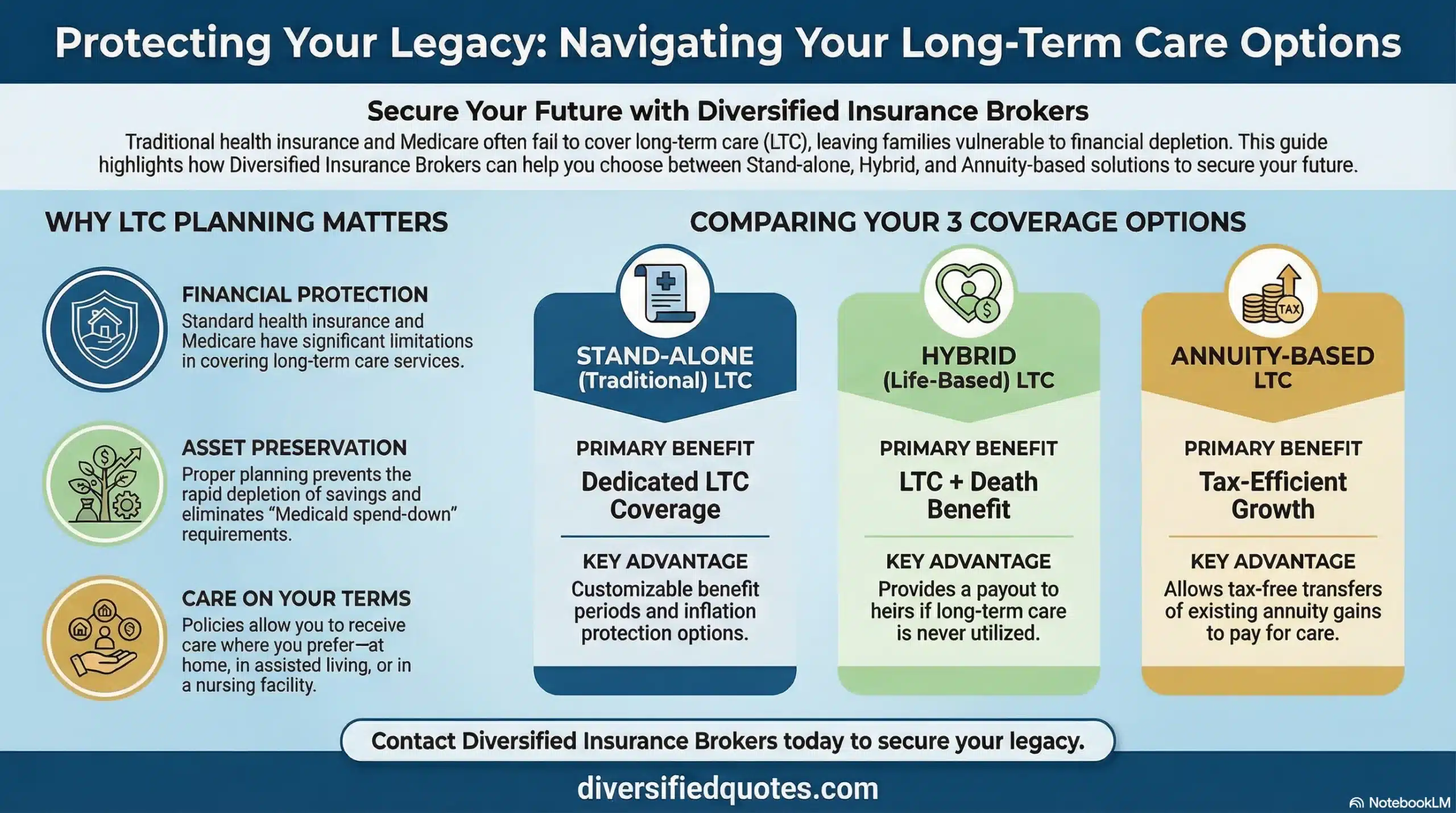
When couples evaluate long-term care insurance with shared benefits, they typically must also decide between traditional long-term care insurance and hybrid designs that combine life insurance or annuity benefits with long-term care coverage. Both categories can incorporate shared-care features for couples, but they have meaningfully different structural characteristics that affect which is the better fit for specific household goals.
Traditional long-term care insurance is built specifically to deliver maximum coverage per premium dollar for care-related expenses. Because the product’s only purpose is long-term care protection, the benefit leverage relative to premium is typically stronger than in hybrid designs. For couples who prioritize maximum monthly benefit coverage relative to premium cost, traditional LTC with a shared-care rider is frequently the most efficient structure. The primary objection couples raise to traditional LTC is the “use it or lose it” concern — if neither spouse ever needs care, the premiums paid may generate no direct return. Our resource on whether long-term care insurance is worth it addresses this concern directly with the realistic probability framing that helps couples evaluate the risk honestly.
Hybrid life/LTC designs address the “use it or lose it” concern by building a life insurance death benefit alongside the long-term care coverage. If LTC benefits are never used, the death benefit passes to beneficiaries — the premium investment is not entirely “lost” if care is never needed. For couples who prioritize legacy value and the certainty that some benefit will reach beneficiaries regardless of care outcome, hybrid designs have genuine appeal. Our resource on fixed annuity with long-term care benefits covers the annuity-based hybrid approach, and our broader long-term care insurance service overview covers the full product landscape across both traditional and hybrid categories.
Some couples approach the choice by coordinating LTC with the couple’s broader income strategy — understanding that guaranteed retirement income covering baseline expenses can inform how much LTC coverage is needed for care-specific costs. For couples building the income side of that integrated plan, our resource on what a joint lifetime income annuity is covers the joint-life income structure that often serves as the companion planning tool to shared-benefit LTC coverage. The income layer handles fixed monthly expenses; the LTC layer handles care-specific costs; and the GLWB income rider may provide the flexible income structure that bridges between the two.
Underwriting Realities for Couples
Long-term care insurance with shared benefits is fully underwritten coverage — both spouses must qualify individually based on health history, current health status, medications, mobility, and cognitive screening. This is not a guaranteed-issue product, and the underwriting process is real and consequential. Understanding what underwriting involves and applying at the right time is one of the most important practical decisions in the entire LTC planning process.
Age and health at application are the two primary determinants of approval, coverage availability, and premium level. Applying in the mid-50s typically produces the best combination of approvability, premium efficiency, and flexibility in coverage design. Applying in the 60s is still common and often effective, though premiums are higher and some health conditions that would have been acceptable at younger ages may result in restrictions or declines. Applying after 70 narrows the carrier pool significantly and increases the probability of rated offers or outright declines — not because older applicants need care less, but because the underwriting math shifts meaningfully. Our resource on long-term care insurance after age 80 covers the carrier options that remain available for those who delayed planning.
Couples often benefit from applying together, both because some carriers offer household discounts when both spouses apply simultaneously and because joint application allows the coverage design to be coordinated coherently across the household from the start. One practical risk of sequential application — one spouse applies and is approved, then the other applies later — is that if the second spouse is declined or receives a rated offer, the household’s coverage design may need to be entirely restructured under time pressure. Applying together, when both spouses are healthy enough to qualify, eliminates this risk. Our resource on how to qualify for LTC insurance covers the underwriting standards that apply to most traditional LTC carriers.
For couples who have already missed the optimal underwriting window or who have health conditions that may complicate traditional LTC underwriting, group long-term care insurance and certain hybrid life/LTC designs may offer more accessible underwriting standards. These alternatives typically provide less leverage per premium dollar than traditional LTC for healthy applicants, but they can provide meaningful coverage for households where traditional underwriting presents challenges. Our second opinion on your LTC quote service is also available for couples who have already received coverage offers and want independent validation that the design and pricing are appropriate for their situation.
How Shared LTC Benefits Fit the Broader Retirement Strategy
Long-term care insurance with shared benefits is not a standalone product decision — it is one component of a retirement protection strategy that works best when coordinated with income, assets, and legacy goals. The most effective coupling-level LTC plans are built to work alongside, not instead of, the couple’s broader retirement income structure.
The coordination logic works as follows: guaranteed retirement income sources — Social Security, pensions, and annuity income — cover fixed monthly expenses that recur regardless of whether a care event occurs. Long-term care insurance benefits cover care-specific costs that arise when a care event begins. Liquid investments and savings cover flexibility needs: large discretionary expenses, investment opportunities, emergencies, and goals that neither income nor LTC coverage is designed for. This three-layer structure — income for fixed costs, LTC for care costs, savings for flexibility — keeps each component doing the job it does best without requiring any single component to solve all retirement financial problems simultaneously.
From an elimination period perspective, the integration with retirement income matters practically. A couple with $6,000 per month of guaranteed income and $3,500 per month of fixed household expenses has approximately $2,500 per month in excess income that can accumulate during healthy retirement years, building a reserve that can cover a 90-day elimination period without hardship. That same financial picture might support a longer elimination period in the LTC design, reducing premiums while relying on the accumulated reserve to bridge the initial coverage gap. The LTC partnership program is another tool worth understanding in this context — it allows policyholders who exhaust qualifying LTC benefits to protect a corresponding amount of assets from Medicaid spend-down requirements, which can be an important planning layer for couples concerned about long-duration care scenarios.
For couples coordinating the income side of this integrated strategy, our resource on joint lifetime income annuities covers the income foundation structure most commonly paired with shared-care LTC coverage, and our resource on annuity beneficiary and death benefit provisions covers the legacy treatment that may affect how the couple coordinates LTC protection with their estate planning intentions. Partnership-qualified coverage is covered in our dedicated resource on partnership-qualified long-term care insurance.
Protect Both Spouses With One Coordinated Plan
We design shared LTC protection that matches your retirement income, assets, and care preferences — comparing shared and separate designs side by side with real local care costs.
Request My LTC PlanRelated Pages: Long-Term Care Planning for Couples
Continue researching shared benefit designs, policy mechanics, and LTC planning strategy.
Financial Protection Essentials
Retirement income tools, cost calculators, and income planning resources for couples coordinating LTC with the broader retirement plan.
Talk With an Advisor Today
Choose how you’d like to connect—call or message us, then book a time that works for you.
Schedule here:
calendly.com/jason-dibcompanies/diversified-quotes
Licensed in all 50 states • Fiduciary, family-owned since 1980
FAQs: Long-Term Care Insurance With Shared Benefits for Couples
What does “shared benefits” mean in long-term care insurance for couples?
Shared benefits in long-term care insurance means that two spouses’ individual coverage pools are combined — through a shared-care rider — into a single household pool that either spouse can draw from. Rather than each spouse being strictly limited to their own policy’s maximum benefit, the combined pool is available to whichever spouse needs care, in whatever proportion the actual care pattern requires. If one spouse exhausts their individual portion of the pool due to extended care needs, the shared structure allows the claim to continue drawing from the remaining household pool, rather than stopping at the individual maximum.
This design directly addresses the most financially damaging long-term care scenario for couples: one spouse needing extended care that consumes their entire individual benefit, while the other spouse’s unused coverage sits inaccessible under a separate policy. The shared pool eliminates this structural gap by making all household coverage available to the spouse who needs it most, regardless of which spouse that is.
The practical result is that shared-care designs generally produce better household-level outcomes than separate policies when care needs are asymmetric — which is the typical real-world pattern. Both spouses maintain individual eligibility requirements (each must independently meet the policy’s disability triggers), but once eligibility is established, the pooled benefits provide more durable coverage for the household as a whole.
How is the shared pool size calculated?
The shared pool is typically calculated by combining both spouses’ individual benefit pools. Each spouse’s individual pool is generally calculated by multiplying the monthly benefit by the benefit period. For example, a $6,000 monthly benefit with a four-year benefit period creates approximately $288,000 of coverage per spouse — or approximately $576,000 combined for the household. With a shared-care rider, that $576,000 is available as a pool that either spouse can draw from in any proportion that reflects their actual care needs.
Couples do not need to have identical monthly benefits or identical benefit periods. A design where one spouse carries a $7,000 monthly benefit with a five-year period ($420,000) and the other carries a $5,000 monthly benefit with a four-year period ($240,000) would create a combined household pool of $660,000 — still available to either spouse under the shared structure. The flexibility to customize each spouse’s individual benefit design while still sharing the pool is one of the advantages of the shared-care approach.
The key variable beyond pool size is how the shared-care rider is structured by the specific carrier — whether it creates a true combined pool from inception or a “borrow from” mechanism once one spouse’s individual portion is exhausted. These structural differences matter in extended-care scenarios and should be reviewed in the specific carrier’s policy language before purchase.
Is shared-care coverage more expensive than two separate policies?
Adding a shared-care rider to two individual policies typically adds a modest cost relative to two standalone policies with the same individual benefit designs. The incremental cost of the rider reflects the additional risk the carrier takes on by allowing the household to access a combined pool rather than two capped individual pools — the carrier’s maximum exposure increases because a single claimant can now draw from a larger combined pool rather than being limited to their individual maximum.
However, shared-care designs often improve household premium efficiency when viewed from the perspective of how much meaningful coverage the household actually buys per premium dollar. Without sharing, unused individual coverage has no value to the other spouse — the premium paid for a policy whose benefits are never accessed is effectively wasted from a household perspective. With sharing, the risk of unused benefits is substantially reduced because the pool is available to whichever spouse actually needs care, maximizing the household’s coverage utilization regardless of which spouse claims first or how much each spouse claims.
In practice, many couples find that shared-care designs allow them to build a more efficiently sized household benefit pool than two oversized individual policies — the shared structure provides more real household protection with comparable or modestly higher premium than two separate policies would require to provide similar household-level certainty. Our resource on how much LTC insurance you need covers the benefit-sizing framework that informs this efficiency comparison.
What happens to shared benefits if one spouse passes away?
In many shared-care designs, remaining benefits in the combined pool continue to be available to the surviving spouse after the first spouse’s death. If the deceased spouse never made a claim — or claimed only a portion of the shared pool — those remaining benefits stay accessible to the survivor for their own future care needs. This survivor-continuation feature is one of the most compelling aspects of shared-care designs for couples who are concerned about the surviving spouse’s long-term financial security.
The specific treatment at death varies by carrier and policy design. Some policies include explicit survivorship provisions that confirm the surviving spouse retains the full remaining pool. Others may have survivorship provisions that adjust premium obligations for the surviving spouse — some carriers waive or reduce ongoing premiums for the survivor after a qualifying period of claims by the deceased spouse. These survivorship features are not universal and are structured differently across carriers, which is one reason comparing specific carrier contract language is essential rather than comparing only headline benefit numbers.
For the surviving spouse’s overall financial picture, understanding how LTC coverage interacts with retirement income planning is also important. Guaranteed income sources that continue for the survivor — Social Security survivor benefits, pension survivor benefits, and joint-life annuity income — form the income foundation that the surviving spouse’s LTC coverage can complement. Our resource on what a joint lifetime income annuity is covers the income continuation structure most often coordinated with shared-care LTC coverage.
What triggers long-term care insurance benefits?
For most tax-qualified traditional LTC policies, benefits become payable when a licensed healthcare practitioner certifies that the insured cannot perform at least two of the standard activities of daily living (ADLs) without substantial assistance, or that a cognitive impairment requires substantial supervision to protect health and safety. The standard ADLs are bathing, dressing, transferring, toileting, continence, and eating. A person needing substantial help with two or more of these activities meets the functional impairment trigger for most policies.
The cognitive impairment pathway provides a separate route to benefits when conditions such as Alzheimer’s disease or other forms of dementia create a need for substantial supervision, regardless of whether ADL criteria are independently satisfied. Many care journeys — particularly those involving progressive memory conditions — qualify primarily through the cognitive impairment pathway rather than through ADL impairment, which makes the policy’s cognitive impairment definition particularly important for couples with family history of dementia.
Most policies also require a plan of care from a licensed healthcare professional and periodic recertification to confirm continued eligibility. In a shared-care household, both spouses must independently meet these eligibility criteria when claiming — the shared pool affects how much coverage is available, not whether eligibility has been established. For couples who want to understand the full claims process before purchasing, our resource on how to apply for LTC insurance covers the process from application through claims.
Should we choose 3% or 5% compound inflation protection?
The choice between 3 percent and 5 percent compound inflation protection depends primarily on the couple’s age at application and the timeline between application and when care is likely to begin. Inflation protection compounds annually — meaning a $6,000 monthly benefit grows to approximately $8,100 after 10 years at 3 percent compound, and to approximately $9,775 after 10 years at 5 percent compound. Over 20 years, those figures diverge further: approximately $10,900 at 3 percent vs. approximately $15,930 at 5 percent. The difference in projected benefit at care start date is substantial, particularly for couples applying in their mid-50s who may not need care for 20 or more years.
The cost difference between inflation options is also meaningful. Five percent compound inflation significantly increases premiums because the carrier is taking on much larger long-term benefit obligations. For couples balancing strong inflation protection against sustainable premium levels, 3 percent compound is frequently the most practical balance — providing meaningful inflation protection while keeping premiums within a range the couple can sustain for decades without needing to reduce coverage.
For couples applying at older ages — 70 or above — the calculus shifts. With a shorter expected window before care begins, the compounding benefit of inflation protection is smaller, and the premium cost may outweigh the inflation-protection value. Some older applicants choose simpler non-inflation designs or future-purchase options that allow benefit increases without ongoing compound inflation costs. Our resource on LTC elimination periods and our broader resource on LTC planning strategies cover these design tradeoffs in the context of age-appropriate planning.
Are long-term care insurance benefits tax-free?
Benefits from tax-qualified long-term care insurance policies are generally received tax-free when the claim meets the policy’s eligibility criteria. The tax-qualified designation — established by the Health Insurance Portability and Accountability Act (HIPAA) in 1996 — sets the federal standard for benefit-trigger definitions that entitle benefits to tax-free treatment. Most traditional LTC policies sold today are designed to meet tax-qualified standards, which means benefits paid for qualifying care are excluded from the policyholder’s taxable income.
Premiums for tax-qualified LTC policies may also be potentially deductible as a medical expense, subject to several conditions: premiums must be paid with after-tax dollars, the policyholder must be itemizing deductions, total medical expenses must exceed 7.5 percent of adjusted gross income, and only the age-limited premium amounts specified annually by the IRS are counted toward the deductible portion. Self-employed individuals may have access to a more favorable deduction structure for LTC premiums. Health Savings Account funds can also be used to pay tax-qualified LTC premiums up to the same IRS age-based limits, which can provide a tax-efficient premium funding strategy for couples with HSA balances.
Tax treatment should be considered an important planning factor but not the primary decision driver for LTC policy selection. The policy should be purchased because it solves a genuine financial and caregiving risk — the tax advantages are meaningful secondary benefits that improve the overall value of coverage. For the full tax context, our resource on tax advantages of long-term care insurance covers the premium and benefit tax treatment in detail.
How do we fit long-term care insurance into our overall retirement plan?
The most effective integration places LTC coverage in a specific role within the retirement income structure: covering care-specific costs while guaranteed income sources cover fixed monthly expenses and liquid savings handle flexibility needs. In this framework, Social Security, pension income, and annuity income provide the monthly income floor that covers housing, food, utilities, and other fixed expenses that continue regardless of health status. LTC benefits activate when care costs arise — covering home health aides, assisted living, memory care, or nursing facility costs — without requiring the couple to liquidate retirement investments at potentially inopportune times.
The elimination period selection connects directly to this income framework. A couple with $3,000 per month in excess income above fixed expenses can accumulate meaningful reserves during healthy retirement years, creating a natural elimination-period reserve. That reserve allows a longer elimination period in the LTC design — reducing premiums while relying on the accumulated savings to bridge the initial coverage gap when a claim begins. This coordination between income surplus and elimination period selection is one of the most practically impactful planning decisions in LTC design and is best made with explicit income projections rather than with generic premium comparisons.
For couples who have not yet established the income foundation of their retirement plan, resources like our coverage of joint lifetime income annuities, GLWB income riders, and COLA on annuity income cover the income tools most frequently coordinated with shared-care LTC coverage. Building both layers — the income layer and the LTC layer — together produces a more integrated and cohesive retirement protection plan than building each in isolation.
About the Author:
Jason Stolz, CLTC, CRPC, DIA, CAA and Chief Underwriter at Diversified Insurance Brokers (NPN 20471358), is a senior insurance and retirement professional with more than 25 years of real-world experience helping individuals, families, and business owners protect their income, assets, and long-term financial stability. As a long-time partner of the nationally licensed independent agency Diversified Insurance Brokers, Jason provides trusted guidance across multiple specialties—including fixed and indexed annuities, long-term care planning, personal and business disability insurance, life insurance solutions, Group Health, Travel Medical and Evacuation Insurance, and short-term health coverage. Diversified Insurance Brokers maintains active contracts with over 100 highly rated insurance carriers, ensuring clients have access to a broad and competitive marketplace.
His practical, education-first approach has earned recognition in publications such as VoyageATL, and contributions from his agency featured in Kiplinger and GoBankingRates— highlighting his commitment to financial clarity and client-focused planning. Drawing on deep product knowledge and years of hands-on field experience, Jason helps clients evaluate carriers, compare strategies, and build retirement and protection plans that are both secure and cost-efficient. Visitors who want to explore current annuity rates and compare options across multiple insurers can also use this annuity quote and comparison tool.
Explore More Long Term Care Insurance Options: Browse our complete guide to How to Buy, Qualify & Coverage Details — covering how to buy, who qualifies, policy types, shared benefits, partnership plans & more from top carriers.
Last Reviewed: May 21, 2026 |
Reviewed by: Jason Stolz, CLTC, CRPC, DIA, CAA
Chief Underwriter, Diversified Insurance Brokers, Inc. | NPN: 20471358 | Diversified Insurance Brokers, Inc. — Licensed in all 50 states
Fact Checked by: Tonia Pettitt, CMIP©
Medicare Specialist, Diversified Insurance Brokers, Inc. | NPN: 14374308 | Diversified Insurance Brokers, Inc. — Licensed in all 50 states
Did you find this content helpful? Leave us a Google review — it helps others find trustworthy guidance too.
Editorial Standards: Diversified Insurance Brokers maintains rigorous editorial standards to ensure accuracy, clarity, and independence in all content. Learn more about our editorial standards and commitment to transparency.
