
Partnership Qualified Long-Term Care Insurance
As an Independent Long Term Care Insurance Broker, we compare traditional, hybrid, and partnership-qualified policies across dozens of carriers to find the structure that actually fits your situation.
Partnership Qualified Long-Term Care Insurance

Jason Stolz CLTC, CRPC, DIA, CAA
Partnership-qualified long-term care insurance is one of the most powerful planning tools for people who want to protect retirement assets while still keeping a realistic backstop if a long-term care event lasts longer than expected. Most families do not plan to rely on Medicaid for care. They plan to pay their own way, preserve control, and protect their spouse. The challenge is that long-term care costs can rise faster than expected, last longer than expected, and show up right when a household’s retirement income plan is most vulnerable. A partnership-qualified LTC policy is designed to reward proactive planning by combining private insurance benefits with a special Medicaid asset-protection feature that can help preserve savings if a policy’s benefits are exhausted.
At Diversified Insurance Brokers, we help clients understand how partnership-qualified long-term care plans work, how they differ from non-partnership LTC policies, and how they can be used to protect both your financial independence and your family’s long-term security. Partnership qualification is not a separate product category the way hybrid or annuity-based options are different structures. Instead, it is a specific certification that certain traditional LTC policies can meet, and that certification is what unlocks the Medicaid-linked asset protection benefit. Understanding this distinction is the foundation of everything else in partnership planning — because the rules are nuanced, but the payoff can be very meaningful when a care event turns into a multi-year claim. Long-term care planning strategies covers the full landscape of approaches — traditional, hybrid, annuity-based, and self-funding — so the partnership decision can be made within the broader context of what each structure accomplishes.
Request a Partnership LTC Quote
See partnership-qualified options available in your state and compare benefits, inflation choices, and premiums.
What Is a Partnership Qualified LTC Policy?
A partnership-qualified long-term care insurance policy is a state-approved LTC policy that meets specific consumer-protection and inflation-protection requirements established under the Long-Term Care Partnership Program. If a policy meets those requirements and is issued as Partnership Qualified in your state, it can provide an additional benefit that most people do not realize exists until they need it: dollar-for-dollar asset protection for Medicaid eligibility purposes. This means the amount the policy pays in benefits becomes the amount of assets you can protect from Medicaid spend-down calculations when and if you apply for Medicaid long-term care assistance after private benefits are exhausted.
In practical terms, partnership qualification is about what happens if the cost of care outlasts the private insurance policy. Traditional long-term care insurance is designed to provide benefits for a defined period or defined pool of money. If a claim is longer than expected and those benefits are exhausted, families face a hard transition: continue to self-fund care and deplete assets quickly, or apply for Medicaid, which typically requires spending down assets to meet eligibility rules. A partnership-qualified policy changes that spend-down dynamic by allowing you to protect assets equal to the amount the policy paid in benefits. This is why partnership policies are frequently described as a bridge between private planning and a public backstop — the private policy helps you maintain control and protect choice while benefits are available, and the partnership feature improves the outcome if benefits run out and Medicaid becomes part of the later-stage funding picture. How to find, evaluate, and apply for long-term care insurance provides the foundational framework of how LTC policies are structured, what benefit triggers look like, and how the application process works — the essential context for evaluating partnership qualification within a complete plan design.
How Partnership LTC Policies Work
The easiest way to understand a partnership-qualified LTC policy is to follow the claim timeline. First, you purchase a long-term care policy that is certified as Partnership Qualified in your state. The policy functions as standard LTC insurance — it pays benefits for covered care once you meet benefit triggers, which are typically tied to needing assistance with activities of daily living or having cognitive impairment. Second, when care is needed, you use your policy benefits to pay for eligible services — home care, assisted living, or skilled nursing, depending on contract terms. During this phase, the most important outcome is that you are not paying entirely out-of-pocket, which reduces the need to liquidate investments, increase retirement account withdrawals, or change the healthy spouse’s lifestyle during what may be a multi-year claim. Third, if care continues and benefits are exhausted, you may apply for Medicaid. This is where partnership qualification activates: the amount your policy paid in benefits becomes the amount of assets you can protect from Medicaid spend-down rules on a dollar-for-dollar basis. The protected assets are excluded from the Medicaid asset calculation up to that amount, allowing you to qualify for assistance while preserving more savings for yourself, your spouse, or your heirs.
Many people hear “Medicaid” and immediately think of limited facility choice or restrictive eligibility. That concern is not wrong. Partnership planning is not designed to make Medicaid simple or eliminate its rules. It is designed to prevent a common retirement scenario: paying for years of care, exhausting a policy, then being forced to spend down nearly everything before qualifying for assistance. Partnership qualification does not eliminate Medicaid’s rules, but it can substantially improve the asset outcome at the point of transition. Are Medicare and long-term care insurance the same covers the important distinction between Medicare’s limited skilled nursing coverage and Medicaid’s long-term care funding role — essential background for understanding why Medicaid planning is relevant even for retirees who have Medicare coverage.
Partnership vs. Non-Partnership LTC: Key Differences
| Feature | Partnership-Qualified LTC Policy | Non-Partnership LTC Policy |
|---|---|---|
| Asset protection at Medicaid | Dollar-for-dollar: assets equal to total benefits paid are protected from Medicaid spend-down calculations | Standard Medicaid asset limits apply — no additional protection linked to insurance benefits paid |
| Inflation protection | Required for partnership certification — typically compound inflation protection for younger buyers; state rules determine specifics | Optional — inflation protection can be added or omitted without affecting policy certification |
| State certification | State-specific — policy must meet Partnership Program requirements in the state where issued; certification is not automatic | No state certification required beyond standard insurance department filing and approval |
| Reciprocity for movers | Many states have reciprocity agreements that recognize partnership protection from other states — varies by state | No partnership reciprocity considerations — Medicaid rules in the new state apply without modification |
| Private benefit phase | Identical to non-partnership — benefits pay for covered care services according to contract terms during the private coverage phase | Identical — benefits pay for covered care services according to contract terms during the private coverage phase |
| Best suited for | Households with meaningful assets to protect who want both private coverage and a better outcome if Medicaid becomes part of the extended-claim funding plan | Households focused entirely on the private coverage phase who are less concerned about Medicaid asset protection as a back-end outcome |
Why Partnership Qualification Exists
Partnership programs were created to encourage private long-term care planning. Without an incentive, many families delay planning and then rely on Medicaid when care becomes unavoidable. States and the federal government have a strong interest in encouraging people to use private insurance first, because it reduces strain on public programs. The Long-Term Care Partnership Program is an attempt to reward responsible planning while still preserving a Medicaid safety net for catastrophic long-duration claims. From a family’s standpoint, partnership qualification is really about protecting middle-retirement wealth — households with meaningful savings they want to protect and a strong desire to avoid spending down everything they have built.
People with very low assets may already qualify for Medicaid, though care choices may be limited. People with very high assets may decide to self-fund. But many households fall in the middle — with enough retirement savings and home equity to make Medicaid eligibility complex, but not enough to absorb years of high-cost care without significant financial damage. Partnership-qualified LTC insurance is often designed for that planning gap — providing real private coverage while creating a better asset outcome if Medicaid becomes part of the long-duration care picture. Is long-term care insurance worth it covers the full cost-benefit framework that helps households evaluate whether the premium investment makes sense relative to the care cost risk and the alternative of self-funding. Cost of long-term care by state calculator provides the state-specific cost benchmarks that ground the coverage sizing decision in actual market rates rather than national averages that may not reflect local care economics.
Inflation Protection and Partnership Qualification
Inflation protection is not optional in partnership planning — it is frequently a requirement for partnership certification, and it is also a practical necessity because long-term care costs are driven by labor-intensive service delivery that can increase faster than general consumer inflation. When people buy long-term care coverage in their fifties or early sixties, the plan they buy today must still function meaningfully decades later when care is actually needed. Inflation protection is the mechanism that prevents the policy’s daily benefit from becoming inadequate relative to actual future care costs.
Partnership inflation requirements vary by age at purchase and by state rules, but the general principle is consistent: younger buyers typically must select compound inflation protection to qualify, while older buyers may have more flexibility in inflation structure. The key takeaway for planning purposes is that partnership certification is tied to buying an inflation structure that keeps benefits meaningful across a long time horizon — which is also what makes the private coverage phase effective, independent of any Medicaid-related benefit. A policy with inadequate inflation protection may not only fail to qualify for partnership certification but may also fail to cover a meaningful share of care costs when the policy actually needs to perform.
It is also important to understand that inflation protection affects both policy value and premium. Higher inflation protection typically increases premium because it increases projected future benefit payments, but it also substantially increases the probability that the policy will remain relevant when care is actually needed. In partnership planning, inflation is not a side detail — it is central to whether the plan qualifies for partnership certification and whether it remains effective across the full planning horizon. Long-term care insurance calculator helps households model how benefit amounts and inflation structures interact over time to determine whether a given daily benefit will be sufficient relative to projected future care costs.
Dollar-for-Dollar Asset Protection in Practice
The dollar-for-dollar asset protection feature is the defining characteristic of partnership-qualified LTC policies, and understanding exactly how it works is essential for evaluating whether partnership certification is worth prioritizing. If a partnership-qualified LTC policy pays a total of $300,000 in long-term care benefits over the life of a claim, the policyholder can generally protect $300,000 of assets from Medicaid spend-down calculations when applying for Medicaid long-term care assistance. Those protected assets are disregarded in the Medicaid asset eligibility calculation up to the amount of benefits paid — meaning the household can qualify for Medicaid while retaining assets that would otherwise need to be depleted to the Medicaid asset floor.
This feature changes the planning conversation for many middle-wealth households in a fundamental way. Most Medicaid asset limits are very low — in many states, a single applicant must spend down to $2,000 in countable assets to qualify. For a household with $400,000 in savings, that spend-down requirement is catastrophic. A partnership policy that pays $300,000 in benefits before benefits are exhausted would allow the household to protect $300,000 of assets rather than the standard $2,000 limit — a difference that can preserve spousal security, protect housing, and leave meaningful assets for heirs rather than requiring near-total depletion before qualifying for assistance.
For some households, the most important application of partnership protection is not inheritance planning — it is spousal security. When one spouse has an extended care claim, the healthy spouse can become financially vulnerable as assets are depleted to fund care. Partnership protection may help preserve assets that support the healthy spouse’s lifestyle and stability later, rather than forcing total spend-down that leaves the surviving spouse with inadequate resources. Long-term care insurance with shared spousal benefits covers how household-based flexibility through shared benefit pools can complement partnership protection for couples who want both enhanced coverage flexibility and the asset protection that partnership certification provides. LTC partnership reciprocity covers an important dimension of partnership planning for retirees who move between states — how reciprocity agreements between states determine whether partnership protection earned under one state’s program is recognized in another state’s Medicaid eligibility calculation.
What Partnership Qualification Does Not Do
Partnership-qualified LTC insurance is powerful, but it is not a comprehensive solution to every long-term care planning challenge. It does not guarantee Medicaid approval regardless of circumstances — Medicaid still has income rules, eligibility requirements, and state-specific procedures. Partnership asset protection generally applies to the asset side of the eligibility calculation, not necessarily the income side, and Medicaid income rules must still be navigated separately. It also does not guarantee unlimited facility choice under Medicaid — Medicaid programs can have limitations depending on state rules and provider participation that restrict the care setting options available to Medicaid recipients regardless of partnership certification status.
Partnership qualification also does not replace the need for a well-designed private insurance plan. The private policy is the primary tool — it pays benefits, provides flexibility in care setting selection, and reduces family stress during the active claim. Partnership protection is the back-end feature that applies if care becomes catastrophic in duration. If the private policy benefit is too small, has too short a benefit period, is misaligned with the intended care setting, or lacks adequate inflation protection, partnership certification alone will not make the plan effective. This is why partnership planning must be executed as part of a full LTC design conversation that addresses benefit amount, benefit duration, elimination period, inflation structure, and household budget — partnership is a feature of the plan, not a substitute for plan design discipline. How to choose the right long-term care insurance policy covers the complete benefit design framework that determines whether a policy will actually perform during a claim, independent of partnership certification.
Who Should Consider Partnership Qualified Coverage
Partnership-qualified coverage is often most relevant for individuals and couples who have meaningful assets but do not want to self-fund unlimited long-term care risk. Many households with retirement savings, home equity, and investment accounts are in the planning gap — they have too much to qualify for Medicaid easily, but not enough to absorb years of high-cost care without significant financial damage. Partnership-qualified coverage can be a fit for that gap because it provides private coverage first and then offers better asset outcomes if Medicaid becomes necessary later as a back-end safety net for extended claims.
Partnership coverage is also particularly relevant for people who strongly prioritize protecting a spouse. When one spouse has a long claim and private benefits are exhausted, partnership protection may help preserve assets that support the healthy spouse’s lifestyle and stability rather than forcing total spend-down. This spousal protection dimension is often the primary motivation for partnership planning in couple-based households where the financial consequences of one partner’s care claim are directly felt by the other partner’s retirement security. Can you still get long-term care insurance after age 60 covers the eligibility and premium impact questions for retirees approaching or past 60 who are evaluating whether partnership-qualified coverage is still accessible at their age. Long-term care insurance for seniors covers how coverage design and partnership qualification considerations shift as applicants age and underwriting requirements tighten.
How Partnership Policies Compare to Hybrid and Annuity Strategies
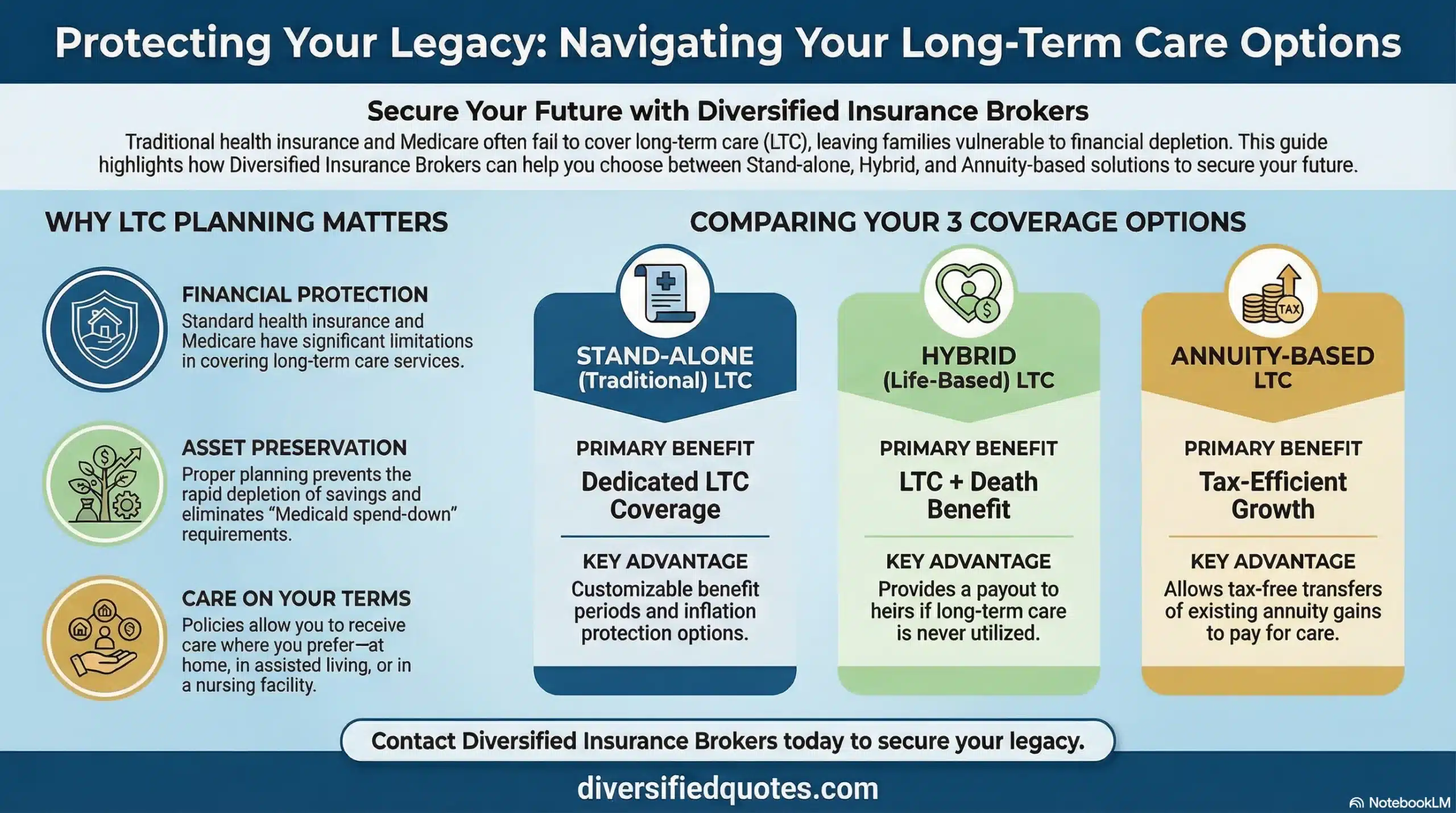
Partnership-qualified LTC policies are typically traditional long-term care insurance policies — an important distinction because many consumers compare partnership planning to hybrid life/LTC or annuity-based strategies. Hybrid strategies can be excellent for people who want value either way — a death benefit if care is never needed, or LTC benefits if care is needed — and for people who prefer premium certainty and do not want the risk of premium increases over time. Annuity-based LTC strategies can be useful for repositioning existing assets into a structure that provides tax-efficient long-term care funding under the Pension Protection Act rules. However, many hybrid and annuity-based LTC structures are not partnership-qualified in the same way traditional LTC policies can be, and the Medicaid-linked dollar-for-dollar asset protection feature is often specific to qualifying traditional LTC designs under the Partnership Program.
This does not mean hybrid or annuity-based options are inferior for all households. It means the decision should be based on what the plan needs to accomplish. If partnership asset protection is the priority, evaluating partnership-certified traditional policies first is the appropriate starting point. If premium certainty, value either way, or asset repositioning are higher priorities, hybrid and annuity-based strategies may be more appropriate. Hybrid life versus traditional long-term care insurance covers the structural comparison between these two approaches in detail and helps households understand which design fits their specific planning objectives. Affordable hybrid long-term care policies covers the accessible entry points for hybrid coverage for households evaluating the hybrid alternative to partnership-qualified traditional coverage. Annuity with long-term care benefits and non-qualified long-term care annuity cover the asset-repositioning approach for retirees who want to use existing savings to fund LTC benefits through a tax-advantaged annuity structure.
Tax Benefits in Partnership LTC Planning
Tax considerations are often part of the partnership planning conversation because LTC insurance can carry meaningful tax advantages that affect the net cost of coverage. Benefits from tax-qualified LTC policies are generally received income-tax-free when paid for qualified long-term care services, meaning the insurance proceeds are not added to taxable income in the year received. Premiums may be deductible within IRS age-based limits for individuals who itemize deductions, and business owners may have additional deductibility options through certain business structures. Understanding how these tax elements work can help clarify the effective cost of coverage for households that can deduct a meaningful portion of premiums. Tax benefits of long-term care insurance covers the complete tax framework — premium deductibility thresholds, benefit tax treatment, and business deductibility structures — that affects how households should evaluate the true net cost of partnership-qualified coverage as part of an integrated retirement income and tax plan.
How to Verify a Policy Is Partnership Qualified
The most important verification step is ensuring the policy is explicitly issued as Partnership Qualified for your state. Partnership certification is state-specific — a policy that qualifies in one state may not qualify in another if rules differ. Carriers typically include required partnership disclosure language and state-specific certification forms when a policy is issued as partnership-qualified, and the policy documents should explicitly reflect the partnership status. You should not assume a policy is partnership-qualified simply because it is issued by a well-known LTC carrier or because it includes inflation protection — partnership is a certification, and that certification must be verified in the policy documents.
If you already own an older long-term care policy, partnership qualification is not always straightforward to determine retroactively. Some older policies were issued before partnership rules were widely adopted and may not meet current certification standards. In some cases, riders or changes may bring a policy into alignment, but that depends on carrier rules and state requirements. The practical approach is to review the actual policy documents and confirm partnership certification status in your current state of residence rather than assuming based on issue date or carrier reputation. LTC partnership reciprocity is particularly relevant for retirees who have relocated since original policy issuance and want to understand whether their partnership protection transfers to their new state of residence under reciprocity agreements. Getting a second opinion on your long-term care insurance quote confirms whether existing coverage is appropriately designed, competitively priced, and — if relevant — correctly certified for partnership qualification in the current state.
Confirm Partnership Eligibility in Your State
We’ll verify partnership certification requirements and show plans that meet state standards, including inflation rules.
What to Compare When Evaluating Partnership Policies
When comparing partnership-qualified LTC policies, focusing on the variables that change real-world outcomes is more productive than comparing surface-level features. Benefit amount and benefit duration determine how much private funding is available before Medicaid becomes relevant — and because the dollar-for-dollar protection is directly tied to the total amount the policy pays, benefit pool size directly affects the potential protected asset amount at the Medicaid transition point. A larger benefit pool paid before benefits are exhausted creates a larger protected asset amount under partnership rules. The elimination period determines how long the insured pays out-of-pocket before benefits begin and affects both the plan’s cash flow impact during the early claim period and the household’s need for liquid emergency reserves alongside the policy. Inflation protection determines whether the plan remains meaningful over time and whether it maintains partnership certification across the full planning horizon. Optional riders — premium waiver during claim, survivorship benefits that eliminate premiums if one spouse claims for a defined period, or return-of-premium features — change how the policy behaves during and after a claim.
For couples, comparing household-level flexibility through shared benefit pool designs alongside individual partnership-qualified policies is an important part of the evaluation. A shared benefit pool allows both spouses to draw from a combined benefit amount rather than being limited to individual policy limits, which can provide meaningful protection if one spouse has a significantly longer claim than the other. Long-term care insurance with shared spousal benefits covers how shared benefit structures work and how they coordinate with partnership certification. For households that have concerns about paying premiums for coverage they may never use, long-term care insurance with return of premium covers how refund-oriented policy designs are structured and what the trade-offs are relative to standard non-return policies. How to get the best long-term care insurance rates covers the underwriting and comparison approach that produces the most competitive premium across the carrier market for a given benefit design. Best independent long-term care insurance broker covers why working with an independent advisor who has access to the full carrier market — rather than a captive agent or single-carrier representative — is essential for partnership-qualified coverage where state certification requirements and carrier availability vary significantly.
Why Work With Diversified Insurance Brokers
We are an independent insurance agency that helps clients compare long-term care strategies across traditional partnership-qualified, hybrid, and annuity-based planning. Because partnership certification is state-specific and carrier rules vary, households benefit from working with advisors who can compare multiple carriers and verify that a policy is actually partnership-certified where you live — not just issued by a carrier that sells in your state. We help clients evaluate benefit design, inflation requirements, premium structure, household budget, and long-term outcomes so coverage decisions are based on how the plan actually performs when needed. We also help clients integrate LTC decisions into broader retirement planning, including how a long-term care event affects investment withdrawals, tax planning, and spousal security — because the goal is not only to get a policy placed, but to build a plan that still works when care needs arrive on their own schedule rather than a convenient one. Our long-term care insurance services covers the full range of LTC planning approaches we help clients evaluate and implement.
Get a Partnership-Qualified LTC Comparison
See which plans in your state qualify for partnership protection and how much asset protection they could create.
Related Topics to Explore
Continue learning about long-term care strategies, tax advantages, and household planning options.
Talk With an Advisor Today
Choose how you’d like to connect—call or message us, then book a time that works for you.
Schedule here:
calendly.com/jason-dibcompanies/diversified-quotes
Licensed in all 50 states • Fiduciary, family-owned since 1980
Frequently Asked Questions: Partnership Qualified Long-Term Care Insurance
What does “dollar-for-dollar” asset protection mean in a partnership LTC policy?
Dollar-for-dollar asset protection means that for every dollar a partnership-qualified LTC policy pays in benefits, one dollar of your assets is protected from Medicaid spend-down calculations when you apply for Medicaid long-term care assistance. If a policy pays $200,000 in total benefits before benefits are exhausted, you can protect $200,000 of assets from the Medicaid asset eligibility calculation — meaning you can qualify for Medicaid while retaining $200,000 more in savings than the standard Medicaid asset limit would otherwise allow. This does not mean Medicaid pays for those assets or transfers them in any way. It means those assets are disregarded in the eligibility determination up to the amount of benefits paid by the partnership policy, allowing the household to qualify for Medicaid assistance without being required to deplete those protected assets first.
Is inflation protection required for a partnership-qualified LTC policy?
In most states, yes — inflation protection is required for partnership certification, though the specific requirements vary by state and by the applicant’s age at purchase. Younger buyers typically must select compound inflation protection to meet partnership certification requirements. Older buyers may have more flexibility in inflation structure while still qualifying. The inflation requirement exists because partnership certification is linked to ensuring the policy remains meaningful over time — a policy without adequate inflation protection would be unlikely to keep pace with future care costs, potentially leaving the insured with a benefit that is too small to cover actual care when needed. Beyond the certification requirement, inflation protection is a practical necessity for long-term care coverage regardless of partnership status, because care costs are labor-intensive and can increase significantly over a decade or more.
Does my partnership LTC policy transfer if I move to another state?
Many states participate in partnership reciprocity agreements that recognize partnership asset protection earned under another state’s program when an individual moves and later applies for Medicaid in the new state. However, reciprocity is not universal — not every state recognizes every other state’s partnership certification, and the rules governing what is recognized can vary. If you own a partnership-qualified policy issued in one state and plan to relocate, verifying whether the new state’s Medicaid program recognizes your policy’s partnership protection under reciprocity is an important planning step. This verification should happen before relocation when possible, because the reciprocity status of a specific policy in a specific state determines whether the asset protection you planned for will actually apply in the new state’s Medicaid eligibility calculation.
How do I know if a policy I’m being shown is actually partnership-qualified?
A partnership-qualified policy will explicitly state its partnership certification status in the policy documents, typically through required state-specific disclosure language and partnership certification forms. You should not assume a policy is partnership-qualified based on the carrier’s reputation, the presence of inflation protection, or a sales representative’s verbal representation. Partnership is a specific state certification, and that certification must be reflected in the actual policy documents. When evaluating a policy, ask the carrier or agent to confirm in writing that the policy is issued as partnership-qualified in your state, and verify that the policy documents include the required state partnership disclosure language. Working with an independent LTC specialist who can confirm partnership certification across multiple carrier options provides the most reliable verification.
Is a partnership-qualified policy better than a hybrid LTC policy?
Neither is categorically better — they solve different problems. A partnership-qualified traditional LTC policy provides the Medicaid-linked dollar-for-dollar asset protection feature and typically offers the broadest benefit design flexibility, but premiums can increase over time and the policy has no value if care is never needed. A hybrid life/LTC policy combines a death benefit with long-term care benefits, provides premium certainty, and delivers value whether or not care is needed — but most hybrid structures are not partnership-certified in the same way traditional LTC policies are, so the Medicaid-linked asset protection feature typically does not apply. If dollar-for-dollar asset protection and Medicaid coordination are the primary planning priorities, a partnership-qualified traditional policy is generally the better fit. If premium certainty, value either way, and legacy planning are the primary priorities, a hybrid structure may be more appropriate. Many households evaluate both and make a decision based on which feature set addresses their most important concerns.
About the Author:
Jason Stolz, CLTC, CRPC, DIA, CAA and Chief Underwriter at Diversified Insurance Brokers (NPN 20471358), is a senior insurance and retirement professional with more than 25 years of real-world experience helping individuals, families, and business owners protect their income, assets, and long-term financial stability. As a long-time partner of the nationally licensed independent agency Diversified Insurance Brokers, Jason provides trusted guidance across multiple specialties—including fixed and indexed annuities, long-term care planning, personal and business disability insurance, life insurance solutions, Group Health, Travel Medical and Evacuation Insurance, and short-term health coverage. Diversified Insurance Brokers maintains active contracts with over 100 highly rated insurance carriers, ensuring clients have access to a broad and competitive marketplace.
His practical, education-first approach has earned recognition in publications such as VoyageATL, and contributions from his agency featured in Kiplinger and GoBankingRates— highlighting his commitment to financial clarity and client-focused planning. Drawing on deep product knowledge and years of hands-on field experience, Jason helps clients evaluate carriers, compare strategies, and build retirement and protection plans that are both secure and cost-efficient. Visitors who want to explore current annuity rates and compare options across multiple insurers can also use this annuity quote and comparison tool.
Explore More Long Term Care Insurance Options: Browse our complete guide to How to Buy, Qualify & Coverage Details — covering how to buy, who qualifies, policy types, shared benefits, partnership plans & more from top carriers.
Last Reviewed: June 16, 2026 |
Reviewed by: Jason Stolz, CLTC, CRPC, DIA, CAA
Chief Underwriter, Diversified Insurance Brokers, Inc. | NPN: 20471358 | Diversified Insurance Brokers, Inc. — Licensed in all 50 states
Fact Checked by: Tonia Pettitt, CMIP©
Medicare Specialist, Diversified Insurance Brokers, Inc. | NPN: 14374308 | Diversified Insurance Brokers, Inc. — Licensed in all 50 states
Did you find this content helpful? Leave us a Google review — it helps others find trustworthy guidance too.
Editorial Standards: Diversified Insurance Brokers maintains rigorous editorial standards to ensure accuracy, clarity, and independence in all content. Learn more about our editorial standards and commitment to transparency.
