
Affordable Hybrid Long-Term Care Policies
As an Independent Long Term Care Insurance Broker, we compare traditional, hybrid, and partnership-qualified policies across dozens of carriers to find the structure that actually fits your situation.
Affordable Hybrid Long-Term Care Policies

Jason Stolz CLTC, CRPC, DIA, CAA
Affordable hybrid long term care policies solve the most persistent objection to long-term care planning — the fear that decades of premium payments might produce nothing if care is never needed — by combining long-term care coverage with a life insurance or annuity component that ensures the dollars committed to the plan retain value regardless of whether qualifying care is ever triggered. When care is needed, the policy activates a pool of benefits that can pay for home health aides, assisted living, memory care, or skilled nursing. When care is never needed, the policy pays a death benefit to beneficiaries or retains accumulated annuity value. The “use it or lose it” problem that made many families avoid traditional long-term care insurance entirely disappears in a hybrid design — replaced by a contract that delivers value across every possible outcome. And because affordable hybrid long term care policies are often funded through repositioning of existing conservative assets rather than adding new cash-flow obligations, many families discover that the planning strategy is more accessible than they assumed.
At Diversified Insurance Brokers, we help clients nationwide compare affordable hybrid long term care policies across every major carrier — including Lincoln MoneyGuard, Nationwide CareMatters, OneAmerica Asset-Care, Pacific Life Premier Care, Brighthouse SmartCare, MassMutual, and Securian SecureCare — identifying which design, funding structure, and benefit architecture produces the most value for a specific health profile, budget, and retirement planning context. Jason Stolz, CLTC, CRPC, DIA, CAA — Chief Underwriter and Certified Long-Term Care specialist — leads this evaluation process, bringing more than two decades of underwriting expertise to every comparison. Our resource on hybrid long-term care strategies covers the complete hybrid LTC landscape, and our resource on hybrid life insurance with long-term care benefits covers the life insurance chassis designs that anchor many of the most popular affordable hybrid long term care policies.
Compare Affordable Hybrid Long Term Care Policies Across Leading Carriers
We model multiple designs, funding structures, and benefit periods — then show you exactly what each option costs, what it provides for care, and what your family receives if care is never needed.
Request a Hybrid LTC ComparisonWhat “Affordable” Really Means for Hybrid Long Term Care Policies
The word “affordable” in the context of hybrid long term care policies does not mean “cheapest.” It means right-sized — structured so that the premiums, funding approach, and benefit design match the household’s actual budget and planning objectives without over-insuring against scenarios unlikely to occur or under-insuring against scenarios that represent the real financial risk. An affordable hybrid long term care policy is one that a family can fund confidently, maintain through retirement without cash-flow strain, and use effectively if qualifying care is needed — without feeling like they bought a policy too large for their situation or too small to actually help when the moment comes.
The cost of affordable hybrid long term care policies exists on a spectrum determined by multiple variables: the funding structure (single premium versus multi-pay), the size of the monthly benefit chosen, the length of the benefit period, the inflation protection elected, the elimination period, and whether the design covers one person or two through a shared care structure. Understanding which of these variables most significantly affects premium — and which can be adjusted to improve affordability without meaningfully reducing the protection value — is the foundation of designing a plan that actually fits a real retirement budget.
For most households considering affordable hybrid long term care policies, the starting point is not a product — it is a number. How much does long-term care actually cost in your area? Our resource on the cost of long-term care by state calculator provides state-specific cost estimates that ground the planning conversation in local reality rather than national averages that may not reflect what care actually costs in the markets where you live and intend to receive care. Once the cost target is established, the hybrid design can be built backward from that number — choosing benefits sized to cover a meaningful portion of projected costs at a premium that the household can fund without disrupting the retirement income plan.
Two Core Structures: Life Insurance Chassis vs Annuity Chassis
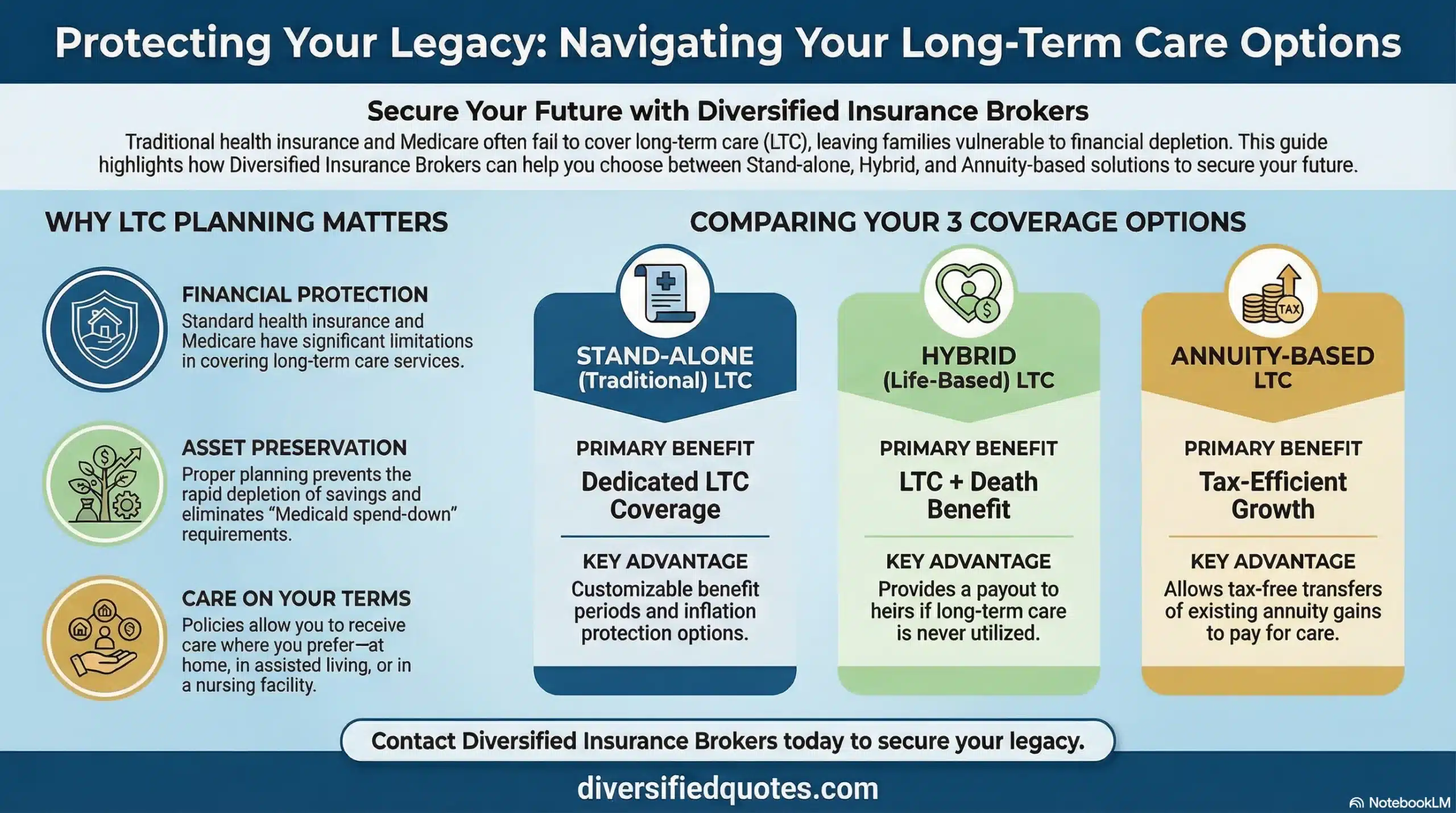
Affordable hybrid long term care policies are built on one of two foundational product structures — a life insurance chassis or an annuity chassis — and the choice between them affects how benefits work, how the policy is funded, how it interacts with existing retirement assets, and what the household receives if care is never needed. Understanding the distinction between these two structures is essential to evaluating which design matches a specific household’s planning profile.
Life insurance-based hybrid long term care policies are the most common design. In the most prevalent structure, a single premium or multi-pay schedule funds a life insurance policy that provides a guaranteed death benefit. An LTC rider attached to the policy allows the insured to accelerate some or all of the death benefit to pay for qualified long-term care expenses when benefit triggers are met. Many life insurance hybrid designs also include an extended benefit rider that creates a care benefit pool beyond the death benefit itself — providing total LTC coverage potentially two to three times the initial death benefit. If care is never needed, beneficiaries receive the full death benefit tax-free. If care is needed and the full benefit pool is exhausted, a small residual death benefit frequently remains available to beneficiaries under many designs, ensuring that the family always receives something from the policy regardless of how extensive the care need was.
Annuity-based hybrid long term care policies use a fixed annuity as the chassis, with an LTC rider that multiplies the annuity’s accumulated value into a larger care benefit pool when qualifying care is triggered. The annuity grows through guaranteed interest crediting during the accumulation period, and if care is never needed, the annuity value — including accumulated growth — is available for income, withdrawal, or inheritance. If care is triggered, the rider doubles or triples the annuity value into a care benefit pool, providing substantially more resources for care than the annuity would have provided as a pure retirement vehicle. Our resource on annuity with long term care benefits and our resource on non-qualified long-term care annuity cover the annuity chassis design in detail. Our resource on fixed annuity with long term care benefits covers the specific fixed annuity plus LTC rider structure.
Affordable Hybrid LTC vs Traditional LTC vs Self-Insuring — A Clear Comparison
| Feature | Affordable Hybrid LTC | Traditional LTC Insurance | Self-Insuring |
|---|---|---|---|
| Premium stability | Guaranteed — premiums are fixed at purchase and will not increase | Not guaranteed — subject to carrier rate increase filings with state approval | No premium — but care costs come directly from retirement savings |
| Value if care never needed | Death benefit or annuity value passes to heirs — never wasted | Premiums not returned — “use it or lose it” if care never needed | Savings available but unprotected from depletion |
| Benefit leverage per dollar | Moderate — typically 2–3x premium in total LTC benefit pool | Highest — lowest premium for largest LTC benefit pool when health qualifies | One-to-one — every dollar of care comes directly from assets |
| Emotional commitment | High — families commit because money retains value regardless of use | Lower — “use it or lose it” creates hesitation to fund at adequate levels | High anxiety — no defined protection, hope is the strategy |
| Underwriting | Simplified to moderate — more lenient than traditional for many conditions | Full underwriting — high decline rate for common conditions at older ages | No underwriting — any health status |
| Retirement plan integration | Strong — assets repositioned rather than additional expense; fits retirement income plan | Moderate — ongoing premiums must be budgeted; tax deductibility can help | Poor — unplanned care costs disrupt portfolio withdrawal strategies mid-retirement |
The table illustrates why affordable hybrid long term care policies have gained dominant market share over the past decade. They solve the specific objections that prevented many households from completing any LTC planning at all — the uncertainty of ongoing premiums, the feeling of wasted money if care never happens, and the difficulty of committing to a product whose only outcome that felt “good” was one the buyer hoped never to need. Our resource on hybrid life versus traditional long-term care insurance covers this comparison in depth, and our resource on self-insured long-term care covers the realities of self-funding that make most households reconsider the “I’ll pay out of pocket” approach when they model the actual cost scenarios.
The Four Funding Structures for Affordable Hybrid Long Term Care Policies
One of the most direct ways to make affordable hybrid long term care policies fit a household’s budget is to select the right premium payment structure. The four primary funding approaches each produce a different annual cost, a different total outlay, and a different experience during the years the premiums are being paid — and the right choice depends on where the household is in their career-to-retirement timeline and how they prefer to manage cash flow during the premium period.
Single-pay designs — where the entire policy is funded with one lump-sum premium — are the most popular structure for retirees and pre-retirees who have accumulated conservative assets that are underperforming. A $75,000 to $150,000 single-pay premium repositions existing savings into a contract that immediately creates a larger pool for long-term care while preserving a legacy for heirs. After the initial deposit, no further premiums are required — the policy is paid up, and the household has no ongoing insurance cash-flow obligation related to this coverage. For households managing retirement income on a fixed budget, the “one and done” nature of single-pay designs is particularly compelling. Our resource on single-pay long-term care insurance covers this funding approach in detail.
Short-pay designs — including 5-pay, 7-pay, and 10-pay structures — spread the premium over a defined number of years, producing a higher annual premium than single-pay but a lower total outlay in many cases than paying for the same coverage over the full lifetime. Five-pay designs are popular for pre-retirees in their mid-50s who want to complete premium payments before or shortly after retirement, eliminating the concern about continuing to pay premiums on a fixed income. Ten-pay designs lower the annual premium further while still containing the payment period within a defined window that the household can plan around.
Level-pay-for-life designs — where a smaller annual premium continues throughout the insured’s lifetime — produce the lowest annual premium of any structure but carry the same conceptual concern as traditional LTC insurance: premiums may continue into very late retirement years when the household might prefer not to have ongoing insurance obligations. These designs are typically more appropriate for younger buyers in their late 40s or early 50s who want to maximize leverage per premium dollar. Level-pay affordable hybrid long term care policies also allow the household to stop paying and access a reduced paid-up benefit in some designs if circumstances change, providing a safety valve that pure lifetime-pay traditional LTC does not.
Seven Levers That Directly Control the Affordability of Hybrid LTC Policies
Affordable hybrid long term care policies are not a fixed product — they are a customizable framework within which multiple design choices interact to determine both the premium and the benefit. Understanding which levers most directly affect cost helps families make intelligent trade-offs rather than simply choosing the cheapest design without understanding what they gave up or the most expensive design without understanding what additional value they are paying for.
The monthly benefit amount is the most direct driver of LTC benefit pool size and premium cost. Choosing a monthly benefit sized to cover the realistic cost of care in your specific area — rather than a maximum benefit based on theoretical national averages — is one of the most practical affordability improvements available. Most care is received at home or in assisted living before eventually reaching skilled nursing; designing for home care costs rather than skilled nursing facility costs can reduce the required benefit without meaningfully underprotecting against the most common care scenarios.
The benefit period defines how many years the monthly benefit continues if care is needed. Longer benefit periods (5 years, 6 years, unlimited) cost more than shorter periods (2 years, 3 years). Research on long-term care duration consistently shows that the majority of care episodes are shorter than 3 years — though some individuals, particularly those with dementia, require care for far longer periods. Choosing a benefit period that covers the statistically likely range while accepting some self-funding responsibility for extreme longevity of care can significantly improve the affordability of hybrid LTC without abandoning protection against the most financially damaging scenarios.
The elimination period — the waiting period before benefits begin, measured in days rather than dollars — directly affects cost. A 90-day elimination period (the most common) means the household self-funds the first 90 days of qualifying care before LTC benefits activate. A 180-day elimination period reduces the premium meaningfully in exchange for a longer self-funded period. For households with adequate liquid savings, a longer elimination period can produce a more affordable hybrid LTC policy without creating genuine financial hardship during the waiting period.
The inflation protection option significantly affects long-term cost because inflation protection increases the monthly benefit over time — but it also meaningfully increases premium. Compound inflation options (where the benefit grows at a compounding rate) cost more than simple inflation or a flat benefit with no inflation protection. Households purchasing affordable hybrid long term care policies at age 55 or younger often need meaningful inflation protection because of the longer horizon before likely care begins. Households purchasing at 65 or 70 may find that modest inflation options or a larger base benefit without a rich inflation rider produces better overall value for the premium paid.
Shared care riders for couples allow both spouses to access the same pool of LTC benefits rather than each having a separate policy with a separate pool. If one spouse exhausts their individual pool, they can draw from the shared reserve. For couples, shared care can be more cost-effective than two fully separate maximum-benefit policies, particularly when health differences between spouses mean different underwriting outcomes or when the household wants to avoid over-insuring the lower-risk spouse.
Return of premium provisions allow the policy to be surrendered for a return of premiums paid if priorities change — a feature that increases premium but provides a psychological safety valve for families uncertain about committing. Understanding the specific return-of-premium mechanics — when it applies, what portion is returned, and what the timing requirements are — helps families evaluate whether the additional cost of this feature is worthwhile for their comfort level.
Benefit type — reimbursement versus indemnity — affects both cost and usability. Indemnity designs pay a defined monthly amount when the insured qualifies for care, regardless of the actual expense incurred and without requiring receipt submission. Reimbursement designs pay up to a monthly maximum for documented care expenses. Indemnity designs can feel simpler and more flexible, particularly for home care situations where informal caregiver arrangements make expense documentation complicated. Certain carriers — including Nationwide CareMatters II — are recognized for cash indemnity designs that provide flexibility beyond what reimbursement models offer.
Repositioning Existing Assets Into Affordable Hybrid Long Term Care Policies
One of the most powerful approaches to funding affordable hybrid long term care policies without adding new cash-flow obligations is repositioning existing conservative assets — savings accounts, CDs, low-yield bonds, underperforming annuities, or old life insurance policies — into hybrid designs that put those same dollars to work simultaneously for care protection and legacy preservation. This repositioning approach fundamentally changes the psychology of the purchase: instead of “adding a new insurance expense to the budget,” the household is “moving money from an underperforming bucket to a more productive one.”
The most common repositioning scenarios involve assets that are not generating meaningful returns and are not allocated to near-term income needs. Money in short-term CDs earning modest interest, savings accounts with negligible yield, conservative bond allocations with limited growth potential, or annuities that have completed their surrender periods and are sitting in renewal-rate environments below their original credited rates — all of these represent candidates for repositioning into single-pay or short-pay affordable hybrid long term care policies. The repositioned dollars create a guaranteed care benefit pool that is substantially larger than the original account value, plus a death benefit or residual annuity value, in exchange for accepting that the funds are now committed to the insurance contract’s terms rather than immediately liquid.
For existing non-qualified annuities with embedded taxable gains, the tax-free 1035 exchange provision — authorized by the Pension Protection Act of 2006 — allows transfer into a qualifying hybrid LTC annuity without triggering income tax at the time of transfer. The gains that would have been taxable as ordinary income on direct withdrawal instead fund a hybrid LTC annuity and may ultimately be distributed as income-tax-free LTC benefits, representing one of the most tax-efficient repositioning strategies available for retirees with non-qualified annuity assets. Our resource on annuity with long term care benefits covers this 1035 exchange mechanism in detail. Our resource on annuity free withdrawal rules covers the liquidity mechanics that affect timing decisions for repositioning from existing annuity contracts.
Age, Health, and Timing — When Affordable Hybrid LTC Becomes Harder to Access
Affordable hybrid long term care policies are most accessible when two conditions align: reasonable age (generally between 45 and 68 for the best pricing and underwriting outcomes) and acceptable health. Both conditions tend to deteriorate with time, which means the household that delays LTC planning faces two simultaneous headwinds — higher premiums at older ages and potentially reduced or eliminated underwriting options as health conditions develop. The planning conversation that happens at 57 is almost always more productive than the same conversation at 67, because the options available at 57 are broader and the premiums for the same benefit are lower.
Hybrid LTC underwriting is generally less rigorous than traditional standalone LTC insurance — a meaningful advantage for families where health concerns have already emerged. But hybrid LTC is not unlimited in its acceptance. Most hybrid designs require good baseline health and may decline applicants with certain serious conditions, cognitive impairment diagnoses, or active cancer treatment. For those with more significant health challenges, annuity-based hybrid designs often have more relaxed underwriting criteria than life insurance chassis hybrids — because the annuity’s principal accumulation reduces the carrier’s risk exposure even without full medical qualification.
Our resource on can you still get long-term care insurance after age 60 covers the underwriting reality for older applicants across different product types, and our resource on how to qualify for long-term care insurance covers the health qualification standards that affect which designs are available for any specific applicant profile. Our resource on affordable long-term care insurance for retirees covers the product landscape for older applicants who want to maintain planning options.
Tax Advantages of Affordable Hybrid Long Term Care Policies
Affordable hybrid long term care policies offer three distinct tax advantages that improve the after-tax value of the coverage — making the economic case for hybrid LTC stronger than the gross premium figures alone suggest. Understanding these tax advantages is relevant for any household evaluating whether the cost of affordable hybrid long term care policies is justified relative to alternatives.
Long-term care benefits received from a qualified hybrid LTC policy are income-tax-free under Internal Revenue Code Section 7702B when the policy meets the federal definition of a tax-qualified long-term care contract. This means that the monthly care benefits the insured receives — whether from a life insurance hybrid or an annuity hybrid — are not included in gross income and do not trigger federal income tax even if the total benefits received ultimately exceed the total premiums paid. For a retiree in the 22% or higher federal tax bracket, this tax-free treatment meaningfully increases the real value of the benefit compared to the same dollar amount drawn from a taxable traditional IRA or 401(k). Our resource on are long-term care benefits taxable covers the tax treatment framework in detail.
Death benefits from life insurance-based hybrid LTC policies are generally received income-tax-free by named beneficiaries under IRC Section 101(a), consistent with all life insurance death benefit treatment. This tax-free death benefit treatment — applying whether or not the LTC benefit was ever used — makes the life insurance hybrid design particularly compelling for households where legacy and tax efficiency are both planning priorities.
The 1035 exchange provision — available for repositioning existing non-qualified annuities or life insurance policies into hybrid LTC designs — allows the transfer to occur without triggering income tax on accumulated gains at the time of the exchange. This tax-deferred repositioning is one of the most financially efficient funding strategies available for households with existing non-qualified assets that would otherwise generate significant tax liability if liquidated directly.
How Affordable Hybrid Long Term Care Policies Integrate With the Retirement Income Plan
The decision to fund affordable hybrid long term care policies does not exist in isolation from the household’s retirement income plan, beneficiary structure, and overall asset allocation. The most effective hybrid LTC designs are those that have been explicitly integrated with the rest of the financial picture — ensuring that the premium source, the benefit access mechanism, and the death benefit structure all align with the household’s income needs, liquidity requirements, and legacy goals rather than conflicting with them.
For households using annuities as part of a retirement income strategy, hybrid LTC planning should be coordinated with understanding how the existing annuity contracts’ terms affect repositioning options. Our resource on annuity beneficiary death benefits covers how death benefits from existing annuities coordinate with hybrid LTC planning when existing contracts are considered for repositioning into LTC designs. Our resource on best short-term MYGA annuities covers the conservative accumulation vehicles that are commonly considered alongside or in preparation for hybrid LTC repositioning strategies.
For households where the LTC planning conversation connects to the broader question of how to protect retirement income from unexpected healthcare costs, our resource on the long-term care playbook covers the strategic framework for building protection that works as part of a complete retirement plan rather than as a standalone insurance purchase. Our resource on LTC partnership reciprocity covers state partnership programs that interact with Medicaid planning in ways that affect the sizing and design of affordable hybrid long term care policies in partnership-participating states.
Find Your Affordable Hybrid Long Term Care Policy Today
We compare designs across every major carrier — modeling different benefit periods, inflation options, funding structures, and shared care arrangements — to show you exactly which affordable hybrid long term care policy produces the best value for your age, health, and planning goals.
Request My Hybrid LTC ComparisonRelated Hybrid and Long-Term Care Planning Resources
Explore the complete LTC planning landscape — structures, costs, carriers, underwriting, and retirement integration.
Financial Protection Essentials
Coordinate affordable hybrid LTC with retirement income planning, self-insurance evaluation, and LTC partnership strategies.
Talk With an Advisor Today
Choose how you’d like to connect—call or message us, then book a time that works for you.
Schedule here:
calendly.com/jason-dibcompanies/diversified-quotes
Licensed in all 50 states • Fiduciary, family-owned since 1980
Frequently Asked Questions: Affordable Hybrid Long Term Care Policies
What is a hybrid long-term care policy and how does it differ from traditional LTC?
A hybrid long-term care policy combines LTC coverage with a life insurance or annuity component, ensuring that the premium invested retains value regardless of whether qualifying care is ever needed. If care is needed, the policy activates a pool of benefits that can pay for home health care, assisted living, memory care, or skilled nursing. If care is never needed, the policy pays a death benefit to beneficiaries or retains annuity value. Traditional standalone LTC insurance provides no value if care is never used — premiums paid over decades produce no benefit if the policyholder stays healthy. This “use it or lose it” structure is the primary reason many families prefer affordable hybrid long term care policies, which eliminate the possibility of wasted premium.
How much does an affordable hybrid long-term care policy cost?
The cost varies significantly based on age, health, benefit design, and funding structure. Single-premium hybrid LTC designs for a person in their late 50s to early 60s typically require a lump-sum commitment in the $70,000 to $150,000 range per person for coverage comparable to traditional LTC policies — though this amount funds the policy entirely with no further premiums. Multi-pay designs (5-pay, 10-pay) spread this cost over several years with lower annual premiums. The “affordable” dimension comes from structuring the right benefit size, benefit period, inflation option, and elimination period for the household’s actual needs — not from finding the lowest number on a quote sheet. Benefits can also be designed at lower levels for households seeking more modest protection at lower cost.
What types of care do affordable hybrid long-term care policies cover?
Modern hybrid LTC policies typically cover the full spectrum of long-term care settings: home health care (including professional home health aides and often informal caregiver arrangements under some designs), adult day care, assisted living and memory care communities, and skilled nursing facilities. Home health care is often the most important coverage category because most care begins at home before transitioning to other settings. The specific covered services, how benefits are triggered, and how expenses are documented or reimbursed vary by carrier and policy design — which is why reviewing the benefit structure before purchase is as important as reviewing the premium.
Can couples purchase affordable hybrid long-term care policies together?
Yes — and couples planning together often produces better overall value than two separate policies designed in isolation. Many hybrid LTC carriers offer shared care riders that allow both spouses to draw from a combined benefit pool, providing flexibility if one spouse needs significantly more care than the other. Shared care designs can be more cost-effective than two fully separate maximum-benefit policies, particularly when health differences between spouses create different underwriting outcomes. Carriers including OneAmerica, Nationwide, and Securian are known for strong couples or shared care options among affordable hybrid long term care policies.
Are benefits from hybrid LTC policies tax-free?
Yes — when the policy meets the federal definition of a tax-qualified long-term care contract under IRC Section 7702B, LTC benefits received are income-tax-free. This applies to both life insurance chassis and annuity chassis hybrid designs that qualify under 7702B. Death benefits from life insurance-based hybrid policies are also generally received income-tax-free by named beneficiaries under IRC Section 101(a). For households repositioning existing non-qualified annuities into hybrid LTC designs, a 1035 exchange allows the transfer to occur tax-free — and subsequent LTC benefits from the new contract flow out income-tax-free under 7702B, converting what would have been a future taxable event into a tax-free care benefit resource.
Can I use existing annuity or life insurance assets to fund an affordable hybrid LTC policy?
In many cases, yes — through a 1035 exchange that allows tax-free transfer of non-qualified annuity or life insurance cash values into a qualifying hybrid LTC contract. This repositioning strategy converts underperforming conservative assets into contracts that provide both care protection and preserved legacy value without triggering income tax on accumulated gains at the time of transfer. Whether this strategy is appropriate depends on what you currently own, how the assets are titled, any surrender charges or liquidity constraints on existing contracts, and how the repositioned assets compare to alternatives. An independent broker with LTC and annuity expertise can model whether repositioning produces a meaningfully better outcome than funding with new cash.
What is the best age to buy an affordable hybrid long-term care policy?
The most favorable pricing and widest underwriting options for affordable hybrid long term care policies are generally available between ages 45 and 65. Earlier in this range, premiums are lower but may span more years of payment. Later in the range, single-pay designs become especially practical as assets have accumulated. Waiting significantly past 65 begins to close some options — both because premiums increase meaningfully with age and because health conditions that develop with age can limit underwriting eligibility. The best time is when health is good, assets are available for repositioning or premium payment, and the household is genuinely ready to commit to the planning — which for most families is the mid-50s to early 60s range.
About the Author:
Jason Stolz, CLTC, CRPC, DIA, CAA and Chief Underwriter at Diversified Insurance Brokers (NPN 20471358), is a senior insurance and retirement professional with more than 25 years of real-world experience helping individuals, families, and business owners protect their income, assets, and long-term financial stability. As a long-time partner of the nationally licensed independent agency Diversified Insurance Brokers, Jason provides trusted guidance across multiple specialties—including fixed and indexed annuities, long-term care planning, personal and business disability insurance, life insurance solutions, Group Health, Travel Medical and Evacuation Insurance, and short-term health coverage. Diversified Insurance Brokers maintains active contracts with over 100 highly rated insurance carriers, ensuring clients have access to a broad and competitive marketplace.
His practical, education-first approach has earned recognition in publications such as VoyageATL, and contributions from his agency featured in Kiplinger and GoBankingRates— highlighting his commitment to financial clarity and client-focused planning. Drawing on deep product knowledge and years of hands-on field experience, Jason helps clients evaluate carriers, compare strategies, and build retirement and protection plans that are both secure and cost-efficient. Visitors who want to explore current annuity rates and compare options across multiple insurers can also use this annuity quote and comparison tool.
Explore More Long Term Care Insurance Options: Browse our complete guide to Hybrid & Annuity LTC Policies — covering hybrid life insurance, annuities with LTC benefits & linked benefit policies from top carriers.
Last Reviewed: September 29, 2026 |
Reviewed by: Jason Stolz, CLTC, CRPC, DIA, CAA
Chief Underwriter, Diversified Insurance Brokers, Inc. | NPN: 20471358 | Diversified Insurance Brokers, Inc. — Licensed in all 50 states
Fact Checked by: Tonia Pettitt, CMIP©
Medicare Specialist, Diversified Insurance Brokers, Inc. | NPN: 14374308 | Diversified Insurance Brokers, Inc. — Licensed in all 50 states
Did you find this content helpful? Leave us a Google review — it helps others find trustworthy guidance too.
Editorial Standards: Diversified Insurance Brokers maintains rigorous editorial standards to ensure accuracy, clarity, and independence in all content. Learn more about our editorial standards and commitment to transparency.
