
Long Term Care Playbook
Long Term Care Playbook
At Diversified Insurance Brokers, we understand that planning for future care needs is one of the most important steps in protecting your retirement savings and your family’s financial well-being. Our Long-Term Care Playbook is designed to guide you through the three primary strategies for funding care—Traditional Long-Term Care Insurance, Hybrid Life + LTC policies, and Annuity + LTC solutions. With decades of experience and access to more than 100 top-rated carriers, we can help you choose a plan that fits your goals, budget, and health profile.

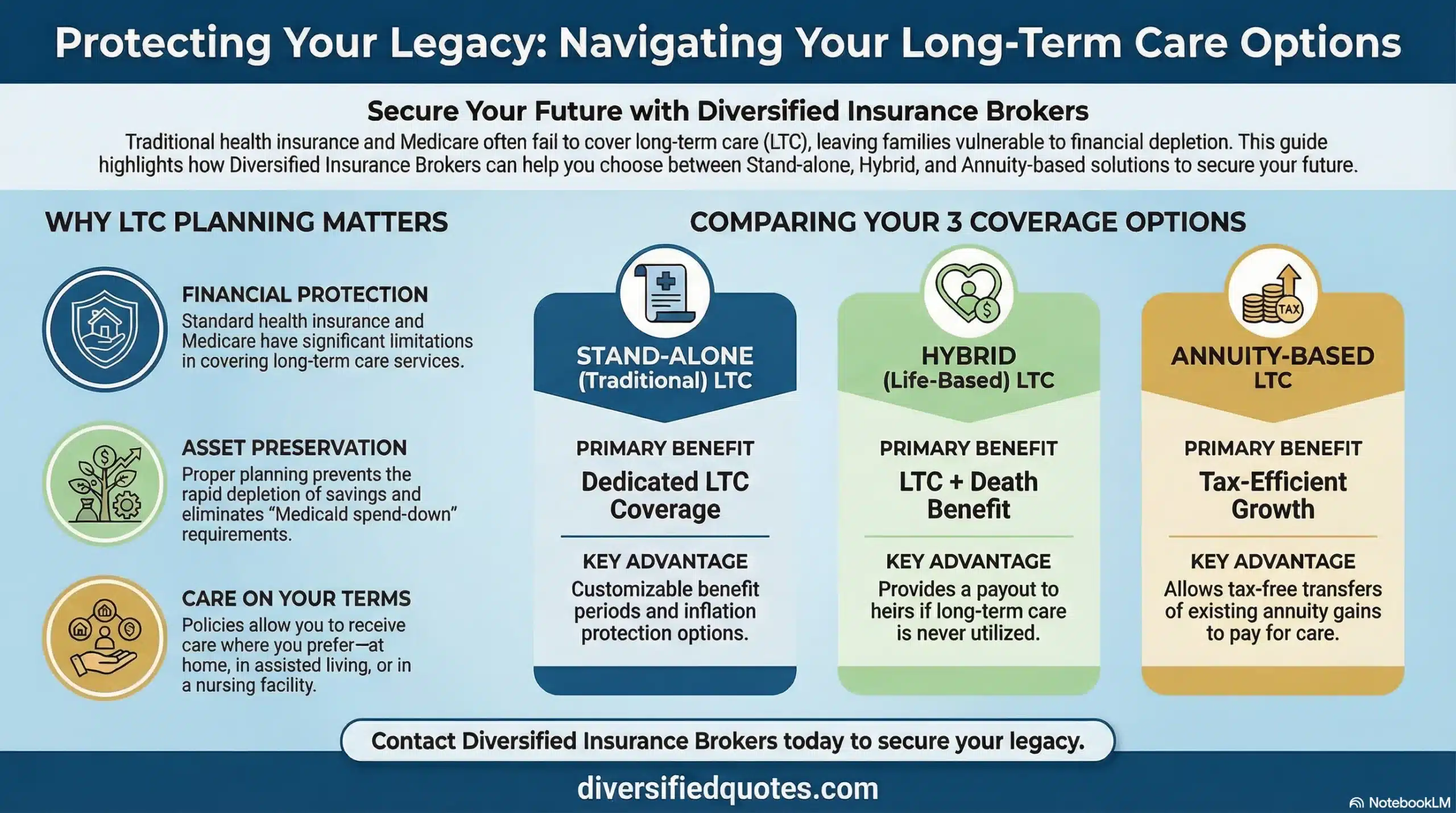
Long-term care planning is one of the most consequential and most frequently deferred financial decisions in retirement preparation. The consequences of deferral are concrete: Medicare does not cover custodial care — help with the Activities of Daily Living such as bathing, dressing, eating, toileting, continence, and transferring that constitute the majority of what long-term care actually involves. Medicare covers only short-term skilled nursing care following a qualifying hospital stay, with cost-sharing beginning at day 21 and coverage ending at day 100 under most circumstances. Medicaid covers custodial LTC for eligible individuals, but eligibility requires substantial prior asset depletion. Self-funding care entirely from personal savings — the default for the majority of Americans who defer this planning — depletes retirement assets that were built for other purposes and may force difficult financial and lifestyle trade-offs on families during a period that is already emotionally and logistically demanding. The planning decision isn’t whether long-term care risk is real; actuarial data has long established that most people will need some form of long-term care in their lifetimes. The planning decision is which strategy best fits your health profile, asset structure, income situation, and legacy objectives before health changes make some options unavailable.
There are three primary funding strategies for long-term care risk, and the right one depends on the intersection of factors that are specific to each person: traditional standalone long-term care insurance, which reimburses qualified care costs and offers the most direct benefit-per-premium ratio; hybrid life insurance plus LTC policies, which combine permanent life insurance with long-term care benefits and guarantee that premiums paid are never “lost” whether or not care is ever needed; and annuity-based LTC solutions, which reposition existing non-qualified assets into a tax-advantaged structure that multiplies care dollars under the Pension Protection Act of 2006 while preserving access to value for income or beneficiaries. Each strategy has genuine strengths, real trade-offs, and a specific buyer profile that it serves best. No single strategy is universally superior — the right answer comes from evaluating all three against your specific financial picture and making the comparison in writing before health changes narrow the field. Our LTC insurance costs, rates, and planning guide covers the full rate landscape and comparison framework, and our long-term care insurance services overview covers the full scope of LTC planning support we provide across all three strategy categories.
This Long-Term Care Playbook covers the three strategies in comprehensive practical detail — how each works mechanically, what the premium economics look like, the tax treatment of each approach, the underwriting requirements that govern eligibility, the inflation protection options that preserve benefit relevance over the years between purchase and use, how to evaluate which strategy or combination fits a specific financial and health profile, and the key planning decisions that affect every LTC funding conversation. For consumers who are concerned about qualifying due to existing health conditions, our resource on long-term care insurance with pre-existing conditions covers the underwriting landscape. For consumers who are evaluating LTC coverage at older ages, our resource on long-term care insurance after age 80 covers the options and limitations that apply at later entry ages. For consumers who have already received a policy proposal and want independent verification that it is competitive, our second-opinion LTC quote review provides that comparison across our full carrier panel.
Compare All Three LTC Strategies Side by Side
We’ll illustrate traditional, hybrid, and annuity-based LTC options for your age, health profile, state, and budget — and show you which strategy produces the best care coverage for your specific situation.
Or call us directly: 800-533-5969
Why Long-Term Care Planning Cannot Be Deferred
The single largest driver of why long-term care planning gets deferred is the perception that it is a problem for the distant future — something to address after retirement, after other financial priorities are resolved, after health concerns become more immediate. That perception is expensive, because the most meaningful variable in long-term care planning is health status at the time of application, and health status changes with age in ways that are neither predictable nor reversible. A traditional LTC policy or hybrid policy that is available at Preferred rates today becomes unavailable — or only available at significantly higher rates — if a major health event occurs before the application is submitted. Policies that could have been purchased in good health at relatively modest cost are frequently unavailable entirely to applicants whose health has changed even modestly. The window for obtaining the most favorable coverage is open longest when you are healthiest, which means the most rational time to plan is typically earlier than it feels necessary — in your 50s or early 60s rather than after health changes have already begun to close some options.
The financial stakes of unplanned long-term care costs are substantial. Long-term care insurance pays for nursing home, assisted living, and in-home aide services that Medicare does not cover. Nursing home care, assisted living, and extended in-home aide services can represent one of the largest unbudgeted costs in retirement — costs that can persist for years and run into hundreds of thousands of dollars depending on the care setting, geographic market, duration of need, and level of services required. For consumers who have not structured a specific funding strategy for this risk, these costs are absorbed directly from retirement savings that were built for income, legacy, and lifestyle purposes — compressing every other financial plan that those assets were meant to support. The retirement savings protection function of LTC planning is as important as the care benefit itself: a well-structured LTC strategy protects the assets that belong to the retirement income plan from being redirected to care expenses that belong to a separate funding bucket. Our resource on how to protect your funds in retirement covers this risk management framework in the broader context of retirement financial planning, and our resource on key retirement considerations covers the full set of planning priorities of which LTC funding is one critical component.
The Three Strategies — Side-by-Side Comparison
| Feature | Traditional LTC Insurance | Hybrid Life + LTC | Annuity + LTC Solution |
|---|---|---|---|
| Primary structure | Standalone policy; reimburses qualified care costs when triggered | Permanent life insurance policy with long-term care acceleration or extension rider | Annuity contract qualified under Pension Protection Act with LTC benefit multiplier |
| Premium structure | Ongoing annual or monthly premium; historically subject to rate increases; newer policies priced more conservatively | Typically single-premium or limited-pay; premiums guaranteed not to increase in most designs | Single premium repositioned from existing assets (may use 1035 exchange from existing life/annuity) |
| “Use it or lose it” risk | Yes — premiums paid are not returned if care is never needed and no return-of-premium rider is included | No — if care is never needed, full death benefit passes to beneficiaries | No — annuity value retained for income, surrender, or beneficiaries if care benefits are not used |
| Benefit potential | Highest LTC benefit per premium dollar; most flexible benefit design (daily amount, benefit period, inflation options) | Death benefit plus 2–5x LTC benefit leverage in many designs; benefit amount defined at issue | Care multiplier of 2–3x or more on annuity value for qualified LTC expenses; specific leverage depends on product and carrier |
| Tax treatment of benefits | Generally income-tax-free for qualified LTC expenses; premiums may be partially deductible as medical expenses (age-based IRS limits apply) | LTC benefits received income-tax-free under IRC §7702B; death benefit generally income-tax-free; 1035 exchange enables tax-free repositioning | Withdrawals for qualified LTC expenses from PPA-qualified annuity generally income-tax-free; tax-free repositioning via 1035 exchange from non-qualified annuity |
| Health underwriting | Full underwriting required; strictest eligibility standards; certain conditions may disqualify or result in rate-up | Full underwriting required; generally must be in good health; some carriers more accommodating than others for specific conditions | Simplified underwriting in most annuity + LTC designs; easier to qualify than traditional or hybrid; more accessible for applicants with health history |
| Best suited for | Healthy applicants who want maximum LTC benefit for the lowest initial premium and can accept some future premium adjustment risk; those focused purely on care benefit efficiency | Applicants who want guaranteed premiums, elimination of “use it or lose it” concern, and a combined life + care benefit; those with funds to reposition from existing life insurance | Applicants with non-qualified assets to reposition; those with mild health concerns who may not fully qualify for traditional or hybrid; those prioritizing tax efficiency and care coverage combined |
Coverage amounts, premium levels, benefit multipliers, tax treatment, and underwriting eligibility vary significantly by carrier, state, age, health status, and specific product design. All figures require a current, state-specific illustration for accurate evaluation. LTC insurance regulations and tax rules are subject to change. Consult a licensed LTC specialist and a tax advisor before making any long-term care coverage decision.
Strategy 1 — Traditional Long-Term Care Insurance
Traditional standalone long-term care insurance remains the product category that provides the most direct benefit per premium dollar in the LTC marketplace — and the one that requires the most careful underwriting and timing consideration to access. A traditional LTC policy reimburses qualified care expenses — in-home care, adult day services, assisted living, memory care, and nursing home care — up to the daily or monthly benefit amount chosen at the time of purchase, for the benefit period elected, once the benefit triggers are met. The policy pays directly for care costs rather than providing a lump sum, and the benefit is structured to match the actual cost of care in the insured’s geographic market at the time care is needed — with inflation protection riders designed to keep the daily or monthly benefit relevant as care costs rise over the years between purchase and use. The flexibility of benefit design is one of traditional LTC insurance’s most distinctive attributes: daily benefit amounts, benefit periods, elimination periods (the waiting period before benefits begin), and inflation protection options can all be customized to balance benefit adequacy with premium affordability in ways that are harder to customize in hybrid designs.
The well-documented concern about traditional LTC insurance is the history of premium increases experienced by older policies. Carriers that issued policies in the 1990s and early 2000s significantly underestimated how long policyholders would live, how much care would cost, and how low investment returns would remain — leading to waves of state-approved premium increases that affected some carriers and policyholders severely. Newer policies are priced more conservatively, and 2023–2024 traditional LTC premiums are largely flat. This is meaningful context for current purchasers: policies being issued in 2025 and 2026 are designed with much more conservative actuarial assumptions than those that created the prior-generation premium increase problem. The risk is not eliminated — future rate increases remain possible for any traditional LTC policy — but the risk profile of currently issued policies is materially different from the older-generation products that generated the most severe increases. Carriers who are active in the traditional LTC market in 2026 have done so with full awareness of historical pricing errors, which informs their current reserve requirements and actuarial conservatism. Our resource on how much long-term care insurance costs covers the full premium landscape for current buyers across age, health, benefit design, and carrier variables.
Strategy 2 — Hybrid Life + LTC Policies
Hybrid life insurance plus long-term care policies represent the fastest-growing segment of the LTC planning market, addressing the two objections that prevented many consumers from purchasing traditional LTC coverage: the concern that premiums could increase unpredictably, and the concern that premiums paid into a standalone LTC policy would be “lost” if care was never needed. A hybrid policy solves both by combining permanent life insurance with long-term care coverage in a single contract. If long-term care is needed, the policyholder draws against the death benefit (and often an LTC extension of benefits pool beyond the death benefit) to pay for qualified care expenses, generally income-tax-free under IRC §7702B of the Pension Protection Act. If long-term care is never needed, the full death benefit passes to named beneficiaries, typically income-tax-free as a life insurance death benefit. The premiums — most commonly paid as a single lump sum or over a limited pay period — are contractually guaranteed not to increase in most hybrid designs, eliminating the premium increase uncertainty that characterized traditional LTC insurance.
The typical cost of a single-premium combination policy (hybrid/linked-benefit long-term care insurance) was $71,700 for men and $76,740 for women in 2024, according to the AALTCI. This reflects a single-premium commitment that is meaningfully larger than traditional LTC annual premiums but encompasses both the life insurance and LTC coverage in one payment, with no future premium obligations in most designs. The trade-off is that the LTC benefit per dollar paid is typically lower than in a traditional policy of equivalent cost — because part of the premium is funding the life insurance component and the guarantee structure — but the absence of “use it or lose it” risk and the guaranteed premium structure make the total value proposition compelling for consumers who have lump-sum assets available to reposition. Under Section 1035, the IRS allows you to transfer the cash value from an old life insurance policy or annuity directly into a new hybrid LTC policy completely tax-free. This 1035 exchange capability is particularly valuable for consumers who hold underperforming life insurance policies or non-qualified annuities — it allows repositioning of existing assets into a hybrid LTC structure without triggering the taxable gain that a cash surrender would produce. Our annuity planning resource covers the broader asset repositioning context within which 1035 exchanges into hybrid LTC policies frequently appear.
Strategy 3 — Annuity + LTC Solutions
The annuity-based long-term care strategy uses a deferred annuity as the funding vehicle for care benefits — repositioning existing non-qualified assets (savings, CDs, existing annuities, or other liquid investments) into an annuity contract that is specifically designed to provide LTC benefit multipliers under the Pension Protection Act of 2006. The Pension Protection Act created the tax framework that makes this strategy uniquely attractive for non-qualified money: withdrawals from a PPA-qualified annuity used to pay for qualified long-term care expenses are generally received income-tax-free, even on funds that would otherwise be taxable as ordinary income on withdrawal. This tax-free treatment transforms the effective value of the annuity for care purposes — the care multiplier built into the product is not just a contractual leverage ratio but a structure where tax-free distributions extend the real-world purchasing power of the care benefit beyond the nominal multiplier figure alone.
The care multiplier mechanics vary by product and carrier, but the core concept is consistent: a defined care pool — typically two to three times (or more in some designs) the premium paid — is made available for qualified LTC expenses. The annuity’s accumulation value continues to grow and remains accessible for income, partial surrender, or beneficiary distribution if care benefits are not used — this is the annuity component’s retained value that distinguishes the annuity + LTC approach from a pure insurance contract. The underwriting requirements for annuity-based LTC products are generally less stringent than for traditional or hybrid life + LTC products, making this strategy more accessible for applicants with health histories that might prevent full qualification for other LTC designs. Our resource on non-qualified long-term care annuity covers this structure in comprehensive detail, including how the PPA tax treatment works and which types of existing assets are most efficiently repositioned using this approach. For consumers who are evaluating whether their existing non-qualified annuity could be repositioned into a LTC-enhanced annuity structure, a 1035 exchange analysis — which the annuity’s existing tax-deferred gains can often be transferred without immediate tax recognition — is frequently the starting point of this planning conversation.
The Pension Protection Act — Tax Advantages That Drive the Annuity Strategy
The Pension Protection Act of 2006 fundamentally changed the economics of annuity-based long-term care planning by establishing the tax-free treatment of LTC distributions from qualified hybrid products. Before the PPA, an annuity owner who drew on their annuity contract to pay for long-term care would recognize ordinary income on the gain portion of each withdrawal — the same as any other non-qualified annuity distribution. After the PPA, withdrawals from contracts specifically designed as qualified long-term care funding vehicles under IRC §7702B are treated as tax-free distributions for qualified LTC expenses, regardless of the gain that has accumulated in the contract. This change made the annuity-based LTC strategy fundamentally more efficient than it had been: the same dollar of care benefit now carries a higher real-world value because it is not subject to the income tax that would have reduced its purchasing power under the pre-PPA framework.
The Pension Protection Act of 2006 created significant tax advantages specifically for hybrid LTC products: tax-free LTC benefits (accelerated death benefits used for qualified long-term care expenses are generally received income tax-free under IRC §7702B), tax-free death benefits, tax-deferred growth, and 1035 exchange benefits (existing life insurance policies or annuities can be converted to asset-based LTC policies through a 1035 exchange without triggering tax consequences — even if the original policy has significant gain). The 2026 per diem limit for tax-free benefit payments from indemnity-style LTC policies is $430 per day — this figure is indexed annually for inflation. Actual qualified care costs that exceed the per diem limit may also be received tax-free if they are substantiated as actual care expenses. This per diem structure is relevant for indemnity-style policies; reimbursement-style policies pay actual care costs up to the daily benefit limit and are generally tax-free as qualified LTC benefits regardless of the per diem cap. Understanding the distinction between indemnity and reimbursement designs is an important part of evaluating any LTC product structure.
How LTC Benefits Are Triggered — Activities of Daily Living and Cognitive Impairment
Long-term care insurance benefits are triggered when the insured meets one of two standard qualifying conditions: the inability to perform at least two of the six recognized Activities of Daily Living (ADLs) without substantial assistance, or the presence of severe cognitive impairment that requires substantial supervision to protect the individual’s health or safety. The six ADLs recognized in most tax-qualified LTC policies are bathing, dressing, eating, toileting (maintaining continence), continence (the ability to control bladder and bowel function), and transferring (moving between a bed and a chair or other similar transfers). A physician or licensed healthcare practitioner must certify that the triggering condition exists and is expected to last at least 90 days for most tax-qualified benefit activations. The benefit trigger is standardized across traditional LTC insurance, hybrid policies, and annuity + LTC designs by the tax-qualification requirements of IRC §7702B, meaning that the conditions that activate benefits are consistent across strategy types even though the product structures and benefit mechanics differ significantly.
The elimination period — which functions similarly to a deductible, requiring a specified number of days of qualifying care before benefit payments begin — is typically 30, 60, or 90 days depending on the policy design. A longer elimination period reduces the premium but requires the insured to self-fund care costs for the elimination period duration before policy benefits begin. A shorter or zero-day elimination period increases the premium but begins paying benefits sooner. For most planning purposes, a 90-day elimination period is the common balance point — most policies with tax-qualified status require at least a 90-day certification of need, meaning a 90-day elimination period effectively aligns with the trigger requirement rather than adding additional waiting time beyond what tax qualification already requires. Consumers evaluating policies with 30- or 60-day elimination periods should weigh the premium savings of a longer elimination period against their ability to self-fund care during that initial period from accessible liquidity. Our resource on can you use long-term care insurance overseas covers how benefits apply for care received outside the United States — an increasingly relevant consideration for retirees who spend extended time abroad.
Inflation Protection — Keeping Benefits Relevant Across a Multi-Decade Gap
The gap between the time of LTC insurance purchase and the time care is actually needed can easily span 20 to 30 years for buyers in their 50s and early 60s. A daily or monthly benefit amount that is appropriate for current care costs can be substantially inadequate for care costs two or three decades from now without a mechanism that grows the benefit over time. Inflation protection riders are the planning tool that addresses this gap in traditional LTC and some hybrid products. The most common inflation options are simple interest growth (adding a fixed dollar amount based on the original benefit each year) and compound interest growth (adding a percentage of the current benefit each year, so the dollar increase accelerates over time). Compound growth at 3% or 5% per year is generally recommended for buyers with a long expected gap between purchase and use — the compounding effect makes a significant difference over 20+ years. Simple growth is less expensive but produces a smaller benefit at later ages.
In annuity-based LTC designs, the inflation protection dynamic works differently — the care pool grows through the annuity’s credited interest rather than through an explicit inflation rider, and the tax-free treatment of care distributions provides an additional real-world benefit that partially offsets the cost-of-care inflation that a rider would address in a traditional policy. The interaction between credited growth in the annuity’s accumulation value, the care multiplier, and the tax-free treatment of LTC distributions creates a different but potentially effective mechanism for keeping care benefits relevant over time. Evaluating inflation protection across strategy types requires a side-by-side illustration that projects the benefit amount available at various ages in the future — not just the initial daily benefit amount — which is why a personalized illustration is more informative than any general description of the feature. Our best independent long-term care insurance broker resource covers how independent broker representation produces better outcomes in LTC planning than single-carrier representation, particularly when comparing inflation protection options across the full carrier market. For consumers who are also evaluating how LTC insurance interacts with the broader disability income protection question, our resource on short-term vs. long-term disability insurance covers the related income protection landscape that is often evaluated alongside LTC planning for working-age buyers.
Who Should Evaluate Each Strategy
The Long-Term Care Playbook is most actionable when it is used as a framework for a personalized three-way comparison rather than a general endorsement of one strategy over another. Traditional LTC insurance is the right starting point for consumers who are in excellent health, are prioritizing maximum care benefit per premium dollar, can accept some future premium adjustment risk in exchange for the most benefit-efficient structure, and have the cash flow to sustain ongoing annual premiums over the pre-claim period. Hybrid life + LTC policies are the right starting point for consumers who want guaranteed premiums with no risk of future increases, have lump-sum assets available to reposition (or an existing life insurance policy with cash value), want the “use it or lose it” concern eliminated through the death benefit return, and are in sufficiently good health to fully qualify for underwriting. The annuity + LTC strategy is the right starting point for consumers who have non-qualified liquid assets they would like to reposition with tax efficiency, who may have mild health concerns that make full qualification for traditional or hybrid products uncertain, or who want to combine LTC coverage with the retained asset access that an annuity structure provides.
For many consumers, the answer is not a single strategy in isolation but a combination — using one strategy for a portion of the LTC risk and self-funding or using other resources for the remainder. A hybrid policy funded with repositioned non-qualified assets might cover the first two to three years of a potential LTC need, while the non-qualified LTC annuity strategy addresses a longer care scenario. A traditional LTC policy might be purchased for inflation-protected daily benefits while an annuity + LTC solution provides a supplemental care pool from existing savings. The right combination is determined by the interaction of health, assets, income, and care planning goals that are specific to each household — which is why the comparison starts with a personalized illustration across all three strategies using real numbers, not general descriptions. To view the downloadable Long-Term Care Playbook document with detailed comparison charts, example scenarios, underwriting checklists, and cost comparison tables, see our Long-Term Care Playbook resource.
Talk With an Advisor Today
Choose how you’d like to connect—call or message us, then book a time that works for you.
Schedule here:
calendly.com/jason-dibcompanies/diversified-quotes
Licensed in all 50 states • Fiduciary, family-owned since 1980
FAQs: Long-Term Care Playbook
What are the three main long-term care funding strategies?
The three primary strategies are traditional standalone long-term care insurance, hybrid life insurance plus LTC policies, and annuity-based LTC solutions. Traditional LTC provides the most direct care benefit per premium dollar but carries some risk of future premium increases and “use it or lose it” if care is never needed. Hybrid life + LTC policies combine permanent life insurance with LTC coverage, guarantee premiums, and eliminate the “use it or lose it” concern by providing a death benefit if care is never needed. Annuity + LTC solutions reposition existing non-qualified assets into a tax-advantaged structure under the Pension Protection Act, providing LTC benefit multipliers while retaining annuity value for income or beneficiaries. Each serves a different buyer profile based on health, assets, income, and planning goals.
How does traditional LTC insurance differ from hybrid or annuity-based options?
Traditional LTC is a standalone policy that reimburses qualified care costs with the most flexible benefit design but can have premium adjustment risk and provides no residual value if care is never needed. Hybrid policies combine permanent life insurance and LTC benefits with guaranteed premiums and a death benefit payable if care is never used — premiums are higher per dollar of LTC coverage but eliminate “use it or lose it” risk. Annuity + LTC solutions use an annuity as the funding vehicle for care benefits, qualified under the Pension Protection Act for tax-free LTC withdrawals, and retain the annuity’s accumulated value for income or beneficiaries if care benefits are not used. Traditional LTC suits healthy applicants prioritizing care efficiency; hybrid suits those wanting premium guarantees and legacy protection; annuity + LTC suits those with non-qualified assets to reposition or mild health concerns.
What is a “care multiplier” in an annuity + LTC solution?
A care multiplier is the leverage factor built into an annuity + LTC product that determines how much care benefit is available relative to the premium paid. In most designs, the care multiplier produces two to three times (or more in some products) the premium amount as a qualified care pool available for LTC expenses. For example, a $150,000 premium may create a $300,000–$450,000 care benefit pool for qualified LTC expenses, with withdrawals from that pool generally income-tax-free under the Pension Protection Act. If the care benefit pool is not fully used, the annuity’s accumulated value remains for income, surrender, or beneficiary distribution. Specific multiplier ratios depend on the carrier, product, state, age at application, and whether optional riders are included — a current carrier illustration is required for accurate evaluation.
Are premiums guaranteed in hybrid LTC policies?
Yes — one of the defining advantages of hybrid life + LTC policies is that premiums are typically guaranteed not to increase for the life of the policy, in contrast to traditional standalone LTC insurance where premium adjustments have historically been possible with state insurance department approval. Most hybrid policies are funded through a single lump-sum premium or a limited pay period (such as 10 years), and once that payment is made, no additional premiums are required and no future increases apply. This premium certainty is a primary reason many buyers choose hybrid over traditional LTC insurance despite the higher initial cost per dollar of LTC coverage. Product terms vary by carrier and state — always confirm the specific guarantee provisions in the policy documents and illustration.
What are the tax benefits of LTC insurance and annuity-based LTC solutions?
Tax-qualified traditional LTC insurance benefits received for qualified care expenses are generally income-tax-free. Premiums may be partially deductible as medical expenses above the 7.5% AGI threshold, subject to age-based IRS limits (for 2026: $5,880 for age 71+; $4,710 for age 61–70; $1,790 for age 51–60). For hybrid life + LTC policies, LTC benefit withdrawals are generally income-tax-free under IRC §7702B; the death benefit is generally income-tax-free; and a 1035 exchange from an existing life policy or non-qualified annuity can fund a hybrid LTC policy without triggering immediate tax on embedded gains. For annuity-based LTC solutions qualified under the Pension Protection Act, withdrawals for qualified LTC expenses are generally income-tax-free even on funds that would otherwise be taxable. Consult a tax advisor for guidance specific to your situation — tax treatment of LTC benefits is subject to IRS rules and individual circumstances.
How do underwriting requirements differ across the three strategies?
Traditional standalone LTC insurance has the most stringent underwriting requirements — full medical underwriting applies, and certain health conditions can disqualify an applicant or result in a significant rate increase. Hybrid life + LTC policies also require full medical underwriting but vary by carrier in how specific health conditions are evaluated — some carriers are more favorable for specific conditions than others. Annuity-based LTC solutions typically have simplified underwriting, making them more accessible for applicants with health histories that might prevent full qualification for traditional or hybrid designs. This underwriting distinction is practically important: consumers who have had health events that close the door on traditional or hybrid LTC options may still qualify for an annuity + LTC solution and can still address a meaningful portion of their LTC risk with tax-advantaged funding even if the other strategies are unavailable to them.
What triggers long-term care insurance benefits?
Long-term care insurance benefits are triggered by one of two qualifying conditions: the inability to perform at least two of the six Activities of Daily Living (ADLs) — bathing, dressing, eating, toileting, continence, and transferring — without substantial assistance; or the presence of severe cognitive impairment requiring substantial supervision to protect health or safety (such as advanced dementia or Alzheimer’s disease). A physician or licensed healthcare practitioner must certify the qualifying condition, which must be expected to last at least 90 days for most tax-qualified LTC benefit activations. These trigger standards are consistent across traditional, hybrid, and annuity-based LTC designs because they are defined by the tax-qualification requirements of IRC §7702B rather than by the specific product design of each carrier.
Who is the Long-Term Care Playbook designed for?
The Long-Term Care Playbook is designed for anyone evaluating how to fund potential long-term care needs as part of a comprehensive retirement plan — including retirees and pre-retirees who want to protect retirement savings from being redirected to care costs, families with a history of chronic illness or dementia who want proactive planning, individuals who have been declined for traditional LTC insurance and want to understand their alternative options, and those who want to maintain a legacy for beneficiaries while ensuring care coverage is available if needed. The Playbook is also useful for consumers who hold non-qualified assets and want to understand how the Pension Protection Act enables tax-efficient repositioning for LTC purposes. The right strategy or combination depends on health, assets, income, age, and planning objectives that are specific to each person.
Can the Playbook help me decide which LTC strategy is right for me?
Yes — the Playbook provides the comparison framework, benefit trade-off tables, underwriting considerations, and planning context needed to evaluate which strategy or combination best aligns with your specific goals, health status, assets, and budget. The comparison is most actionable when it is accompanied by current, personalized illustrations across all three strategy types using your actual age, health profile, state, and premium range — so the decision is based on real numbers rather than general descriptions. Working with an independent broker who has access to the full carrier market for all three strategy categories ensures the comparison reflects the most competitive options across traditional, hybrid, and annuity-based LTC designs. The right answer for most consumers is not a single strategy but a thoughtful combination tailored to their specific financial picture.
About the Author:
Jason Stolz, CLTC, CRPC, DIA, CAA and Chief Underwriter at Diversified Insurance Brokers (NPN 20471358), is a senior insurance and retirement professional with more than 25 years of real-world experience helping individuals, families, and business owners protect their income, assets, and long-term financial stability. As a long-time partner of the nationally licensed independent agency Diversified Insurance Brokers, Jason provides trusted guidance across multiple specialties—including fixed and indexed annuities, long-term care planning, personal and business disability insurance, life insurance solutions, Group Health, Travel Medical and Evacuation Insurance, and short-term health coverage. Diversified Insurance Brokers maintains active contracts with over 100 highly rated insurance carriers, ensuring clients have access to a broad and competitive marketplace.
His practical, education-first approach has earned recognition in publications such as VoyageATL, and contributions from his agency featured in Kiplinger and GoBankingRates— highlighting his commitment to financial clarity and client-focused planning. Drawing on deep product knowledge and years of hands-on field experience, Jason helps clients evaluate carriers, compare strategies, and build retirement and protection plans that are both secure and cost-efficient. Visitors who want to explore current annuity rates and compare options across multiple insurers can also use this annuity quote and comparison tool.
Explore More Long Term Care Insurance Options: Browse our complete guide to LTC Insurance Costs, Rates & Planning — covering how much it costs, best rates, calculators, planning strategies & is it worth it from top carriers.
Last Reviewed: June 3, 2026 |
Reviewed by: Jason Stolz, CLTC, CRPC, DIA, CAA
Chief Underwriter, Diversified Insurance Brokers, Inc. | NPN: 20471358 | Diversified Insurance Brokers, Inc. — Licensed in all 50 states
Fact Checked by: Tonia Pettitt, CMIP©
Medicare Specialist, Diversified Insurance Brokers, Inc. | NPN: 14374308 | Diversified Insurance Brokers, Inc. — Licensed in all 50 states
Did you find this content helpful? Leave us a Google review — it helps others find trustworthy guidance too.
Editorial Standards: Diversified Insurance Brokers maintains rigorous editorial standards to ensure accuracy, clarity, and independence in all content. Learn more about our editorial standards and commitment to transparency.
