
Highest Guaranteed Annuity Rates
As an Independent Annuity Broker, we compare rates across 100+ carriers and 1,000 different annuities— not just one company’s product offerings — to find the best fit for your goals.
Highest Guaranteed Annuity Rates

Jason Stolz CLTC, CRPC, DIA, CAA
The word “guaranteed” in the phrase “highest guaranteed annuity rates” is doing more work than most buyers realize when they first read it. It is not a marketing qualifier — it is a precise contractual and legal term that describes the strongest form of financial commitment an insurance carrier can make to a policyholder. When a MYGA contract declares a 6.35% guaranteed rate for a 5-year term, the carrier is making a legally enforceable promise, documented in a state-regulated insurance contract, backed by statutory reserve requirements, and protected by the state guaranty association framework. The guarantee cannot be reduced during the term regardless of market conditions, interest rate movements, or internal carrier financial results. That precision — the contractual certainty of outcome — is what separates the highest guaranteed annuity rates from yields on money markets, savings accounts, or even Treasury securities, whose rates may be excellent but which either float with market conditions or can be repositioned by the issuer. This page covers the full landscape of what “guaranteed” means in the annuity marketplace — not just the MYGA declared rate guarantee, but the full spectrum of guarantees available through fixed annuity products — alongside today’s highest guaranteed declared rates and the framework for matching the right guarantee to the right retirement planning need. For the broader annuity market orientation, our annuities overview and the dedicated resource on what a deferred annuity is provide the foundational context. For the complete rate landscape across both guaranteed fixed and bonus FIA structures, our current annuity rates page provides the full market view.
Today’s highest guaranteed annuity rates — reaching 6.45% at 5-year terms and 6.35% at 10-year terms — are the product of an interest rate environment that has given insurance carriers more investment income to work with than at any point since the early 2010s. The mechanism is straightforward: MYGA carriers invest policyholder premiums in investment-grade fixed income portfolios, and the yield on those investments — net of operating costs, reserve requirements, and the cost of providing the guaranteed floor — determines the declared rates they can credibly offer. When long-term bond yields rise, as they have since 2022, the declared rates insurance carriers can sustain while maintaining their solvency requirements also rise. The result is today’s MYGA market, where buyers can lock guaranteed, principal-protected, tax-deferred growth at rates that compare favorably to most conservative alternatives — and do so with the contractual certainty that the rate will not change during the selected term. For the detailed comparison of how multi-year guaranteed annuities compare to CDs, our dedicated resource provides the specific mechanics and after-tax analysis. For buyers who want to understand how annuities earn interest at the product mechanics level before evaluating specific rates, that resource provides the foundational explanation of crediting, compounding, and accumulation within the MYGA structure.
The highest guaranteed annuity rates are most meaningful when evaluated as part of a complete retirement plan rather than as an isolated rate-maximization exercise. A 6.35% guaranteed MYGA rate is compelling on its own, but it is most powerful when it is matched to the buyer’s actual holding horizon, coordinated with other income sources, structured for appropriate tax efficiency, and connected to a clear plan for what happens at maturity. Buyers who approach the highest guaranteed annuity rates through a planning lens — not just a rate-shopping lens — consistently make better decisions because they evaluate the rate within the context of the contract’s full design rather than in isolation. That planning context includes understanding whether the guaranteed accumulation rate serves them better than a GLWB income guarantee through a fixed annuity income rider, whether the term aligns with a Social Security optimization strategy, and whether the funds should be positioned for accumulation or eventual guaranteed income. Our resources on retirement annuity planning, annuities for conservative investors, and the dedicated best fixed annuity for retirees guide provide the comprehensive planning frameworks that surround the rate selection decision.
Ensure you are receiving the absolute top rates
Current Fixed Annuity Rates
Compare today’s best fixed annuity rates from top carriers.
View Current RatesCurrent Bonus Annuity Rates
See which annuities offer the highest upfront bonus today.
View Bonus RatesRequest an Annuity Quote
Submit our annuity request form to get personalized rate options.
Quote Request FormLifetime Income Calculator
Use our calculator to see how much guaranteed income your annuity can provide.
What “Highest Guaranteed Annuity Rate” Actually Guarantees — The Legal Precision That Matters
In the insurance annuity context, a “guaranteed” rate has specific legal meaning that distinguishes it from yields on products where the rate can be changed at any time. When a MYGA contract specifies a 6.35% declared rate for a 5-year term, the following conditions apply by contract law and state insurance regulation: (1) the declared rate cannot be reduced during the 5-year term under any circumstances; (2) the carrier must maintain statutory reserves sufficient to meet the obligation regardless of investment performance; (3) the state insurance department requires annual actuarial certification that reserves are adequate; and (4) if the carrier becomes insolvent before the term ends, the state guaranty association provides protection up to applicable limits. None of these protections apply to money market accounts, savings accounts, or floating-rate instruments — all of which can reprice at any time. The “guaranteed” label is not marketing language — it is a description of a legally enforceable contractual obligation with specific regulatory oversight requirements behind it. Understanding this distinction is central to understanding why the highest guaranteed annuity rates represent a specific category of financial commitment rather than simply a high interest rate.
The rate guarantee also has important nuances that buyers should understand before comparing products. The guarantee applies to the declared rate for the term selected at issuance — it does not extend to the renewal rate after the term ends. At maturity, the carrier declares a new rate for a new term, which may be higher or lower than the original depending on the interest rate environment at that time. The guarantee also applies to the accumulation value calculation — it does not guarantee the cash surrender value if the policyholder exits during the surrender period, which may be reduced by surrender charges and, in some contracts, a market value adjustment (MVA). Understanding what a market value adjustment is and how it interacts with the declared rate guarantee is part of reading any MYGA contract accurately. The simplest statement of the guarantee is: “hold through the term, and you will receive exactly what the contract promises.” The highest guaranteed annuity rates are worth comparing on this basis — which carrier is offering the highest declared rate for the selected term, with contract provisions that let you hold through the term most comfortably.
📊 Highest Guaranteed Annuity Rates (as of October 2026)
The table below shows today’s highest guaranteed declared rates across the full term spectrum from competitive MYGA carriers. These are contractually locked rates for new contracts issued. Rates change frequently — use the quote button for a confirmed live rate for your specific state, age, and premium amount. Note both the declared rate and the AM Best carrier rating at each term length — some of the highest guaranteed rates come from B-range carriers. A-rated alternatives exist at slightly lower declared rates and are available alongside the highest-rate options in our full comparison.
| Term | Rate | Provider | Product | AM Best Rating |
|---|---|---|---|---|
| 1 Year | 3.90% | GCU Life | 1+4 Choice | A- |
| 2 Years | 5.25% | Mountain Life | Secure Summit | B- |
| 3 Years | 6.10% | Mountain Life | Secure Summit | B- |
| 4 Years | 6.05% | Mountain Life | Secure Summit | B- |
| 5 Years | 6.45% | Mountain Life | Secure Summit | B- |
| 6 Years | 6.10% | Oceanview | Harbourview MYGA | A |
| 7 Years | 6.25% | Aspida | Synergy Choice | A- |
| 8 Years | 6.00% | Mountain Life | Secure Summit | B- |
| 9 Years | 5.95% | Oxford Life | Multi Select Annuity | A |
| 10 Years | 6.30% | RevolOne | Direct Growth MYGA | B++ |
Rates are subject to change and may vary by state, age, and deposit size. Higher premiums may qualify for enhanced rates. Guarantees rely on the insurer’s claims-paying ability. A-rated carrier alternatives available at modestly lower declared rates — request a full comparison for your situation.
Annuity Interest Rate Examples by Deposit Size
See how annuity interest and income potential can vary depending on the size of your investment.
The Three Levels of Guarantee in the Annuity Marketplace
When buyers search for “highest guaranteed annuity rates,” they are typically thinking about the MYGA declared rate guarantee — the most visible form of annuity guarantee. But the annuity marketplace offers three distinct levels of guarantee, each serving a different planning purpose. Understanding all three helps buyers select the right guarantee for their specific retirement need rather than defaulting to the most familiar form.
Level 1 — The Declared Accumulation Rate Guarantee (MYGA)
The MYGA declared rate guarantee is the straightforward, quantified promise that drives this rate table: a specified interest rate credited to the accumulation value for the full selected term. On a $250,000 deposit at 6.00% for 5 years, the guaranteed outcome is approximately $334,000 at maturity — a $84,000 gain that is not dependent on index performance, market conditions, or any factor other than the carrier honoring its contractual obligation through the term. Understanding how simple vs. compound interest functions in annuities is important at this level because the accumulation outcome depends on whether interest compounds annually (standard for most MYGAs) or accrues without compounding. At 6.00% compound interest on $250,000 for 5 years: approximately $334,558. At 6.00% simple interest on the same deposit: $325,000. The compounding advantage accumulates across the full term and is part of what makes MYGAs competitive against simple-interest alternatives. The term-specific highest guaranteed rates by term length — 5-year at our best 5-year annuity rate page, 7-year at our best 7-year annuity rate page, and 10-year at our best 10-year annuity rate page — provide the term-focused analysis for buyers who have already selected their target term.
Level 2 — The Guaranteed Lifetime Withdrawal Rate (GLWB Income Riders)
The second level of guarantee available through fixed annuity products is the guaranteed lifetime withdrawal benefit (GLWB) — an income rider that guarantees a minimum annual withdrawal percentage from a specified benefit base, for life, regardless of how long the policyholder lives or what happens to the contract’s underlying accumulation value. A GLWB rider provides a different kind of guarantee than the MYGA declared rate: instead of guaranteeing a specific accumulation outcome, it guarantees a minimum annual income stream that cannot be outlived. For buyers whose planning priority is guaranteed lifetime income rather than guaranteed accumulation, a GLWB rider on a fixed or fixed indexed annuity may be the more relevant “highest guaranteed rate” — where the relevant rate is the withdrawal percentage applied to the benefit base at the chosen income start age. Understanding what a GLWB is and how the benefit base accumulates during the deferral period before income begins is essential for buyers evaluating this level of guarantee. The income calculator embedded on this page provides a practical tool for estimating what different GLWB options produce at various ages and premium amounts. For the full market overview of annuities with strong income rider designs, our resources on lifetime income annuity options and annuities for monthly retirement income provide the comprehensive analysis.
Level 3 — The Guaranteed Death Benefit and Spousal Continuation
The third level of guarantee is the contractual death benefit — the commitment that any remaining accumulated value in the annuity at the time of the owner’s death will pass to named beneficiaries rather than being retained by the carrier. Most fixed annuities including MYGAs provide a standard death benefit equal to the accumulated contract value (premium plus credited interest, minus any withdrawals taken), which typically passes directly to beneficiaries outside of the probate process. For buyers with estate planning or legacy objectives, the death benefit guarantee is part of the complete picture of what the annuity guarantees. Understanding whether annuities have a death benefit and how death benefits are structured is important for buyers who are considering annuities as part of a broader estate plan. For married couples, the spousal continuation provision available in many annuity contracts allows the surviving spouse to continue the contract without triggering a taxable distribution — a planning advantage that extends the guaranteed structure beyond the original owner’s lifetime. Our dedicated resource on annuity beneficiary death benefits provides the complete treatment of how death benefits function across different contract types.
How Guaranteed Rates Compound — The Growth Mechanics Behind the Numbers
The practical impact of today’s highest guaranteed annuity rates becomes most visible through specific dollar growth examples at different premium levels. At 6.35% annually compounding, a $100,000 deposit grows to approximately $136,000 at the end of 5 years — a $36,000 guaranteed gain. A $300,000 deposit at the same rate produces approximately $408,000 — a $108,000 guaranteed gain. A $500,000 deposit produces approximately $680,000 — a $180,000 guaranteed gain. None of these results depend on market performance, index participation, or any factor other than the carrier honoring its contractual accumulation obligation through the term. For buyers who want to understand the mechanics of how these calculations work in more depth — including how compounding frequency and crediting timing affect the effective yield — our resource on how annuities earn interest provides the foundational explanation, and the dedicated simple vs. compound interest in annuities resource provides the specific mechanics comparison. These resources are particularly useful for buyers who are comparing MYGAs against competing products that use different interest crediting methodologies — helping ensure the comparison is genuinely apples-to-apples rather than headline-rate to headline-rate.
How to Use the Highest Guaranteed Rates in a Real Retirement Plan
The highest guaranteed annuity rates serve different functions depending on where the buyer sits in the retirement timeline. Understanding which function is most relevant for your situation determines how to use today’s highest guaranteed rates most effectively.
Pre-Retirement: The Safe Growth Sleeve
For buyers still 5–10 years from retirement, a MYGA at today’s highest guaranteed rates can function as a “safe growth sleeve” — a principal-protected allocation that earns competitive guaranteed interest while the rest of the portfolio remains in market-based investments. This positioning protects a defined portion of retirement savings from sequence-of-returns risk during the critical pre-retirement accumulation phase while locking guaranteed rates that outperform most conservative alternatives. The term selection should align with the anticipated retirement date — a buyer who plans to retire in 5 years and wants access to the MYGA proceeds at retirement selects a 5-year term, while a buyer with a 7-year horizon selects accordingly. For buyers considering MYGAs as a pre-retirement allocation strategy alongside other annuity structures, our resource on protecting your nest egg provides the broader portfolio protection context.
Near-Retirement: The Guaranteed Ladder Strategy
For buyers approaching retirement, a fixed annuity ladder — multiple MYGAs at different term lengths maturing on a scheduled cadence — provides both competitive guaranteed rates and predictable liquidity windows. A ladder built on today’s highest guaranteed rates might allocate equal portions to 3-year, 5-year, and 7-year MYGAs, creating maturities in 2029, 2031, and 2033. Each maturity provides a decision point: withdraw for retirement income, reinvest at then-current rates, or convert to an income-generating structure. The ladder ensures no single reinvestment risk event determines the buyer’s entire outcome — instead, three independent maturities create three independent decision points across a 7-year planning window. The near-retirement ladder is one of the most practical applications of today’s highest guaranteed rate environment precisely because competitive guaranteed rates are available across the full 3-to-7-year term spectrum.
Post-Retirement: Coordination With Social Security and Other Income
For buyers already in retirement, guaranteed annuity growth can serve as a stability anchor that funds predictable expenses while coordinating with Social Security and other income streams. Understanding how Social Security and annuities work together is central to this coordination — particularly for buyers who are deferring Social Security to maximize the benefit, where a MYGA can bridge the deferral period at guaranteed interest while preserving principal for the eventual conversion or continued accumulation. The post-retirement coordination strategy works because the MYGA’s guaranteed accumulation is predictable in a way that market-based allocations are not — making the annuity portion of the retirement income plan a reliable foundation that other variable income sources can rest on. For buyers who want to explore how the guaranteed accumulation in a MYGA can eventually convert to guaranteed lifetime income, our resource on how to transfer a retirement account to an annuity provides the mechanics of that conversion process.
Guaranteed Rates vs. Fixed Indexed Annuity Crediting — Choosing the Right Structure
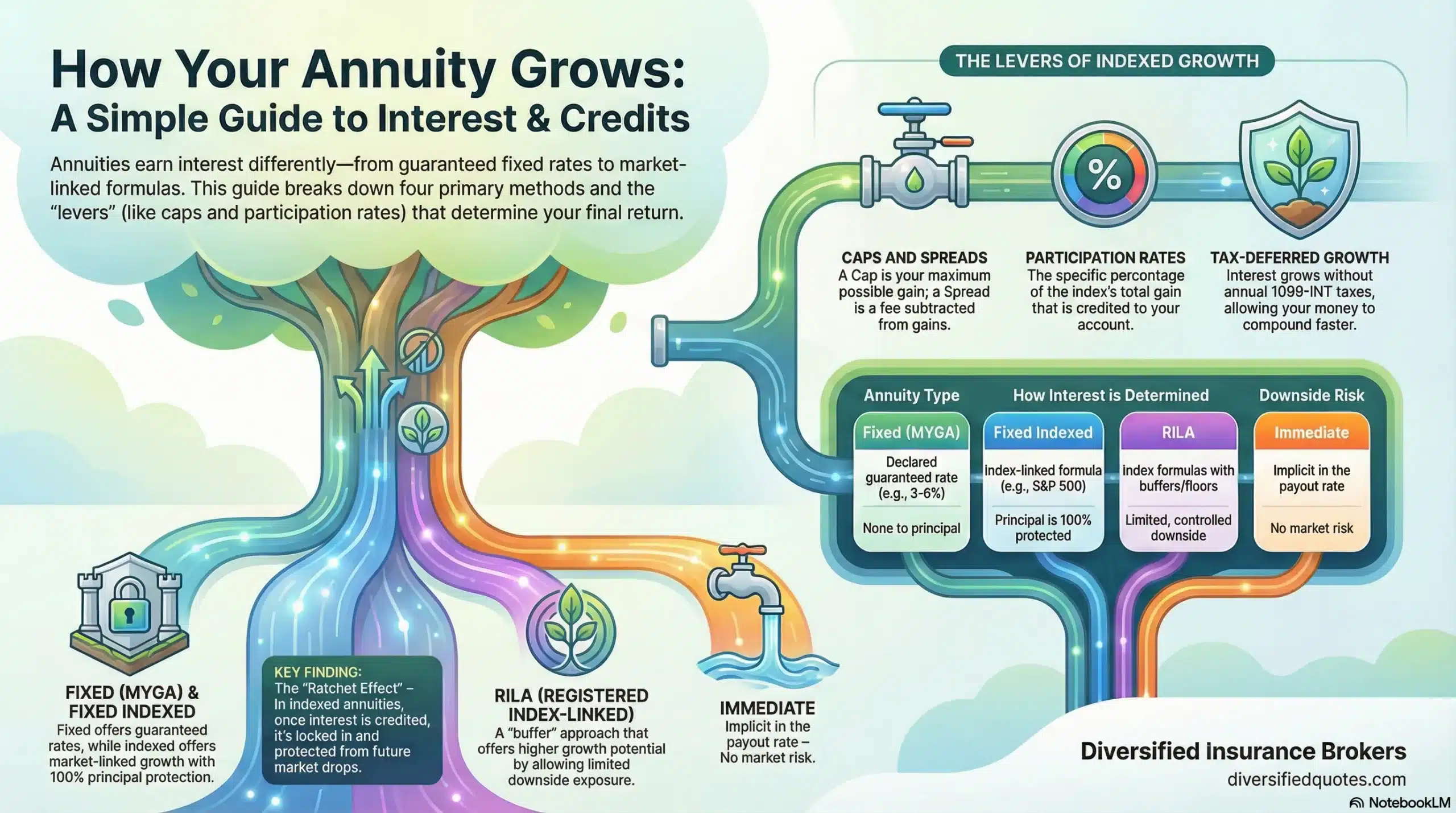
One of the most common evaluation decisions for buyers seeking the highest guaranteed rates is whether to choose a MYGA (with its contractually guaranteed declared rate) or a fixed indexed annuity (with its index-linked crediting that can exceed the MYGA rate in good years but may credit zero in flat or down years). Understanding how a fixed indexed annuity works before making this comparison is essential because the two structures serve genuinely different buyer objectives. The MYGA’s declared rate guarantee means the buyer knows exactly what the contract will be worth at any future date during the term — there is no scenario where the accumulation falls below the guaranteed trajectory. The FIA’s index crediting means the buyer has the possibility of earning more than the MYGA rate in strong index years, paired with the certainty of zero loss in negative index years. For buyers whose primary value is absolute certainty of accumulation outcome — knowing precisely what their contract will be worth at maturity — the highest guaranteed MYGA rate is the correct selection regardless of what the FIA might earn in favorable market conditions. For buyers who can tolerate the variability of index crediting in exchange for the possibility of higher growth in positive years, the FIA may be the better structural choice even at a lower guaranteed floor. The comparison is not about which product offers the highest potential return — it is about which guarantee type matches the buyer’s actual priorities for their retirement savings.
Guaranteed Rate vs. Bonus Annuity — When the Highest Guaranteed Rate Wins
Bonus annuities present a specific comparison challenge for buyers focused on the highest guaranteed annuity rates. A bonus FIA with a 26% upfront credit can look dramatically different from a MYGA’s 6.35% declared rate — but the comparison is not straightforward because the two numbers represent fundamentally different kinds of value. The MYGA’s 6.35% is a guaranteed annual rate that applies every year for the full 5-year term, compounding the full balance annually regardless of market conditions. The bonus FIA’s 26% is an upfront credit applied to a specified value (accumulation value, income base, or both), paired with index-linked annual crediting that may be higher or lower than the MYGA’s declared rate in any given year. Understanding the bonus annuity pros and cons before comparing the two structures is essential for buyers who want to make this comparison accurately. In many scenarios, a straightforward highest guaranteed MYGA rate outperforms a bonus product over the intended holding period — particularly when the bonus FIA’s crediting terms are conservative and the MYGA’s declared rate is strong. The cases where the bonus structure wins are typically those where the buyer has a long deferral horizon, a specific income planning goal, and a large enough premium that the bonus credit creates a meaningful advantage in the income calculation. Our current bonus annuity rates page provides the full market context for this comparison.
Moving Qualified Funds to Capture the Highest Guaranteed Rates
Many buyers seeking the highest guaranteed annuity rates are moving funds from qualified retirement accounts — IRAs, 401(k)s, 403(b)s, TSPs — that are currently held in lower-yielding vehicles. The transfer process must be structured correctly to preserve the tax-deferred status of the funds and avoid creating a taxable event. For IRA-to-MYGA transfers, the cleanest approach is a direct trustee-to-trustee IRA transfer — the receiving MYGA carrier accepts the IRA assets directly from the existing custodian without the funds passing through the buyer’s hands. Understanding how to transfer an IRA to an annuity and the specific documentation requirements for a clean transfer is essential for buyers doing this move. For buyers moving 401(k) or employer plan assets, a direct rollover to a new IRA hosted inside the MYGA is the standard approach — with the employer plan custodian issuing payment directly to the receiving carrier rather than to the employee. For buyers considering a 1035 exchange from an existing non-qualified annuity to a new MYGA with the highest guaranteed rates, the exchange is tax-free when structured as a direct carrier-to-carrier transfer. The full rollover and transfer mechanics for the various retirement account types are covered in our resource on how to transfer a retirement account to an annuity. For the tax treatment of guaranteed annuity interest in both qualified and non-qualified contexts, our resources on non-qualified annuities, the annuity exclusion ratio, and qualified annuity taxation provide the comprehensive tax mechanics treatment. For buyers evaluating their 401(k) rollover decision in the broader context of retirement income planning, our resource on what to do with a 401(k) after retiring and what to do with an IRA after retiring provide the full decision framework that surrounds the annuity transfer decision.
Death Benefits, Spousal Continuation, and Legacy Planning Within Guaranteed Annuities
The highest guaranteed annuity rates operate within a broader legacy planning context that matters increasingly as buyers age and accumulate more assets in annuity contracts. Most fixed annuities — including MYGAs — provide a contractual death benefit equal to the accumulated contract value at the time of the owner’s death, which passes to named beneficiaries according to the contract terms and applicable state law. This death benefit guarantee is part of what makes fixed annuities useful within legacy plans: unlike money in a brokerage account, the annuity’s death benefit typically passes directly to beneficiaries outside of probate, with a defined contractual value that does not require court-supervised distribution. Our resource on whether annuities have a death benefit covers the specific mechanics of how death benefits are calculated, paid, and taxed under different scenarios. For married couples, the spousal continuation annuity provision available in many fixed annuity contracts allows the surviving spouse to step into the owner’s position and continue the contract — preserving the guaranteed accumulation rate, avoiding immediate distribution, and maintaining the tax-deferred structure without triggering a taxable event at the time of the original owner’s death. For buyers using fixed annuities as part of a pension replacement strategy where both guaranteed accumulation and spousal income protection matter, our resource on the pension alternative strategy provides the complete planning framework that integrates the guaranteed accumulation rate with the survivor protection features that make fixed annuities genuinely useful as a long-term retirement planning tool.
Compare the Highest Guaranteed Annuity Rates
Compare guaranteed contracts side-by-side and match the best rate to your term, liquidity needs, and state availability. We confirm live rates, A-rated and B-rated carrier comparisons, and full contract provisions before you commit.
Talk With an Advisor Today
Choose how you’d like to connect—call or message us, then book a time that works for you.
Schedule here:
calendly.com/jason-dibcompanies/diversified-quotes
Licensed in all 50 states • Fiduciary, family-owned since 1980
FAQs: Highest Guaranteed Annuity Rates
What does “guaranteed annuity rate” mean — what exactly is being guaranteed?
A guaranteed annuity rate is a declared interest rate that the carrier commits by contract to credit for the full selected term — typically 1 to 10 years — regardless of market conditions, interest rate movements, or any subsequent carrier decision. The guarantee is contractual and legally enforceable under state insurance law. The carrier cannot reduce the declared rate during the term. It must maintain statutory reserves sufficient to meet the obligation, and those reserves are subject to annual actuarial review by state insurance regulators. If the carrier becomes insolvent, the state guaranty association provides protection up to applicable limits. The guarantee is specifically for the accumulation rate — the amount by which the contract balance grows annually. It does not extend to the renewal rate (which is set anew at maturity) or to the surrender value if the policyholder exits during the surrender period (which may be reduced by surrender charges and, in some contracts, an MVA).
How are guaranteed annuity rates determined — why do they differ by term and carrier?
Guaranteed annuity declared rates are set by the carrier’s investment department based on the yield the carrier can earn on its general account portfolio for the selected term, net of operating costs, reserve requirements, and the cost of providing the principal protection guarantee. Longer terms typically offer higher rates because carriers have more investment runway to generate income on the premium. Carrier-to-carrier differences at the same term reflect differences in investment portfolio composition — carriers accepting more investment risk in their portfolios (often reflected in B-range AM Best ratings) generate higher investment yields that translate into higher declared rates. Premium banding also affects rates: many carriers offer higher declared rates to larger deposits at defined thresholds (typically $50K, $100K, $250K, and $500K+).
Are these guaranteed rates locked for the entire term?
Yes. Once the contract is issued and the effective date is established, the declared rate is locked for the full selected term. The carrier cannot reduce it regardless of market conditions, interest rate changes, or internal financial developments. This full-term rate lock is the defining feature of the MYGA structure and what distinguishes it from floating-rate instruments. At maturity — the end of the declared term — the carrier declares a new rate for a new term, which may be higher or lower depending on the rate environment at that time. The locked rate guarantee applies only to the original term, not to any renewal period.
Can I access my money before maturity without losing the guaranteed rate?
The guaranteed rate continues to apply to all funds remaining in the contract during the term — including after partial withdrawals. Most MYGA contracts allow annual penalty-free withdrawals of 5%–10% of the accumulation value per year after the first contract anniversary, without triggering surrender charges or any adjustment to the remaining balance’s guaranteed rate. Withdrawals above the free-withdrawal allowance trigger surrender charges (typically 7%–10% in year one, declining to zero by the surrender period end) and, in contracts with MVA provisions, a possible interest rate adjustment to the surrendered amount. The guaranteed rate does not change as a result of any withdrawal — it is the accumulation rate for the balance that remains in the contract through the term. For qualified accounts, most MYGAs include RMD accommodation provisions that waive surrender charges on required minimum distributions.
Do guaranteed annuities charge fees that reduce the effective rate?
Standard MYGAs do not charge ongoing management fees or annual administration fees — the declared rate is the net rate credited to the accumulation value after all carrier costs. This distinguishes MYGAs from variable annuities and some FIA products that carry annual mortality and expense charges, rider fees, and fund management expenses that reduce the effective net return. The MYGA rate shown in a rate table is the rate the buyer actually receives on the accumulation value — there is no separate fee structure applied on top of it. Surrender charges apply only to excess withdrawals during the surrender period, not as an ongoing reduction to the credited rate. Some optional riders added to fixed annuities carry annual fees — but standard MYGAs without riders have no ongoing fee structure beyond the surrender charge design that governs early exit provisions. Our dedicated resource on whether annuities have fees provides the full fee transparency context across different annuity types.
Can I hold a guaranteed annuity in an IRA or use it for a 401(k) rollover?
Yes. MYGAs accept qualified retirement account funding — traditional IRA, 401(k), 403(b), 457, TSP, and SEP-IRA — through direct rollover or trustee-to-trustee transfer without triggering a taxable event. For IRA transfers, the cleanest approach is a direct trustee-to-trustee transfer where the receiving MYGA carrier accepts the IRA assets directly from the existing custodian. For 401(k) or employer plan assets, a direct rollover to a new IRA hosted inside the MYGA is standard. The guaranteed rate applies to the transferred premium subject to minimum requirements and state availability. RMD rules continue to apply at the required beginning date — confirm the product accommodates RMDs without surrender charges before funding.
What happens at the end of the guaranteed term?
At maturity, most MYGA contracts provide a penalty-free window — typically 30 days — during which the buyer can withdraw the full accumulated value without surrender charges, transfer to a new MYGA (same or different carrier) at then-current rates, or convert to a different annuity structure. If no action is taken during the maturity window, most contracts auto-renew into a new term at the carrier’s then-current declared rate — which may be higher or lower than the original rate depending on the market environment at renewal. Understanding the exact maturity window length, the default auto-renewal terms, and what action is required to elect a different outcome before purchasing any MYGA is important. Knowing the maturity date in advance and planning to act within the window ensures the buyer maintains full control over the reinvestment decision rather than defaulting into whatever the carrier automatically applies.
Are annuities with the highest guaranteed rates safer than market investments?
Fixed annuities including MYGAs are fundamentally different from market investments — they are contractual obligations of the insurance carrier backed by state-regulated reserve requirements, not market performance. The “safety” comparison requires clarity on what risks are being compared. A MYGA eliminates market risk — the principal cannot lose value due to stock or bond market performance. The carrier’s claims-paying ability backs the guarantee, and the state guaranty association provides additional protection within applicable limits. The risks that remain are the carrier’s financial insolvency risk (addressed by AM Best ratings and state regulatory oversight) and interest rate reinvestment risk at maturity (managed through laddering strategies). These risks exist but are fundamentally different from — and generally lower volatility than — market risk in equity or bond investments. For conservative retirement savings that should not be exposed to market drawdowns, MYGAs provide a level of outcome certainty that market investments by design cannot.
What is the minimum investment amount for the highest guaranteed annuity rates?
Most MYGA carriers set minimum premium requirements in the range of $10,000–$25,000, though some carriers set minimums as low as $5,000 and others as high as $50,000. The benchmark rates in the rate table above typically reflect rates available at standard minimum deposit levels. Many carriers offer tiered pricing — higher declared rates at larger deposit thresholds, commonly $50,000, $100,000, $250,000, and $500,000+. A buyer depositing $300,000 may receive a higher declared rate from the same carrier than the benchmark table shows for the minimum deposit. When requesting a live quote, specifying your exact premium amount is essential to confirm the tier rate that actually applies to your deposit rather than the published minimum-tier benchmark.
Can I use a 1035 exchange to move an existing annuity to one with a higher guaranteed rate?
Yes. A 1035 exchange allows a tax-free transfer from an existing non-qualified annuity to a new annuity contract, preserving the tax-deferred status of the funds and carrying the original contract’s cost basis to the new contract. To qualify for tax-free treatment under IRC Section 1035, the exchange must be structured as a direct carrier-to-carrier transfer — the funds cannot pass through the policyholder’s hands. Before executing a 1035 exchange to capture a higher guaranteed rate, evaluate the economics carefully: any remaining surrender charges on the existing contract reduce the net amount available for the new contract, and the break-even period (how long the new higher rate must be credited before the exchange becomes net-positive versus holding the existing contract) should be calculated explicitly. In many cases, the new contract’s higher guaranteed rate makes the exchange clearly beneficial. In others, the remaining surrender charge friction on the old contract may not be worth the rate improvement. We provide this break-even analysis as part of the exchange evaluation process before any recommendation is made.
About the Author:
Jason Stolz, CLTC, CRPC, DIA, CAA and Chief Underwriter at Diversified Insurance Brokers (NPN 20471358), is a senior insurance and retirement professional with more than 25 years of real-world experience helping individuals, families, and business owners protect their income, assets, and long-term financial stability. As a long-time partner of the nationally licensed independent agency Diversified Insurance Brokers, Jason provides trusted guidance across multiple specialties—including fixed and indexed annuities, long-term care planning, personal and business disability insurance, life insurance solutions, Group Health, Travel Medical and Evacuation Insurance, and short-term health coverage. Diversified Insurance Brokers maintains active contracts with over 100 highly rated insurance carriers, ensuring clients have access to a broad and competitive marketplace.
His practical, education-first approach has earned recognition in publications such as VoyageATL, and contributions from his agency featured in Kiplinger and GoBankingRates— highlighting his commitment to financial clarity and client-focused planning. Drawing on deep product knowledge and years of hands-on field experience, Jason helps clients evaluate carriers, compare strategies, and build retirement and protection plans that are both secure and cost-efficient. Visitors who want to explore current annuity rates and compare options across multiple insurers can also use this annuity quote and comparison tool.
Explore More Annuity Options: Browse our complete guide to Current Annuity Rates — covering current fixed, bonus, MYGA & income annuity rates by term from top carriers from 100+ carriers.
Last Reviewed: October 16, 2026 |
Reviewed by: Jason Stolz, CLTC, CRPC, DIA, CAA
Chief Underwriter, Diversified Insurance Brokers, Inc. | NPN: 20471358 | Diversified Insurance Brokers, Inc. — Licensed in all 50 states
Fact Checked by: Tonia Pettitt, CMIP©
Medicare Specialist, Diversified Insurance Brokers, Inc. | NPN: 14374308 | Diversified Insurance Brokers, Inc. — Licensed in all 50 states
Did you find this content helpful? Leave us a Google review — it helps others find trustworthy guidance too.
Editorial Standards: Diversified Insurance Brokers maintains rigorous editorial standards to ensure accuracy, clarity, and independence in all content. Learn more about our editorial standards and commitment to transparency.
