
What is the Interest Rate on a $250,000 Annuity
What is the Interest Rate on a $250,000 Annuity

Jason Stolz CLTC, CRPC, DIA, CAA
A $250,000 annuity represents a genuinely consequential retirement allocation — large enough to function as a meaningful income floor, substantial enough that the dollar impact of rate differences between carriers adds up to real money, and significant enough that the selection of annuity type, term, and carrier all carry meaningful financial weight. Like all annuity evaluations, the interest rate on a $250,000 annuity is not determined by the premium amount itself. The same product from the same carrier on the same day will credit the same rate to a $250,000 premium as to a $50,000 premium. What is determined by the $250,000 figure is the total dollar value of what the interest earns in each compounding period — and that dollar value is five times larger than on $50,000, which means that a fraction of a percentage point difference in credited rate produces a meaningfully larger dollar outcome over the term of the contract. A one-percentage-point rate differential on $250,000 generates $2,500 more in the first year alone, compounding from a larger base in every subsequent year. Over a 7- or 10-year annuity term, that compounding rate advantage accumulates into a difference that changes the retirement income picture.
There is a second reason why $250,000 is a meaningful threshold in annuity planning that goes beyond the arithmetic of compounding: it sits at or near the state guaranty association protection limit that most states apply to annuity contracts. State guaranty associations provide a backstop if an insurance carrier becomes insolvent, but that protection has a ceiling — most states provide coverage up to $250,000 per covered contract per insurer, though the exact limit varies by state and some states have lower coverage thresholds. This means that a $250,000 annuity buyer is essentially at the maximum coverage limit for the state guaranty system in many states. Any amount above that limit sits in unprotected territory if the carrier fails. This is not an argument against purchasing a $250,000 annuity — it is an argument for selecting an A-rated carrier with genuine financial strength rather than chasing marginal additional yield from a lower-rated carrier whose failure risk is higher. At $250,000, the case for insisting on A-rated carrier financial strength is not a preference. It is a financially rational imperative given the protection structure of the guaranty system.
This page covers everything a $250,000 annuity buyer needs to understand about how interest works at this premium level — including the mechanics of each annuity type, why the rate differential matters more in dollar terms at $250,000, how tax deferral compounds the advantage over taxable alternatives, how term selection interacts with rate levels, how the state guaranty association threshold makes carrier selection essential, how $250,000 converts to retirement income at different ages, and how to evaluate whether to place the full $250,000 with a single carrier or spread it strategically across multiple carriers for diversification. Our resource on how annuities earn interest covers the crediting mechanics in depth, and our annuities 101 guide covers the full product landscape. Our resource on interest rates on a $50,000 annuity covers this topic for a smaller allocation and provides a useful comparative reference. An investment risk analysis can help determine how a $250,000 annuity allocation fits within the broader risk profile of your retirement portfolio.
Ensure you are receiving the absolute top rates on your $250,000
Current Fixed Annuity Rates
Compare today’s best fixed annuity rates from top carriers.
Current Bonus Annuity Rates
See which annuities offer the highest upfront bonus today.
Request an Annuity Quote
Submit our annuity request form to get personalized rate options.
Lifetime Income Calculator
Model how much guaranteed monthly income your $250,000 could generate — compare by age, term, and carrier.
Compare Multi-Year Guaranteed Annuity Rates by Term
Find the term that best matches your $250,000 timeline and income objective.
Why $250,000 Is a Significant Threshold in Annuity Planning
Most annuity buyers at any premium level share the same core evaluation framework: what rate is available, how does the contract grow, and how does it eventually produce income. But $250,000 brings two considerations into sharp focus that are less consequential at smaller premium levels. The first is the dollar impact of rate competitiveness. At $250,000, a 0.50% rate difference — half a percent — generates $1,250 more in the first year’s interest, and because that additional interest is added to the accumulation base, the gap widens through every subsequent compounding period. Over a 7-year term, a sustained 0.50% rate advantage on $250,000 produces a materially different account value at maturity. This is money that belongs to the buyer if they select the most competitive carrier, and it is money that is silently left on the table if they accept the first offer without comparison. The discipline of comparing rates across the full field of qualified carriers is worth the effort at any premium level — at $250,000, it is genuinely important.
The second consideration is the state guaranty association limit. State guaranty associations exist to protect policyholders if an insurance carrier becomes insolvent, but the protection has a statutory ceiling that varies by state. In most states, the annuity coverage limit is $250,000 per covered contract per insurer — meaning that every dollar up to that limit has a regulatory backstop, and every dollar above it does not. A $250,000 annuity buyer at the limit has the full protection of the state guaranty system working in their favor — as long as they choose a carrier that the guaranty association covers in their state and the contract is structured within the covered limits. This is not a reason to avoid annuities at $250,000 — it is a strong reason to insist on an A-rated carrier where the probability of the guaranty system ever being needed is genuinely low. The guaranty association is an emergency backstop, not a substitute for selecting a financially sound carrier. At $250,000, treating carrier financial strength as a primary selection criterion — not an afterthought after rate optimization — is the prudent approach.
How Interest Is Credited on a $250,000 Annuity
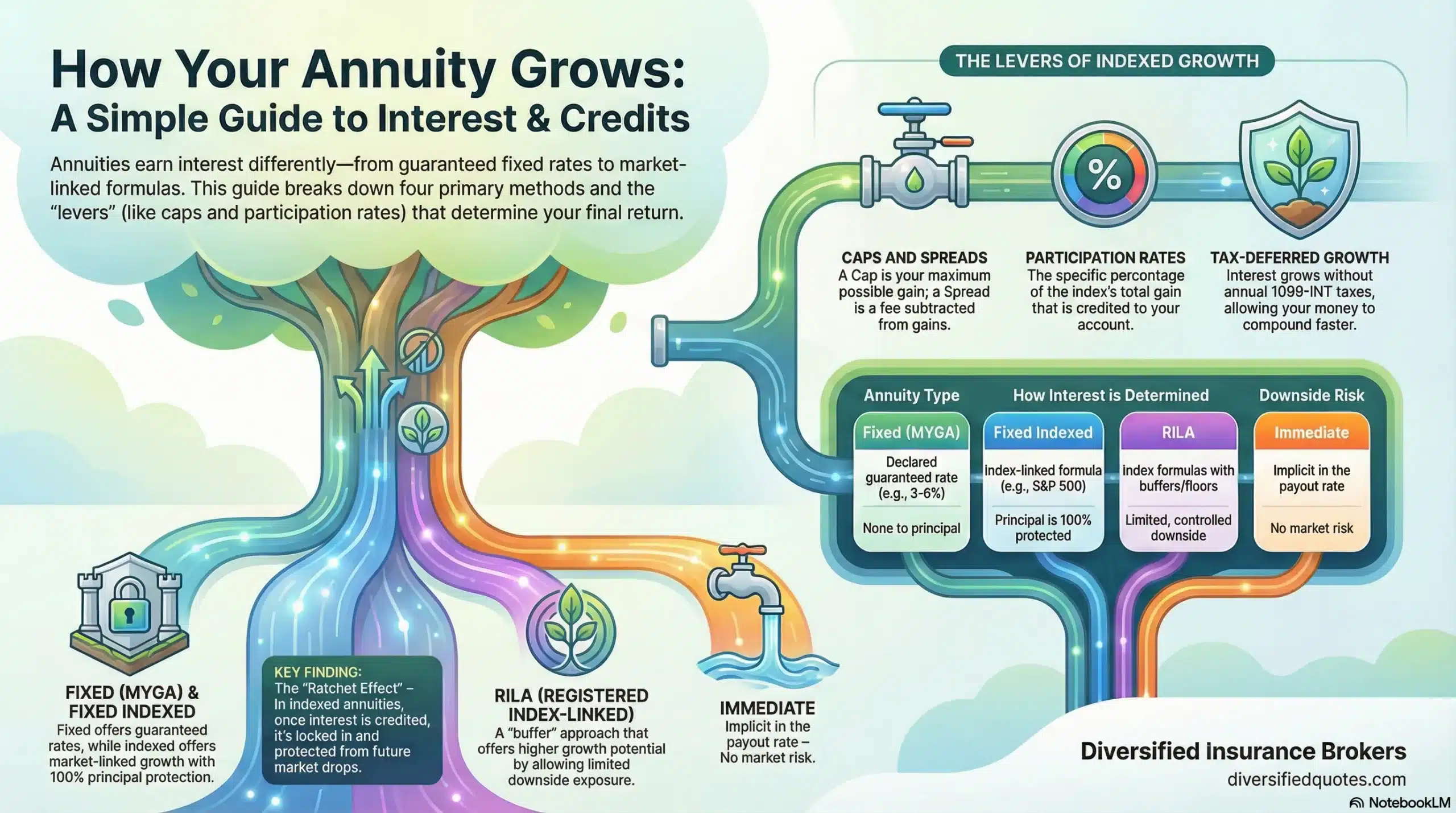
The mechanisms that credit interest to a $250,000 annuity are identical to those that credit interest to any fixed or indexed annuity — what changes is the dollar magnitude of what those mechanisms produce. In a fixed multi-year guaranteed annuity (MYGA), the carrier declares a specific annual interest rate at contract issuance and guarantees that rate for the full term. For a $250,000 MYGA, the declared rate applied annually to the account value produces a predictable, mathematically certain accumulation that the buyer can calculate from day one. There is no market variability, no index tracking, no year-to-year uncertainty. The account value at the end of year one, year three, year five, and maturity is entirely determined by the starting premium, the declared rate, and the term — nothing else. This predictability is one of the most valuable features of the MYGA structure at any premium level, and at $250,000 it provides the certainty that a meaningful retirement asset is growing reliably without being subject to timing or sequence-of-returns risk.
In a fixed indexed annuity, the crediting mechanism is more nuanced. The carrier sets a floor of zero — meaning the account value cannot decline from index-linked negative performance — and credits interest each period based on the performance of an external index, subject to the contract’s participation rate, cap, or spread. In a year where the index performs positively and the cap is not a binding constraint, the FIA credits meaningful interest above what a MYGA might have declared. In a year where the index is flat or negative, the FIA credits zero — protecting the principal accumulated to that point. The sum of all positive index credits, locked in each period, constitutes the FIA’s accumulated growth over time. For a $250,000 buyer, the FIA’s value proposition is different from the MYGA’s: more potential upside in strong market years, less certainty about the accumulation path. The choice between them depends on whether the planning priority is maximum certainty of accumulation or maximum potential accumulation with protected downside. Our comprehensive guide to understanding MYGAs covers the fixed rate structure in full detail, and our resource on how MYGAs compare to CDs provides the competitive context for evaluating fixed annuity rates against bank alternatives.
Hypothetical Growth of a $250,000 Annuity at Different Rates
The tables below illustrate how $250,000 grows under three hypothetical compounding scenarios across multiple time horizons. These are illustrative examples only — the rates shown are round numbers chosen to demonstrate compounding mechanics and are not representations of currently available rates or quotes. Actual annuity rates change frequently based on the bond market environment, carrier, term length, and state. For current live rates from active carriers, our best MYGA annuity rates and current annuity rates pages reflect today’s competitive market.
| Year | 4.00% (Hypothetical) | 5.00% (Hypothetical) | 6.00% (Hypothetical) |
|---|---|---|---|
| Year 1 | $260,000 | $262,500 | $265,000 |
| Year 3 | $281,216 | $289,406 | $297,753 |
| Year 5 | $304,163 | $319,070 | $334,557 |
| Year 7 | $328,984 | $351,782 | $375,901 |
| Year 10 | $370,061 | $407,224 | $447,712 |
| Year 15 | $450,235 | $519,734 | $599,137 |
| Year 20 | $547,780 | $663,324 | $801,785 |
All figures are hypothetical illustrations of compound interest mechanics and are not quotes, projections, or representations of currently available annuity rates. Actual credited rates depend on the specific annuity product, carrier, term, state of purchase, and date of purchase. Tax deferral is assumed — no annual tax drag reduces the compounding base. Consult a licensed insurance professional and a tax advisor for guidance specific to your situation and state.
The dollar spread across hypothetical rate scenarios becomes more striking at $250,000 than it was at $50,000. By year 10, the gap between the 4% and 6% hypothetical scenarios is approximately $77,000 — nearly a third of the original premium — on a starting investment of $250,000. By year 20, that same 2-percentage-point hypothetical differential produces more than $250,000 in additional accumulation on the same starting premium. These numbers illustrate why rate competitiveness matters so much at this premium level and why accepting the first carrier offer without comparing the full market of qualified carriers is a costly decision. The difference between a competitive rate and a below-market rate on $250,000 is not a rounding error — it is a meaningful retirement resource that compounds its way into a materially different financial outcome.
Tax Deferral — The Compounding Multiplier at $250,000
Tax deferral provides a compounding advantage that scales with both the premium amount and the marginal tax rate of the investor. For a $250,000 non-qualified (after-tax) annuity, the tax deferral advantage over a taxable alternative earning the same gross rate is quantifiable and substantial. In a taxable savings vehicle — a CD, money market account, or taxable bond fund — the interest earned each year is recognized as ordinary income and taxed in the year it is earned. At a 22% or higher federal marginal rate, a meaningful portion of each year’s interest is redirected to the IRS rather than remaining in the account to compound. Over a multi-year holding period, this annual tax drag reduces the effective compounding base each year, producing a total accumulated value that is lower than what the same gross rate would produce in a tax-deferred structure. In a $250,000 annuity, the credited interest accumulates without current-year tax recognition — the full interest amount remains in the account and participates in compounding each subsequent year.
The practical magnitude of this advantage on a $250,000 holding grows with the marginal rate and the time horizon. For a buyer in a 24% or 32% federal bracket holding the annuity for 7 to 15 years, the after-tax accumulation advantage of the annuity over a taxable alternative at the same gross rate is a real and measurable dollar figure — not a theoretical benefit. This is why many conservative savers and retirees with meaningful non-qualified savings choose annuities over CDs even when the gross rate differential is small: the after-tax accumulation story is more favorable in the annuity because the deferral advantage compounds along with the interest. For investors in lower marginal brackets or with very short holding periods, the deferral advantage is smaller — but it is still present. For the full framework around how to protect $250,000 as part of a broader retirement asset protection strategy, our resource on how to protect your funds in retirement covers the safe-money planning context within which this decision belongs.
Carrier Financial Strength — Non-Negotiable at $250,000
The state guaranty association system provides meaningful protection for annuity policyholders in the event of carrier insolvency, but it is not unlimited protection. State guaranty association coverage limits typically range from $100,000 to $300,000 per covered contract per insurer depending on the state, with most states providing $250,000 in annuity coverage. This means that a $250,000 annuity buyer in most states is purchasing protection right at the statutory limit — every dollar is covered, but only if the carrier and contract meet the specific requirements of the state guaranty association and only up to the statutory limit. Any portion above the limit in states with lower thresholds would be outside guaranty protection. And in all cases, the guaranty association is an emergency backstop — it activates only if the carrier actually becomes insolvent, a process that is stressful, time-consuming, and disruptive even when the dollar amounts are eventually recovered.
The straightforward implication is this: at $250,000, selecting an A-rated carrier from AM Best is the most important decision in the annuity evaluation process, not the last consideration after rate optimization. An A- (Excellent) rating from AM Best represents the minimum threshold that most experienced advisors specify for any annuity commitment, with a preference for A (Excellent) or higher at premium levels that approach or exceed state guaranty limits. A $250,000 placement with a B++ carrier for a marginally higher rate is a trade-off that exchanges guaranteed carrier quality for incremental yield — and at this premium level, that trade-off is worth explicit evaluation rather than casual acceptance. The additional rate from a lower-rated carrier does not grow if the carrier has difficulties, and the guaranty system process, while protective, is not seamless. The disciplined approach is to compare the best available rates from A-rated carriers first, then evaluate whether any lower-rated carrier’s rate premium justifies the additional carrier risk at this specific premium magnitude.
How a $250,000 Annuity Converts to Retirement Income
For many retirees, the $250,000 annuity is purchased not primarily as an accumulation vehicle but as the foundation of a guaranteed retirement income stream. At this premium level, the income potential is substantial enough to cover a significant portion of monthly essential expenses — which is exactly the strategic purpose of the income floor concept in retirement planning. The income amount a $250,000 annuity generates depends on the accumulated contract value at income start, the annuitant’s age, the specific payout structure selected, and the payout factors offered by the carrier at the time income elections are made. A $250,000 premium that has grown through a 5- to 7-year accumulation phase before income begins produces more monthly income than the same amount starting immediately, because the larger accumulated base converts to higher payments at the same payout rate.
As a rough frame of reference — not a quote or commitment — annuity income at various ages from a $250,000 contract generally represents a meaningful monthly income contribution when combined with Social Security and any other guaranteed income sources. Our how much does an annuity pay guide covers the full income framework for understanding what different premium amounts produce at different ages. For scale context, our resource on how much a $100,000 annuity pays shows the lower reference point, and our resources on $500,000 and $1 million annuities show how income scales at higher premium levels. The income from a $250,000 annuity is proportional to these larger examples — the rate mechanics are the same, only the base differs. For the largest end of the scale, our resource on how much a $6 million annuity pays illustrates how income grows with large premiums using the same underlying mechanics.
$250,000 as an Income Floor — The Retirement Planning Role
The income floor concept is one of the most important frameworks in retirement income planning, and $250,000 is large enough to make a meaningful contribution to it. An income floor is the layer of guaranteed retirement income — from Social Security, pension, and annuity income combined — that covers essential monthly expenses regardless of what markets do and regardless of how long retirement lasts. When the income floor covers housing, utilities, food, and healthcare premiums, the rest of the retirement portfolio can be invested for growth and discretionary spending without the anxiety of wondering whether market performance will sustain essential living costs. The annuity’s guaranteed income becomes the bedrock; everything else is flexibility on top of that bedrock.
At $250,000, depending on age and income structure, an annuity can produce a guaranteed monthly income that meaningfully closes the gap between Social Security income and essential monthly expenses for many retirees. For couples where one or both partners have modest Social Security benefits, a $250,000 FIA with a guaranteed lifetime withdrawal benefit rider can be structured to provide joint lifetime income that supplements Social Security and eliminates longevity risk — the risk of outliving the income — for both spouses. Our resource on how annuity income riders work and what they cost covers the GLWB mechanics that drive income design decisions. For the Social Security coordination dimension, our resource on Social Security planning strategies covers how to optimize the combination of guaranteed income sources. For the broader income protection context including how sequence of returns risk is managed by a guaranteed income floor, our resource on sequence of returns risk covers why the guaranteed floor changes the risk profile of the entire retirement portfolio. And for income planning that combines guaranteed growth with inflation protection, our resource on annuities with inflation protection for seniors covers how to structure the income component to maintain purchasing power over a long retirement.
The Split Strategy — Spreading $250,000 Across Multiple Carriers
For buyers at the $250,000 level, the split strategy — dividing the premium across two or more carriers rather than placing it all with a single insurer — addresses both the guaranty association limit concern and the rate optimization opportunity simultaneously. A buyer in a state with a $250,000 guaranty limit who places the full $250,000 with a single carrier has no guaranty protection margin for any future growth — once the account grows above the covered limit, that growth sits in unprotected territory. Splitting $125,000 across two different A-rated carriers maintains full guaranty protection on both contracts throughout the accumulation period (assuming growth stays within limits and state-specific rules), while also diversifying the carrier risk rather than concentrating it in one institution.
The split strategy also creates an opportunity to ladder terms — placing a portion in a shorter-term contract and the remainder in a longer-term contract, creating staggered maturity dates at different points in the future. This approach solves the single-maturity-date problem: rather than having the full $250,000 come due at one moment in time (forcing a large reinvestment decision in whatever rate environment exists at that future date), staggered maturities create multiple decision windows that average across different market conditions. For comprehensive guidance on how laddering and term strategy work across multiple contracts, our resource on understanding multi-year guaranteed annuities covers the full framework. The annuity free withdrawal rules resource ensures you understand what access is available during each contract’s surrender period before committing to any term structure. For buyers who have already received a $250,000 annuity proposal and want independent verification of its competitiveness, our second-opinion annuity quote review provides that carrier comparison. And if you hold an existing annuity that is underperforming relative to the current market, our annuity rescue plan covers when and how repositioning makes sense for a $250,000 allocation. Our resource on bonus annuity with lifetime income covers the FIA designs that combine upfront bonus credits with income rider mechanics — often evaluated for their potential in $250,000 income-focused allocations. For broader market context around where a $250,000 guaranteed annuity fits alongside risk assets, our resource on downside protection strategies in bear markets covers how guaranteed instruments serve the portfolio when equity markets are declining. Our best annuity rates for seniors guide covers the income and accumulation options most relevant for retirees evaluating $250,000 allocations across the carrier market.
Talk With an Advisor Today
Choose how you’d like to connect—call or message us, then book a time that works for you.
Schedule here:
calendly.com/jason-dibcompanies/diversified-quotes
Licensed in all 50 states • Fiduciary, family-owned since 1980
FAQs: What Is the Interest Rate on a $250,000 Annuity?
What interest rate can a $250,000 annuity earn?
The interest rate on a $250,000 annuity is determined by the type of annuity (fixed MYGA, fixed indexed, or immediate income), the term length, the carrier, and the bond market environment at the time of purchase — not by the $250,000 premium amount itself. A $250,000 and a $100,000 premium in the same product from the same carrier typically receive the same credited rate. What the $250,000 premium changes is the total dollar value of what the interest earns — at this level, even a half-percentage-point rate difference generates thousands of dollars of additional accumulation each year. For current competitive rates from active carriers, our live rate pages show what is available today, as rates change frequently with market conditions.
Why does carrier financial strength matter more at $250,000?
State guaranty associations protect annuity policyholders if a carrier becomes insolvent, but coverage is limited — most states provide $250,000 per covered contract per insurer, though limits vary by state. A $250,000 annuity buyer is at or near this statutory limit, meaning any amount above it (including accumulated growth over time) may fall outside guaranty protection. This makes selecting an A-rated carrier from AM Best the most important decision in the evaluation process for a $250,000 annuity — not an afterthought. An A-rated carrier with strong financial strength significantly reduces the probability of ever needing the guaranty system. At $250,000, optimizing for rate from a lower-rated carrier at the expense of carrier quality is a trade-off that deserves explicit evaluation rather than casual acceptance.
Does investing more money like $250,000 increase the annuity interest rate?
In most cases, no — the credited rate is determined by the contract and market conditions, not the premium amount. A $250,000 and a $500,000 premium in the same annuity from the same carrier typically receive the same rate. What the larger premium changes is the total dollar value of interest earned each period. Some carriers set minimum premiums ($10,000–$25,000 is common) and occasionally offer slightly improved rates on very large premiums through negotiation or special products, but these are exceptions. For most buyers at the $250,000 level, the rate comparison is between carriers and products — not between premium sizes.
How much income can a $250,000 annuity generate?
The monthly or annual income a $250,000 annuity generates depends on the accumulated contract value when income begins, the annuitant’s age at that time, the income structure selected (life-only, joint life, period-certain), and current payout factors from the carrier. A $250,000 contract that has grown through a multi-year accumulation phase before income begins produces more income than the same amount starting immediately, because the larger accumulated base converts to higher payments. For many retirees, $250,000 in an income-focused FIA with a guaranteed lifetime withdrawal benefit rider can generate a meaningful monthly payment that, combined with Social Security, covers a substantial portion of essential monthly expenses. The Lifetime Income Calculator on this page models current income amounts from active carriers — enter your age and premium to see real comparative results.
Should I split $250,000 across multiple annuity carriers?
Splitting $250,000 across two or more A-rated carriers is worth serious consideration at this premium level for two reasons. First, it keeps each individual carrier allocation within the state guaranty association protection limit, providing full statutory coverage on both contracts throughout the accumulation period (subject to state-specific rules and future growth). Second, it allows staggered term structures — placing a portion in a shorter-term contract and the remainder in a longer-term contract — creating multiple maturity dates rather than forcing the full $250,000 into a single reinvestment decision at one future point in time. The split strategy adds some administrative complexity but addresses both carrier concentration risk and term concentration risk simultaneously. Whether the tradeoffs are worthwhile depends on the specific carrier options, rate differentials available, and state guaranty limits applicable to your situation.
How does tax deferral benefit a $250,000 annuity?
For a non-qualified (after-tax) $250,000 annuity, tax deferral means that credited interest accumulates without generating a current-year income tax liability. The full interest amount remains in the account and participates in compounding each subsequent year without being partially redirected to taxes. In contrast, a taxable CD or savings account earning the same gross rate credits interest that is recognized as ordinary income in the year it is earned — the taxes paid each year reduce the effective compounding base for subsequent years. At $250,000 and for a buyer in a 22% or higher federal marginal bracket, this deferral advantage produces a measurably better after-tax accumulation over a multi-year holding period than a taxable alternative at the same gross rate. The advantage grows with the holding period and the marginal tax rate.
Are $250,000 annuity interest rates guaranteed?
Fixed MYGA annuity interest rates are contractually guaranteed for the full term — the declared rate cannot be reduced during the guarantee period regardless of changes in market rates. This means a $250,000 MYGA buyer knows from day one exactly what rate applies for the full term and exactly what the account value will be at maturity. Fixed indexed annuity credits are not pre-declared — they are determined each crediting period based on index performance subject to the contract’s crediting parameters. The FIA guarantees that principal will not decline from market losses, but the interest credited in any year is variable based on index results. Both product types protect the $250,000 principal from market loss; the MYGA provides complete accumulation certainty, while the FIA provides accumulation potential with protection.
What should I do if I’ve already received a $250,000 annuity quote?
If you have already received a $250,000 annuity proposal, the most important next step is verifying whether it is competitive against the full market of qualified carriers at the same term in your state on the same date. A single carrier’s offer — particularly at $250,000 — should always be compared against the best available alternatives before commitment. An independent broker with access to 75 or more active carriers can run a side-by-side comparison of credited rates, surrender schedules, free withdrawal provisions, waiver features, and carrier financial strength for the same inputs. Our second-opinion annuity quote review service provides exactly that comparison at no cost. At $250,000, a rate difference of even half a percentage point is worth investigating before signing, because the dollar impact over the contract term is substantial.
About the Author:
Jason Stolz, CLTC, CRPC, DIA, CAA and Chief Underwriter at Diversified Insurance Brokers (NPN 20471358), is a senior insurance and retirement professional with more than 25 years of real-world experience helping individuals, families, and business owners protect their income, assets, and long-term financial stability. As a long-time partner of the nationally licensed independent agency Diversified Insurance Brokers, Jason provides trusted guidance across multiple specialties—including fixed and indexed annuities, long-term care planning, personal and business disability insurance, life insurance solutions, Group Health, Travel Medical and Evacuation Insurance, and short-term health coverage. Diversified Insurance Brokers maintains active contracts with over 100 highly rated insurance carriers, ensuring clients have access to a broad and competitive marketplace.
His practical, education-first approach has earned recognition in publications such as VoyageATL, and contributions from his agency featured in Kiplinger and GoBankingRates— highlighting his commitment to financial clarity and client-focused planning. Drawing on deep product knowledge and years of hands-on field experience, Jason helps clients evaluate carriers, compare strategies, and build retirement and protection plans that are both secure and cost-efficient. Visitors who want to explore current annuity rates and compare options across multiple insurers can also use this annuity quote and comparison tool.
Explore More Annuity Options: Browse our complete guide to How Much Does an Annuity Pay? — covering annuity payout calculators, income amounts & interest rates by investment size from 100+ carriers.
Last Reviewed: June 19, 2026 |
Reviewed by: Jason Stolz, CLTC, CRPC, DIA, CAA
Chief Underwriter, Diversified Insurance Brokers, Inc. | NPN: 20471358 | Diversified Insurance Brokers, Inc. — Licensed in all 50 states
Fact Checked by: Tonia Pettitt, CMIP©
Medicare Specialist, Diversified Insurance Brokers, Inc. | NPN: 14374308 | Diversified Insurance Brokers, Inc. — Licensed in all 50 states
Did you find this content helpful? Leave us a Google review — it helps others find trustworthy guidance too.
Editorial Standards: Diversified Insurance Brokers maintains rigorous editorial standards to ensure accuracy, clarity, and independence in all content. Learn more about our editorial standards and commitment to transparency.
