
What is a Variable Annuity
As an Independent Annuity Broker, we compare rates across 100+ carriers and 1,000 different annuities— not just one company’s product offerings — to find the best fit for your goals.
What is a Variable Annuity

Jason Stolz CLTC, CRPC, DIA, CAA
A variable annuity is a type of retirement contract issued by an insurance company that allows investors to allocate premium into market-based investment options — called subaccounts — that function similarly to mutual funds. Unlike fixed annuities or fixed indexed annuities, the account value of a variable annuity fluctuates directly with market performance. Understanding the difference between a variable annuity and other retirement income structures begins with one central fact: in a variable annuity, the investor bears the investment risk. The account can grow substantially during favorable markets, and it can decline substantially during downturns. That full two-way market exposure is both the defining feature and the primary risk consideration of this product type.
Variable annuities are often marketed as retirement planning tools because they offer tax-deferred growth and optional lifetime income features layered on top of investment subaccounts. The tax deferral means no annual 1099 is generated on internal gains, allowing the full credited amount to compound year over year without annual tax friction. The income features — typically riders added to the base contract — can provide a guaranteed income floor even if the account value declines. However, these contracts are also known for having complex, multi-layered fee structures that can meaningfully reduce long-term returns, and they expose investors to market volatility in a way that makes them unsuitable for individuals whose primary concern is principal protection. Understanding where variable annuities fit — and where they do not — requires examining both their structure and their costs honestly.
Ensure you are receiving the absolute top rates
Current Fixed Annuity Rates
Compare today’s best fixed annuity rates from top carriers.
Current Bonus Annuity Rates
See which annuities offer the highest upfront bonus today.
Request an Annuity Quote
Submit our annuity request form to get personalized rate options.
Lifetime Income Calculator
Use our calculator to see how much guaranteed income your annuity can provide.
Variable Annuity vs. Fixed and Indexed Alternatives — Key Differences
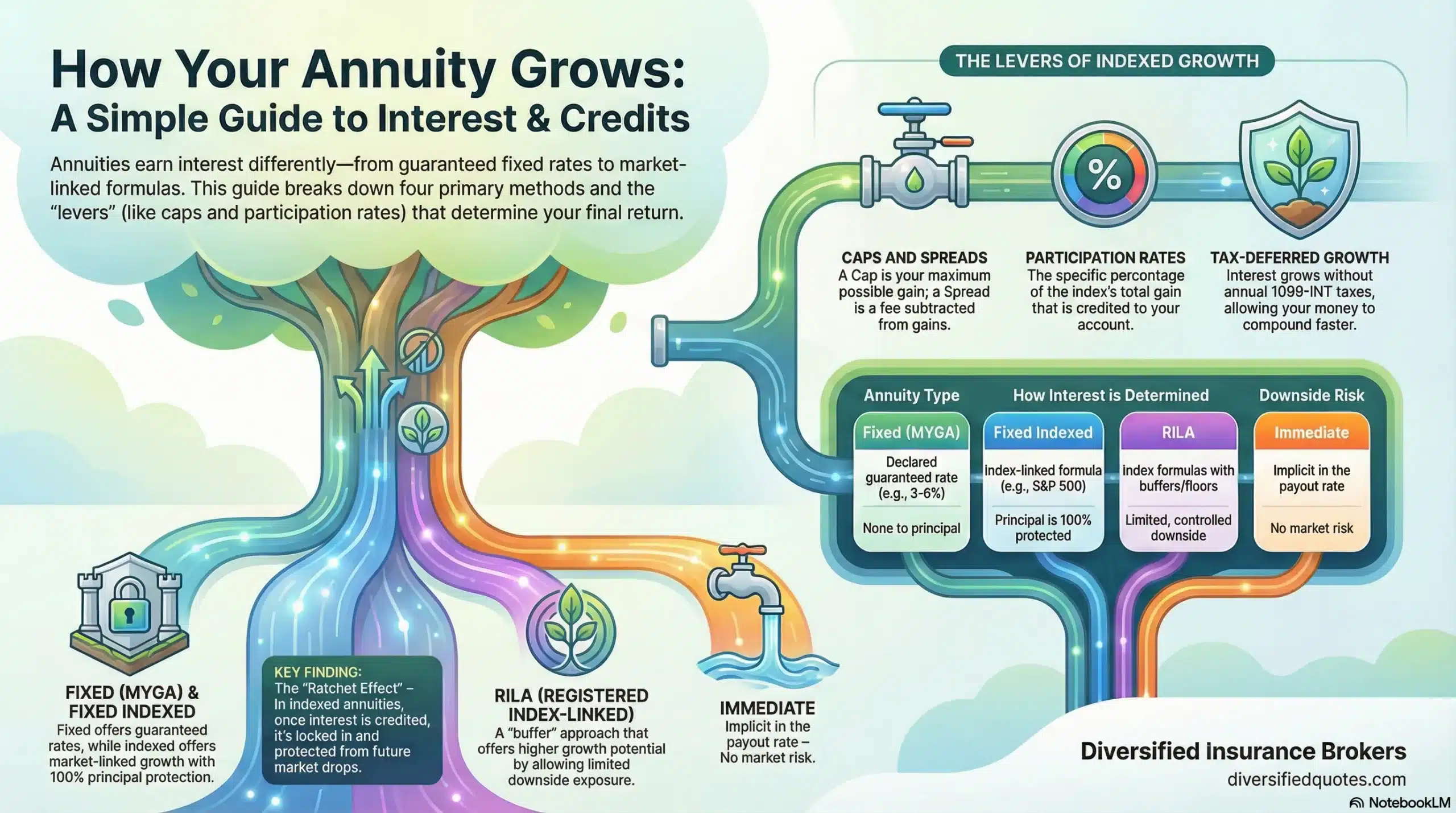
Before examining how variable annuities work in detail, the table below maps the most consequential differences between variable annuities and the two most commonly compared alternatives — fixed indexed annuities and fixed annuities — across the dimensions that matter most in retirement planning.
| Feature | Variable Annuity | Fixed Indexed Annuity (FIA) | Fixed Annuity (MYGA) |
|---|---|---|---|
| Principal Protection | None — account value is directly exposed to subaccount market performance and can decline substantially in a down market | Full — principal is protected from index losses; negative index periods credit 0%, not a loss | Full — principal and declared interest are contractually guaranteed for the full term |
| Growth Mechanism | Direct market participation through investment subaccounts; returns reflect actual fund performance, positive and negative | Index-linked interest crediting using caps, participation rates, or spreads; gains subject to crediting limits | Declared fixed interest rate guaranteed for the full contract term regardless of market conditions |
| Typical Fee Layers | Mortality and expense (M&E) charges averaging ~1.25%, subaccount investment management fees of 0.5%–2.0%, administrative fees, plus rider fees if elected — total annual drag commonly 2%–4%+ | No subaccount fees; costs embedded in crediting terms; income rider fees typically 0.90%–1.25% annually when elected | No ongoing fees in most designs; costs embedded in the declared rate; very straightforward cost structure |
| Income Rider Availability | Optional riders available (GMIB, GMWB, GLWB) but add cost and complexity; income guarantee may be more expensive than equivalent FIA income rider | GLWB income riders widely available and well-established; income base grows at guaranteed roll-up rate independent of market performance | Typically no income rider; fixed annuities are primarily accumulation tools; income requires annuitization or a separate product |
| Tax Treatment | Tax-deferred growth; gains taxed as ordinary income at withdrawal; no step-up in basis at death; death benefit may pass to beneficiaries | Same tax-deferred treatment; gains taxed as ordinary income at withdrawal; similar death benefit and beneficiary options | Same tax-deferred treatment; simplest tax structure because growth is a known, fixed amount each year |
| Best Fit | Long-horizon investors with genuine risk tolerance who want full market participation inside a tax-deferred insurance wrapper and understand the fee drag | Retirees and pre-retirees who want index-linked growth potential with full principal protection and a clear income framework | Conservative savers who want a guaranteed, predictable accumulation rate for a defined term with zero market exposure |
How Variable Annuities Work
When someone purchases a variable annuity, the premium is allocated into investment subaccounts — the defining structural feature of the product. These subaccounts function similarly to mutual funds, with options that may include equity funds, bond funds, international funds, balanced portfolios, and money market options. The investor selects how to allocate the premium among available subaccounts at the time of purchase and can typically reallocate between them within the contract without triggering taxable events, which is one of the advantages of holding market investments inside a tax-deferred annuity wrapper. Understanding the differences between stocks, bonds, and annuities as asset classes provides helpful context for why the variable annuity structure — which blends investment subaccounts with insurance contract features — occupies a distinct planning role from any of those categories individually.
Because the subaccount values fluctuate with market conditions, a variable annuity can produce strong account value growth during extended bull markets. In the same way, it can experience substantial declines during market corrections or extended bear markets — and because fixed indexed annuities protect against market downturns through a zero-floor mechanism, the contrast with variable annuity behavior in down markets is one of the most commonly cited reasons investors migrate from variable to indexed designs in the years approaching retirement. In a severe market decline, a variable annuity account with no income rider can lose a significant percentage of its value, with no contractual protection preventing that decline. Optional income riders can provide a guaranteed income floor regardless of account performance, but they add annual costs that further reduce the net growth of the underlying subaccounts.
Fees Associated With Variable Annuities
The fee structure of a variable annuity is one of the most important factors to evaluate before purchasing — and one of the most commonly misunderstood. Variable annuities typically carry multiple simultaneous fee layers, each deducted from the account value annually, that combine to create a total annual cost drag that is meaningfully higher than most other annuity types. Understanding the full annuity fee structure across all layers is essential context before evaluating any specific variable annuity contract.
The mortality and expense (M&E) charge is the largest and most distinctive fee in a variable annuity. It compensates the insurer for the death benefit guarantee and for the insurance risk embedded in the contract. According to Morningstar data, the industry average M&E charge for commission-based variable annuities is approximately 1.25% of account value annually — charged continuously regardless of market performance. This means in a year when the subaccounts generate 0% net return, the M&E charge still reduces the account value by 1.25%. Subaccount investment management fees — which function like mutual fund expense ratios — typically add another 0.5% to 2.0% annually depending on the type of subaccount selected. Administrative fees add a further layer, commonly ranging from 0.10% to 0.50% per year. When optional income or death benefit riders are added, their costs — commonly 0.50% to 1.50% per year — stack on top of all existing charges. Total annual cost drag of 2% to 4% or more is common in fully loaded variable annuity contracts. Understanding how much annuity income riders cost individually helps evaluate whether the guaranteed income feature justifies the incremental cost above the already substantial base charges.
These fees are not inherently disqualifying — a variable annuity’s tax deferral, death benefit, and income guarantee features provide value that a direct mutual fund investment does not. But the fee differential between a variable annuity and a comparable fixed indexed annuity is significant and should be quantified explicitly when comparing options. A bonus annuity or a fixed annuity with principal protection carries a dramatically simpler and lower cost structure, which affects the net long-term accumulation meaningfully when compounded over a 10- or 20-year holding period.
Market Risk and the Sequence-of-Returns Problem
Unlike fixed annuities or fixed indexed annuities, variable annuities expose investors to the full downside of market performance. If the subaccounts decline 30% in a market correction, the variable annuity account value declines by approximately 30% minus any fees already deducted. There is no zero floor, no buffer, and no contractual mechanism preventing losses beyond whatever an optional rider may guarantee. This exposure can be appropriate for investors with long accumulation horizons and genuine risk tolerance — but it creates a specific and well-documented problem for people at or near retirement.
The risk that most directly threatens retirement sustainability is sequence-of-returns risk — the danger that poor market performance in the early years of retirement, combined with ongoing withdrawals, permanently damages the portfolio’s ability to sustain income throughout retirement even when long-run average returns appear adequate. A variable annuity that loses 25% in the first two years of retirement, while distributions are simultaneously reducing the account, may never fully recover to the level needed to support the intended income over a 20- to 30-year retirement. An optional income rider can protect the income payment from declining, but the rider guarantee is separate from the account value — meaning the account itself can erode to zero while the rider continues to pay income, which can trigger complex tax and estate consequences. Individuals researching how long their savings will last in retirement should factor sequence risk explicitly into any analysis of how a variable annuity account will perform across realistic market scenarios, not just favorable ones.
Variable Annuity Riders — Optional Guarantees and Their Costs
Variable annuities can include a range of optional variable annuity riders that provide guarantees layered on top of the base investment structure. The most commonly elected are income riders and death benefit riders. Income riders — typically structured as Guaranteed Minimum Income Benefits (GMIB), Guaranteed Minimum Withdrawal Benefits (GMWB), or Guaranteed Lifetime Withdrawal Benefits (GLWB) — create a guaranteed income stream or withdrawal amount that continues regardless of what happens to the underlying account value. Death benefit riders can ensure that beneficiaries receive at least the original premium invested, or a stepped-up value, even if the account has declined.
These riders provide real planning value in specific situations — particularly when an investor wants full market participation during accumulation but wants a guaranteed income floor during retirement. However, understanding whether income riders have fees and quantifying those costs is essential because rider charges on variable annuities can be higher than equivalent rider charges on fixed indexed annuities, while the underlying account — being market-exposed — carries risks that the FIA account does not. Understanding how annuity income riders work mechanically across both variable and indexed structures allows a genuine comparison of which income framework is most appropriate for a specific retirement plan before any product commitment is made.
Why Many Retirees Choose Fixed Indexed Annuities Instead
Although variable annuities allow direct market participation, many retirees — particularly those in the final years before retirement or in the early retirement years — prefer annuity designs that provide principal protection alongside income potential. Fixed indexed annuities have become one of the most widely selected retirement income vehicles because they address the two most common concerns about variable annuities: market risk and fee complexity.
The primary structural advantage of a fixed indexed annuity is principal protection. As covered in our resource on what happens to a fixed indexed annuity if the market goes down, the minimum credited interest in a negative index period is 0% — the index decline is not passed through to the account value. The question of whether you can lose principal in a fixed indexed annuity has a clear answer: not from index performance, which is fundamentally different from the variable annuity experience. The cost structure is also meaningfully simpler — FIAs do not carry subaccount investment management fees or M&E charges in the same way variable annuities do, and the index annuity crediting methods — caps, participation rates, and spreads — represent all-in pricing rather than layered charges on top of an already expensive base contract.
For income planning specifically, a fixed indexed annuity with an income rider provides a GLWB structure where the income benefit base grows at a guaranteed roll-up rate during deferral, independent of index performance. This means the income guarantee builds even in years when the index credits 0%, which is meaningfully different from a variable annuity income rider where the income base’s performance can be affected by the underlying subaccount volatility depending on the specific contract design. Individuals evaluating specific FIA products sometimes compare options such as the EquiTrust MarketForce Bonus annuity, which combines upfront bonus crediting with indexed growth and income potential, as a concrete alternative to variable annuity accumulation strategies.
How Variable Annuities Fit Into Retirement Planning
Variable annuities may appeal to investors who are comfortable with market volatility, have long accumulation time horizons, want the potential for higher investment returns than a fixed or indexed product can provide, and value the tax deferral and insurance features that the annuity wrapper adds on top of market exposure. For a high-income earner who has already maximized contributions to IRAs and 401(k) plans and wants additional tax-deferred investment capacity, a variable annuity can sometimes serve that role — though the fee drag must be weighed against the tax deferral benefit to determine whether the net advantage justifies the cost. This is one of the planning considerations addressed in our broader review of annuity drawbacks across product types.
Many retirees approaching or in retirement, however, prioritize guaranteed income at retirement age and principal protection over market exposure. For these individuals, fixed or indexed annuity structures may provide a more predictable and less costly retirement income framework. Our resource on guaranteed income from annuities covers how different annuity types — fixed, indexed, and immediate — create income certainty in ways that variable annuities, by their nature, do not provide without an added-cost rider.
Understanding how annuities interact with other retirement assets also matters. Retirees with inherited retirement accounts must understand distribution rules alongside any annuity income strategy they are building. Our resource on how inherited IRAs work helps families coordinate income planning and wealth transfer across both variable and non-variable structures. Similarly, understanding the rules governing inherited qualified annuities and inherited non-qualified annuities is important when an annuity of any type is part of the estate planning picture, since the tax treatment at the beneficiary level differs based on how the original contract was funded. For anyone evaluating how a specific deferred annuity accumulation projection compares across product types, our deferred annuity calculator allows side-by-side modeling that can clarify the long-term impact of fee differences between variable and non-variable designs.
Request an Annuity Quote
Related Pages
Talk With an Advisor Today
Choose how you’d like to connect—call or message us, then book a time that works for you.
Schedule here:
calendly.com/jason-dibcompanies/diversified-quotes
Licensed in all 50 states • Fiduciary, family-owned since 1980
FAQs: What Is a Variable Annuity?
What is a variable annuity and how does it work?
A variable annuity is a retirement contract issued by an insurance company in which the premium is allocated into investment subaccounts that function similarly to mutual funds. The account value fluctuates directly with the performance of the chosen subaccounts — it can grow substantially during favorable markets and decline substantially during market downturns. Unlike a fixed indexed annuity, which protects principal from index losses, a variable annuity exposes the investor to full market risk in both directions. The insurance wrapper around the subaccounts provides tax-deferred growth — no annual income tax is owed on internal gains — and optional features such as death benefits and income guarantees can be added through riders. The combination of market exposure, tax deferral, and optional insurance guarantees defines the variable annuity’s unique position among retirement products, and understanding how it differs from stocks, bonds, and other annuity types is the starting point for evaluating whether it fits a specific retirement plan.
What are the fees in a variable annuity?
Variable annuities carry multiple simultaneous fee layers that combine to create a total annual cost drag significantly higher than most other annuity types. The mortality and expense (M&E) charge — the core insurance fee — averages approximately 1.25% of account value annually according to Morningstar data and is charged regardless of market performance. Subaccount investment management fees add another 0.5% to 2.0% annually depending on the investment options selected, functioning like mutual fund expense ratios. Administrative fees typically add 0.10% to 0.50% per year. If optional income or death benefit riders are elected, their fees — commonly 0.50% to 1.50% or more annually — stack on top of all existing charges. Total annual fee drag of 2% to 4% or more is common in fully loaded variable annuity contracts. These fees are charged against the account value continuously, which means in years of flat or negative subaccount performance the fees amplify the decline. A full review of annuity fee structures across different product types helps clarify how variable annuity costs compare to fixed and indexed alternatives before any purchase decision.
Can you lose money in a variable annuity?
Yes — without an optional income or principal protection rider, a variable annuity account value can decline to zero if the underlying subaccounts perform sufficiently poorly. There is no zero floor, no buffer, and no contractual protection preventing losses in the base variable annuity contract. This distinguishes variable annuities clearly from fixed indexed annuities, where principal is protected from index losses by design. The risk of account value decline is particularly consequential at and during retirement, when ongoing withdrawals combined with poor early-retirement market performance can permanently reduce the portfolio below the level needed to sustain income — the problem known as sequence-of-returns risk. Optional income riders can protect the income payment from declining even if the account value reaches zero, but these riders add annual costs and do not prevent the account value itself from eroding. The account erosion can have estate and tax implications that must be understood before relying solely on a rider guarantee as the retirement income plan.
What is the difference between a variable annuity and a fixed indexed annuity?
The most consequential difference is how each product handles market risk. A variable annuity places premium directly into investment subaccounts with full market exposure — account value rises and falls with subaccount performance, and there is no principal protection from losses in the base contract. A fixed indexed annuity credits interest linked to an external market index but protects the principal completely — negative index periods credit 0%, not a loss. Understanding how fixed indexed annuities protect against market downturns clarifies exactly where this protection mechanism operates. The fee structure also differs substantially — variable annuities carry M&E charges, subaccount management fees, and administrative fees that typically total 1.5%–3%+ annually before any rider costs; FIAs embed costs in crediting terms rather than charging layered fees against the account. For income planning, a fixed indexed annuity with an income rider builds the income benefit base at a guaranteed roll-up rate independent of index performance — providing income certainty without the market risk inherent in a variable annuity structure.
Who is a variable annuity appropriate for?
A variable annuity may be appropriate for investors with long accumulation time horizons — typically 10 or more years before they expect to draw on the funds — who have genuine risk tolerance for full market downside, who have already maximized contributions to IRA and 401(k) plans and want additional tax-deferred accumulation capacity, and who understand that the fee structure will reduce net returns relative to direct market investments. The tax deferral and insurance features have the most value when the holding period is long enough for compounding to outweigh the annual fee drag, and when the specific insurance guarantees provided — death benefits, income floors — are genuinely needed and not duplicated elsewhere in the plan. Variable annuities are generally not appropriate for individuals approaching or in retirement who prioritize principal protection, income predictability, and lower ongoing costs — for those planning objectives, fixed indexed annuities with income riders often deliver a more suitable combination of lifetime income and protection. Our resource on the full spectrum of annuity drawbacks across product types provides additional context for matching the right structure to the right planning objective.
About the Author:
Jason Stolz, CLTC, CRPC, DIA, CAA and Chief Underwriter at Diversified Insurance Brokers (NPN 20471358), is a senior insurance and retirement professional with more than 25 years of real-world experience helping individuals, families, and business owners protect their income, assets, and long-term financial stability. As a long-time partner of the nationally licensed independent agency Diversified Insurance Brokers, Jason provides trusted guidance across multiple specialties—including fixed and indexed annuities, long-term care planning, personal and business disability insurance, life insurance solutions, Group Health, Travel Medical and Evacuation Insurance, and short-term health coverage. Diversified Insurance Brokers maintains active contracts with over 100 highly rated insurance carriers, ensuring clients have access to a broad and competitive marketplace.
His practical, education-first approach has earned recognition in publications such as VoyageATL, and contributions from his agency featured in Kiplinger and GoBankingRates— highlighting his commitment to financial clarity and client-focused planning. Drawing on deep product knowledge and years of hands-on field experience, Jason helps clients evaluate carriers, compare strategies, and build retirement and protection plans that are both secure and cost-efficient. Visitors who want to explore current annuity rates and compare options across multiple insurers can also use this annuity quote and comparison tool.
Explore More Annuity Options: Browse our complete guide to What Is a Fixed Annuity? — covering fixed annuities, MYGAs, laddering strategies & conservative growth options from 100+ carriers.
Last Reviewed: June 20, 2026 |
Reviewed by: Jason Stolz, CLTC, CRPC, DIA, CAA
Chief Underwriter, Diversified Insurance Brokers, Inc. | NPN: 20471358 | Diversified Insurance Brokers, Inc. — Licensed in all 50 states
Fact Checked by: Tonia Pettitt, CMIP©
Medicare Specialist, Diversified Insurance Brokers, Inc. | NPN: 14374308 | Diversified Insurance Brokers, Inc. — Licensed in all 50 states
Did you find this content helpful? Leave us a Google review — it helps others find trustworthy guidance too.
Editorial Standards: Diversified Insurance Brokers maintains rigorous editorial standards to ensure accuracy, clarity, and independence in all content. Learn more about our editorial standards and commitment to transparency.
