
Injury Lawsuit Cash Advance – Fast Legal Funding
Injury Lawsuit Cash Advance – Fast Legal Funding

Jason Stolz CLTC, CRPC, DIA, CAA
Recovering from an accident-related injury creates financial pressure that arrives immediately, regardless of how strong your legal case is. Medical bills accumulate during treatment. Income stops or drops when you cannot work at full capacity. Rent, utilities, car payments, and every other household expense continues on its normal schedule. Meanwhile, the legal process moves on its own timeline — insurance adjusters conduct investigations, medical records are gathered and reviewed, damages are documented, and your attorney builds the strongest possible negotiating position before accepting any offer. That timeline can take months or longer, and for many injured plaintiffs, the gap between when the financial pressure starts and when a settlement check actually arrives is where serious problems develop. An injury lawsuit cash advance is designed to bridge that gap — providing access to a portion of your expected recovery before your case resolves, so you can stay financially stable while your attorney works toward the outcome your case deserves.
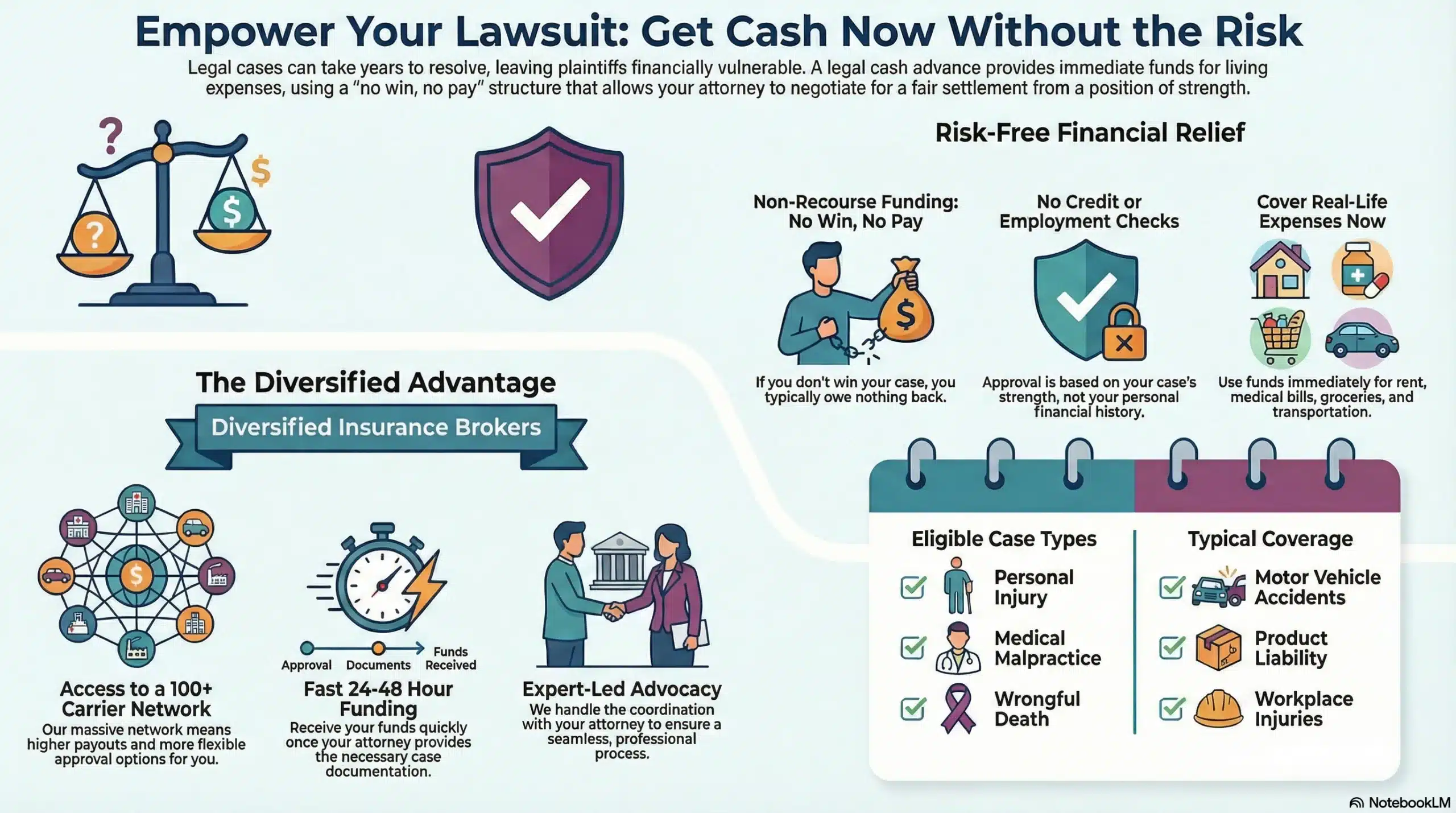
Understanding what this type of funding actually is — and what it is not — is the first step toward making a confident decision about whether it fits your situation. Despite being marketed with terms like “lawsuit loan” or “legal loan,” pre-settlement funding for personal injury cases is typically structured as a non-recourse cash advance, not a conventional loan with monthly payments. In a conventional loan, you owe repayment regardless of what happens. In a non-recourse advance, repayment is tied to your case proceeds: if there is a settlement or award, the advance plus the agreed fees is repaid from those proceeds through your attorney’s trust account at the time of resolution. If the case does not result in a recovery, the advance is typically not repaid. Your specific agreement governs all terms, and reviewing it with your attorney before signing is always the right step.
Apply for an Injury Lawsuit Cash Advance
Fast approvals, high payouts, and no repayment if there’s no recovery (non-recourse).
| Case Type | Key Eligibility Factors | Funding Resource |
|---|---|---|
| Auto and car accidents | Clear liability (police report, witness statements, photos), documented medical treatment, adequate at-fault insurance coverage; the most common case type in legal funding | Car accident lawsuit loan |
| Personal injury (general) | Slip and fall, premises liability, dog bites, product liability — liability must be documentable; insurance coverage of the at-fault party is critical to underwriting | Personal injury lawsuit funding |
| Workers’ compensation | Workplace injury with a pending or disputed workers’ comp claim; employer’s insurance carrier and claim status are evaluated; structured differently from third-party tort cases | Workers’ comp settlement loan |
| Medical malpractice | Higher complexity — requires expert opinion on standard of care deviation; typically longer timelines and higher potential damages; harder to fund without strong expert support but advance amounts can be larger | Medical malpractice lawsuit funding |
| Wrongful death | Estate or surviving family members may qualify; liability determination and damages calculation involve estate documentation; typically high-value cases with longer resolution timelines | Wrongful death settlement funding |
Most people first search for funding after realizing how long the legal process can actually take. A strong personal injury claim still involves documentation, negotiation, and often multiple rounds of back-and-forth with insurers. Cases require complete medical records, updated treatment notes, and a clear picture of damages — especially when injuries involve ongoing therapy, extended recovery timelines, or future care recommendations. Even after settlement terms are agreed to, the time between signing and actually receiving a check can add weeks of additional delay. Funding can be used during any phase of that timeline when you need practical help covering expenses. If you want a broader overview of how this process works and how advance amounts are determined, what pre-settlement funding is explains the framework and how underwriting decisions are made based on case value, coverage, and risk.
What Is an Injury Lawsuit Cash Advance?
An injury lawsuit cash advance is a non-recourse advance based on the expected value of your pending claim. The approval decision is focused entirely on the case itself — liability clarity, documented damages, available insurance coverage, and the realistic likelihood of recovery — not your credit score, employment status, or personal financial history. In other words, the case is the collateral. Plaintiffs with no current income, limited credit, and no personal assets can qualify if the underlying claim is strong, because strength of the case is what the underwriter evaluates. For a detailed explanation of how much can typically be advanced relative to anticipated settlement value, how much you can get from pre-settlement funding covers the factors that determine advance amounts across different case types and damage profiles.
Because repayment is tied to case proceeds rather than to a monthly payment schedule, there are no out-of-pocket payments during the funding period. Costs accrue based on the agreement terms and are settled along with the principal at the time of case resolution — handled through your attorney, who manages the repayment from settlement proceeds before the remainder is distributed to you. That attorney-mediated repayment structure is one of the built-in protections in the process, and it is also why reputable funding providers require attorney confirmation and case documentation as part of every approval. How lawsuit loans work walks through the full mechanics from application through repayment in plain terms.
Why People Use Funding During an Injury Case
Most plaintiffs do not seek funding because they want extra money. They seek it because injury-related financial disruption is immediate and real: time away from work eliminates or reduces income at exactly the moment when new expenses — medical co-pays, prescriptions, therapy appointments, transportation to specialists, temporary home assistance — are being added. The normal household bills that existed before the injury do not pause. For most families, the combination of reduced income and increased expenses creates a deficit that simply cannot be sustained across a legal timeline measured in months or years. Funding provides access to money during the period when that gap is widest, covering the essentials — rent, utilities, groceries, transportation, medical costs — while the case works toward resolution.
The less obvious but equally important reason is negotiating leverage. Defense attorneys and insurance adjusters are professional negotiators who operate with a clear understanding of financial pressure. A plaintiff who is behind on rent, facing utility shutoffs, or unable to cover basic living expenses is far more likely to accept a settlement offer that does not reflect the full value of their claim — not because the offer is fair, but because waiting any longer feels financially impossible. Funding removes that pressure. It gives your attorney time to document damages completely, reach maximum medical improvement, reject inadequate early offers without crisis forcing a premature decision, and negotiate from a position of strength rather than urgency. The advance does not change the legal facts of your case. It changes the financial context in which those facts are negotiated — and that context matters enormously. For cases involving vehicle accidents specifically, car accident lawsuit loan options are closely aligned with the documentation typically available in auto claims and often move faster through underwriting because liability documentation tends to be more standardized.
That said, funding is not the right choice for every situation. Because costs accrue over time and are repaid from settlement proceeds, the net amount you receive at the end of your case is reduced by the payoff. The longer the case takes to resolve, the more the cost compounds depending on the fee structure in your agreement. The right approach is to borrow only what you genuinely need, request a written payoff schedule at multiple time horizons before accepting any advance, and treat the funding as a bridge to resolution — not as a source of discretionary spending. Working through this math with your attorney before signing gives you the clearest picture of what the advance costs relative to what your case is expected to recover.
How Approval Is Determined
Funding decisions are based entirely on attorney-verified case facts: the claim type, how clearly liability is established, the available insurance limits on the at-fault side, the extent and consistency of documented medical treatment, and the realistic timeline to resolution. A case with unambiguous liability, adequate insurance coverage, consistent treatment with documented damages, and a straightforward path to settlement will be evaluated more favorably than a case with disputed liability, thin documentation, or uncertain collection potential. The strength of the case — not the financial condition of the plaintiff — drives the outcome.
Documentation is the practical driver of how quickly and how favorably a case is evaluated. Medical records through the current date, billing records showing the full scope of damages, the incident report or accident documentation, and the attorney’s case summary all help the underwriter understand what the case is worth and what recovery is realistically expected. The fastest approval outcomes come from cases where documentation is complete and the attorney’s office responds promptly to the information request. Delays are almost always tied to documentation gaps or attorney availability — not to the strength of the underlying case. Legal funding and the pre-settlement process covers how underwriting timelines work and what steps move the process forward most efficiently.
Transparent Costs and What to Verify Before Accepting
The most important thing to understand before accepting any advance is that legal funding has a real cost, and that cost reduces your net settlement proceeds. The advance is not free money — it is a portion of your expected recovery provided now in exchange for a larger repayment from those proceeds at settlement. Fees are typically higher than conventional lending rates because the funding provider accepts genuine non-recourse risk: if the case is lost, the advance is not repaid and the provider absorbs that loss. The cost structure varies by provider — some use flat fees, some use compounding rates, some use capped structures — and the differences between them matter significantly depending on how long your case takes to resolve.
Before signing any agreement, request a written payoff schedule showing exactly what would be repaid if the case settles in 6 months, 12 months, 18 months, and 24 months. Compare those numbers to your expected settlement range and confirm that the net proceeds after repayment remain meaningful relative to what you need. Your attorney can help interpret those payoff figures in the context of a realistic case timeline and settlement estimate. For a side-by-side comparison of how different funding providers and structures compare, legal funding companies and how to evaluate them provides the framework for making a genuinely informed choice rather than accepting the first offer that arrives.
The Process — Simple and Attorney-Friendly
The application process is designed to be straightforward for both the plaintiff and their attorney. You submit basic information about yourself and your case, your attorney confirms representation and provides the documentation needed for underwriting, and an underwriter reviews the file for eligibility and advance amount. If approved, you receive disclosure documents detailing all terms and costs, and funds are delivered quickly once everything is signed and verified. In clear-cut cases with complete documentation and a responsive attorney, the entire process from application to funded can happen in 24 to 48 hours. Getting an advance on a pending lawsuit covers the process at a broader level, including how the attorney coordination works and what to expect at each stage from submission through funding. If you are comparing funding across multiple case types or stages, lawsuit funding options by case category and lawsuit settlement loans explained provide the additional context for evaluating which option fits your specific situation.
Some plaintiffs also use the waiting period to think about longer-term financial protection beyond the case outcome. If the injury has affected your ability to work, high-risk disability insurance options for people with medical challenges covers how income protection works for individuals with existing or recent health conditions — including post-injury situations where conventional disability coverage may require specialized underwriting. Financial stability that does not depend entirely on a single case outcome is worth planning for regardless of how strong the claim is.
Get Started Today
Apply now and receive your injury lawsuit cash advance as quickly as possible once your case is verified.
Related Pages
Explore more lawsuit funding resources and options for getting cash while a case is pending.
Talk With an Advisor Today
Choose how you’d like to connect—call or message us, then book a time that works for you.
Schedule here:
calendly.com/jason-dibcompanies/diversified-quotes
Licensed in all 50 states • Fiduciary, family-owned since 1980
Frequently Asked Questions: Injury Lawsuit Cash Advance
What is a non-recourse cash advance and how is it different from a loan?
A conventional loan is recourse debt: you owe repayment regardless of what happens with the purpose for which you borrowed. A non-recourse cash advance ties repayment exclusively to your case proceeds. If the case results in a settlement or award, the advance plus fees is repaid from those proceeds at resolution — handled through your attorney’s trust account. If the case does not result in a recovery, the advance is typically not repaid, and you owe nothing from your personal assets. This distinction is what makes legal funding fundamentally different from borrowing money and why approval is based on the merits of your case rather than your personal creditworthiness, employment, or financial history. Your specific agreement governs how this applies to your situation, which is why reviewing it with your attorney before signing is non-negotiable.
Does receiving a cash advance affect the amount my case settles for?
No — the existence of a pre-settlement advance has no bearing on the settlement value your attorney negotiates. The defendant and their insurance carrier do not know you received funding, and that information plays no role in the demand presented or the settlement reached. What the advance does affect is your net proceeds at the end of the case: the repayment of the advance plus fees comes out of the settlement, reducing what you take home after resolution. This is precisely why understanding the payoff amount at different time horizons — what you would owe at 6 months versus 12 versus 18 months — matters before accepting the advance. The advance also creates no obligation for your attorney to settle for any particular amount or on any particular timeline. Your attorney’s duty to pursue the best possible outcome for your case is completely unchanged.
How quickly can I receive funding after I apply?
In cases where documentation is complete and your attorney responds promptly, funding can be received within 24 to 48 hours of a completed application. The speed is almost entirely determined by how quickly case information can be confirmed — the incident documentation, current medical records and billing, and the available insurance coverage information. Cases where documentation is scattered, treatment records are not yet updated, or attorney communication is slow will take longer regardless of how strong the underlying claim is. The underwriting process itself moves quickly; the limiting factor is nearly always documentation availability and attorney responsiveness on the case side. If fast funding is a priority, making sure your attorney is aware you are applying and is prepared to respond to the documentation request is the most effective step you can take.
What happens if my case takes longer than expected to resolve?
This depends on the fee structure in your specific agreement, and it is one of the most important things to understand before signing. If the funding uses a compounding rate — where fees accrue on an ongoing basis for as long as the advance is outstanding — a case that takes 24 months to resolve costs significantly more than the same advance on a case that resolves in 8 months. If the funding uses a flat fee or a capped structure — where fees stop accruing after a defined period — the cost is predictable regardless of timeline. Requesting a written payoff schedule at 6, 12, 18, and 24 months before accepting any advance is the one step that prevents unpleasant surprises. Comparing those payoff amounts to your expected settlement range tells you whether the funding makes financial sense across your case’s realistic timeline — and your attorney is the right person to help you interpret those numbers.
Do I need my attorney involved to apply for funding?
Yes — attorney involvement is required, not optional. Funding providers require attorney confirmation of representation and attorney cooperation in providing the case documentation used to evaluate the application. This is because the attorney has a professional obligation to manage all third-party interests in the settlement proceeds, including the advance repayment; because attorney verification of case facts is the primary basis for every underwriting decision; and because the actual repayment at settlement is processed through the attorney’s trust account according to the agreement terms. Plaintiffs who do not yet have an attorney representing them cannot obtain pre-settlement funding — legal representation is a prerequisite. If your attorney is unfamiliar with pre-settlement funding or has questions about a specific provider’s process, those should be resolved before proceeding. A reputable provider will have a straightforward, attorney-friendly process that keeps documentation requests reasonable and communication clear.
About the Author:
Jason Stolz, CLTC, CRPC, DIA, CAA and Chief Underwriter at Diversified Insurance Brokers (NPN 20471358), is a senior insurance and retirement professional with more than 25 years of real-world experience helping individuals, families, and business owners protect their income, assets, and long-term financial stability. As a long-time partner of the nationally licensed independent agency Diversified Insurance Brokers, Jason provides trusted guidance across multiple specialties—including fixed and indexed annuities, long-term care planning, personal and business disability insurance, life insurance solutions, Group Health, Travel Medical and Evacuation Insurance, and short-term health coverage. Diversified Insurance Brokers maintains active contracts with over 100 highly rated insurance carriers, ensuring clients have access to a broad and competitive marketplace.
His practical, education-first approach has earned recognition in publications such as VoyageATL, and contributions from his agency featured in Kiplinger and GoBankingRates— highlighting his commitment to financial clarity and client-focused planning. Drawing on deep product knowledge and years of hands-on field experience, Jason helps clients evaluate carriers, compare strategies, and build retirement and protection plans that are both secure and cost-efficient. Visitors who want to explore current annuity rates and compare options across multiple insurers can also use this annuity quote and comparison tool.
Explore All Lawsuit Loan & Legal Funding Options: Browse our complete guide to Lawsuit Loans & Legal Funding — covering pre-settlement funding, lawsuit cash advances, injury claims & more.
Last Reviewed: June 13, 2026 |
Reviewed by: Jason Stolz, CLTC, CRPC, DIA, CAA
Chief Underwriter, Diversified Insurance Brokers, Inc. | NPN: 20471358 | Diversified Insurance Brokers, Inc. — Licensed in all 50 states
Fact Checked by: Tonia Pettitt, CMIP©
Medicare Specialist, Diversified Insurance Brokers, Inc. | NPN: 14374308 | Diversified Insurance Brokers, Inc. — Licensed in all 50 states
Did you find this content helpful? Leave us a Google review — it helps others find trustworthy guidance too.
Editorial Standards: Diversified Insurance Brokers maintains rigorous editorial standards to ensure accuracy, clarity, and independence in all content. Learn more about our editorial standards and commitment to transparency.
