
Legal Cash Advances – Fast, Higher Payout Funding
Legal Cash Advances – Fast, Higher Payout Funding

Jason Stolz CLTC, CRPC, DIA, CAA
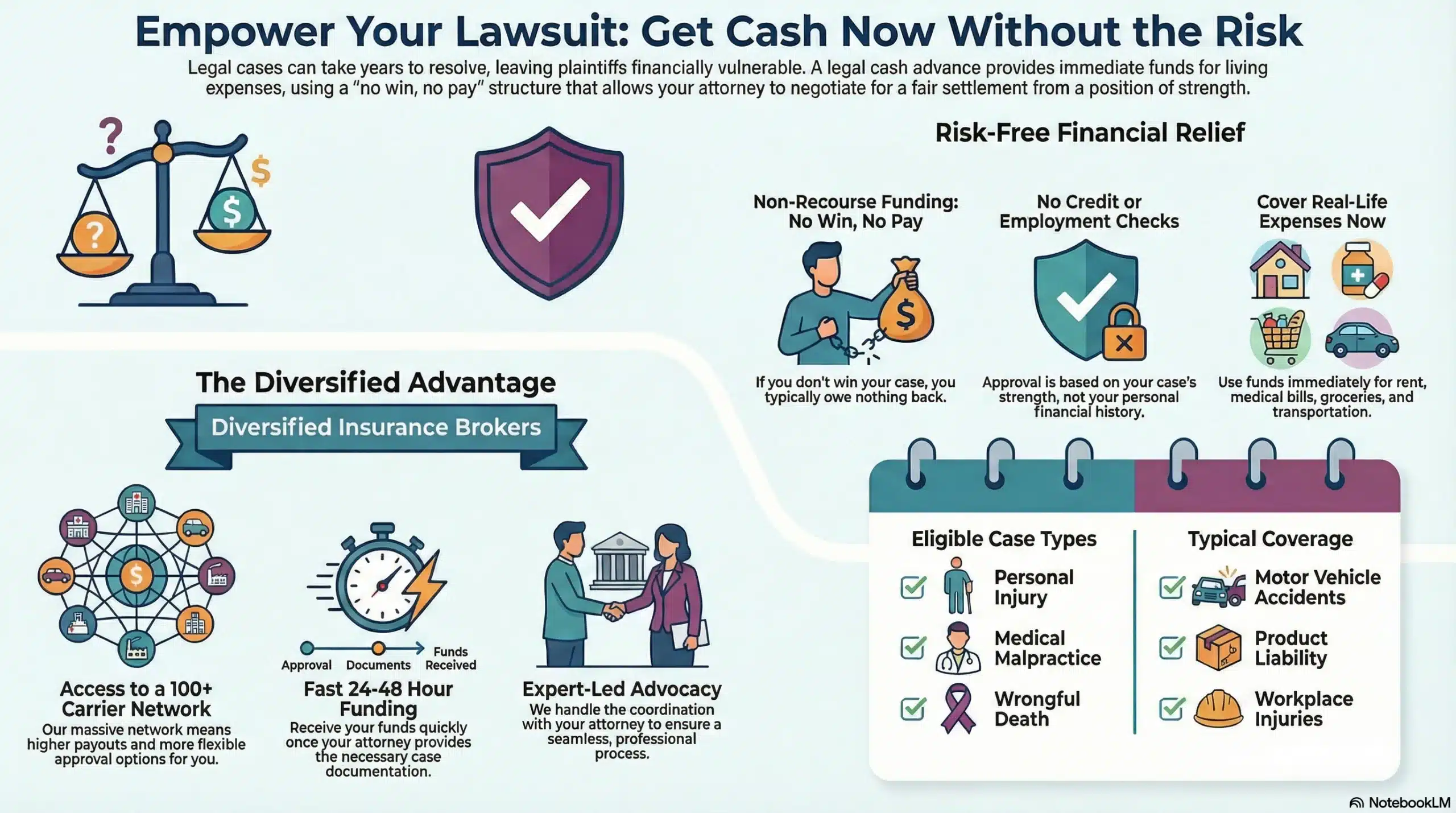
When you are in the middle of a lawsuit, your bills do not wait for the legal process to finish. Medical bills accumulate. Rent comes due. Car payments do not stop because your personal injury case is still in negotiation. That financial pressure is exactly what insurance defense attorneys and defendants count on — a plaintiff who needs money now is far more likely to accept a quick, undervalued settlement rather than wait for the fair outcome the case actually supports. A legal cash advance is designed to close that gap. It gives you access to money now, tied to the expected value of your pending lawsuit, so you can stay financially stable while your attorney builds the strongest possible case. At Diversified Insurance Brokers, we connect plaintiffs with a broad network of legal funding partners — which means more flexibility, more competitive offers, and a better shot at approval than a single-provider model can provide. The funding is non-recourse in most cases: if you win or settle, the advance is repaid from the proceeds. If your case does not result in a recovery, you typically owe nothing. Approval is based on the strength of your case and its expected settlement value — not your credit score, employment status, or income. There are no monthly payments while your lawsuit is pending. You can use the funds for whatever you need: rent, mortgage, utilities, groceries, childcare, medical expenses, or any other bill that cannot wait for the legal timeline. A legal cash advance is not free money — the repayment agreement will spell out exactly how fees and costs are calculated, and you should review those terms carefully with your attorney before signing. Used strategically, it removes the financial pressure that leads to bad settlement decisions and keeps your family stable while the case moves forward on its merits.
Ready to Get Your Legal Cash Advance?
Higher payouts, fast approval, and no repayment if you lose your case. Our funding network helps match your claim with the best offer available — no credit check required.
Request Your Legal Cash Advance
Questions? Call 800-533-5969
How a Legal Cash Advance Works
| Feature | How It Works | What Plaintiffs Should Know |
|---|---|---|
| Non-Recourse Structure | The advance is repaid from settlement or judgment proceeds if you win; if your case does not result in a recovery, you typically owe nothing | This is the fundamental difference from a traditional loan — you are not personally liable if the case fails; the funder takes on the risk, which is why the advance is evaluated on case strength rather than your credit |
| Approval Criteria | Based on case type, liability, damages, insurance coverage, and the realistic settlement value — not your credit score, income, or employment history | A plaintiff with poor credit and no current income can qualify if the case is strong; conversely, excellent credit does not help if the case has weak liability or limited insurance coverage |
| Advance Amount | Typically 10% to 20% of the expected settlement value, factoring in attorney fees, medical liens, and case costs that must also be satisfied from the proceeds | Taking only what you need is strategically sound — a smaller advance means a lower repayment amount at settlement and more money in your pocket when the case resolves |
| No Monthly Payments | Nothing is owed while the case is pending — repayment comes entirely from the settlement proceeds after the case resolves | This is critical for plaintiffs already struggling financially — there is no additional monthly bill to manage during the lawsuit, regardless of how long the case takes |
| Speed | Many cases can be approved and funded within 24 to 48 hours once attorney documentation is received and reviewed | Attorney responsiveness is the biggest variable in funding speed — cases where the attorney’s office provides documentation promptly move the fastest |
| Cost and Fees | The repayment agreement specifies how fees are calculated — typically a flat fee or a rate that may compound over the life of the advance until settlement | Review the fee structure carefully with your attorney before signing; longer cases accumulate more cost, which is another reason to take only what you genuinely need |
Who Qualifies for a Legal Cash Advance
Legal cash advances are available to plaintiffs with pending civil claims that carry a realistic expectation of settlement or judgment. The most common case types include personal injury accidents, motor vehicle accidents, medical malpractice, product liability, wrongful death lawsuits, and some workplace injury claims depending on jurisdiction and case structure. If you are the plaintiff in a case with clear liability, documented damages, and an identifiable insurance policy or defendant with assets, you are likely a strong candidate for funding. Our resource on what pre-settlement funding is covers the full landscape of who qualifies and how underwriters evaluate different case types. For plaintiffs in workers’ compensation situations specifically, our resource on workers’ comp settlement loans covers the specific funding structure that applies to those claims. For wrongful death plaintiffs, our resource on wrongful death settlement loans covers the case-type considerations that affect eligibility and advance amounts. And for plaintiffs in medical malpractice cases — which often have higher case values but longer timelines — our resource on medical malpractice lawsuit funding covers the specific dynamics of that category.
The Strategic Case for a Legal Cash Advance
The most important thing a legal cash advance does is not put money in your pocket — it removes the pressure that leads to bad decisions. Insurance companies and defense attorneys understand that financial desperation is their most powerful settlement tool. A plaintiff who cannot make rent, who is behind on medical bills, or who is watching their savings drain away is far more likely to accept an inadequate settlement offer simply because they need the money now. Refusing to wait for what the case is actually worth becomes impossible when the financial alternative is eviction or shutoff. A legal cash advance changes that dynamic. With immediate bills covered, you can make settlement decisions based on case value rather than personal financial emergency. Your attorney can negotiate from a position of strength rather than urgency. Cases that were heading toward a forced low settlement can run their proper course. For plaintiffs who want to understand how the funding process works from start to finish before applying, our resources on how lawsuit loans work and how much you can get from pre-settlement funding cover those questions in full. For plaintiffs who are also managing income disruption because the underlying incident left them unable to work, our resource on short-term health insurance covers one option for bridging healthcare coverage gaps during that period, and our resource on income protection insurance covers the longer-term disability income planning that can reduce future financial vulnerability of this kind.
What Your Attorney Will Need to Provide
Legal funding decisions are made through attorney verification — the underwriter needs to confirm case details from the legal representative, not just from the plaintiff directly. When you apply, your attorney’s office will typically be asked to provide the case type and incident summary, available insurance coverage and carrier information, medical treatment records and documentation of damages, the current status of negotiations or any offers on the table, and a disclosure of known liens — medical liens, attorney fee agreements, or other obligations that will reduce the net proceeds at settlement. Attorney responsiveness is the single biggest factor in how quickly funding can be approved and disbursed. Cases where the attorney’s office provides clean documentation promptly can move from application to funding in 24 to 48 hours. Cases where documentation is delayed take longer. Our resources on lawsuit funding and legal funding cover the process in detail, and our resource on cash advance for lawsuit covers what plaintiffs can expect at each stage of the application review.
Using Funding Wisely — And Protecting the Rest of Your Financial Picture
A legal cash advance should cover what you genuinely need to stay stable — not everything you wish you had. The repayment amount at settlement is directly tied to how much you borrowed and how long the case runs, which means taking a larger advance than necessary reduces the net amount you take home when the case resolves. The disciplined approach: request enough to stabilize your immediate situation, pay the bills that cannot wait, and avoid treating the advance as a windfall. The goal is to preserve your ability to wait for the settlement your case actually deserves. While the lawsuit is pending, it is also worth evaluating your broader financial protection. If the underlying incident left you unable to work, the lawsuit proceeds are one form of compensation — but protecting your income going forward through disability coverage or protecting your family through life insurance are separate decisions that belong in any complete financial picture. Our resources on why disability insurance matters and how short-term health insurance can bridge coverage gaps cover those parallel planning decisions. And for plaintiffs who want to explore the full range of cash advance options available for their specific case, our resources on advance on lawsuit settlement, get cash before your case settles, and pre-settlement funding cover the full category.
Ready to Get Your Legal Cash Advance?
Higher payouts, fast approval, and no repayment if you lose your case. Our funding network helps match your claim with the best offer available — no credit check required.
Request Your Legal Cash Advance
Questions? Call 800-533-5969
Talk With an Advisor Today
Choose how you’d like to connect—call or message us, then book a time that works for you.
Schedule here:
calendly.com/jason-dibcompanies/diversified-quotes
Licensed in all 50 states • Fiduciary, family-owned since 1980
Frequently Asked Questions: Legal Cash Advances
What is a legal cash advance and how is it different from a loan?
A legal cash advance — also called pre-settlement funding or a lawsuit cash advance — is money provided to a plaintiff while a lawsuit is still pending. It is structurally different from a traditional loan in one critical way: repayment is non-recourse in most cases, meaning it is tied to the outcome of your case. If you win or settle and receive proceeds, the advance and agreed fees are repaid from those proceeds. If your case does not result in a recovery, you generally owe nothing. A traditional loan requires repayment regardless of outcome. Because the funder takes on the risk of a case loss, approval is based on the strength of your legal claim — not your credit score, income, or employment history. There are no monthly payments while the case is pending. Our resource on what pre-settlement funding is covers the structure and terminology in detail.
What types of cases qualify for a legal cash advance?
Legal cash advances are most commonly available for civil cases where there is a realistic expectation of settlement or judgment and documented damages. The most eligible case types include personal injury claims, motor vehicle accidents, medical malpractice, product liability, wrongful death lawsuits, and some workplace injury and workers’ compensation claims depending on jurisdiction. The underwriting decision is based on the specific facts of the case — liability strength, damages documentation, available insurance coverage, and where the case sits in the litigation timeline. If your case type is not listed here, it may still qualify. The best way to find out is to apply and allow underwriting to review the details through your attorney. Our resource on how lawsuit loans work covers what underwriters look for across different case types.
How much money can I get from a legal cash advance?
Advance amounts are typically determined by the expected settlement value, available insurance coverage, the strength of liability, known medical liens and attorney fees that must be satisfied from the proceeds, and where the case stands in the timeline. Most funding partners advance between 10% and 20% of the anticipated settlement value — not the full expected amount, because the settlement must also cover attorney fees, case costs, and any medical liens. The goal is to provide meaningful financial relief without creating an excessive repayment burden that leaves you with little at settlement. Strategic use of funding means requesting enough to stabilize your situation without taking more than necessary. Our resource on how much you can get from pre-settlement funding covers the factors that determine advance amounts in detail.
How fast can I get a legal cash advance?
Many cases can be approved and funded within 24 to 48 hours once documentation is received from your attorney. The application itself takes only a few minutes. After you submit the request, we coordinate directly with your attorney’s office to gather the case documentation needed for underwriting review. Once underwriting completes its review and an offer is made, funding is disbursed after you accept the offer and sign the agreement. The biggest variable in speed is your attorney’s responsiveness — cases where the legal team provides complete documentation promptly move the fastest. Cases where documentation requires follow-up take longer. Our resource on lawsuit funding covers what to expect at each stage of the process.
Do I need good credit to qualify for a legal cash advance?
No. Legal cash advances do not require a credit check, income verification, or employment confirmation. Approval is based entirely on the strength of your legal claim — the liability facts, damages documentation, available insurance coverage, and the realistic settlement potential of the case. A plaintiff with no income, poor credit, and no assets can qualify if the case is strong. A plaintiff with excellent credit cannot qualify if the case has weak liability or limited insurance coverage. This structure exists because the funding is non-recourse — the funder’s repayment is tied to the case outcome, not to your personal financial history. What matters to underwriters is the case, not the plaintiff’s balance sheet. Our resource on cash for lawsuit plaintiffs covers the qualification process in detail.
About the Author:
Jason Stolz, CLTC, CRPC, DIA, CAA and Chief Underwriter at Diversified Insurance Brokers (NPN 20471358), is a senior insurance and retirement professional with more than 25 years of real-world experience helping individuals, families, and business owners protect their income, assets, and long-term financial stability. As a long-time partner of the nationally licensed independent agency Diversified Insurance Brokers, Jason provides trusted guidance across multiple specialties—including fixed and indexed annuities, long-term care planning, personal and business disability insurance, life insurance solutions, Group Health, Travel Medical and Evacuation Insurance, and short-term health coverage. Diversified Insurance Brokers maintains active contracts with over 100 highly rated insurance carriers, ensuring clients have access to a broad and competitive marketplace.
His practical, education-first approach has earned recognition in publications such as VoyageATL, and contributions from his agency featured in Kiplinger and GoBankingRates— highlighting his commitment to financial clarity and client-focused planning. Drawing on deep product knowledge and years of hands-on field experience, Jason helps clients evaluate carriers, compare strategies, and build retirement and protection plans that are both secure and cost-efficient. Visitors who want to explore current annuity rates and compare options across multiple insurers can also use this annuity quote and comparison tool.
Explore All Lawsuit Loan & Legal Funding Options: Browse our complete guide to Lawsuit Loans & Legal Funding — covering pre-settlement funding, lawsuit cash advances, injury claims & more.
Last Reviewed: September 7, 2026 |
Reviewed by: Jason Stolz, CLTC, CRPC, DIA, CAA
Chief Underwriter, Diversified Insurance Brokers, Inc. | NPN: 20471358 | Diversified Insurance Brokers, Inc. — Licensed in all 50 states
Fact Checked by: Tonia Pettitt, CMIP©
Medicare Specialist, Diversified Insurance Brokers, Inc. | NPN: 14374308 | Diversified Insurance Brokers, Inc. — Licensed in all 50 states
Did you find this content helpful? Leave us a Google review — it helps others find trustworthy guidance too.
Editorial Standards: Diversified Insurance Brokers maintains rigorous editorial standards to ensure accuracy, clarity, and independence in all content. Learn more about our editorial standards and commitment to transparency.
