
Income Protection Insurance
Income Protection Insurance

Jason Stolz CLTC, CRPC, DIA, CAA
Income protection insurance — more commonly known as disability income insurance — is designed to replace a portion of your income if a medical condition prevents you from working. For most households, income is the engine that powers everything else: mortgage payments, rent, groceries, savings, retirement contributions, insurance premiums, and daily living expenses. Yet while families routinely insure their homes, vehicles, and even smartphones, the very asset that funds all of it — the paycheck — is often left exposed. Income protection insurance exists to close that gap. At Diversified Insurance Brokers, we help individuals, families, business owners, and high-income professionals build disability strategies that are customized to how they actually earn money. Whether you are W-2, 1099, self-employed, a partner in a firm, or a business owner whose income fluctuates year to year, your coverage must reflect real-world income patterns, tax treatment, and occupational risk — not just a generic template. Our resource on disability insurance services covers the full disability insurance landscape, and our resource on disability insurance for self-employed covers the specialized design considerations for business owners and independent earners whose income documentation and policy structure differ from W-2 employees.
Unlike health insurance, which pays doctors and hospitals, disability income insurance pays you. If an illness, injury, surgery, pregnancy complication, or mental health condition prevents you from performing the duties of your occupation, the policy pays a monthly benefit designed to help cover housing, utilities, transportation, groceries, debt obligations, and ongoing financial commitments. It does not require you to justify how the money is spent. The purpose is simple: keep your financial life stable while your health recovers. For business owners, this stability is even more critical because personal and business finances are often intertwined. When personal income stops, fixed business obligations do not. Income protection insurance can be the difference between a temporary health setback and long-term financial disruption. For business owners specifically, the design of coverage — how income is documented, what benefit period is selected, and whether business overhead coverage is coordinated — is a more complex set of decisions than for salaried employees, and getting those decisions right requires an advisor familiar with both personal and business disability structures.
One of the biggest misconceptions about disability income insurance is that it is only necessary for high-risk occupations. In reality, statistically speaking, long-term disabilities are more likely to result from illness than catastrophic injury. Cancer, cardiovascular events, autoimmune disorders, back conditions, neurological disorders, and mental health conditions account for a significant portion of long-term claims. Even relatively routine surgeries can require months of recovery depending on complications and job duties. For professionals whose income depends on fine motor skills, cognitive clarity, or physical endurance — surgeons, dentists, attorneys, engineers, first responders — the inability to perform specific occupational tasks even temporarily can trigger significant income loss. This is why policy definition matters far more than many people realize, and why understanding how to size and structure coverage correctly is the first priority in any disability income planning conversation. Our resource on how much disability insurance do I need covers the coverage sizing framework for different income types and household structures.
Request Your Income Protection Quote
Tell us your occupation and income structure, and we’ll compare disability income options that fit your goals.
Get My Income Protection QuoteKey Policy Design Decisions — What Each Choice Means for Your Protection
Disability income insurance is not a standard product — it is a contract that is built through a series of structural decisions that together determine what you are covered for, when you collect, how much you receive, and for how long. The table below maps each major design dimension against the available options and what each choice means for real-world protection.
| Policy Dimension | Options Available | What It Means in Practice | Planning Guidance |
|---|---|---|---|
| Definition of disability | Own-occupation; modified own-occupation; any-occupation; income replacement-based | Own-occupation pays if you cannot perform the material duties of your specific job, even if you can work elsewhere. Any-occupation requires that you be unable to perform any job you are reasonably suited for by education, training, or experience — a much higher bar for claim qualification | Own-occupation is the strongest definition and essential for physicians, dentists, attorneys, surgeons, engineers, and skilled tradespeople; any-occupation is cheaper but dramatically narrows claim eligibility — the premium savings rarely justify the reduced protection for high earners |
| Monthly benefit amount | Typically 50-70% of pre-disability gross income; carriers cap at 70% to maintain return-to-work incentive; cannot exceed verified earned income | The benefit amount is fixed at policy issue and reflects income verification at the time of underwriting. For individually owned policies paid with after-tax premiums, benefits are typically received income-tax-free, making a 60-70% gross income replacement equivalent to a higher percentage of take-home pay | Establish the benefit amount based on actual monthly essential expenses (housing, debt, living costs) rather than on an arbitrary percentage; future increase options allow benefits to grow with income without new medical underwriting |
| Elimination period | 30, 60, 90, or 180 days; some policies offer 365-day elimination periods for maximum premium reduction | The waiting period from the onset of disability until benefits begin. Benefits are not retroactive to disability onset — the elimination period is a true out-of-pocket window. A 90-day elimination period means 90 days of living expenses must come from savings, short-term disability coverage, or employer-paid sick leave | 90 days is the most common balance between cost and practicality. If you have employer short-term disability, coordinate the LTD elimination period with the end of STD benefits to prevent an income gap. Adequate emergency reserves should cover the full elimination period |
| Benefit period | 2 years; 5 years; 10 years; to age 65; to age 67 (Social Security Full Retirement Age) | How long benefits continue during an ongoing qualifying disability. A 2-year benefit period protects against most recoverable disabilities but provides no protection for career-ending conditions. A to-age-65 or to-age-67 benefit period maintains income replacement through retirement age for permanent or very long-term disabilities | The longer the benefit period, the higher the premium — but the longest benefit period represents the strongest protection against catastrophic income loss. For younger professionals, the statistical risk of a multi-year disability before retirement justifies the premium difference for to-age-65 coverage over a 2-year benefit period |
| Residual / partial disability | Residual disability rider (income loss-based); partial disability provision; return-to-work benefit | Residual disability benefits pay when you can work in a reduced capacity but suffer a proportional income loss — typically triggered when income loss exceeds 20-25% of pre-disability earnings. Without this rider, you must meet the total disability definition to receive any benefits | Residual coverage is particularly important for self-employed individuals and professionals who may partially return to work during recovery — and represents a significant share of real-world disability claims where total disability is never formally reached but income is still meaningfully reduced |
| Key riders | Cost-of-living adjustment (COLA); future increase option (FIO); catastrophic disability; non-cancellable and guaranteed renewable; own-occupation | COLA increases the monthly benefit during long-term claims to offset inflation — critical for long benefit periods where purchasing power erodes over time. FIO allows additional coverage purchase as income grows without new medical underwriting — critical for younger professionals still building income. Non-cancellable and guaranteed renewable locks both premium and benefit terms for the life of the policy | Non-cancellable and guaranteed renewable is the most important policy form distinction — it prevents the carrier from changing your premium or terms as long as you pay. COLA and FIO add cost but protect long-term value more than almost any other feature for younger policyholders |
The Definition of Disability — The Most Critical Policy Language
When evaluating income protection coverage, the definition of disability is the single most important distinction to understand — more important than the premium, more important than the carrier, and more important than most riders. The difference between an own-occupation and any-occupation definition can be the difference between collecting benefits that sustain your household and being denied on the basis that you could technically work in a different field. A strong own-occupation policy can pay benefits if you cannot perform the substantial duties of your specific occupation — even if you are capable of working in another capacity. This is particularly important for physicians, dentists, attorneys, engineers, executives, first responders, and skilled tradespeople whose income is tied to specialized abilities. A surgeon whose hand tremors prevent operating may still be physically capable of desk work — but under a true own-occupation definition, the policy pays because the surgeon cannot perform the material duties of their specific occupation. Under an any-occupation definition, the same surgeon might be denied because they could work as a medical consultant or educator. The difference in claim outcome between these definitions can be dramatic over a long-term disability, which is why policy language must be evaluated carefully before focusing on premium alone. Our resource on own-occupation disability insurance covers the definition in detail, including how modified own-occupation policies blend features of both definitions and when that structure is appropriate versus when true own-occupation coverage is essential.
Benefit Structure, Replacement Ratios, and Long-Term Coverage
Most disability income policies replace 50-70% of earned income rather than the full amount. Carriers set maximum replacement ratios based on verified income and occupational class, and maintain the cap below 100% to preserve the financial incentive to return to work when medically possible — a standard actuarial principle embedded in disability contract design. For W-2 earners, underwriting typically involves pay stubs and tax documentation. For self-employed individuals and business owners, carriers may require multiple years of tax returns, K-1 statements, or business financials. Because income can fluctuate — especially for entrepreneurs, commission-based earners, and professionals in partnership structures — designing the correct benefit amount involves both underwriting realities and forward-looking planning. An important advantage of individually owned policies: when you pay the premiums with after-tax personal income, the benefits received during a disability are generally income-tax-free. This means a 60% gross income replacement from an individually owned policy can be functionally equivalent to a higher percentage of your actual take-home pay — making the true replacement ratio more favorable than the gross percentage suggests. Our resource on are disability insurance payments taxable covers the tax treatment of benefits from individual policies, employer group plans, and combination structures in detail — a critical planning consideration when deciding how much coverage to buy and how to structure it. Our resource on long-term disability insurance covers the benefit period options and how to evaluate the right coverage duration for your age, income trajectory, and financial situation.
Self-Employed and Business Owner Income Protection — A Different Equation
For self-employed individuals and business owners, income protection planning is more complex than for W-2 employees because the financial exposure is often larger and more intertwined. When a business owner is disabled, personal income may stop — but business overhead costs, lease obligations, staff payroll, loan payments, and fixed operating expenses continue. An individual disability income policy replaces personal income; it does not cover ongoing business overhead. This distinction means many business owners need both a personal disability income policy and a separate Business Overhead Expense (BOE) policy that covers fixed business costs during a disability. Beyond overhead, the income documentation process for self-employed applicants requires different underwriting evidence — typically two to three years of filed tax returns, Schedule C or K-1 statements, and sometimes current year profit-and-loss statements. Income that fluctuates year to year requires careful underwriting review to establish the appropriate benefit amount, and benefits are typically capped at the average of recent documented income rather than the highest recent year. Planning for this reality before applying — rather than after an income decline — produces better underwriting outcomes and more accurately sized coverage. Our resource on disability insurance for self-employed covers the full planning framework for independent earners, including how to document income for underwriting, coordinate personal and business overhead policies, and select features appropriate for variable-income situations.
Elimination Period — Choosing the Right Waiting Period
The elimination period — commonly 30, 60, 90, or 180 days — is the waiting period from the onset of a qualifying disability until benefit payments begin. It functions similarly to a deductible but is expressed in time rather than dollars. A shorter elimination period results in faster benefit payments but higher premiums. A longer elimination period lowers cost but requires sufficient reserves to bridge the waiting period without income replacement. Many financially disciplined households choose a 90-day elimination period as a balance between affordability and risk management — this is the most common elimination period across the individual disability income market. The appropriate selection depends on liquidity, debt levels, employer sick leave, short-term disability coverage, and overall financial structure. One practical rule of thumb: the elimination period should not exceed the amount of emergency savings available to cover essential expenses. If you have short-term disability coverage through an employer or individual policy, the long-term disability elimination period should align with the end of the short-term benefit period to prevent an income gap between the two policies. Our resource on how to buy short-term disability insurance online covers short-term disability options that can serve as the bridge coverage coordinated with a longer-term individual policy for comprehensive income protection across the full disability timeline.
Riders That Determine Long-Term Policy Value
Riders often determine whether a disability income policy remains effective over decades or gradually becomes less relevant as income grows and inflation erodes purchasing power. A cost-of-living adjustment (COLA) rider increases benefits during long-term claims — typically by a fixed percentage annually — to offset inflation. For a disability that begins at age 45 and continues to age 65, an unadjusted benefit that was adequate at claim onset may represent significantly less purchasing power twenty years later without COLA. A future increase option (FIO) allows additional coverage to be purchased as income grows without new medical underwriting — meaning if a health event after policy purchase would otherwise prevent you from qualifying for more coverage, the FIO ensures you can still increase your benefit in proportion with your income. This is particularly important for younger professionals whose income trajectory is still rising. Residual or partial disability riders — one of the most practically impactful features in any well-designed policy — provide benefits when you can work in a reduced capacity but experience income loss as a result. Our resource on residual disability insurance benefits explained covers how the residual benefit calculation works, what income loss threshold typically triggers the benefit, and why residual coverage is particularly valuable for self-employed individuals and professionals who partially return to work during recovery. Catastrophic disability riders may enhance benefits for severe impairments requiring continuous care. Non-cancellable and guaranteed renewable policy forms — the strongest available — lock both your premium and policy terms for the life of the contract, preventing the carrier from adjusting either as you age or as your health changes.
Occupation-Specific Coverage for Higher-Risk Roles and Professionals
We frequently design coverage for professionals in higher-risk public service occupations, skilled trades, and specialized professional roles where the occupational class and underwriting approach differ significantly from standard white-collar coverage. Firefighters and law enforcement officers face underwriting nuances tied to occupational hazards that affect both premium and benefit structure. Our resources on disability income insurance for firefighters and disability income insurance for law enforcement cover the specific coverage considerations for these roles. General contractors and construction trade professionals have a distinct occupational class profile that affects carrier selection and available policy features — our resource on disability income insurance for general contractors covers the trade professional underwriting framework. For dental professionals — where fine motor skill dependence and the own-occupation definition are most consequential — our resource on disability insurance for dentists covers the policy features and carriers most appropriate for dental practitioners. Business leaders and executives may also consider specialized solutions like disability insurance for key person employees, which can protect organizational continuity alongside personal income security by funding the cost of replacing a key individual’s function while they recover.
How Income Protection Planning Integrates With Broader Financial Strategy
Income protection planning often works best when integrated with broader personal and business financial strategy rather than treated as a standalone product decision. Disability planning coordinates with life insurance sizing — the household financial obligations that life insurance protects are the same obligations that disability income insurance must sustain during a disability. Individuals managing medical histories may also benefit from coordinated underwriting strategy across both disability and life insurance, ensuring that pre-existing conditions are disclosed and presented consistently in both applications. Our resource on life insurance with pre-existing conditions covers the medical disclosure and carrier selection framework that applies across both product types for individuals whose health history introduces underwriting complexity. For applicants who have received a disability income quote they want to independently verify — or who are comparing their existing coverage against the current market — our resource on get a 2nd opinion on your disability insurance quote covers the independent review process that evaluates whether current or proposed coverage is appropriately structured and competitively priced before any commitment is made. Ultimately, income protection insurance is about maintaining financial dignity during vulnerable moments. Health recovery should not be overshadowed by fear of missed mortgage payments or mounting debt. With properly structured disability income coverage, the focus can remain where it belongs — on healing and long-term stability.
Get a Personalized Disability Income Review
We evaluate your occupation class, benefit structure, elimination period, and riders — then shop carriers for the strongest fit.
Request My Income Protection Review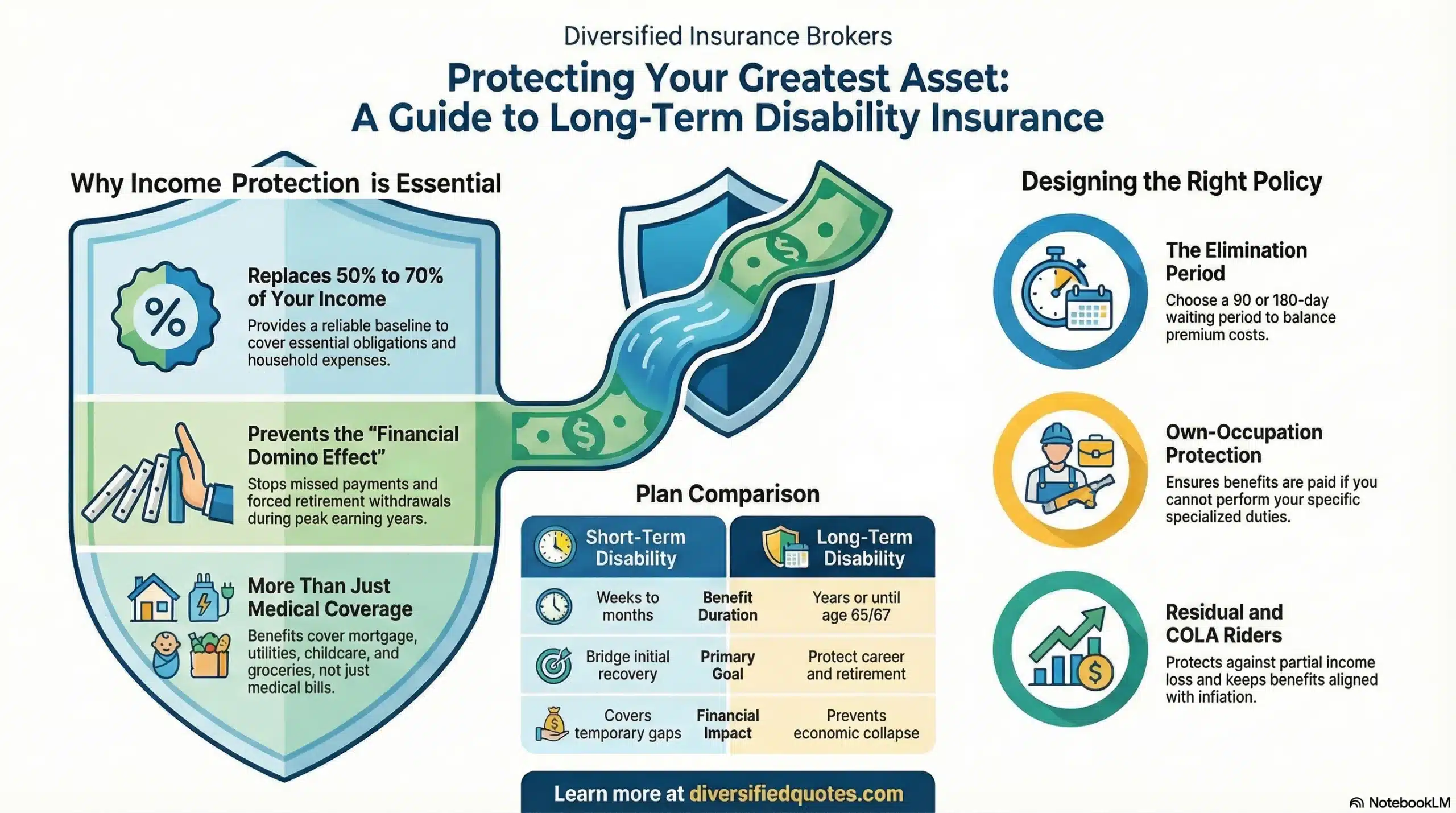
Talk With an Advisor Today
Choose how you’d like to connect—call or message us, then book a time that works for you.
Schedule here:
calendly.com/jason-dibcompanies/diversified-quotes
Licensed in all 50 states • Fiduciary, family-owned since 1980
FAQs: Income Protection Insurance
What is income protection insurance and how is it different from disability insurance?
Income protection insurance is the same product as disability income insurance — two names for coverage that pays you a monthly benefit if an illness or injury prevents you from working. The product replaces a portion of your earned income — typically 50-70% of pre-disability gross income — to cover housing, debt obligations, daily living expenses, and financial commitments during a period when you cannot perform your occupational duties. Unlike health insurance, which pays healthcare providers, income protection insurance pays you directly. How the money is spent is entirely your decision.
What is the difference between own-occupation and any-occupation disability definitions?
Own-occupation disability coverage pays benefits if you cannot perform the material and substantial duties of your specific occupation — even if you are physically capable of working in a different capacity. A surgeon with a hand tremor preventing surgery would qualify under own-occupation even if they could consult or teach. Any-occupation coverage is far more restrictive — it requires that you be unable to perform any occupation for which you are reasonably suited by education, training, or experience. The same surgeon would likely be denied benefits because they could work in a less specialized medical role. For professionals whose income depends on specialized skills, own-occupation is the essential definition. The premium difference between the two is significant, but so is the difference in claim eligibility.
How much of my income can disability insurance replace?
Most disability income policies replace 50-70% of pre-disability gross income, with carriers typically capping the replacement ratio at 70% to maintain the incentive to return to work when medically possible. For individually owned policies where premiums are paid with after-tax personal income, the benefits received are generally income-tax-free — making a 60% gross replacement equivalent to a higher percentage of actual take-home pay, depending on your tax bracket. Self-employed applicants and business owners must document income through tax returns and business financials, and benefit amounts are typically based on average documented income rather than the highest recent year.
What is the elimination period and how do I choose the right one?
The elimination period is the waiting period from the onset of a qualifying disability until benefit payments begin — typically 30, 60, 90, or 180 days. It functions like a time-based deductible. The longer the elimination period, the lower the premium, but the more personal reserves you must have to bridge the income gap. A 90-day elimination period is the most common choice, balancing cost and practicality. The elimination period should not exceed the emergency savings or short-term disability coverage available to cover essential expenses during the waiting period. If you have employer-provided short-term disability coverage, coordinate the LTD elimination period to align with the end of short-term benefits.
Do I need income protection insurance if I already have disability coverage through my employer?
Employer group disability plans are often insufficient as standalone protection for several reasons. Group plans are tied to employment — if you leave the job, the coverage goes with it. Many group LTD policies shift to an any-occupation definition after an initial period (often two years), dramatically tightening the disability threshold. Group plan benefits are typically taxable as ordinary income if the employer pays the premiums, which further reduces the effective replacement ratio. Individual policies are portable, offer stronger own-occupation definitions, allow customized benefit periods and riders, and provide tax-free benefits when premiums are personally paid. Many professionals add individual coverage to supplement employer plans for these reasons.
What is residual disability insurance and why does it matter?
Residual disability coverage pays benefits when you can return to work in a reduced capacity but suffer a proportional income loss — typically triggered when income loss exceeds 20-25% of pre-disability earnings. Without a residual rider, a policy only pays during total disability (when you cannot work at all). In practice, many real-world disability claims involve a period of partial return to work where income is reduced but not eliminated. Residual coverage bridges this gap by paying a benefit proportional to the income loss, creating a financial safety net during the recovery phase and encouraging return to work without complete income loss. This rider is particularly valuable for self-employed individuals and professionals whose income is directly tied to hours worked or procedures performed.
About the Author:
Jason Stolz, CLTC, CRPC, DIA, CAA and Chief Underwriter at Diversified Insurance Brokers (NPN 20471358), is a senior insurance and retirement professional with more than 25 years of real-world experience helping individuals, families, and business owners protect their income, assets, and long-term financial stability. As a long-time partner of the nationally licensed independent agency Diversified Insurance Brokers, Jason provides trusted guidance across multiple specialties—including fixed and indexed annuities, long-term care planning, personal and business disability insurance, life insurance solutions, Group Health, Travel Medical and Evacuation Insurance, and short-term health coverage. Diversified Insurance Brokers maintains active contracts with over 100 highly rated insurance carriers, ensuring clients have access to a broad and competitive marketplace.
His practical, education-first approach has earned recognition in publications such as VoyageATL, and contributions from his agency featured in Kiplinger and GoBankingRates— highlighting his commitment to financial clarity and client-focused planning. Drawing on deep product knowledge and years of hands-on field experience, Jason helps clients evaluate carriers, compare strategies, and build retirement and protection plans that are both secure and cost-efficient. Visitors who want to explore current annuity rates and compare options across multiple insurers can also use this annuity quote and comparison tool.
Explore More Disability Insurance Options: Browse our complete guide to Disability Insurance for the Self-Employed & Business Owners — covering independent contractors, business overhead, guaranteed issue group, 1099 workers & entrepreneurs from 100+ carriers.
Explore More: Browse our complete Lifetime Income Planning guide — covering retirement income strategies, account transfers & annuity income solutions from 100+ carriers.
Last Reviewed: June 5, 2026 |
Reviewed by: Jason Stolz, CLTC, CRPC, DIA, CAA
Chief Underwriter, Diversified Insurance Brokers, Inc. | NPN: 20471358 | Diversified Insurance Brokers, Inc. — Licensed in all 50 states
Fact Checked by: Tonia Pettitt, CMIP©
Medicare Specialist, Diversified Insurance Brokers, Inc. | NPN: 14374308 | Diversified Insurance Brokers, Inc. — Licensed in all 50 states
Did you find this content helpful? Leave us a Google review — it helps others find trustworthy guidance too.
Editorial Standards: Diversified Insurance Brokers maintains rigorous editorial standards to ensure accuracy, clarity, and independence in all content. Learn more about our editorial standards and commitment to transparency.
