
How Much Disability Insurance Do I Need
As an Independent Disability Insurance Broker, we have access to exclusive discounts and negotiated pricing most captive agents can’t offer — see the full breakdown near the end of this page.
How Much Disability Insurance Do I Need

Jason Stolz CLTC, CRPC, DIA, CAA
How much disability insurance do I need? If you rely on your income to run your household, keep your financial plan on track, and protect the lifestyle you’ve built, this is one of the most practical questions you can ask. Disability insurance is often best understood as income insurance — its purpose is to replace a portion of your earnings if an illness or injury prevents you from working, reduces your capacity, or causes a meaningful income loss for an extended period of time. At Diversified Insurance Brokers, Jason Stolz, CLTC, CRPC, DIA, CAA helps working adults, professionals, and business owners size disability coverage to the specific financial outcomes they are trying to protect — not just “a percentage of income” but the actual household decisions that would be forced if income stopped for 12, 24, or more months. Our resources how much disability insurance costs covers the costs and mechanics — benefit triggers, definition of disability, elimination periods, benefit periods — that determine whether a policy performs as expected in real claims. Understanding why people buy disability insurance helps frame the sizing question from the outset: the goal is not to “profit” from a claim but to preserve stability so your family can keep living, saving, and planning even while you recover.
Most people underestimate how quickly an income interruption becomes a long-term financial problem. A short disruption can create missed payments, debt accumulation, and stress. A longer disruption can force unwanted decisions — selling investments at the wrong time, draining retirement accounts, abandoning business plans, or returning to work earlier than your health realistically supports. For many working adults, the risk of being unable to work for months or years is far more likely than an early death during peak earning years. High earners, business owners, and key professionals often need more sophisticated disability planning because the “distance” between their actual lifestyle and the benefit cap on typical coverage is large. If you want to see how deeply a disability can affect income, retirement momentum, and long-term lifestyle decisions, review the executive-focused discussion at disability insurance for executives. The concepts are relevant even if you don’t consider yourself an “executive” — anyone with performance-based income, high fixed expenses, or a specialized career faces the same exposure. Our hub resource on disability insurance services covers the full landscape of available coverage types, carriers, and program structures across individual, group, supplemental, and business disability solutions.
Estimate the Right Disability Benefit for Your Situation
Share your income, existing coverage, and priorities. We’ll help you identify the benefit target that actually protects your lifestyle.
Request a Disability Insurance Plan Call 800-533-5969What Disability Insurance Actually Protects
Disability insurance protects your ability to fund your life. That sounds obvious, but it’s easy to miss what’s really at stake until you map your income to your monthly obligations. Your paycheck does more than pay bills. It maintains housing stability, funds healthcare, supports family responsibilities, powers retirement savings, and creates options. When income stops, your options shrink fast. Most people start with a simple question: “Can I pay my bills if I’m disabled?” That’s a good starting point, but it’s not the full picture. A more useful question is: “If my income drops for 12–24 months (or longer), what financial decisions would I be forced to make that permanently change my future?” That’s where disability coverage becomes the difference between a hard season and a long-term setback.
Instead of thinking in a generic list, think in categories. Housing is usually the largest fixed cost (mortgage, rent, property taxes, insurance, utilities). Healthcare costs often rise during a disability (premiums, deductibles, medications, therapy). Debt obligations don’t pause just because your income does (student loans, auto loans, revolving balances, business obligations). And then there’s the “invisible damage” category: missed retirement contributions, paused investing, and the loss of compounding that never comes back. When you ask, “How much disability insurance do I need?” you’re really asking: “How much of this structure do I need to keep intact if I can’t work the way I work today?”
Start With the Two Numbers That Matter Most
Most people get stuck because they try to calculate an exact benefit amount first. A better approach is to establish two numbers and then build from there. The first is your minimum required monthly lifestyle cost — the “keep the house running” number. It covers housing, utilities, food, insurance, transportation, basic family obligations, and minimum debt payments. If you’re disabled, this is the threshold you need to avoid immediate crisis. The second is your desired stability number — the “keep our plan intact” number. It includes the minimum required costs, plus the items that prevent long-term damage: maintaining savings habits, preserving certain retirement contributions, covering healthcare surprises, and reducing the likelihood you’ll have to liquidate long-term investments under pressure. If you’re not sure which number to use, many households choose a disability target that keeps them close to their current monthly spending level, then adjust based on existing coverage and what the market will reasonably allow.
Disability Insurance Benefit Sizing — Income Reference Guide
The table below provides approximate monthly benefit targets across common income ranges, mapping the “two numbers” framework — minimum required and desired stability — to the coverage amounts most households in each income tier are typically trying to protect. These are general reference points for illustrative comparison only. Individual needs vary significantly based on taxes, household debt structure, savings reserves, existing group coverage, benefit period selection, and the specific financial outcomes you are trying to protect. After-tax disability benefits (from personally paid premiums) may produce net spendable income closer to the desired stability number than gross replacement math suggests.
Approximate estimates for illustrative comparison only. Individual outcomes depend on income structure, taxes, existing coverage, household obligations, and benefit period selection. Figures represent approximate monthly amounts. Not a guarantee of coverage availability or benefit pricing.
| Annual Income Range | Approx. Monthly Gross | Minimum Required Number* | Desired Stability Number* | Typical Coverage Target | Key Design Priority |
|---|---|---|---|---|---|
| $50K – $80K | ~$5,400/mo | ~$2,800–$3,500/mo | ~$3,500–$4,200/mo | ~$3,000–$4,000/mo | Benefit period length; residual disability for partial income protection |
| $80K – $120K | ~$8,300/mo | ~$4,000–$5,500/mo | ~$5,500–$7,000/mo | ~$5,000–$6,500/mo | Own-occupation definition; residual/partial disability protection; benefit period to age 65 |
| $120K – $180K | ~$12,500/mo | ~$6,000–$8,500/mo | ~$9,000–$11,500/mo | ~$7,500–$10,000/mo (policy caps may apply) | Strong own-occupation; group coverage gap analysis; variable comp (bonus, commission) coverage |
| $180K – $250K | ~$18,000/mo | ~$9,000–$12,000/mo | ~$12,000–$16,000/mo | ~$10,000–$15,000/mo (may require stacking carriers) | Multi-carrier stacking; supplemental DI; own-occupation with specialty-specific language |
| $250K – $400K | ~$27,000/mo | ~$13,000–$18,000/mo | ~$18,000–$25,000/mo | ~$15,000–$20,000/mo (multi-carrier placement standard) | Executive supplement programs; bonus/incentive comp protection; carrier capacity coordination |
| $400K+ | $33K+/mo | ~$20,000+/mo | ~$30,000+/mo | $20,000–$30,000+/mo (specialty markets; maximum benefit gap common) | Specialty high-limit programs; multi-carrier placement; equity/deferred comp integration; BOE for business owners |
The table’s most important observation is that the gap between the minimum required number and the desired stability number widens as income increases — and that standard carrier benefit caps often sit below the stability number for high earners. This is why the higher the income, the more important carrier selection, multi-carrier placement, and supplemental programs become. For professionals in specialized careers — physicians, surgeons, radiologists, attorneys, executives — the sizing question is compounded by the own-occupation dimension: the “right amount” is not just the stability number, it is the benefit amount that preserves the specialized earning capacity of the specific role. Our resource on disability insurance for radiologists illustrates this dynamic clearly — a radiologist who cannot perform imaging interpretation due to a vision or neurological condition may be technically capable of “working” in some capacity but would face a dramatic income loss specific to their specialty.
How Much Disability Insurance Do I Need as a Percentage of Income?
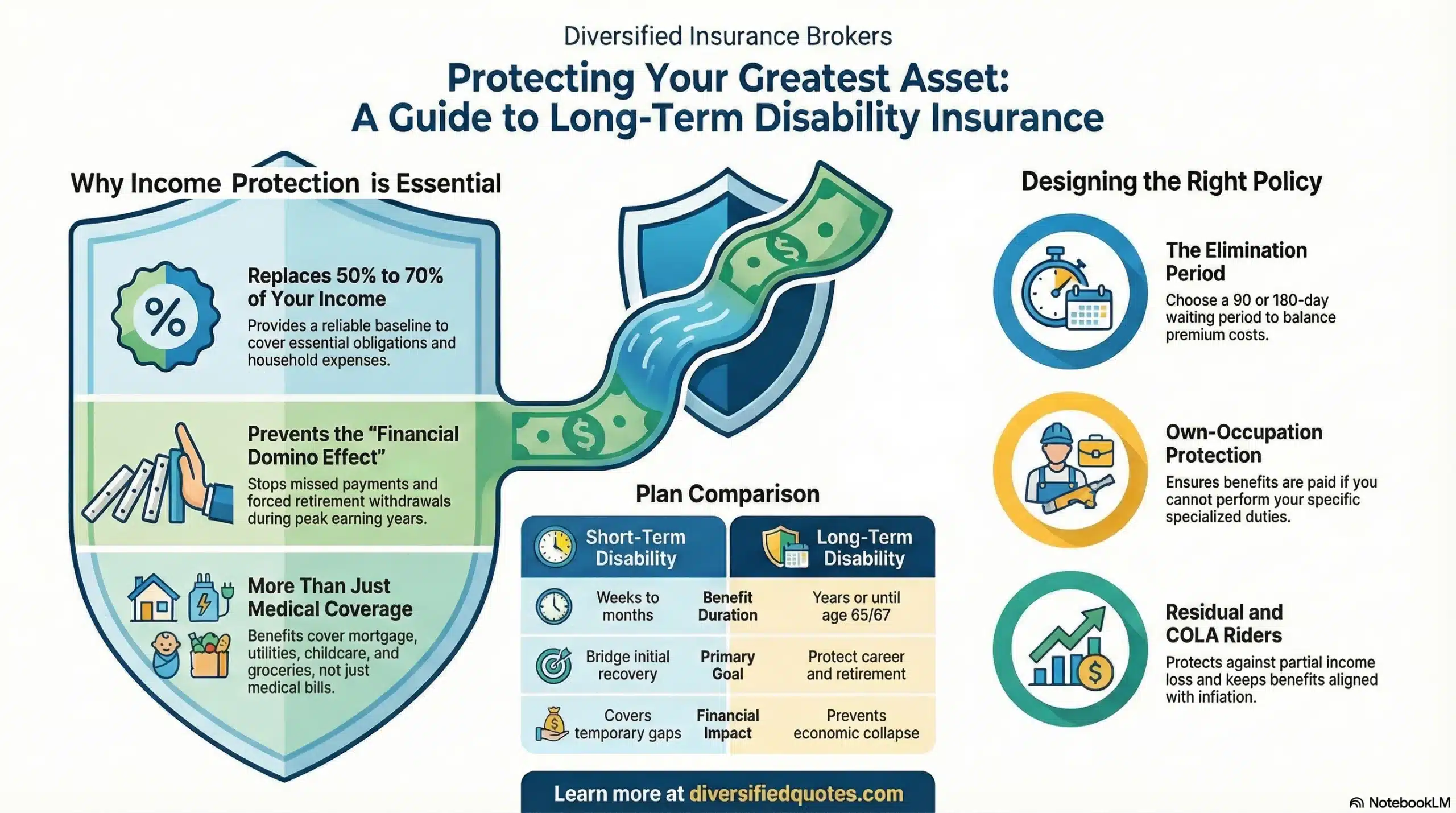
Most individual disability insurance policies are designed to replace a portion of your income — often around half to roughly two-thirds of earnings — because disability insurance is built to maintain stability without removing the financial incentive to return to work when you are able. But percentage-based thinking can be misleading unless you translate it into your actual after-tax lifestyle. Here’s why: two people earning the same salary can have completely different “need” profiles based on taxes, debt, savings habits, and household structure. A professional earning $200,000 with a large mortgage, childcare, and aggressive retirement contributions may need a higher “stability number” than someone earning $200,000 with no debt, a paid-off home, and a spouse with strong income. Percentage is a useful starting point, but it’s not the finish line. Also, disability benefits are often structured so that when you pay premiums personally (with after-tax dollars), benefits are generally received tax-free. That means a lower benefit amount can sometimes preserve a surprisingly similar spendable lifestyle compared to your gross income.
Why “Partial Disability” Often Determines the Right Benefit Amount
Most people picture disability as an all-or-nothing event: either you can work or you can’t. In reality, many claims are capacity claims. You may work fewer hours. You may be able to do some duties but not others. You may return but at reduced production, reduced travel, or reduced stamina. That often results in a meaningful income loss even when you’re technically still employed or still “working.” This matters because your benefit amount isn’t only about total disability — it’s also about whether your policy design will actually protect you in the more common scenario: partial income loss. Professionals in production-driven careers — sales, consulting, law, medicine, executive leadership — are especially exposed to this. If reduced capacity means reduced bonuses, reduced billable hours, or reduced performance-based compensation, the “right amount” of coverage is the amount that closes the gap between your reduced earnings and your stability number. That’s why benefit design and rider selection matter alongside the monthly benefit. A smaller monthly benefit paired with strong residual/partial disability provisions can sometimes protect you better than a larger benefit with weak partial disability language. For a broader perspective on how disability risk affects different occupation categories and which occupational classes receive the most favorable terms, our resource on disability insurance for high-risk occupations covers the full classification framework.
How Much Disability Insurance Do I Need if I’m a Professional?
Licensed and highly trained professionals often need a benefit target that protects more than “a paycheck.” Your income is often tied to a narrow set of duties — clinical work, surgical procedures, trial work, complex analysis, executive leadership, or specialized production. If a condition prevents you from performing your core duties, even if you can still “work,” your income can change dramatically. Healthcare is a clear example. If you work in medicine, your ability to practice can be affected by physical limitations, fine motor impairment, or even cognitive stamina issues. Review disability income insurance for doctors and physicians and disability income insurance for nurses for profession-specific context on how definition of disability and partial disability provisions become critical. Even small limitations can create big income changes, which means your “needed” benefit is often higher than someone in a role with more flexible duties. For precision-dependent specialties like radiology and related imaging fields, the fine motor and cognitive precision dimension creates a particularly narrow definition of “fully functional” — our resource on disability insurance for radiologists covers how this profile is evaluated. An analogous dynamic exists in non-medical precision work — our resource on disability insurance for jewelers covers how fine motor precision dependence affects DI sizing and definition selection in that occupation, providing useful parallel context for any professional whose earning capacity depends on narrow physical or cognitive capabilities.
Attorneys often experience the same issue from a different angle. Billable hours, trial readiness, concentration, and stress tolerance can determine earning ability. A partial limitation can reduce output for months, and those months can alter client retention and partnership tracks. See disability income insurance for attorneys for how disability definitions and partial disability provisions become critical in practice. In all of these cases, you’re usually not asking whether you need disability insurance. You’re asking how much and what type will preserve your specialized earning power if your capacity changes. That’s exactly what proper benefit sizing is meant to solve.
Short-Term vs Long-Term: How the Time Horizon Changes the Answer
When people ask how much coverage they need, they’re usually thinking about a short recovery window — surgery, a severe illness, a serious injury. But the financial damage often comes from the long-duration event: a chronic condition, a complication, a multi-year recovery, or a permanent impairment that changes career trajectory. A well-sized disability strategy should be built around the scenario that creates the most permanent financial consequences. Short-term disability is designed to cover shorter disruptions and typically has shorter benefit periods. Long-term disability is designed to protect against extended or permanent loss of income and often includes benefit durations that align with career timelines and retirement planning. If your plan is “I can handle 30–90 days with savings,” that can be true — and still not solve the risk of a multi-year disruption. For many households, the “right amount” of disability insurance is not determined by whether you can survive a short gap. It’s determined by whether you can survive the long gap without destroying the plan you’ve built.
Design Choices That Change How Much Disability Insurance You Need
Two people can buy the same monthly benefit and end up with completely different real-world protection. Why? Because disability insurance is contract-driven. Definitions and design features determine whether benefits pay in the scenarios that actually occur.
If you have specialized work, the definition of disability can determine whether your “coverage” is real or mostly theoretical. Own-occupation style definitions are designed to pay if you cannot perform the material and substantial duties of your own occupation, even if you can work in another role. If you want a deep breakdown of why this matters in plain language, review own-occupation disability insurance. In practical terms, the stronger the own-occupation language, the more confident you can be that your benefit amount will actually protect your lifestyle if your specialized duties are impacted.
The elimination period is how long you must be disabled before benefits begin — often 60, 90, 120, or 180 days. This decision changes your “need” because it determines how much cash you must self-fund before the policy becomes your paycheck. A longer elimination period can reduce premium cost, but it increases the importance of emergency reserves, short-term benefits, or household flexibility. Our resource on disability insurance elimination period covers how the waiting period is selected, how it affects premium cost, and how to evaluate the right elimination period given existing savings, any short-term employer benefits, and monthly fixed expenses. The benefit period is the maximum length of time benefits can be paid while you remain disabled. Short benefit periods can be helpful as a bridge — longer benefit periods protect against career-altering events. Partial disability is often where real-world protection is won or lost. If you can work in a limited capacity but experience a measurable income loss due to illness or injury, residual benefits can provide a proportional benefit — a major factor in the “how much do I need” question because a benefit that only pays for total disability may not protect the more common “reduced output” scenario.
How Much Disability Insurance Do I Need if I Already Have Group Coverage?
Employer-provided long-term disability coverage is common, but it often does not protect high earners as well as they expect. Group plans may replace a percentage of income, but they often cap the maximum monthly benefit. They may also exclude bonuses, commissions, or other variable compensation. Some group plans have definitions that are less favorable than strong individual policies, and benefits can be taxable if the employer pays premiums. To decide how much additional coverage you need, don’t start with the “percentage” listed in the benefits booklet. Start with the net cash flow you’d actually receive during a claim and compare it to your two baseline numbers: minimum required and desired stability. If group coverage covers the minimum required number but not the stability number, individual coverage can be structured as the gap filler. Also, review how long group benefits can last and how the plan defines disability after a certain period (some plans shift to a stricter definition after 24 months). These details determine whether group coverage is a helpful foundation or a plan that creates false confidence.
How Much Disability Insurance Do I Need if My Income Is Variable?
Many people with the greatest need for disability insurance are the ones whose income is hardest to insure: commission earners, business owners, partners, and professionals whose income changes year to year. Variable income can be protected, but the way it’s documented matters. Carriers often look at multi-year averages, tax returns, and income stability trends to determine insurable benefit limits. This means your “need” might be higher than what’s immediately insurable, especially if you’ve had a recent income increase. In those cases, the strategy is often to secure the maximum available now with policy provisions that allow growth later, then review and increase coverage as income documentation supports it. Our resource on disability insurance for self-employed professionals covers the income documentation dynamics specific to self-employed workers — variable income, Schedule C documentation, and how multi-year tax return averaging affects the insurable benefit amount. Our resource on disability insurance for high income and business owners covers the additional layer that applies when a disability also threatens business continuity — the Business Overhead Expense (BOE) dimension that some business owners need alongside personal disability coverage to keep the business operating while they recover. If your income is tied to long-term wealth-building strategy — investing, tax planning, and disciplined saving — disability becomes more than a paycheck problem. It becomes a compounding problem. That’s why some people also evaluate broader wealth-behavior concepts like how the wealthy stay wealthy as part of framing the goal: protect the income engine so the long-term plan doesn’t collapse under stress.
How Much Disability Insurance Do I Need as My Income Grows?
If you expect your income to rise through promotions, business growth, partnership tracks, or expanding production, you should assume your disability need will rise too. Many people buy a policy once and never revisit it, even though their income doubles over time. That creates a growing protection gap — your lifestyle expands, your obligations increase, your retirement contributions rise, but your disability benefit stays fixed. The best way to prevent this is to build a plan that can evolve. Some policies include options that allow benefit increases as income rises (subject to program rules). In other cases, you may add coverage layers over time. If you’re integrating disability protection with a broader tax strategy and long-term compounding goals, it can also help to understand how long-term tax strategy impacts wealth over decades — see how tax deferral creates generational compounding. The connection is simple: disability risk can interrupt the very contributions that make compounding work. Benefit sizing is partially about ensuring you can keep the long-term strategy intact.
Practical Case Examples: What “The Right Amount” Looks Like
A 38-year-old professional earns a strong salary with bonuses and contributes aggressively to retirement accounts. Their minimum required monthly number is manageable, but their stability number includes continued retirement contributions and avoiding liquidation of investments. The “right amount” of disability coverage is not just enough to pay the mortgage — it’s enough to keep them from pausing the plan for multiple years. In this scenario, benefit sizing tends to favor strong residual benefits and a benefit period aligned with career timeline. A household with a large mortgage, childcare, and high monthly commitments may need a higher stability number because they have less room to “cut expenses” without major life disruption. The right amount is often the amount that prevents forced decisions — selling a home, pulling kids out of school, or draining savings quickly — during a 12–24 month disruption. A 58-year-old professional still earning strong income may not need a benefit period to age 67 if the main goal is protecting the transition into retirement and preventing early withdrawals. In this case, “the right amount” is often a bridge benefit that preserves timing and prevents damaging portfolio decisions. These examples show why benefit sizing is personal. The best answer is the one that protects the decisions you care about most: keeping housing stable, preserving retirement momentum, protecting family obligations, and avoiding forced liquidation of long-term investments.
Putting It All Together: A Clean Framework
Here is a practical way to turn “How much disability insurance do I need?” into an actionable decision. First, establish your minimum required number and your desired stability number — the first protects survival, the second protects the plan. Second, identify what coverage you already have: group LTD, union coverage, employer benefits, or existing individual coverage. Translate it into net, spendable income during a claim. Third, decide the gap you need to fill: if your goal is to preserve the plan, size the gap to your stability number, not your minimum required number. Fourth, choose the design that matches your real claim scenario — own-occupation language for specialized work, residual/partial benefits for capacity claims, and a waiting period you can realistically self-fund. Fifth, plan for growth and review periodically so the gap doesn’t quietly widen over time as income rises. The goal is simple: if you can’t work, your family can stay stable, keep your long-term plan intact, and avoid the cascade of forced financial decisions that can permanently change your future. When you’re ready to compare options across multiple carriers and identify the benefit level that actually closes your gap, working with an independent broker who places disability coverage for a wide range of professionals and income levels consistently produces better outcomes than working with a single carrier. Our resource on why to work with an independent disability insurance broker covers the structural advantage of independent broker access — carrier comparison, definition optimization, and ongoing benefit review — for any professional sizing disability coverage against a specific financial outcome.
Find Out What Benefit Level Actually Protects Your Lifestyle
We’ll help you compare your real monthly need against what your current coverage would actually pay — then identify the gap.
Request Your Disability Insurance Plan Call 800-533-5969Related Pages
Adjacent strategies that high earners use to protect cash flow, strengthen long-term planning, and reduce financial risk.
Financial Protection Essentials
Adjacent planning resources for income protection, retirement timing, and legacy strategy.
Talk With an Advisor Today
Choose how you’d like to connect—call or message us, then book a time that works for you.
Schedule here:
calendly.com/jason-dibcompanies/diversified-quotes
Licensed in all 50 states • Fiduciary, family-owned since 1980
FAQs: How Much Disability Insurance Do I Need?
Is there a standard amount of disability insurance everyone should have?
No. The right amount of disability insurance depends on your income, monthly expenses, household structure, existing coverage, and how much of your lifestyle you want to protect if you cannot work. A simple rule like “60% of income” is a starting point, but it does not account for tax treatment of benefits, variable income components, existing group coverage caps, the specific financial decisions that would be forced by an income interruption, or the benefit period that matches your actual recovery risk. The most useful framework is to establish your minimum required monthly number (survival) and your desired stability number (plan preservation), then size coverage to close the gap between existing coverage and your stability target. This produces a more accurate and meaningful benefit target than any percentage-based rule applied without context.
How much of my income should disability insurance replace?
Many people aim to replace enough income to cover essential expenses and maintain a reasonable standard of living — typically in the range of 50–70% of gross income, though the specific percentage is less important than the net spendable income it produces. When disability insurance premiums are paid personally with after-tax dollars, benefits are generally received income-tax-free. This means a 60% benefit replacement rate can often preserve a significantly higher percentage of actual take-home spending power than the gross percentage suggests. The most useful approach is to convert the benefit percentage into actual monthly after-tax cash flow and compare it to your stability number — the amount that keeps retirement contributions in place, prevents forced liquidation of investments, and covers all household essentials without running out of savings within the first 12–24 months of a long-duration claim.
Do I still need disability insurance if I have coverage through work?
Often yes — employer group coverage is a valuable foundation but frequently does not protect high earners as well as they expect. Group plans typically cap the maximum monthly benefit at a fixed dollar amount (commonly $10,000–$15,000/month), which may be well below 60% of income for earners in the $200K+ range. Group plans often exclude bonuses, commissions, and other variable compensation from the income base used for benefit calculation, which can significantly understate the actual income loss during a disability. Benefits received from employer-paid group plans are typically taxable, reducing the net benefit further. Some group plans shift from an own-occupation to an any-occupation definition of disability after 24 months, changing when benefits continue to be paid. An individual private policy can address each of these gaps — providing portability, tax-free benefits, and a definition of disability that remains favorable throughout the claim period.
How does my occupation affect how much disability insurance I need?
Occupation affects both the sizing and the design of the right disability coverage. Specialized or higher-skill occupations with narrow job duties — physicians, surgeons, attorneys, financial professionals, technical specialists — often justify stronger coverage and more protective policy definitions because the income depends on a specific set of capabilities that cannot easily be redirected to other work. If a condition prevents you from performing your primary specialty, even if you could technically perform some other type of work, the income loss can be enormous without an own-occupation definition that pays based on inability to perform your specific duties. Blue-collar, physical, or service occupations are often classified at lower occupational classes, which can limit the maximum benefit period or the definition of disability available, making carrier selection and benefit design even more important for those workers to maximize the protection available within their classification.
What is the difference between short-term and long-term disability insurance?
Short-term disability insurance covers shorter income interruptions — typically with elimination periods of 7–14 days and benefit periods of 90 days to one year. It provides protection during the initial recovery period after an injury or illness. Long-term disability insurance is designed for extended or permanent disabilities that can last years or even to retirement age, with elimination periods typically ranging from 90 to 180 days and benefit periods that may extend to age 65 or 67. For most households, the catastrophic financial risk is not a short disruption manageable with savings — it is the long-duration event that permanently alters income trajectory, retirement savings, and financial stability. A well-sized disability strategy is usually built around the long-duration risk and uses the elimination period selection and emergency savings to handle the shorter gap between disability onset and long-term benefit payments.
How do elimination periods affect how much disability insurance I need?
A longer elimination period lowers premiums but requires more savings — or other bridge resources — to cover expenses before benefits begin. The financial impact of the waiting period is most acute in the first year of a disability, when the full income loss is being experienced but policy benefits have not yet begun. The right elimination period depends on how much liquid savings you have available to bridge the gap, whether any employer-sponsored short-term benefits are in place, and how quickly your fixed monthly obligations would create cash flow pressure if income stopped. Many working adults choose a 90-day elimination period as the practical balance between cost and waiting time — it reduces premium compared to a 30-day period while still beginning benefits before most savings reserves are fully depleted. Choosing an elimination period that is longer than your liquid savings can realistically cover creates a real-world vulnerability even when the policy itself is properly sized.
How often should I review my disability insurance amount?
You should review your disability coverage whenever your income, debts, or lifestyle change significantly — and at minimum every two to three years during peak earning years when income tends to grow. Common trigger events that should prompt an immediate review include meaningful income increases (particularly if your disability benefit has not changed), major household changes (a new mortgage, additional dependents, loss of a second household income), a change in employer that affects group coverage terms, and a health event that could affect future insurability. The risk of under-reviewing is a growing protection gap: your lifestyle expands, your obligations increase, your retirement contributions rise, but your disability benefit stays fixed at the level it was when you first purchased coverage. Many policies include future increase option riders that allow you to purchase additional coverage without new medical underwriting — using these options at the right times is a meaningful advantage of early coverage purchases.
Can I increase my disability insurance later as my income grows?
Yes — many policies include future purchase options (FPO) or guaranteed insurability riders that allow you to purchase additional coverage over time based on income growth, without new medical underwriting. These options are typically exercisable on specific event dates (marriage, birth of a child, income increase above a threshold) or at defined policy anniversaries. The benefit of exercising these options is that increased coverage is issued at your then-current age and income, without re-underwriting your health — meaning a health change that might otherwise limit future insurability does not prevent the increase. This makes it strategically valuable to purchase a base policy with strong future increase options early in your career, even if the initial benefit amount doesn’t fully cover your stability number, with a plan to increase coverage as income documentation supports higher benefit levels.
How does variable income (commissions, bonuses) affect disability coverage sizing?
Variable income — bonuses, commissions, incentive compensation, profit distributions — is one of the most common sources of protection gaps in disability insurance planning. Standard individual DI policies base benefit calculations on documented earned income, typically averaged over two to three years of tax returns. If your compensation includes substantial variable elements that fluctuate year to year, the insurable benefit amount may be lower than your current year income suggests, particularly if recent performance has been strong. Group disability plans often exclude variable compensation entirely from the income base, which means the benefit is calculated only on base salary regardless of how large the bonus component is. For workers whose variable income is material — sales professionals, partners, executives, performance-driven producers — the sizing question must account for this gap between actual total compensation and what standard coverage will protect. Specialty programs, supplemental DI policies, and executive benefit structures can address variable income gaps that standard group and individual policies leave uncovered.
What is own-occupation disability insurance and why does it matter for sizing coverage?
Own-occupation disability insurance is a policy definition that pays benefits if you are unable to perform the material and substantial duties of your own specific occupation, even if you are capable of working in a different capacity. This definition matters for coverage sizing because it determines whether your benefit amount is accessible in the scenarios that actually affect professionals with specialized skills. Without an own-occupation definition, a surgeon who cannot perform surgery due to a hand condition might be denied benefits because they could theoretically teach, consult, or work administratively — none of which preserves their surgical income. With an own-occupation definition, benefits are paid because they cannot perform their specific occupation, regardless of theoretical alternative work capacity. For anyone whose income depends on a narrow, specialized set of duties — physicians, surgeons, attorneys, financial professionals, technical specialists — the own-occupation definition can be the single most consequential feature in determining whether the policy actually protects the income it is sized to replace.
About the Author:
Jason Stolz, CLTC, CRPC, DIA, CAA and Chief Underwriter at Diversified Insurance Brokers (NPN 20471358), is a senior insurance and retirement professional with more than 25 years of real-world experience helping individuals, families, and business owners protect their income, assets, and long-term financial stability. As a long-time partner of the nationally licensed independent agency Diversified Insurance Brokers, Jason provides trusted guidance across multiple specialties—including fixed and indexed annuities, long-term care planning, personal and business disability insurance, life insurance solutions, Group Health, Travel Medical and Evacuation Insurance, and short-term health coverage. Diversified Insurance Brokers maintains active contracts with over 100 highly rated insurance carriers, ensuring clients have access to a broad and competitive marketplace.
His practical, education-first approach has earned recognition in publications such as VoyageATL, and contributions from his agency featured in Kiplinger and GoBankingRates— highlighting his commitment to financial clarity and client-focused planning. Drawing on deep product knowledge and years of hands-on field experience, Jason helps clients evaluate carriers, compare strategies, and build retirement and protection plans that are both secure and cost-efficient. Visitors who want to explore current annuity rates and compare options across multiple insurers can also use this annuity quote and comparison tool.
Explore More Disability Insurance Options: Browse our complete guide to Disability Insurance Planning & Education — covering how it works, riders, elimination periods, own occupation, costs & buying guides from 100+ carriers.
Last Reviewed: May 31, 2026 |
Reviewed by: Jason Stolz, CLTC, CRPC, DIA, CAA
Chief Underwriter, Diversified Insurance Brokers, Inc. | NPN: 20471358 | Diversified Insurance Brokers, Inc. — Licensed in all 50 states
Fact Checked by: Tonia Pettitt, CMIP©
Medicare Specialist, Diversified Insurance Brokers, Inc. | NPN: 14374308 | Diversified Insurance Brokers, Inc. — Licensed in all 50 states
Did you find this content helpful? Leave us a Google review — it helps others find trustworthy guidance too.
Editorial Standards: Diversified Insurance Brokers maintains rigorous editorial standards to ensure accuracy, clarity, and independence in all content. Learn more about our editorial standards and commitment to transparency.
