
Disability Insurance for Executives: Why Income Protection Is Non-Negotiable
As an Independent Disability Insurance Broker, we have access to exclusive discounts and negotiated pricing most captive agents can’t offer — see the full breakdown near the end of this page.
Disability Insurance for Executives: Why Income Protection Is Non-Negotiable
For business executives, physicians, attorneys, consultants, engineers, and other high-income professionals, the single greatest financial asset on the balance sheet is not the investment portfolio — it is the capacity to generate earned income. A 40-year-old executive earning $350,000 annually with 25 working years remaining has more than $8.75 million in projected future earnings at stake before accounting for bonuses, equity compensation, deferred income, or business distributions. That income funds the retirement account contributions, the real estate acquisitions, the college savings plans, the investment portfolio growth, and every other wealth-building activity that constitutes the financial plan. Disability income insurance for executives exists to protect that engine — to ensure that a serious illness or injury does not eliminate the income stream on which the entire financial structure depends. At Diversified Insurance Brokers, Jason Stolz, CLTC, CRPC, DIA, CAA works with executives and high-income professionals to structure disability coverage that addresses the full scope of their compensation, the limitations of employer-provided group coverage, and the specific policy design features that determine whether a policy actually protects executive-level income when a claim occurs. Our resource on high-income disability insurance covers the broader framework for income protection at senior earning levels, and our resource on disability insurance for high earners and business owners covers the specific design considerations that apply when total compensation is significantly above the thresholds that standard group and individual policies are built to serve.

Disability represents a statistically greater income risk than premature death during working years — yet most executives who maintain carefully structured life insurance and estate plans give disability insurance far less planning attention. A long-term disability that eliminates earned income for two, five, or ten years can permanently alter a retirement timeline, force the liquidation of investment positions at inopportune valuations, and compel the use of tax-advantaged retirement accounts before retirement — triggering penalties and tax obligations that compound the financial damage. The interruption does not need to last a career to be devastating: even a 36-month disability during peak earning years can eliminate $1 million or more of compounding capital from a retirement account that was being built during the most productive contribution window. The executive who plans carefully for market risk, sequence-of-returns risk, and longevity risk but leaves income risk unaddressed has identified three of the four major financial threats while ignoring the one with the highest probability of occurring during the next 20 years of their career.
Secure High-Limit Disability Coverage Built for Executives
We design executive disability coverage around your full compensation structure — base salary, bonuses, equity, and deferred income — and compare options across 100+ carriers to identify the strongest available policy for your income level and health profile.
Request a Custom Executive DI Quote Call 800-533-5969Executive Disability Insurance — Group Plan vs. Individual Policy Comparison
The most consequential disability planning question for most executives is not “should I have disability insurance” — it is “does my employer’s group plan actually protect my income at the level I need, or does it leave a gap that an individual policy must address?” The answer is almost always that a meaningful gap exists. Group disability plans are designed for median employee income replacement, not for executive-level compensation with variable components, benefit caps that are misaligned with senior earnings, and contract terms that protect the employer’s interests as much as the employee’s. The table below maps the most important plan design features across both policy types to show exactly where the gap occurs and why it matters for high-income professionals.
| Plan Feature | Typical Employer Group DI Plan | Individual Executive DI Policy | Why It Matters to Executives |
|---|---|---|---|
| Disability Definition | Often “any occupation” after 24 months — meaning benefits stop if the insured can perform any work at all, not just their prior role | True own-occupation — benefits pay if the insured cannot perform the substantial duties of their specific occupational role, regardless of ability to work elsewhere | A CFO who develops a cognitive impairment preventing strategic financial leadership could lose group benefits after 24 months despite being unable to return to their actual role — own-occupation ensures the benefit standard matches the actual occupational requirement |
| Benefit Calculation Base | Typically base salary only — bonuses, commissions, equity grants, and deferred compensation usually excluded from the calculation base | Can be structured to include base salary plus documented bonus, commission, and certain variable compensation components | An executive with $200K base and $150K in annual bonus has 43% of their total compensation excluded from group coverage — the effective replacement rate drops from 60% to 34% of actual earnings, creating an immediate and severe income gap |
| Maximum Monthly Benefit Cap | Often $10,000–$15,000/month regardless of actual income — group benefit caps are set for median workforce, not executive earnings | No fixed cap — benefit is sized to actual documented income; high earners can stack individual policies across multiple carriers to reach appropriate coverage levels | An executive earning $500K annually ($41,600/month gross) with a $15,000/month group cap receives 36% replacement — individual coverage supplements to reach the 60%–70% replacement target that supports ongoing financial obligations |
| Tax Treatment of Benefits | Benefits are taxable income when employer pays premiums — the actual after-tax replacement rate is significantly lower than the stated percentage | Benefits are tax-free when the insured pays premiums personally — the stated replacement rate is the actual net benefit received | A stated 60% group benefit becomes approximately 40%–45% after taxes for an executive in the 32% bracket — the effective income replacement gap is substantially larger than the plan design suggests on paper |
| Portability When Leaving Employer | Group coverage typically terminates with employment — portability options (if available) often produce inferior coverage at significantly higher cost | Individually owned — fully portable across employers, career transitions, self-employment, and retirement regardless of employment status changes | An executive who develops a health condition and then changes employers may find they cannot qualify for new group or individual coverage — individually owned non-cancellable policies remain in force regardless of any employment or health changes |
| Premium and Coverage Stability | Employer can change plan design, reduce benefits, change carriers, or eliminate the group plan entirely — often with 30–60 days notice | Non-cancellable and guaranteed renewable provisions lock in both premium rates and contract terms for the life of the policy — the insurer cannot change the terms or increase rates unilaterally | An executive who is diagnosed with a health condition after purchasing a non-cancellable individual policy retains their full coverage at the original premium — the insurer cannot react to a health change by modifying, restricting, or canceling the policy |
| Benefit Period | Often 2–5 years maximum; some plans extend to age 65 but with progressively restrictive disability definitions after the initial period | To age 65 or 67 benefit periods available — protecting income for the full remaining career regardless of disability duration | A permanent disability at age 45 with a 5-year group benefit period leaves 15–20 years of career income unprotected; a to-age-65 individual policy ensures continuous income replacement for the full duration regardless of when disability occurs |
| Residual / Partial Disability | Partial disability benefits vary widely — many group plans do not provide meaningful residual benefits for reduced-capacity work situations | Residual disability riders pay proportional benefits when income declines due to reduced working capacity — covering the partial return-to-work scenario most long-term disability claims follow | Most long-term disability recoveries are gradual, not binary — an executive returning at 60% capacity for 18 months before full recovery needs proportional income support during the transition, not a policy that treats anything short of total disability as a full recovery |
| Future Benefit Increase Options | Group benefit typically adjusts only when the employer updates the plan — no individual option to increase coverage as personal income grows | Future insurability options allow coverage increases at defined intervals without new medical underwriting — protecting increased income levels as career advances | A physician in early practice or an executive on a promotion trajectory needs the ability to expand coverage as income grows without underwriting risk from any health changes that develop during the career period |
| Offset Provisions | Group benefits are often reduced dollar-for-dollar by Social Security disability benefits, workers’ compensation, or other income sources — the insurer captures the offset benefit | Individual policies typically do not reduce benefits based on Social Security disability — the full stated benefit is paid regardless of any SSDI the insured also receives | An executive whose group plan offsets SSDI receives effectively zero incremental benefit from Social Security if SSDI benefit equals or approaches the group plan limit — individual coverage has no such offset mechanism |
The table’s most financially significant row for most executives is the benefit calculation base row — because it reveals the compensation gap that most executives do not fully quantify until they run the calculation. Base salary replacement at 60% sounds adequate until you realize that for many senior executives, base salary represents only 55–70% of total annual compensation. The bonus and equity components that make the executive role financially meaningful are typically excluded from group coverage calculations, meaning the stated replacement rate of 60% of base translates to 30–40% of actual total compensation. That gap — the difference between what the group plan appears to provide and what it actually provides in the context of real executive income — is the most important number in executive disability planning. Our resource on long-term disability insurance covers the foundational design framework that applies to all long-term income protection, and our resource on own-occupation disability insurance covers the specific disability definition that matters most for executives whose professional roles are specialized and whose earning capacity cannot be replicated in a general workforce context.
Why Own-Occupation Definition Is Non-Negotiable for Executives
The disability definition in any policy is the most consequential contractual element — it determines what the insured must be unable to do before benefits are payable, and for executives with highly specialized roles, a weak definition can eliminate the benefit in the scenarios most likely to affect a senior professional. Own-occupation disability insurance provides benefits if the insured cannot perform the substantial material duties of their specific occupation — not a general occupational category, and not any employment whatsoever. The distinction is critical for executives whose work involves specific cognitive, strategic, or technical capabilities that cannot simply be transferred to another professional context. A chief technology officer who develops a neurological condition affecting complex technical reasoning cannot perform their CTO responsibilities — but may technically be able to work in a less demanding role. An any-occupation policy denies benefits in that scenario. A true own-occupation policy pays the full benefit because the CTO cannot perform the substantial duties of their actual occupation.
For executive-level professionals, the own-occupation definition should also address how “substantial duties” maps to the executive’s actual job responsibilities rather than a generic job description. A CEO whose primary value is strategic leadership, stakeholder management, and high-stakes decision-making has a different disability profile than a CFO whose primary value is financial modeling, regulatory compliance, and capital markets communication. Each role creates a distinct functional requirement set, and the disability definition should be evaluated against that specific requirement set rather than against a general “executive” category. Our resource on disability insurance for high-risk occupations covers how occupational risk assessment affects policy design across different professional categories, including those where travel, physical demands, or specialized cognitive requirements create elevated or concentrated disability risk profiles.
Variable Compensation — The Coverage Gap Most Executives Overlook
Executives at the vice president level and above often derive a significant portion of their total annual compensation from sources other than base salary: annual performance bonuses, long-term incentive plans, restricted stock units that vest over time, profit-sharing distributions, commission on business development, and partnership draws. These variable components can represent 40–80% of total annual compensation for C-suite executives, managing partners, and senior business developers. Standard group disability insurance almost universally excludes these components from the benefit calculation — meaning that group coverage at 60% of base salary may replace only 25–35% of actual total earnings for an executive whose compensation is heavily weighted toward variable components.
Individual disability income policies can be structured to include documented variable compensation in the benefit calculation base, subject to carrier underwriting and state availability. The documentation requirement for variable comp — typically two years of tax returns showing consistent bonus or commission income — means that the planning conversation should happen before a disability claim, when the documentation is readily available and the underwriting process is straightforward. The executive who waits until after a disability occurs to realize that group coverage excluded three years of bonus income has permanently closed the window to address that gap. Our resource on disability insurance future insurability riders covers the mechanism by which executives on promotion tracks can expand their coverage as income grows without submitting to new underwriting at a future health class — an essential feature for professionals whose variable compensation is increasing rapidly and who want coverage that keeps pace with actual earnings without repeated medical examinations.
Essential Riders for Executive Disability Coverage
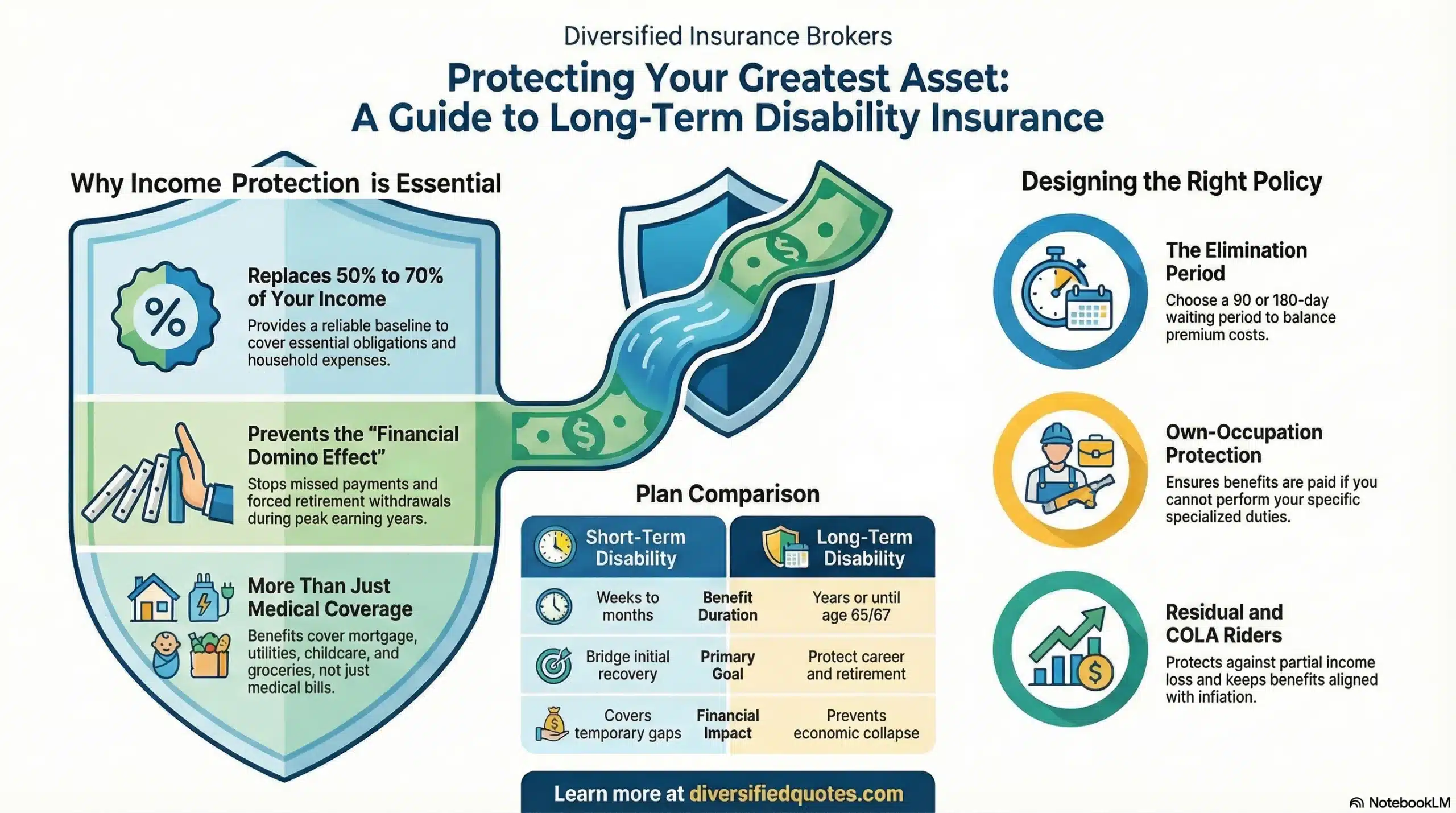
A well-structured executive disability policy is defined as much by its riders as by its base benefit amount. The base policy establishes the benefit, the disability definition, and the elimination and benefit periods. The riders address the specific income protection dimensions that standard base policies do not cover — and for executives, several riders are consistently the difference between a policy that works in the actual claim scenarios most likely to occur and a policy that works only in idealized scenarios. Our resource on disability insurance riders explained covers the full rider landscape with detail on how each provision functions in practice.
The residual disability rider is among the most important for executives because most long-term disability recoveries are gradual rather than binary. An executive who suffered a cardiac event or a serious neurological episode does not typically return to full executive capacity in a single day — the recovery involves months of partial capacity, reduced cognitive endurance, limited work schedule, and progressive return to full productivity. A base disability policy that requires total disability for benefits pays nothing during that partial recovery period. A residual disability rider pays a proportional benefit based on the income reduction experienced — if the executive is working at 60% capacity and earning 60% of pre-disability income, the rider pays 40% of the base benefit, providing income replacement proportional to the actual income loss throughout the recovery continuum.
The cost-of-living adjustment (COLA) rider is critical for executives who would experience a long-term or permanent disability. Our resource on disability income insurance with COLA covers how the COLA rider works — typically increasing the monthly benefit payment annually by a defined percentage or indexed to CPI, up to a stated cap. Without a COLA rider, a benefit that provides meaningful income replacement in the first year of a claim may provide materially reduced purchasing power by year five or year ten. For an executive who becomes permanently disabled in their mid-40s with 20 years of potential benefit period remaining, inflation compounds into a significant purchasing power erosion that undermines the financial stability the policy was designed to maintain. The COLA rider prevents that erosion by indexing the benefit to inflation throughout the claim period.
The future insurability option (also called future increase option) allows the insured to increase their benefit amount at defined intervals without submitting to new medical underwriting — protecting the right to expand coverage as income grows regardless of any health changes that develop during the career. For an executive in their early career phase whose compensation is on a significant upward trajectory, the future insurability rider ensures that coverage can match income growth rather than becoming progressively inadequate as earnings increase. The rider typically requires only financial documentation — proof of income increase — not medical requalification, allowing executives who develop health conditions during their career to maintain the ability to expand coverage that a new underwriting application would restrict or deny.
Elimination Period — Matching the Wait to Executive Financial Reality
The elimination period for executive disability insurance should be set in direct relationship to the executive’s personal liquidity and the financial obligations that would require continuous funding during a disability period. Our resource on disability insurance elimination periods explained covers the full framework for elimination period selection — including how the waiting period interacts with SSDI waiting periods, employer-provided short-term disability coverage, and personal emergency reserves.
Most executives select 90-day elimination periods as a baseline, matching the typical short-term disability or paid leave period provided by employer plans and aligned with the emergency reserve most financial advisors recommend maintaining. Executives with 6–12 months of liquid emergency reserves may select 180-day elimination periods to reduce premium cost, accepting a longer self-funded waiting period in exchange for lower long-term premium. The premium reduction from a 90-day to 180-day elimination period is meaningful — often 15–25% — but the 90-day self-funded gap must be genuinely affordable from liquid reserves rather than requiring investment liquidation or borrowing to bridge. For executives with significant unvested equity, pending bonus payments, or other income components that would be disrupted early in a disability, the 90-day period is typically the more protective choice.
Tax Planning Around Executive Disability Coverage
The tax treatment of disability insurance premiums and benefits has significant implications for executive financial planning — and the correct structure depends on how premiums are paid and what the income replacement tax outcome should be at claim time. Our resource on are disability insurance payments taxable covers the complete disability insurance tax framework, but the executive summary for most senior professionals is this: premiums paid personally with after-tax dollars produce tax-free benefit payments at claim time, while premiums paid by the employer produce taxable benefit payments that are subject to ordinary income tax rates when received.
For executives in the 32–37% federal income tax bracket, the after-tax calculation reveals why personally paid premiums are almost always preferable despite the lack of a current deduction. A taxable $20,000 monthly group benefit produces approximately $12,600–$13,600 of after-tax income for a senior executive — a meaningful reduction from the stated benefit amount. A tax-free $20,000 monthly individual benefit produces the full $20,000 of spendable income regardless of tax bracket. The premium cost of the individual policy is paid with after-tax dollars, but the lack of current-year deductibility is typically far less consequential than the tax-free treatment of benefits during a potentially multi-year disability claim. Many executives who have employer-paid group disability coverage strategically pay for supplemental individual coverage personally rather than having the employer pay those premiums — specifically to ensure tax-free benefit treatment at claim time.
Executive Disability in a Business Ownership Context
Executives who also have ownership stakes in their business — equity partners, managing partners, closely held company owners, and significant shareholders — face disability risk that extends beyond personal income replacement into business continuity and ownership structure dimensions. The disability of an owner-executive simultaneously threatens household income, business operational stability, and partnership equity dynamics. A complete disability protection plan for an executive with meaningful ownership interest addresses all three dimensions through coordinated coverage layers.
Our resource on disability business overhead expense covers the BOE coverage layer that keeps the business’s fixed operating costs funded when an owner-executive cannot work — preventing the lease, payroll, and operating expense obligations from collapsing the enterprise during the disability period. Our resource on key person disability insurance covers the business continuity layer that stabilizes revenue, funds replacement leadership, and protects the company’s operational capacity when the executive-level contributor is absent. For businesses with multiple ownership partners, our resource on disability insurance for the self-employed covers the personal income foundation for self-employed business owners who have no employer-provided coverage backstop and must structure their full income protection through individually owned policies.
For executives whose business involves deferred compensation arrangements, executive bonus plans, or split-dollar life insurance structures, the disability planning conversation should include how each deferred compensation vehicle performs during a disability period. Our resource on executive bonus Section 162 plans covers the executive compensation planning structure where businesses fund executive life insurance — an adjacent planning context that often involves the same executives for whom disability coverage is being structured. The complete executive protection plan coordinates personal disability, BOE, key person disability, and executive life insurance planning in a coherent framework rather than treating each coverage type as an isolated decision. Our resource on key person life insurance for executives covers the mortality risk complement to the disability planning — the coverage that addresses the business continuity risk from the same individual for whom disability insurance addresses the income and continuity risk during a disabling illness or injury.
High-Limit Coverage — Stacking Policies for Adequate Benefit
Individual disability carriers impose maximum benefit limits — typically based on a percentage of insurable income and subject to aggregate maximum benefit caps that apply across all DI carriers. For very high-income executives, a single carrier’s maximum benefit may not adequately replace 60% of total compensation, requiring a multi-carrier stacking approach where individual policies from different carriers are combined to reach the appropriate coverage level. This strategy is available to qualified executives and requires coordination between carriers during the underwriting process — typically through a broker who has access to all relevant carriers and can manage the application sequence to avoid anti-selection issues.
The stacking process requires documenting total compensation from all sources, identifying the maximum insurable benefit at each carrier based on their individual benefit limits and income-based underwriting guidelines, and structuring the application sequence so that each carrier’s benefit is based on the correct income figure after accounting for any prior coverage in force. Underwriters require disclosure of all existing disability coverage — personal and group — when determining the available benefit amount. Attempting to purchase high-limit coverage without disclosing existing coverage produces both underwriting inaccuracies and potential claim complications. The correct approach is transparent total-income-based planning that reaches the appropriate coverage level through properly disclosed and coordinated multi-carrier placement. Our resource on disability insurance for high earners and business owners covers the high-limit coverage strategy in detail — including how benefit maximums interact with income documentation and how the carrier selection sequence affects the total achievable benefit for executive-level incomes.
When to Establish Executive Disability Coverage
The optimal time to establish disability income coverage for executives is when income is significant, health is excellent, and the financial need for income protection is clear — which typically means the mid-career window between ages 30 and 50 when income has reached a level worth protecting and health classification is most favorable. The underwriting classification assigned at application determines the premium rate for the life of a non-cancellable policy — a healthy 38-year-old executive secures a premium rate that remains locked in regardless of any health changes that develop over the following 20 or 25 years of the policy’s duration.
Waiting to establish coverage introduces two compounding risks: the premium increases that come with age, and the potential for health changes that either prevent coverage or restrict it. An executive who develops hypertension, a musculoskeletal condition, or a psychological diagnosis before applying for disability coverage faces a materially different underwriting outcome than the same executive would have faced with an application three years earlier. The conditions that most commonly affect disability insurance underwriting — orthopedic, cardiovascular, and mental health — are also the conditions most commonly associated with successful professional careers at high stress and high responsibility levels. Early application is the strategy that eliminates the risk of being underinsured due to health changes that could not be anticipated but can be prevented from affecting coverage terms by acting before they occur.
Protect Your Executive Income — Before It Becomes Urgent
We design coverage around your full compensation structure and compare options across 100+ carriers — including the own-occupation definition quality, rider availability, and maximum benefit capacity that determine whether executive coverage works when you need it most.
Request Your Executive DI QuoteRelated Pages
Core disability services, carrier review, annuity rate resources, and contact information.
Financial Protection Essentials
DI coverage for white-collar professional occupations frequently held by executives and senior professionals.
Talk With an Advisor Today
Choose how you’d like to connect—call or message us, then book a time that works for you.
Schedule here:
calendly.com/jason-dibcompanies/diversified-quotes
Licensed in all 50 states • Fiduciary, family-owned since 1980
FAQs: Disability Insurance for Executives
Why do executives need disability insurance beyond their employer’s group plan?
Employer-provided group disability plans are designed for median workforce income replacement — not executive compensation levels, structures, or career circumstances. The gap between group coverage and actual executive income protection needs is typically significant across multiple dimensions simultaneously. Group plans usually calculate benefits based on base salary alone, excluding bonuses, commissions, equity compensation, and deferred income components that often represent 30–60% of total executive compensation. Group benefit caps — frequently $10,000–$15,000 per month — are misaligned with senior earnings levels, producing effective replacement rates of 25–40% of actual total compensation rather than the stated 60% replacement rate. Benefits from employer-paid group plans are taxable, further reducing the after-tax replacement rate. Group coverage terminates with employment, leaving the executive unprotected through job changes, career transitions, or early retirement — and potentially uninsurable if health has changed during the employment period. Individual executive disability policies address each of these gaps: they can include variable compensation in the benefit base, reach benefit levels commensurate with actual earnings, are tax-free when premiums are personally paid, and are individually owned and fully portable regardless of employment status.
What makes executive disability insurance different from standard group DI?
Executive disability insurance is distinguished from standard group coverage primarily by disability definition quality, benefit calculation scope, coverage limits, contract stability, and available rider features. True own-occupation disability definitions — which pay benefits if the insured cannot perform the substantial duties of their specific role regardless of ability to work elsewhere — are the standard for high-quality individual policies but uncommon in group plans beyond the initial claim period. Individual executive policies can be structured as non-cancellable and guaranteed renewable, meaning the insurer cannot change the premium rates, benefit terms, or disability definition for the life of the policy regardless of any changes in the insured’s health or claims experience. Residual disability riders provide proportional income replacement during the partial recovery period that characterizes most long-term disability return-to-work scenarios — a benefit structure absent from most group plans. Future insurability options allow benefit increases without medical requalification as income grows. COLA riders index benefits to inflation throughout a potentially multi-year claim period. Together, these features produce a coverage structure that actually protects executive income in the realistic disability scenarios most likely to affect senior professionals — rather than in simplified all-or-nothing scenarios that favor the insurer’s claims exposure.
Does employer disability coverage adequately protect executive income?
For most executives at the director level and above, employer-provided group disability coverage does not adequately protect total compensation. The primary inadequacy is the benefit calculation base: group plans typically cover only base salary at 60%, excluding the bonuses, commissions, long-term incentive plan payouts, restricted stock unit income, and business distributions that constitute a substantial portion of senior executive earnings. A senior vice president with $180,000 in base salary and $120,000 in annual bonus receives group coverage calculated on the $180,000 base — replacing $108,000 per year before taxes, against a total pre-disability income of $300,000. After federal income taxes on the taxable group benefit, the effective replacement is approximately $65,000–$75,000 against a $300,000 income — a 22–25% replacement rate that does not sustain the financial structure the executive has built. The complementary individual policy, structured to include documented bonus income in the benefit base and paid with personal after-tax premium dollars, fills the gap with tax-free benefit payments. Most properly designed executive disability plans combine employer group coverage as a first-dollar foundation with an individually owned supplemental policy that addresses the benefit base gap, cap gap, tax gap, and portability gap simultaneously.
What income sources can executive disability insurance cover?
Individual disability income policies for executives can be structured to include multiple compensation components beyond base salary, subject to carrier underwriting guidelines and documentation requirements. Base salary is included in all individual DI policies. Annual performance bonuses, commissions, and production-based incentives can typically be included if two years of consistent income history is documentable through tax returns and employer compensation records. Partnership distributions and business owner draws from closely held companies are typically insurable based on Schedule K-1 income documentation. Deferred compensation, equity grants, and stock options are generally not included in the disability benefit calculation base — these income forms create complex timing, tax, and ownership questions that most DI carriers exclude from insurable income definitions. The practical implication for executive disability planning is that the insurable income for benefit calculation purposes is typically the sum of base salary plus regularly recurring cash compensation that has a consistent two-year history — the variable components that are genuinely irregular are less likely to be insurable in full, and the planning expectation should be built around that limitation rather than assuming all compensation is coverable.
What is a true own-occupation disability definition and why does it matter?
A true own-occupation disability definition pays benefits if the insured cannot perform the substantial and material duties of their specific occupation — regardless of whether they are capable of working in any other role. This definition is the strongest available protection for executives and specialized professionals because it anchors the disability standard to the insured’s actual job requirements rather than to general employment capacity. An any-occupation definition (found in many group plans after an initial period) requires the insured to be unable to perform virtually any gainful employment before benefits are payable — a standard that effectively eliminates benefits for executives whose cognitive, strategic, or technical disabilities prevent their specific professional performance while still leaving them capable of less demanding work. A true own-occupation policy for a corporate attorney who develops a disabling cognitive condition pays the full benefit even if that attorney could theoretically work as a receptionist or retail associate — because the disability standard is measured against the attorney’s actual occupation, not against general workforce participation. For executives in specialized roles where the income, the seniority, and the career path are all tied to their specific professional capability, the own-occupation definition is not a premium luxury — it is the foundational contract provision that makes the policy perform in the scenarios it was purchased to address.
Are executive disability insurance benefits taxable?
The tax treatment of disability insurance benefits depends on who pays the premium — not on whether the policy is group or individual. When the insured executive pays the premium personally with after-tax dollars, benefits received during a disability claim are tax-free at the federal level and in most states. When an employer pays the premium on behalf of the employee — as is typically the case with group disability plans — benefits received are treated as ordinary taxable income subject to federal income taxes, FICA, and applicable state income taxes. For executives in the 32–37% federal bracket, this distinction is financially significant: a $20,000 monthly benefit from an employer-paid plan produces approximately $12,000–$13,600 in after-tax spendable income, while a $20,000 monthly benefit from a personally paid individual policy delivers the full $20,000 tax-free. Many executives who receive employer-paid group coverage also purchase supplemental individual coverage that they pay for personally — specifically to ensure that the supplemental benefit is received tax-free at claim time. Some executives also elect to pay the group plan premium personally rather than having the employer pay it, accepting a current-year taxable income inclusion of the premium cost in exchange for tax-free benefit treatment if a disability claim occurs. The correct approach depends on the specific premium amounts, benefit levels, and the executive’s marginal tax situation — a determination that benefits from coordination between a disability insurance specialist and the executive’s tax advisor.
Can disability insurance coordinate with executive retirement planning?
Disability insurance and retirement planning are closely linked because disability during the accumulation phase of a career eliminates the income that funds retirement contributions — potentially creating a permanent shortfall in retirement assets that compounds through the loss of contribution capacity and the loss of decades of compounding on those contributions. A 45-year-old executive who becomes permanently disabled without adequate income replacement may be forced to pause or eliminate retirement account contributions during what would have been the highest-earning and highest-contribution decade of the career. The compounding impact of that contribution gap — particularly in tax-advantaged accounts — extends far beyond the immediate disability period. Some individual disability policies include a retirement protection rider or a separate disability retirement benefit rider that continues making contributions to a defined retirement account during a covered disability, preserving the retirement accumulation trajectory even when the executive cannot generate earned income. Beyond the rider option, the disability benefit itself — properly sized and tax-free — provides the liquidity that allows retirement contributions to continue from benefit income during a disability period, protecting the accumulation trajectory that the executive’s financial plan depends on.
What optional riders should executives consider?
The rider selection for executive disability coverage should be driven by the specific income structure, career trajectory, and recovery scenario most likely to affect the executive’s particular role and health profile. The residual disability rider is important for virtually all executives because most long-term disabilities involve a gradual return to productivity rather than a binary total disability followed by full recovery — proportional benefit payment during partial recovery prevents a coverage gap during the most common claim outcome. The cost-of-living adjustment rider is critical for younger executives and for any executive who would face a multi-year benefit period — without COLA protection, a fixed monthly benefit loses meaningful purchasing power over a 5–10 year disability. The future insurability option is essential for executives on ascending income trajectories who want to expand coverage as compensation grows without requalifying medically — physicians in early practice, executives approaching equity partner or managing director status, and business owners whose revenue is scaling all benefit from preserving the right to grow coverage without health risk. The catastrophic disability rider provides enhanced benefits if the disability results in total loss of two or more activities of daily living or severe cognitive impairment — covering the most severe disability scenarios with an additional benefit layer. Careful evaluation of how each rider interacts with the base policy design and with the executive’s total financial plan produces a coverage structure that works in the realistic range of scenarios rather than only in the easiest claim scenario.
How much disability insurance coverage does an executive typically need?
The coverage amount target for executive disability insurance should be set at 60–70% of total pre-disability income, including all regularly recurring cash compensation components that the executive depends on to fund ongoing financial obligations. The calculation starts with total annual income — base salary plus documented bonus or commission — then applies the 60–70% replacement ratio, then subtracts any existing disability coverage already in force (group or individual). The difference between the target benefit and existing coverage is the gap that the new or supplemental individual policy should fill. The practical constraint is insurable income: carriers will not issue benefit amounts that exceed approximately 60–65% of documented earned income, so the target benefit must be supportable by the income documentation the executive can provide. For executives with high total compensation but significant variable components, the insurable base may be lower than total compensation suggests — and the coverage planning should account for that limitation rather than assuming the full compensation level is insurable. Beyond the income replacement calculation, executives should consider the specific financial obligations that must be met during a disability: mortgage payments, investment account contributions, insurance premiums, education funding, and debt service obligations that would continue regardless of disability and that must be addressed from benefit income if earned income is eliminated. Sizing coverage to fund actual ongoing obligations rather than to match a generic percentage of income produces a more accurate benefit target for most senior executives.
Can I get disability insurance with a pre-existing health condition?
Many executives with prior or current health conditions can still qualify for individual disability insurance, though the coverage terms may reflect the health history through an exclusion rider, a rating adjustment to the premium, or a modified benefit definition for claims arising from the specific condition. The range of outcomes depends heavily on the specific condition, its current treatment status, and how carriers underwrite that particular medical history in the current market. Common manageable conditions — controlled hypertension, resolved orthopedic injuries, mild depression managed with medication — are frequently insurable at standard or slightly rated terms. More significant histories — prior cancer treatment, cardiovascular procedures, significant psychiatric history — may produce exclusion riders or ratings that limit the benefit in specific scenarios. The carrier selection matters significantly for impaired-risk disability underwriting: different carriers apply different guidelines to the same medical history, and the most favorable placement for any specific health profile requires presentation to the right carrier rather than a single-carrier application. An independent broker with access to all major disability carriers can present the health profile informally before application to identify the most favorable underwriting treatment — allowing the formal application to go to the carrier most likely to produce the best outcome rather than creating MIB records at multiple carriers through unsuccessful applications.
About the Author:
Jason Stolz, CLTC, CRPC, DIA, CAA and Chief Underwriter at Diversified Insurance Brokers (NPN 20471358), is a senior insurance and retirement professional with more than 25 years of real-world experience helping individuals, families, and business owners protect their income, assets, and long-term financial stability. As a long-time partner of the nationally licensed independent agency Diversified Insurance Brokers, Jason provides trusted guidance across multiple specialties—including fixed and indexed annuities, long-term care planning, personal and business disability insurance, life insurance solutions, Group Health, Travel Medical and Evacuation Insurance, and short-term health coverage. Diversified Insurance Brokers maintains active contracts with over 100 highly rated insurance carriers, ensuring clients have access to a broad and competitive marketplace.
His practical, education-first approach has earned recognition in publications such as VoyageATL, and contributions from his agency featured in Kiplinger and GoBankingRates— highlighting his commitment to financial clarity and client-focused planning. Drawing on deep product knowledge and years of hands-on field experience, Jason helps clients evaluate carriers, compare strategies, and build retirement and protection plans that are both secure and cost-efficient. Visitors who want to explore current annuity rates and compare options across multiple insurers can also use this annuity quote and comparison tool.
Explore More Disability Insurance Options: Browse our complete guide to Disability Insurance for Legal, Finance & White Collar Professionals — covering attorneys, accountants, bankers, executives, financial planners & business professionals from 100+ carriers.
Last Reviewed: May 28, 2026 |
Reviewed by: Jason Stolz, CLTC, CRPC, DIA, CAA
Chief Underwriter, Diversified Insurance Brokers, Inc. | NPN: 20471358 | Diversified Insurance Brokers, Inc. — Licensed in all 50 states
Fact Checked by: Tonia Pettitt, CMIP©
Medicare Specialist, Diversified Insurance Brokers, Inc. | NPN: 14374308 | Diversified Insurance Brokers, Inc. — Licensed in all 50 states
Did you find this content helpful? Leave us a Google review — it helps others find trustworthy guidance too.
Editorial Standards: Diversified Insurance Brokers maintains rigorous editorial standards to ensure accuracy, clarity, and independence in all content. Learn more about our editorial standards and commitment to transparency.
