
Get a 2nd Opinion on Your Disability Insurance Quote
As an Independent Disability Insurance Broker, we have access to exclusive discounts and negotiated pricing most captive agents can’t offer — see the full breakdown near the end of this page.
Get a 2nd Opinion on Your Disability Insurance Quote

Jason Stolz CLTC, CRPC, DIA, CAA
Getting a 2nd opinion on your disability insurance quote is one of the most important financial decisions you can make—yet it is one of the most overlooked. Disability insurance is not just about price. It is about contract structure, definitions, exclusions, and how the policy actually pays when you need it most. Two quotes that look similar on the surface can behave dramatically differently when a claim occurs, which is why reviewing your coverage before committing is critical.
Unlike many other types of insurance, disability coverage is highly customized and deeply dependent on underwriting interpretation. Income, occupation class, medical history, and policy design all play a role in determining both pricing and eligibility. A quote you receive from one source may not reflect your best possible outcome. When you take the time to get a second opinion on your disability insurance quote, you are not just shopping—you are validating the entire structure of your financial protection plan.
At Diversified Insurance Brokers, we regularly review disability policies where the original quote was either misclassified, incorrectly structured, or submitted to a carrier that was not competitive for the applicant’s profession or health profile. This is especially common among professionals, business owners, and individuals with complex income structures, where even small underwriting differences can lead to major long-term cost differences.
Why You Should Get a 2nd Opinion on Your Disability Insurance Quote
Disability insurance is one of the most nuanced areas of financial planning. Unlike life insurance, which focuses on mortality risk, disability insurance focuses on morbidity risk—meaning the probability of becoming unable to work due to illness or injury. This creates far more variability in underwriting and policy design.
When you get a second opinion on your disability insurance quote, you gain clarity around whether your occupation was classified correctly, whether your income was structured appropriately, and whether your policy definitions truly protect your ability to earn a living. These factors often matter more than premium alone.
Many professionals are surprised to learn that two carriers can view the same occupation differently. For example, white-collar professionals may benefit from specialized underwriting, as outlined in disability insurance for white collar professionals, where policy definitions and occupational classifications significantly impact coverage quality.
Where Disability Insurance Quotes Often Fall Short
The most common issue with disability insurance quotes is not price—it is structure. Many quotes are built using simplified assumptions that do not reflect how the policy will actually function during a claim. For example, definitions such as “own occupation” versus “any occupation” can dramatically change how benefits are paid, yet these distinctions are often overlooked in initial quotes.
Another common issue is benefit design. Policies may include limitations on mental/nervous conditions, residual disability benefits, or partial disability triggers that are not immediately obvious. Without a detailed review, these limitations can go unnoticed until it is too late.
Additionally, underwriting inconsistencies can lead to unnecessary rating increases or exclusions. This is particularly relevant for individuals with pre-existing conditions or specialized medical histories, similar to how underwriting varies in other insurance areas like life insurance for IgA nephropathy or life insurance for Behçet’s disease.
We Can Run a Quote Comparison for You Too
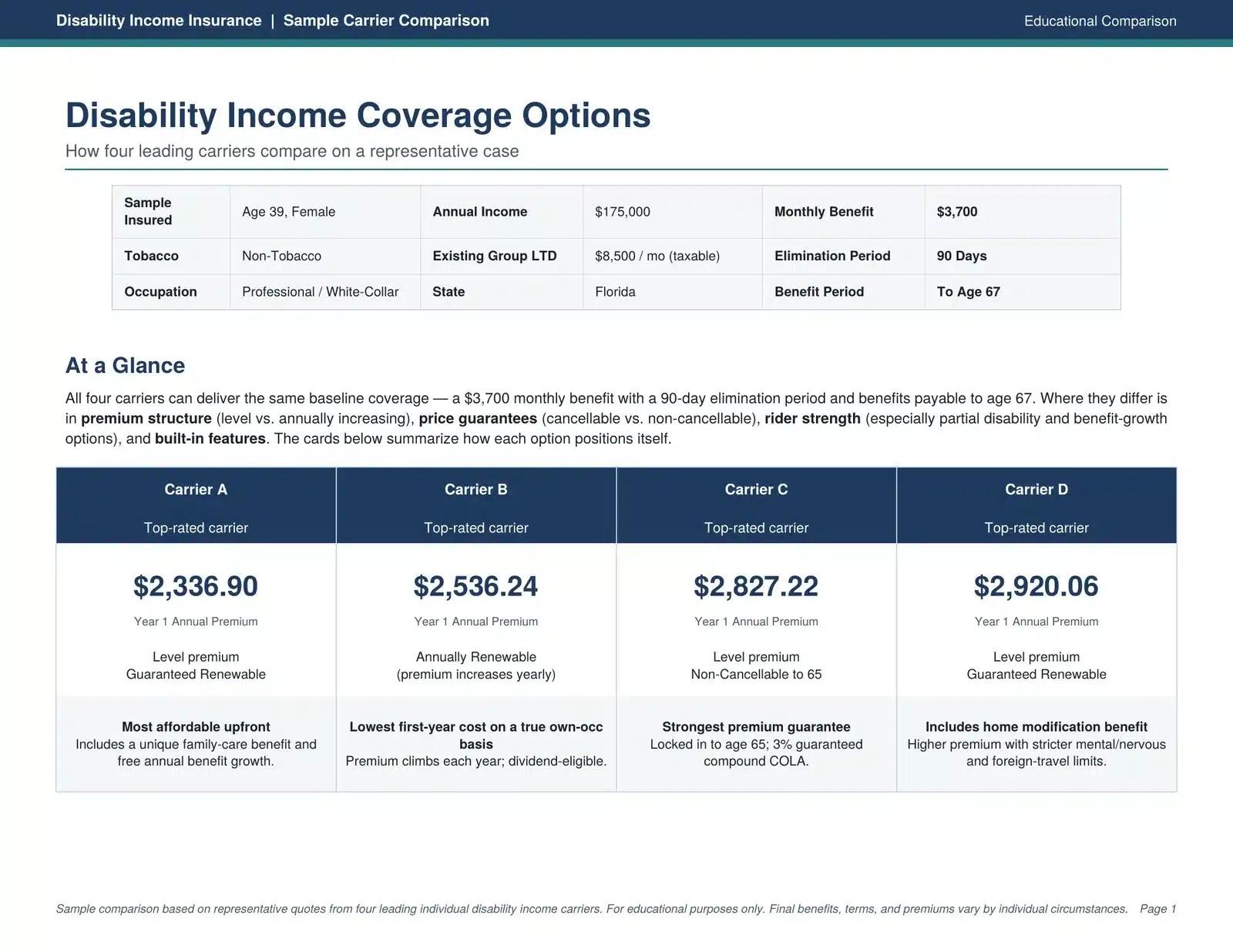
Why Working with an Independent Disability Broker Matters
One of the most important decisions you can make when evaluating disability insurance is who you work with. A captive agent represents one company. An independent disability broker evaluates multiple carriers and structures coverage based on your specific needs.
When you work with an independent broker, your policy is not limited by a single company’s underwriting guidelines or product design. Instead, your profile is matched across multiple carriers to identify the most competitive option. This approach is similar to broader insurance strategies discussed in working with an independent disability insurance broker, where flexibility and comparison drive better outcomes.
This is particularly important for professionals, business owners, and individuals with fluctuating income, where policy customization can significantly impact long-term protection.
How a Second Opinion Improves Your Financial Plan
Disability insurance is not just a standalone product—it is a core component of your financial protection strategy. It works alongside other elements such as retirement planning, healthcare planning, and asset protection. For example, understanding how disability coverage fits alongside strategies like Roth IRA planning or long-term care considerations such as why people buy long-term care insurance can help create a more comprehensive plan.
A second opinion ensures that your disability coverage is not just adequate, but optimized. It helps eliminate blind spots, improve policy structure, and align your coverage with your broader financial goals.
Are You Getting Every Discount You Qualify For?
One of the biggest mistakes disability insurance buyers make is paying full price when they qualify for a meaningful discount — sometimes 10% to 25% off their premiums. These discounts are not always proactively offered by carriers, and a captive agent representing a single company can only show you what that one company offers. Working with an independent disability insurance broker changes that. Jason Stolz, CLTC, CRPC, DIA, CAA has over 25 years of experience placing disability coverage for physicians, attorneys, federal employees, and business owners nationwide — comparing options across dozens of carriers to find the right fit at the lowest qualified rate. Connect with Jason to find out which discounts apply to your situation before you buy.
| Who Qualifies | Discount | Notes |
|---|---|---|
| Medical Residents | 20% | All medical residents qualify |
| Dental Residents | 10% | All dental residents qualify |
| Dental Students | 10% | Students at select accredited dental schools — contact us to confirm eligibility |
| Federal Employees (FERS) — Non-Dental | 25% | One of the largest available occupational discounts |
| Federal Employees (FERS) — Dental | 10% | Dental-specific FERS coverage discount |
| Military Physicians & Attorneys | 25% | Up to $4,000/month in coverage available with no financial documentation required |
| Military Dentists | 10% | Up to $4,000/month in coverage available with no financial documentation required |
| Business Owners (with W2 employees) | Varies | Competitive pricing available; multiple discounts can be stacked |
| Solo Business Owner (Buy-Out) | Varies | Disability buy-out coverage designed to fund succession planning |
| Preferred Occupations (Attorneys, CPAs, Engineers, Executives) | Varies | Professional license holders; Advanced degree holders; Income thresholds may apply |
| Young Professionals (Under 50) | Varies | Competitive rates for medical and non-medical professionals |
| Law Enforcement & Firefighters | Varies | Occupational discount for eligible first responders |
| Blue-Collar Workers | Varies | Specialized underwriting for trades and manual occupations |
| Employer-Paid Multilife (3+ employees) | 15% | Gender-neutral pricing applies |
| Employee-Paid Multilife (3+ employees) | 10% | Sex-distinct pricing applies |
| Multi Life Discount (2 Spouses applying) | 10% | Applies when both spouses apply for coverage together |
Note: Discount percentages vary by carrier and underwriting. Not sure which discounts apply to your situation? Our independent research includes a complete discount eligibility assessment before quoting — many clients discover they qualify for discounts they never even knew existed.
Note: Discount percentages vary by carrier and underwriting. Not sure which discounts apply to your situation? Our independent research includes a complete discount eligibility assessment before quoting — many clients discover they qualify for discounts they never even knew existed.
Request Your Disability Insurance Review
Get a Professional Second Opinion
We’ll review your disability insurance quote and compare it across top carriers to ensure you’re getting the best possible coverage.
Choosing to get a second opinion on your disability insurance quote is not about second-guessing—it is about making an informed decision. The difference between an average policy and a properly structured one can determine whether your income is fully protected when you need it most. Taking the time to review your options today can provide clarity, confidence, and long-term financial security.
Related Pages
Financial Protection Essentials
Compare Disability Insurance Products
Every carrier writes a different contract. These reviews cover what each one includes in the base policy, what it charges extra for, and who it genuinely fits.

Talk With an Advisor Today
Choose how you’d like to connect—call or message us, then book a time that works for you.
Schedule here:
calendly.com/jason-dibcompanies/diversified-quotes
Licensed in all 50 states • Fiduciary, family-owned since 1980
Second Opinion Disability Insurance FAQs
Disability insurance is one of the most complex and consequential financial products available — and unlike most purchases, the real differences between policies are hidden in contract language rather than visible in the price. Two quotes that look nearly identical on paper can behave dramatically differently when a claim occurs. A second opinion from Diversified Insurance Brokers evaluates not just the premium but the entire structure of your coverage — the definition of disability, the elimination period, the benefit period, the exclusion riders, the residual disability provisions, and the carrier’s financial strength. In many cases, we find that clients were placed with a carrier that was not the most competitive for their occupation or health profile, that they qualify for discounts that were never offered, or that their policy contains limitations that would significantly reduce benefits in the most likely disability scenarios. A second opinion costs nothing and can be the difference between adequate coverage and genuinely comprehensive income protection.
When you request a second opinion from Diversified Insurance Brokers, we conduct a comprehensive review of your existing quote or policy across several dimensions. We evaluate your occupational class assignment — verifying that your profession was classified correctly and identifying whether a more favorable classification is available at a different carrier. We review the policy definition of disability to determine whether it provides genuine own-occupation protection for your specific professional duties or whether the definition would limit benefits in scenarios most likely to affect your career. We assess income documentation to confirm your benefit amount is appropriately calibrated to your actual earning capacity. We evaluate all rider provisions — residual disability, cost-of-living adjustment, future increase options — to identify any gaps. And we conduct a full discount eligibility review to determine whether you qualify for occupational, professional, or multilife discounts that were not applied to your original quote. We then provide a clear comparison of your existing quote against the best available alternatives across our carrier marketplace.
Yes — significantly. Disability insurance underwriting is far less standardized than most other types of insurance, and the differences between carriers go well beyond premium pricing. Different carriers assign different occupational class ratings to the same profession, which directly affects both the premium and the quality of policy features available. One carrier may classify a physician who performs any procedures as a lower occupational class than a carrier that classifies the same physician at the highest tier based on their income structure and specialty. Carriers also differ meaningfully in how they define disability — some provide true own-occupation coverage that pays if you cannot perform your specific specialty regardless of other work capacity, while others use modified definitions that shift to any-occupation standards after a period of disability. Elimination period options, maximum benefit amounts, mental health benefit period limits, residual disability triggers, and COLA rider availability all vary by carrier. For professionals, business owners, and individuals with complex income structures, the difference between the right carrier and the wrong one can be tens of thousands of dollars in premium savings or — far more importantly — the difference between a policy that pays at claim time and one that finds reasons not to.
The definition of disability is the single most important provision in any disability insurance policy, and the distinction between own-occupation and any-occupation coverage is the most consequential version of that definition. An own-occupation policy pays benefits when you cannot perform the material duties of your specific occupation — regardless of whether you could theoretically work in another field. If a surgeon develops a hand tremor that prevents operating, an own-occupation policy pays full benefits even if the surgeon could technically work as a medical consultant. An any-occupation policy only pays if you cannot perform virtually any gainful employment — meaning the same surgeon with the same hand tremor would likely receive no benefits because they retain the ability to do non-surgical work. For any professional whose income reflects specialized training, licensure, or skills that cannot simply be transferred to lower-paying work, own-occupation coverage is the only definition that provides meaningful income protection. One of the most common findings in our second opinion reviews is that a client was sold a policy with an any-occupation definition, or an own-occupation definition that converts to any-occupation after two years of disability — without understanding the practical consequences of that limitation.
Many professionals qualify for significant discounts on disability insurance premiums that are not automatically offered or proactively disclosed. Medical residents qualify for a 20% discount. Dental residents qualify for a 10% discount, as do dental students at select accredited dental schools. Federal employees covered under the Federal Employees Retirement System — FERS — qualify for a 25% discount on non-dental disability coverage or a 10% discount on dental-specific coverage. Military physicians and attorneys qualify for the FERS 25% discount, and military dentists qualify for the FERS 10% discount. Military medical and legal professionals may also access up to $4,000 per month in coverage with no financial documentation required. When three or more employees at the same organization apply together, employer-paid multilife arrangements qualify for a 15% group discount with gender-neutral pricing, and employee-paid multilife arrangements qualify for a 10% discount. Our second opinion review always includes a complete discount eligibility assessment — in our experience, a significant number of clients were never offered discounts they clearly qualify for.
Residual disability coverage — sometimes called partial disability coverage — pays proportional benefits when a disability reduces your income without completely eliminating your ability to work. Most disabling conditions do not produce a clean on-off pattern of total incapacity followed by full recovery. More commonly, a disability reduces work capacity and income progressively or intermittently — a physician who can work three days per week instead of five, a surgeon who can perform some but not all procedures, a business owner who can manage limited operations but not their full practice. Without a residual disability rider, a total-disability-only policy pays nothing during this partial recovery or partial disability period, because you can technically work. A residual rider supplements reduced income proportionally, ensuring the policy provides financial support across the full spectrum of disability severity rather than only at the extreme of total incapacity. Most professionals should have residual disability coverage in their policy — and one of the most common gaps we find in second opinion reviews is that this rider was either omitted entirely or structured with a trigger threshold that is higher than it needs to be.
A cost-of-living adjustment rider — COLA — increases your monthly disability benefit annually during a disability claim period, typically tied to the Consumer Price Index or a fixed annual percentage. Without a COLA rider, a benefit amount that adequately covers your expenses at the onset of a disability loses real purchasing power with each passing year of an extended claim. For a professional facing a serious long-term or permanent disability in their forties, a monthly benefit that seems adequate today may cover significantly less of their actual living costs a decade into the claim without inflation protection. The COLA rider is particularly important for younger professionals who have more years of potential claim ahead of them and for those who might face disability from a progressive condition that produces extended or permanent income loss. Whether you need it depends on your age, the nature of your most likely disability scenarios, and how the premium cost of the rider weighs against the inflation protection it provides — all of which we evaluate as part of a second opinion review.
Occupation is one of the most significant factors in disability insurance underwriting — it affects premium cost, maximum available benefit amounts, the quality of the disability definition available, and the range of supplemental riders you can access. Carriers divide occupations into class tiers based on estimated disability risk, and the tier assigned to your specific role depends not just on your job title but on the actual duties you perform and the environment in which you perform them. An engineer who works entirely in an office may receive a more favorable classification than one who spends significant time on job sites. A physician in a non-procedural specialty may receive a higher occupational class than one who performs procedures daily. A dentist has a different classification than a dental hygienist. These distinctions matter because a single occupational class difference can produce meaningful premium differences and may affect whether true own-occupation coverage is available at all. One of the most valuable services we provide in a second opinion review is verifying that your occupation was classified correctly and identifying whether a more favorable classification is available at a different carrier based on a more complete description of your actual duties.
Yes — and the difference is material, not marginal. A captive agent represents one carrier and can only present that company’s products, pricing, and underwriting interpretation. If that carrier is not the most competitive for your occupation, your health history, or your income structure, you have no way of knowing — and the captive agent has no ability or incentive to tell you. An independent broker like Diversified Insurance Brokers represents multiple highly rated carriers and evaluates your specific profile against each of them simultaneously. We can identify which carrier provides the most favorable occupational class assignment for your specific role, which offers the strongest own-occupation definition for your profession, which has the most competitive pricing for your age and health status, and which applies any occupational or professional discounts you qualify for. Independence means our recommendation is based on what is genuinely best for you — not what is available from a single company. For disability insurance, where carrier selection is arguably the single most important decision in the planning process, working with an independent broker consistently produces better outcomes than any single-carrier alternative.
To conduct a thorough second opinion review, the most useful information to have available includes your existing quote or policy documents, a description of your occupation and the specific duties you perform daily, your income documentation including how your income is structured — salary, self-employment, partnership, bonus — and approximate annual earnings, your age and general health status, and any existing policy riders or features you have been offered. If you have already received a formal quote from another carrier, having that quote available allows us to conduct a direct comparison against the best available alternatives in the marketplace. You do not need to have everything perfectly organized before reaching out — our second opinion process is designed to work with whatever information you have available and to identify the additional details needed to complete a thorough analysis. Many clients begin the process with just a quote PDF and a few minutes of conversation about their occupation and income. We handle the research, comparison, and analysis from there.
No — and in many cases, a second opinion on an existing policy is even more valuable than one on a pending quote. If you purchased a disability policy and have concerns about whether it is structured correctly, whether you are paying a competitive premium, or whether a discount you qualify for was never applied, a review of your existing coverage can identify whether changes, additions, or replacement coverage would better serve your needs. Disability insurance policies typically have a free-look period after purchase during which you can cancel for a full refund — but even outside of that window, there are often options to add riders, increase benefits through future increase options if available, or complement existing coverage with a supplemental policy that addresses gaps. If you believe your current policy may not be optimally structured, contact Diversified Insurance Brokers for a no-obligation review. We will provide an honest assessment of whether your existing coverage is adequate, where gaps exist, and what options are available to address them.
About the Author:
Jason Stolz, CLTC, CRPC, DIA, CAA and Chief Underwriter at Diversified Insurance Brokers (NPN 20471358), is a senior insurance and retirement professional with more than 25 years of real-world experience helping individuals, families, and business owners protect their income, assets, and long-term financial stability. As a long-time partner of the nationally licensed independent agency Diversified Insurance Brokers, Jason provides trusted guidance across multiple specialties—including fixed and indexed annuities, long-term care planning, personal and business disability insurance, life insurance solutions, Group Health, Travel Medical and Evacuation Insurance, and short-term health coverage. Diversified Insurance Brokers maintains active contracts with over 100 highly rated insurance carriers, ensuring clients have access to a broad and competitive marketplace.
His practical, education-first approach has earned recognition in publications such as VoyageATL, and contributions from his agency featured in Kiplinger and GoBankingRates— highlighting his commitment to financial clarity and client-focused planning. Drawing on deep product knowledge and years of hands-on field experience, Jason helps clients evaluate carriers, compare strategies, and build retirement and protection plans that are both secure and cost-efficient. Visitors who want to explore current annuity rates and compare options across multiple insurers can also use this annuity quote and comparison tool.
Get a Second Opinion: Browse our complete 2nd Opinion Quote Review — see how a second opinion from an independent broker could save you money across life, annuity, disability, group health, long term care, and Medicare.
Explore More Disability Insurance Options: Browse our complete guide to Disability Insurance Planning & Education — covering how it works, riders, elimination periods, own occupation, costs & buying guides from 100+ carriers.
Last Reviewed: August 18, 2026 |
Reviewed by: Jason Stolz, CLTC, CRPC, DIA, CAA
Chief Underwriter, Diversified Insurance Brokers, Inc. | NPN: 20471358 | Diversified Insurance Brokers, Inc. — Licensed in all 50 states
Fact Checked by: Tonia Pettitt, CMIP©
Medicare Specialist, Diversified Insurance Brokers, Inc. | NPN: 14374308 | Diversified Insurance Brokers, Inc. — Licensed in all 50 states
Did you find this content helpful? Leave us a Google review — it helps others find trustworthy guidance too.
Editorial Standards: Diversified Insurance Brokers maintains rigorous editorial standards to ensure accuracy, clarity, and independence in all content. Learn more about our editorial standards and commitment to transparency.
