
What is the Primary Reason People Buy Long Term Care Insurance
As an Independent Long Term Care Insurance Broker, we compare traditional, hybrid, and partnership-qualified policies across dozens of carriers to find the structure that actually fits your situation.
What is the Primary Reason People Buy Long Term Care Insurance

Jason Stolz CLTC, CRPC, DIA, CAA
The primary reason people buy long term care insurance is to protect their savings and financial security from the potentially devastating cost of extended healthcare services. As people age, the likelihood of needing assistance with daily activities such as bathing, dressing, mobility, or cognitive care increases substantially — and the cost of that assistance, whether delivered at home, in an assisted living facility, or in a nursing home, can quickly reach levels that standard retirement savings were never designed to absorb. Long term care insurance helps cover the cost of these services so that individuals do not have to rely solely on personal savings, retirement accounts, or family support to pay for care that can stretch for years.
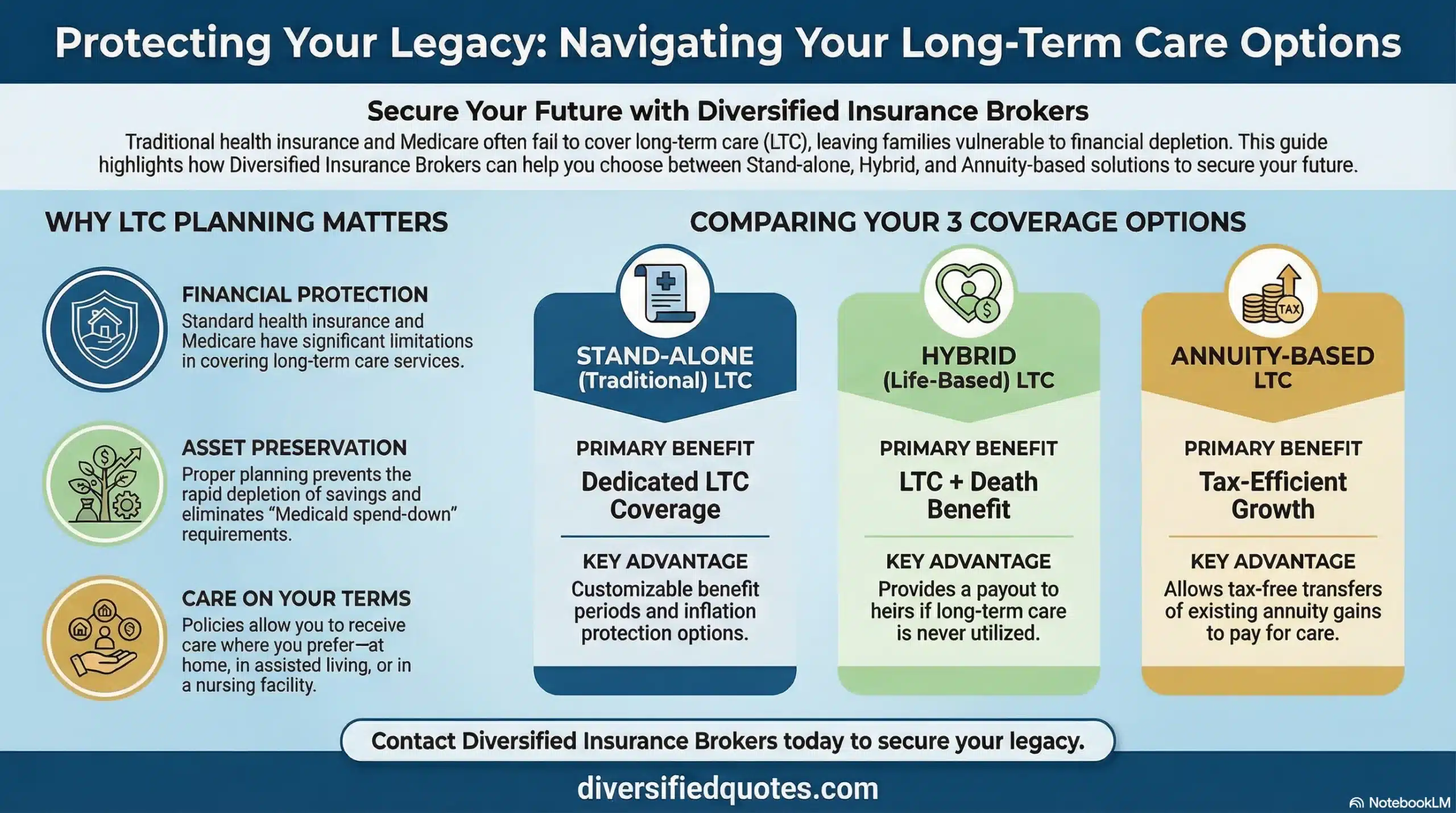
Healthcare costs have risen steadily over several decades, and long term care expenses represent one of the most significant and least predictable financial risks in retirement. Without insurance protection, a multi-year care need can deplete retirement assets that were intended to support a comfortable and independent lifestyle for the policyholder and their spouse. At Diversified Insurance Brokers, we help clients across all 50 states compare long term care insurance options from more than 100 carriers — including traditional standalone LTC policies, hybrid linked-benefit policies that combine life insurance or annuities with LTC benefits, and short-term care alternatives — so that the coverage structure matches the actual household financial picture and care preference rather than a generic template.
Speak With a Long Term Care Insurance Advisor
We compare LTC options from 100+ carriers and help you find the structure that fits your budget, health, and care preferences.
Request Long Term Care Insurance InformationProtecting Retirement Savings From Long Term Care Costs
One of the most significant concerns retirees face is the potential cost of long term care — and how quickly those costs can deplete savings that took decades to accumulate. While most retirement planning focuses on income generation, income replacement ratios, and portfolio longevity, far fewer people adequately plan for how extended healthcare needs could disrupt even a well-constructed financial strategy. Long term care services can include assistance with activities of daily living such as bathing, dressing, and eating; rehabilitation services following a major health event; skilled nursing care; memory care for dementia and Alzheimer’s; and round-the-clock nursing home care. Each of these service categories carries substantial monthly costs that compound over multi-year care periods into totals that can genuinely overwhelm retirement savings.
Without long term care insurance, these services are paid for out of pocket until the individual either exhausts their savings and qualifies for Medicaid coverage or relies on family members to provide or fund care. For individuals who require care for several years — which is not uncommon — the total cost can reach several hundred thousand dollars. This financial burden does not just affect the person receiving care. It can force the liquidation of assets that a surviving spouse depended on, eliminate the inheritance a family expected, and shift the financial and emotional weight of care decisions onto adult children who were not financially prepared to bear it. Long term care insurance addresses this risk directly by covering many of the costs associated with extended care, allowing retirement savings to remain intact for the purposes they were intended to serve. For a complete framework on how much long term care coverage is actually needed to address this risk appropriately, our resource on how much long term care insurance do I need provides a practical planning guide.
Maintaining Independence and Care Choices
The second most frequently cited reason people buy long term care insurance is to maintain control over where and how they receive care. Without adequate financial resources, care decisions are often made by default — driven by what a family can afford rather than what the individual actually wants. Financial constraints can force individuals into institutional settings that do not match their preferences, when in-home care, assisted living, or a specific care community would have been the preferred option if resources had been available.
Long term care insurance provides the financial flexibility that makes genuine care choice possible. Most policies provide benefits for in-home care services — allowing individuals to remain in familiar surroundings and receive professional assistance with daily needs rather than transitioning to a facility before that level of care is truly necessary. Other policies cover assisted living facilities, memory care communities, adult day care programs, and skilled nursing facilities. By providing financial support across the full spectrum of care settings, long term care insurance allows both the individual and the family to focus on quality of care and personal preference rather than spending limits. For those evaluating policies that provide the longest possible coverage window, our resource on LTC insurance with lifetime benefits covers how unlimited benefit period policies work and when they make the most planning sense. Our resource on long term care insurance with lifetime benefits provides additional detail on how these structures are underwritten and priced across carriers.
Reducing the Financial and Emotional Burden on Family
Many individuals purchase long term care insurance not only to protect their own finances but explicitly to reduce the burden — financial, physical, and emotional — that a care need would otherwise place on family members. When extended care is required without insurance resources in place, family members frequently step into the role of primary caregivers. While that support reflects love and commitment, it also comes with real costs that are rarely anticipated in advance. Adult children who provide care often reduce their own working hours, delay career advancement, spend personal savings on care-related expenses, and experience the compounding stress of managing a parent’s care needs alongside their own household and family responsibilities.
Long term care insurance changes that dynamic by providing resources that allow professional caregivers to handle daily assistance needs — so family members can focus on the relationship rather than the logistics and cost of care. Families who have watched a parent navigate a long care need without insurance resources are often the most motivated long term care insurance purchasers, because the experience makes the financial and personal cost of an uninsured care need concrete rather than theoretical. Planning ahead with the right coverage protects not just assets but the quality of family relationships during one of the most demanding periods a household will face. For families evaluating whether self-funding care costs is a viable alternative, our resource on self-insured long term care provides an honest analysis of what self-funding actually requires and the thresholds at which it makes financial sense versus the cost of insurance.
Planning for Longevity and the Real Probability of Needing Care
Life expectancy has increased substantially over the past several decades, and the practical implication for retirement planning is that many individuals will spend a significantly longer time in retirement than previous generations. Longer retirement periods create greater opportunity to enjoy financial independence — and they also create meaningfully higher probability that some period of extended care need will occur before death. The risk is not limited to nursing home care. A large share of long term care needs involve home-based assistance, assisted living, or memory care — often beginning years or decades before nursing facility care would become necessary.
Long term care insurance addresses this longevity risk by preparing households for potential care needs before those needs arrive, rather than forcing reactive financial decisions under the pressure of an active care situation. Individuals who purchase coverage while they are still in good health and meet underwriting requirements are the ones who have the most options — including the ability to qualify for better benefit structures, lower premiums, and coverage features such as inflation protection riders that are critical for policies purchased years before they are expected to be used. For a clear analysis of who typically qualifies for coverage and what health conditions most commonly affect eligibility, our resource on who qualifies for long term care insurance covers underwriting standards across the carrier landscape. For applicants who may have difficulty qualifying for traditional underwritten LTC coverage, our resource on guaranteed issue long term care insurance covers the alternative pathways available when standard underwriting is not an option.
Some retirees combine long term care planning with retirement income strategies that address both income security and care cost protection simultaneously. Hybrid annuity products that include long term care benefit provisions are one example of this integrated approach — our resources on annuities with long term care benefits and fixed annuities with long term care benefits explain how these products work and for which household situations they provide the most planning value.
Why Medicare Does Not Replace Long Term Care Insurance
One of the most common misconceptions about retirement healthcare planning is that Medicare will cover long term care costs. Understanding what Medicare actually covers — and where its coverage ends — is foundational to understanding why long term care insurance exists as a distinct planning need. Medicare is designed to cover acute medical care: hospital stays, physician services, medically necessary skilled nursing care following a qualifying hospital admission, and short-term rehabilitation. It is not designed to cover custodial care — ongoing assistance with daily living activities that does not require skilled medical supervision — which is precisely the category of care that most long term care needs involve.
Medicare’s skilled nursing facility benefit covers up to 100 days following a qualifying hospital stay of at least three days, and only the first 20 days are covered at no cost to the patient. After that initial window, significant daily co-insurance applies, and coverage ends entirely at 100 days. Custodial care beyond that point — which is the ongoing assistance that constitutes the vast majority of long term care need — must be paid out of pocket until the individual qualifies for Medicaid, which requires spending down assets to very low thresholds. For a clear explanation of exactly what Medicare does and does not cover for nursing home and long-term care needs, our resource on does Medicare cover nursing home care addresses this question in practical terms. Understanding the Medicare coverage gap is often the moment that makes the value of long term care insurance most concrete for individuals who had assumed they were already covered.
Is Long Term Care Insurance Worth the Cost?
The question of whether long term care insurance is worth its cost is one of the most common and legitimate questions in retirement financial planning — and the answer is genuinely not the same for every household. For individuals with very limited assets, Medicaid may ultimately cover care needs, making private LTC insurance less economically necessary. For individuals with very large assets who can comfortably self-fund an extended care need without affecting lifestyle or spousal financial security, self-funding may be a viable strategy. But for the large middle segment — households with meaningful retirement savings that would be materially affected by a multi-year care need — long term care insurance typically provides significant financial protection relative to the premium cost over a realistic planning horizon.
The cost-benefit analysis of long term care insurance also depends on the coverage structure, the age and health at which the policy is purchased, the inflation protection provisions, and the benefit period selected. Policies purchased at younger ages with good health carry substantially lower premiums than those purchased later — which is one of the most important practical arguments for evaluating coverage in the 50s and early 60s rather than waiting. Our resource on is long term care insurance worth the cost provides a structured framework for thinking through this question across different asset levels and planning contexts. For households evaluating the alternatives to traditional standalone LTC policies — including hybrid products and short-term care options — our resource on short term care insurance alternatives covers the tradeoffs between the available structures. For additional planning context on strategies people use when traditional LTC coverage is not pursued, our resource on long term care planning strategies covers the full range of approaches that households use to address this risk.
Related Long Term Care Resources
Talk With an Advisor Today
Choose how you’d like to connect—call or message us, then book a time that works for you.
Schedule here:
calendly.com/jason-dibcompanies/diversified-quotes
Licensed in all 50 states • Fiduciary, family-owned since 1980
Long Term Care Insurance FAQs
The primary reason people buy long term care insurance is to protect their retirement savings and financial independence from the potentially high and prolonged cost of extended care services. Assisted living, in-home care, memory care, and nursing home services can cost thousands of dollars per month and may be needed for years — costs that standard retirement savings were not designed to absorb. Long term care insurance transfers this financial risk to an insurer, allowing retirement assets to remain intact for income, lifestyle, and spousal financial security rather than being consumed by care expenses. Secondary motivations include maintaining control over care choices, reducing the burden placed on family members, and ensuring access to professional care rather than relying entirely on informal family caregiving.
Long term care insurance typically covers a broad spectrum of care services designed to assist individuals who cannot independently perform activities of daily living — bathing, dressing, eating, toileting, transferring, and continence — or who require supervision due to cognitive impairment. Covered settings commonly include in-home care by licensed home health aides or skilled nurses, assisted living facility care, adult day care programs, memory care communities for dementia and Alzheimer’s, respite care for family caregivers, and skilled nursing facility care. Most traditional LTC policies use a benefit trigger structure based on either inability to perform a defined number of activities of daily living or cognitive impairment diagnosis — once the trigger condition is met and the elimination period is satisfied, benefits become payable for covered services up to the daily or monthly benefit limit. The specific covered services, benefit limits, and elimination period vary by policy, which is why comparing policies across multiple carriers rather than evaluating a single option is important for getting the most appropriate coverage structure.
Many financial professionals recommend evaluating long term care insurance in the mid-50s to early 60s — old enough that the planning need feels real and concrete, but young enough to take advantage of lower premiums, better health-based underwriting, and a wider range of policy options. Purchasing coverage earlier in this window provides several practical advantages. Premiums are substantially lower for younger applicants because the statistical probability of a claim in the near term is lower, and the insurer has more time to collect premiums before benefits are likely to be needed. Underwriting is also typically more favorable for younger applicants in good health, which means access to better benefit structures, higher daily benefit amounts, stronger inflation protection options, and fewer exclusions. Waiting until the late 60s or 70s can result in significantly higher premiums, more restrictive underwriting, or outright ineligibility if health conditions have developed. The optimal time to purchase is while health permits favorable underwriting terms — which for most people means acting in the decade before they expect to need the coverage, not the year before.
Medicare does not cover long term custodial care — which is the ongoing assistance with daily living activities that constitutes the vast majority of long term care need. Medicare is designed to cover acute medical care: hospital stays, physician services, medically necessary skilled nursing care following a qualifying hospital admission of at least three days, and short-term rehabilitation following a covered hospital stay. The skilled nursing facility benefit under Medicare covers up to 100 days following a qualifying admission, with full coverage only for the first 20 days and significant daily co-insurance applying from day 21 through day 100. After 100 days, Medicare coverage for nursing facility care ends entirely. Personal care and custodial assistance — help with bathing, dressing, eating, and daily living — that does not require skilled medical supervision is not covered by Medicare at all, regardless of setting. This is the coverage gap that long term care insurance is specifically designed to fill. Medicaid does cover custodial care for those who qualify financially, but qualification requires spending down assets to very low thresholds, which is why planning with private insurance before a care need arises is generally the more appropriate approach for middle-income and higher-income households.
Long term care costs vary significantly by care setting, geographic location, and level of care required — but all categories carry substantial monthly costs that compound significantly over multi-year care periods. In-home care provided by a home health aide runs into thousands of dollars per month for part-time assistance, and full-time in-home care can easily exceed $5,000 to $8,000 or more per month depending on the market. Assisted living facilities typically run $3,500 to $6,000 or more per month for standard care, with memory care wings often commanding a significant premium above those rates. Skilled nursing facility care is typically the most expensive setting, with private room rates commonly ranging from $7,000 to $12,000 or more per month in many markets. For a care need that lasts three to five years — which is not uncommon — total out-of-pocket costs in the absence of insurance can easily reach $250,000 to $500,000 or more. The combination of cost level and duration uncertainty is precisely what makes long term care one of the most significant and least predictable financial risks in retirement planning.
Yes — protecting family members from the financial, physical, and emotional burden of caregiving is one of the most commonly cited motivations for purchasing long term care insurance. When extended care is needed without insurance resources in place, family members — most often adult children and spouses — frequently become primary caregivers, often with little preparation and significant personal sacrifice. Adult children providing care commonly reduce their working hours, delay or forego career advancement, spend personal savings on care-related expenses, and experience the cumulative stress of managing a parent’s care needs alongside their own household and family obligations. Long term care insurance changes the dynamic by funding professional care services, which allows family members to remain in a supportive relationship role rather than a full-time caregiving role. It also removes the financial decision-making pressure that forces families to choose among care options based on cost rather than quality and preference. For married couples specifically, LTC insurance protects the financial security of the healthy spouse by preventing the care costs of the other spouse from depleting shared retirement assets.
Traditional long term care insurance is a standalone policy that pays benefits exclusively for qualifying long term care services. Premiums are paid on an ongoing basis — monthly or annually — and the policy provides defined daily or monthly benefit amounts for covered care services once benefit triggers are met. Traditional policies typically offer the most comprehensive LTC-specific coverage for a given premium dollar when the primary goal is maximizing the care benefit itself. The main concern with traditional LTC policies for many applicants is the “use it or lose it” perception — if the policyholder never needs care, the premiums paid do not produce a return in another form. Hybrid or linked-benefit policies combine long term care coverage with either a life insurance death benefit or an annuity accumulation component. If the LTC benefit is not used, the policy still provides a life insurance death benefit or returns accumulated value — eliminating the use-it-or-lose-it concern. Hybrid policies are typically funded with a single premium or a defined series of premium payments rather than ongoing premiums, which appeals to households with lump-sum assets to deploy. The tradeoff is that hybrid policies generally provide a lower LTC benefit per premium dollar compared to traditional standalone policies, so the right structure depends on what the applicant values most — maximum care benefit efficiency or guaranteed value regardless of whether care is needed.
Yes — inflation is one of the most important considerations in long term care insurance policy design, particularly for policies purchased years or decades before benefits are expected to be used. A daily benefit of $150 that is adequate to cover care costs today may cover only a fraction of care costs 15 or 20 years from now if care costs continue to rise with healthcare inflation. Most traditional long term care policies offer inflation protection riders — the most common structures being simple inflation (a flat percentage increase each year applied to the original benefit), compound inflation (which compounds on the growing benefit amount and produces significantly larger benefits over long periods), and CPI-indexed adjustments tied to a healthcare cost index. Compound inflation protection is generally the most valuable option for applicants who purchase policies at younger ages and have many years before benefits are likely needed, because the compounding effect over 20 or 30 years produces dramatically larger benefits than simple inflation over the same period. For applicants purchasing closer to anticipated need, the cost of compound inflation protection may outweigh the benefit, making a simpler or no-inflation structure more appropriate. Evaluating inflation protection options carefully — not just the base benefit amount — is one of the most important aspects of comparing long term care policy designs.
Whether long term care insurance is worth its cost is genuinely not the same answer for every household — and honest evaluation requires looking at the specific financial picture rather than applying a blanket conclusion. For individuals with very limited assets, Medicaid may ultimately fund care needs, making private LTC insurance less economically critical. For individuals with very large assets who can comfortably self-fund an extended care need without affecting lifestyle or spousal financial security, self-funding may be a viable strategy. For the large middle segment — households with meaningful retirement savings that would be materially diminished by a multi-year care need — long term care insurance typically provides substantial financial protection relative to the premium cost over a realistic planning horizon. The cost-benefit analysis also depends on the age and health at which the policy is purchased, the inflation protection structure, the benefit period, and the daily benefit amount relative to local care costs. Policies purchased at younger ages with favorable health offer substantially better cost-to-benefit ratios than those purchased later. At Diversified Insurance Brokers, we help clients model the actual numbers — comparing expected premiums over the policy’s lifetime against the financial exposure of a realistic care scenario — so the decision is based on the household’s specific financial situation rather than general assumptions.
An independent broker provides access to the full competitive marketplace — comparing policy designs, benefit structures, premium schedules, inflation options, elimination periods, benefit triggers, and carrier financial strength ratings across multiple companies rather than being limited to a single carrier’s product lineup. Long term care insurance products vary significantly across carriers in ways that matter enormously over the lifetime of a policy: benefit period options, inflation protection designs, care coordination services, facility network quality, claims processing reputation, and long-term financial stability of the insurer. These differences are not visible in a superficial premium comparison — they require detailed policy-level evaluation across multiple options. An independent broker also brings experience evaluating which carriers have the strongest claims payment track records and the most favorable underwriting positions for specific health profiles, which can make a meaningful difference in both the quality of the offer and the long-term reliability of the coverage. At Diversified Insurance Brokers, we have helped clients across all 50 states compare and secure long term care coverage since 1980 — and our process begins with understanding the household’s full financial picture, care preferences, and health profile before any product conversation begins.
About the Author:
Jason Stolz, CLTC, CRPC, DIA, CAA and Chief Underwriter at Diversified Insurance Brokers (NPN 20471358), is a senior insurance and retirement professional with more than 25 years of real-world experience helping individuals, families, and business owners protect their income, assets, and long-term financial stability. As a long-time partner of the nationally licensed independent agency Diversified Insurance Brokers, Jason provides trusted guidance across multiple specialties—including fixed and indexed annuities, long-term care planning, personal and business disability insurance, life insurance solutions, Group Health, Travel Medical and Evacuation Insurance, and short-term health coverage. Diversified Insurance Brokers maintains active contracts with over 100 highly rated insurance carriers, ensuring clients have access to a broad and competitive marketplace.
His practical, education-first approach has earned recognition in publications such as VoyageATL, and contributions from his agency featured in Kiplinger and GoBankingRates— highlighting his commitment to financial clarity and client-focused planning. Drawing on deep product knowledge and years of hands-on field experience, Jason helps clients evaluate carriers, compare strategies, and build retirement and protection plans that are both secure and cost-efficient. Visitors who want to explore current annuity rates and compare options across multiple insurers can also use this annuity quote and comparison tool.
Explore More Long Term Care Insurance Options: Browse our complete guide to LTC Insurance Costs, Rates & Planning — covering how much it costs, best rates, calculators, planning strategies & is it worth it from top carriers.
Last Reviewed: June 19, 2026 |
Reviewed by: Jason Stolz, CLTC, CRPC, DIA, CAA
Chief Underwriter, Diversified Insurance Brokers, Inc. | NPN: 20471358 | Diversified Insurance Brokers, Inc. — Licensed in all 50 states
Fact Checked by: Tonia Pettitt, CMIP©
Medicare Specialist, Diversified Insurance Brokers, Inc. | NPN: 14374308 | Diversified Insurance Brokers, Inc. — Licensed in all 50 states
Did you find this content helpful? Leave us a Google review — it helps others find trustworthy guidance too.
Editorial Standards: Diversified Insurance Brokers maintains rigorous editorial standards to ensure accuracy, clarity, and independence in all content. Learn more about our editorial standards and commitment to transparency.
