
Fixed Annuity with Long Term Care Benefits
As an Independent Long Term Care Insurance Broker, we compare traditional, hybrid, and partnership-qualified policies across dozens of carriers to find the structure that actually fits your situation.
As an Independent Annuity Broker, we compare rates across 100+ carriers and 1,000 different annuities— not just one company’s product offerings — to find the best fit for your goals.
Fixed Annuity with Long Term Care Benefits

Jason Stolz CLTC, CRPC, DIA, CAA
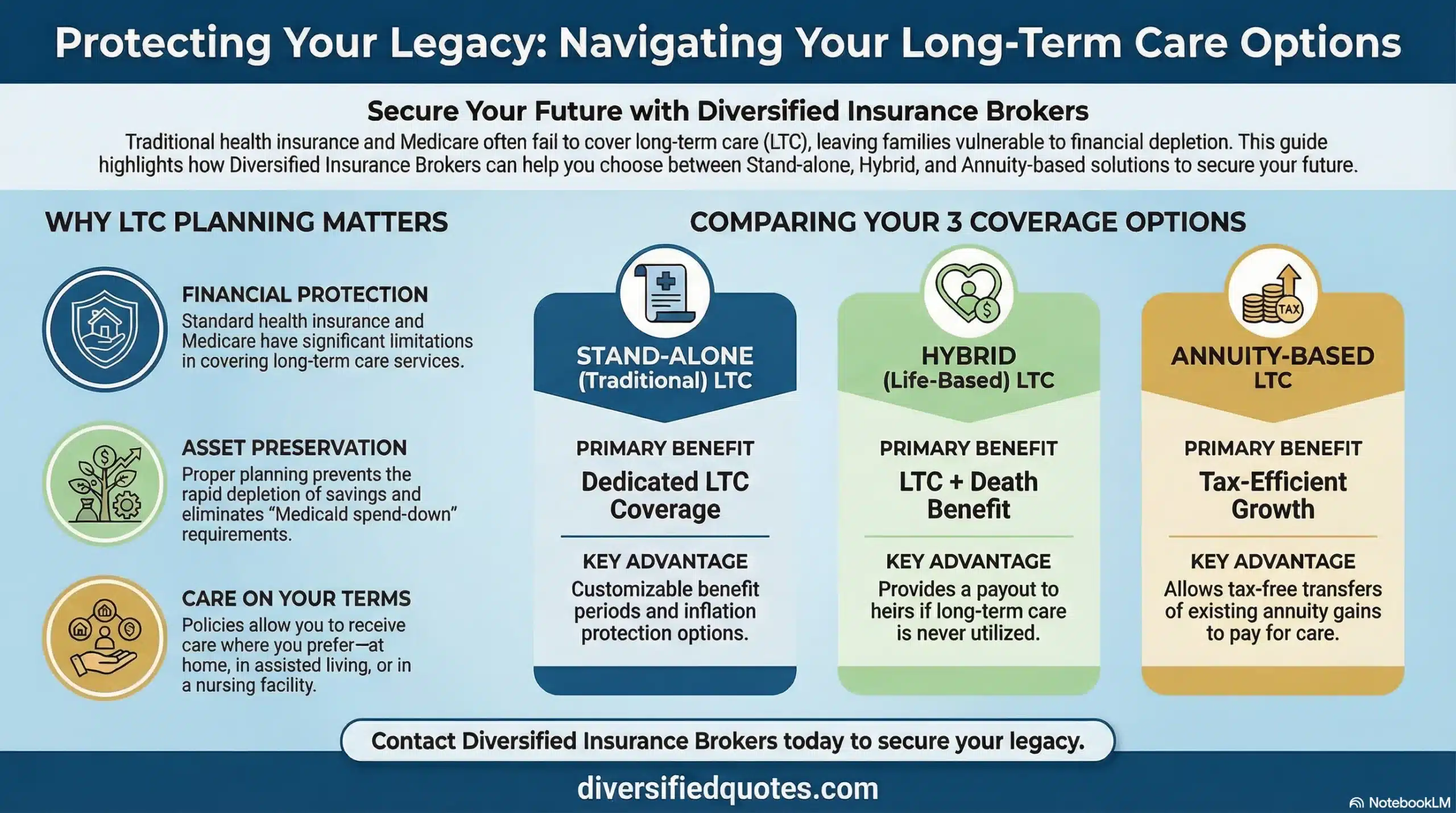
A fixed annuity with long term care benefits combines the principal-protected, guaranteed-growth structure of a fixed annuity with an embedded long term care benefit layer — creating a single contract that can serve two major retirement planning needs simultaneously. The annuity portion preserves and grows the deposited premium at a guaranteed interest rate, providing the stability and predictability that conservative retirement savers depend on. The long term care benefit portion activates when qualifying care triggers are met, typically expanding the available monthly benefit beyond the annuity’s accumulated value to fund home health care, assisted living, memory care, or skilled nursing facility costs. If care is never needed, the annuity value remains available for retirement income, income planning, or transfer to beneficiaries — eliminating the “use it or lose it” concern that causes many households to hesitate on traditional long term care insurance.
At Diversified Insurance Brokers, we help clients evaluate fixed annuities with long term care benefits the way all annuity-based products should be evaluated: by comparing the specific contract mechanics — benefit multiplier, monthly maximum, elimination period, benefit period, LTC trigger definitions, and tax treatment — against the actual care cost exposure and planning priorities of the household. A fixed annuity with LTC benefits is not the right solution for everyone, and it is not always better or worse than traditional long term care insurance — it is different in specific ways that favor different planning situations. The right evaluation starts with understanding what the hybrid structure actually does and comparing it honestly against the alternatives.
Ensure you are receiving the absolute top rates
Current Fixed Annuity Rates
Compare today’s best fixed annuity rates from top carriers.
Current Bonus Annuity Rates
See which annuities offer the highest upfront bonus today.
Request an Annuity Quote
Submit our annuity request form to get personalized rate options.
Lifetime Income Calculator
Use our calculator to see how much guaranteed income your annuity can provide.
How Fixed Annuities With LTC Benefits Work
A fixed annuity is built around a simple, powerful promise: your deposited premium earns a guaranteed interest rate and the principal is protected from market loss. The contract accumulates tax-deferred growth inside its declared interest framework, and at the end of any surrender period the full accumulated value is available — for income planning, lump-sum access, or legacy transfer depending on the contract’s specific terms. When a long term care benefit is added to this foundation, the contract gains a second layer of functionality that activates in a specific, contractually defined circumstance: when the policyholder meets the long term care eligibility triggers.
In most fixed annuity + LTC designs, the LTC benefit works by accelerating and multiplying the annuity’s accumulated value when care triggers are met. A contract with a $150,000 account value and a 2x LTC multiplier, for example, would provide up to $300,000 in total LTC benefit — paid as monthly distributions subject to monthly maximums and a defined benefit period. The monthly maximum defines how much can be accessed per month during a qualifying care period, and the benefit period defines how long the total LTC pool can be spread across monthly payments. These two parameters — monthly maximum and benefit period — are the most important design variables for determining whether the contract’s LTC benefit is adequate for the actual care costs in the policyholder’s area. Our resource on the cost of long term care by state provides the regional cost benchmarks that inform this adequacy analysis.
LTC benefit eligibility in most fixed annuity + LTC contracts is triggered when a licensed health care practitioner certifies that the insured is unable to perform at least two of the standard Activities of Daily Living (ADLs) without substantial assistance, or that a cognitive impairment requires substantial supervision to protect the insured’s health and safety. These are the same federally defined triggers used in traditional tax-qualified LTC policies. The ADL list typically includes bathing, dressing, transferring, toileting, continence, and eating. Benefits become available after any applicable elimination period — the contractual waiting period before payments begin — which functions like a time-measured deductible. Our resource on LTC elimination periods explained covers how elimination period length affects benefit availability and how to coordinate the waiting period with the household’s liquid reserves.
Fixed Annuity With LTC Benefits vs. Traditional LTC Insurance
The choice between a fixed annuity with long term care benefits and a traditional stand-alone LTC insurance policy is not a question of which is universally better — it is a question of which structure aligns better with the specific household’s funding preference, planning priorities, and tolerance for different types of risk. The table below maps both approaches across the dimensions that matter most in this comparison.
Fixed Annuity + LTC Benefits vs. Traditional LTC Insurance: Key Differences
| Planning Dimension | Fixed Annuity With LTC Benefits | Traditional Stand-Alone LTC Insurance |
|---|---|---|
| Funding Structure | Single premium (repositioned asset); no ongoing payment obligation | Annual or monthly premiums; ongoing payment commitment |
| Premium Increase Risk | Generally fixed at purchase; no ongoing premium uncertainty | Traditionally subject to carrier rate increases (class-based, not individual) |
| LTC Benefit Leverage | Typically 2x–3x annuity value; varies by carrier and design | Often higher monthly benefit per premium dollar for healthy, younger buyers |
| Value if LTC Never Needed | Account value retained; available for income, withdrawal, or beneficiaries | No residual value (traditional); return-of-premium designs cost more |
| Underwriting | Simplified (health questions; possible phone interview; no exam in many cases) | More comprehensive (full health history; possible exam; more restrictive) |
| Death Benefit | Remaining contract value to beneficiaries (subject to withdrawals and design) | Limited or no death benefit in most traditional designs |
| Partnership Program Eligibility | Generally not eligible; state Partnership programs typically require stand-alone LTC | Eligible when meeting state-specific Partnership qualification standards |
| Best Fit | Asset repositioners; single premium preference; “value either way” priority | Maximum LTC leverage; younger, healthier buyers; ongoing premium manageable |
Neither approach is universally superior — the right choice depends on how the household prioritizes the specific tradeoffs each structure represents. Our resources on whether long term care insurance is worth it and how much long term care insurance you need cover the foundational analysis that applies to both approaches. Our broader resource on long term care planning strategies covers the full strategic framework within which the fixed annuity + LTC option sits alongside traditional and other hybrid alternatives.
The 1035 Exchange: Repositioning Existing Assets Into a Fixed Annuity + LTC Contract
One of the most compelling practical features of fixed annuities with long term care benefits is the ability to fund them through a 1035 exchange — a tax-deferred transfer of an existing annuity or life insurance policy into the new hybrid contract. For households with older non-qualified annuities that have accumulated significant gain, a direct surrender to fund a new annuity + LTC design would trigger ordinary income tax on the accumulated gain in the year of surrender. A 1035 exchange moves the full accumulated value — including the gain — into the new contract without triggering a taxable event, deferring the tax while repositioning the asset from a passive holding into an active protection strategy.
The tax advantage of the 1035 exchange to an annuity + LTC design goes beyond simple deferral in one specific circumstance: when the annuity value is eventually accessed for qualified long term care expenses, the gains that flow through as LTC benefit payments may be excluded from taxable income entirely rather than deferred to a future distribution. This means the accumulated tax liability on the annuity’s gain may be permanently eliminated by the LTC benefit payment — not merely moved to a later date. The combination of tax deferral at the exchange and potential tax elimination at the LTC claim creates a meaningful tax efficiency advantage that pure annuity repositioning cannot achieve and that traditional LTC insurance premium payments cannot replicate. Our resource on how 1035 exchanges work in annuity planning covers the transfer mechanics, documentation requirements, and the specific scenarios where this repositioning approach is most advantageous.
Beyond the tax dimension, the 1035 exchange repositioning serves a practical behavioral purpose: it converts a passive asset — a low-yielding money market, a maturing CD, a dormant older annuity — into a purposeful protection strategy aligned with a specific planning goal. Many households have conservative assets sitting in accounts that are generating minimal returns and serving no explicit planning function. Repositioning those dollars into a fixed annuity + LTC design transforms their purpose from “excess savings without a clear role” to “a funded care strategy with guaranteed growth and leverage for care costs.” Our resource on single-pay long term care insurance covers the broader single-premium LTC strategy context within which 1035-funded fixed annuity + LTC designs operate.
LTC Benefit Mechanics: Multipliers, Monthly Maximums, and Benefit Periods
Understanding the specific LTC benefit mechanics of a fixed annuity + LTC contract is essential for evaluating whether the design is adequate for the household’s actual care cost exposure. Three parameters define the scope of the LTC benefit: the benefit multiplier, the monthly maximum, and the benefit period. These three variables determine how much total LTC coverage is available, how much can be accessed in any given month, and how long the benefit pool lasts.
The benefit multiplier is the factor by which the annuity’s accumulated value is enlarged to create the total LTC benefit pool. A 2x multiplier on a $150,000 contract value creates a $300,000 LTC benefit pool. A 3x multiplier creates $450,000. Some designs use fixed multipliers applied at the time of purchase; others allow the LTC benefit pool to grow as the annuity value grows over time, so that a longer deferral period before care is needed results in a larger available LTC benefit. The multiplier is the headline feature in most annuity + LTC comparisons, but it is only meaningful in the context of the monthly maximum and benefit period that define how the pool can actually be accessed.
The monthly maximum defines the maximum monthly LTC benefit payment. A contract with a $300,000 LTC benefit pool but a $5,000 monthly maximum would provide up to 60 months (five years) of benefits if accessed at the full monthly maximum. A contract with the same $300,000 pool and a $10,000 monthly maximum would provide up to 30 months (two and a half years). The monthly maximum should be compared against the actual cost of care in the household’s geographic area — a monthly maximum that covers memory care costs in rural Tennessee may fall well short of the same care costs in coastal California. Our resource on the cost of long term care by state provides the regional benchmarks for this comparison, and our resource on LTC with limited-term vs. lifetime benefits covers how benefit period selection affects the overall adequacy of any LTC design.
Reimbursement vs. Indemnity: How Benefits Are Paid
Fixed annuity + LTC designs use two primary benefit payment structures that differ in how flexible the payments are in practice. Understanding which structure a specific contract uses — and how that aligns with the household’s expected care scenario — is an important pre-purchase evaluation step.
Reimbursement-based benefit payment means the contract pays back eligible documented care expenses up to the monthly maximum. The policyholder incurs care costs, submits invoices or receipts from licensed care providers, and the contract reimburses the eligible expenses up to the monthly cap. This structure is most common in tax-qualified LTC designs and ensures benefits are used specifically for qualified care expenditures. The documentation requirement can add administrative burden during a care event, but the reimbursement structure also means the benefit is directly tied to actual incurred costs — providing appropriate benefit amounts relative to the care being received.
Indemnity-based benefit payment (sometimes called cash benefit or per-diem benefit) provides a fixed payment once the policyholder qualifies for care, without requiring invoice-level documentation for the benefit amount. Once eligibility is certified and any elimination period has been satisfied, the contract pays the defined monthly amount regardless of the specific breakdown of care costs. This structure is generally more flexible for households that use a mix of formal licensed care and informal family-provided care, where not all care expenses generate invoices that can be submitted for reimbursement. Our LTC care coordination benefits resource covers how these payment structure differences interact with care plan design. Our broader resource on the tax advantages of LTC insurance and hybrid policies covers how the benefit payment structure interacts with the tax treatment of LTC benefit payments from qualified contracts.
Tax Treatment: The Unique Advantage of Annuity-Based LTC
The tax treatment of a fixed annuity with long term care benefits is one of the most distinctive and favorable features of the hybrid structure — particularly for households with non-qualified annuities carrying large accumulated gains. Understanding this tax advantage requires distinguishing between the tax treatment of the annuity growth component and the tax treatment of the LTC benefit component.
For a non-qualified annuity (funded with after-tax dollars outside a retirement account), accumulated gains are eventually taxable as ordinary income when distributed — typically on a LIFO (last in, first out) basis. When a 1035 exchange moves a non-qualified annuity into a hybrid annuity + LTC design, those gains are deferred rather than triggered at the exchange. When the hybrid contract subsequently pays LTC benefits for qualified care, those payments may be received income-tax-free to the extent they qualify under the IRS’s tax-qualified LTC benefit rules — even if the payments represent distributions of the annuity’s accumulated gain. The gain that would otherwise have been taxable upon distribution is permanently excluded from income rather than merely deferred, as long as the care expenses qualify and the contract meets tax-qualified LTC standards.
For buyers considering whether this tax treatment is available for their specific situation, our resource on whether long term care benefits are taxable covers the federal tax rules for LTC benefit treatment, and our resource on tax benefits of long term care insurance covers the deduction and exclusion framework more broadly. For non-qualified annuity contexts, our resource on non-qualified long term care annuity covers the specific tax mechanics for non-qualified funded hybrid designs. Individual tax situations vary, and the tax treatment described above should always be evaluated with a qualified tax advisor before purchase, since contract design details and specific circumstances affect the actual outcome.
Who This Strategy Fits Best
The fixed annuity with long term care benefits structure is most naturally suited to a specific household profile, and being clear about that profile helps evaluate whether the design is a strong fit or a poor one for any given buyer. The ideal buyer has conservative assets — low-yield CDs, money market funds, older non-qualified annuities, or savings account balances — that are not producing meaningful returns and are not serving a clear retirement income purpose. The repositioning of these assets into a hybrid annuity + LTC design converts them from passive holdings into purposeful protection without requiring new cash contributions or ongoing premium obligations.
The ideal buyer also has some hesitation about traditional LTC insurance — typically because of the ongoing premium commitment, the “use it or lose it” perception, or underwriting concerns from health conditions that make traditional LTC approval uncertain. Annuity + LTC designs typically offer simplified underwriting that is more accessible than traditional LTC underwriting, making them available to buyers who might face limitations with stand-alone LTC policies. The simplified underwriting comes with some tradeoff in benefit leverage compared to traditional policies for healthy young buyers, but for buyers who face traditional underwriting challenges, the hybrid may be the most practical available option.
The ideal buyer also values the dual-purpose nature of the asset — the fact that the deposited premium retains value for retirement income or legacy transfer even if LTC benefits are never accessed. This “value either way” characteristic addresses the emotional resistance many people have to traditional LTC insurance premiums, which can feel like paying for a risk that may never materialize. For a detailed comparison of self-insuring vs. transfer strategies, our resource on self-insured long term care covers the trade-off framework that helps determine when a hybrid purchase makes more sense than retaining the risk entirely.
Who It May Not Fit
Several scenarios make the fixed annuity + LTC structure a less appropriate choice than traditional LTC insurance or other planning approaches. The first scenario is a young, healthy buyer in their mid-to-late 50s who qualifies for traditional LTC underwriting at standard rates. For this buyer, traditional LTC insurance typically provides substantially more monthly benefit coverage per dollar of premium than a hybrid annuity design of equivalent cost. The benefit leverage of traditional LTC — pure insurance designed exclusively for care — generally exceeds the leverage of a hybrid annuity + LTC for buyers who can obtain favorable traditional underwriting. Our resource on affordable hybrid long term care policies covers the cost comparison that helps buyers in this category evaluate whether traditional or hybrid is more efficient for their situation.
The second scenario where the hybrid is a poor fit is a buyer who wants state LTC Partnership program asset protection. Traditional LTC insurance meeting Partnership qualification standards allows policyholders who exhaust qualifying benefits to protect a corresponding dollar amount of assets from Medicaid spend-down — a meaningful estate protection benefit for buyers concerned about Medicaid eligibility. Most annuity-based LTC designs do not qualify for state Partnership programs, which means buyers who prioritize this specific asset protection mechanism should consider traditional LTC insurance designed to meet Partnership standards. Our resources on Partnership-qualified long term care insurance and LTC Partnership reciprocity cover the Partnership framework and multi-state portability for buyers evaluating this option.
Fixed Annuity + LTC vs. Life Insurance + LTC: Choosing the Right Hybrid
The fixed annuity + LTC hybrid is one of two primary hybrid LTC designs — the other being hybrid life insurance + LTC, which pairs a life insurance death benefit with LTC accelerated benefits. Understanding the distinction between these two hybrid approaches helps buyers select the one that better matches their specific priorities.
Fixed annuity + LTC is most naturally suited to buyers who want to preserve and access the deposited asset value — either for LTC costs, for retirement income, or for beneficiaries. The annuity’s accumulated value remains a financial asset that can serve multiple purposes, and the LTC benefit multiplies that value when care is needed. The annuity growth component ensures the asset is working during the deferral period, and the LTC layer activates the additional benefit when triggers are met.
Hybrid life + LTC is most naturally suited to buyers who want to ensure that a death benefit reaches beneficiaries regardless of whether LTC is needed. In a life + LTC design, if LTC benefits are never used, the full death benefit passes to heirs income-tax-free. If LTC benefits are accessed, the death benefit is drawn down by LTC payments, with any remaining death benefit passing at death. The life + LTC structure addresses the legacy concern more directly than the annuity + LTC design for buyers whose primary hybrid motivation is “value either way for either LTC or heirs.” Our resource on hybrid life insurance with long term care benefits covers that design in detail, and our broader resource on understanding hybrid long term care insurance covers the comparison framework for the two hybrid approaches. Our comprehensive resource on hybrid long term care covers the full landscape of hybrid LTC product categories.
Medicare and Long Term Care: Clarifying What Each Covers
One of the most important context-setting points in any fixed annuity + LTC discussion is clarifying what Medicare does and does not cover for long term care. Many buyers approaching their retirement years significantly overestimate Medicare’s role in funding extended care, and this overestimation creates false confidence that additional planning is unnecessary. The reality is that Medicare does not cover most long term care, and the gap between what Medicare provides and what extended care actually costs is the financial exposure that LTC planning is designed to address.
Medicare is a medical insurance program designed to cover acute medical care — hospital stays, physician services, skilled nursing care following a qualifying hospitalization (for up to 100 days under specific conditions), and rehabilitative services. Custodial care — the extended, daily assistance with activities of daily living that constitutes most long term care spending — is specifically excluded from Medicare’s benefit structure. Medicare and long term care insurance are fundamentally different things: Medicare and long term care insurance are not the same, and treating them as interchangeable planning tools creates gaps that can materially damage a household’s retirement financial plan. A fixed annuity with LTC benefits addresses the custodial care gap that Medicare’s medical focus leaves uncovered. The strategy can also be coordinated with other components of a retirement protection plan — for households with international care needs, some LTC designs can be used overseas for qualifying care situations depending on the specific contract terms.
Compare Fixed Annuity + LTC Options for Your Situation
We compare fixed annuities with long term care benefits against traditional LTC and other hybrid designs — side by side, using real local care costs and your specific asset position.
Request a ComparisonRelated Pages: LTC Planning and Hybrid Strategy
Continue researching fixed annuity + LTC options, traditional LTC comparisons, and hybrid insurance strategy.
Financial Protection Essentials
LTC cost tools, tax advantage resources, annuity repositioning guides, and retirement protection planning.
Talk With an Advisor Today
Choose how you’d like to connect—call or message us, then book a time that works for you.
Schedule here:
calendly.com/jason-dibcompanies/diversified-quotes
Licensed in all 50 states • Fiduciary, family-owned since 1980
FAQs: Fixed Annuity With Long-Term Care Benefits
What is a fixed annuity with long-term care benefits?
A fixed annuity with long term care benefits is a hybrid contract that combines the principal-protected, guaranteed-growth structure of a fixed or multi-year guaranteed annuity with an embedded long term care benefit rider. The annuity portion preserves and grows the deposited premium at a contractually guaranteed interest rate. The LTC benefit portion activates when qualifying care eligibility triggers are met, expanding the available monthly benefit beyond the annuity’s accumulated value to fund home health care, assisted living, memory care, or skilled nursing facility costs.
The core appeal is the dual-purpose design: the deposited premium retains its value as a financial asset regardless of whether LTC benefits are ever needed. If care is never needed, the annuity value remains available for retirement income, lump-sum withdrawals, or transfer to beneficiaries. If care is needed, the LTC benefit multiplies the available funds — typically 2x to 3x the annuity value — to cover extended care costs. This “value either way” structure eliminates the “use it or lose it” concern that leads many households to hesitate on traditional LTC insurance premiums.
How do the LTC benefits work and when do they activate?
LTC benefits activate when a licensed health care practitioner certifies that the insured meets the contract’s eligibility triggers. In most tax-qualified annuity + LTC designs, two eligibility pathways exist: inability to perform at least two of the six standard Activities of Daily Living (ADLs) without substantial assistance, or cognitive impairment requiring substantial supervision to protect health and safety. The ADL list typically includes bathing, dressing, transferring, toileting, continence, and eating.
Once eligibility is certified, any applicable elimination period begins — the contractual waiting period before payments start. Elimination periods of 30 to 90 days are common; some designs offer 0-day home care elimination periods that begin paying immediately when care starts in the home. After the elimination period is satisfied, the LTC benefit pool becomes accessible for monthly distributions up to the contract’s monthly maximum. Benefits continue until the total LTC benefit pool is exhausted or the maximum benefit period ends, whichever comes first.
The practical difference between reimbursement and indemnity benefit structures determines how flexible the monthly benefit payment is. Reimbursement requires documented invoices from licensed providers. Indemnity pays a fixed monthly amount once eligible, providing more flexibility for informal or mixed formal/informal care arrangements.
How big can the LTC benefit pool be?
The LTC benefit pool size is determined by the benefit multiplier applied to the annuity’s accumulated value. Typical multiplier designs range from 2x to 3x, creating an LTC benefit pool that is two to three times the deposited premium or current account value depending on the specific design. A $150,000 premium in a 2x design creates a $300,000 LTC benefit pool; in a 3x design, a $450,000 pool.
Some designs allow the LTC benefit pool to grow as the annuity accumulates over the deferral period, so that a longer holding period before care is needed produces a larger LTC benefit. Others establish the benefit pool at a fixed multiplier applied at the time of purchase. The monthly maximum and benefit period define how the pool is actually deployed — a $300,000 pool with a $6,000 monthly maximum provides 50 months of maximum benefits, while the same pool with a $10,000 monthly maximum provides 30 months.
The adequacy question is whether the monthly maximum and total pool are sufficient for the actual care costs in the household’s geographic area. Our resource on the cost of long term care by state provides the regional benchmarks needed to evaluate whether a specific contract’s benefit structure covers real-world care costs or falls meaningfully short.
Can I use a 1035 exchange to fund a fixed annuity with LTC benefits?
Yes — and for households with existing non-qualified annuities carrying accumulated gains, a 1035 exchange is often the most tax-efficient funding strategy available. Section 1035 of the Internal Revenue Code allows for the tax-deferred transfer of an existing annuity into a new annuity contract without triggering a taxable event at the time of transfer. This means accumulated gains in the existing contract are moved into the new hybrid design without generating ordinary income in the year of the exchange.
Beyond simple deferral, the 1035 exchange into an annuity + LTC design offers a potential permanent tax advantage: when the hybrid contract pays LTC benefits from funds that represent the annuity’s accumulated gain, those payments may be excluded from taxable income entirely rather than merely deferred. The gain that would otherwise have been taxable upon distribution from the original annuity may be permanently eliminated when distributed as qualified LTC benefit payments under a tax-qualified rider. This combination of deferral at exchange and possible permanent exclusion at LTC claim is one of the most compelling tax-planning arguments for the fixed annuity + LTC structure for buyers with non-qualified annuities carrying large gains.
Life insurance policy cash values can also be 1035-exchanged into annuity + LTC designs in certain circumstances, allowing the repositioning of older life policies that may no longer serve their original purpose into a more relevant protection structure for the current retirement situation.
Is medical underwriting required for an annuity with LTC benefits?
Most fixed annuity + LTC designs use simplified underwriting rather than the comprehensive underwriting process required for traditional stand-alone LTC insurance. Simplified underwriting typically involves a health questionnaire — questions about significant medical conditions, medications, and functional status — and in some cases a brief phone interview. Paramedical exams and physician statement requests are often not required, making the application process faster and more accessible than traditional LTC underwriting.
This simplified underwriting approach means that buyers who face challenges qualifying for traditional LTC insurance due to health conditions may still be able to obtain an annuity + LTC design. The tradeoff is that simplified underwriting typically produces more conservative benefit designs and lower multipliers than the benefit leverage available to healthy buyers through traditional LTC underwriting. Buyers who can qualify for traditional LTC at favorable rates should compare both structures honestly before selecting the simplified-underwriting hybrid based on accessibility alone — the LTC benefit per premium dollar may be meaningfully different between the two options for buyers who qualify for either.
How are annuity + LTC benefits taxed?
Tax treatment depends on the contract’s qualification status and how benefits are received. For tax-qualified annuity + LTC designs, LTC benefit payments received for qualifying care are generally excluded from taxable income up to the higher of actual qualifying expenses or the federal per-diem limit for LTC benefits. This means that LTC benefit payments — including those representing the annuity’s accumulated earnings — may be received income-tax-free when care expenses qualify under the contract’s definitions.
For non-qualified annuities funded with after-tax money and repositioned via 1035 exchange, the accumulated gain that flows through as qualified LTC benefit payments may be permanently excluded from income rather than simply deferred. This is a meaningful tax advantage that applies specifically to the annuity + LTC hybrid structure and is not available from traditional annuity distributions or traditional LTC insurance premium payments. Our resource on tax advantages of LTC insurance and hybrid policies covers the full tax framework for qualified, non-qualified, and hybrid LTC structures. Individual tax outcomes vary by situation and should always be confirmed with a qualified tax advisor before purchase.
Does this affect required minimum distributions from an IRA?
If a fixed annuity with LTC benefits is funded with IRA money, RMD rules continue to apply to the Traditional IRA that holds the annuity. The annuity’s accumulated value is included in the IRA’s year-end balance calculation for RMD purposes, and annual RMD withdrawals must be taken beginning at the applicable starting age regardless of whether LTC benefits have been activated. Most annuity contracts designed for IRA funding include RMD accommodation provisions that allow RMD withdrawals without triggering surrender charges, but the specific contract language should be confirmed before purchase.
For the LTC benefit component specifically, there is an important planning consideration: if the annuity is held inside a Traditional IRA, LTC benefit payments made from the contract are IRA distributions and are generally taxable as ordinary income — because the IRA wrapper means all distributions are pre-tax dollars. The tax-free LTC benefit treatment described for non-qualified annuity + LTC designs does not apply to IRA-funded contracts in the same way, because the IRA’s pre-tax status means distributions are taxable regardless of their purpose. Buyers considering funding an annuity + LTC design with IRA money should model the after-tax income picture for both the annuity growth and LTC benefit components before committing to that funding approach.
Who is this strategy best suited for?
The fixed annuity with long term care benefits structure is best suited to pre-retirees and retirees who want principal protection and a dedicated LTC reserve without the ongoing premium commitment of traditional LTC insurance, and who have existing conservative assets — CDs, money market funds, older non-qualified annuities, or savings account balances — that can be repositioned into the hybrid design without requiring new cash contributions. The “value either way” structure provides emotional comfort for buyers who resist traditional LTC insurance because of the use-it-or-lose-it perception.
It is also well-suited to buyers who have health conditions that create uncertainty in traditional LTC underwriting, since simplified annuity + LTC underwriting is generally more accessible. And it is particularly compelling for buyers with older non-qualified annuities carrying large accumulated gains, where the 1035 exchange + tax-free LTC benefit pathway creates a meaningful tax advantage that pure annuity holding or direct surrender cannot achieve.
The structure is less well-suited to young, healthy buyers who can obtain traditional LTC insurance at favorable rates (where the LTC leverage per dollar is typically higher), or buyers who specifically need state Partnership program asset protection (which annuity + LTC designs typically do not provide).
About the Author:
Jason Stolz, CLTC, CRPC, DIA, CAA and Chief Underwriter at Diversified Insurance Brokers (NPN 20471358), is a senior insurance and retirement professional with more than 25 years of real-world experience helping individuals, families, and business owners protect their income, assets, and long-term financial stability. As a long-time partner of the nationally licensed independent agency Diversified Insurance Brokers, Jason provides trusted guidance across multiple specialties—including fixed and indexed annuities, long-term care planning, personal and business disability insurance, life insurance solutions, Group Health, Travel Medical and Evacuation Insurance, and short-term health coverage. Diversified Insurance Brokers maintains active contracts with over 100 highly rated insurance carriers, ensuring clients have access to a broad and competitive marketplace.
His practical, education-first approach has earned recognition in publications such as VoyageATL, and contributions from his agency featured in Kiplinger and GoBankingRates— highlighting his commitment to financial clarity and client-focused planning. Drawing on deep product knowledge and years of hands-on field experience, Jason helps clients evaluate carriers, compare strategies, and build retirement and protection plans that are both secure and cost-efficient. Visitors who want to explore current annuity rates and compare options across multiple insurers can also use this annuity quote and comparison tool.
Explore More Long Term Care Insurance Options: Browse our complete guide to Hybrid & Annuity LTC Policies — covering hybrid life insurance, annuities with LTC benefits & linked benefit policies from top carriers.
Last Reviewed: May 21, 2026 |
Reviewed by: Jason Stolz, CLTC, CRPC, DIA, CAA
Chief Underwriter, Diversified Insurance Brokers, Inc. | NPN: 20471358 | Diversified Insurance Brokers, Inc. — Licensed in all 50 states
Fact Checked by: Tonia Pettitt, CMIP©
Medicare Specialist, Diversified Insurance Brokers, Inc. | NPN: 14374308 | Diversified Insurance Brokers, Inc. — Licensed in all 50 states
Did you find this content helpful? Leave us a Google review — it helps others find trustworthy guidance too.
Editorial Standards: Diversified Insurance Brokers maintains rigorous editorial standards to ensure accuracy, clarity, and independence in all content. Learn more about our editorial standards and commitment to transparency.
