
Cost of Long Term Care by State Calculator
As an Independent Long Term Care Insurance Broker, we compare traditional, hybrid, and partnership-qualified policies across dozens of carriers to find the structure that actually fits your situation.
Cost of Long Term Care by State Calculator

Jason Stolz CLTC, CRPC, DIA, CAA
The cost of long-term care by state varies dramatically across the country, and understanding those differences is one of the most important steps in retirement risk planning. Nursing home care, assisted living, and extended facility care can cost anywhere from moderate five-figure amounts annually in lower-cost regions to well into six figures per year in higher-cost states. Those numbers are not static — they rise over time, often faster than general inflation. That means a care event 15 or 20 years from now may look very different from today’s pricing. This page is designed to help you estimate current facility care costs by state, understand how those expenses could impact your retirement income plan, and identify the planning strategies that provide the most protection against extended care costs. At Diversified Insurance Brokers, our long-term care insurance services and our comprehensive long-term care playbook help clients move from awareness of the risk to a structured plan that coordinates protection with retirement income, assets, and legacy goals.
Use the Long-Term Care Cost by State Calculator
Estimate nursing home and facility care costs in your state and compare expenses nationwide. This tool provides a practical starting point for retirement planning discussions.
Launch the Cost CalculatorCall 800-533-5969 to discuss your state’s costs and planning options
Why State-Level Cost Data Changes Everything About LTC Planning
Many retirees approach long-term care planning with a vague sense of “it could be expensive” but no concrete numbers to plan around. That vagueness is the planning gap — because it is impossible to size coverage appropriately, evaluate self-funding capacity, or compare insurance benefit amounts without knowing what care actually costs in the state where you live or where you expect to retire. The cost calculator above closes that gap by providing state-specific facility cost estimates you can use as the foundation for a realistic planning analysis.
State-by-state variation in long-term care costs is significant. Private room nursing home care in certain Northeastern or West Coast states may exceed double the cost of comparable care in parts of the Midwest or South. Assisted living facilities show similar geographic spread. Even within a single state, urban metro areas may carry materially higher monthly costs than rural regions. Selecting a long-term care insurance benefit amount based on national averages without checking your state’s actual current costs can produce coverage that is either oversized for your location or — more commonly — insufficient for what facilities in your area actually charge. Our resource on how much long-term care insurance you need covers how to translate state cost data into an appropriate benefit amount selection, and our guide on how much long-term care insurance costs provides the premium context for different benefit levels.
The Medicare Gap: Why Most Retirees Are More Exposed Than They Think
Many retirees are surprised to learn that Medicare does not pay for long-term custodial nursing home care beyond limited short-term rehabilitation under specific medical conditions. Medicare Part A covers up to 100 days of skilled nursing facility care following a qualifying three-day hospital inpatient stay — and even that coverage phases out significantly after day 20 (requiring daily co-insurance), and stops entirely after day 100 regardless of continued care need. Once the Medicare benefit exhausts and the care need becomes custodial — assistance with activities of daily living rather than medically necessary skilled nursing — Medicare stops paying entirely. Our resources on whether Medicare covers long-term care, whether Medicare covers nursing home care, and our guide on whether Medicare and long-term care insurance are the same cover the coverage gap in clear terms.
Medicaid does cover long-term custodial care — but only after the person receiving care has spent down assets to qualifying program thresholds that vary by state. For households that have spent decades building retirement accounts, investment portfolios, real estate equity, and guaranteed income streams, qualifying for Medicaid means first depleting most of those assets. This is the financial exposure that motivates most long-term care insurance purchases — not the fear of needing care, but the specific financial consequence of needing care without a plan. Our resource on the primary reason people buy long-term care insurance covers the motivating factors and planning scenarios that most commonly drive the purchase decision.
Duration Risk and the Inflation Factor
After reviewing what care costs today in your state, two variables determine the total financial exposure: how long care will be needed, and how much costs will increase before care actually begins. Duration and inflation together determine whether a fixed retirement account balance can absorb the care expense or whether it will be overwhelmed by it.
Duration risk is genuinely unpredictable. Average stay statistics for nursing facilities can be misleading because the distribution is highly skewed: many people stay for a few months following a specific health event, but a meaningful percentage requires multiple years due to chronic illness, mobility decline, or cognitive impairment. A multi-year stay at current costs — particularly in a higher-cost state — can rapidly deplete retirement accounts that were designed to produce steady income through systematic withdrawals or annuitized income. Our resource on how long savings last in retirement and our guide on how long an IRA lasts in retirement provide the longevity context for evaluating whether current asset levels can absorb an extended care event before running out.
Long-term care inflation historically outpaces general consumer price inflation because it is driven by labor costs, regulatory requirements, healthcare staffing, and facility overhead. A nursing home room costing $110,000 per year today could cost substantially more 15 years from now when many of today’s planners will actually need it. Retirement plans that do not account for this growth risk may inadvertently underestimate future liabilities by 30% to 50% or more. This is why many long-term care insurance policies include inflation protection riders designed to increase benefit pools over time — and why selecting the right inflation adjustment provision is one of the most consequential decisions in LTC policy design. Our resource on long-term care planning strategies covers the full planning framework including inflation protection design and duration risk management.
The Self-Funding Question: When It Works and When It Doesn’t
Self-funding long-term care — relying on personal assets and income to cover care costs without insurance — is an option some households evaluate, particularly those with substantial liquid assets and strong guaranteed income floors. But self-funding is not automatically a sound strategy simply because assets are large. It requires specific analysis and deliberate structure to avoid unintended consequences that can affect the entire retirement plan.
The self-funding analysis involves several dimensions. Drawing large sums from retirement accounts during market downturns can accelerate sequence-of-returns risk by forcing asset sales at depressed prices that permanently reduce the portfolio’s base. Liquidating appreciated assets may trigger tax consequences that reduce the net value available for care. Using home equity through a reverse mortgage or sale-leaseback may disrupt estate intentions and potentially create housing instability for a surviving spouse. Depleting qualified accounts raises MAGI for Medicare premium purposes and can push more Social Security income into taxable ranges. Our resource on self-insured long-term care covers the full analytical framework for evaluating whether self-funding is financially appropriate for a specific household, and our guide on how to protect your funds in retirement covers the broader asset protection strategies that intersect with care planning decisions.
Traditional vs. Hybrid LTC Insurance: Which Structure Fits Best
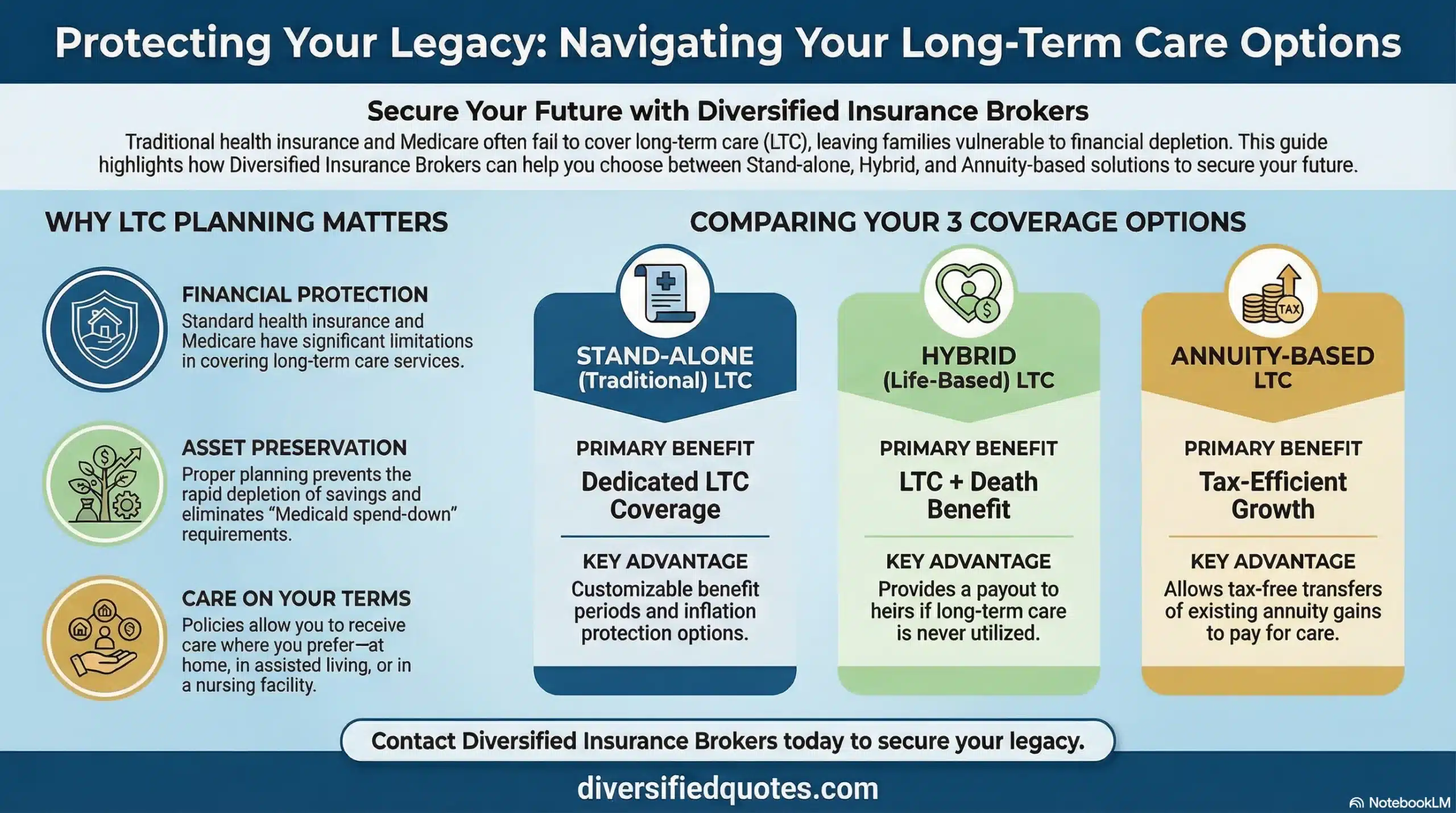
| Feature | Traditional Stand-Alone LTC | Hybrid Life / LTC | Annuity with LTC Rider |
|---|---|---|---|
| Primary purpose | Dedicated LTC benefit pool | Death benefit + LTC access | Retirement income + care enhancement |
| Premium structure | Ongoing annual/monthly premiums (subject to increase) | Single premium or limited-pay; guaranteed rates | Single premium annuity deposit |
| If care is never needed | Premiums paid; no return of value in most designs | Death benefit paid to heirs | Account value available to heirs or for surrender |
| Benefit pool size | Largest per premium dollar for pure LTC | 2x–4x of premium through leverage | Typically 2x account value for LTC benefit |
| Underwriting | Full underwriting; health history matters significantly | Full underwriting; typically easier than stand-alone LTC | Simplified; some guaranteed issue options available |
| Tax treatment | Benefits tax-free; premiums may be deductible | Benefits tax-free under IRC 7702B; AIME rules apply | Benefits for LTC may be tax-free per IRC 7702B |
Traditional long-term care insurance policies are structured around a defined daily or monthly benefit, a benefit period (typically 2, 3, 4, or unlimited years), and an elimination period before benefits begin (typically 30, 60, or 90 days). The correct structure depends on age, health, asset levels, and personal preferences. Our resources on how to choose the right long-term care insurance policy, our guide on LTC elimination periods explained, and our resource on LTC with limited-term vs. lifetime benefits cover these structural design decisions in full. For the most comprehensive benefit protection, our resource on LTC insurance with lifetime benefits covers the unlimited benefit period design.
Hybrid life-LTC policies combine permanent life insurance with long-term care riders, addressing the objection that “if I never need care, I’ve paid premiums for nothing.” Our resources on hybrid long-term care, understanding hybrid long-term care insurance, hybrid life insurance with long-term care benefits, and our comparison of hybrid life vs. traditional long-term care insurance cover the structural trade-offs in detail. For single-premium funding, our resource on single-pay long-term care insurance covers the lump-sum funding approach that appeals to households with existing assets earmarked for care protection. Our resource on affordable hybrid long-term care policies provides current carrier and premium context for hybrid designs, and our guide on affordable long-term care insurance for retirees covers cost management strategies for retirees evaluating LTC coverage on a fixed income.
Annuities with LTC Riders: The Income-Care Combination
Fixed annuities with long-term care or nursing home care riders offer a third structural option that combines retirement income generation with care cost protection. These designs typically provide the standard annuity income stream with an enhanced payout when care needs are triggered — often doubling the monthly withdrawal amount during qualifying care events. Our resources on annuities with long-term care benefits, fixed annuities with long-term care benefits, and our guide on annuity with nursing home care rider cover these combined designs. The non-qualified long-term care annuity specifically addresses tax positioning for after-tax premium funding of care-enhanced annuity designs.
Couple-Specific Planning: Shared Care, Survivor Dynamics, and Income Gaps
Couples face additional planning complexity beyond the individual cost-of-care analysis. When one spouse requires care, household income may drop simultaneously — if pension options were structured as single-life rather than joint-life payouts, or if the caregiving spouse reduces work to provide at-home assistance. Social Security survivor benefit timing decisions also interact with care planning: understanding how income changes at the first death is an essential part of projecting cash flow during a care scenario.
Shared-care riders allow spouses to access unused benefits from each other’s long-term care policy — if one spouse uses less than their benefit pool and the other needs more, the shared pool prevents the second spouse from being unprotected. Our resources on shared-care riders in LTC and long-term care insurance with shared spousal benefits cover how these provisions work and when they are most valuable. Long-term care insurance that is designed for both spouses simultaneously may also qualify for couples discounts at many carriers — our resource on how to get the best long-term care insurance rates covers the rate optimization strategies including spousal and couples discounts.
Tax Advantages and Partnership Programs: Two Benefits That Reduce the Net Cost
Long-term care insurance carries two significant financial incentives that are frequently overlooked in initial planning discussions. The first is favorable federal income tax treatment: benefits paid from a tax-qualified long-term care insurance policy are generally not included in gross income — qualifying as tax-free payments under IRC Section 7702B. Premiums may be deductible as medical expenses subject to AGI thresholds, and self-employed individuals can deduct 100% of qualified LTC premiums. Our resources on tax advantages of long-term care insurance, tax benefits of long-term care insurance, and our comprehensive guide on tax advantages of LTC insurance and hybrid policies cover the full federal and state tax treatment framework. Our resource on tax-free long-term care insurance explains specifically how tax-free benefit distributions work in practice. For qualified account funding, our resource on whether qualified funds can be used for long-term care insurance covers the IRA funding pathway.
The second frequently overlooked incentive is the LTC Partnership Program — a joint federal-state initiative available in most states that allows qualified LTC insurance policy benefits to protect an equivalent amount of personal assets from Medicaid spend-down requirements. A policy providing $300,000 in benefits under a Partnership-qualified design protects $300,000 in assets from Medicaid asset calculations — a dollar-for-dollar asset protection provision that can significantly increase the effective value of an LTC policy for estate protection purposes. Our resources on Partnership-qualified long-term care insurance and LTC Partnership reciprocity explain how these programs work across states.
After the Calculator: The Next Steps
Using the cost calculator above provides a concrete starting point — it moves the discussion from abstract risk to tangible numbers specific to your state. Once you see the projected annual cost of nursing home or assisted living care in your region, you can evaluate how those figures align with your retirement income, assets, and long-term goals. The planning sequence from that point: determine how long care might be needed (and budget for a scenario significantly longer than average); project what care will cost at your likely care year with inflation applied; determine whether your assets and income can absorb that cost without disrupting your retirement lifestyle and legacy goals; and identify what coverage amount, policy structure, and benefit period would close the gap most efficiently.
Our resources on whether you should buy long-term care insurance, whether long-term care insurance is worth it, and our guide on how to buy long-term care insurance cover the full decision framework from cost analysis to coverage selection to application. Our resource on how to qualify for long-term care insurance covers the underwriting process, and our guide on who qualifies for long-term care insurance clarifies eligibility considerations by health and age. For applicants concerned about whether their age creates urgency, our resources on whether you can get long-term care insurance after age 60 and long-term care insurance after age 80 address the age dimension of LTC underwriting. For existing policyholders who want an independent evaluation of their current coverage, our second opinion on your long-term care insurance quote provides that assessment against current market alternatives.
Review Your Long-Term Care Plan
After reviewing state-specific costs, schedule a personalized evaluation of traditional and hybrid long-term care insurance options tailored to your retirement income strategy.
Request Your LTC Strategy ReviewCall 800-533-5969
Related Pages
LTC policy design resources, hybrid options, Medicare coordination, and retirement income planning tools from Diversified Insurance Brokers.
Financial Protection Essentials
Tax advantages, Partnership programs, self-funding analysis, and retirement protection tools from Diversified Insurance Brokers.
Talk With an Advisor Today
Choose how you’d like to connect—call or message us, then book a time that works for you.
Schedule here:
calendly.com/jason-dibcompanies/diversified-quotes
Licensed in all 50 states • Fiduciary, family-owned since 1980
FAQs: Cost of Long-Term Care by State
How much does nursing home care cost per month?
Nursing home costs vary significantly by state, facility type, and whether a semi-private or private room is selected. Private rooms commonly exceed $8,000 to $12,000 per month in many states, and higher-cost regions — particularly parts of the Northeast, Mid-Atlantic, and West Coast — may exceed $15,000 monthly. Semi-private rooms are generally less expensive but still represent a substantial annual expense. Use the Long-Term Care Cost Calculator on this page to estimate current pricing in your specific state, which is the most accurate foundation for planning rather than national averages that may not reflect local facility costs.
For long-term care insurance benefit sizing, the monthly cost in your state — not a national average — should drive your benefit amount selection. If your state’s private room nursing home cost is $12,000 per month and you select a policy with an $8,000 monthly benefit, you have 33% of the care cost uncovered from the policy itself. Our resource on how much long-term care insurance you need covers how to translate state cost data into an appropriate benefit amount selection that aligns with local facility pricing rather than national benchmark figures.
Does Medicare cover long-term nursing home costs?
Medicare only covers short-term skilled nursing care following a qualifying three-day hospital inpatient stay — and only for up to 100 days, with the coverage phasing out significantly after day 20. From days 21 through 100, Medicare requires a daily co-insurance payment that is substantial. After day 100, Medicare coverage ends entirely regardless of continued need. Crucially, Medicare does not pay for ongoing custodial care — assistance with activities of daily living such as bathing, dressing, eating, or mobility — which is precisely the type of care most nursing home and assisted living residents require over months or years of extended stays.
Once the Medicare benefit exhausts and the care need becomes custodial rather than medically necessary skilled nursing, the expense becomes entirely the individual’s responsibility — unless Medicaid coverage applies, which requires spending down assets to qualifying program thresholds. Our resources on whether Medicare covers long-term care, whether Medicare covers nursing home care, and our guide on whether Medicare and long-term care insurance are the same explain the coverage gap that motivates most long-term care insurance purchases.
Why do long-term care costs vary so much by state?
Long-term care costs vary by state for the same reasons that most healthcare and housing costs vary geographically: differences in labor costs (nursing staff wages are substantially higher in some states than others), state regulatory requirements that affect facility staffing ratios and quality standards, real estate and facility overhead costs, and regional cost-of-living differentials that affect everything from utilities to food to supplies. States with high general cost-of-living — parts of the Northeast, California, Alaska, Hawaii — consistently show the highest long-term care facility costs. States in the South and parts of the Midwest typically show lower costs, though even in these regions there is significant variation between metro and rural areas.
For retirement planning purposes, the state-level variation means that the same annual long-term care cost exposure can differ by 50% to 100% depending purely on geography. A family planning for care in metropolitan New York faces a fundamentally different financial scenario than a family planning for care in rural Kentucky — and their long-term care insurance benefit amounts, self-funding reserves, and overall care planning strategy should reflect those differences. Using the cost calculator to get your state’s specific data before making any coverage decisions ensures that the coverage you purchase is calibrated to your actual exposure rather than a national average that may significantly misrepresent your situation.
How long do people typically stay in a nursing facility?
Length of stay varies widely and the average figure is often misleading as a planning baseline because the distribution is highly skewed. Many people stay for a relatively short period — weeks or a few months — following a specific health event such as a fall, surgery recovery, or stroke rehabilitation. However, a meaningful percentage of nursing home residents require multi-year stays due to chronic conditions including advanced dementia, Parkinson’s disease, ALS, or other progressive neurological conditions. For planning purposes, relying on “the average stay” can substantially understate financial exposure for the scenario that creates the most financial risk.
Because duration is fundamentally unpredictable — no one can know whether their future care need will be brief or extended — the planning approach that most effectively manages duration risk is either purchasing long-term care insurance with a benefit period long enough to cover an extended scenario, or maintaining sufficient liquid assets set aside specifically for care costs to fund multi-year care without disrupting the broader retirement income plan. Our resource on what a long-term care insurance benefit period is and our guide on LTC with limited-term vs. lifetime benefits cover the benefit period decision framework in detail.
Should I self-fund long-term care or buy insurance?
The decision depends on your assets, income structure, risk tolerance, and how important asset preservation and legacy planning are to you — and it is rarely a black-and-white choice between “self-fund everything” and “insure everything.” Many households end up with a blended approach: some self-funding capacity for short-duration care events combined with insurance protection for the extended care scenario that creates the most financial risk. The blended approach acknowledges that buying maximum coverage for every possible scenario is inefficient, while relying entirely on self-funding exposes the retirement plan to a potentially catastrophic care cost event.
Key variables in the self-fund versus insure analysis: if a multi-year nursing home stay at your state’s rates would reduce your assets below a level that disrupts the retirement income plan or eliminates intended inheritance, the case for insurance is strong. If you have substantial guaranteed income that covers all essential expenses independently of investment assets, and a large enough asset base that even an extended care cost would not materially change your financial situation, self-funding may be viable. Our resources on self-insured long-term care and whether long-term care insurance is worth it cover the complete framework for this analysis. Reviewing both options with an independent long-term care insurance broker allows you to compare the actual cost of transferring the risk through insurance against the financial exposure you are retaining through self-funding — with real numbers rather than abstractions.
What is hybrid long-term care insurance and how does it compare to traditional LTC coverage?
Hybrid long-term care insurance combines permanent life insurance with a long-term care rider — addressing one of the most common objections to traditional LTC coverage: “if I never need care, I’ve paid years of premiums for nothing.” With a hybrid design, the death benefit is available to heirs if long-term care is never needed, and the long-term care benefits are available if care is needed. The policyholder cannot “lose” the premium investment in either outcome. Hybrid policies are typically funded with a single premium or limited-pay structure, and the premium is guaranteed — unlike traditional stand-alone LTC insurance where premiums can be increased with regulatory approval.
The trade-offs: traditional stand-alone LTC insurance typically provides more long-term care benefit pool per premium dollar for buyers focused exclusively on care cost protection. Hybrid insurance provides both a death benefit and LTC coverage from the same premium — but may produce a smaller LTC benefit pool than a pure LTC policy at the same premium level. The right choice depends on whether the guaranteed death benefit and premium certainty of a hybrid design are priorities, or whether maximum LTC benefit efficiency per dollar is the goal. Our resources on hybrid long-term care, understanding hybrid long-term care insurance, and our comparison of hybrid life vs. traditional long-term care insurance cover the full structural trade-off analysis.
Are long-term care insurance benefits taxable?
In most cases, no — long-term care insurance benefits paid from a tax-qualified policy are generally not included in the recipient’s gross income. Under IRC Section 7702B, benefits from a federally tax-qualified long-term care insurance policy are treated as tax-free reimbursements for qualifying long-term care services up to the IRS per-diem limit (which is adjusted annually). Benefits from per-diem indemnity policies that exceed the IRS limit may have a taxable portion above that threshold, but most benefit amounts stay within tax-free limits. This favorable tax treatment significantly increases the after-tax value of long-term care insurance coverage.
On the premium side, long-term care insurance premiums may be deductible as medical expenses for taxpayers who itemize, subject to age-based limits defined annually by the IRS and the 7.5% AGI threshold for medical expense deductions. Self-employed individuals may be able to deduct 100% of qualified LTC premiums as a business expense. Certain hybrid policies funded with qualified retirement account assets through a 1035 exchange or direct rollover may also have specific tax treatment implications. Our resources on whether long-term care benefits are taxable, tax advantages of long-term care insurance, and our comprehensive guide on tax advantages of LTC insurance and hybrid policies cover the full federal and state tax treatment framework.
About the Author:
Jason Stolz, CLTC, CRPC, DIA, CAA and Chief Underwriter at Diversified Insurance Brokers (NPN 20471358), is a senior insurance and retirement professional with more than 25 years of real-world experience helping individuals, families, and business owners protect their income, assets, and long-term financial stability. As a long-time partner of the nationally licensed independent agency Diversified Insurance Brokers, Jason provides trusted guidance across multiple specialties—including fixed and indexed annuities, long-term care planning, personal and business disability insurance, life insurance solutions, Group Health, Travel Medical and Evacuation Insurance, and short-term health coverage. Diversified Insurance Brokers maintains active contracts with over 100 highly rated insurance carriers, ensuring clients have access to a broad and competitive marketplace.
His practical, education-first approach has earned recognition in publications such as VoyageATL, and contributions from his agency featured in Kiplinger and GoBankingRates— highlighting his commitment to financial clarity and client-focused planning. Drawing on deep product knowledge and years of hands-on field experience, Jason helps clients evaluate carriers, compare strategies, and build retirement and protection plans that are both secure and cost-efficient. Visitors who want to explore current annuity rates and compare options across multiple insurers can also use this annuity quote and comparison tool.
Explore More Long Term Care Insurance Options: Browse our complete guide to LTC Insurance Costs, Rates & Planning — covering how much it costs, best rates, calculators, planning strategies & is it worth it from top carriers.
Last Reviewed: August 28, 2026 |
Reviewed by: Jason Stolz, CLTC, CRPC, DIA, CAA
Chief Underwriter, Diversified Insurance Brokers, Inc. | NPN: 20471358 | Diversified Insurance Brokers, Inc. — Licensed in all 50 states
Fact Checked by: Tonia Pettitt, CMIP©
Medicare Specialist, Diversified Insurance Brokers, Inc. | NPN: 14374308 | Diversified Insurance Brokers, Inc. — Licensed in all 50 states
Did you find this content helpful? Leave us a Google review — it helps others find trustworthy guidance too.
Editorial Standards: Diversified Insurance Brokers maintains rigorous editorial standards to ensure accuracy, clarity, and independence in all content. Learn more about our editorial standards and commitment to transparency.
