
Tax Free Long Term Care Insurance
As an Independent Long Term Care Insurance Broker, we compare traditional, hybrid, and partnership-qualified policies across dozens of carriers to find the structure that actually fits your situation.
Tax Free Long Term Care Insurance

Jason Stolz CLTC, CRPC, DIA, CAA
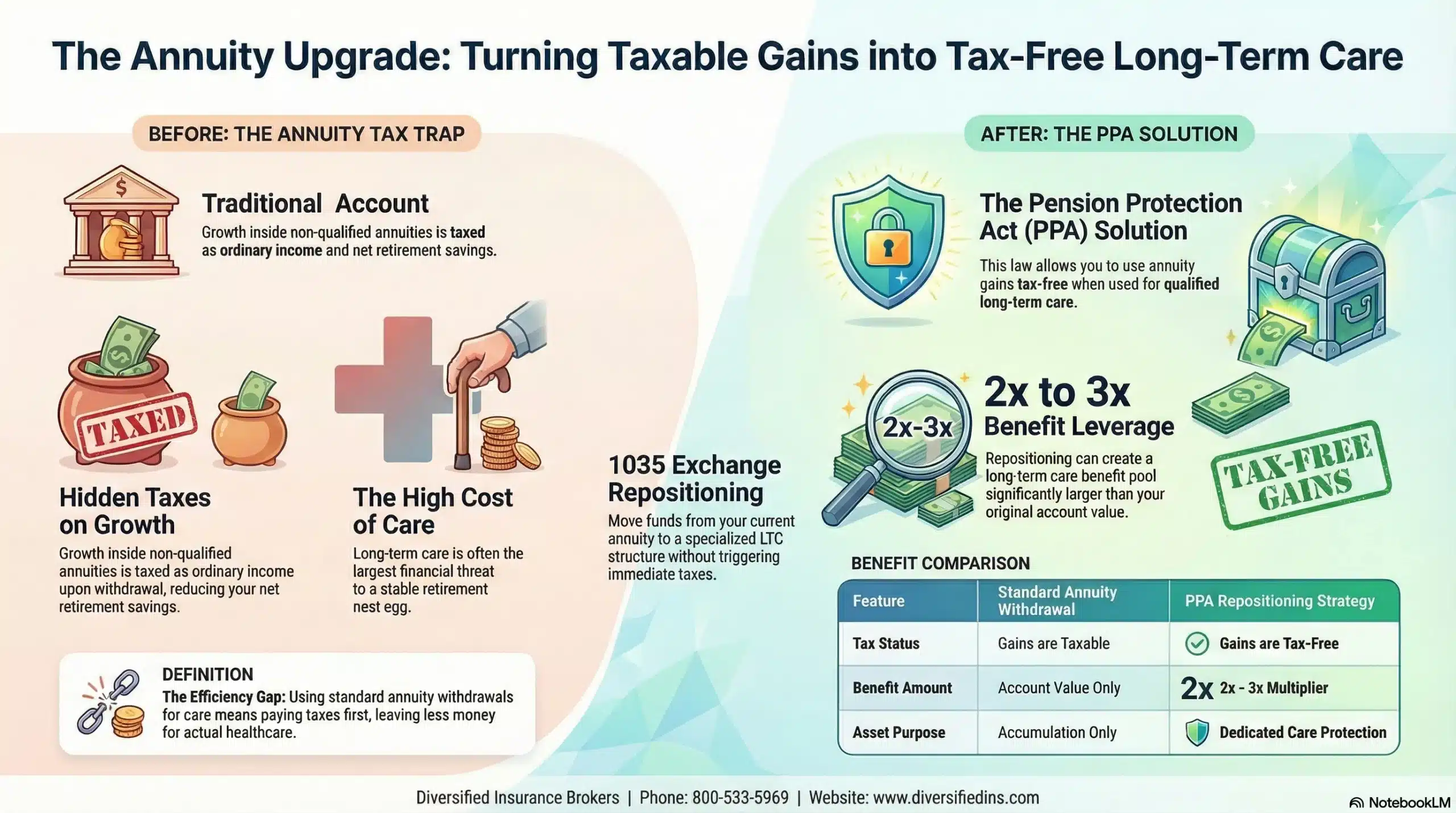
Tax-free long-term care insurance is not a single product — it is the outcome of a correctly structured planning strategy that converts existing assets into LTC protection without creating a taxable event, and ensures that LTC benefits received during a claim are income-tax free under federal law. Two distinct planning goals fall under this description. The first is funding LTC coverage without triggering the taxes that normally accompany repositioning existing assets — specifically non-qualified annuities and life insurance policies with accumulated gain. The second is receiving LTC benefits during a claim without those benefits being included in gross income. Both goals are achievable within the current tax framework, and the mechanisms that make them possible have been in federal law since the Pension Protection Act of 2006 and the Internal Revenue Code’s 7702B qualification framework. Our resource on are long-term care benefits taxable covers the benefit-side tax treatment in detail, and our resource on tax advantages of LTC insurance and hybrid policies covers the full tax advantage landscape for both traditional and hybrid LTC strategies.
The audience most directly served by this page is the retirement saver who holds a non-qualified annuity — a MYGA, deferred fixed annuity, or variable annuity held outside of an IRA or other qualified account — that has accumulated gain above the original premium paid. This situation is common and creates a specific planning friction: the annuity has done exactly what it was supposed to do, growing the value conservatively over years or decades. The problem is that when the owner wants to reposition or access those assets for another planning purpose — including long-term care — the gain inside the contract is taxable as ordinary income in the year it is distributed. Because non-qualified annuities use last-in-first-out (LIFO) accounting for withdrawals, gains come out first, meaning that the first dollars withdrawn from a $300,000 annuity with $80,000 of gain are fully taxable until all $80,000 of gain is exhausted. The owner who withdraws $80,000 to fund a long-term care plan owes ordinary income tax on all $80,000, reducing the net value available for care planning by the tax cost. Our resource on non-qualified annuity taxation covers the LIFO withdrawal rules and how gains are taxed in detail, and our resource on annuity exclusion ratio covers the cost basis recovery calculation for non-qualified annuity distributions.
The Pension Protection Act of 2006 created a specific mechanism to solve this problem: a direct exchange of an existing non-qualified annuity or life insurance policy into a qualified long-term care insurance or hybrid LTC product — a 1035 exchange — that does not trigger the gain in the source contract as taxable income. Under this provision, the accumulated gain in the non-qualified annuity transfers into the LTC policy without being recognized as income at the time of the exchange. The gain effectively becomes the basis of the LTC policy and is recovered tax-free as LTC benefits are paid. This exchange — if properly structured — converts a taxable annuity gain that would otherwise cost the owner ordinary income tax into a tax-free LTC benefit pool. Our resource on can you use qualified funds for long-term care insurance covers the separate strategy for IRA and qualified plan dollars, which involves different mechanics and different tax consequences. Our resource on hybrid long-term care insurance covers the full hybrid LTC product landscape, and our resource on hybrid life insurance with long-term care benefits covers the life insurance chassis into which non-qualified annuities are most commonly exchanged.
Get a Tax-Efficient LTC Planning Review
We evaluate your existing annuity or life insurance position for 1035 exchange potential, model the tax savings, and compare LTC benefit structures — showing you the before and after of a properly structured exchange.
Five Ways to Fund LTC Costs — Tax Treatment Compared
Long-term care costs can be funded from multiple sources, each with different tax treatment. The table below maps the five most common funding approaches against their tax consequences — both at the time of funding and when benefits are actually received.
| Funding Approach | Tax at Funding / Premium Payment | Tax on Benefits / Care Costs | Key Advantage | Key Limitation |
|---|---|---|---|---|
| Self-funding from after-tax savings | None — money was already taxed when earned; no additional tax to access savings | Care costs paid from after-tax savings may qualify as a medical expense deduction on Schedule A if total qualified medical expenses exceed 7.5% of AGI; otherwise no deduction | Full liquidity; no insurance product required; no underwriting | No LTC leverage; $400,000+ of care costs require $400,000+ of liquid assets; spousal financial exposure is complete; no guaranteed benefit pool |
| Non-qualified annuity withdrawals (to pay care costs directly) | LIFO treatment: gains come out first as ordinary income; first dollar withdrawn is taxable until all accumulated gain is exhausted; then cost basis is recovered tax-free | No LTC insurance; care costs are an out-of-pocket expense; possible medical deduction on Schedule A if total qualified medical expenses exceed 7.5% of AGI | Liquid; no insurance required | No LTC leverage; taxes owed on gains as they are distributed; annuity purchased to avoid taxes becomes a source of taxable income; net care funding is reduced by the tax cost on gains |
| 1035 exchange — non-qualified annuity or life insurance cash value → hybrid LTC policy | No tax at exchange — the Pension Protection Act of 2006 allows a direct exchange into a qualified LTC contract without recognizing the gain; gain transfers basis into the new LTC policy | LTC benefits received from a 7702B-qualified contract are generally income-tax free; reimbursement benefits have no dollar cap; indemnity benefits are tax-free up to $430/day (2026 per diem limit) | Converts taxable gain into LTC benefit dollars without triggering the tax; LTC leverage amplifies total coverage well beyond the original annuity value; benefits received tax-free | Health underwriting required; life chassis may have stricter underwriting than annuity chassis; the asset is repositioned and is no longer a liquid savings vehicle; surrender charges may apply on the source annuity if not yet matured |
| Traditional standalone LTC insurance (ongoing premiums) | Premiums MAY be deductible as a medical expense for qualified 7702B-compliant policies; age-based 2026 limits: age 61-70 up to ~$4,960; age 71+ up to $6,200; subject to 7.5% AGI floor on Schedule A; self-employed may deduct 100% | Benefits from 7702B-qualified policies generally tax-free; reimbursement benefits have no cap; indemnity benefits tax-free up to $430/day (2026) or actual qualified LTC costs | Potentially deductible premiums; highest LTC coverage per annual premium dollar; no lump sum required | Premiums NOT guaranteed — historical rate increases of 50-150%+ on many traditional LTC blocks; “use it or lose it” — if care is never needed, premiums produce no remaining value; underwriting required |
| IRA / qualified plan withdrawal to pay LTC premiums or care costs | All withdrawals taxable as ordinary income; SECURE 2.0 (2026): penalty-free distributions up to $2,600/year from eligible employer plans for certified LTC premiums — still taxable, just no 10% penalty; IRA qualification pending IRS guidance | If premium was paid with taxable IRA withdrawal, LTC benefits received from the policy remain tax-free under 7702B; the tax was on the IRA distribution, not the LTC benefit | Large asset base available in most retirees’ IRAs; SECURE 2.0 makes small penalty-free distributions available from employer plans for this purpose | Every IRA dollar used for LTC premiums is a taxable withdrawal; no tax-free mechanism like the 1035 exchange exists for moving IRA dollars directly into LTC policies; the 10-year IRA distribution strategy (separate from this) can spread tax over multiple years |
Tax treatment above reflects general federal income tax principles. Specific outcomes depend on individual tax situations, state tax rules, policy qualification under IRC 7702B, and applicable limitations. The per diem limits, deductibility thresholds, and SECURE 2.0 rules reflect 2026 IRS guidance and are subject to annual adjustment. Consult a qualified tax professional before implementing any of these strategies. This table is educational and does not constitute tax advice.
The Non-Qualified Annuity Tax Problem — Why Gains Feel Stuck
Non-qualified annuities accumulate gain on a tax-deferred basis — one of their primary design advantages over bank CDs and other taxable savings vehicles. The deferral works exactly as intended while the money stays inside the contract. The friction appears when the owner wants to access or reposition those assets. Under IRS rules for non-qualified annuity distributions, withdrawals are taxed using last-in-first-out (LIFO) accounting — meaning the most recently credited gains come out first. In practical terms, this means the first dollar withdrawn from a non-qualified annuity with any accumulated gain is taxable as ordinary income, and withdrawals continue to be fully taxable until the entire accumulated gain has been distributed. Only after the gain is exhausted does the original cost basis (the premium paid) come out tax-free. For an annuity owner who paid $200,000 in premium and now has $280,000 in accumulated value, the first $80,000 withdrawn is 100% taxable. Withdrawing $80,000 to fund a hybrid LTC policy creates an $80,000 ordinary income tax event, at whatever marginal rate applies — potentially $19,000-$29,000+ in federal income tax alone at common retirement marginal rates. The tax cost reduces the net value available for LTC planning dollar for dollar. Our resource on how are annuities taxed covers the full tax mechanics, and our resource on how annuities are taxed in retirement covers the withdrawal timing strategies. Our resource on what is a fixed annuity covers the MYGA and fixed annuity product structure that most commonly creates this planning situation.
The Pension Protection Act 1035 Exchange — Converting the Gain Without Triggering the Tax
Section 1035 of the Internal Revenue Code has historically allowed tax-free exchanges between certain insurance products — life insurance to life insurance, annuity to annuity, life insurance to annuity. The Pension Protection Act of 2006 expanded this framework to allow tax-free 1035 exchanges from non-qualified annuities and life insurance policies directly into qualified long-term care insurance contracts and hybrid LTC policies. This means an annuity owner with $80,000 of accumulated gain can, through a properly structured 1035 exchange, transfer that entire balance — including the gain — directly into a hybrid LTC policy without any of the gain being recognized as taxable income in the year of the exchange. The gain does not disappear: it becomes the cost basis of the new LTC policy and is recovered tax-free as LTC benefits are paid. But the owner avoids the immediate ordinary income tax that would have arisen from a withdrawal. The LTC benefit pool created by the exchange is typically a multiple of the annuity value — because hybrid LTC products provide LTC leverage through the extension of benefits structure — meaning the tax-efficient repositioning converts a $280,000 annuity not just into $280,000 of LTC coverage, but potentially into $500,000-$700,000+ depending on the product design, age, and health. For the exchange to qualify, it must be a direct institution-to-institution transfer, and the receiving contract must meet the 7702B qualified LTC insurance requirements. Our resources on annuity with long-term care benefits, fixed annuity with long-term care benefits, and non-qualified long-term care annuity cover the specific product structures that commonly receive 1035 exchanges.
What Qualifies as Tax-Free LTC Benefits — IRC 7702B and the Per Diem Limit
Long-term care insurance benefits are tax-free under federal law when they are paid by a qualified long-term care insurance contract — one that meets the requirements of IRC Section 7702B. Most traditional standalone LTC policies and qualifying hybrid LTC products meet this standard. For reimbursement-style policies, benefits received to cover actual documented qualified LTC expenses are income-tax free with no dollar ceiling — the full benefit paid for actual care costs is excluded from gross income regardless of amount. For indemnity-style (per diem) policies, benefits are tax-free up to the greater of the IRS per diem limit ($430 per day for 2026, equivalent to approximately $13,000 per month) or the actual qualified LTC costs incurred. The per diem limit represents the maximum tax-free daily benefit that can be paid without documentation of actual care costs; amounts exceeding this limit may be taxable unless they are offset by actual care expenses. For most hybrid LTC policyholders with monthly benefit amounts in the $6,000-$12,000 range, benefits will fall within or near the per diem limit and be received effectively tax-free. Our resource on understanding hybrid long-term care insurance covers the 7702B qualification requirements for hybrid products.
Traditional LTC Premium Deductibility — What the Age-Based Limits Allow
Traditional standalone long-term care insurance premiums — for policies qualifying under IRC 7702B — may be treated as a deductible medical expense, subject to age-based annual limits and the overall 7.5% of AGI floor for Schedule A medical expense deductions. For 2026, the IRS age-based premium limits are: approximately $4,960 for insureds aged 61-70 and $6,200 for insureds aged 71 and over, with lower limits for younger age bands. These limits represent the maximum amount of qualified premium that can be included as a deductible medical expense — not a guaranteed deduction. The full deduction is available only to the extent that total qualified medical expenses (including the LTC premium up to the age-based limit) exceed 7.5% of the taxpayer’s adjusted gross income. Self-employed individuals and certain business owners may deduct qualified LTC premiums more directly through the self-employed health insurance deduction, subject to the same age-based limits. Traditional LTC premium deductibility is one of the few remaining tax advantages that standalone LTC maintains over hybrid products in the comparison, and it is particularly valuable for self-employed business owners in higher income brackets. Our resource on tax benefits of long-term care insurance covers the traditional LTC deductibility framework in further detail.
Hybrid LTC Premiums — Why Most Are Not Deductible
One of the most important tax-treatment distinctions between traditional standalone LTC insurance and hybrid life/LTC products is premium deductibility. Most hybrid LTC premiums — including single premium deposits into hybrid life/LTC policies — are NOT tax-deductible. The reason is structural: most hybrid LTC products are life insurance policies with LTC benefits built in, and the premium funds both the life insurance component and the LTC component simultaneously. The IRS allows deduction only for the portion of the premium specifically allocable to the qualified LTC insurance component, not the life insurance or annuity component. Most hybrid LTC carriers do not separately state a distinct LTC premium amount, meaning the entire hybrid premium is non-deductible. Some hybrid designs with a separately identified LTC continuation rider may have a deductible LTC premium component, but this is the exception rather than the rule in the current market. The offset for this limitation is the superior tax treatment on the benefit side: hybrid LTC benefits are tax-free under 7702B, and the life insurance death benefit is tax-free to beneficiaries under IRC 101(a). The non-deductible premium is typically funded from after-tax assets or from a tax-free 1035 exchange — avoiding the tax problem rather than deducting the premium. Our resource on affordable hybrid long-term care policies covers cost-efficient hybrid design for buyers working within specific premium budgets.
The SECURE 2.0 Qualified LTC Distribution (2026)
SECURE 2.0, enacted in 2022, created a new category of “qualified long-term care distributions” from eligible employer retirement plans, effective for distributions made after December 29, 2025. Under this provision, individuals may take a limited distribution from eligible defined contribution retirement plans specifically to pay premiums on a certified qualified LTC insurance policy — and the standard 10% early withdrawal penalty that normally applies to distributions before age 59½ is waived. The 2026 cap for this penalty-free treatment is $2,600 per year. Important clarifications: the distribution is still fully taxable as ordinary income — only the 10% penalty is waived, not the income tax. The provision applies to distributions used to pay LTC insurance premiums; it does not allow penalty-free distributions to pay for care costs directly. Not all employer plans have elected to offer this feature; it requires the plan sponsor to adopt the provision. As of this writing, IRS guidance on whether traditional IRAs qualify under this rule in addition to employer plans remains pending. For most buyers, the $2,600 annual cap is a modest supplement to other LTC funding strategies rather than a primary mechanism — it does not change the fundamental tax efficiency of the 1035 exchange approach for non-qualified annuity owners. Our resource on can you use qualified funds for long-term care insurance covers the full IRA and qualified plan strategy in detail. Our resources on long-term care planning strategies, long-term care insurance for couples, partnership qualified long-term care insurance, self-insured long-term care, does Medicare cover long-term care, is long-term care insurance worth it, best MYGA annuity rates, Roth conversions, long-term care insurance services, long-term care insurance calculator, and get a 2nd opinion on your LTC quote complete the planning resource set.
Talk With an Advisor Today
Choose how you’d like to connect—call or message us, then book a time that works for you.
Schedule here:
calendly.com/jason-dibcompanies/diversified-quotes
Licensed in all 50 states • Fiduciary, family-owned since 1980
FAQs: Tax-Free Long-Term Care Insurance
How can I convert my non-qualified annuity into long-term care coverage without paying taxes on the gain?
Through a Section 1035 exchange authorized by the Pension Protection Act of 2006. A properly structured 1035 exchange allows you to transfer your existing non-qualified annuity — including all accumulated gain — directly into a qualified hybrid LTC policy without the gain being recognized as taxable income in the year of the exchange. The exchange must be executed as a direct institution-to-institution transfer from the annuity carrier to the LTC policy carrier; withdrawing the funds yourself and then contributing them to the LTC policy creates a taxable event. The receiving contract must meet IRC Section 7702B requirements for qualified LTC insurance. Once the exchange is complete, LTC benefits received from the hybrid LTC policy are generally income-tax free.
Are all long-term care insurance benefits tax-free?
Benefits from qualified 7702B LTC contracts are generally income-tax free, but the rules differ slightly by benefit payment type. For reimbursement-style policies, benefits paid to cover actual documented qualified LTC expenses are income-tax free with no dollar ceiling. For indemnity (per diem) policies, benefits are tax-free up to the greater of the IRS per diem limit ($430/day for 2026) or actual qualified LTC costs incurred. For most hybrid LTC policyholders with monthly benefits in the $6,000-$12,000 range, benefits fall within or near the per diem limit and are received effectively tax-free. Benefits from non-qualified policies (not meeting 7702B standards) may receive less favorable treatment.
Are hybrid long-term care insurance premiums tax-deductible?
Generally no — most hybrid LTC premiums are not tax-deductible. Traditional standalone LTC insurance premiums for qualified 7702B policies are potentially deductible as medical expenses up to age-based IRS limits ($6,200 per person for age 71+ in 2026). Hybrid LTC products combine a life insurance or annuity component with the LTC component, and the IRS allows deduction only for the portion specifically allocable to qualified LTC benefits. Most hybrid carriers do not separately state a distinct LTC premium, making the entire hybrid premium non-deductible. Some hybrid designs with a separately identified LTC continuation rider may have a deductible LTC component, but this is the exception. The 1035 exchange strategy avoids this limitation by repositioning existing non-qualified annuity gains into the hybrid policy without triggering tax — addressing the problem at the funding stage rather than through a deduction.
What is the SECURE 2.0 qualified LTC distribution for 2026?
SECURE 2.0 Section 334 created a penalty-free distribution exception for qualified LTC insurance premiums from eligible employer retirement plans, effective for distributions after December 29, 2025. In 2026, up to $2,600 per year can be distributed from an eligible employer plan (such as a 401k) to pay for certified qualified LTC insurance premiums without incurring the normal 10% early withdrawal penalty. The distribution is still fully taxable as ordinary income — only the 10% penalty is waived. Not all employer plans have adopted this feature. IRS guidance confirming whether IRAs qualify has not yet been released as of this writing. The $2,600 cap makes this most useful as a supplement to other LTC funding strategies, particularly for pre-retirees under age 59½ who have a modest LTC insurance premium need.
Can I use an existing life insurance policy to fund hybrid LTC coverage tax-free?
Yes — the same 1035 exchange provision that applies to non-qualified annuities also applies to existing life insurance policies. Life insurance cash value accumulated above the cost basis can be exchanged directly into a qualified hybrid LTC policy without triggering the gain as taxable income. This applies to permanent life insurance policies (whole life, universal life, and similar) with meaningful cash value that may no longer be needed for its original death benefit purpose. The exchange must be structured as a direct carrier-to-carrier transfer. The life insurance basis transfers into the new hybrid LTC policy and is recovered tax-free as LTC benefits are paid. Both the 1035 exchange from annuity and from life insurance are authorized by the Pension Protection Act of 2006.
Why does the annuity gain feel “stuck” and hard to access without a tax hit?
Non-qualified annuity withdrawals are taxed using LIFO (last-in-first-out) accounting — the most recently credited gains come out first and are fully taxable as ordinary income before any cost basis is recovered tax-free. An annuity with $200,000 in premium and $280,000 in value has $80,000 of gain that comes out first in any withdrawal sequence. Withdrawing $80,000 to reposition assets creates an immediate $80,000 ordinary income tax event, potentially costing $19,000-$29,000+ in federal income tax at typical retirement marginal rates. This is why many non-qualified annuity owners feel their gain is “stuck” — they don’t want to trigger the tax, but they don’t want to keep an asset that no longer serves its original purpose. The 1035 exchange resolves this by converting the gain into LTC protection without triggering the tax at the time of the repositioning.
About the Author:
Jason Stolz, CLTC, CRPC, DIA, CAA and Chief Underwriter at Diversified Insurance Brokers (NPN 20471358), is a senior insurance and retirement professional with more than 25 years of real-world experience helping individuals, families, and business owners protect their income, assets, and long-term financial stability. As a long-time partner of the nationally licensed independent agency Diversified Insurance Brokers, Jason provides trusted guidance across multiple specialties—including fixed and indexed annuities, long-term care planning, personal and business disability insurance, life insurance solutions, Group Health, Travel Medical and Evacuation Insurance, and short-term health coverage. Diversified Insurance Brokers maintains active contracts with over 100 highly rated insurance carriers, ensuring clients have access to a broad and competitive marketplace.
His practical, education-first approach has earned recognition in publications such as VoyageATL, and contributions from his agency featured in Kiplinger and GoBankingRates— highlighting his commitment to financial clarity and client-focused planning. Drawing on deep product knowledge and years of hands-on field experience, Jason helps clients evaluate carriers, compare strategies, and build retirement and protection plans that are both secure and cost-efficient. Visitors who want to explore current annuity rates and compare options across multiple insurers can also use this annuity quote and comparison tool.
Explore More Long Term Care Insurance Options: Browse our complete guide to Tax, Medicare & Special Situations — covering tax advantages, Medicare vs LTC, seniors, couples, diabetics & age-specific coverage from top carriers.
Last Reviewed: June 17, 2026 |
Reviewed by: Jason Stolz, CLTC, CRPC, DIA, CAA
Chief Underwriter, Diversified Insurance Brokers, Inc. | NPN: 20471358 | Diversified Insurance Brokers, Inc. — Licensed in all 50 states
Fact Checked by: Tonia Pettitt, CMIP©
Medicare Specialist, Diversified Insurance Brokers, Inc. | NPN: 14374308 | Diversified Insurance Brokers, Inc. — Licensed in all 50 states
Did you find this content helpful? Leave us a Google review — it helps others find trustworthy guidance too.
Editorial Standards: Diversified Insurance Brokers maintains rigorous editorial standards to ensure accuracy, clarity, and independence in all content. Learn more about our editorial standards and commitment to transparency.
