
Are Annuities a Good Investment
As an Independent Annuity Broker, we compare rates across 100+ carriers and 1,000 different annuities— not just one company’s product offerings — to find the best fit for your goals.
Are Annuities a Good Investment

Jason Stolz CLTC, CRPC, DIA, CAA
Are annuities a good investment? The direct answer is: yes — for the specific problems they are designed to solve. Annuities are not built to outperform aggressive market portfolios, and evaluating them against equity returns is the single most common analytical error people make when asking this question. Annuities are built to do three things that market investments cannot guarantee: protect principal from market losses, create income that the owner cannot outlive, and grow tax-deferred without annual tax drag on credited interest. For retirees and pre-retirees whose most urgent financial problem is “will my money last as long as I do,” an annuity structured correctly is often one of the most powerful answers available. For people whose primary objective is maximum growth and who have a long time horizon and no concern about outliving their assets, a different conversation is warranted.
The evaluation of whether annuities are a good investment must begin with a clearly defined investment objective — because “good investment” means something different depending on what problem needs to be solved. A retiree who needs guaranteed income to cover essential monthly expenses alongside Social Security and who wants to eliminate the risk of running out of money regardless of how long they live needs a fundamentally different tool than a 35-year-old accumulating wealth for a retirement that is 30 years away. Annuities are designed for the first scenario, not the second — and understanding that distinction is the starting point for an honest evaluation. At Diversified Insurance Brokers, Jason Stolz, CLTC, CRPC, DIA, CAA evaluates annuity appropriateness within the complete retirement income plan rather than as an isolated product decision — coordinating annuity income with Social Security timing, portfolio withdrawal strategy, long-term care planning, and tax management. Our comprehensive resource on Annuities 101 covers the foundational framework for understanding how annuities work before any product comparison begins, and our resource on common annuity myths addresses the most persistent misconceptions that distort the “are annuities a good investment” question before it can be properly answered.
Ensure you are receiving the absolute top rates
Current Fixed Annuity Rates
Compare today’s best fixed annuity rates from top carriers.
Current Bonus Annuity Rates
See which annuities offer the highest upfront bonus today.
Request an Annuity Quote
Submit our annuity request form to get personalized rate options.
Lifetime Income Calculator
Use our calculator to see how much guaranteed income your annuity can provide.
Annuities vs. Market Investments vs. CDs vs. Pensions — The Honest Comparison
The question “are annuities a good investment” is most productively answered by comparing them against the specific retirement vehicle alternatives that serve the same objectives. The table below does that comparison across the dimensions that matter most for retirement income planning — not abstract investment theory, but practical retirement outcomes.
| Feature | Fixed / Indexed Annuity | Market Portfolio (Stocks / Funds) | Bank CD | Pension / Defined Benefit |
|---|---|---|---|---|
| Principal protection from market loss | Yes — fixed and indexed annuities protect principal; the 0% floor prevents index losses from reducing account value | No — market portfolios expose principal to full market loss; a 30% decline produces a 30% reduction in value | Yes — FDIC insured up to limits; principal is guaranteed by government deposit insurance | Yes — pension benefits are a contractual employer obligation; benefit amount is not affected by market performance |
| Guaranteed income you cannot outlive | Yes — with income riders or annuitization, guaranteed payments continue for life regardless of account value; solves longevity risk | No — withdrawals deplete the portfolio; if the portfolio is exhausted, income stops regardless of how long the owner lives | No — CDs are accumulation vehicles, not income vehicles; no mechanism for guaranteed lifetime income | Yes — defined benefit pensions provide guaranteed lifetime income; payments continue for life regardless of investment performance |
| Tax treatment during accumulation | Tax-deferred — no annual tax on credited interest or gains; compounding is uninterrupted by annual tax obligations | Varies — tax-deferred inside 401(k)/IRA; fully taxable annually in taxable brokerage accounts on dividends, interest, and realized gains | Fully taxable annually — CD interest is ordinary income in the year credited regardless of whether funds are withdrawn | Tax-deferred — employer contributions and investment returns accumulate tax-deferred; payments are taxed as ordinary income when received |
| Liquidity | Limited during surrender period — typically 10% annual free withdrawal; full access after surrender period ends; not appropriate for funds needed in the short term | High (taxable accounts) to moderate (retirement accounts) — publicly traded securities can typically be sold and liquidated relatively quickly | Limited during term — early withdrawal typically triggers a penalty; full access at maturity | None — pension income is paid on a fixed schedule; the underlying asset is the employer’s obligation, not a personal account the participant can access |
| Growth potential | Moderate — fixed annuities offer guaranteed declared rates; indexed annuities offer capped participation in index growth; not designed for maximum growth | Highest — full participation in market returns; equity exposure can significantly outperform guaranteed vehicles over long periods when markets perform well | Limited — declared interest rate only; historically lower than equity market returns over long periods, though competitive in high-rate environments | Defined — benefit is based on formula, not investment performance; no participation in market upside beyond formula calculation |
| Inflation protection | Optional — COLA riders and inflation-linked income designs available; not automatically included; fixed income loses real value if no inflation adjustment | Best natural inflation hedge — equity portfolios tend to outpace inflation over long periods; real return potential is strongest among these four | None — fixed rate; if inflation exceeds the CD rate, the real return is negative | Varies — some pensions include COLA; many do not; inflation can erode fixed pension income over long payout periods |
| Availability to most retirees | Widely available — purchasable by any individual with qualifying premium; no employer relationship required; no contribution limits for non-qualified contracts | Widely available — brokerage accounts available to any individual; retirement account access depends on employment or IRS eligibility | Widely available — any individual can open a CD at a bank or credit union; FDIC insured up to applicable limits | Limited — only available through employers who sponsor defined benefit plans; most private sector workers do not have pension access |
| Best suited for | Retirees and pre-retirees who need guaranteed lifetime income, want principal protection from market loss, and want tax-deferred growth — the “guaranteed income floor” in a retirement income architecture | Long-term accumulation with high growth potential; best during working years or as part of a portfolio where income guarantees are provided by other sources | Short-term guaranteed savings with maximum safety and full FDIC protection; appropriate for near-term cash needs, not long-term retirement income | Employees with access to defined benefit plans who want the security of guaranteed employer-funded lifetime income — a benefit increasingly rare in the private sector |
The table reveals the most important truth about the “are annuities a good investment” question: annuities are the only vehicle among these four that an individual can purchase independently to create guaranteed lifetime income while simultaneously protecting principal from market loss. Market portfolios offer better growth potential but no income guarantee and no principal protection. Bank CDs offer principal protection but no lifetime income and historically modest returns. Pensions offer the best combination of lifetime income and guaranteed payments — but they are not available to most people because the employer relationship required to access them no longer exists for the majority of private sector workers. The annuity fills this gap. Our resource on pension alternative covers this dynamic in detail — explaining why the annuity is the closest private-market substitute for the defined benefit pension that most retirees don’t have access to through an employer.
What Annuities Are Designed to Do — The Honest Framework
The most productive way to evaluate whether annuities are a good investment is to start with a clear articulation of what they were designed to do — and then honestly assess whether those objectives align with what the specific individual needs. Annuities were designed by insurance companies to solve the longevity risk problem: the mathematical reality that some people will live far longer than average, and that a retirement portfolio sized around average life expectancy will be exhausted before the person with above-average longevity reaches their end of life. The guaranteed income feature of annuities solves this problem contractually: the carrier bears the risk that the annuitant outlives the premium funding the income, and the annuitant benefits from certainty that income continues regardless of how long they live.
The secondary design objective — principal protection — addresses the timing risk that is most severe in the years immediately before and after retirement. When a retiree’s portfolio declines 30% in year one of retirement and simultaneously requires withdrawals to cover living expenses, the combination of losses and withdrawals produces a permanent impairment to the portfolio’s long-term sustainability that simply recovering to breakeven cannot repair. This is the sequence-of-returns problem, and it is one of the most consequential risks in retirement income planning. Our resource on sequence of returns risk covers this dynamic in detail. Annuities with principal protection — particularly fixed indexed annuities — remove market losses from the equation for the capital allocated to them, which reduces the portfolio’s vulnerability to this timing risk and allows the remaining market-invested assets to continue pursuing growth without bearing the entire income responsibility during market stress periods.
Tax deferral is the third design feature — and for some investors, it is the deciding advantage. Earnings inside a non-qualified annuity accumulate tax-deferred, meaning no annual income tax on credited interest, dividends, or indexed gains during the accumulation phase. This is the same deferral benefit that makes IRAs and 401(k) plans valuable — except that non-qualified annuities have no contribution limits, making them useful for investors who have already maximized qualified retirement accounts and want additional tax-advantaged accumulation. The tax-deferred compounding over a multi-year horizon produces meaningfully better outcomes than the same growth in a fully taxable account where annual taxes interrupt the compounding process every year. Our resource on are annuities worth it covers the comprehensive value evaluation framework that determines whether the annuity’s specific features produce better outcomes than the alternatives for a specific household’s situation.
The Different Annuity Types — What Each Is a Good Investment For
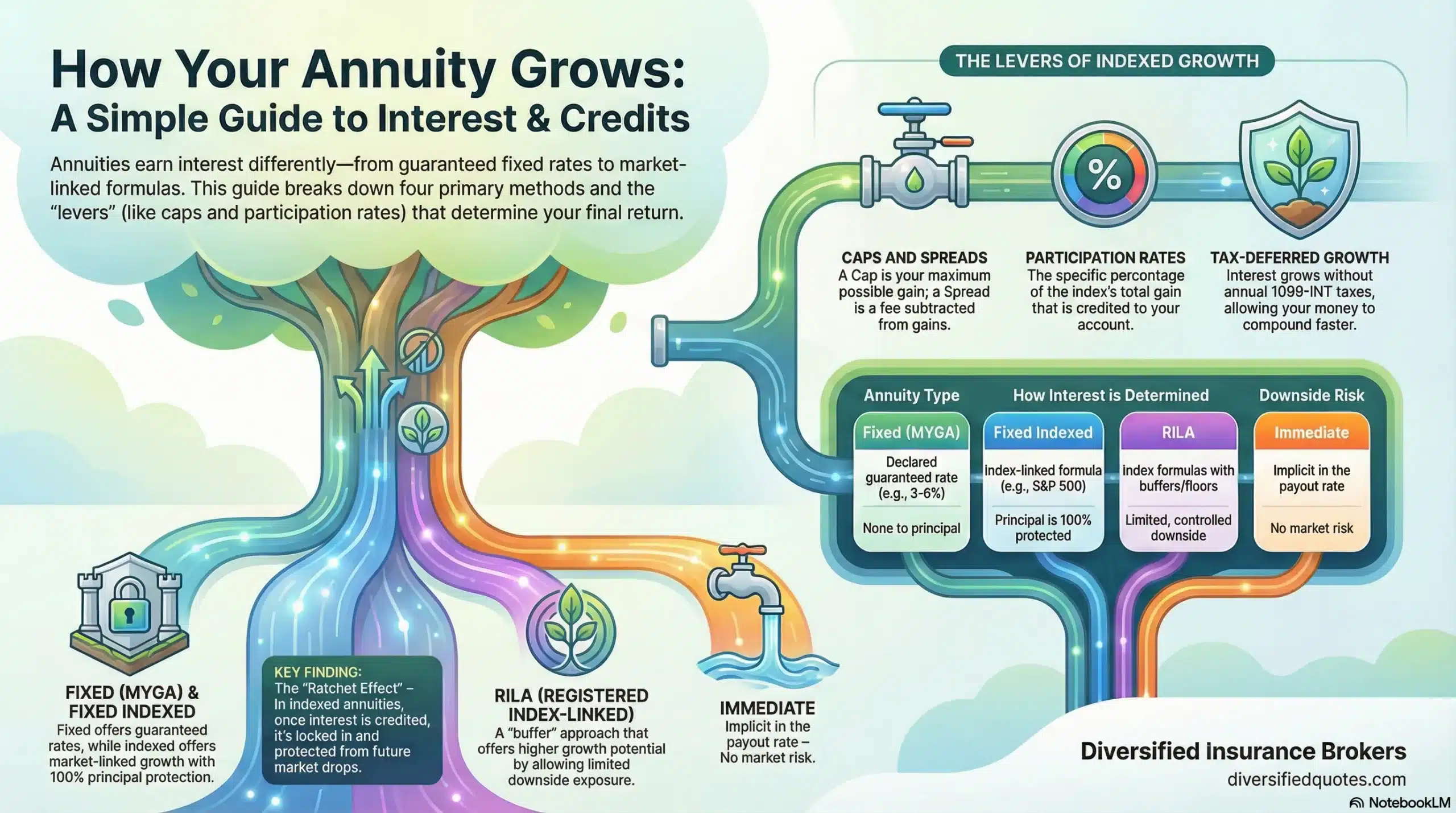
Whether an annuity is a good investment depends critically on which type of annuity is under evaluation — because the four primary annuity categories serve meaningfully different objectives and produce very different outcomes for different investor profiles. Applying the performance characteristics of one annuity type to the evaluation of another is one of the most common sources of confusion in the “are annuities a good investment” discussion.
Fixed annuities — including multi-year guaranteed annuities (MYGAs) — provide a declared interest rate for a defined term, with full principal protection and tax-deferred growth. They are compared most naturally against bank CDs, where MYGAs often produce competitive or superior yields with the added benefit of tax deferral. The fixed annuities vs. CDs comparison is one of the most practically useful evaluations for conservative investors who prioritize safety and predictable growth. Our resource on best MYGA annuity rates covers the current competitive rate landscape for declared fixed annuity rates across the carrier market. For individuals evaluating what a specific premium amount would grow to under a fixed design, our deferred annuity calculator provides the accumulation projection tool. Our resource on what is a fixed annuity covers the complete fixed annuity structural overview.
Fixed indexed annuities offer accumulation with upside potential linked to index performance — capped or participation-rate-constrained — combined with principal protection from market loss. They are the annuity most frequently positioned as the “balance point” between the safety of a fixed contract and the growth potential of a market investment. For investors who want to participate in some portion of positive market years without being exposed to the full losses of negative years, the FIA’s 0% floor and index-linked crediting provide this balance. Our resource on what is a fixed indexed annuity covers the complete structure and crediting mechanics. For an evaluation of whether this structure matches specific investor needs, our resource on who is best suited for an indexed annuity maps the FIA’s characteristics against investor profile types. Our resource on what happens to an indexed annuity when the market goes down addresses the most common question about FIA performance in negative markets, and our resource on do you lose your principal in an indexed annuity covers the principal protection mechanics comprehensively.
Income annuities convert a premium into guaranteed lifetime income payments — either immediately (single premium immediate annuity) or at a defined future date (deferred income annuity or QLAC). These are the annuity type that most directly answers the “can I create guaranteed income that I cannot outlive” objective. They are the closest private-market equivalent to a pension — providing a predictable monthly income that continues regardless of market performance, longevity, or any external financial variable. Our resource on guaranteed income from annuities covers the full income activation framework, and our resource on how much does an annuity pay covers the income amounts that different premium levels produce at various activation ages. For deferred income planning — pre-scheduling income to begin at a specific future date — our resource on what is a deferred income annuity covers the structure and planning applications. Our annuity payout calculator provides the projection tool for modeling income at different premium amounts and activation ages.
Bonus annuities add an upfront premium credit — typically 5–15% of the initial premium — that immediately enhances the account value or income base. This bonus effectively accelerates the starting value of the annuity, which can meaningfully improve the long-term accumulation or income projection when the policy is held for the full surrender period. Bonus structures require careful evaluation because the bonus may be “vested” over time rather than immediately accessible and may not be available if the policy is surrendered early. Our bonus annuity options page covers the current competitive bonus landscape, allowing comparison of which carriers offer the strongest bonus structures alongside competitive underlying crediting.
Where Annuities Don’t Fit — The Honest Limitations
A fair evaluation of whether annuities are a good investment requires an equally honest discussion of where they are not the right tool. Annuities should not be purchased with money that is likely to be needed in the near term — specifically within the surrender period, which typically spans 3–10 years depending on the product. During the surrender period, accessing more than the free withdrawal provision (commonly 10% of account value annually) triggers carrier-imposed surrender charges that reduce the amount received below the account value. Annuities are long-term commitments, and buying them with funds that may be needed for short-term obligations creates the risk of surrendering during the penalty period at a cost. Our resource on annuity surrender charges explained covers how these schedules work and how to evaluate their impact in a specific product design.
Annuities are also not an appropriate vehicle for maximizing growth when time horizon and risk tolerance favor full market participation. For a 40-year-old with 25 years until retirement and no concern about near-term income needs, a fixed indexed annuity’s capped participation in market growth is a significant opportunity cost relative to a low-cost index fund with full market exposure. The protection and guarantees that make annuities valuable in retirement income planning are less critical during the accumulation phase when time is the primary risk management tool. The question of when to introduce annuities into the planning picture — at what age, with what allocation, for what specific objective — is the practical application of understanding when annuities are and are not a good investment. Our resource on how to use an annuity in retirement covers the integration of annuity income with the complete retirement income architecture.
Carrier Strength — Why It’s Part of the Investment Evaluation
Annuity guarantees — principal protection, income that cannot be outlived, declared interest rates — are contractual obligations of the issuing insurance carrier, not government guarantees like FDIC. The reliability of these guarantees depends entirely on the financial strength of the carrier that wrote the contract. For most retirees allocating a meaningful portion of retirement assets to an annuity, carrier financial strength evaluation is as important as product design comparison. A beautifully designed annuity issued by a financially fragile carrier provides less actual security than a comparably designed annuity issued by a carrier with strong, long-established financial ratings.
The state guaranty association system provides a backstop when carriers become insolvent — covering annuity benefits up to applicable state limits (commonly $250,000 for annuity values in most states) when a carrier fails. Our resource on state guaranty association covers the protection that this system provides and the limits that apply in each state. For larger annuity allocations, some households address counterparty concentration risk by placing annuities with multiple carriers rather than a single insurer — taking advantage of the guaranty association protection limits at each carrier independently. For retirees who purchased annuities in earlier environments and are evaluating whether the current contract still serves their needs optimally, our annuity rescue plan covers the systematic review process for identifying whether the existing annuity should be retained, modified, or replaced with a more suitable current-market alternative.
How to Integrate Annuity Income With the Rest of the Retirement Plan
Annuities work best as one component of a complete retirement income architecture rather than as the sole or predominant retirement tool. The most effective retirement income plans typically combine a guaranteed income floor — sourced from Social Security, any pension available, and a properly sized annuity income stream — with a liquid investment portfolio that provides growth potential, inflation sensitivity, and flexibility for unplanned expenses, and a liquidity reserve for near-term cash needs. Each component serves a specific function, and the annuity’s role is specifically to anchor the income floor with guarantees that the investment portfolio cannot provide.
The allocation to the annuity should be sized around the essential income floor — the minimum monthly income needed to cover non-discretionary living expenses (housing, food, healthcare, utilities) that must be met regardless of market conditions. When the guaranteed income floor covers essential expenses, the investment portfolio can remain invested through market volatility without requiring forced withdrawals at depressed prices to cover bills — which directly reduces the sequence-of-returns risk that most threatens long-term retirement sustainability. Our resource on annuity with inflation protection covers the COLA and inflation-adjustment features that prevent the guaranteed income floor from losing purchasing power over a multi-decade retirement. And for retirees who are considering funding a new annuity from existing IRA or 401(k) assets, our resource on how to transfer an IRA to an annuity covers the rollover mechanics that allow existing qualified retirement funds to be repositioned into an annuity structure without triggering a taxable event.
Get a Personalized Annuity Analysis
We model how an annuity fits your complete retirement income plan — showing income projections, carrier comparisons, and how the annuity coordinates with Social Security, your portfolio, and tax strategy.
Start Your Annuity Review Call 800-533-5969Related Pages
Carrier reviews, disability income planning, and retirement income resources for complete financial planning.
Financial Protection Essentials
Retirement income protection, healthcare cost awareness, and smart policy selection strategies.
Talk With an Advisor Today
Choose how you’d like to connect—call or message us, then book a time that works for you.
Schedule here:
calendly.com/jason-dibcompanies/diversified-quotes
Licensed in all 50 states • Fiduciary, family-owned since 1980
FAQs: Are Annuities a Good Investment?
Are annuities good for long-term retirement income?
Yes — annuities with income features, particularly guaranteed lifetime withdrawal benefit riders and single premium immediate annuities, are specifically designed to provide guaranteed lifetime income that the owner cannot outlive. This longevity risk management is the most distinctive advantage annuities offer compared to any other retirement vehicle: market portfolios can provide higher long-term growth but can also be exhausted if withdrawals are too large or market performance is poor; bank CDs provide safety but no income guarantee; pensions provide lifetime income but are accessible only through employer relationships most private-sector workers don’t have. An annuity allows any individual to purchase guaranteed lifetime income contractually — creating a private pension funded by their own assets. The income it provides works most effectively when paired with Social Security to create a combined income floor that covers essential monthly expenses regardless of market conditions or longevity. Our resource on guaranteed income from annuities covers the complete income activation framework, and our resource on pension alternative covers how annuity income fills the pension gap for retirees without employer-sponsored defined benefit plans.
Do annuities offer good returns?
Annuities are not designed for maximum returns — they are designed for guaranteed, stable, protected growth. In that context, they compare favorably against alternatives with equivalent risk profiles. Fixed annuities (MYGAs) often produce yields competitive with or superior to CDs of comparable terms while adding the benefit of tax deferral. Fixed indexed annuities can produce meaningful returns in positive market years while protecting principal in negative years — the 0% floor prevents market losses from reducing account value. The return comparison that is most relevant for annuities is not “annuity vs. stock market” — it is “annuity vs. what I would otherwise hold for the same conservative allocation objective.” A retiree who would otherwise hold cash, CDs, or short-term bonds in the safe portion of their portfolio is making a meaningful comparison when they evaluate a MYGA or FIA against those alternatives. Our resource on best MYGA annuity rates provides the current rate benchmark for declared fixed annuity yields, and our deferred annuity calculator provides the accumulation projection tool for modeling what a specific premium grows to over a defined holding period.
Are annuities risky?
The risk profile of an annuity depends entirely on the type. Fixed and indexed annuities (the most commonly purchased by retirees and pre-retirees) carry minimal market risk — the carrier contractually protects principal from market losses, and the 0% floor on indexed crediting prevents index declines from reducing account value. The primary risks in fixed and indexed annuities are not market risks but contract risks: liquidity risk from the surrender period (early access beyond the free withdrawal provision triggers penalties), inflation risk (a fixed income that doesn’t grow loses purchasing power over time), and carrier counterparty risk (the guarantee is backed by the carrier’s general account, not government deposit insurance). Variable annuities, which invest in market-linked sub-accounts, do carry market risk and can decline in value — these are a different product category with a fundamentally different risk profile from fixed and indexed designs. For retirees comparing annuities against other conservative vehicles, the relevant risk comparison is: a fixed annuity carries surrender period liquidity risk and carrier risk, while a bank CD carries no market or surrender risk but is FDIC-insured at lower yields, and a bond fund carries interest rate risk and credit risk but provides daily liquidity. Each risk profile has different implications depending on the investor’s timeline and flexibility needs.
When is an annuity not a good investment?
Annuities are not a good investment in several specific circumstances. When the investor needs full liquidity and anticipates accessing the funds within the surrender period (typically 3–10 years), the surrender charges can reduce proceeds below what would have been available in a liquid alternative. When the primary objective is maximum long-term growth and the investor has the time horizon and risk tolerance to accept full market exposure, the capped upside of a fixed indexed annuity or the modest declared rate of a fixed annuity represents a meaningful opportunity cost compared to a low-cost equity index fund. When the investor is young and decades from retirement, the annuity’s primary value proposition — guaranteed lifetime income and principal protection — is less relevant because time itself is the primary risk management tool. When the investor’s financial situation requires frequent access to capital for irregular expenses, the annuity’s structured liquidity constraints are a genuine limitation rather than a manageable tradeoff. And when premiums are funded from money that is already optimally positioned — yielding more in current investments, serving a specific near-term purpose, or needed for other planning obligations — the annuity’s value is not additive. The honest evaluation is whether the specific household’s retirement income architecture has a gap that an annuity’s unique combination of features fills better than any available alternative.
How do I know which type of annuity is right for me?
The right annuity type follows directly from the specific objective being served. If the objective is protected accumulation at a guaranteed declared rate for a defined term — similar to a CD but with tax deferral and potentially higher yield — a MYGA (multi-year guaranteed annuity) is the appropriate structure. If the objective is accumulation with some upside potential from market performance while maintaining principal protection — capturing some of the positive years without experiencing the negative years — a fixed indexed annuity without an income rider is the appropriate structure. If the objective is guaranteed lifetime income that begins immediately — converting a lump sum into a predictable monthly paycheck for life — a single premium immediate annuity is the appropriate structure. If the objective is deferring the income start to a future date while growing an income base in the meantime — pre-scheduling retirement income — a fixed indexed annuity with a guaranteed lifetime withdrawal benefit rider or a deferred income annuity is the appropriate structure. Our resource on are annuities worth it covers the comprehensive value evaluation framework, and our resource on common annuity myths addresses the misconceptions that often cloud the product selection decision by conflating the characteristics of different annuity types.
How does an annuity fit alongside Social Security in a retirement income plan?
Annuity income and Social Security income serve complementary roles in a retirement income architecture — and they work best when coordinated rather than considered independently. Social Security provides a guaranteed, inflation-adjusted income stream that begins at a defined claiming age and continues for life with annual cost-of-living adjustments. An annuity provides a guaranteed income stream that can begin at a date the policyholder controls and can be sized to complement Social Security in covering essential monthly expenses. The most effective combination is typically to delay Social Security to maximize the permanent base benefit — which our resource on sequence of returns risk explains is particularly valuable because the delayed Social Security benefit is itself inflation-adjusted — while using an annuity to provide income during the delay period or to supplement Social Security once both are active. When the combined income from Social Security and annuity payments covers essential monthly expenses (housing, food, healthcare, utilities), the investment portfolio is relieved of the obligation to fund essential spending during market downturns — which significantly reduces the portfolio’s vulnerability to the sequence-of-returns problem that can devastate retirement sustainability when the portfolio must sell at depressed prices to fund necessary expenses.
Are annuities good for tax deferral?
Yes — tax deferral is one of the most genuine and quantifiable advantages of non-qualified annuities for investors who have already maximized contributions to IRAs, 401(k) plans, and other tax-advantaged vehicles. Inside a non-qualified annuity, credited interest, dividends, and indexed gains accumulate without annual income tax until the funds are withdrawn. This uninterrupted compounding produces meaningfully better accumulation outcomes over multi-year periods compared to the same growth in a fully taxable account where annual taxes consume a portion of the return each year. For investors in higher marginal tax brackets who are accumulating assets in taxable accounts, the annuity’s tax deferral can produce a material improvement in net after-tax accumulation even after accounting for the ordinary income tax that applies to gains when distributions are eventually taken. For qualified annuities funded with IRA or 401(k) rollovers, the tax deferral already exists from the qualified account status — in that context, the annuity’s value comes primarily from the income guarantee, principal protection, and product features rather than from adding an additional layer of tax deferral. Our resource on how to transfer an IRA to an annuity covers the qualified rollover mechanics for funding an annuity from existing retirement accounts without triggering immediate taxation.
What happens to an annuity when the owner dies?
What happens to an annuity at the owner’s death depends on the contract structure, the payment option elected, and the beneficiary designation — and understanding these mechanics is important for both estate planning and income security planning. For accumulation-phase annuities where income has not yet begun, most contracts pay the greater of the account value or a guaranteed death benefit to named beneficiaries — the death benefit provisions vary by carrier and contract design. For income annuities or income riders that have been activated, the outcome depends on the payout option elected at income start: a life-only option provides maximum income but ends at the annuitant’s death; a joint-life option continues payments to the surviving spouse; period-certain options guarantee payments for a defined number of years regardless of when death occurs. Beneficiary designations generally allow non-spouse beneficiaries to receive proceeds either as a lump sum or through a stretch distribution over time, depending on current IRS rules and the contract’s provisions. Our resource on how does an annuity work after death covers the complete death benefit and beneficiary payout mechanics for the most common annuity designs, including how different payment options affect what beneficiaries receive and how the estate planning dimension of the annuity decision should be incorporated into the overall income and legacy plan.
About the Author:
Jason Stolz, CLTC, CRPC, DIA, CAA and Chief Underwriter at Diversified Insurance Brokers (NPN 20471358), is a senior insurance and retirement professional with more than 25 years of real-world experience helping individuals, families, and business owners protect their income, assets, and long-term financial stability. As a long-time partner of the nationally licensed independent agency Diversified Insurance Brokers, Jason provides trusted guidance across multiple specialties—including fixed and indexed annuities, long-term care planning, personal and business disability insurance, life insurance solutions, Group Health, Travel Medical and Evacuation Insurance, and short-term health coverage. Diversified Insurance Brokers maintains active contracts with over 100 highly rated insurance carriers, ensuring clients have access to a broad and competitive marketplace.
His practical, education-first approach has earned recognition in publications such as VoyageATL, and contributions from his agency featured in Kiplinger and GoBankingRates— highlighting his commitment to financial clarity and client-focused planning. Drawing on deep product knowledge and years of hands-on field experience, Jason helps clients evaluate carriers, compare strategies, and build retirement and protection plans that are both secure and cost-efficient. Visitors who want to explore current annuity rates and compare options across multiple insurers can also use this annuity quote and comparison tool.
Explore More Annuity Options: Browse our complete guide to Annuities 101 — covering annuity education, planning guides, pros & cons, how to choose & buy from 100+ carriers.
Last Reviewed: May 27, 2026 |
Reviewed by: Jason Stolz, CLTC, CRPC, DIA, CAA
Chief Underwriter, Diversified Insurance Brokers, Inc. | NPN: 20471358 | Diversified Insurance Brokers, Inc. — Licensed in all 50 states
Fact Checked by: Tonia Pettitt, CMIP©
Medicare Specialist, Diversified Insurance Brokers, Inc. | NPN: 14374308 | Diversified Insurance Brokers, Inc. — Licensed in all 50 states
Did you find this content helpful? Leave us a Google review — it helps others find trustworthy guidance too.
Editorial Standards: Diversified Insurance Brokers maintains rigorous editorial standards to ensure accuracy, clarity, and independence in all content. Learn more about our editorial standards and commitment to transparency.
