
Who is Best Suited for an Indexed Annuity
As an Independent Annuity Broker, we compare rates across 100+ carriers and 1,000 different annuities— not just one company’s product offerings — to find the best fit for your goals.
Who is Best Suited for an Indexed Annuity

Jason Stolz CLTC, CRPC, DIA, CAA
Who is best suited for an indexed annuity? The honest answer is not tied to age, net worth, or whether someone is already retired. Indexed annuities are best suited for people who want a specific combination that is hard to find in one place: principal protection from market declines, the potential for interest credits tied to index performance, and the ability to build predictable long-term income options using a contractual framework. The “best fit” is almost always a planning fit: the timeline has to match the surrender period, the investor’s risk comfort has to match the limited-upside tradeoff, and the purpose of the money needs to align with what indexed annuities are designed to do. At Diversified Insurance Brokers, Jason Stolz, CLTC, CRPC, DIA, CAA helps retirement savers evaluate whether a fixed indexed annuity fits their specific combination of timeline, income objectives, tax situation, and behavioral preferences — matching contract structure to planning purpose rather than selecting a product first and fitting it to a goal second.
In real-world retirement planning, indexed annuities often fit investors who are transitioning from aggressive accumulation into preservation, individuals who are approaching retirement and cannot afford a large drawdown at the wrong time, and savers who want tax-deferred growth without exposing principal to direct stock market losses. They also fit many retirees who want to create a more stable income foundation so that market volatility doesn’t dictate their lifestyle. When used correctly, indexed annuities can be one of the most efficient bridges between “market participation” and “income stability,” because they aim to participate in positive index movement while removing negative index credits during down markets. The concept of sequence of returns risk — the specific vulnerability that makes early-retirement market declines permanently damaging — is the core mathematical argument behind most indexed annuity decisions: protecting the early withdrawal years from forced selling during a downturn removes the most damaging scenario in market-dependent retirement income. Our foundational resource on Annuities 101 covers the full annuity landscape in plain English — indexed alongside fixed, variable, and immediate designs — providing the foundational context that makes comparing specific product features more meaningful. For the deeper mechanics specific to the indexed structure, our resource on how a fixed indexed annuity works covers the crediting methods, cap rates, participation rates, spreads, and floor mechanics that define how interest is actually earned — the essential education before any product comparison.
Ensure you are receiving the absolute top rates
Current Fixed Annuity Rates
Compare today’s best fixed annuity rates from top carriers.
Current Bonus Annuity Rates
See which annuities offer the highest upfront bonus today.
Request an Annuity Quote
Submit our annuity request form to get personalized rate options.
Lifetime Income Calculator
Use our calculator to model how an indexed annuity allocation could generate guaranteed lifetime income based on your age, premium, and income start date.
1) Investors Transitioning From Market Risk Toward Income Protection
One of the largest groups suited for indexed annuities includes investors who are shifting from accumulation-focused portfolios toward income-focused retirement planning. These individuals are not necessarily abandoning the market. More often, they are reallocating a portion of their savings into protected vehicles that can support income later. This transition commonly shows up in households that have spent decades building assets inside 401(k) plans, IRAs, brokerage accounts, or concentrated equity positions and now want a portion of the plan to be less sensitive to market timing. For these investors, the biggest risk is not missing a year of strong market returns. The biggest risk is suffering a large drawdown close to retirement and losing time needed for recovery. Indexed annuities address that specific risk by removing negative index credits from the contract’s interest crediting.
To understand how different indexed annuities design their protection and their “floor,” reviewing fixed indexed annuities with guaranteed rate components can help you see the protection-versus-upside tradeoff in a very tangible way, especially if you’re comparing how caps, spreads, and participation rates interact with the guaranteed elements. For a balanced pros and cons evaluation before selecting, our resource on fixed indexed annuity pros and cons covers the real-world trade-offs — limited upside in exchange for principal protection — in plain language that helps investors decide whether the tradeoff is worth it for their specific risk picture. People who fit this category often describe their goal as “sleep at night protection.” They aren’t chasing maximum return. They are protecting retirement timing, withdrawal sustainability, and the ability to stay consistent through volatility without making emotionally-driven decisions.
2) Pre-Retirees Within 5–15 Years of Retirement
Indexed annuities are particularly well suited for pre-retirees who are entering what many advisors call the “retirement red zone.” This period — often five to fifteen years before retirement — is when market losses have the greatest impact on long-term withdrawal sustainability. A 25% loss at age 35 can be recovered with time and continued contributions. A 25% loss at age 60 can change retirement timing or permanently reduce future income potential, even if markets eventually recover. Indexed annuities can mitigate that “bad timing” risk by protecting principal from direct index losses while still allowing interest credits in positive periods. Pre-retirees also tend to value tax deferral because their highest earning years often occur during this same window. Indexed annuities can allow money to compound without annual tax drag, which can be a meaningful secondary advantage when someone has already maximized other tax-advantaged contributions.
Some pre-retirees compare indexed annuities to “pure income” products and decide they want more flexibility. That’s where understanding the tradeoffs covered in lifetime income annuity disadvantages becomes relevant. For some households, locking into an immediate income annuity feels too rigid. Indexed annuities can sometimes offer a middle path: the potential for accumulation plus optional income features later, depending on the contract. For pre-retirees who want to understand what optional income rider features actually produce in terms of monthly income, our resource on guaranteed lifetime withdrawal benefits explained covers the income base, rollup rate, payout percentage, and how the lifetime income amount is actually calculated — the fundamental mechanics behind the income rider feature that is most commonly added to FIA contracts for pre-retirement planning.
3) Conservative Investors Leaving CDs and Low-Yield Fixed Accounts
Another strong candidate group includes conservative savers moving away from low-yield fixed accounts. Many CD investors are comfortable with principal protection but discover that long-term inflation can quietly erode purchasing power even when nominal principal is “safe.” Indexed annuities can offer a familiar “contract-based” feel — principal protection, insurer backing, structured terms — while introducing performance-linked interest potential that can help improve outcomes over long time horizons. For many CD investors, indexed annuities feel familiar because they are not daily-traded accounts and they are not dependent on trying to time market entries and exits. The key difference is that crediting potential is tied to index performance and formulas, rather than being a fixed interest rate only. Because contract structure differences can materially impact results, this is also a category where independent comparisons matter. Many investors explore broker selection and comparison processes like those discussed in best independent annuity broker guidance because the “best contract” depends on how the person values liquidity, caps, rider options, and long-term income goals.
For conservative savers who want the structure of a fixed annuity but a shorter initial commitment period than a traditional 7–10 year FIA, our resource on short-term fixed indexed annuity options covers the designs with shorter surrender schedules — 3 to 5 years — that allow CD-oriented savers to access index-linked crediting potential without a long-term lock-up commitment. This is the entry point that converts many CD ladders into FIA strategies at a comfortable pace.
4) Retirees Building Protected Income Layers
Indexed annuities are frequently used by retirees who want to build layered income systems. Instead of relying on one source of income, many retirees combine Social Security, pensions, dividend income, rental income, and annuity-driven income. Indexed annuities can serve as a “future income layer” that starts later, or in some designs, they can support income planning relatively soon through rider structures, depending on the contract and the individual’s age and timeline. The planning goal is often simple: reduce dependency on market timing. When a portion of income is stabilized through contractual structures, retirees often report greater confidence in their spending plan and less temptation to make reactive investment decisions during downturns. Our resource on what is a GLWB covers the guaranteed lifetime withdrawal benefit mechanism — the specific income rider structure that converts an FIA’s accumulated value into a lifetime income stream that cannot be outlived, regardless of what happens to the underlying contract value after income begins.
For retirees who specifically want to understand the deferred income approach — where the FIA accumulates for several years before income begins, producing a higher eventual payout — our resource on deferred annuity with lifetime payout covers the deferral mechanics and rollup rate structure in detail. Retirees also often evaluate indexed annuities as part of broader risk planning that includes healthcare. While indexed annuities are not “long-term care insurance,” some retirees like the idea of coordinating income planning with healthcare contingency planning. That overlap is why some people explore strategies and structures discussed in annuities with long-term care benefits, especially when they want to understand whether hybrid features make sense compared to stand-alone solutions. For the specific PPA annuity structure — which allows tax-free LTC benefit payments from a qualified annuity — our resource on what is a Pension Protection Act PPA annuity covers this planning intersection directly.
5) Tax-Sensitive Investors Seeking Deferred Growth
Another strong match is the investor who cares about tax deferral and has limited remaining tax-advantaged capacity. Indexed annuities grow tax-deferred: interest is not taxed annually and instead is taxed when withdrawn. That can improve compounding versus a taxable account where interest and gains may be taxed along the way, reducing the amount that stays invested. Tax deferral is rarely the only reason someone chooses an indexed annuity, but it is often a meaningful supporting reason — especially for high-income earners who are already maxing retirement accounts or for retirees who want to manage taxable income carefully across multiple sources. However, tax deferral doesn’t mean “tax-free.” Withdrawals are generally taxed as ordinary income on gains. That’s why understanding basis mechanics matters. Many investors review the practical impact of cost basis rules and withdrawal sequencing through resources like annuity cost basis planning. This helps clarify how much of a withdrawal is taxable, how sequencing works, and why planning the timing can affect after-tax outcomes.
6) Investors Who Value “Behavioral Protection” as Much as Mathematical Protection
There is a category of “best suited” that has nothing to do with spreadsheets: investors who know themselves. Some people can handle volatility and stay invested through a downturn. Others can’t. The problem is that many people overestimate their tolerance until they experience a real bear market with real dollars at stake. Indexed annuities remove one major pressure point: the visible posting of negative market returns inside the contract value for the portion allocated to the annuity. In many designs, down index periods credit 0% rather than negative. That doesn’t guarantee growth each year, but it often reduces the emotional trigger that causes bad timing decisions. If the annuity helps someone avoid selling risk assets at the bottom, the annuity can improve the household’s real-life outcome even if pure market exposure might have delivered a higher theoretical return over the same cycle. This is why “fit” matters more than headlines. The best product is the one that someone will stick with through multiple market conditions while still meeting income needs. For a balanced assessment of when FIA design does and does not produce the best outcome, our resource on are annuities worth it covers the evidence-based evaluation framework — when the tradeoffs make mathematical sense and when they don’t.
7) People Who Want a Contractual Framework (Not a Trading Framework)
Many consumers don’t want to manage portfolios actively. They don’t want to monitor headlines, watch daily swings, or feel like their retirement depends on constant oversight. Indexed annuities can appeal to this group because they are rules-based and contractual. You choose a strategy or set of strategies, and the contract follows the crediting method. You are not making daily buy/sell decisions. You are using a long-term structure designed for stability. That does not mean you ignore the contract. It means you choose intentionally and understand the key terms: surrender period, free withdrawal provisions, crediting method, renewal expectations, rider costs, and how income is calculated if you add income features. Our resource on annuity surrender charges explained covers how the surrender schedule works, what typical surrender charge structures look like across different contract lengths, and how to evaluate the surrender period in the context of the money’s planned timeline — essential context before committing to any indexed annuity design. Our resource on annuity free withdrawal rules covers the liquidity provisions built into most contracts — what percentage can be accessed penalty-free each year, when additional access is available under qualifying circumstances, and how free withdrawal rules interact with the income rider if one is elected.
8) People With a Clear “Job” for the Money
Indexed annuities work best when the money has a clearly defined job. A few common examples: “This portion will become income in 7–12 years.” “This portion is a stable reserve so I don’t have to sell investments in a downturn.” “This portion is for later retirement years when I want more guaranteed cash flow.” “This portion is the conservative layer that lets me keep the rest invested for growth.” When the money has no defined job — when it’s just “money I might need” without a timeline — indexed annuities can be a poor fit because surrender schedules and contract rules may not match uncertain liquidity needs. The clearer the job, the easier it is to choose a contract structure that supports it. Our resource on how to pick the right annuity covers the objective-first decision process — identifying the specific role the annuity will play before comparing products — which consistently produces better match quality than starting with a product and fitting a goal to it afterward. This is why many comparisons start with basic planning questions before discussing products. The contract is a tool. Tools are only “good” when they match the task. The broader context for initial curiosity about what competitive annuity environments look like is covered in resources exploring best annuity rate environments, because long-term crediting potential, renewal expectations, and guarantees often drive the initial interest.
9) Who May Not Be Well Suited for an Indexed Annuity
Indexed annuities are not universal solutions. They are generally not ideal for investors who need significant short-term liquidity, aggressive investors who want maximum upside with no caps or formulas, or individuals who dislike insurance contract structures and prefer the transparency of market-based accounts. They are long-term planning tools. If your timeline is short, or if you know you’ll likely need a large portion of the money soon, surrender schedules can become a real cost. They can also be a poor fit for people who want full market participation, including dividends and unrestricted upside. Indexed annuities prioritize stability and contractual predictability over maximum growth. A simple way to frame this is: if a 0% credit year would frustrate you more than a market loss would scare you, you may not be the ideal candidate. Conversely, if a market loss would cause you to change behavior or delay retirement, you may be a better fit for a product designed to remove negative index credits from the equation.
10) A “Best Fit” Checklist Before You Compare Products
If you want a quick way to decide whether indexed annuities are even worth comparing, use this checklist. Do you value principal protection against market downturns for a portion of assets? Do you have a time horizon that matches a multi-year contract? Do you want tax-deferred growth as a supporting feature? Do you want an optional path to future income without fully giving up liquidity from day one? Are you comfortable trading some upside for stability? If most of those are true, you are likely a strong candidate for comparing indexed annuity designs. If most of those are false — if you need short-term liquidity, you want maximum upside, and you are comfortable riding out full volatility — then indexed annuities may not be the first tool you evaluate. In that case, the best plan might still include some principal-protected assets, but you may choose different vehicles than indexed annuities to accomplish that.
FIA Suitability Reference — Profile-by-Profile Assessment
The table below maps the investor profiles covered throughout this page to their primary planning need, FIA suitability level, the contract features most important for that profile, and what would indicate a poor fit. Use this as a quick self-diagnostic before moving to product comparison.
| Investor Profile | Primary Need | FIA Suitability | Key Features to Prioritize | Poor Fit Signal |
|---|---|---|---|---|
| Pre-retiree (5–15 years out) | Protect against “bad timing” drawdown during the retirement red zone; preserve tax deferral during peak earning years | Strong — timeline typically matches surrender period; protection benefit is most valuable at this phase | Floor protection (0% floor), crediting potential during positive years, optional income rider for future activation, tax deferral | Retirement planned in less than 3–5 years with high near-term liquidity needs; aggressive return expectations |
| Market-to-income transitioner | Reallocate portion of equity portfolio into protected vehicle; reduce sequence risk without abandoning all growth exposure | Strong — FIA fills the “middle ground” between full market exposure and fixed rates | Principal protection, crediting linked to chosen index, income rider option if income is a future goal, surrender period matching allocation timeline | Investor wants dividend reinvestment, full upside capture, or direct index returns — FIA caps and formulas will underperform those expectations |
| Conservative CD / low-yield saver | Maintain principal safety while improving crediting potential over CD rates; familiar contract-based structure | Strong — familiar protection structure with index-linked upside potential; lower cost than broader alternatives | Competitive caps/participation rates, carrier financial strength, renewal rate history, free withdrawal provisions for ongoing liquidity | Investor needs access to principal in less than the surrender period; CD laddering strategy requires more liquidity than FIA allows |
| Retiree building income layers | Create contractual income layer to reduce market dependency; protect essential expenses from portfolio volatility | Strong — income rider designs are specifically built for this objective; reduces forced selling during downturns | Income rider rollup rate and payout percentage, joint-life income option, free withdrawal compatibility with income, carrier income strength | Entire retirement income plan is allocated to FIA; zero flexibility maintained; account value growth is the primary goal rather than income |
| Tax-sensitive investor | Defer taxable gain recognition; compound without annual tax drag; coordinate withdrawal timing with other income sources | Moderate — tax deferral is a supporting benefit but not the only reason to choose FIA; qualified vs. nonqualified funding changes the tax picture | Cost basis mechanics, withdrawal sequencing options, timing of income election relative to RMDs and Social Security, ordinary income tax treatment of gains | High ordinary income tax rate makes FIA withdrawals less tax-efficient than capital gains alternatives; Roth conversions may be prioritized instead |
| Behavioral investor (emotional market decisions) | Remove the trigger that causes panic selling; protect a portion of savings from the emotional response to visible portfolio declines | Strong — 0% floor in down years removes the visible loss that triggers behavioral risk; can protect the rest of the portfolio by reducing panic-selling pressure | 0% floor design confirmed, contract simplicity, clear crediting rules that are easy to understand and explain, surrender schedule awareness | Investor expects FIA to “beat the market” — 0% credit years will frustrate rather than reassure this profile, defeating the behavioral benefit |
| Contractual / rules-based preference | Reduce management burden; use a long-term, stable structure that does not require ongoing tactical decisions | Strong — FIA is rules-based and contractual; crediting follows defined formulas rather than requiring ongoing portfolio management | Clear understanding of surrender period and free withdrawal rules before purchase; renewal rate credibility; carrier communication quality | Investor underestimates contract complexity; purchases without reviewing surrender schedule, free withdrawal rules, and crediting method mechanics |
| Short-term liquidity needed | Access to a significant portion of principal within 1–3 years | Poor — surrender schedules typically 5–10 years; excess withdrawals trigger surrender charges; not designed for short-term liquidity | N/A — consider MYGA, CD, or money market for short-term liquidity needs | Timeline shorter than surrender period; probability of needing funds before free withdrawal provisions cover the need |
| Maximum-upside aggressive investor | Pursue highest possible return including dividends and full index gains | Poor — caps, spreads, and participation rates limit upside; no dividend participation; FIA is designed for stability, not maximum growth | N/A — consider direct equity, ETF, or mutual fund accounts for full market participation objectives | Strong long-term horizon and high genuine behavioral discipline make full market exposure reasonable — FIA’s limited upside is not the right tradeoff |
11) Putting It All Together: The People Indexed Annuities Tend to Help the Most
Ultimately, the people best suited for indexed annuities are those who want to reduce the chance that a bad market cycle disrupts retirement timing or income sustainability. That includes pre-retirees in the red zone, retirees building income layers, conservative savers moving away from low-yield fixed accounts, and tax-sensitive investors who want to compound without annual tax drag. It also includes people who know their behavior and want a structure that reduces the urge to make emotional market timing decisions. Used correctly, indexed annuities can help households build a retirement plan that feels more stable and easier to follow. The key is matching the contract to the timeline and the “job” for the money. When that match is right, the tradeoffs tend to feel reasonable, and the benefits tend to show up where they matter most: confidence, consistency, and protection against the retirement risks that are hardest to recover from.
Get Personalized Indexed Annuity Quotes
Compare top carriers, income riders, crediting strategies, and protection structures — matched to your timeline and income objectives.
Request Quote Comparison Call 800-533-5969Related Planning Resources
Continue researching annuities, carriers, and planning topics related to stability and income design.
Financial Protection Essentials
Retirement income transfer guides, cost context, taxation education, and income alternative resources.
Talk With an Advisor Today
Choose how you’d like to connect—call or message us, then book a time that works for you.
Schedule here:
calendly.com/jason-dibcompanies/diversified-quotes
Licensed in all 50 states • Fiduciary, family-owned since 1980
FAQs: Who Is Best Suited for an Indexed Annuity?
What age is best for indexed annuities?
Typically investors between ages 45 and 75 are the most common buyers of indexed annuities, but suitability depends more on goals and risk tolerance than age alone. The most meaningful question is whether the money’s timeline matches the contract’s surrender period and whether the money has a defined purpose that indexed annuity design supports. A 55-year-old with 10 years before income is needed and no short-term liquidity requirements is often a better candidate than a 70-year-old who is uncertain whether the funds will be needed within 2–3 years. For pre-retirees in the 50–65 age range who are concerned about sequence of returns risk — the vulnerability that makes early-retirement market declines permanently damaging — indexed annuities are frequently evaluated because the protection benefit is most valuable precisely during this phase.
Are indexed annuities safe?
Fixed indexed annuities protect principal from direct market losses when held to contract terms — meaning the contract value does not decline due to negative index performance in a given crediting period. Instead, the floor is typically set at 0%: a negative market year credits 0% rather than a loss. This “principal protection” is backed by the financial strength of the issuing insurance company, not by FDIC insurance or government guarantee. The safety therefore depends on the carrier’s financial strength rating and claims-paying ability. There are also contract-level risks: surrender charges apply for early withdrawals beyond the free-withdrawal provision, and rider costs can reduce the contract value over time. “Safe” in the indexed annuity context means protected from negative index credits, not protected from all possible value reduction.
Can indexed annuities provide lifetime income?
Yes. Many fixed indexed annuities include optional guaranteed lifetime withdrawal benefit riders that guarantee income payments regardless of market performance. Once elected, the income stream continues for life even if the underlying contract value reaches zero — the insurance company’s obligation to pay continues beyond the depletion of the account value. The income amount is determined by an income base (which may grow at a defined rollup rate during a deferral period) and a payout percentage applied to that income base. Income can be structured as single-life or joint-life to cover a surviving spouse. The rider typically carries an annual cost expressed as a percentage of the income base or contract value, which reduces the accumulation performance of the contract in exchange for the income guarantee.
Do indexed annuities beat the stock market?
Not typically, and they are not designed to. Indexed annuities are designed for protected growth — they participate in upside index movement up to a cap or participation rate, and they protect against downside by crediting 0% during negative index periods rather than negative returns. The tradeoff is intentional: by accepting limited upside through caps, spreads, and participation rates, the investor receives the floor protection. Over long periods, a pure equity portfolio will generally produce higher average returns than an indexed annuity because of the cap limitation. However, real-life outcomes also depend on when market cycles occur relative to withdrawal timing. An investor who experienced 2008–2009 during the early years of retirement with a market-dependent portfolio faced a very different outcome than one who had part of the portfolio in a principal-protected structure — even if the average returns favored equity over the full period.
How long should you hold an indexed annuity?
Indexed annuities are long-term contracts, typically designed to be held for the full surrender period and beyond. Surrender periods commonly range from 5 to 10 years depending on the contract, during which early withdrawals beyond the free-withdrawal provision (typically 10% of contract value per year) incur surrender charges that decline over the surrender period. Beyond the surrender schedule consideration, indexed annuities work best when the money has a timeline that extends at least as long as the contract’s horizon — ideally matching a specific income start date or retirement milestone. Contracts held for shorter periods than intended may incur surrender charges that reduce or eliminate the benefit of the protection and crediting features. Most financial planning guidance treats indexed annuities as a “7–10 years or longer” commitment, with the specific timeline driven by the money’s designated purpose.
Are indexed annuities good for retirement income planning?
Yes — indexed annuities are widely used for retirement income planning, specifically because they combine principal protection, tax-deferred accumulation, and optional income rider features into a single contractual structure. They are frequently used to create a “protected income layer” that covers essential retirement expenses independent of market performance. When essential expenses are covered by contractual income, the remaining portfolio can be managed with a longer investment horizon and less forced-selling pressure during downturns — which is the structural benefit that extends the useful life of the overall retirement plan. The most effective retirement income plans typically combine Social Security, any pension, and annuity income for the essential expense floor, while leaving the investment portfolio for discretionary spending, growth, and liquidity.
What is a crediting method and why does it matter?
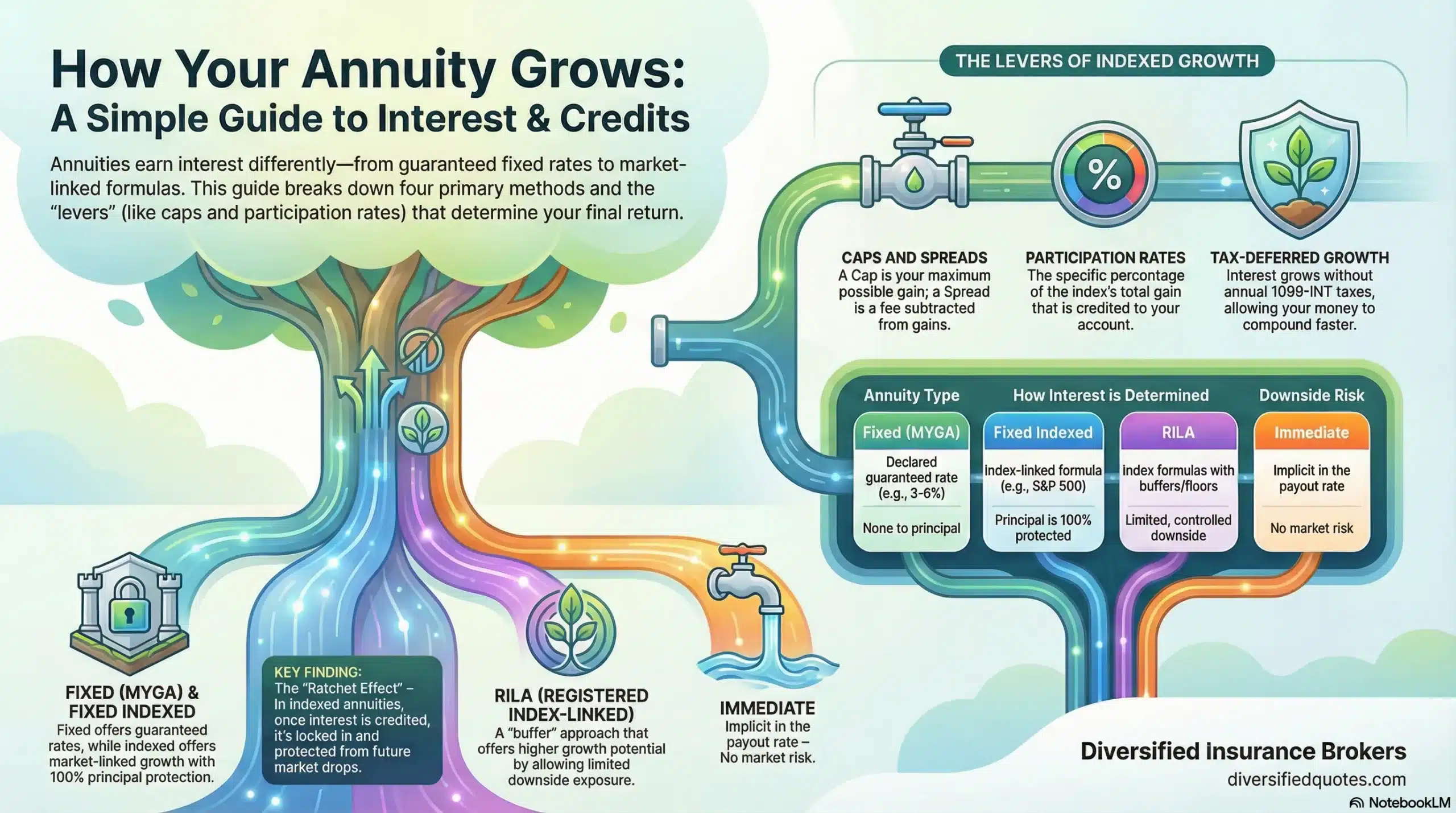
A crediting method is the formula used to calculate the interest credited to an indexed annuity during each crediting period, typically annual. The most common crediting methods are annual point-to-point (comparing the index level at the start and end of the year), monthly averaging (averaging monthly index values), and monthly sum (adding monthly cap-limited changes). Each method produces different results in different market environments. Annual point-to-point is often the simplest and most commonly used. The limits applied within the crediting method — the cap rate (maximum interest credited), the participation rate (percentage of index gain credited), and the spread (amount subtracted from index gain before crediting) — are the numbers that define how much index performance actually translates into credited interest. These limits can change at renewal and are a critical comparison point across carriers and contracts.
What is sequence of returns risk and why is it relevant to indexed annuity fit?
Sequence of returns risk is the specific vulnerability that makes early-retirement market declines permanently damaging to a withdrawal strategy — even when long-term average returns eventually normalize. The mechanism is that forced withdrawals during a declining account reduce the number of shares available to recover when markets rebound. Two retirees with identical 30-year average returns can have dramatically different outcomes depending on whether bad markets occurred early or late in retirement. Indexed annuities address sequence risk for the portion of assets allocated to the contract by removing the negative-market withdrawal scenario: because the contract protects against negative index credits, the account does not require selling depressed assets to fund withdrawals during a market downturn. When indexed annuity income covers essential expenses, the remaining portfolio can remain invested during downturns rather than being liquidated at the worst time.
What is the difference between an indexed annuity and a variable annuity?
A fixed indexed annuity credits interest based on the performance of an external index, subject to caps, participation rates, or spreads, with a floor at 0% protecting against negative index performance. The principal is not directly invested in the market. A variable annuity invests the premium in sub-accounts that are directly exposed to market performance — both upside and downside — similar to mutual funds. Variable annuity values can decline with market losses, unlike fixed indexed annuities. Variable annuities may offer higher long-term growth potential in bull markets but carry full market risk. Variable annuities also typically carry higher expense ratios than fixed indexed annuities because of the underlying sub-account management fees and mortality and expense charges. Most investors who are evaluating indexed annuities specifically are attracted to the principal protection feature — which is what distinguishes the FIA from a variable annuity most clearly.
How do I know if an indexed annuity is the right fit for my situation?
The clearest signal that an indexed annuity may be a good fit is the combination of: a defined timeline for the money that matches a multi-year contract, a specific purpose for the money (income at a future date, stable reserve, conservative layer alongside a growth portfolio), a preference for principal protection over maximum upside, and comfort with the trade-off of limited crediting in exchange for the floor. The clearest signals that it may not be a good fit are: significant near-term liquidity needs, a desire for full market participation including dividends, a very short time horizon, or a fundamental preference for transparent market-based accounts over insurance contract structures. The FIA suitability assessment table on this page maps nine common investor profiles to their suitability level and the key contract features that matter for each, providing a quick self-diagnostic before moving to product comparison.
About the Author:
Jason Stolz, CLTC, CRPC, DIA, CAA and Chief Underwriter at Diversified Insurance Brokers (NPN 20471358), is a senior insurance and retirement professional with more than 25 years of real-world experience helping individuals, families, and business owners protect their income, assets, and long-term financial stability. As a long-time partner of the nationally licensed independent agency Diversified Insurance Brokers, Jason provides trusted guidance across multiple specialties—including fixed and indexed annuities, long-term care planning, personal and business disability insurance, life insurance solutions, Group Health, Travel Medical and Evacuation Insurance, and short-term health coverage. Diversified Insurance Brokers maintains active contracts with over 100 highly rated insurance carriers, ensuring clients have access to a broad and competitive marketplace.
His practical, education-first approach has earned recognition in publications such as VoyageATL, and contributions from his agency featured in Kiplinger and GoBankingRates— highlighting his commitment to financial clarity and client-focused planning. Drawing on deep product knowledge and years of hands-on field experience, Jason helps clients evaluate carriers, compare strategies, and build retirement and protection plans that are both secure and cost-efficient. Visitors who want to explore current annuity rates and compare options across multiple insurers can also use this annuity quote and comparison tool.
Explore More Annuity Options: Browse our complete guide to What Is a Fixed Indexed Annuity? — covering FIA education, mechanics, crediting methods & indexed annuity strategies from 100+ carriers.
Last Reviewed: May 29, 2026 |
Reviewed by: Jason Stolz, CLTC, CRPC, DIA, CAA
Chief Underwriter, Diversified Insurance Brokers, Inc. | NPN: 20471358 | Diversified Insurance Brokers, Inc. — Licensed in all 50 states
Fact Checked by: Tonia Pettitt, CMIP©
Medicare Specialist, Diversified Insurance Brokers, Inc. | NPN: 14374308 | Diversified Insurance Brokers, Inc. — Licensed in all 50 states
Did you find this content helpful? Leave us a Google review — it helps others find trustworthy guidance too.
Editorial Standards: Diversified Insurance Brokers maintains rigorous editorial standards to ensure accuracy, clarity, and independence in all content. Learn more about our editorial standards and commitment to transparency.
