
How Does a Fixed Indexed Annuity Work?
How Does a Fixed Indexed Annuity Work?

Jason Stolz CLTC, CRPC, DIA, CAA
A fixed indexed annuity works by crediting interest to your account based on the performance of an external market index — such as the S&P 500 — while contractually guaranteeing that your principal is protected from negative index performance. Unlike investing directly in stocks or equity funds, you do not own any underlying shares, and your account cannot lose value due to market declines. If the tracked index rises during a crediting period, the insurance carrier credits interest to your account subject to defined contractual limits. If the index falls, your interest credit for that period is zero — not negative — and your previously accumulated value remains intact. This combination of market-linked growth potential and a guaranteed principal floor is the defining structural characteristic of fixed indexed annuities, and it is why many retirees and pre-retirees consider them as a stabilizing component when transitioning retirement savings from accumulation toward income.
For a broader understanding of where fixed indexed annuities fit within the overall annuity category, our annuities overview covers the full landscape. For the foundational definition of what a fixed indexed annuity is before diving into mechanics, our resource on what a fixed indexed annuity is provides the definitional framework. For a comparison with traditional fixed annuities, our resource on how a fixed annuity works covers the pure declared-rate alternative.
Ensure you are receiving the absolute top rates
Current Fixed Annuity Rates
Compare today’s best fixed annuity rates from top carriers.
Current Bonus Annuity Rates
See which annuities offer the highest upfront bonus today.
Request an Annuity Quote
Submit our annuity request form to get personalized rate options.
Lifetime Income Calculator
Use our calculator to see how much guaranteed income a fixed indexed annuity could provide at different ages and premium amounts.
How FIA Interest Crediting Works: Caps, Participation Rates, and Spreads
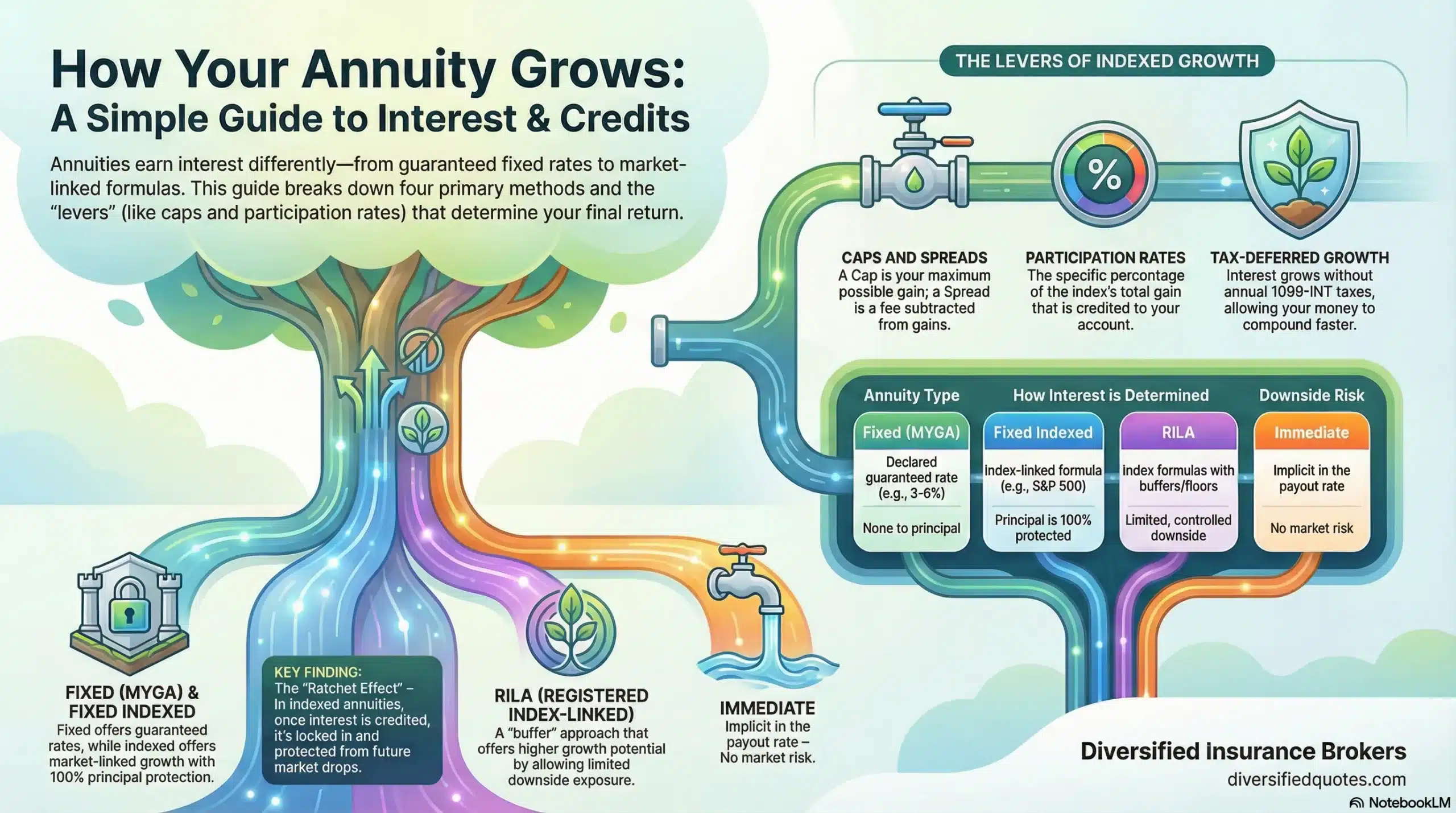
The most important mechanics to understand in a fixed indexed annuity are the interest crediting methods. These methods determine how much of any index gain actually reaches your account — and understanding them is more important than any headline rate, because two FIAs that both reference the S&P 500 Index can produce very different credited interest amounts depending on which crediting method applies and what the current parameters are. The three primary crediting methods are caps, participation rates, and spreads, and different carriers and products use different methods. Some contracts offer multiple crediting strategies within the same product, allowing policyholders to allocate across different method types.
FIA Interest Crediting Methods: How Each Works With Concrete Examples
| Crediting Method | How It Works | Index Gains 10% | Index Gains 5% | Index Falls 8% |
|---|---|---|---|---|
| Cap Rate (e.g., 7%) | Maximum interest credited regardless of how much the index gains | 7% credited (capped) | 5% credited (below cap) | 0% credited (floor protects principal) |
| Participation Rate (e.g., 60%) | A fixed percentage of the index gain is credited to the account | 6% credited (60% × 10%) | 3% credited (60% × 5%) | 0% credited (floor protects principal) |
| Spread / Margin (e.g., 2%) | Index gain minus the spread percentage is credited; floor still applies | 8% credited (10% − 2%) | 3% credited (5% − 2%) | 0% credited (floor applies; no negative result) |
Caps provide predictability at the cost of unlimited upside — you know the maximum you can earn in any period regardless of how well the index performs. Participation rates give you a defined fraction of all index gains, providing more upside exposure in strong years but less in moderate ones. Spreads subtract a fixed amount from index gains, potentially allowing unlimited upside in strong years while reducing credits in weaker positive years. A spread of 2 percent on a 1 percent index year produces zero credit, identical to the floor; a spread on a 15 percent index year produces 13 percent — more than a typical cap would allow. Understanding the specific crediting method in any contract you are evaluating is essential before comparing products, because a low cap and a high participation rate can produce similar long-term results while performing very differently in specific market environments. Our resource on index annuity crediting methods covers the mechanics of all three methods in technical detail.
The Annual Reset and Lock-In Feature
One of the defining characteristics of how a fixed indexed annuity works is its annual reset mechanism — one of the most misunderstood but most powerful features of the product structure. At the end of each crediting period, any interest earned is locked in as part of your new account value, and the index measurement resets from its current level for the next period. This means two things of significant planning importance.
The first is that gains are permanent. Once interest is credited to your account at the end of a crediting period, it becomes part of your protected value. A subsequent period in which the index declines cannot reduce the interest that was already credited. The value locked in at the end of a positive period becomes the new floor from which the next period is measured. This is structurally different from direct investment in an index fund, where a market decline that follows a previous gain reduces the account value directly — your $110,000 after a 10 percent gain becomes $88,000 after a 20 percent decline, not $110,000. With a FIA, that $110,000 credited value is protected from the subsequent decline.
The second implication is that the index measurement always starts fresh each period. When the index has declined over the preceding period, the next period’s starting point is that lower level — which means a recovery in the index generates positive credits from that lower starting point rather than needing to first recapture the prior decline before generating gains. This is the reset mechanism’s particular value in volatile markets: it systematically repositions the FIA’s starting point after downturns, allowing participation in recoveries from lower bases. Our resource on how fixed indexed annuities protect against market downturns covers the reset mechanism’s protective function in detail.
The Principal Protection Floor: What It Means and What It Does Not
The zero-percent floor in a fixed indexed annuity means that the interest credit in any period cannot be negative due to index performance. If the index tracks at negative 15 percent during the crediting period, your interest credit for that period is zero — not negative. Your accumulated account value does not decrease as a result of index performance.
This protection is meaningful and real, but it is important to understand precisely what it protects and what it does not. The zero-floor protects against index-performance losses. It does not protect against: surrender charges on withdrawals made before the surrender period ends; market value adjustments that some contracts apply to certain surrenders; reductions to account value caused by income rider fees if an optional income rider is attached; or the opportunity cost of holding a floor-protected product instead of a direct market investment in a sustained bull market.
Understanding both the protection and its limits is one of the most important parts of evaluating FIA suitability. Our resource on what the downside of a fixed indexed annuity is covers the tradeoffs honestly, and our resource on whether you lose your principal in an indexed annuity directly addresses the protection question many buyers ask. For a comprehensive review of common misconceptions about FIAs, our resource on fixed indexed annuity myths debunked addresses the most frequently misunderstood aspects of how these products work.
What Drives Index Credits: Options Budgets and Carrier Economics
Understanding why FIAs work the way they do — specifically why caps, participation rates, and spreads exist as limiting mechanisms — requires understanding the financial architecture behind the product. When you deposit a premium into a fixed indexed annuity, the insurance carrier does not invest your money directly in the stock market. Instead, the carrier invests the premium primarily in high-quality fixed-income instruments — bonds and similar assets — that generate a predictable yield over the crediting period. A portion of that yield is used to purchase options on the reference index (typically S&P 500 call options), which is how the carrier generates the index-linked credit when the index performs positively. The remaining yield funds the carrier’s operations and guarantees.
The cost of index options fluctuates with market conditions — specifically with market volatility and interest rates. When interest rates are higher, the fixed-income yield is greater, providing a larger budget to purchase options, which typically allows for higher caps or participation rates. When interest rates fall or volatility rises (making options more expensive), the carrier’s option budget may decrease, potentially reducing caps or participation rates at renewal. This is why FIA crediting parameters change at the end of each crediting period — carriers renew them based on current option costs and their own pricing decisions, subject to contractual minimums that protect policyholders from excessively low renewals. Evaluating minimum guaranteed crediting parameters alongside current offered parameters is an important part of realistic product evaluation.
Dividends Are Not Credited: An Important FIA Reality
One of the most important mechanical facts about how fixed indexed annuities work is that index dividends are not included in the interest calculation. The S&P 500, for example, represents both price returns (the movement of stock prices themselves) and total returns (price returns plus dividends paid by constituent companies). Fixed indexed annuities typically track the price-only version of the index — the movement in index price level — without including the dividend yield component.
Historically, dividends have represented a meaningful portion of total stock market returns over long periods, often one to two percentage points per year in typical market environments. By excluding dividends, FIA credits are based on a lower effective index return than the total return an index fund investor would receive. This is part of the tradeoff the FIA buyer accepts in exchange for principal protection and the zero floor: the floor protects against index price declines, and the absence of dividend crediting is part of the cost of that protection. Buyers who understand this tradeoff explicitly — rather than discovering it after purchase — are better positioned to evaluate whether a FIA’s protected growth potential justifies its role in their portfolio.
Tax Deferral and Funding Sources
Fixed indexed annuities grow tax-deferred — credited interest is not reported as taxable income in the year it is credited. This allows compounding to occur without the annual tax drag that applies to interest earned in a taxable savings account or CD. Tax deferral can be meaningful over multi-year accumulation periods, particularly in higher tax brackets where each year of delayed taxation preserves a greater percentage of credited interest for continued compounding.
FIAs can be funded with non-qualified after-tax dollars — making them non-qualified annuities subject to LIFO taxation on distributions — or with qualified retirement funds such as IRAs and 401(k)s. When funded inside an IRA, the FIA’s additional tax deferral is redundant (the IRA already provides deferral), so the value of FIA ownership inside an IRA comes from the product’s contractual guarantees — principal protection, crediting potential, and optional income riders — rather than from tax deferral. Our resource on best annuities for a 401(k) rollover covers the product evaluation framework for rollover-funded FIA purchases, and our resource on how annuities are taxed in retirement covers the tax treatment of FIA distributions for both qualified and non-qualified contexts.
Existing non-qualified annuities or life insurance cash values can often be repositioned into a fixed indexed annuity using a tax-free 1035 exchange, allowing the accumulated value — including embedded gains — to move into the new contract without triggering immediate income taxation. This can be a compelling strategy for policyholders with older annuities that no longer serve their current planning needs.
Liquidity, Surrender Periods, and Free Withdrawal Provisions
Fixed indexed annuities are long-term insurance contracts, not liquid savings vehicles. Most FIAs include a surrender period — typically 5 to 12 years — during which withdrawals above the annual free withdrawal amount may trigger surrender charges and in some contracts a market value adjustment (MVA). Understanding the surrender schedule before purchase is one of the most important steps in FIA evaluation: the right surrender period length is one that aligns with your genuine intended holding horizon, not just the longest available period that happens to offer the highest current cap rate.
Most FIA contracts provide an annual free withdrawal provision — typically 10 percent of the account value per year beginning in the second contract year — that allows limited access without surrender charges. This provision provides meaningful but not unlimited liquidity: it can cover routine supplemental income needs, required minimum distributions from a qualified IRA, or occasional one-time withdrawals within the annual limit. Withdrawals above the free amount during the surrender period trigger declining surrender charges that reduce the net distribution. Our resource on annuity free withdrawal rules covers the specific mechanics, and our resource on annuity surrender charges explained covers the surrender charge schedule mechanics in detail.
Income Riders: Adding Guaranteed Lifetime Income to a FIA
Many fixed indexed annuities offer optional income riders — typically called guaranteed lifetime withdrawal benefits (GLWBs) — that transform the FIA from purely an accumulation vehicle into a combined accumulation and income planning tool. When an income rider is attached, the contract maintains two separate values: the account value (the actual accumulation balance) and the income benefit base (a calculation value used solely to determine the guaranteed withdrawal amount).
The income benefit base typically grows at a contractual roll-up rate during the deferral period — often in the range of 5 to 8 percent annually, either simple or compound depending on the rider design. This growth is not accessible as a lump sum; it exists only to calculate the guaranteed withdrawal amount when income is activated. When the policyholder elects to begin income, the annual withdrawal amount is calculated as a percentage of the income benefit base — typically ranging from 4 to 6 percent depending on the policyholder’s age at income activation. Once income begins, the guaranteed withdrawal continues for the policyholder’s lifetime regardless of what happens to the account value. Our resource on what a fixed indexed annuity with an income rider is covers the combined structure, and our resource on what an annuity income benefit base is covers the benefit base mechanics that drive the income calculation. Our resource on whether income riders have fees covers the fee structure that should always be evaluated alongside income projections when comparing income-oriented FIA designs.
For households coordinating FIA income with Social Security timing and other retirement income sources, our resource on how Social Security and annuities work together covers the income-layering framework that makes these two guaranteed income sources most effective in combination.
Who Fixed Indexed Annuities Are Best Suited For
Fixed indexed annuities are most naturally suited to pre-retirees and retirees who want a defined structure for a portion of retirement savings — protection from market downturns with meaningful growth potential — without accepting the full risk of direct equity investing. The ideal FIA buyer is typically in the 55-to-70 age range, within 5 to 15 years of needing income from the asset, and has a clear planning purpose for the FIA: accumulation for a defined period, a future income floor, or a combination of both.
The FIA is less appropriate for buyers who need full liquidity at any time, buyers with investment horizons shorter than the surrender period, buyers whose primary goal is maximizing long-term returns (where direct index investing typically outperforms over sufficiently long periods), or buyers who are not prepared for the tradeoffs of capped or limited upside. Evaluating both the strengths and limitations honestly produces better long-term outcomes than purchasing based on the upside potential alone. Our resource on fixed indexed annuity myths debunked addresses the most common ways buyers misunderstand both sides of the product’s profile.
For buyers interested in how FIAs interact with Roth conversion strategies — using a FIA’s protected accumulation to reduce pressure on an investment portfolio during conversion years — our resource on Roth conversions with a fixed indexed annuity covers this specific planning combination. And for buyers comparing FIAs against other annuity types, our resources on highest annuity rates and whether annuities are worth it provide the broader marketplace context.
Related Pages: FIA Mechanics and Annuity Strategy
Continue researching FIA crediting methods, income riders, protection features, and carrier options.
Financial Protection Essentials
Carrier reviews, income planning tools, and protection resources.
Talk With an Advisor Today
Choose how you’d like to connect—call or message us, then book a time that works for you.
Schedule here:
calendly.com/jason-dibcompanies/diversified-quotes
Licensed in all 50 states • Fiduciary, family-owned since 1980
FAQs: How Does a Fixed Indexed Annuity Work?
What is a fixed indexed annuity and how is it different from a variable annuity?
A fixed indexed annuity is an insurance contract that credits interest based on the performance of an external market index — such as the S&P 500 — subject to contractual limits (caps, participation rates, or spreads), while guaranteeing that your principal is protected from negative index performance. If the index rises during the crediting period, you receive a portion of that gain up to the applicable limit. If the index falls, you receive zero interest for that period — not negative interest — and your accumulated value is protected from market decline.
A variable annuity works fundamentally differently: your premium is invested in underlying “subaccounts” that function like mutual funds and whose value fluctuates directly with the market. In a variable annuity, your account value can decrease when the market declines because you are directly exposed to market performance. This is the defining difference — FIAs use the index as a measurement tool for interest crediting while protecting principal; variable annuities use actual market investment with full market risk exposure. FIAs are insurance products regulated by state insurance departments; variable annuities are securities products regulated by the SEC and FINRA.
How does a fixed indexed annuity earn interest?
Interest is credited based on how a referenced index performs during a defined crediting period, filtered through one of three crediting methods: a cap rate (maximum interest regardless of index gain), a participation rate (a percentage of index gain credited), or a spread (index gain minus a defined percentage). In all three cases, if the index performs negatively, the credit is zero — not negative. If the index performs positively, the credit is determined by the method and current parameters.
The carriers fund this structure through insurance company options strategies: they invest premiums primarily in fixed-income instruments and use a portion of the yield to purchase index call options. This is how they can offer index-linked credits without directly investing your money in the market. The cost of these options fluctuates with interest rates and market volatility, which is why crediting parameters such as caps and participation rates can change at each crediting period renewal — they reflect the current option budget available from the yield on the underlying fixed-income portfolio.
Two important limitations apply in all FIA designs: dividends from the reference index are not included in the interest calculation (only price-return movement is tracked), and there is no FIA that can outperform direct index investment in strongly positive, sustained bull markets because of the caps and participation limits. The tradeoff for this limited upside is the principal protection floor — a tradeoff worth making for the portion of a portfolio where the priority is protection over maximum return.
Can I lose money in a fixed indexed annuity?
Your account value cannot decrease due to index performance — the zero-floor ensures that negative index periods produce zero interest credits rather than negative credits. However, there are other ways account value can be reduced that the zero-floor does not protect against. If you take withdrawals that exceed the annual free withdrawal provision during the surrender period, surrender charges apply to the excess amount, reducing your net proceeds. Some contracts also apply a market value adjustment to certain surrenders, which can increase or decrease the surrender value depending on interest rate movements since the contract was issued.
If you have an optional income rider attached to the contract, the annual rider fee — typically 0.5 to 1.5 percent of the income benefit base — is deducted from the account value each year. Over time, particularly in years when the index credit is low or zero, these fees can reduce the account value even when the zero-floor has prevented index-performance losses. In a prolonged period of minimal index credits combined with ongoing rider fees, it is possible for the account value to gradually decline over time even with the principal protection floor — while the income benefit base (a separate calculation value) may still be growing according to its contractual roll-up rate.
What is the annual reset feature and why does it matter?
The annual reset mechanism means that at the end of each crediting period, any credited interest is locked in permanently as part of the new account value, and the index measurement starting point resets to the current index level for the next period. This has two significant implications for how a FIA performs over time compared to direct market investment.
The first is that credited gains cannot be subsequently reduced by market declines. Once interest is credited at the end of a positive period, that value is protected going forward. A market decline in the following period produces a zero credit but does not reverse the previously credited interest. The second is that the reset systematically repositions the crediting starting point after downturns: if the index falls 20 percent during one period, the next period starts from that lower level, meaning a subsequent 20 percent index recovery produces a positive credit rather than just recovering to the prior starting point. This is the annual reset’s particular structural value in volatile market environments.
What is an income rider and how does it affect how the FIA works?
An income rider — specifically a guaranteed lifetime withdrawal benefit (GLWB) — is an optional feature that transforms a FIA from a pure accumulation vehicle into a combined accumulation and guaranteed income tool. When attached, the contract maintains two separate values: the actual account value (which accumulates based on index credits, fee deductions, and withdrawals) and the income benefit base (a separate calculation value used solely to determine the guaranteed income amount).
The income benefit base typically grows at a contractual roll-up rate — often 5 to 8 percent annually — during the deferral period before income begins. This growth is not accessible as a lump sum. It exists only to calculate the guaranteed annual withdrawal amount when income is eventually activated. When income is activated, the guaranteed withdrawal is a percentage of the income benefit base — typically 4 to 6 percent depending on age at activation — and that withdrawal continues for the policyholder’s lifetime regardless of what happens to the actual account value. If the account value depletes to zero due to ongoing withdrawals and fees, the carrier continues the guaranteed income payments from its own resources.
Income riders carry annual fees, typically 0.5 to 1.5 percent of the income benefit base, charged to the actual account value. This fee reduces account value annually and should be evaluated alongside projected income outputs when comparing income-rider FIAs. A rider that costs 1 percent annually but generates substantially higher guaranteed income than a rider charging 0.6 percent may be the better economic choice depending on the income level and the policyholder’s planning timeline.
Are FIAs tax-deferred and how are distributions taxed?
Yes — credited interest inside a fixed indexed annuity grows tax-deferred. You do not report the interest credits as taxable income in the year they are credited. This compounding advantage can be meaningful over multi-year accumulation periods, particularly in higher tax brackets where each year of tax on interest income would otherwise reduce the compounding base.
The tax treatment of distributions depends on whether the FIA is qualified (held inside an IRA or other retirement account) or non-qualified (funded with after-tax money outside a retirement account). For qualified FIAs, all distributions are fully taxable as ordinary income because the IRA already funded the account with pre-tax dollars. For non-qualified FIAs, the IRS applies LIFO (last in, first out) taxation: accumulated earnings come out first and are taxed as ordinary income before the after-tax cost basis is recovered tax-free. Systematic income payments from annuitized non-qualified FIAs receive different tax treatment through the exclusion ratio, which spreads cost basis recovery across the payment stream.
One strategically powerful application of non-qualified FIAs involves 1035 exchanges from older non-qualified annuities carrying large accumulated gains — repositioning those gains into a new FIA without triggering immediate taxation, with the potential for those gains to eventually exit tax-advantaged under the new contract’s provisions. Our resource on how annuities are taxed in retirement covers the full tax framework for FIA distributions in both qualified and non-qualified contexts.
Who is a fixed indexed annuity best suited for?
Fixed indexed annuities are most naturally suited to pre-retirees and retirees in the 55-to-70 age range who want a defined structure for a portion of their retirement savings — principal protection with meaningful growth potential — without accepting full equity market risk. The FIA performs the “protected accumulation” role in a retirement portfolio: it can grow meaningfully in positive market environments while preventing the account-value damage that direct equity exposure would produce during market downturns.
The ideal FIA buyer has a planning purpose that aligns with the product’s structure: accumulation for a defined period (matching the surrender period), a future income floor through an income rider, or a combination of both. The ideal buyer also does not need fully liquid access to the FIA funds during the surrender period — only the annual free withdrawal amount — because the surrender charge structure makes partial access above that limit costly. Buyers who match their holding horizon to the surrender period avoid ever facing a surrender charge scenario.
The FIA is less appropriate for buyers who prioritize maximum long-term returns above all else — direct equity investing typically outperforms in sustained bull markets because it captures both price appreciation and dividends without caps or participation limits. The FIA’s value proposition is the protection-plus-growth combination, not maximum return. Understanding this clearly produces better buyer-product fit, which is why our resource on what the downside of a fixed indexed annuity is is as important as understanding the upsides.
About the Author:
Jason Stolz, CLTC, CRPC, DIA, CAA and Chief Underwriter at Diversified Insurance Brokers (NPN 20471358), is a senior insurance and retirement professional with more than 25 years of real-world experience helping individuals, families, and business owners protect their income, assets, and long-term financial stability. As a long-time partner of the nationally licensed independent agency Diversified Insurance Brokers, Jason provides trusted guidance across multiple specialties—including fixed and indexed annuities, long-term care planning, personal and business disability insurance, life insurance solutions, Group Health, Travel Medical and Evacuation Insurance, and short-term health coverage. Diversified Insurance Brokers maintains active contracts with over 100 highly rated insurance carriers, ensuring clients have access to a broad and competitive marketplace.
His practical, education-first approach has earned recognition in publications such as VoyageATL, and contributions from his agency featured in Kiplinger and GoBankingRates— highlighting his commitment to financial clarity and client-focused planning. Drawing on deep product knowledge and years of hands-on field experience, Jason helps clients evaluate carriers, compare strategies, and build retirement and protection plans that are both secure and cost-efficient. Visitors who want to explore current annuity rates and compare options across multiple insurers can also use this annuity quote and comparison tool.
Explore More Lifetime Income Options: Browse our complete guide to How Retirement Accounts & Annuities Work — covering how IRAs, 401ks, annuities, pensions, GLWBs & fixed indexed annuities work from 100+ carriers.
Explore More Annuity Options: Browse our complete guide to What Is a Fixed Indexed Annuity? — covering FIA education, mechanics, crediting methods & indexed annuity strategies from 100+ carriers.
Last Reviewed: May 21, 2026 |
Reviewed by: Jason Stolz, CLTC, CRPC, DIA, CAA
Chief Underwriter, Diversified Insurance Brokers, Inc. | NPN: 20471358 | Diversified Insurance Brokers, Inc. — Licensed in all 50 states
Fact Checked by: Tonia Pettitt, CMIP©
Medicare Specialist, Diversified Insurance Brokers, Inc. | NPN: 14374308 | Diversified Insurance Brokers, Inc. — Licensed in all 50 states
Did you find this content helpful? Leave us a Google review — it helps others find trustworthy guidance too.
Editorial Standards: Diversified Insurance Brokers maintains rigorous editorial standards to ensure accuracy, clarity, and independence in all content. Learn more about our editorial standards and commitment to transparency.
