
Best Burial Insurance for Parents over 80
Best Burial Insurance for Parents over 80

Jason Stolz CLTC, CRPC, DIA, CAA
Finding the best burial insurance for parents over 80 is less about chasing a “perfect” policy and more about getting the structure right for real-world senior underwriting. At ages 80-85, families typically want three things: a plan that is actually available at this age, premiums that stay level and predictable, and a benefit that is simple to claim when the time comes. The good news is that final expense whole life coverage is designed specifically for this stage of life, and many options can be approved without a medical exam. At Diversified Insurance Brokers, we help families compare final expense policies for seniors nationwide, including options that may pay immediate full benefits when health qualifies and options that still provide a reliable path to coverage when health is uncertain or more complex. The “best” plan is the one your parent can keep in force long-term, with a benefit size that matches final expenses without creating monthly budget pressure. If you are the adult child helping a parent over 80, you’re not alone. Many families start this process because they want to avoid last-minute decisions, prevent out-of-pocket funeral costs, and make sure siblings or caregivers aren’t forced to scramble for funds during an emotional time. This page will walk you through what types of policies work at 80+, how to choose a realistic coverage amount, and how to set up ownership and premium payments so the plan stays active. Our companion resource on burial insurance for seniors over 80 covers the carrier-specific landscape for this exact age group, including which carriers accept applications up to age 85 and which stop earlier.
Compare Burial Insurance Options for Ages 80–85
We’ll show policies that accept seniors at 80+ and explain immediate benefits versus graded benefit periods in plain English.
Request a Burial Insurance Quote Call 800-533-5969Why Burial Insurance Is Often the Best Fit After Age 80
After age 80, many traditional life insurance pathways narrow. Large term policies often become expensive, more difficult to qualify for, or simply unnecessary when the goal is covering final expenses rather than income replacement. Burial insurance (also called final expense life insurance) was created for this exact situation: smaller face amounts, permanent coverage that does not expire, and underwriting that is built around senior ages. For most families, the practical value is straightforward. A burial insurance policy creates a dedicated pool of cash that can be used for funeral home costs, cremation or burial expenses, cemetery charges, travel for family members, leftover household bills, and final medical costs. Even when a parent has savings or assets, timing matters. Survivors often need funds quickly, and a policy benefit can prevent the family from putting expenses on credit cards or borrowing from relatives. If you’re newer to this topic and want the broad overview first, our resource on burial insurance is a helpful starting point. If you specifically want to compare burial insurance versus other forms of coverage, our resource on final expense life insurance provides useful context. For the specific product type — final expense whole life insurance — that makes up the majority of burial insurance policies for seniors, our resource on final expense whole life insurance covers how these permanent policies are structured and why they’re the dominant product in this market segment.
What Types of Policies Work Best for Parents Over 80?
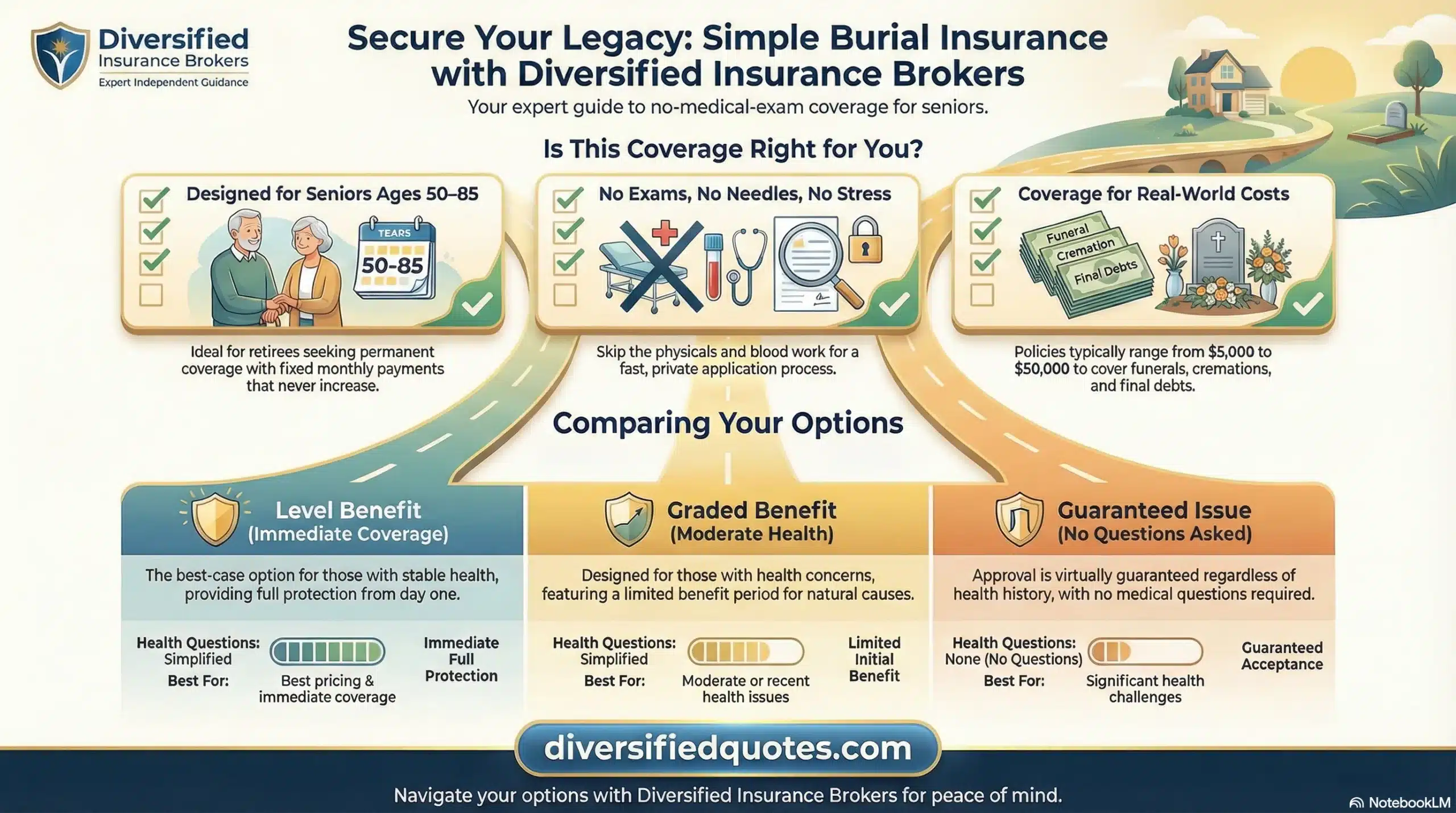
At 80+, most burial insurance options fall into two underwriting categories. Both are typically “no exam” in the sense that there is no paramedical exam with bloodwork, urine samples, or in-home nurse visits. The difference is whether the carrier asks health questions and how the death benefit behaves in the first one to two years. Simplified issue burial insurance uses a short health questionnaire and electronic data checks to make an underwriting decision. If your parent can answer “no” to the key screening questions and the background checks align, simplified issue policies often provide level benefits — meaning the full death benefit is available immediately once the policy is active. Guaranteed issue burial insurance typically has no health questions. Approval is generally based on age eligibility and state availability. This is often the most reliable “yes” option for parents with more complicated health histories. For a comprehensive look at guaranteed issue options specifically — the coverage structures, graded period mechanics, and carrier selection criteria that apply when health questions are removed from the process — our resource on guaranteed issue burial insurance covers that underwriting path in detail. For the specific question of which products provide benefits without a waiting period from day one, our resource on burial insurance with no waiting period covers the level-benefit policies that eliminate the graded period entirely.
Simplified Issue vs. Guaranteed Issue — The Core Decision for Ages 80–85
The choice between simplified issue and guaranteed issue is the most important underwriting decision for burial insurance at age 80+. Both paths are no-exam. Both provide permanent coverage. But they differ fundamentally in how they handle the health evaluation and how they structure the early death benefit. The table below maps the key differences so families can evaluate which path is right for their situation.
General reference only. Specific eligibility, graded period terms, coverage limits, and features vary by carrier and state. Review full policy documents before any purchase decision.
| Feature | Simplified Issue (Level Benefit) | Guaranteed Issue (Graded Benefit) |
|---|---|---|
| Health questions required | Yes — typically 5-15 questions about recent diagnoses, treatments, and hospitalizations; answers are verified through electronic prescription and MIB checks | No — approval based on age eligibility and state availability only; no medical or health information required |
| Medical exam required | No exam — no bloodwork, nurse visit, or physical examination | No exam — no medical evaluation of any kind |
| Day-one death benefit for natural causes | Full death benefit payable immediately from policy effective date — no waiting period for natural causes | Graded benefit applies — natural-cause death in early period (typically first 2 years) pays return of premiums plus interest, not the full face amount |
| Day-one accidental death coverage | Full death benefit paid for accidental death from day one | Most policies pay the full death benefit for accidental death from day one, even during the graded period |
| Typical graded period | No graded period — coverage is level from policy effective date | Typically 2 years from policy effective date; after graded period ends, full death benefit is payable for all covered causes |
| Coverage amounts (typical at age 80–85) | Often $5,000 to $25,000+ depending on carrier, state, and age; higher face amounts sometimes available for qualifying applicants | Often $5,000 to $25,000; maximum face amounts may be lower than simplified issue at the same age, reflecting the higher risk profile of no-health-question coverage |
| Premium (relative comparison) | Generally lower premium for the same face amount — health screening allows carriers to price more favorably for qualifying applicants | Generally higher premium for the same face amount — no health screening means carriers price conservatively for the unknown risk pool |
| Prior life insurance declines | Prior declines may affect eligibility — some simplified issue carriers ask specifically about prior declines or use MIB data that reflects prior application history | Prior declines generally do not affect eligibility — guaranteed issue does not evaluate any health or prior insurance history |
| Best suited for | Parents in relatively stable health whose conditions are controlled and who want immediate full benefits from day one at the best available premium | Parents with complicated health histories, recent serious health events, prior declines, or families who want acceptance certainty and are comfortable with the graded period |
| Premium stability | Level premiums for life — premiums do not increase due to age or health changes after policy issue | Level premiums for life — same guarantee applies regardless of underwriting path chosen |
Burial Insurance Calculator
Get a baseline estimate for ages 80-85, then we’ll help you compare immediate benefit and graded benefit options side by side. After you view a price range, the next step is choosing the correct underwriting path for your parent’s health profile.
Graded Benefit vs. Level Benefit — The Detail That Matters Most at 80+
Families often assume that if a policy is approved, the full benefit is available immediately. That is true for many level benefit simplified issue plans, but it is not always true for guaranteed issue policies and some modified plans. Understanding graded versus level benefits is crucial because it tells you what the policy actually does during the early policy period. A level benefit burial insurance policy is what most people expect. Once the policy is in force and the first premium has been paid, the full death benefit is payable for natural causes or accidental death according to the contract terms. This structure is usually the ideal outcome when your parent qualifies. A graded benefit burial insurance policy introduces a waiting period for natural causes. In that early period, a natural-cause death claim typically does not pay the full face amount. Instead, many contracts pay a return of premium (often with interest or a multiplier). Accidental death may still be paid in full from day one. After the graded period ends, the policy typically transitions to paying the full face amount for natural-cause claims. The purpose of this design is not to “trap” families — it is an underwriting tool that allows carriers to accept higher-risk applicants at senior ages while still keeping premiums stable and coverage permanent. If your family’s top priority is immediate full benefits, our related resource on best burial insurance with immediate coverage covers the specific simplified issue products that deliver level benefits from day one. Our companion resource on affordable burial insurance with no medical exam covers the no-exam landscape where both simplified issue and guaranteed issue options are compared for affordability.
How Much Burial Insurance Do Parents Over 80 Typically Buy?
Most families choose burial insurance amounts based on a realistic estimate of final costs plus a small buffer. At age 80+, common face amounts are often in the $5,000 to $20,000 range, with some policies allowing higher depending on the carrier, state, and underwriting class. The “best” amount is not a generic number — it is the smallest benefit that realistically accomplishes the goal without making the monthly premium hard to sustain. If your parent wants basic coverage for cremation and a simple service, a lower face amount may be sufficient. If your family expects a traditional funeral and burial with cemetery expenses, the target may be higher. Many families also include a cushion for travel costs, final medical bills, or a month or two of household expenses. If you want a structured way to pick the number, our guide on how much burial insurance do I need walks through the methodology. To align coverage with real-world funeral pricing, our resources on how much does a funeral cost and how much does it cost to be cremated provide current cost context. For seniors over 80 who want to compare how this age group’s options differ from adjacent age brackets, our resource on burial insurance for seniors over 70 covers the 70+ landscape for context, while our broader resource on burial insurance for seniors covers the full senior age spectrum.
What Affects Burial Insurance Pricing After Age 80?
At 80+, pricing is primarily influenced by age, state, tobacco status, the face amount you choose, and whether the policy is simplified issue or guaranteed issue. Because senior pricing can vary widely across carriers, comparison shopping matters more at this age than most families expect. Age is a major driver. Even within the 80-85 range, monthly premiums can shift meaningfully from one age to the next. That’s why families who are already considering coverage often benefit from acting sooner rather than later, since burial insurance is generally designed with level premiums that lock in at issue. Tobacco use can increase premiums substantially, and at older ages the difference between tobacco and non-tobacco pricing often becomes more noticeable. If tobacco status is a factor, it’s even more important to compare multiple carriers, because some companies price tobacco more aggressively than others. Health conditions and medication profiles matter most for simplified issue plans. Many parents over 80 still qualify for simplified issue if conditions are stable and there have not been recent serious events. For specific health conditions common in the 80+ population, build and mobility factors may influence eligibility or pricing. These resources may help: burial insurance for overweight people, burial insurance for people with high blood pressure, and burial insurance for smokers. For two of the most common health concerns in the 80+ age group — diabetes and ADL Decline — our resources on burial insurance for diabetics and burial insurance for Alzheimer’s and dementia patients cover how underwriters approach these specific conditions and which coverage paths are most accessible.
Carrier Age Limits — Not All Carriers Accept Ages 80–85
One of the most practically important facts about burial insurance for parents over 80 is that not all carriers offer coverage at this age. Some carriers stop accepting new applications at age 75 or 80, while others accept applicants up to age 85. Among those that do accept 80+ applicants, maximum face amounts may be lower than what’s available at younger ages, and simplified issue products may have tighter eligibility criteria. This means that identifying the right carrier is the first step — and working with an independent broker who has access to multiple companies is the most efficient way to identify which carriers are actively competitive for your parent’s specific age and state. A carrier that is competitive for a 79-year-old may not be the right choice for an 81-year-old. At Diversified Insurance Brokers, we maintain current carrier data across the burial insurance marketplace specifically to address this: knowing which companies are genuinely competitive at 80, 82, and 85 — rather than theoretically accepting applications at those ages — is a meaningful service for families in this situation.
Medicare and Burial Insurance — What They Don’t Share
A common point of confusion for families helping parents over 80 is the relationship between Medicare and burial insurance. Medicare does not pay for funeral expenses, burial costs, or cremation. Medicare covers medical treatment during life — hospital stays, physician services, and medically necessary procedures. It has no role in paying for end-of-life arrangements. Some families also wonder whether Medicaid, which covers long-term care costs for qualifying low-income individuals, pays for funerals. Medicaid does not fund funerals or burial costs either, though some states have specific Medicaid burial allowance programs with very limited benefits. The practical implication is that even parents with comprehensive Medicare coverage have no insurance mechanism covering their final expense costs — which is exactly the planning gap that burial insurance fills. For families who also want to review Medicare plan options for their parents, the Medicare comparison tool on our Medicare pages can help with that parallel planning need.
Can an Adult Child Own and Pay for Burial Insurance for a Parent Over 80?
In many cases, yes. Families commonly set up burial insurance so the adult child is the payer and, when appropriate, the owner of the policy, while the parent is the insured. This can be a practical way to keep the coverage in force, especially when the parent has a fixed income or when the family wants to ensure premiums are paid consistently through automatic draft. Ownership rules can vary depending on the carrier and state regulations, and your parent’s consent is required because coverage is on their life. The benefit of correct ownership structure is control: the owner can manage billing, confirm beneficiary designations, and keep the paperwork organized so that filing a claim later is straightforward. Beneficiary designations matter, too. Many families name a child (or multiple children) as beneficiary, or they name a trust when appropriate. The goal is clarity — making sure the benefit goes where it is intended with minimal confusion. If you’re thinking about how the benefit is treated for taxes, this is a helpful reference: is life insurance death benefit taxable. For a comparison of burial insurance with whole life versus term structures — an important structural question when evaluating permanence of coverage — our resource on the whole life burial insurance vs. term comparison covers when each structure is appropriate.
How to Choose the Right Policy at 80+ Without Guessing
Most families want to do this once and do it correctly. The simplest approach is to decide what matters most, then match the underwriting path to that goal. If immediate full benefits are the top priority and your parent’s health is relatively stable, exploring simplified issue is often the best first step. When simplified issue is available, it can deliver level benefits from day one and more favorable pricing than guaranteed issue. If acceptance certainty is the top priority and your parent has a complicated health history, recent declines, or you simply don’t want uncertainty, guaranteed issue may be the cleanest path. The trade-off is the graded benefit period, which should be reviewed carefully so the family understands the early policy years. If budget is the primary concern, right-sizing the face amount is usually the most effective lever. A smaller policy that stays active is often better than a larger policy that becomes difficult to maintain. Many families benefit from seeing these options side-by-side. We can show a simplified issue quote (when eligible) alongside a guaranteed issue alternative so you can compare premium, benefit structure, and early-year payout details clearly.
Application and Timing Tips for Parents Over 80
Burial insurance applications are often simpler than families expect. Most begin with basic demographic information, beneficiary details, and either a short health questionnaire (simplified issue) or no health questions (guaranteed issue). Many decisions come back quickly, and once the policy is issued and the first premium is paid, coverage becomes active according to the carrier’s effective date rules. One practical tip is to gather a current list of medications and doctors before applying, even if you’re targeting guaranteed issue. For simplified issue, accurate health answers are essential because electronic checks may reference prescription history and other data sources. Being upfront helps avoid delays and helps us match your parent to the most appropriate plan. Another important tip is to set up premium payments in a way that prevents lapses. For many families, monthly EFT draft is the simplest approach. Some carriers may also offer more favorable effective cost with annual billing, but monthly is usually the most comfortable choice for senior budgets. If your parent has been declined for other life insurance in the past, it doesn’t automatically mean burial insurance is unavailable — it often means the wrong underwriting path or the wrong carrier was chosen. A strategic approach is usually more efficient than applying randomly. If you’re helping a parent with broader health concerns, this page can help set expectations: life insurance with pre-existing conditions.
Why Work With Diversified Insurance Brokers for Burial Insurance After 80?
At ages 80-85, small differences in underwriting rules can matter a lot. Two parents of the same age can receive very different offers depending on health stability, medications, tobacco status, and the carrier’s screening criteria. Our job is to make the process clear and realistic, compare options quickly, and help you select the plan that best matches your parent’s needs and budget. We also help families avoid the most common pain points: confusion about graded benefits, buying too much coverage and stressing a fixed budget, and selecting a plan that doesn’t match the family’s expectations for early-year claims. When the structure is clear, burial insurance becomes one of the simplest forms of protection to put in place. If you’re ready to compare options, request a quote below and we’ll walk you through what is available for your parent’s age and state.
Get the Best Burial Insurance Option for Parents 80–85
We’ll compare carriers, confirm eligibility, and explain graded versus immediate benefits in plain English.
Request a Burial Insurance Quote Call 800-533-5969Related Burial Insurance Pages
Helpful resources for choosing coverage amounts, understanding benefits, and comparing senior-friendly plans.
Financial Protection Essentials
Core strategies to protect retirement income, prepare for healthcare costs, and build long-term financial stability.
Talk With an Advisor Today
Choose how you’d like to connect—call or message us, then book a time that works for you.
Schedule here:
calendly.com/jason-dibcompanies/diversified-quotes
Licensed in all 50 states • Fiduciary, family-owned since 1980
FAQs: Best Burial Insurance for Parents Over 80
Can you get burial insurance at age 80 or older?
Yes. Many final expense whole life policies accept applicants in the 80-85 age range. Availability and maximum benefit amounts vary by carrier and state, so it helps to compare multiple options rather than assuming there is only one choice. Not every carrier accepts applications at every age within this range — some stop at 80 while others accept through 85. Working with an independent broker who knows which carriers are actively competitive at specific ages (not just technically accepting applications) produces the most efficient comparison at ages 80 and above. Once a policy is issued, premiums are level for life and coverage does not expire as long as premiums are paid.
Is a medical exam required for ages 80–85?
Usually no. Most burial insurance for seniors in the 80-85 age range is designed as no-exam coverage. You will typically choose between simplified issue (which uses a short health questionnaire and electronic data verification) or guaranteed issue (which requires no health information at all). Neither requires a nurse visit, blood draw, or in-home examination. The best path depends on your parent’s health profile and whether immediate full benefits are a priority. Simplified issue offers the opportunity for immediate level benefits at potentially lower premiums if health qualifies. Guaranteed issue provides acceptance certainty regardless of health history but includes a graded benefit period for natural causes.
How much coverage do parents over 80 typically buy?
Many families choose $5,000-$15,000, with some selecting $20,000 or more when budgets allow and when the carrier permits it at these ages. The goal is to match expected final expenses while keeping premiums comfortable for the long term. A useful sizing exercise: estimate the realistic funeral or cremation cost in your area, add travel costs for family members coming from out of town, add a small buffer for outstanding medical bills or household expenses, and that total usually suggests the right face amount. A smaller policy that stays in force long-term is almost always preferable to a larger policy that creates premium pressure and risks lapsing.
Will premiums increase or can the policy expire?
Final expense whole life policies are typically designed with level premiums and lifetime coverage. Premiums generally do not increase due to age or health changes after issue, and coverage does not expire as long as premiums are paid. This is one of the most important structural features of burial insurance versus term life insurance — the coverage is permanent. An 80-year-old who purchases a burial insurance policy today will have the same monthly premium at age 90 or 95, and the policy will remain in force as long as payments continue. This predictability is one of the primary reasons families choose whole life for final expense planning rather than any form of term coverage.
What is a graded death benefit and why does it matter?
A graded benefit policy limits natural-cause death benefits during the first one to two years after policy issue. During that graded period, many policies pay a return of premiums paid (commonly with interest) rather than the full face amount for natural-cause deaths. Accidental death is usually covered at the full face amount from day one even during the graded period. After the graded period ends — typically at the 24-month mark — the policy pays the full death benefit for natural causes. This matters practically because it changes what the family receives if a claim occurs in the early policy years. Before purchasing any burial insurance policy, it’s important to understand whether it is a level benefit (immediate full benefits from day one) or graded benefit design, and to communicate clearly to family members what the policy does during its early period.
Can serious health conditions still qualify at 80+?
Often yes. Even when health is complex, guaranteed issue coverage is typically available because it does not evaluate health at all — approval is based only on age eligibility and state availability. If health is stable enough for simplified issue, that path may offer lower premiums and immediate full benefits. Common health conditions in the 80+ population — including managed diabetes, high blood pressure, heart disease that has been stable, and prior cancer with completed treatment — may still qualify for simplified issue depending on the carrier’s specific guidelines and the stability of the conditions. Cognitive decline and dementia create more complexity in underwriting because carriers must ensure that the applicant understands and consents to the policy, but guaranteed issue remains available in many situations even when cognitive impairment is present.
How fast can coverage start for an 80-year-old?
Many simplified issue decisions are returned quickly — sometimes within minutes to a few days, depending on the carrier’s electronic verification checks. Guaranteed issue approvals can also be fast because there is no health information to evaluate. Coverage becomes active according to the carrier’s effective date rules once the policy is issued and the first premium is paid. For simplified issue, the effective date is typically the policy issue date or a specific date aligned with the premium receipt. For guaranteed issue, the same general principle applies — the coverage is active from issue, and the graded period clock begins running from that date.
Can an adult child own and pay for the policy?
In many cases, yes. With the parent’s consent and depending on carrier rules, an adult child can often be the payer and may be able to own the policy. This structure keeps premiums organized, prevents lapses due to forgotten payments on the parent’s fixed income, and gives the adult child clear access to policy documents and beneficiary information when the time comes to file a claim. The parent’s informed consent is required because the insurance is on their life. Carrier rules vary — some require the owner and insured to have an established insurable interest relationship (which a parent-child relationship satisfies), while others may have specific rules about third-party ownership at older ages.
How can we keep premiums affordable at age 80+?
Affordability usually comes from right-sizing the benefit amount, comparing multiple carriers, and selecting the underwriting path that best matches your parent’s health profile. Right-sizing means choosing the face amount that realistically covers expected final expenses without adding a large excess that increases premiums without adding proportional value. Comparing carriers matters because pricing for the same age, face amount, and health profile can vary meaningfully across companies — some carriers are significantly more competitive for 80+ applicants than others. If simplified issue is available for your parent, it typically produces lower premiums than guaranteed issue for the same coverage amount, because health screening allows carriers to price more favorably for qualifying applicants.
Does tobacco use affect rates for over-80 applicants?
Yes. Tobacco status can significantly increase premiums at older ages, and at 80+ the premium difference between tobacco and non-tobacco rates is often more pronounced than at younger ages. Most carriers apply tobacco classification based on whether nicotine or tobacco products have been used within the past 12-24 months (the specific look-back period varies by carrier). If your parent qualifies for non-tobacco pricing, premiums are often meaningfully lower — which is one reason it’s important to compare carriers rather than accepting the first quote received. Some carriers have narrower tobacco surcharges than others, and identifying the most competitive non-tobacco or tobacco carrier for your parent’s specific profile can produce meaningful savings on a fixed-income budget.
What happens when a claim is filed after the insured passes away?
Filing a burial insurance claim is typically straightforward. The beneficiary (or policy owner if different from the beneficiary) contacts the insurance carrier to initiate the claim. The carrier typically requires a completed claim form, a certified copy of the death certificate, and in some cases the original policy document. Most carriers process burial insurance claims relatively quickly because the benefit amounts are smaller and the documentation is simpler than larger life insurance policies. Having the policy documents organized — including the policy number, carrier contact information, and beneficiary designations on file — makes the claim process faster during what is already an emotionally difficult time. This is one practical reason to review policy documents annually and confirm that all information is current and accessible to the intended beneficiaries.
Is burial insurance different from a pre-paid funeral plan?
Yes — burial insurance and pre-paid funeral plans are fundamentally different products, though both aim to address final expense costs. A pre-paid funeral plan is a contract with a specific funeral home where you prepay for services at today’s prices. The money goes to that specific funeral home, the services are defined in advance, and the contract is typically tied to that provider. Burial insurance is a life insurance policy that pays a cash benefit to a named beneficiary who can use the funds for any final expense — including choosing any funeral home, adjusting the service based on actual circumstances, paying travel costs, covering medical bills, or handling other household obligations. The flexibility of burial insurance is often preferable for families who want the beneficiary to have freedom in how funds are used, who don’t want to be locked into a specific provider, and who want proceeds to be available for all end-of-life costs rather than only pre-defined services.
About the Author:
Jason Stolz, CLTC, CRPC, DIA, CAA and Chief Underwriter at Diversified Insurance Brokers (NPN 20471358), is a senior insurance and retirement professional with more than 25 years of real-world experience helping individuals, families, and business owners protect their income, assets, and long-term financial stability. As a long-time partner of the nationally licensed independent agency Diversified Insurance Brokers, Jason provides trusted guidance across multiple specialties—including fixed and indexed annuities, long-term care planning, personal and business disability insurance, life insurance solutions, Group Health, Travel Medical and Evacuation Insurance, and short-term health coverage. Diversified Insurance Brokers maintains active contracts with over 100 highly rated insurance carriers, ensuring clients have access to a broad and competitive marketplace.
His practical, education-first approach has earned recognition in publications such as VoyageATL, and contributions from his agency featured in Kiplinger and GoBankingRates— highlighting his commitment to financial clarity and client-focused planning. Drawing on deep product knowledge and years of hands-on field experience, Jason helps clients evaluate carriers, compare strategies, and build retirement and protection plans that are both secure and cost-efficient. Visitors who want to explore current annuity rates and compare options across multiple insurers can also use this annuity quote and comparison tool.
Explore More Burial Insurance Options: Browse our complete guide to Burial Insurance for Seniors — covering burial insurance for seniors over 50, 60, 70, 80 & parents from top carriers from top carriers.
Last Reviewed: May 31, 2026 |
Reviewed by: Jason Stolz, CLTC, CRPC, DIA, CAA
Chief Underwriter, Diversified Insurance Brokers, Inc. | NPN: 20471358 | Diversified Insurance Brokers, Inc. — Licensed in all 50 states
Fact Checked by: Tonia Pettitt, CMIP©
Medicare Specialist, Diversified Insurance Brokers, Inc. | NPN: 14374308 | Diversified Insurance Brokers, Inc. — Licensed in all 50 states
Did you find this content helpful? Leave us a Google review — it helps others find trustworthy guidance too.
Editorial Standards: Diversified Insurance Brokers maintains rigorous editorial standards to ensure accuracy, clarity, and independence in all content. Learn more about our editorial standards and commitment to transparency.
