
Best Burial Insurance
Best Burial Insurance with Immediate Coverage

Jason Stolz CLTC, CRPC
Finding the best burial insurance means finding a policy your family can actually rely on when it matters most — with coverage that pays out as expected, premiums that stay manageable for life, and an approval process that matches your real health situation rather than assuming perfect health. Burial insurance — also called final expense life insurance — is permanent whole life coverage specifically designed for funeral costs, cremation or burial expenses, final medical bills, family travel costs, and other end-of-life expenses that arrive without warning and require quick resolution.
At Diversified Insurance Brokers, we help families nationwide compare burial insurance options from a wide range of top-rated carriers so you can choose the right policy based on your age, health history, and budget — without the sales pressure of a single-carrier agent pushing one product. The best burial insurance is not the one with the most marketing spend or the most television advertising. It is the policy that is structured correctly for your specific profile, priced at a premium you can maintain for decades, and backed by a carrier whose claims process is straightforward when your family needs it most. If you are new to final expense coverage, our overview of burial insurance provides the foundational framework for how these policies work and why they are different from term life insurance.
Get the Best Burial Insurance Quotes (No Medical Exam)
We’ll compare simplified issue vs. guaranteed issue burial insurance and help you lock in the best fit for your age, health, and budget.
Request a Burial Insurance QuoteQuestions? Call 800-533-5969
What Makes One Burial Insurance Policy Better Than Another
The burial insurance market is large and genuinely competitive, with dozens of carriers offering products that appear similar on the surface but differ meaningfully in the ways that matter at claim time. Understanding what distinguishes a genuinely good burial insurance policy from an adequate one — and what distinguishes both from a poor one — allows for shopping that produces real value rather than simply the lowest premium on a comparison spreadsheet.
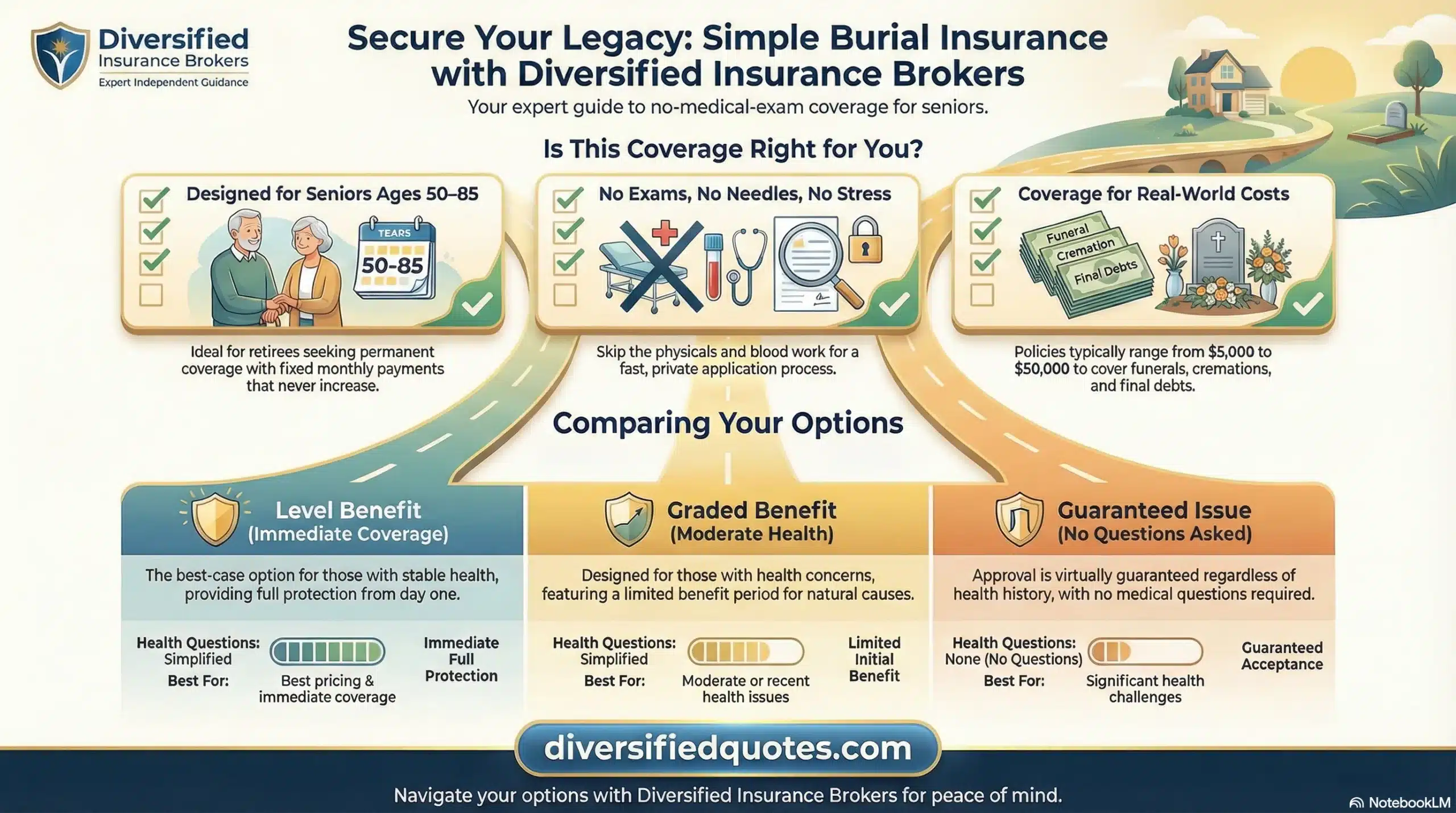
Benefit structure is the most important distinction. The single most consequential variable in burial insurance is whether the policy provides immediate full coverage from day one (level benefit) or limited coverage during an initial waiting period (graded benefit). A level benefit policy means the full death benefit is available for covered causes of death from the moment the policy is active. A graded benefit policy means the benefit for natural causes of death is limited — often returning premiums plus interest — during a waiting period that typically lasts two years. Accidental death may be covered at the full face amount from day one even under graded benefit plans, but natural causes represent the vast majority of senior mortality claims. A policy that appears to cost less per month may appear better until the graded benefit structure is understood — at which point a family discovers that coverage purchased six months ago would not pay the full benefit for a claim filed today. The best burial insurance for any applicant is the highest-quality benefit structure they can legitimately qualify for.
Premium sustainability is the second critical dimension. A burial insurance policy is only as valuable as its ability to stay in force until the claim is filed. A policy purchased at 72 may need to remain active until the insured is 85, 90, or beyond — which means the premium must be genuinely manageable within a fixed-income budget for potentially 15 to 20 years. The best burial insurance is not the policy with the highest face amount — it is the policy with a face amount calibrated to real needs and a premium that the insured can comfortably maintain for life without financial stress. A $15,000 policy that stays in force for 20 years is worth exponentially more than a $25,000 policy that lapses at year seven because the premium became burdensome.
Carrier financial strength and claims reliability complete the picture. A burial insurance policy is a long-term contract with an insurance carrier, and the carrier’s financial strength — its ability to pay claims years or decades from now — is a genuine consideration. Large, established carriers with strong AM Best ratings and long track records in the final expense market provide more reliable long-term claims payment confidence than newer or financially weaker carriers. Claims processing speed and beneficiary service quality also matter: burial insurance benefits are most often used to pay funeral costs and immediate expenses under time pressure, and a carrier that processes claims quickly with minimal friction produces better real-world outcomes for families than one that creates administrative delays.
The Two Main Underwriting Paths and How to Choose Between Them
Every burial insurance policy issued in the United States falls into one of two underwriting categories: simplified issue or guaranteed issue. The choice between these paths is not a preference decision — it is determined by the applicant’s health history and what underwriting each carrier will accept. Understanding both paths clearly is the foundation for finding the best available policy for any specific applicant.
Simplified issue burial insurance uses a short health questionnaire — typically 10 to 20 questions — to evaluate whether the applicant qualifies for coverage without a full medical examination. The questions are designed to screen for conditions and recent events that significantly elevate near-term mortality risk: active cancer treatment, oxygen dependency, dialysis, recent major cardiac events, current nursing home residence, cognitive impairment requiring supervision. Applicants who can honestly answer these questions without triggering the adverse conditions that the carrier is screening for typically qualify for simplified issue coverage, which usually provides level benefit (immediate full coverage) at premium rates that are meaningfully lower than guaranteed issue alternatives for the same age and face amount.
The most important thing to understand about simplified issue underwriting is that carrier variation is large and consequential. Different carriers ask different questions with different lookback windows and different definitions. A health history that triggers a decline or a graded benefit offer at one simplified issue carrier may qualify for level benefit coverage at another — not because one carrier is more or less careful, but because carriers have genuinely different underwriting philosophies and risk appetites for specific conditions. Prior hospitalizations, common chronic conditions, combinations of medications, and prior cancer histories are all evaluated differently across the simplified issue market. This variation is precisely why shopping across multiple carriers — ideally through an independent broker who knows which carriers are most favorable for specific health profiles — produces better outcomes than applying to a single carrier based on a television advertisement or a Google search result.
Guaranteed issue burial insurance asks no health questions and requires no medical examination. Acceptance is guaranteed for applicants within the eligible age range (typically 45 to 85) in states where the product is available. The tradeoff is that guaranteed issue premiums are higher per dollar of coverage than simplified issue — often meaningfully so — and virtually all guaranteed issue products include a graded benefit waiting period of two years during which the benefit for natural causes of death is limited. Guaranteed issue is appropriate as a last resort for applicants who genuinely cannot qualify for simplified issue underwriting due to serious health conditions — active cancer treatment, oxygen dependency, dialysis, recent major cardiac events, or combinations of conditions that place them outside all simplified issue carriers’ acceptance ranges. Our resource on guaranteed issue burial insurance explains the full mechanics and appropriate use cases for this product category.
The practical decision framework is straightforward: always evaluate simplified issue eligibility honestly before defaulting to guaranteed issue. Many applicants who assume they need guaranteed issue because of common managed conditions — controlled high blood pressure, stable diabetes, multiple medications — can qualify for simplified issue level benefit coverage at the right carrier. The premium savings and benefit quality improvement from choosing simplified issue when it is genuinely available can be significant over a multi-decade policy duration.
What “Best Burial Insurance” Looks Like for Different Profiles
The best burial insurance is not a universal answer — it varies by the applicant’s specific situation. Understanding what optimal looks like for different common profiles helps frame the carrier and product selection process more practically.
For a healthy 62-year-old with no significant health history, the best burial insurance is almost certainly a simplified issue level benefit whole life policy from a financially strong carrier at preferred or standard rates — immediate full coverage, level premiums locked in at a relatively young age (producing lower lifetime premiums than waiting until 72 or 75), and face amount calibrated to realistic final expense needs of $15,000 to $25,000. At this age and health profile, the applicant has the broadest market access and should take full advantage of competitive carrier pricing rather than defaulting to a familiar brand name that may not offer the best value for the profile.
For a 74-year-old with controlled hypertension and type 2 diabetes, the best burial insurance requires careful carrier matching — because this profile sits in the range where some simplified issue carriers are competitive and others are not. Controlled hypertension and managed diabetes together do not prevent simplified issue qualification at many carriers, but the specific combination of medications, any history of complications, and any recent hospitalizations affect which carriers are most favorable. An independent broker who can pre-screen this profile against multiple carrier guidelines and identify the carrier most likely to offer level benefit coverage at competitive rates produces meaningfully better outcomes than the applicant applying directly to one carrier. Our resources on burial insurance for people with high blood pressure and burial insurance for overweight people provide additional underwriting context for common complicating factors.
For an 81-year-old with prior cancer and current COPD, the best burial insurance is likely a guaranteed issue policy — because the combination of prior cancer and current COPD will likely trigger simplified issue declines across most of the market. The best guaranteed issue policy for this profile is the carrier offering the most competitive premium for the desired face amount with the most straightforward claims process, ideally from a carrier with strong financial ratings and an established track record in the final expense market. Face amount selection should be calibrated to what is genuinely manageable on a fixed income rather than maximized, because the greatest risk at this age and premium level is policy lapse from unaffordable premiums rather than inadequate face amount. Our resource on burial insurance for seniors over 80 provides specific context for this age range.
For an adult child purchasing coverage for an aging parent, the best burial insurance involves understanding both the underwriting path appropriate for the parent’s health history and the ownership and payment structure that best ensures the policy stays in force. An adult child can typically serve as the payer and in many cases as the owner of a burial insurance policy on a parent, with the parent as the insured. This ownership structure ensures that premium payments are managed by someone with stable income and that beneficiary designations are kept current. The coverage amount should reflect realistic final expense needs in the parent’s geographic market, and the product type should reflect the parent’s health profile. Our resource on burial insurance for seniors over 50 provides context for the most common parental age range where this shopping scenario occurs.
Burial Insurance Calculator — Compare Rates Instantly
Compare burial insurance rates from multiple carriers — find the best coverage for your age, health, and budget in minutes.
Tip: If you want immediate coverage, look for level-benefit plans — then compare pricing side-by-side across face amounts.
How Pricing Works — and What Actually Drives the Numbers
Burial insurance pricing is more carrier-specific and health-profile-specific than most comparison tools reveal, which is why the same applicant can receive meaningfully different quotes from different carriers for what appears to be equivalent coverage. Understanding the variables that drive pricing — and which of those variables you can influence and which you cannot — helps interpret quote results intelligently rather than simply accepting the lowest number without understanding why it is lower.
Age at application is the most powerful pricing variable and the one most clearly within an applicant’s control through timing. Every year of delay in purchasing burial insurance translates directly into higher premiums for the same coverage amount — and the increase is not linear but accelerating, with the year-over-year premium differential growing larger at older ages. A 65-year-old’s level premium for $15,000 in coverage is substantially lower than a 72-year-old’s premium for the same coverage from the same carrier, and both are lower than a 78-year-old’s premium. The premium locked in at the time of issue is the premium for life — there is no adjustment for aging after the policy is issued — which means every year of delay locks in a higher starting premium that persists for decades. This compounding cost of delay is one of the strongest arguments for purchasing burial insurance when the option is first seriously considered rather than deferring the decision.
Tobacco status creates a significant premium differential across essentially all burial insurance carriers. Tobacco users — defined broadly to include cigarettes, cigars, pipe tobacco, chewing tobacco, and often nicotine replacement products like patches and gum — pay meaningfully higher premiums than non-tobacco users of the same age and health profile. The differential varies by carrier and age band but is commonly 30% to 60% higher for tobacco users. Some carriers define non-tobacco status as requiring 12 months of non-use; others use different windows. Applicants who have recently quit tobacco use should confirm the specific carrier’s non-tobacco qualification period before expecting non-tobacco pricing.
Health classification within the simplified issue framework affects pricing where carriers offer multiple rate classes — preferred, standard, or in some cases rated — based on the applicant’s responses to health questions. Applicants with the cleanest health histories may qualify for preferred rates that are lower than standard rates; applicants with acceptable but more complex health histories qualify at standard rates; and some carriers may apply standard-plus or rated classifications for specific combinations of conditions. Understanding which rate class your profile is likely to receive at different carriers is part of the broker’s matching process and affects whether a carrier that appears to have the lowest published rate actually produces the lowest real-world premium for a specific health profile.
Face amount affects premium proportionally within a carrier’s rate structure — higher face amounts produce higher premiums on a roughly linear basis within the ranges common for burial insurance ($5,000 to $40,000). The face amount selection decision is best made by working backward from the specific expenses the policy is meant to cover — funeral costs, burial or cremation, final medical bills, small debts, family travel — rather than by selecting a round number. Our resource on how much burial insurance you need provides a structured framework for this calculation, and our resource on the monthly cost of a $10,000 burial insurance policy provides specific pricing context for the most common entry-level coverage amount.
The Role of Independent Brokers vs. Direct-Carrier Agents in Burial Insurance
The burial insurance market is heavily populated by direct-to-consumer marketing from specific carriers — television advertisements, direct mail, online banner campaigns — that create brand familiarity without providing any basis for comparison. An applicant who responds to a Colonial Penn, Globe Life, or similar direct-carrier advertisement is engaging with a single carrier’s sales process rather than a market comparison. That carrier may or may not represent the best available option for the applicant’s specific age, health profile, and coverage goals — and the applicant has no way to know without comparing alternatives.
An independent broker has relationships with multiple carriers and can submit the same applicant profile to multiple carriers simultaneously — generating a genuine comparison of premiums, benefit structures, and underwriting outcomes rather than a single-carrier offer that the applicant accepts by default. For applicants in standard health profiles, this comparison primarily surfaces premium differences across carriers for equivalent coverage. For applicants with health complexity, the comparison also reveals which carriers are willing to offer level benefit coverage versus graded benefit, which carriers’ underwriting guidelines are most favorable for specific conditions, and which carriers represent the best overall value for the specific health profile.
The economics of using an independent broker for burial insurance are uncomplicated: broker compensation is embedded in the premium structure and does not add cost to the applicant above what the carrier would charge directly. Choosing to use an independent broker produces access to broader carrier options and better-informed recommendations without paying a fee — making independent broker access genuinely additive to the shopping process rather than a cost tradeoff. Our resource on the best-rated burial insurance companies in the U.S. provides context on carrier quality evaluation for applicants who want to understand the competitive landscape before beginning the quote process.
Common Mistakes That Lead to Poor Burial Insurance Outcomes
Most burial insurance disappointments — discovered at claim time by beneficiaries who expected something different — trace back to a small set of avoidable mistakes made at the time of purchase. Understanding these mistakes prevents the most common negative outcomes.
Accidentally selecting a graded benefit policy when level benefit was available. This is the most common and most consequential burial insurance mistake. A graded benefit policy appears cheaper than a level benefit policy for the same face amount at the same carrier — but the lower premium reflects reduced early coverage, not equivalent value at lower cost. Applicants who select the cheapest quote without verifying whether it corresponds to level or graded benefit may discover that a policy purchased for $12,000 in coverage will pay only a fraction of that if a claim occurs in the first two years. Confirming the benefit structure — level or graded — before purchasing is the single most important due diligence step in the burial insurance buying process.
Choosing a face amount that is too large to sustain on a fixed income. A burial insurance policy only provides value if it stays in force. A face amount selected to impress rather than to match real needs, paired with a premium that creates financial stress on a Social Security income, is a policy that will likely lapse before the claim is ever filed. The best policy is the one the insured can pay for reliably for the rest of their life — which often means a $12,000 to $15,000 policy with a comfortable premium rather than a $25,000 policy with a monthly cost that becomes a source of anxiety.
Failing to compare across carriers. Applying to a single carrier based on brand recognition, a television advertisement, or the first Google result produces a single offer that may or may not represent the best available terms for the applicant’s profile. Given that carrier underwriting philosophies, premium pricing, and benefit structures vary meaningfully across the final expense market, a single-carrier quote is an incomplete market evaluation. For applicants with health complexity, the difference between carriers can be the difference between level benefit and graded benefit coverage — not just a few dollars per month in premium.
Not informing the beneficiary that the policy exists. A burial insurance policy that no one knows exists or cannot locate at the time of a claim provides no benefit to the family it was purchased to protect. Communicating to the named beneficiary that the policy exists, where the policy documents are stored, what the carrier name and policy number are, and how to initiate a claim is simple, requires no ongoing maintenance, and prevents a genuinely tragic outcome where a well-intentioned financial plan produces no benefit because the information was never shared.
Not sure what coverage amount is right?
We’ll help you size coverage to your budget and explain which policies offer immediate benefits vs. graded benefits for your specific profile.
Request a Burial Insurance QuoteQuestions? Call 800-533-5969
Burial Insurance vs. Pre-Paid Funeral Arrangements: The Key Differences
Burial insurance and pre-paid funeral contracts are both used to address final expense planning, but they serve different functions and have meaningfully different characteristics that affect which is more appropriate for a given household. Many families benefit from understanding the comparison before committing to either approach.
Pre-paid funeral contracts lock in specific services at current prices with a specific funeral home — typically including the funeral director’s services, selected casket or cremation urn, transportation, basic cemetery or crematory fees, and the specific service format the family selected. The appeal is price certainty: costs are locked in at today’s rates for services that will be provided in the future, insulating the family from funeral cost inflation. The limitation is inflexibility: the contract is with a specific funeral home, and if the family moves, the funeral home is sold or closes, or the family’s preferences change, adjusting or transferring the contract can be administratively complicated and in some cases financially costly. Pre-paid contracts also typically cover only the contracted services and do not address ancillary final expenses — the medical bills, utility balances, family travel costs, and other end-of-life expenses that regularly surface in the weeks following a death.
Burial insurance is more flexible: the death benefit is paid as a lump sum directly to the named beneficiary, who then has complete discretion over how it is used. The family can choose any funeral home, can adjust service plans based on actual circumstances, and can apply remaining funds to the full range of final expenses rather than only the contracted services. The premium cost of burial insurance is paid monthly for the duration of the insured’s life rather than as a lump sum upfront, which preserves liquidity. Our resource on burial insurance vs. pre-paid funeral provides a detailed comparison of both approaches for families evaluating which planning tool better fits their situation.
Compare the Best Burial Insurance Options
We’ll help you choose the right burial policy — simplified issue or guaranteed issue — based on your health profile, coverage goals, and budget.
Request a Burial Insurance QuoteQuestions? Call 800-533-5969
Related Burial Insurance Pages
Use these guides to compare coverage options, understand approvals, and choose the right benefit amount for your family.
Financial Protection Essentials
Core strategies to protect retirement income, prepare for healthcare costs, and build long-term financial stability.
Talk With an Advisor Today
Choose how you’d like to connect—call or message us, then book a time that works for you.
Schedule here:
calendly.com/jason-dibcompanies/diversified-quotes
Licensed in all 50 states • Fiduciary, family-owned since 1980
FAQs: Best Burial Insurance
What is the best burial insurance?
The best burial insurance is the policy that provides the highest-quality benefit structure you can legitimately qualify for, at a premium you can sustain for life, from a financially strong carrier with a straightforward claims process. For most applicants in reasonable health, the best burial insurance is a simplified issue level benefit whole life policy — immediate full coverage from day one, level premiums that never increase, and a face amount calibrated to realistic final expense needs rather than maximized for its own sake. For applicants whose health history prevents simplified issue qualification, the best available burial insurance is the guaranteed issue product from the carrier offering the most competitive premium, clearest benefit structure, and strongest financial ratings.
The “best” policy for any individual depends on three variables: health profile (which determines which underwriting path is available), budget (which determines the face amount that can be sustained for life), and coverage goals (which determine the face amount that adequately addresses the specific expenses the policy is meant to cover). A policy that optimizes all three simultaneously is genuinely better than a policy that excels on one dimension while failing on another.
Is burial insurance the same as final expense life insurance?
Yes — “burial insurance” and “final expense life insurance” are used interchangeably in the market to describe the same product category: smaller permanent whole life insurance policies with simplified or guaranteed issue underwriting, designed to cover end-of-life costs. Some carriers and agents prefer “final expense insurance” because it more accurately describes how the benefit is typically used — for any final expense, not only the literal burial — while “burial insurance” remains the most commonly used consumer search term for this type of coverage. “Funeral insurance” is a third interchangeable term for the same product category. The underlying product structure — permanent whole life, fixed premiums, no expiration — is consistent across all three terms regardless of what a specific carrier calls their product.
Do I need a medical exam for burial insurance?
Most burial insurance policies are no-exam plans — they do not require scheduling a paramedical examination, providing blood or urine samples, or waiting for medical records reviews. The two categories of burial insurance underwriting are simplified issue (which uses a health questionnaire and sometimes a prescription database check but no physical exam) and guaranteed issue (which asks no health questions and conducts no medical review at all). Both eliminate the medical exam that fully underwritten life insurance requires, making burial insurance significantly faster and less burdensome to apply for.
The practical implication is that most applicants can complete the application process entirely online or by phone, receive an underwriting decision within minutes to a few days, and have coverage in force shortly after the first premium payment. The absence of medical exams is one of the defining features of the burial insurance product category — it is specifically designed for the senior population that may have managed health conditions that would complicate fully underwritten life insurance but that do not prevent simplified issue final expense qualification.
How much burial insurance do most people buy?
Most people choose between $10,000 and $25,000 in burial insurance coverage, which typically balances meaningful final expense protection with premiums that are manageable on a fixed income. The right amount depends on the specific expenses the policy is meant to cover — funeral home services, cremation or burial costs, cemetery fees, final medical bills, small debts, and family travel — and on what premium level is genuinely sustainable for the insured’s income and budget. A basic funeral with burial in most U.S. markets costs $8,000 to $12,000 or more; cremation with a memorial service is typically $3,000 to $7,000. Adding a buffer for ancillary final expenses typically brings most families to a $12,000 to $18,000 target. Our resource on how much burial insurance you need provides a structured framework for working through this calculation.
Does burial insurance have a waiting period?
Some burial insurance policies have a waiting period and some do not — and this distinction is one of the most important factors in evaluating any burial insurance product. Simplified issue level benefit burial insurance typically provides immediate full coverage from day one for covered causes of death — no waiting period. Guaranteed issue burial insurance almost universally includes a graded benefit period of two years during which the benefit for natural causes of death is limited (typically returning premiums plus interest) before the full face amount becomes available. Some simplified issue products also offer graded benefit structures rather than immediate level benefit, typically for applicants whose health history falls into a modified-acceptance category rather than full immediate approval.
Confirming whether a policy provides level benefit (immediate full coverage) or graded benefit (limited early coverage with full coverage after the waiting period ends) before purchasing is the most important due diligence step in the burial insurance buying process. A policy with a graded benefit may appear cheaper in the premium comparison but provides meaningfully less protection during the first two years.
What is a graded death benefit on burial insurance?
A graded death benefit means the policy does not pay the full face amount for natural causes of death during an initial waiting period — typically two years from policy issue. Instead, the policy pays a limited benefit during the graded period, most commonly structured as a return of 100% of premiums paid plus a defined interest rate (often 10% to 20% of total premiums paid), or as a tiered percentage of the face amount increasing each year (such as 30% in year one, 70% in year two, 100% from year three onward). After the graded period ends, the full face amount is payable for all covered causes of death. Accidental death is typically covered at the full face amount from day one even under graded benefit plans.
The graded benefit structure exists because carriers who accept applicants without health screening — or with simplified screening — use the waiting period to manage adverse selection risk during the period when claims from high-risk applicants are most likely. For applicants who are purchasing burial insurance as a long-term planning tool with the expectation of holding the policy for many years, the graded period is a short initial phase relative to the policy’s lifetime. The primary concern is for applicants with serious health conditions who might file a claim within the first two years — for them, the full face amount is not available during the graded period regardless of premium paid.
Will burial insurance premiums ever go up?
Most burial insurance is structured as whole life insurance with level premiums — meaning the premium quoted and paid at the time of enrollment stays the same for the life of the policy, regardless of aging, health changes, or any other factors. There is no age-band adjustment, no renewal cycle with recalculated rates, and no premium increase mechanism tied to policy performance or the insured’s changing health status. The level premium structure is one of the most practically important features of whole life burial insurance for seniors on fixed incomes — it creates a predictable, budgetable monthly expense that remains constant rather than escalating over time as the insured ages.
The premium is fixed for the life of the policy as long as premiums are paid on schedule. Missing premiums may trigger a grace period (typically 30 days), and extended non-payment can result in policy lapse — after which reinstatement may require additional underwriting or new waiting periods depending on the carrier’s reinstatement rules. Maintaining consistent premium payments is the most important ongoing maintenance task for keeping a burial insurance policy in force.
Can I be declined for burial insurance?
Yes — simplified issue burial insurance can decline applicants whose health responses trigger the carrier’s adverse condition screening criteria. Recent major cardiac events, active cancer treatment, current oxygen use, dialysis, nursing home residence, and certain cognitive impairments are the most common conditions that produce simplified issue declines. However, guaranteed issue burial insurance cannot decline applicants who meet the age eligibility requirements and live in a state where the product is available — acceptance is guaranteed regardless of health history. Guaranteed issue provides coverage of last resort for applicants who cannot qualify for simplified issue underwriting, though at higher premiums and with a graded benefit waiting period.
The practical guidance for applicants concerned about declines is to evaluate simplified issue eligibility honestly before applying — an independent broker can pre-screen a health profile against multiple carrier guidelines and identify which carriers are most likely to offer favorable terms for a specific health history, reducing the risk of unnecessary declined applications that create an adverse MIB record. If simplified issue is genuinely not viable, guaranteed issue provides coverage access regardless of health complexity.
How fast does burial insurance pay out?
Burial insurance benefits are paid to the named beneficiary after a claim is filed with required documentation — typically a certified copy of the death certificate and a completed claim form submitted to the carrier. Many carriers process smaller final expense claims quickly relative to larger traditional life insurance claims, with payment timelines commonly ranging from a few days to a few weeks after a properly submitted claim. The speed of payment depends on the carrier’s internal claims processing timeline, the completeness of the claim documentation submitted, and whether any contestability or investigation is triggered by the circumstances of the claim.
The most common cause of claims delay for burial insurance specifically is incomplete documentation — missing or non-certified death certificate, incomplete claim form, or outdated beneficiary designation that requires additional verification. Ensuring the beneficiary knows the carrier name, policy number, and how to initiate a claim before the need arises — and keeping beneficiary designations current — are the most important preparation steps for ensuring fast, smooth claims processing when the policy is needed.
What’s the difference between burial insurance and term life insurance?
Burial insurance is typically permanent whole life insurance designed for smaller coverage amounts ($5,000 to $40,000) with simplified or guaranteed issue underwriting — no medical exam, easier qualification, level premiums for life, and coverage that never expires as long as premiums are paid. It is specifically calibrated for final expense planning: covering the costs that arise immediately after a death, from a product that is accessible to the senior population that commonly has managed health conditions.
Term life insurance provides coverage for a defined period — commonly 10, 20, or 30 years — after which the policy expires with no benefit paid if the insured is still living. Term is typically used for income replacement and financial protection during the working years when dependents need protection against lost earnings. It usually requires more extensive underwriting, offers larger face amounts, and is less accessible for seniors with health history. At older ages, term premiums escalate significantly or coverage becomes unavailable as renewal options diminish. Burial insurance’s permanent structure — coverage for life rather than for a term — is specifically appropriate for final expense planning because the need for final expense funds does not have an expiration date.
Browse All Burial Insurance Guides
About the Author:
Jason Stolz, CLTC, CRPC, DIA, CAA and Chief Underwriter at Diversified Insurance Brokers (NPN 20471358), is a senior insurance and retirement professional with more than 25 years of real-world experience helping individuals, families, and business owners protect their income, assets, and long-term financial stability. As a long-time partner of the nationally licensed independent agency Diversified Insurance Brokers, Jason provides trusted guidance across multiple specialties—including fixed and indexed annuities, long-term care planning, personal and business disability insurance, life insurance solutions, Group Health, Travel Medical and Evacuation Insurance, and short-term health coverage. Diversified Insurance Brokers maintains active contracts with over 100 highly rated insurance carriers, ensuring clients have access to a broad and competitive marketplace.
His practical, education-first approach has earned recognition in publications such as VoyageATL, and contributions from his agency featured in Kiplinger and GoBankingRates— highlighting his commitment to financial clarity and client-focused planning. Drawing on deep product knowledge and years of hands-on field experience, Jason helps clients evaluate carriers, compare strategies, and build retirement and protection plans that are both secure and cost-efficient. Visitors who want to explore current annuity rates and compare options across multiple insurers can also use this annuity quote and comparison tool.
Explore All Burial Insurance Options: Browse our complete Burial Insurance guide — covering seniors, high risk conditions, no medical exam options & final expense planning.
Last Reviewed: September 28, 2026 |
Reviewed by: Jason Stolz, CLTC, CRPC, DIA, CAA
Chief Underwriter, Diversified Insurance Brokers, Inc. | NPN: 20471358 | Diversified Insurance Brokers, Inc. — Licensed in all 50 states
Fact Checked by: Tonia Pettitt, CMIP©
Medicare Specialist, Diversified Insurance Brokers, Inc. | NPN: 14374308 | Diversified Insurance Brokers, Inc. — Licensed in all 50 states
Did you find this content helpful? Leave us a Google review — it helps others find trustworthy guidance too.
Editorial Standards: Diversified Insurance Brokers maintains rigorous editorial standards to ensure accuracy, clarity, and independence in all content. Learn more about our editorial standards and commitment to transparency.
