
Life Insurance for Veterans with PTSD
As an Independent Life Insurance Broker, we compare rates across 100+ carriers and prescreen every application before submission.
Life Insurance for Veterans with PTSD

Jason Stolz CLTC, CRPC, DIA, CAA
Life insurance for veterans with PTSD is absolutely available — and in many cases it can still be competitive in pricing — when the application is matched to the right carrier and the case is presented in a way that allows the underwriter to see the stability story clearly rather than defaulting to conservative assumptions about what a PTSD diagnosis implies. The mistake most veteran applicants make is applying to a carrier that treats PTSD as a blanket risk factor and then interpreting the unfavorable result as a market-wide verdict. In reality, PTSD underwriting varies dramatically across carriers. Some insurers apply rigid mental health rules that produce unnecessarily conservative outcomes for stable, well-managed veteran profiles. Others evaluate PTSD in a modern, evidence-based way — focusing on symptom stability, treatment consistency, functional capacity, and the timeline since any acute events — and produce competitive offers for the same veterans those other carriers declined.
At Diversified Insurance Brokers, Jason Stolz, CLTC, CRPC, DIA, CAA works with veterans across the full PTSD profile spectrum — from mild service-connected cases with straightforward stability documentation to complex cases involving multiple service-connected conditions, VA disability ratings at various levels, and comorbid diagnoses that require careful carrier matching and documentation strategy. Veterans deserve a process that is professional, respectful of the sensitivity of mental health history, and built around real underwriting outcomes rather than generic assumptions. Our resource on life insurance for PTSD covers the complete PTSD underwriting framework — including the underwriting spectrum from mild to severe profiles, comorbid condition stacking, and the documentation strategy that produces the best outcomes across carrier types. This page specifically focuses on the veteran-specific dimensions of that evaluation: how VA records interact with private underwriting, how SGLI and VGLI fit alongside private coverage, how military service-connected conditions stack in the underwriting assessment, and why veterans frequently get better results with the right independent broker than with direct-to-consumer platforms.
See Real-Term Rates Side by Side
Life Insurance Quoter
Get a Life Insurance Quote — Veterans With PTSD
We compare carriers that evaluate veteran PTSD histories fairly — matching your profile before any formal application is submitted to protect your record and pursue the best realistic outcome.
Get My Quote Call 800-533-5969Veteran PTSD Life Insurance — Underwriting Spectrum by Profile
The spectrum of underwriting outcomes for veterans with PTSD is much wider than most applicants realize — which means the difference between submitting to the right carrier and the wrong carrier can be the difference between a competitive offer and an unnecessary decline.
| Veteran Profile | Typical Outcome | Key Underwriting Factors | Primary Coverage Options |
|---|---|---|---|
| Mild service-connected PTSD, any VA rating, stable treatment, no hospitalization history | Often standard or near-standard at veteran-nuanced carriers — functional stability and consistent care dominate the evaluation over the diagnosis label | Stability timeline, treatment consistency, no crisis history, overall daily function | Fully underwritten term or permanent; prescreen first |
| Moderate PTSD, VA rating 50–70%, stable 2+ years, no acute crisis, consistent treatment | Commonly insurable — table 2–4 typical at most carriers; right carrier may produce standard; carrier selection is decisive | Length and quality of stable period, medication stability, functional evidence (employment, family life) | Fully underwritten term; clean stability documentation essential |
| PTSD + stable TBI (no significant cognitive or behavioral complications) | More carrier-specific — evaluated as combined profile; carriers assess each condition’s stability independently; overall functional picture drives the rating | TBI severity classification, neurological stability, cognitive function documentation, PTSD stability alongside | Fully underwritten with experienced carrier selection; may carry table rating |
| PTSD + multiple service-connected conditions (musculoskeletal, chronic pain, sleep disorder — each individually manageable) | Aggregate risk evaluated — individual conditions may be insurable separately; combined profile requires carriers who can assess holistic stability rather than applying blanket rules | How conditions interact functionally, whether treatment for each is stable, overall daily function versus individual diagnosis labels | Specialized carrier selection essential; may require focused documentation of each condition’s stability |
| High VA rating (70–100%) with documented functional stability, employment, consistent treatment | Outcome varies significantly by carrier — VA rating alone does not determine insurability; functional stability documentation can overcome what a VA rating might suggest about severity | Documented employment or functional activity, treatment records confirming stability, no recent acute events | Experienced carrier placement required; functional evidence often overrides rating perception |
| PTSD + substance/alcohol use history (sobriety well-documented, no recent issues) | Timeline-driven — both conditions evaluated on independent stability tracks; carriers assess recency, severity, and documentation of sobriety separately from PTSD stability | Last substance use date, sobriety documentation, PTSD management independent of substance history, any legal record | Specialized carrier; see resources on substance abuse history |
| Recent instability — acute crisis, recent hospitalization, escalating care intensity | Traditional underwriting postponement likely — most carriers require defined stability period; simplified issue or GI options may provide bridge coverage during stability period | Recency of acute event, current care plan, timeline to re-evaluation, any safety-related documentation | Simplified/GI bridge now; re-evaluate traditional underwriting after stability established |
The table’s most important row for most veterans is the “High VA rating with documented functional stability” row — because it addresses the most common veteran misconception about how private insurance underwriters use VA disability ratings. A VA rating reflects the degree to which a service-connected condition interferes with average employability for VA disability compensation purposes. A private life insurance underwriter is not using the same standard — they are evaluating whether the applicant is expected to have a higher-than-average probability of early death during the policy period. These are different questions with different answers, and a veteran with a 100% VA rating for PTSD who is employed, stable, and consistently treated may present as a very different underwriting profile than the VA rating alone would suggest. Our resource on life insurance table ratings explained covers how carriers translate underwriting evaluations into specific rate classes and what each rating level means for the actual premium.
Can Veterans With PTSD Get Life Insurance?
Yes — many veterans with PTSD qualify for term life, permanent life, and when needed, final expense or guaranteed issue coverage. What determines the outcome is not the VA disability rating, not the service-connected diagnosis label, and not the severity descriptor that appears in VA records. The determining factors are whether symptoms are currently stable, whether treatment has been consistent, whether there have been recent crisis events or hospitalizations, and whether the overall health and lifestyle picture supports a manageable risk assessment. Veterans with stable, well-managed PTSD are often treated far better in private life insurance underwriting than they expect — when the case is matched to the right carrier.
The “apply to one carrier online and accept the result” approach produces the worst outcomes for veteran PTSD cases. Direct-to-consumer platforms and single-company agencies typically submit to one underwriting path — and when that path has conservative mental health guidelines, the outcome reflects the carrier’s philosophy rather than the veteran’s actual insurability profile. The veteran receives a decline or an excessive table rating, concludes that life insurance is unavailable or unaffordable, and moves on without coverage. This outcome is avoidable in the majority of cases when the right carrier match is identified before any formal application creates a permanent underwriting record. Our resource on how to prescreen a life insurance application covers the informal carrier evaluation process that protects the MIB record while identifying the most favorable placement path for complex profiles like veteran PTSD cases.
What VA Disability Ratings Actually Mean for Private Life Insurance Underwriting
The VA disability rating system and private life insurance underwriting are built around fundamentally different questions. The VA rates service-connected conditions based on the degree of average occupational impairment those conditions cause — a structured scale from 0% to 100% based on symptom severity criteria established in the VA’s rating schedule. The private life insurance underwriter is asking a different question: based on the applicant’s complete health picture, what is the expected probability of a claim during the policy period? These are not the same question, and a high VA disability rating does not automatically translate to a high life insurance rating or a decline.
In practice, private underwriters consider the VA rating as context — it provides confirmation that a service-connected condition exists and may indicate severity. But the underwriting evaluation then proceeds to examine the clinical picture independently: what do the medical records show about symptom control, treatment consistency, functional capacity, and the presence or absence of acute risk markers? Veterans who have high VA ratings for PTSD but who are employed, maintaining consistent treatment, showing no recent hospitalizations or crisis events, and demonstrating good daily function routinely receive competitive offers from carriers whose underwriting focuses on actual documented stability rather than VA rating levels. The veteran’s ability to document this stability clearly — through medical records, provider statements, or a structured case summary — is often the difference between a favorable outcome and an unnecessarily conservative one. Our comprehensive resource on life insurance for PTSD covers the complete documentation strategy framework that applies to both veteran and civilian PTSD cases.
SGLI, VGLI, and Private Life Insurance — How They Fit Together
Servicemembers’ Group Life Insurance (SGLI) provides automatic group coverage to active duty military members — typically up to $500,000 in coverage at group rates that are not medically underwritten. SGLI is a critical benefit during active service because it provides substantial coverage at guaranteed-issue group rates regardless of health status. But SGLI terminates when active service ends, creating an immediate coverage gap for separating service members who have not yet secured private coverage.
Veterans’ Group Life Insurance (VGLI) provides a conversion path after separation — veterans can convert their SGLI coverage to VGLI within 240 days of separation without new medical underwriting. VGLI is group term coverage that the veteran pays for directly; the premium is not subsidized by the government, and rates increase with age. VGLI provides a guaranteed-issue coverage floor that is particularly valuable for veterans whose health history — including PTSD — might make private underwriting more challenging. However, VGLI has important limitations: coverage is term-only (no permanent coverage), face amounts are capped at the SGLI amount the veteran had at separation (maximum $500,000), and rates are not individually priced — which means healthy veterans often overpay relative to what individually underwritten private coverage would cost.
For veterans with stable PTSD who can qualify for private coverage, the most effective approach is often a combination: maintaining VGLI for the guaranteed-issue floor while pursuing private coverage for additional protection, lower long-term cost, or permanent coverage that VGLI doesn’t provide. For veterans whose current health profile makes private underwriting challenging, VGLI may serve as the primary coverage while stability time builds for a potential private placement later. Our resource on life insurance for the military covers the complete landscape of military benefit programs and how they interface with private coverage decisions at different career stages — including the timing considerations for when to pursue private coverage relative to the SGLI-to-VGLI conversion window.
Military Service-Related Comorbid Conditions — How They Stack
Veterans presenting for life insurance often have medical histories that include multiple service-connected conditions alongside PTSD — traumatic brain injury, orthopedic injuries, chronic pain, sleep disorders, hearing loss, musculoskeletal conditions, and other diagnoses accumulated through the physical demands of military service. Each of these conditions appears in the medical record that private carriers review, and the combined picture is what underwriters evaluate rather than any single condition in isolation.
The “stacking” of multiple service-connected conditions is one of the most important veteran-specific underwriting considerations. A private carrier that might readily approve a single condition in isolation may become more conservative when the same condition is accompanied by multiple additional diagnoses — even if each is individually manageable. This is why carrier selection matters more for complex veteran health profiles than for civilian applicants whose files may have one or two health factors. Identifying which specific carriers have the most favorable aggregate risk evaluation guidelines for the combination of conditions in a veteran’s file — not just for PTSD alone — is the specialized work that independent broker placement provides. Our resource on best high-risk life insurance companies covers the carrier landscape for complex multi-condition profiles, and our resource on life insurance for high-risk occupations covers the occupational underwriting context that applies to veterans whose service-related roles may add an additional evaluation dimension.
Veterans who have PTSD alongside a history of depression — which frequently co-occurs with PTSD, particularly in veteran populations — face a combined mental health file evaluation where both diagnoses are assessed together. For veterans with PTSD alongside substance use history, our resources on life insurance for substance abuse history cover the specific underwriting framework for that combination, including how sobriety documentation interacts with the PTSD stability evaluation in the combined file.
Documentation Strategy for Veterans — VA Records vs. Private Treatment Records
Veterans with PTSD often receive treatment through both VA healthcare and private providers, which creates a records landscape that requires careful attention in the underwriting process. Private life insurance carriers typically request medical records from treating providers — not directly from the VA — through a medical records release authorization signed with the application. When a veteran receives all care through VA, VA records are the primary documentation source. When care is split between VA and private providers, both may be requested.
VA records can be extensive and may include clinical notes, medication records, mental health assessments, hospitalization records, and other documentation accumulated across years of treatment. The content of those records — particularly mental health treatment notes, crisis documentation, and any notations about suicidal ideation or self-harm — is what underwriters actually read rather than simply seeing a diagnosis code. This makes accurate and thorough record presentation important: records that clearly show a consistent stability narrative produce better outcomes than records that are ambiguous about when instability occurred or that contain notes the underwriter might interpret conservatively without context.
For veterans seeking to present the strongest possible case to underwriters, understanding what is in their VA records before submitting any application is valuable. Veterans can request a complete copy of their VA medical records through MyHealtheVet or through a FOIA request to the VA. Understanding what the records show — including any documentation that might raise underwriter concerns — allows for proactive documentation strategy rather than reactive damage control after an unexpected question from the carrier. Our resource on what is a life insurance exam covers the paramedical examination process and the medical records review that accompanies most fully underwritten applications, including how mental health records are evaluated in the context of the overall file.
Term vs. Permanent Life Insurance for Veteran Families
Veterans choosing between term and permanent life insurance face the same fundamental tradeoff as any buyer — but with a veteran-specific consideration about future insurability that makes the decision more nuanced. Term life insurance provides maximum death benefit for a defined period at the most competitive premium, making it the standard choice for income replacement, mortgage protection, and family security during peak responsibility years. Our resource on how to protect your mortgage with life insurance covers one of the most common veteran coverage objectives.
Permanent life insurance — whole life or universal life — provides coverage that doesn’t expire and in some designs builds cash value. For veterans with PTSD whose health history suggests that future medical developments might complicate new underwriting at the end of a term, locking in permanent coverage now eliminates the future underwriting question. The ability to convert term to permanent life insurance without new medical underwriting is also a relevant feature for veterans who want term coverage now but want to preserve the option to extend coverage permanently without requalifying medically in the future. Our resource on how much does life insurance cost provides the premium comparison framework that helps veterans evaluate which coverage type best serves their budget and planning horizon.
First Responders and Veterans — Adjacent High-Risk Profiles
Veterans transitioning to first responder careers after military service — law enforcement, firefighting, emergency medical services — create a unique underwriting picture where military PTSD history is combined with an ongoing high-risk occupational profile. Private carriers evaluate both the mental health history and the occupational risk simultaneously, and the combination requires even more careful carrier selection than either factor alone. Our resources on life insurance for police officers and life insurance for paramedics cover the occupational underwriting frameworks that apply when PTSD history is combined with first responder occupations — which is relevant for the significant number of veterans who enter these fields after separation. The disability income dimension of career protection is also important for veteran first responders: our resource on short-term vs. long-term disability insurance covers the income protection structure that addresses the veteran first responder’s most immediate financial vulnerability beyond life insurance.
What to Do If You’ve Been Declined or Overquoted
A decline or high quote from one insurer is not the end of the evaluation — it is a signal that the wrong carrier received the file. PTSD underwriting varies widely across carriers, and many veterans are declined by direct-to-consumer platforms specifically because those platforms submit to single-carrier paths with rigid underwriting rules that are not designed for nuanced mental health evaluation. When the carrier is not a fit for the specific profile, the outcome is worse than it needs to be — and the resulting MIB record makes subsequent applications slightly more complex to navigate.
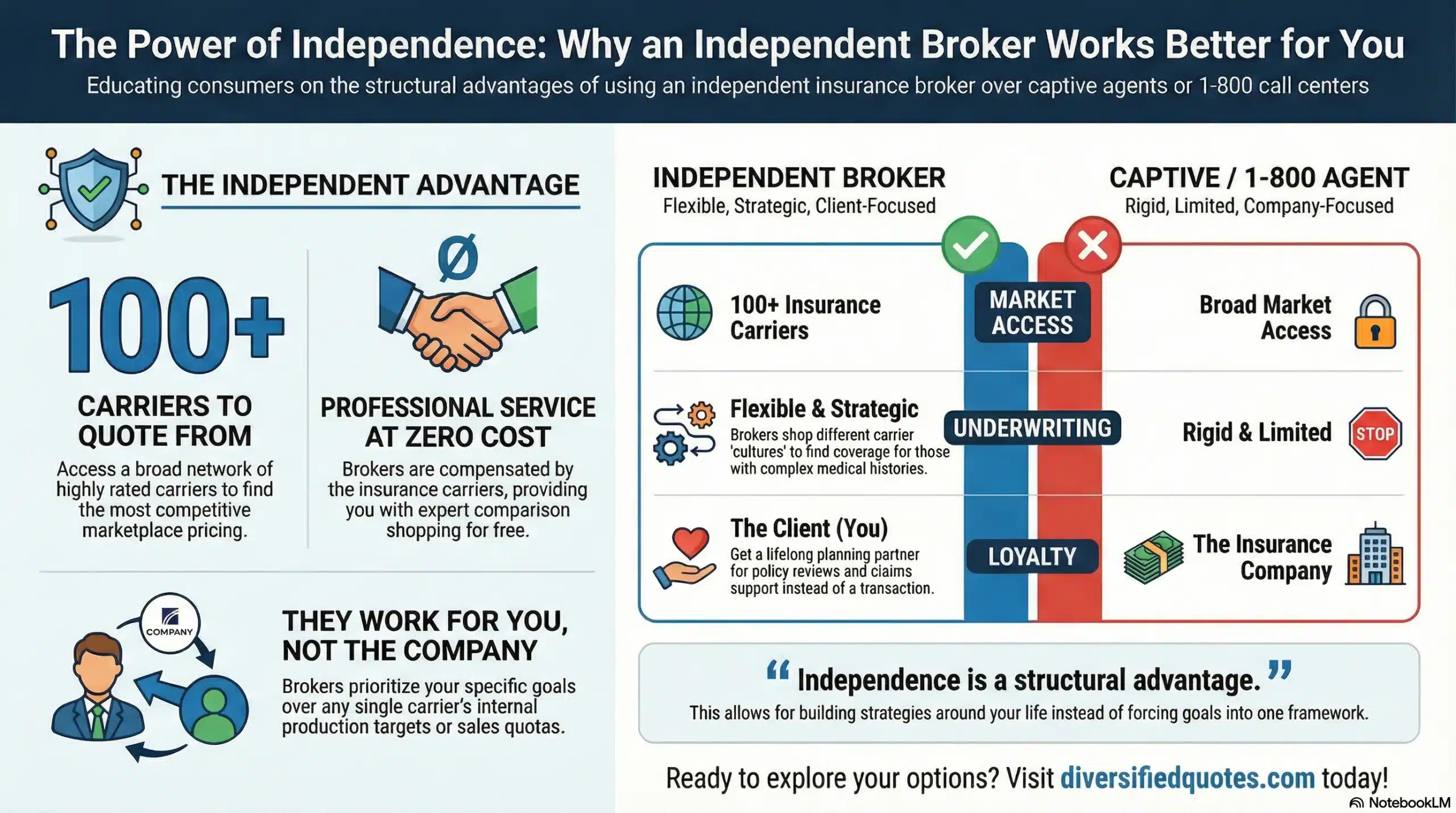
After a decline, the first step is understanding what specifically triggered it: was it the PTSD diagnosis alone, was it a comorbid factor, was it the timing relative to a recent event or medication change, or was it a VA rating level that the carrier’s system flagged conservatively? Each of these scenarios suggests a different path forward. Our resource on life insurance with a prior decline covers the complete strategy for navigating coverage after a prior underwriting decision, including how to interpret the specific decline reason and identify better-fit carriers for the same profile. Our resource on what will disqualify me from life insurance covers the spectrum from absolute underwriting bars to carrier-specific limitations — helping veterans understand which aspects of their history are genuinely limiting versus which simply require better carrier placement. Our resource on best independent life insurance broker covers why independent market access across 100+ carriers is the most critical structural advantage for veteran PTSD placement — where the right carrier match produces the right outcome and no single-carrier platform can replicate that market breadth.
Burial and Final Expense Coverage — When Traditional Underwriting Is Temporarily Unavailable
For veterans whose current PTSD profile places them outside the range where traditional underwriting is viable — due to recent hospitalization, active instability, or recent crisis events — final expense and guaranteed issue coverage provides a meaningful interim foundation that ensures some protection is in place while the stability record develops. These products are designed specifically for smaller face amounts covering funeral costs and final expenses, accepted without medical underwriting, and they serve as an important bridge during the period before traditional underwriting becomes accessible. Our resource on final expense life insurance covers these products comprehensively, including the graded benefit structure that applies in the first two years. Our resource on guaranteed issue life insurance under age 50 covers the guaranteed acceptance options available for younger veterans. And our comprehensive burial insurance resource covers the complete final expense product landscape — relevant for veterans who want to ensure no coverage gap exists while pursuing traditional underwriting through the right channels.
Get the Right Veteran PTSD Life Insurance Strategy
We respect your service and understand the complexity of mental health underwriting for veterans. Confidential, professional, results-focused — we match your profile before any formal application is submitted.
Get My QuoteRelated Pages
Mental health underwriting guidance, military coverage resources, and high-risk placement strategies.
Financial Protection Essentials
Comorbid condition guides, table rating resources, prescreening tools, and fallback coverage options for veterans with mental health history.
Compare Term Life Insurance Lengths
Explore different term periods to find coverage that best matches your timeline and budget.
Talk With an Advisor Today
Choose how you’d like to connect—call or message us, then book a time that works for you.
Schedule here:
calendly.com/jason-dibcompanies/diversified-quotes
Licensed in all 50 states • Fiduciary, family-owned since 1980
FAQs: Life Insurance for Veterans With PTSD
Can veterans with PTSD qualify for life insurance?
Yes — many veterans with PTSD qualify for term, permanent, or final expense life insurance. Approval depends on symptom stability, treatment history, functional capacity, and the overall health picture rather than simply whether the PTSD diagnosis exists or what VA disability rating has been assigned. Veterans with stable, well-managed PTSD regularly receive competitive offers when the case is matched to the right carrier — one whose mental health underwriting guidelines are nuanced enough to distinguish between stable long-term PTSD and actively unstable cases. The most common reason veteran PTSD applicants are declined or over-rated is not that coverage is unavailable — it is that the wrong carrier received the application. Our resource on how to prescreen a life insurance application covers the carrier evaluation process that identifies the best carrier match before any formal application creates a permanent record.
Does having a VA disability rating for PTSD affect private life insurance approval?
A VA disability rating alone does not disqualify a veteran from private life insurance. The VA rating system and private life insurance underwriting are built around different questions — the VA measures average occupational impairment for disability compensation purposes, while private insurers evaluate the probability of early claim during the policy period. A veteran with a 100% VA rating for PTSD who is employed, consistently treated, and showing no recent crisis events may present as a very different private underwriting profile than the VA rating level alone would suggest to a carrier applying blanket rules. What matters to private underwriters is the documented clinical picture: how stable are the symptoms, how consistent is the treatment, how long has stability been established, and are there acute risk markers present in the medical record? Veterans who can document functional stability clearly — through medical records, provider statements, or a structured case summary organized by an experienced broker — often receive far more favorable private underwriting outcomes than they expected based on their VA rating level.
How does PTSD severity impact life insurance rates?
PTSD severity affects rates along a spectrum rather than producing binary approved/declined outcomes. Mild or well-managed PTSD with a long stability record often results in standard or near-standard rates at carriers with nuanced mental health underwriting guidelines. Moderate PTSD with documented stability of one to two or more years is commonly insurable, though a table rating — a percentage surcharge above standard premium — is more typical than standard class depending on the specific carrier and the complete file. Severe or recently unstable PTSD may trigger postponement from traditional underwriting, with simplified issue or guaranteed issue products available as bridge coverage during the stability period. The interaction of PTSD severity with other health factors — additional service-connected conditions, comorbid depression or anxiety, substance use history — affects both the outcome and which carriers are the best match for the specific profile. Our resource on life insurance table ratings explained covers what each table rating level means for the actual monthly premium — important context for evaluating whether a rated offer represents the best available outcome or whether a different carrier would produce a more favorable result for the same stability profile.
Does being in therapy or taking medication help underwriting?
In most cases, yes — consistent treatment helps rather than hurts underwriting for PTSD cases. Ongoing therapy and stable medication management demonstrate that the condition is being actively managed under professional supervision, which is a positive signal to most underwriters. The underwriting concern is not that treatment is occurring but whether treatment is working and whether the regimen is stable. A veteran who has been on the same medication for two or more years with no significant changes and who attends regular therapy or follow-up appointments is demonstrating the kind of managed, stable profile that carriers respond to favorably. The treatment factors that concern underwriters most are those that suggest instability: frequent medication switches without documented improvement, dosage escalations without stabilization notes, sporadic or inconsistent care, or provider notes documenting persistent severe symptoms despite active treatment. Veterans whose treatment records clearly show a stable, consistent pattern consistently produce better underwriting outcomes than those with gaps in care or repeated treatment changes.
Will past psychiatric hospitalizations affect eligibility?
Yes — psychiatric hospitalizations, emergency department visits for acute mental health concerns, and crisis stabilization episodes are among the most significant underwriting factors and typically trigger a more conservative evaluation. Many carriers require a defined stability period following any inpatient psychiatric admission before offering traditional fully underwritten coverage — the required timeframe varies by carrier, but 12–36 months of documented stability following discharge is common. The factors that matter most in evaluating hospitalization history are: how long ago it occurred, what clinical circumstances led to the admission, what the follow-up care plan has been since discharge, whether there has been any recurrence or escalation since, and the veteran’s current functional status. Veterans with older hospitalization history and well-documented long-term stability since often receive competitive offers from the right carriers. Veterans with more recent events may be better served by a staged approach: interim coverage through simplified issue or guaranteed issue products now, followed by re-evaluation for traditional underwriting after a defined stability period is established.
What types of life insurance are available for veterans with PTSD?
Veterans with PTSD can access the same primary product types as any other applicant — the underwriting evaluates the PTSD history, but it does not restrict the available product menu for most profiles. Fully underwritten term life insurance provides maximum death benefit for a defined period at competitive pricing and is typically the most cost-efficient choice for income replacement, mortgage protection, and family security when the profile qualifies. Permanent life insurance — whole life or universal life — provides lifetime coverage that doesn’t expire and in some designs builds cash value; veterans concerned about future insurability due to evolving health conditions may find permanent coverage particularly valuable because it eliminates future underwriting exposure. The conversion provision in term policies — which allows conversion to permanent coverage without new medical underwriting — is also specifically valuable for veterans who want term coverage now but want to preserve the option to extend coverage permanently without requalifying. Simplified issue policies are available when the fully underwritten path is uncertain and speed or simplified process is preferred. Guaranteed issue and final expense products serve as the final backstop for profiles where traditional underwriting is temporarily unavailable. Our resource on life insurance with pre-existing conditions covers the complete product evaluation framework for complex health profiles.
What if I was previously declined for life insurance due to PTSD?
A prior decline does not permanently close the life insurance market for veterans with PTSD. Many prior declines are carrier-specific rather than representing a universal market response — the result of a carrier with conservative mental health guidelines receiving a file that a different carrier would have evaluated more favorably. The first step after a decline is understanding what specifically triggered it: was it the PTSD alone, was it a comorbid condition, was it the timing relative to a recent event, or was it the VA rating level interpreted rigidly by a system not designed for nuanced mental health evaluation? Each scenario suggests a different path forward. A prior decline also creates a Medical Information Bureau (MIB) record that subsequent carriers can see — which is one of the most important reasons that prescreening with appropriate carriers before any new formal application is submitted is the right process for veterans with complex profiles. Our resource on life insurance with a prior decline covers the complete strategy for navigating coverage after a prior underwriting decision, and our resource on best high-risk life insurance companies covers the carrier landscape where veteran PTSD profiles are evaluated most reasonably.
How long does underwriting usually take for PTSD cases?
Underwriting timelines vary significantly depending on the product type, the face amount, and the complexity of the medical record review. Simplified issue policies can be decided within days because they don’t require a full medical records review or paramedical examination. Fully underwritten policies typically take several weeks when medical records — including VA records, private provider notes, and medication history — are requested to document the stability and treatment history that the underwriter needs for a complete evaluation. When records are incomplete, when a provider is slow to respond to record requests, or when the initial file raises questions that require clarification, timelines can extend. Veterans with VA records should understand that VA records requests may take longer than private provider records requests — planning for this timeline in advance, or ensuring records are already on hand, can prevent delays. The most effective way to accelerate underwriting is to have records well-organized before the application is submitted and to work with an experienced broker who knows what carriers typically request for veteran PTSD profiles and can anticipate documentation needs before they become delays.
Can veterans combine private life insurance with VA or military benefits?
Yes — and for most veterans, the combination is the optimal strategy rather than relying on any single source of coverage. SGLI provides guaranteed-issue group coverage during active service; VGLI provides a conversion path after separation that is available without new underwriting within 240 days of separation. But VGLI has limitations: it is term-only coverage, it is capped at the SGLI amount the veteran had at separation, and premiums are not individually priced — which often means healthy veterans overpay compared to individually underwritten private coverage. Veterans with stable PTSD who can qualify for private coverage typically benefit from a layered approach: maintaining VGLI for the guaranteed-issue floor while pursuing private coverage for additional death benefit, lower long-term cost, or permanent coverage that VGLI cannot provide. For veterans whose current health profile makes private underwriting challenging, VGLI serves as the primary coverage while a strategy for private placement is developed. Our resource on life insurance for the military covers the complete military benefits landscape and how private coverage fits alongside it at different career stages.
About the Author:
Jason Stolz, CLTC, CRPC, DIA, CAA and Chief Underwriter at Diversified Insurance Brokers (NPN 20471358), is a senior insurance and retirement professional with more than 25 years of real-world experience helping individuals, families, and business owners protect their income, assets, and long-term financial stability. As a long-time partner of the nationally licensed independent agency Diversified Insurance Brokers, Jason provides trusted guidance across multiple specialties—including fixed and indexed annuities, long-term care planning, personal and business disability insurance, life insurance solutions, Group Health, Travel Medical and Evacuation Insurance, and short-term health coverage. Diversified Insurance Brokers maintains active contracts with over 100 highly rated insurance carriers, ensuring clients have access to a broad and competitive marketplace.
His practical, education-first approach has earned recognition in publications such as VoyageATL, and contributions from his agency featured in Kiplinger and GoBankingRates— highlighting his commitment to financial clarity and client-focused planning. Drawing on deep product knowledge and years of hands-on field experience, Jason helps clients evaluate carriers, compare strategies, and build retirement and protection plans that are both secure and cost-efficient. Visitors who want to explore current annuity rates and compare options across multiple insurers can also use this annuity quote and comparison tool.
Explore More Life Insurance Options: Browse our complete guide to Life Insurance for Mental Health & Substance Use — covering depression, PTSD, ADHD, bi-polar disorder, and substance use from 100+ carriers.
Last Reviewed: September 28, 2026 |
Reviewed by: Jason Stolz, CLTC, CRPC, DIA, CAA
Chief Underwriter, Diversified Insurance Brokers, Inc. | NPN: 20471358 | Diversified Insurance Brokers, Inc. — Licensed in all 50 states
Fact Checked by: Tonia Pettitt, CMIP©
Medicare Specialist, Diversified Insurance Brokers, Inc. | NPN: 14374308 | Diversified Insurance Brokers, Inc. — Licensed in all 50 states
Did you find this content helpful? Leave us a Google review — it helps others find trustworthy guidance too.
Editorial Standards: Diversified Insurance Brokers maintains rigorous editorial standards to ensure accuracy, clarity, and independence in all content. Learn more about our editorial standards and commitment to transparency.
